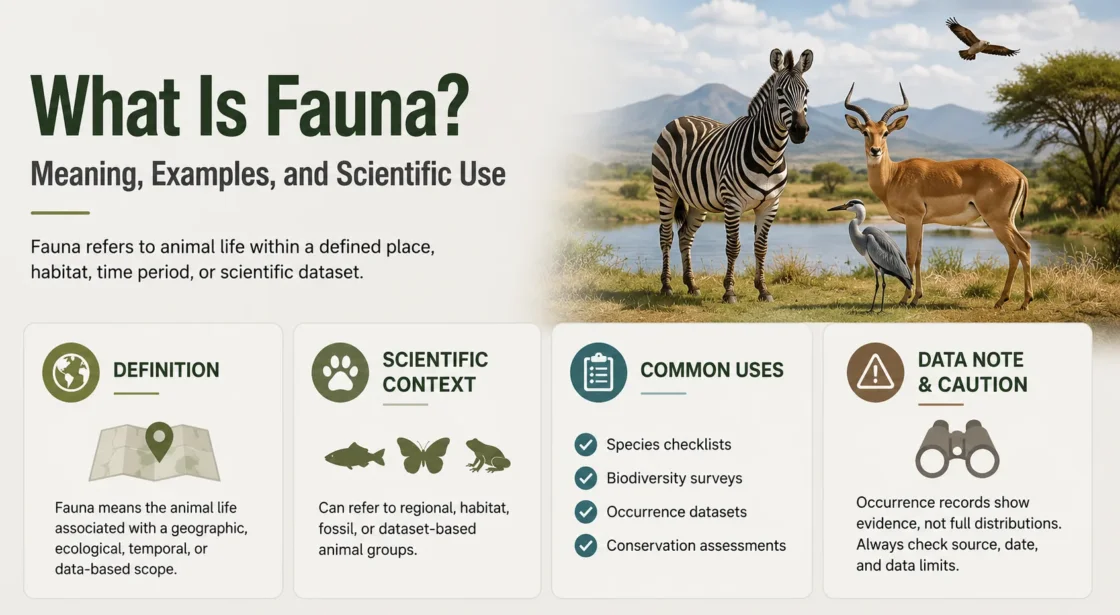
Fauna means the animal life associated with a defined place, environment, geological period, or other biological scope. The fauna of an island may include every animal group documented there, while terms such as bird fauna, cave fauna, freshwater fauna, or Pleistocene fauna describe narrower assemblages. Fauna is therefore a collective biological term, not the name of one species or a formal taxonomic rank. [a]
The Biological Meaning of Fauna
In its broadest biological use, fauna refers to animals considered together. The word becomes more informative when it is attached to a boundary such as a country, island, river basin, habitat, depth zone, season, or interval of geological time. The Australian Museum describes fauna as all animal life present in a particular region or time, with flora serving as the corresponding term for plant life. [b]
A reference to “the fauna” is incomplete unless the surrounding text makes the scope clear. The phrase could mean every recorded animal in a national checklist, only vertebrates sampled during a field survey, insects collected in a forest canopy, animals living within a cave system, or fossils recovered from one rock formation.
A Fauna Has Defined Boundaries
Fauna does not automatically mean every animal that has ever occurred in an area. A useful faunal statement identifies the geographic boundary, time period, habitat, taxonomic coverage, evidence source, and treatment of native, introduced, captive, fossil, or uncertain records.
Aquatic Fauna Explained: Freshwater and Marine Animal Life
Aquatic fauna includes freshwater and marine animal life, separating river and lake communities from coastal and ocean ecosystems.
Endemic Fauna Explained: Why Some Animals Live Only in One Region
Endemic fauna consists of animals restricted to a particular region, with the explanation centered on limited ranges and...
Fauna vs Flora: Key Differences in Biology
Fauna and flora are separated as animal and plant life, with the comparison covering biological definitions, ecosystem roles,...
How Scientists Classify Fauna by Region, Habitat, and Taxonomy
Scientists classify fauna by geographic region, habitat, and taxonomy, using each system to answer a different question about...
Native Fauna Explained: Meaning and Examples
Native fauna refers to animals occurring naturally within a region, with examples showing how origin differs from introduced...
Regional Fauna Explained: How Animal Life Changes by Geography
Regional fauna describes animal life within a defined area, showing how geography, climate, habitat, and biogeographic history shape...
Terrestrial Fauna Explained: Land Animals and Their Habitats
Terrestrial fauna covers animals living mainly on land, with habitat examples ranging from forests and grasslands to deserts...
Urban Fauna Explained: Animals Living in Cities
Urban fauna includes animals living in cities and built environments, with attention to habitat use, adaptation, food sources,...
Wildlife vs Fauna: What Is the Difference?
Wildlife and fauna overlap but are not identical; the distinction rests on usage, geographic scope, and whether all...
9 articles in What Is Fauna?
Examples of Fauna at Different Scientific Scales
Scientists can define fauna through several dimensions at once. A study of freshwater fish in a national park combines a habitat boundary, a taxonomic boundary, and a geographic boundary. A study of mammal fossils from a sediment layer adds a geological-time boundary.
| Faunal expression | Boundary being applied | What it may include | What the expression does not establish by itself |
|---|---|---|---|
| Fauna of an island | Geographic | Animals recorded within the island boundary | Whether every listed species is native, breeding, resident, or still present |
| Freshwater fauna | Environmental | Animals associated with rivers, lakes, springs, wetlands, or other freshwater systems | A precise geographic area or taxonomic group |
| Cave fauna | Habitat | Animals recorded in caves or subterranean habitats | Whether each animal is permanently cave-adapted or only an occasional visitor |
| Avifauna of a region | Taxonomic and geographic | Bird species reported within the stated region | Whether the list includes migrants, escapes, introduced birds, or unverified sightings |
| Soil microfauna | Habitat and body-size category | Small animals living within soil pores, litter, or closely associated substrates | One universally fixed size threshold across every study |
| Marine invertebrate fauna | Environment and taxonomic exclusion | Marine animals without vertebral columns within the study boundary | All marine life, because vertebrates, plants, fungi, and microorganisms are outside the stated scope |
| Pleistocene mammal fauna | Geological time and taxonomic group | Mammal taxa represented by evidence assigned to the Pleistocene | A complete reconstruction of the living community at every moment during that period |
Fauna Is Not a Formal Taxonomic Rank
Formal zoological classification places animals within named taxa such as kingdom, phylum, class, order, family, genus, and species. A species name follows zoological nomenclature rules and normally consists of a genus name followed by a specific name. “Fauna” has no equivalent position in that hierarchy. It groups animals according to the scope of a discussion or dataset rather than shared ancestry alone. [c]
A regional fauna may contain animals from many distant branches of Animalia. Mammals, birds, fishes, insects, molluscs, crustaceans, spiders, worms, corals, and other groups can all belong to the same regional fauna even though they do not form one taxonomic unit below Animalia.
Scientific Names Still Matter in a Faunal List
Although fauna is not a rank, the animals within a faunal inventory must be linked to taxonomic names. Common names can vary by country, language, and institution, while the same scientific name may have historical combinations or synonyms. Catalogue of Life records can include the accepted name, authorship, nomenclatural status, synonyms, higher classification, environment, distribution statements, and the taxonomic source used for a record. [d]
A change in taxonomy can alter the apparent size of a fauna even when no animals have entered or left the area. One formerly broad species may be divided into several accepted species, or several names may be treated as synonyms of one taxon.
How Fauna Is Used in Ecology and Biogeography
Ecologists use faunal information to describe the animal component of habitats and communities. A forest survey may compare ground-dwelling invertebrate fauna between leaf-litter conditions. A river study may examine fish and aquatic-insect fauna across water-quality gradients. An island study may separate resident fauna from migratory visitors, recent introductions, and historical records.
Biogeographers examine how faunas differ among regions and how barriers, climate, geological history, dispersal, isolation, and extinction help explain those differences. Expressions such as island fauna, alpine fauna, desert fauna, deep-sea fauna, and Afrotropical fauna therefore refer to animal assemblages linked by spatial or environmental context rather than one formal lineage.
Native, Introduced, and Recorded Fauna
The word fauna does not automatically mean native fauna. An inventory may include native species, established introduced species, seasonal migrants, accidental visitors, reintroduced populations, escaped captive animals, and records whose origin is uncertain. A source must state which categories it accepts before its total can be compared with another list.
The terms endemic and native also describe different conditions. A native animal occurs naturally within the stated area, while an endemic animal has a naturally restricted distribution tied to that area or another defined range. Every endemic species is native to its natural range, but most native species are not endemic.
Fauna in Paleontology
In paleontology, fauna can refer to animal fossils associated with a locality, rock unit, depositional setting, or interval of geological time. Researchers may discuss a fossil fauna or faunal assemblage when comparing the taxa represented in collected remains. Natural history collections also organize fossil material by fauna, locality, and assemblage, reflecting the term’s role in connecting animal evidence with place and geological context. [e]
A fossil fauna is not a direct census of every animal that lived in the former ecosystem. Preservation depends on anatomy, burial conditions, transport, decay, collection methods, exposed rock, and research effort. Animals with hard shells, bones, or teeth may be represented differently from soft-bodied animals. A faunal assemblage therefore records preserved and recovered evidence rather than an untouched copy of the living community.
Fauna in Species Checklists and Biodiversity Databases
Modern faunal research often combines taxonomic checklists with occurrence records. A checklist states which taxa are accepted within a defined scope. An occurrence record documents evidence of a taxon at a place and date, commonly through an observation, preserved specimen, fossil, camera record, or another stated basis of record. GBIF describes occurrence datasets as evidence that a species or other taxon occurred at a particular place on a specified date. [f]
Occurrence records can support a faunal inventory, but a database search is not automatically a complete fauna. Records may be duplicated, geographically imprecise, assigned to outdated names, based on uncertain identifications, or concentrated around accessible survey locations. Areas with few records may be poorly sampled rather than biologically empty.
The Fields Behind a Faunal Record
Darwin Core provides standardized terms for exchanging biodiversity information. These terms can describe the occurrence, event, location, taxon, identification, geological context, and basis of record associated with biological evidence. The standard helps datasets express what was recorded, where and when it was recorded, and how the organism was identified. [g]
- Scientific name: the taxonomic name attached to the record.
- Taxon rank: whether the identification reaches species, genus, family, or another level.
- Event date: when the observation, collection, or other recording event occurred.
- Location: the place associated with the occurrence, sometimes with coordinates and uncertainty.
- Basis of record: the kind of evidence, such as a human observation, preserved specimen, fossil specimen, or machine observation.
- Identification information: who assigned the taxonomic identity and when that determination was made.
Fauna Compared with Related Biological Terms
| Term | What it describes | Main distinction |
|---|---|---|
| Fauna | Animals considered within a defined geographic, environmental, temporal, or taxonomic scope | A collective concept whose boundary must be stated |
| Wildlife | Wild-living organisms or wild animals, depending on legal and institutional usage | Usually emphasizes organisms living outside domestication or captivity; some policies also include wild plants |
| Species checklist | A structured list of taxa accepted for a stated area, dataset, institution, or study | A checklist is a data product that may represent a fauna but requires rules for inclusion |
| Occurrence record | Evidence relating an organism or taxon to a place and time | One record is evidence of an event, not a complete distribution or regional inventory |
| Community | Populations of different species occurring and interacting within an ecological setting | Ecological community studies emphasize coexistence and relationships, not merely membership in a regional list |
| Biodiversity | Variation within species, between species, and among ecosystems | Broader than fauna because it includes genetic, species, and ecosystem-level variation across living organisms |
The Convention on Biological Diversity defines biological diversity as variability among living organisms, including diversity within species, between species, and of ecosystems. Fauna can be one component of biodiversity, but the two terms are not interchangeable. A list of animals may describe faunal composition without measuring genetic variation, ecosystem diversity, abundance, ecological function, or change through time. [h]
Why Faunal Species Counts Differ
Two credible sources can report different totals for the fauna of the same area without either total being fabricated. The difference may result from geographic boundaries, publication date, taxonomic treatment, survey coverage, accepted evidence, or rules for including introduced and uncertain species.
- Geographic scope: political borders, watersheds, protected-area boundaries, coastlines, and marine zones may not match.
- Taxonomic scope: one inventory may cover vertebrates, while another includes insects, molluscs, arachnids, and other invertebrates.
- Time coverage: historical records, recent observations, fossils, and presumed extirpations may be handled differently.
- Name changes: species can be split, combined, renamed, or moved between genera.
- Record standards: one source may accept published observations while another requires specimens or expert review.
- Residency rules: migrants, accidental visitors, escapes, and introduced populations may be included or excluded.
- Sampling effort: frequently surveyed locations and conspicuous animals tend to produce more records.
- Identification depth: records identified only to genus or family cannot always be counted as separate species.
A Record Total Is Not a Species Total
A database may contain thousands of occurrence records for a small number of repeatedly observed species. Conversely, one verified specimen may represent a species known from only a single record in the dataset. Record count, species richness, abundance, and distribution measure different things.
Fauna, Faunal, Faunas, and Faunae
Fauna is commonly used as a collective singular noun: “The island’s fauna includes several seabird species.” When separate animal assemblages are compared, both faunas and faunae are accepted plural forms. Faunal is the adjective, as in faunal survey, faunal composition, faunal remains, faunal turnover, and faunal assemblage.
The word entered English through New Latin and is connected with Fauna, a Roman figure associated with Faunus. Modern scientific usage is independent of that mythological origin: the term now functions as a practical label for animal life within an explicitly or implicitly defined scope.
Sources and Verification
- [a] Merriam-Webster: Fauna Definition and Word History — Used for the core definition, adjective, accepted plural forms, and New Latin word history.
- [b] Australian Museum: What Is Fauna? — Used for the natural-history definition of fauna as animal life associated with a region or time.
- [c] International Code of Zoological Nomenclature: Principle of Binominal Nomenclature — Used to distinguish collective faunal terminology from formal species naming under zoological nomenclature.
- [d] Catalogue of Life: Accessing Taxonomic Data — Used for accepted names, authorship, synonyms, classification, recorded distribution, environment, and source fields.
- [e] Natural History Museum: Fossil Mollusc Collection — Used to verify the paleontological use of fauna, locality groupings, and faunal assemblages in research collections.
- [f] GBIF: Data Quality Requirements for Occurrence Datasets — Used for the definition of occurrence evidence and the roles of scientific name, date, locality, taxon rank, and basis of record.
- [g] TDWG: Darwin Core Quick Reference Guide — Used for standardized biodiversity-data classes and terms covering occurrences, events, locations, taxa, and identifications.
- [h] Convention on Biological Diversity: Article 2, Use of Terms — Used to distinguish fauna from biological diversity across genetic, species, and ecosystem levels.