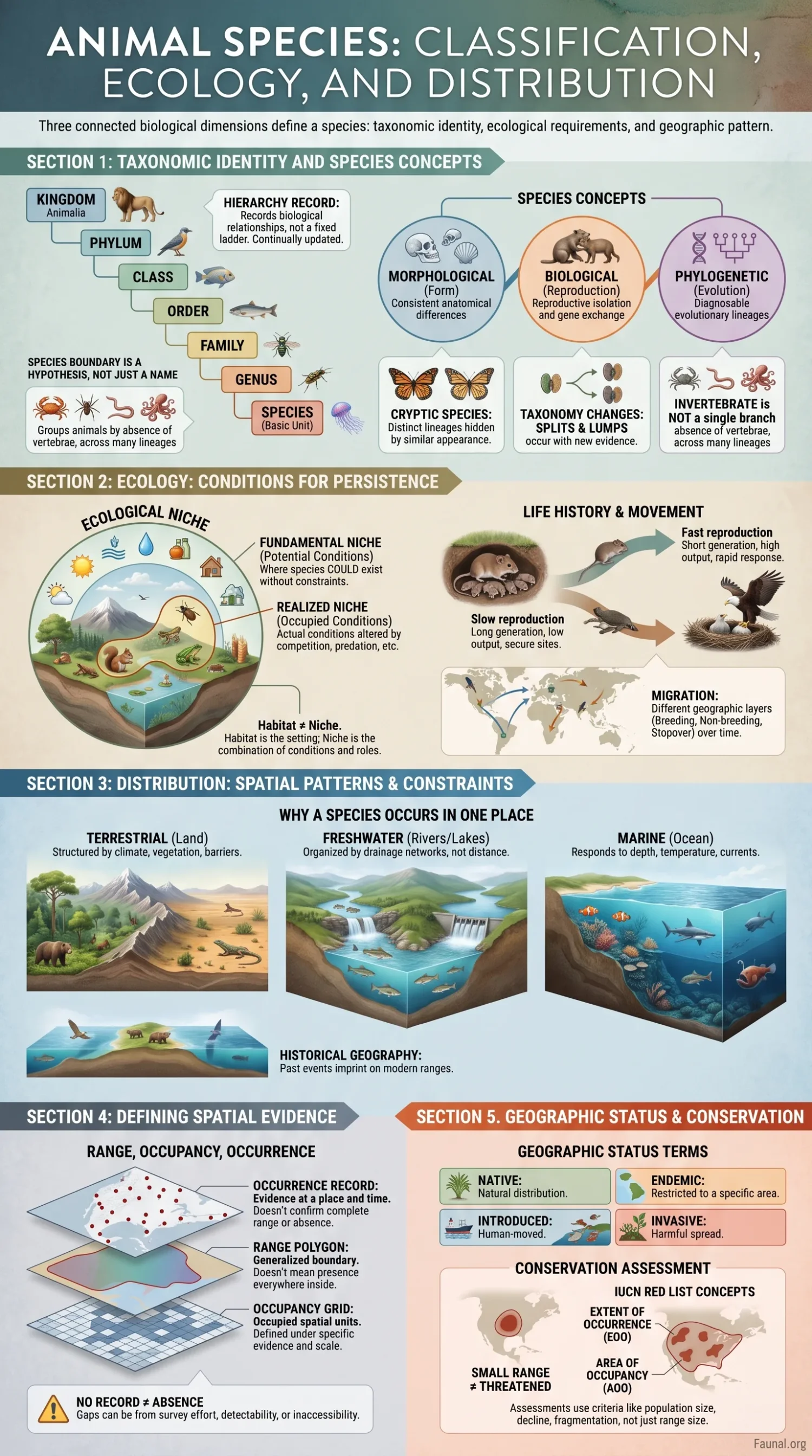
An animal species has three connected biological dimensions: a taxonomic identity, an ecological set of conditions in which populations can persist, and a geographic distribution produced by those requirements together with dispersal, history and species interactions. Taxonomy identifies the lineage being discussed. Ecology describes how that lineage survives and reproduces. Distribution describes where populations or records occur in space and time. None of these dimensions can substitute for the others.
A scientific name on a checklist therefore says less than it may appear to say. The name must refer to a defined taxon concept; a habitat association does not prove occupancy throughout that habitat; and an observation point documents evidence at a place and time rather than the complete geographic range of the species. Species-level wildlife data become more reliable when identity, ecological requirements and spatial evidence remain separate but connected.
A Species Boundary Is a Biological Hypothesis, Not Just a Name
Species is one of the basic units used to describe biological diversity, but there is no single test that resolves every animal species boundary. Reproductive isolation can be informative for populations that can potentially interbreed. Morphological differences are valuable when specimens can be compared directly. Phylogenetic evidence can identify independently evolving lineages from inherited characters and DNA data. Ecological divergence may add evidence when populations occupy different environments or resources.
Three species concepts are especially common in zoological discussion: morphological, biological and phylogenetic concepts. They ask different questions and can produce different boundaries when populations are geographically isolated, hybridize, contain strong internal variation or look nearly identical despite deep genetic separation. The distinctions among these approaches are described in zoological treatments of species recognition and systematics, including the species treatment published by Oxford Academic.
| Species approach | Primary evidence | Useful application | Boundary problem |
|---|---|---|---|
| Morphological | Consistent anatomical or external differences | Specimens, fossils and taxa with diagnosable form | Cryptic species may remain morphologically similar |
| Biological | Reproductive isolation and gene exchange | Sexually reproducing populations whose reproductive relationships can be assessed | Difficult to apply directly to fossils, asexual taxa and widely separated populations |
| Phylogenetic | Diagnosable evolutionary lineages and inherited characters | Lineage delimitation using molecular and phenotypic evidence | Results depend on characters, sampling and the criterion adopted for delimitation |
| Ecological evidence | Persistent differentiation in resources, environmental conditions or ecological roles | Supporting separation of lineages associated with different niches | Ecological differences alone do not automatically establish a taxonomic species |
Cryptic Species Can Hide Behind Similar Appearance
Morphological similarity does not guarantee that two populations belong to the same species. Cryptic species are distinct lineages that are difficult to separate using ordinary external appearance. Genetic evidence, vocalizations, reproductive behaviour, internal anatomy, chemistry, geography or combinations of these data can reveal divisions that were previously concealed under one name.
The reverse situation also occurs. Populations once named as separate species may later be combined when new evidence does not support the earlier separation. Taxonomy therefore contains both splits, where one recognized species becomes two or more, and lumps, where previously separate taxa are combined.
From Animalia to a Named Species
Formal classification places a species inside successively broader taxa. A familiar rank sequence is kingdom → phylum → class → order → family → genus → species, although modern classifications can also contain subfamilies, tribes, subgenera, superfamilies, clades and other intermediate groupings. The hierarchy is a way of recording biological relationships; it should not be mistaken for a fixed ladder that remains unchanged as phylogenetic evidence develops.
“Mammals, birds, reptiles, amphibians and fish” is not a classification of Animalia as a whole. It is primarily a familiar grouping of vertebrate lineages. Most animal diversity lies outside Vertebrata, across many other branches of Animalia.
“Invertebrate” Does Not Name a Single Evolutionary Branch
Vertebrates form a lineage within Chordata. The term invertebrate, by contrast, groups animals by the absence of vertebrae rather than by membership in one exclusive taxonomic branch. An insect, an octopus, a coral and an earthworm can all be called invertebrates, yet they belong to widely separated animal lineages.
| Selected lineage | Representative animals | Biological distinction |
|---|---|---|
| Arthropoda | Insects, spiders, crustaceans and myriapods | Jointed appendages and an external skeleton characterize the lineage |
| Chordata | Mammals, birds, reptiles, amphibians, fishes and other chordates | Members possess a notochord during at least part of development; vertebrates form one branch within Chordata |
| Mollusca | Gastropods, bivalves, cephalopods and related groups | A highly varied lineage containing marine, freshwater and terrestrial forms |
| Annelida | Earthworms, many marine worms and leeches | Segmented worms occupying terrestrial, freshwater and marine environments |
| Cnidaria | Corals, jellyfish and sea anemones | Aquatic animals characterized by specialized stinging cells called cnidocytes |
| Echinodermata | Sea stars, brittle stars, sea urchins and sea cucumbers | Exclusively marine lineage with distinctive body organization and a water vascular system |
These are selected lineages rather than a complete list of animal phyla. A reference to Animalia should not reduce the kingdom to a few conspicuous vertebrate classes.
Animal Classification Changes as New Evidence Changes Species Boundaries
Taxonomic databases are versioned because animal classification is continually revised. New species are described, genera are rearranged, populations are split, named taxa are lumped and historical names are placed into synonymy. A specimen collected decades ago does not physically change when a revision is published, but the accepted taxonomic name or the biological limits attached to that name may change.
Animalia in Catalogue of Life COL26.8 XR
1,780,634 species
The active Extended Release was issued on 26 August 2026. Catalogue of Life states that its catalogue remains incomplete and may contain errors.
Mammal Diversity Database v2.5
6,904 species
The 28 July 2026 release recognizes living and recently extinct mammals and records 79 taxonomic changes from v2.4.
The active Catalogue of Life Extended Release COL26.8 XR indexes 1,780,634 species under Animalia. This is an indexed catalogue total, not a count of every animal species that exists on Earth. Catalogue of Life explicitly warns that its data are not complete.
A current mammalian example shows how quickly classification can move. The American Society of Mammalogists’ Mammal Diversity Database v2.5, released on 28 July 2026, documents 6,904 living and recently extinct species and 79 taxonomy changes relative to v2.4. Those changes include newly described taxa, species splits, species lumps, genus changes and changes at higher ranks.
A Species Count Depends on the Taxonomy Being Counted
Different taxonomic sources can produce different totals because they may adopt different species limits, include different groups, use different release dates or differ in coverage. A defensible species count therefore needs a named taxonomic source and version rather than an unsupported claim that a fixed number of animal species exists.
Recorded Names and Accepted Names Are Not Always Identical
Historical specimens and biodiversity datasets may preserve a name that is no longer accepted under the taxonomy used by the data publisher. Darwin Core keeps these concepts separate. Its scientificName term can contain the name associated with a taxon record or identification, while acceptedNameUsage can identify the currently accepted or valid name under the stated taxonomic treatment. The distinction is defined in the current Darwin Core vocabulary.
This matters when older records are combined with modern records. Matching only the printed name can separate records that belong to the same accepted taxon or combine records that now belong to different species.
Ecology Defines the Conditions Under Which a Species Can Persist
Taxonomy identifies the animal; ecology describes the conditions and relationships that allow populations to survive and reproduce. Temperature tolerance, water availability, salinity, oxygen, food, breeding sites, shelter, competitors, predators, parasites and mutualistic partners can all affect where a population persists. The relevant combination differs among species and often among life stages of the same species.
Habitat and Ecological Niche Describe Different Properties
A habitat is the environmental setting in which an animal lives or carries out an activity. Forest canopy, leaf litter, coral reef, tidal flat, deep pelagic water, alpine grassland and temporary pond are habitat descriptions at different spatial scales. An ecological niche is broader. It concerns the combination of environmental conditions, resources and biological relationships under which a species can maintain populations.
Many species can share the same named habitat while using it differently. Two forest birds may feed at different heights, select different prey, breed in different structures or remain active at different times. Habitat overlap therefore does not imply ecological equivalence.
Fundamental and Realized Niches Separate Potential Conditions from Occupied Conditions
The fundamental niche describes environmental conditions under which a species could maintain itself in the absence of constraining biological interactions. The realized niche is the portion expressed under actual ecological conditions, where competition, predation, parasitism, facilitation, dispersal limits and resource availability alter which environments are occupied. Modern discussion of the distinction continues to build on Hutchinson’s niche concept, as summarized in Nature Reviews Biodiversity.
Suitable climate does not automatically produce an occupied range. A species must also be able to reach the area, find the necessary resources, survive interactions with other organisms and maintain reproduction there.
Life History and Movement Change the Spatial Pattern of a Species
Species respond differently to the same landscape because their life histories differ. Age at maturity, generation length, reproductive output, parental investment, lifespan, dispersal ability and dependence on particular breeding sites can alter population recovery and colonization. A mobile species producing many offspring can respond to habitat openings in a different way from a slow-reproducing animal whose young depend on a small number of secure breeding sites.
Movement also changes what “distribution” means. Some animals remain within relatively stable local areas. Others migrate between breeding and non-breeding regions, track rainfall or food irregularly, move along rivers, shift elevation seasonally or disperse widely during one life stage before becoming sedentary.
A Species Can Occupy Several Geographic Layers During One Year
Migratory distribution cannot be represented accurately as a single seasonless label. A migratory animal may have a breeding range, a non-breeding range, migration corridors and stopover areas. Some marine species use feeding and reproductive areas separated by thousands of kilometres. Some mountain animals move vertically rather than across large latitudinal distances.
Temporal context is therefore part of a distribution claim. A record from a country can represent year-round residence, seasonal residence, migration passage, dispersal, vagrancy or a historical occurrence. Presence on a national list alone does not identify which condition applies.
Why a Species Occurs in One Place but Not Another
Animal distributions emerge from several processes acting together. Physiological tolerance restricts which temperatures, moisture conditions, salinities, oxygen levels or depths an animal can tolerate. Habitat determines whether necessary physical structures are present. Food, hosts and breeding resources further narrow usable space. Competition, predation and disease can exclude populations from otherwise suitable environments.
Dispersal adds another limit. A habitat patch may be ecologically suitable but unreachable. Oceans, mountain systems, dry valleys, glaciers, waterfalls, drainage divides and long stretches of unsuitable habitat can prevent colonization. The barrier depends on the organism: a river may stop a small terrestrial mammal while functioning as a dispersal corridor for an aquatic species.
Terrestrial, Freshwater and Marine Ranges Follow Different Spatial Constraints
Terrestrial species are often structured by climate, vegetation, substrate, elevation and connectivity between habitat patches. Two places with similar temperature can still support different animals if intervening barriers prevent movement or local habitat structure differs.
Freshwater species are often organized by drainage networks rather than straight-line distance. Two lakes can be geographically close yet belong to different drainage systems with little or no natural connection. Waterfalls, salinity changes, dams and unsuitable river reaches can isolate populations.
Marine species respond to depth, temperature, salinity, dissolved oxygen, substrate, currents, fronts and larval dispersal. A surface map can conceal strong vertical separation between coastal, pelagic, benthic and deep-water fauna.
Historical Geography Can Remain Visible in Modern Ranges
Present environmental conditions are not the only explanation for a range. Island isolation, former land connections, glaciation, sea-level change, river capture and long-term mountain uplift can leave related populations separated even when suitable habitat now occurs between them. Modern distributions can therefore contain the imprint of both current ecology and past geography.
Range, Occupancy and Occurrence Describe Different Spatial Evidence
A geographic range is not the same thing as every occupied patch inside that range, and neither is the same thing as a recorded observation. This distinction is central to species-distribution data.
An occurrence record documents evidence of a taxon at a particular place and normally a specified date. GBIF defines occurrence datasets in this record-based sense and requires or recommends fields describing identification, locality, date and record basis. The current GBIF occurrence-data requirements emphasize that an occurrence is evidence tied to an event rather than a complete statement of distribution.
A range describes a broader spatial pattern associated with the species. Depending on the dataset, it may be represented by polygons, grid cells, modeled suitability or other spatial products. Occupancy concerns which units within a defined area are actually occupied. These products answer different biological questions and should not be treated as interchangeable representations.
| Spatial evidence | What it represents | What it cannot establish by itself |
|---|---|---|
| Occurrence point | Reported evidence of a taxon at a place and time | The complete range, continuous occupancy or local abundance |
| Range polygon | A generalized spatial boundary or mapped range treatment | Presence in every location enclosed by the polygon |
| Occupancy grid | Defined spatial cells treated as occupied under stated evidence and scale | Uniform density within occupied cells |
| Species distribution model | Estimated spatial relationship between observations and modeled environmental variables | Confirmed presence at every location predicted as suitable |
| Telemetry-derived space use | Locations and movement patterns of tracked individuals over an observation period | The full species-level geographic range |
Movement ecology adds another distinction. A 2026 paper in Ecology separates range distributions describing long-term space use from occurrence distributions describing uncertainty in an individual’s movement path during a defined observation period. The terminology reinforces a broader rule: the spatial product must be matched to the biological question being asked.
No Record Is Not Automatically Evidence of Absence
Biodiversity databases are spatially uneven. Accessible roads, cities, research stations, protected areas, museums and popular wildlife sites can accumulate many records while remote areas remain poorly documented. Large and conspicuous animals are often easier to detect than small, nocturnal, fossorial, deep-water or cryptic species.
Season also changes detectability. A survey made outside the breeding period may miss animals that are conspicuous when calling or nesting. Migratory species may be absent from a site during part of the year. Identification difficulty, survey technique, observer effort and whether historical collections have been digitized can create additional gaps.
A Blank Map Cell Can Have Several Causes
A location without available occurrence records may represent true absence, failed detection, inadequate survey effort, inaccessible data, uncertain identification or a place that has not been sampled. Structured surveys that record sampling effort and non-detections can support stronger absence inference than opportunistic presence-only records.
GBIF distinguishes occurrence datasets from sampling-event data. Sampling-event datasets can include protocol and effort information needed for comparisons among places and times and can support inferences that presence-only records cannot. A high density of database points may therefore reflect observation effort as well as biological density.
Native, Endemic, Introduced and Invasive Describe Different Distribution Claims
Geographic status terms answer different questions about how a species relates to a region. They should not be collapsed into a simple present-versus-absent label.
| Status term | Meaning in a regional context | Does not automatically mean |
|---|---|---|
| Native | The species occurs in the region as part of its natural distribution rather than through human-mediated introduction | Endemic, common or secure |
| Endemic | The natural distribution is restricted to a stated geographic unit | Rare at every site or threatened |
| Introduced | Human activity moved the species beyond its natural distribution, deliberately or accidentally | Established or invasive |
| Established | A self-sustaining population persists outside the native range under the terminology adopted by the data source | Ecologically harmful |
| Invasive | An introduced taxon meeting the spread or impact definition adopted by the assessment or authority | Every non-native species |
| Vagrant | An animal recorded outside its normal distributional pattern | A resident or breeding population |
| Reintroduced | A taxon deliberately returned to part of its former range | Uninterrupted natural persistence at that location |
Endemism also depends on geographic scale. A species can be endemic to an island, lake, mountain system, country or biogeographic region. The boundary must be stated. Calling a species “endemic” without identifying the relevant area leaves the claim incomplete.
Taxonomic Revision Can Redraw a Species Range Without Moving a Single Animal
Classification and distribution are directly linked because a range map is attached to a taxon concept. Suppose one named species is believed to extend across three isolated regions. Later evidence shows that the populations represent three separately recognized species. The original broad range can no longer be assigned unchanged to any one of them.
- The range attributed to each newly recognized species may become much smaller.
- A lineage previously treated as widespread may become regionally endemic.
- Historical occurrence records may require reassignment to the appropriate species.
- Records identified only from old names or poorly documented specimens may remain uncertain.
- Existing conservation assessments may need reassessment if the accepted taxonomic unit changes.
A lump can produce the opposite effect by combining ranges previously attributed to separate taxa. This is why distribution datasets should retain taxonomic provenance rather than replacing every historical identification with a new name without documenting the relationship between them.
Wide Range, Local Abundance and Ecological Specialization Are Separate Properties
A geographically widespread species can be uncommon at most sites. A narrow-range endemic can be locally abundant within its small area. Another species may occupy many countries but depend on one narrow habitat type wherever it occurs. Range size, local abundance and ecological specialization describe different dimensions of rarity.
The same caution applies to specialists and generalists. A dietary specialist does not necessarily have a small geographic range if its required food occurs widely. A broad-feeding generalist can still have a restricted range because of climatic limits, geographic isolation or breeding requirements. Specialization must identify the ecological dimension being restricted: food, host, habitat, microhabitat, climate, breeding site or another resource.
Range Size Alone Does Not Determine Extinction Risk
Geographic restriction can matter to conservation assessment, but a small range is not synonymous with a threatened category. Extinction-risk assessment can involve distribution, population size, population change, fragmentation, generation length and other evidence depending on the criterion applied.
The IUCN Red List Guidelines version 16 distinguish extent of occurrence (EOO) from area of occupancy (AOO). EOO describes a boundary containing the known, inferred or projected sites of present occurrence under the IUCN definition. AOO measures the area within that extent that is occupied by the taxon, normally using an explicit spatial scale. Unsuitable or unoccupied areas can occur inside EOO.
The IUCN categories are designed to classify global extinction risk under stated criteria; they are not labels for local abundance. A species assessed as Least Concern globally can be uncommon or declining in a particular jurisdiction, while a globally threatened species can remain locally abundant in part of its range. The scale and date of an assessment belong with the status claim.
A Species Record Connects Identity, Ecology, Space and Time
Reliable species information becomes more informative when the major evidence classes remain explicit. A scientific name needs a taxonomic treatment. A locality needs spatial precision. Habitat requires direct ecological context rather than inference from a broad map. A conservation category requires the assessment scale and assessment version. An occurrence requires a date and evidence basis.
| Species information | Biological question answered | Evidence that should remain attached |
|---|---|---|
| Accepted scientific name | Which taxon is being discussed? | Taxonomic authority, treatment or database version |
| Higher classification | How is the taxon related to broader animal lineages? | Order, family, genus and other supported ranks or clades |
| Habitat and niche information | Which environments and resources support persistence? | Life stage, activity, season, habitat scale and ecological evidence |
| Life-history traits | How does the species reproduce, survive and disperse? | Measured or published trait data with population or taxonomic scope |
| Occurrence record | Where and when has the taxon been documented? | Identification, date, locality, coordinate uncertainty and basis of record |
| Range treatment | What broader spatial distribution is assigned to the species? | Map method, taxonomic concept, season and temporal scope |
| Regional status | Is the species native, endemic, introduced, vagrant or otherwise classified in the region? | Declared geographic boundary and status authority |
| Conservation assessment | What extinction-risk category has been assigned? | Assessment authority, geographic scale, date and taxon concept |
These evidence classes interact without becoming interchangeable. Taxonomy determines which biological unit receives a name. Ecology constrains where that unit can maintain populations. Dispersal and geographic history determine which suitable areas can actually be reached. Occurrence data document where animals have been recorded. Range products generalize spatial evidence at broader scales. Conservation assessments evaluate extinction risk using their stated criteria. Keeping these distinctions intact allows animal species data to remain usable when names, maps and assessments change.
Sources and Verification
- Catalogue of Life — Active COL26.8 XR release, Animalia species indexing, release date and catalogue-completeness qualification.
- American Society of Mammalogists — Mammal Diversity Database Release Notes — MDD v2.5 species total, release date and documented taxonomy changes between releases.
- TDWG — Darwin Core List of Terms — Definitions separating scientific names, accepted name usage and other biodiversity-record fields.
- GBIF — Data Quality Requirements for Occurrence Datasets — Definition and required context of occurrence evidence, including record identity, date and locality information.
- Ferrante, M. — The Niche Concept in a Changing World, Nature Reviews Biodiversity — Ecological niche, fundamental niche and realized niche concepts.
- Price, T. — Species, Ecology of a Changed World, Oxford Academic — Morphological, biological and phylogenetic approaches to species recognition.
- Alston et al. — Clarifying Space Use Concepts in Ecology: Range vs. Occurrence Distributions, Ecology — Distinction between range distributions and occurrence distributions in animal movement ecology.
- IUCN Species Survival Commission — Guidelines for Using the IUCN Red List Categories and Criteria, Version 16 — Definitions and assessment treatment of extent of occurrence, area of occupancy and extinction-risk parameters.
- IUCN Red List Categories and Criteria — Scope and purpose of the global extinction-risk category system.
Amphibians
Explore amphibian species with freshwater and wetland habitat data, occurrence records, taxonomy, and conservation summaries.
Birds
Explore bird species with taxonomy, migration context, habitat data, occurrence records, and conservation status information.
Freshwater Fish
Explore freshwater fish with river basin records, habitat data, native and endemic species status, and conservation information.
Insects
Explore insects with taxonomy, habitat associations, biodiversity records, ecological roles, and regional occurrence data.
Mammals
Explore mammal species with taxonomy, regional occurrence records, habitat data, native status, and conservation status summaries.
Marine Animals
Explore marine animals with ocean habitat data, regional occurrence records, taxonomy, and conservation status summaries.
Reptiles
Explore reptile species with taxonomy, habitat preferences, regional occurrence records, native status, and conservation data.
What Is Fauna?
Learn what fauna means in biology, including animal life by region, habitat, taxonomic group, biodiversity data, and conservation context.
8 sub-topics in