Complete guide: Regional Fauna Guides
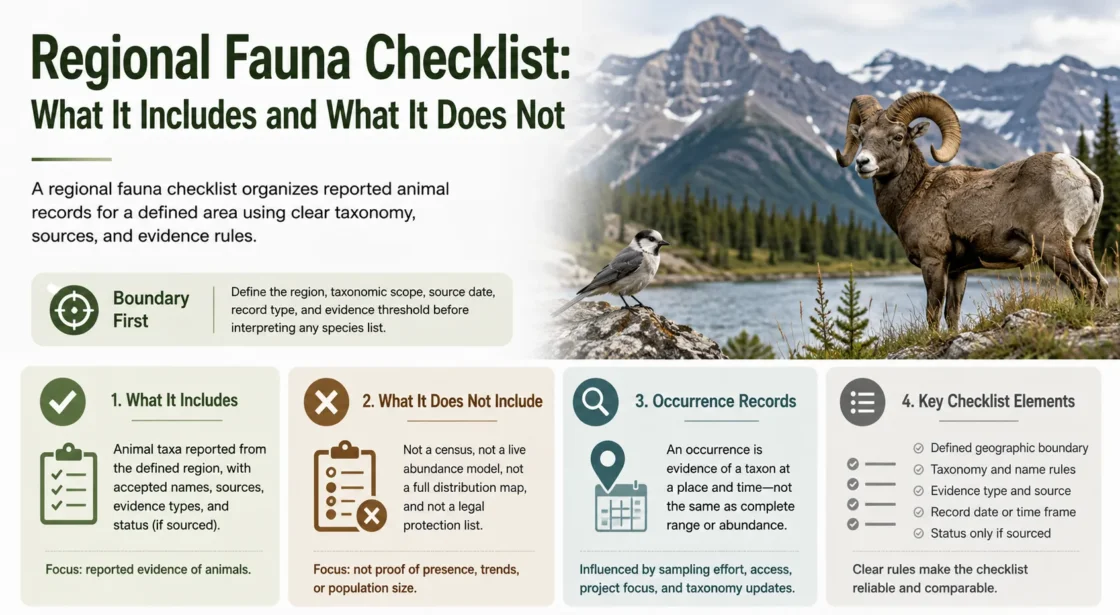
A regional fauna checklist is a source-based list of animal taxa accepted for a defined geographic area under stated taxonomic, temporal, and evidentiary rules. It identifies which names the compiler includes within that scope, but it does not automatically provide complete distribution, current presence at every locality, abundance, population trend, conservation status, or proof that an omitted species is absent.
The Checklist Represents a Defined Taxon Set
The central unit in a checklist is normally a taxon record rather than an observation. A record may represent a species, subspecies, genus, family, or another rank, although regional fauna lists are commonly filtered to species or subspecies. GBIF describes checklist datasets as catalogues, rapid summaries, or baseline inventories of named organisms arranged by taxonomic, geographic, thematic, or combined scopes.[a]
The word regional does not define a fixed spatial scale. A checklist may cover a country, province, island, drainage basin, mountain range, marine zone, protected area, ecoregion, or another mapped boundary. The geographic unit must be named precisely because a political boundary, a biogeographic region, and a watershed can produce different species lists even when they overlap.
The Boundary Determines Membership
A species recorded ten metres outside a protected-area boundary may be relevant to the surrounding landscape but still fall outside a checklist restricted to records within the protected area. Conversely, a country-level checklist may include the species even when its known records come from only one small part of that country.
Four Boundaries Define the List
Geographic boundary
The checklist should identify the area by an unambiguous name, description, map reference, gazetteer identifier, coordinates, administrative code, or polygon source. Statements such as “northern region,” “coastal zone,” or “highlands” are inadequate unless the limits of those terms are defined.
The metadata should also state whether offshore waters, islands, border rivers, subterranean habitats, artificial reservoirs, urban areas, or disputed territories are included. GBIF metadata guidance allows the geographic, temporal, and taxonomic coverage of a dataset to be documented as part of its study-area description.[b]
Taxonomic boundary
A checklist titled “fauna of the region” may still cover only vertebrates, terrestrial mammals, freshwater fishes, breeding birds, marine molluscs, or another selected group. The included kingdoms, phyla, classes, orders, families, and ranks must therefore be stated rather than inferred from the title.
The taxonomic authority or reference version also matters. Species may be split, merged, transferred to another genus, reduced to synonymy, or recognised at a different rank. Two lists can describe the same biological records but report different totals because they follow different taxonomic treatments.
Temporal boundary
A regional checklist may represent all accepted records known up to a publication date, only records from a defined survey period, or only taxa considered extant at the time of review. Historical specimens, archaeological material, fossils, formerly resident species, recent colonists, and unconfirmed old literature reports require separate treatment.
Without a temporal statement, the presence of a name cannot be interpreted reliably. A species collected in 1890, observed during migration in 2018, and breeding throughout the region in 2026 would all appear as present unless the list records their different temporal and biological contexts.
Evidence and inclusion boundary
The compiler must decide which evidence is sufficient for inclusion. Possible sources include verified specimens, museum catalogues, reviewed photographs or recordings, published surveys, institutional databases, environmental DNA detections, expert-confirmed observations, and historical literature.
The list should also explain how doubtful identifications, records lacking locality information, untraceable literature statements, escaped animals, intercepted specimens, unestablished introductions, and records outside the boundary were handled. A name list without admission and rejection rules cannot show why one taxon was accepted and another was excluded.
Information a Publishable Checklist Should Carry
The shortest possible checklist can contain little more than scientific names. A research-ready regional list should preserve enough information to distinguish taxa, trace the adopted taxonomy, explain regional membership, and identify the source or decision behind each accepted record.
| Checklist element | What it records | Why it matters |
|---|---|---|
| Stable taxon identifier | A persistent or dataset-level identifier for the taxon record. | Allows the same record to be followed across revisions even when a name changes. |
| Accepted scientific name | The name adopted by the checklist, with authorship when supplied by the taxonomic source. | Provides the primary label for the taxon concept used in the list. |
| Taxonomic rank | Species, subspecies, genus, family, or another stated rank. | Prevents higher taxa, species, and infraspecific taxa from being counted as equivalent units. |
| Higher classification | Placement within genus, family, order, class, phylum, and other relevant ranks. | Supports grouping, filtering, comparison, and detection of misplaced names. |
| Taxonomic status | Accepted name, synonym, misapplied name, doubtful name, or another stated category. | Separates biological taxa from alternative names and unresolved usages. |
| Accepted-name relationship | A link from a synonym or former combination to the accepted taxon record. | Prevents synonyms from being counted as additional species. |
| Regional status | Native, endemic, introduced, vagrant, regionally extinct, uncertain, or another defined state. | Shows why the taxon belongs to the list and how it relates to the area. |
| Temporal qualification | Record period, last accepted date, historical-only flag, seasonal status, or checklist cut-off date. | Separates current, seasonal, historical, and undated evidence. |
| Evidence or source reference | Specimen, publication, dataset, survey, observation, expert review, or another documented basis. | Makes the regional inclusion decision traceable. |
| Record notes | Comments on uncertainty, disputed identity, boundary treatment, taxonomy, or excluded reports. | Preserves information that cannot be represented by a simple status field. |
| Checklist version | Release number, publication date, revision date, or archived edition. | Allows totals and names to be interpreted against the correct edition. |
GBIF checklist publishing guidance treats the taxon record as the central data unit. Its Taxon Core can represent classification, accepted names, synonyms, identifiers, vernacular names, references, descriptions, and regional distribution annotations through linked records.[c]
Regional Presence Categories Are Not Interchangeable
A checklist becomes misleading when every included animal is labelled simply “present.” Regional membership can arise through natural range, seasonal movement, accidental arrival, human introduction, captivity, historical occurrence, or uncertain evidence. These conditions should be kept separate.
| Regional category | Meaning within a checklist | What should not be inferred |
|---|---|---|
| Native | The taxon occurs in the area without its presence being attributed to modern human introduction. | Native does not mean endemic, common, secure, or present in every habitat. |
| Endemic | The accepted natural range is restricted to the stated region or to a clearly defined area contained within it. | A regional record alone does not prove endemism; the wider range must also be checked. |
| Introduced | Human activity directly or indirectly moved the taxon beyond its native range. | Introduced does not automatically mean established, invasive, harmful, or legally controlled. |
| Established | The introduced population survives and reproduces without continual release or replacement. | Establishment does not by itself demonstrate ecological impact. |
| Invasive | The checklist applies a stated invasion definition or adopts the status from an identified authority. | The label should not be assigned merely because the species is non-native. |
| Vagrant or accidental | An individual or small number occurred outside the normal regional range or movement pattern. | The record does not establish a resident or breeding population. |
| Seasonal visitor or migrant | The taxon occurs regularly during a defined season or movement stage. | Seasonal occurrence does not imply year-round residence or regional breeding. |
| Historical | Accepted evidence exists from an earlier period, but current occurrence has not been demonstrated under the checklist rules. | Historical inclusion is not evidence of present-day persistence. |
| Regionally extinct | The taxon has been assessed as extinct within the region while surviving elsewhere. | This is not the same as global extinction. |
| Captive, escaped, or released | The record involves captivity or an animal outside confinement without evidence of an established wild population. | Such a record should not be merged automatically with wild regional fauna. |
| Uncertain | The identity, locality, origin, date, or evidence does not allow a firm regional assignment. | Uncertain records should not be counted silently as accepted resident species. |
Darwin Core separates several of these concepts. Its establishmentMeans term describes whether modern human activity introduced an organism, while degreeOfEstablishment describes whether it is captive, casual, reproducing, established, colonising, invasive, or in another establishment state. Its taxon terms separately record accepted names, synonyms, and taxonomic status.[d]
What a Regional Fauna Checklist Does Not Establish
It is not a set of individual occurrence records
A checklist normally states that a taxon has been accepted for the regional list. It may cite specimens or observations, but it does not necessarily contain a separate date, locality, coordinates, observer, collection method, or record identifier for every detection.
GBIF distinguishes checklist datasets from occurrence datasets and sampling-event datasets. Checklists provide summary taxon lists; occurrence datasets add evidence of a taxon at a place and time; sampling-event datasets also describe the sampling event and method.[e]
It is not a complete distribution map
Inclusion at country, island, basin, or park level does not identify where the species occurs inside that area. A taxon may occupy one cave, one river system, a narrow elevation band, a coastal strip, several disconnected populations, or nearly the entire region. The checklist alone cannot distinguish these patterns.
It is not proof of current presence
A name may be retained because of an old specimen, historical publication, former breeding population, uncertain recent report, or policy requirement. Current presence requires dated evidence or an explicit current-status review. The checklist cut-off date and status fields determine whether historical records remain part of the accepted list.
It is not evidence of absence
A missing name may indicate true absence, inadequate survey effort, an identification problem, unpublished evidence, exclusion by taxonomic scope, rejection under the evidence rules, or a delay in updating the dataset. Absence is supported more reliably by structured surveys that record effort and non-detections than by omission from a taxon list.
It is not a measure of abundance or population trend
A checklist entry does not show whether a species is represented by one individual, a small isolated population, seasonal aggregations, or a widespread population. It also does not demonstrate increase, decline, stability, reproductive success, mortality, or population viability.
It is not automatically a conservation assessment
A checklist may add conservation categories, but regional inclusion and extinction risk are different claims. The IUCN Red List was developed for global extinction-risk assessment, while regional assessments evaluate only the part of a taxon occurring within the assessed region and follow additional regional guidance.[h]
A species can therefore be globally listed in one category and assigned a different category in a national or regional assessment. The checklist must identify the assessment authority, geographic scale, category, assessment year, and taxon concept rather than displaying an unexplained status label.
It is not automatically a legal protection list
Presence on a regional fauna checklist does not establish legal protection, harvest restrictions, trade controls, protected-species status, or permit requirements. CITES Appendices, for example, list taxa receiving different levels or types of protection from over-exploitation through international trade; that purpose is separate from documenting regional occurrence.[i]
Checklist, Survey, Atlas, Red List, and Legal List Serve Different Purposes
| Data product | Primary unit | Usually provides | Does not provide by default |
|---|---|---|---|
| Regional fauna checklist | Taxon accepted for a defined area | Names, classification, regional membership, optional status annotations, sources, and version | Individual observation details, survey effort, abundance, or fine-scale range |
| Occurrence dataset | Documented organism or taxon occurrence | Taxon, place, date, record basis, collector or observer, and optional coordinates | A reviewed inventory of every taxon accepted for the region |
| Sampling-event dataset | Survey event linked to detections or counts | Site, date, protocol, effort, sampled community, detections, counts, and sometimes non-detections | All historical or unsurveyed taxa known from the wider region |
| Distribution atlas | Spatial representation of records or modelled range | Mapped occurrence, grid occupancy, range polygons, or model outputs | A complete taxonomic and nomenclatural history unless added separately |
| Red List | Extinction-risk assessment for a stated taxon and geographic scale | Category, criteria, rationale, threats, distribution, population information, and assessment date | Every species occurring in the region unless the assessment project covers the full fauna |
| Protected or regulated species list | Taxon covered by a law, convention, regulation, or policy | Legal listing, schedule, appendix, restrictions, or management obligations | Proof that the taxon currently occurs in every jurisdiction where the law applies |
| Field identification guide | Recognisable organism or taxon account | Images, descriptions, diagnostic characters, habitat notes, and comparison with similar species | A formal, versioned inventory with a documented inclusion decision for every regional taxon |
Why Regional Checklist Totals Often Disagree
Different species totals do not always indicate that one list is wrong. The totals may be based on different boundaries, taxonomic ranks, reference dates, source collections, evidence thresholds, or rules for vagrants and introduced animals.
- Taxonomic splits and merges: one authority may recognise several species where another recognises one broadly defined species.
- Synonym handling: alternative names may be counted incorrectly as separate taxa when accepted-name relationships are absent.
- Subspecies policy: one checklist may count species only, while another includes subspecies in the headline total.
- Geographic interpretation: coastal waters, offshore islands, border rivers, caves, or transitional zones may be included by one compiler and excluded by another.
- Temporal cut-off: a newer list may include recent colonists, newly described species, or records published after the older list closed.
- Historical species: formerly resident or regionally extinct taxa may be retained in one total and removed from another.
- Vagrants and accidentals: isolated records may be included, placed in an appendix, or rejected.
- Introduced fauna: lists differ in whether they count captive escapes, casual introductions, established populations, and invasive populations.
- Evidence threshold: an unvouchered sighting may be accepted by one checklist but require a specimen, photograph, sound recording, or expert review in another.
- Unresolved identifications: records identified only to genus, species group, or species complex may be included as separate operational entries or excluded from species totals.
Accepted names and synonyms should be compared before totals are interpreted. Catalogue of Life distinguishes an accepted name from a synonym that refers to a taxon properly known by another accepted name. It also recognises provisional and ambiguous states where taxonomic certainty is incomplete.[f]
A Higher Number Is Not Automatically a Better Checklist
A longer list may contain newer records, but it may also mix accepted taxa with synonyms, include records outside the boundary, count subspecies beside species, or accept unsupported reports. Checklist quality depends on scope, taxonomic control, evidence, documentation, and revision history rather than the headline total alone.
The Word “Complete” Requires a Defined Standard
No regional fauna checklist should be described as complete merely because it contains many species. A defensible completeness claim must identify what was intended to be covered and the sources against which coverage was checked.
A list may be complete relative to a stated set of published records, museum collections, taxonomic groups, survey sites, or records available before a cut-off date. That is different from proving that every animal taxon living in the region has been detected, identified, described, and included.
The safest claim is usually that the checklist is a source-based working inventory for a stated scope and version, not a final inventory of all animal life in the region.
Poorly sampled habitats, cryptic species, microscopic fauna, seasonal taxa, subterranean animals, deep-water species, recently introduced populations, undescribed species, and specimens awaiting identification can all remain outside a published list. Even a carefully maintained checklist is therefore a versioned scientific product rather than a permanent endpoint.
A Checklist Must Remain Traceable Across Revisions
Regional fauna lists change as new records are verified, errors are corrected, taxonomic concepts are revised, and species establish or disappear. Each public edition should retain a stable citation, release date, version identifier, licence, compiler information, geographic definition, taxonomic source, inclusion rules, and change history.
Record-level decisions should remain recoverable. When a species is added, the supporting source and regional status should be recorded. When a name is replaced, the earlier name should remain linked as a synonym or previous usage. When a report is rejected, the reason should be preserved rather than silently deleting the evidence trail.
Peer-reviewed work on open checklist publication recommends reproducible data transformation, recognised biodiversity standards, version control, documentation, and publication through accessible data systems. These practices allow a checklist to be corrected and updated without losing the provenance of earlier decisions.[g]
A well-documented checklist therefore answers a precise question: which animal taxa were accepted for this geographic and taxonomic scope, under these evidence rules, according to this taxonomic treatment, up to this date? Questions about exact locality, abundance, breeding, current persistence, extinction risk, legal protection, and full distribution require additional datasets or assessments.
Sources and Verification
- [a] GBIF: Data Quality Requirements for Checklist Datasets — Used for the definition of checklist datasets and the minimum taxon fields expected in a GBIF-published checklist.
- [b] GBIF Metadata Profile: How-to Guide — Used for geographic, temporal, taxonomic, and study-area metadata requirements.
- [c] GBIF: Best Practices in Publishing Species Checklists — Used for Taxon Core structure, scientific-name publication, synonym relationships, references, and regional distribution annotations.
- [d] Darwin Core Quick Reference Guide — Used for the formal meanings of taxonomic status, occurrence, establishment means, degree of establishment, accepted names, and taxon remarks.
- [e] GBIF Freshwater Data Publishing Guide — Used to distinguish checklist datasets from occurrence and sampling-event datasets.
- [f] Catalogue of Life Glossary — Used for accepted-name, provisional-name, synonym, and ambiguous-synonym distinctions.
- [g] Reyserhove et al. (2020): A Checklist Recipe—Making Species Data Open and FAIR — Used for reproducible checklist management, biodiversity standards, version control, documentation, and open publication.
- [h] IUCN Regional Red List Guidelines — Used to separate global extinction-risk categories from assessments applied at regional or national scales.
- [i] The CITES Appendices — Used to distinguish regional fauna membership from international wildlife-trade protection listings.
Related Topics
- → How Regional Fauna Guides Are Built from Species Records
- → Toads of Turkey: Identification, Habitats, and Regional Records
- → Forest Mammals of Turkey: Woodland Species and Records
- → Why Islands Often Have Unique Fauna
- → How Habitat Diversity Shapes Regional Fauna
- → Wild Ungulates of Europe: Deer, Bison, Boar, Goats, and Sheep