Complete guides: •Regional Fauna Guides•Mammals•Fauna of Europe
Updated: September 16, 2026 What changed?
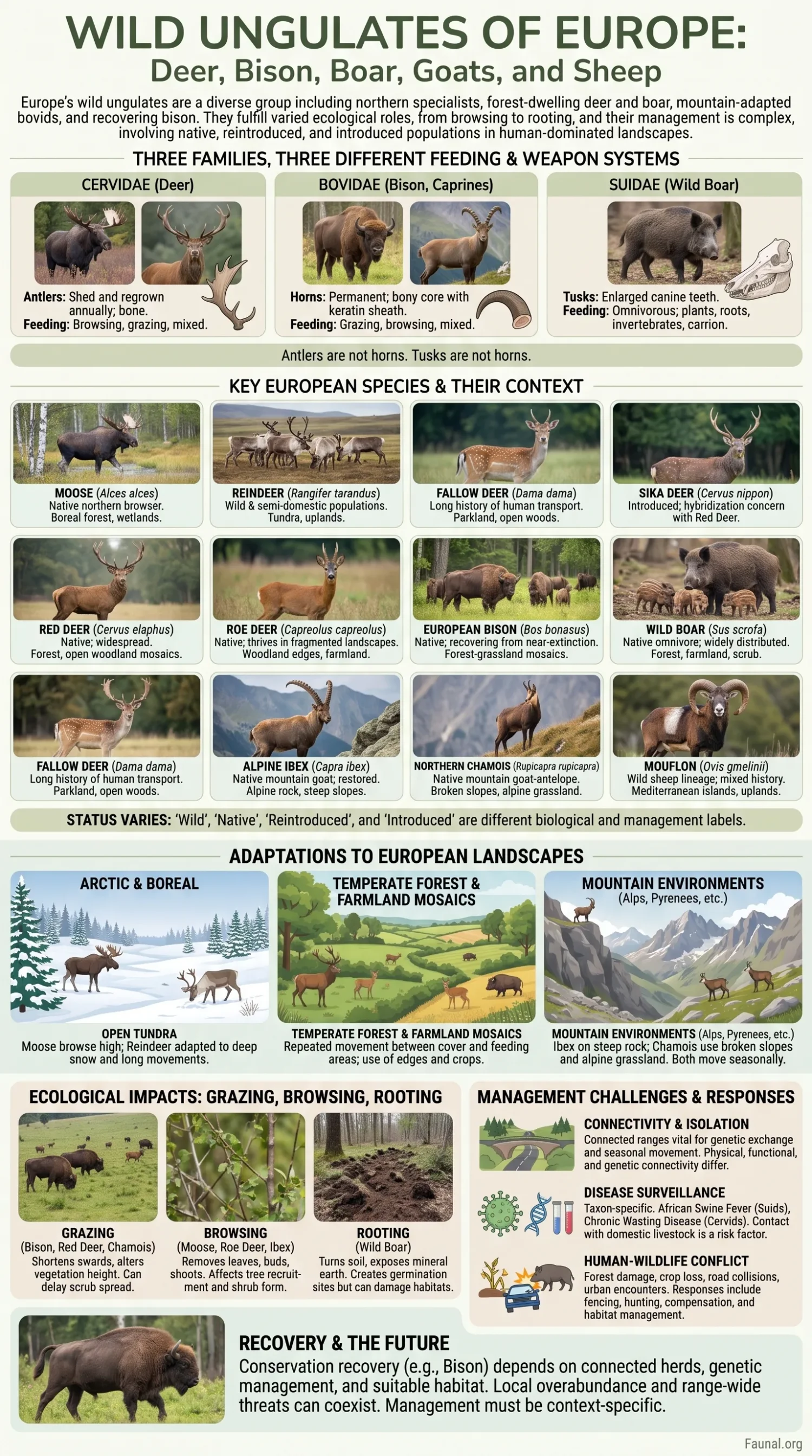
Europe’s wild ungulates include northern deer, temperate-forest browsers, mountain bovids, European bison, and the omnivorous wild boar. They do not form one uniform ecological group. Moose and reindeer are shaped by boreal winters and open northern ranges; red deer, roe deer, and wild boar often occupy forest–farmland mosaics; ibex and chamois use steep mountain terrain; and European bison recovery depends on managed herds, suitable habitat, and movement between populations. Their status also differs: a species may be native, reintroduced, introduced, feral, locally abundant, or genetically vulnerable, and more than one of those labels can apply at the same time.
Main families covered
Cervidae, Bovidae, Suidae
Deer; bison and caprines; wild boar.
Northern specialists
Moose and reindeer
Boreal forest, wetlands, tundra, and mountain plateaus.
Mountain specialists
Ibex and chamois
Rock faces, scree, alpine grassland, and upper forest zones.
Ungulate omnivore
Wild boar
Plant food, invertebrates, carrion, and other animal matter.
Scope of the European reference set
The species set follows the groups named in the title: deer, European bison, wild boar, ibex, chamois, wild-goat lineages, and mouflon. It is not presented as a checklist of every hoofed mammal recorded within every political definition of Europe. Equids, antelopes, domestic livestock, and most feral populations fall outside the page unless they clarify a taxonomic or native-status problem.
Three Families, Three Different Feeding and Weapon Systems
Most species discussed here belong to Cervidae, Bovidae, or Suidae. The distinction is more than a naming exercise. It separates animals with annually replaced antlers from animals with permanent horns, and it separates specialist herbivores from a boar that regularly eats both plant and animal material. Current mammal taxonomy is checked against the Mammal Diversity Database, while accepted names and alternate treatments are compared with Catalogue of Life where the two systems do not use the same combination.[a][b]
| Family | European examples in this scope | Head structures | Feeding pattern |
|---|---|---|---|
| Cervidae | Moose, reindeer, red deer, roe deer, fallow deer, sika deer | Antlers, normally shed and regrown; sex pattern varies by species | Browsing, grazing, or mixed feeding according to species and season |
| Bovidae | European bison, Alpine ibex, Iberian ibex, northern chamois, southern chamois, mouflon | Permanent horns with a bony core and keratin sheath | Grazing, browsing, or mixed feeding; strong seasonal shifts are common |
| Suidae | Wild boar | Enlarged canine teeth forming tusks | Omnivory, including mast, roots, crops, fungi, invertebrates, carrion, and small vertebrates |
Antlers are not horns. Deer antlers are bone and are replaced on a cycle. Bovid horns retain a living bony core beneath a keratin sheath and are not shed annually. Wild-boar tusks are teeth, not horns.
The Main Species Behind Europe’s Deer, Bison, Boar, Goat, and Sheep Assemblages
Europe-wide lists change with geographic boundaries, taxonomic revisions, and decisions about introduced or feral populations. The table below is therefore a source-based reference set, not a claim that every marginal, escaped, or locally managed population has been captured. The Atlas of European Mammals provides a common geographic baseline for many of the taxa, while current taxonomic databases are used for accepted names and disputed combinations.[c]
| Common name | Scientific name used here | Family | Main European setting | Status context |
|---|---|---|---|---|
| Moose | Alces alces | Cervidae | Boreal forest, wetlands, young woodland, and northern forest edges | Native northern species |
| Reindeer | Rangifer tarandus | Cervidae | Tundra, uplands, boreal margins, and open mountain plateaus | Wild and semi-domesticated populations must be separated |
| Roe deer | Capreolus capreolus | Cervidae | Woodland edges, farmland, scrub, and fragmented forest | Native and widespread across much of Europe |
| Red deer | Cervus elaphus | Cervidae | Forest, heath, upland grassland, and open woodland mosaics | Native, with restored or managed populations in parts of its range |
| Fallow deer | Dama dama | Cervidae | Open woodland, grassland–woodland mosaics, estates, and park-like landscapes | Long history of human movement; many present populations are introduced |
| Sika deer | Cervus nippon | Cervidae | Forest, heath, grassland, and plantation mosaics | Introduced; hybridisation with red deer is a management issue |
| Reeves’s muntjac | Muntiacus reevesi | Cervidae | Dense woodland, scrub, gardens, and wooded urban margins | Introduced and established in parts of western Europe |
| Chinese water deer | Hydropotes inermis | Cervidae | Wet grassland, reedbeds, farmland, and woodland edges | Introduced and localised in Europe |
| European bison | Bos bonasus; often Bison bonasus | Bovidae | Forest–grassland mosaics, clearings, meadows, and woodland edges | Native, extirpated in the wild, then reintroduced |
| Wild boar | Sus scrofa | Suidae | Forest, wetland, farmland, scrub, and peri-urban landscapes | Native across broad parts of Europe; locally expanding or managed |
| Alpine ibex | Capra ibex | Bovidae | Alpine rock faces, scree, steep grassland, and high valleys | Native Alpine species restored from remnant populations |
| Iberian ibex | Capra pyrenaica | Bovidae | Iberian cliffs, rocky slopes, scrub, woodland, and mountain grassland | Native to the Iberian Peninsula |
| Northern chamois | Rupicapra rupicapra | Bovidae | Alps, Balkans, Carpathians, and adjoining mountain systems | Native mountain taxon with several regional forms |
| Southern chamois | Rupicapra pyrenaica | Bovidae | Pyrenees, Cantabrian Mountains, and central Apennines | Native southern European mountain taxon |
| Mouflon | Ovis gmelinii or Ovis gmelini, depending on authority | Bovidae | Mediterranean islands, dry uplands, rocky slopes, and introduced continental ranges | Wild-living populations with complicated ancestry and human-mediated range history |
Wild, native, reintroduced, and introduced are different labels
A free-ranging animal is not automatically native to the place where it occurs. A native species may be reintroduced after regional extinction. An introduced species may be well established without being native, and a native species may still require local population control. These labels describe different biological and management questions.
Why the Ungulate Assemblage Changes from Tundra to Mediterranean Mountains
Arctic and boreal Europe
Moose and reindeer dominate the northern image of European ungulates, but they use the landscape differently. Moose are large browsers tied to woody vegetation, wetlands, young forest, and places where shrubs and saplings remain available above snow. Reindeer are adapted to open country, long seasonal movements, wind-exposed ridges, and digging through snow for food. Deep snow can restrict both species, but the costs differ because of body form, hoof design, forage, and movement strategy.
Temperate forest and farmland mosaics
Roe deer, red deer, fallow deer, and wild boar often occupy landscapes made from woodland patches, crops, grassland, roads, and settlement edges. Roe deer can use small cover patches and field margins. Red deer usually need larger connected areas when seasonal movement remains possible, although many populations live in heavily managed terrain. Wild boar benefit from woodland mast, dense cover, crops, and mild winters. The result is not a clean division between “forest species” and “farmland species,” but repeated movement between feeding and shelter habitats.
Carpathian and eastern European recovery landscapes
Large forest complexes in central and eastern Europe support red deer, roe deer, wild boar, and many of the free-ranging European bison herds. Bison restoration, however, is not achieved by placing animals inside forest alone. Herd size, genetic exchange, access to open forage, winter feeding practices, disease control, crop conflict, and connections between neighbouring populations all affect whether a herd functions as part of a viable range-wide population.
Alpine, Iberian, Pyrenean, Apennine, Balkan, and Carpathian mountains
Ibex and chamois are often grouped as “mountain goats,” yet they are not interchangeable. Ibex are true goats in the genus Capra. Chamois belong to Rupicapra and have a lighter build, shorter hooked horns, and broader use of alpine grassland, broken woodland, and steep slopes. Mouflon adds another layer because its European populations reflect both wild ancestry and human transport over long periods.
A Europe-wide occupancy analysis published in 2020 estimated that about 90% of the continent was home to at least one native wild ungulate, with roe deer and wild boar occupying especially broad portions of the mapped area. The same analysis stressed that modern ungulate distributions are embedded in human-dominated landscapes rather than confined to remote reserves.[d]
Moose and Reindeer Use Northern Landscapes in Different Ways
Moose are tall browsers of forest and wet ground
The moose’s long legs and high shoulder place much of its feeding zone above the ground layer used by smaller deer. It takes leaves, twigs, shoots, bark, and aquatic plants. Wetlands and young forest can be productive feeding areas, while mature forest may provide shelter without offering the same volume of browse. Moose are often solitary or occur in small temporary groups rather than in the large, stable herds associated with reindeer.
Its body size also changes the nature of human conflict. A moose crossing a road presents a different collision hazard from a roe deer because the animal’s mass is carried high above long legs. Forest regeneration can be affected where repeated browsing concentrates on pine, birch, willow, aspen, or other preferred woody plants. The outcome depends on tree species, snow, forestry practice, predator presence, and local moose density.
Wild reindeer should not be merged with semi-domesticated herds
Reindeer can occur as wild populations, managed semi-domesticated herds, or populations with mixed histories. Treating all European records as one wild population hides differences in ownership, movement, breeding management, and land use. Norway retains almost all of Europe’s wild mountain reindeer. The Norwegian Environment Agency reports roughly 20,000 wild reindeer divided among 24 more-or-less separated areas, with roads, railways, cabins, hydropower infrastructure, and recreation contributing to habitat fragmentation and disturbance.[e]
Both sexes can grow antlers, although timing and retention differ by sex, age, and reproductive condition. Broad hooves spread load on soft ground and snow, and their edges can help expose buried forage. Movement is central to the species’ ecology: access to seasonal ranges may matter as much as the condition of any single feeding site. A protected patch can therefore remain inadequate when roads or repeated disturbance sever the routes connecting calving, summer, and winter areas.
Red Deer, Roe Deer, and Fallow Deer Are Not Interchangeable
These three deer overlap in parts of Europe and can use similar woodland–grassland mosaics, but body size, social behaviour, antler form, and rump pattern separate them. Their effects on vegetation also differ because the amount eaten, preferred feeding height, group size, and seasonal concentration are not the same.
| Feature | Red deer | Roe deer | Fallow deer |
|---|---|---|---|
| Relative build | Large, long-bodied deer | Small, compact deer | Medium-sized deer |
| Male antlers | Branched beams with multiple tines | Short, usually three-tined adult form in mature males | Broad, palmate antlers in mature males |
| Rump and tail | Pale rump patch; short tail | Prominent pale rump patch; tail barely visible | Longer dark-topped tail and contrasting rump pattern |
| Typical social pattern | Sexes often segregate outside the rut; herds can be large | Often solitary or in small groups, with winter aggregations in some landscapes | Frequently forms herds; group structure changes with season |
| Common confusion | Large hinds may be mistaken for other large deer where introductions occur | Distance can hide its much smaller size | Spotted coats are variable; adults may also be dark, pale, or unspotted |
Red deer combine grazing and browsing
Red deer feed on grasses, dwarf shrubs, leaves, shoots, and bark, with the balance changing among habitats and seasons. Open ground may provide feeding areas while forest offers cover, yet many herds move across both. Where movement is constrained or winter feeding concentrates animals, browsing and bark stripping can become highly localised. The rut is marked by male roaring, displays, parallel walking, and fights, but the rest of the year is governed by forage, shelter, disturbance, and sex-specific grouping.
Roe deer thrive in edges and small cover patches
Roe deer are selective feeders that take herbs, leaves, buds, shoots, and crop plants. Their small body size and use of woodland edges help them persist in fragmented countryside. They can rest in modest patches of scrub or woodland and move into nearby fields to feed. Adult males hold territories during part of the year, while winter groups can form where food and open land bring animals together.
Fallow deer carry a long record of human transport
Fallow deer are easy to recognise when mature males carry broad palmate antlers, but their coat colour is unusually variable. Spotted, dark, pale, and nearly white forms may occur in the same population. The present European distribution cannot be treated as a simple natural range because people moved fallow deer among islands, parks, estates, hunting grounds, and continental regions over many centuries. Each regional account therefore needs its own evidence for native, anciently introduced, or recently introduced status.
Introduced Deer Have Become Part of Several European Assemblages
Sika deer, Reeves’s muntjac, Chinese water deer, and white-tailed deer occur in parts of Europe because of deliberate release, escape, or later spread from established populations. Their ranges are uneven. A species that is common in one country may be absent or represented only by isolated records in another. European occurrence maps must therefore separate established breeding populations from escapees and single observations.
Sika deer create both habitat and genetic concerns
Sika deer can browse woodland vegetation, damage young trees, and maintain populations in forest–heath mosaics. In 2025 the species was added to the European Union list of invasive alien species of Union concern, bringing controls on keeping, transport, sale, breeding, and release within the regulation’s scope.[f]
The more unusual issue is hybridisation with red deer. Where the two species meet, mating can produce fertile descendants, allowing sika ancestry to move through red-deer populations even when hybrid animals are not obvious in the field. Genetic work in Scotland has documented extensive admixture in some contact zones, showing why visual identification alone cannot define the boundary between the two gene pools.[g]
Muntjac and water deer do not look like smaller versions of native deer
Reeves’s muntjac are small woodland deer with short antlers in males, elongated upper canine teeth, and a capacity to use dense cover near people. Chinese water deer lack antlers in both sexes; adult males carry long upper canines. Wet grassland and reedbed associations distinguish water deer from muntjac, although both can also use farmland and woodland edges. Their European populations are introduced, so local presence should be based on national records rather than assumed from a continent-level species list.
European Bison Recovery Still Depends on Connected Herds
European bison survived the early twentieth century only through captive animals and were later returned to free-ranging conditions. The IUCN assessment announced in 2020 moved the species from Vulnerable to Near Threatened. It reported growth from about 1,800 wild animals in 2003 to more than 6,200 in 2019, but also found that the 47 free-ranging herds were largely isolated and that only eight were large enough at that time to meet the assessment’s long-term genetic viability threshold.[h]
Recovery is therefore measured by more than the continental total. Small herds may require exchanges of animals, breeding records, disease screening, and coordinated management across borders. The IUCN SSC Bison Specialist Group’s 2024–2025 report describes work toward a new range-wide conservation action plan, larger metapopulations, technical guidance for reintroductions, and new or developing herds in central, eastern, and western Europe.[i]
Bison are not restricted to closed forest
The common image of European bison as a deep-forest animal partly reflects where the last survivors were protected, not the full range of habitats they can use. Bison graze in meadows, feed in clearings, browse woody plants, move along forest edges, create trails, wallow, and transport seeds. A 2024 field study in a forest landscape found higher plant species richness where bison activity removed biomass, dispersed seeds, and created small disturbed patches. That result is evidence from a defined study system, not a promise that every release will produce the same vegetation response.[j]
Bos bonasus and Bison bonasus
The Mammal Diversity Database v2.5 places the European bison in the genus Bos, subgenus Bison, as Bos bonasus. IUCN assessments, European conservation plans, and much of the established literature use Bison bonasus. Both combinations may therefore appear in current sources; the authority and date should be recorded instead of silently treating one form as a spelling error.[k]
Wild Boar Is Europe’s Ungulate Omnivore
Wild boar differ from the deer and bovids in both diet and foraging method. Acorns, beechnuts, roots, bulbs, fungi, grain, fruit, and green plant matter may be joined by earthworms, insect larvae, eggs, carrion, and small vertebrates. Their snout and neck muscles allow them to turn soil and litter while searching for food. This rooting can expose mineral soil, bury seeds, alter nutrient movement, and create germination sites, but it can also damage crops, lawns, wet ground, archaeological sites, and sensitive plant communities.
Rooting can create habitat and damage it
The ecological effect depends on frequency, area, season, soil, vegetation, and the conservation target. Research summarised by the European Commission in 2025 found that wild-boar rooting could help maintain plant diversity in priority calcareous grassland under the studied conditions. The same behaviour may be destructive where rooting is intense, repeated, or concentrated in a small vulnerable site. “Ecosystem engineer” and “pest” are not mutually exclusive labels; each describes an effect observed under a particular set of conditions.[l]
African swine fever makes boar management a veterinary issue
African swine fever affects wild and domestic suids, not deer, bison, goats, sheep, or people. In May 2026, the European Food Safety Authority reported that recorded outbreaks in wild boar across the European Union rose by 44% in 2025 compared with 2024. Spain’s re-emergence brought the number of affected Member States to 14 for that reporting period. Carcass detection, safe disposal, biosecurity, transport controls, hunting practice, and coordination with pig farming are therefore part of wild-boar management in affected regions.[m]
High boar numbers are not explained by one cause. Food from crops and mast, mild winters, dense refuge cover, hunting practice, supplemental feeding, reproductive output, disease, and movement across borders can all alter local population growth.
Ibex and Chamois Solve Mountain Life Differently
Ibex and chamois share steep terrain but differ in body form, horns, movement, and habitat use. Calling all of them “wild goats” hides those differences. Alpine and Iberian ibex belong to Capra. Northern and southern chamois belong to Rupicapra. Both groups can move below exposed alpine zones into scrub or forest, especially when snow, heat, forage, disturbance, or reproduction changes their seasonal needs.
| Feature | Ibex | Chamois | Mouflon |
|---|---|---|---|
| Taxonomic group | True goats, genus Capra | Goat-antelopes, genus Rupicapra | Wild-sheep lineage, genus Ovis |
| Adult male horns | Long, heavy, strongly curved, with visible growth ridges | Shorter, slender, with sharply hooked tips | Curved outward and backward; form varies by population |
| Build | Heavy and powerfully muscled, especially adult males | Lighter, compact, and agile | Sheep-like body with strong sexual dimorphism in many populations |
| Typical terrain | Cliffs, rock faces, scree, steep grassland | Broken slopes, alpine grassland, rock, scrub, and upper forest | Dry rocky uplands, open woodland, scrub, and grassland |
| European status question | Native range and restoration history | Species and subspecies boundaries among mountain systems | Wild ancestry versus prehistoric and historic human movement |
Alpine ibex were restored from a remnant Alpine population
Alpine ibex were eliminated from most of the Alps and survived in the Gran Paradiso area of the Italian Alps. Protection, captive transfer, and reintroduction then rebuilt populations across the Alpine arc. Modern herds are therefore native to the mountain system but often result from documented restoration rather than uninterrupted local survival. The species account in Mammalian Species records this contraction and subsequent translocation history.[n]
Large male horns are useful for identification but should not be used as a direct age counter from a distant photograph. Horn annuli, wear, growth interruptions, sex, and viewing angle all matter. Females also carry horns, though they are much smaller and more slender.
Iberian ibex occupy more than bare cliffs
Iberian ibex use cliffs and rocky slopes, but populations may also move through scrub, open woodland, pine forest, and mountain grassland. The species is native to the Iberian Peninsula and contains geographically differentiated populations. Regional history matters because the Pyrenean ibex became extinct in 2000, while other populations persisted or expanded. A single peninsula-wide status should not be used to erase those regional outcomes.
Northern and southern chamois are separate species
Northern chamois, Rupicapra rupicapra, occur across several central, eastern, and south-eastern European mountain systems. Southern chamois, Rupicapra pyrenaica, are distributed in the Pyrenees, Cantabrian Mountains, and central Apennines in the current Mammal Diversity Database treatment.[o] Both sexes carry short horns with hooked tips. Their facial markings, coat, body size, and exact range can aid identification, but geographic origin is often more reliable than one distant visual feature.
Mouflon Sits on the Boundary Between Wild Sheep and Human-Moved Populations
Mouflon are wild-living sheep, yet the origin of European populations cannot be reduced to a simple native-versus-introduced label. Mediterranean island populations are connected to early human transport and to domestic-sheep history, while many continental populations were established much later for hunting or game management. A free-ranging mouflon herd may behave as wildlife and affect vegetation as wildlife while still occupying a human-created range.
The taxonomic name also changes among current authorities. Mammal Diversity Database v2.5 accepts Ovis gmelinii for Asian mouflon and includes anciently and recently introduced European populations in that treatment.[p] The Catalogue of Life backbone served through GBIF uses Ovis gmelini.[q] Other publications place European mouflon with domestic sheep as Ovis aries musimon. European pages should state the authority being followed, identify the population under discussion, and avoid using a species name alone as proof of native status.
Cretan wild goats require population-specific wording
Kri-kri and other Aegean wild-goat populations are often linked to Capra aegagrus, but their ancestry and the role of ancient human transport have been interpreted in different ways. They should not be inserted into a European “native wild goat” list without naming the population and the taxonomic source used.
Grazing, Browsing, and Rooting Reshape Vegetation
Ungulate effects begin with what is eaten, but they extend to where animals walk, rest, rub, wallow, defecate, and die. Grazers shorten grasses and can slow woody encroachment. Browsers remove leaves, buds, and shoots, altering tree recruitment and shrub form. Wild boar turn soil. Bison create trails, dung patches, rubbing sites, and wallows. Hooves move seeds and disturb the ground surface. Carcasses feed scavengers and return nutrients.
The same process can have different outcomes at different densities. Moderate browsing may create varied vegetation heights and open patches. Repeated browsing on the same preferred tree species can suppress regeneration for years. Rooting may produce germination microsites or remove a small plant population. Grazing may retain open habitat or simplify it when animals are concentrated and alternative forage is scarce.
| Foraging process | Common European examples | Possible habitat effect | Possible pressure when concentrated |
|---|---|---|---|
| Grazing | Bison, red deer, reindeer, ibex, chamois, mouflon | Shorter swards, delayed scrub spread, varied vegetation height | Loss of palatable plants, erosion, repeated use of small feeding areas |
| Browsing | Moose, roe deer, red deer, bison, ibex | More open understorey, altered shrub form, patch creation | Suppressed tree recruitment, bark damage, selective loss of preferred species |
| Rooting | Wild boar | Exposed soil, litter mixing, germination sites, nutrient redistribution | Crop loss, damage to wet ground, disturbance of rare plants or ground nests |
| Transport and deposition | All groups | Seed dispersal, dung resources, nutrient movement | Movement of pathogens or non-native plant seeds between sites |
Conservation Recovery and Local Overabundance Can Occur Together
A continent-level category cannot describe every local population. European bison can be recovering in total number while individual herds remain small and isolated. Roe deer may be widespread while a particular woodland has browsing pressure above its regeneration target. An introduced deer can be scarce nationally but damaging inside one reserve. Management begins by defining the scale, the population, and the ecological or social outcome being measured.
| Species or group | Range-wide concern | Possible local concern | Evidence needed before action |
|---|---|---|---|
| European bison | Isolation, limited founder ancestry, uneven herd size | Crop use, winter concentration, disease, conflict near settlements | Herd demography, pedigree or genomic data, habitat use, disease screening |
| Red deer and roe deer | Connectivity and regional population structure | Browsing, bark damage, collisions, concentration around feeding sites | Vegetation plots, pellet or camera indices, harvest data, collision records |
| Wild boar | Cross-border disease circulation | Crop loss, urban encounters, rooting in vulnerable sites | Carcass surveillance, damage mapping, reproduction and harvest records |
| Ibex and chamois | Mountain isolation, disease, climate exposure | Competition at feeding sites, recreation disturbance, local overuse | Population counts, genetic data, seasonal range and health monitoring |
| Introduced deer | Spread, hybridisation, effects on native habitats | Dense local browsing, garden damage, road collisions | Breeding evidence, genetic sampling where relevant, mapped impacts |
| Mouflon | Unclear conservation unit and mixed population history | Artificial range expansion, vegetation pressure, disease exchange with sheep | Population origin, taxonomy, health data, management purpose |
“Common,” “threatened,” “overabundant,” and “recovering” are scale-dependent descriptions. They should be attached to a named population, place, measure, and time period rather than used as permanent properties of a species.
Disease Surveillance Is Taxon-Specific
Ungulate disease is sometimes discussed as if one infection applies to every hoofed mammal. It does not. African swine fever is a suid disease. Chronic wasting disease is a prion disease of cervids. Chamois and ibex have their own bacterial, viral, and parasitic concerns, and contact with domestic sheep or goats can alter exposure. European bison management includes herd-specific screening and movement controls because translocation can connect disease systems as well as gene pools.
Chronic wasting disease surveillance focuses on deer relatives
Europe’s first detected chronic wasting disease cases were reported in Norway in 2016 in wild reindeer and moose. EFSA’s current transmissible spongiform encephalopathy summary records 31 detected CWD cases during enhanced monitoring from 2017 to February 2022 across the countries covered: 13 reindeer, 15 moose, and three red deer, with cases found in Norway, Sweden, and Finland. Its report on 2024 surveillance recorded two cases in wild European moose. These are detected cases under defined surveillance programmes, not a count of all infections present across Europe.[r]
Contact with domestic herds can change mountain-disease risk
Ibex, chamois, mouflon, domestic goats, and domestic sheep can share alpine pastures, mineral licks, water points, or winter ranges. That contact does not prove transmission, but it creates routes that health programmes may need to test. A sound assessment names the pathogen, host species, sampling method, and population. General statements that livestock always infect wildlife, or that wildlife always infect livestock, go beyond the evidence.
Forest Damage, Crop Loss, Roads, and Urban Encounters Require Different Responses
Browsing and bark damage are measured against a forest target
A browsed sapling is evidence of feeding, not by itself evidence that a deer population is too large. Foresters assess which tree species are selected, how many leaders are damaged, whether seedlings survive above browsing height, and whether the desired forest mixture can regenerate. Fencing, tree guards, altered harvesting, habitat changes, hunting, predator presence, and feeding policy can all affect the result. The target may be timber production, natural regeneration, woodland diversity, or a mixture of them.
Crop damage follows feeding opportunities and refuge
Wild boar may root or consume maize, cereals, vineyards, orchards, and grassland. Deer and bison may graze crops or browse young plants. Damage often reflects the arrangement of crops beside woodland refuge, the ripening calendar, hunting disturbance, fencing, and alternative forage. Compensation can support coexistence, but it does not replace prevention or population evidence. Claims should separate the number of damage reports, the area affected, and the monetary value because they measure different things.
Road risk depends on species, speed, and crossing location
Collision risk rises where feeding and shelter areas sit on opposite sides of a road, where roadside vegetation attracts animals, or where migration routes intersect transport corridors. Moose, red deer, roe deer, and wild boar differ in body height, group size, activity timing, and the damage caused by impact. Warning signs alone do not reconnect habitat. Crossing structures, fencing designed to lead animals toward safe passages, speed management, vegetation control, and collision mapping work as a linked system.
Urban food changes behaviour
Wild boar and deer can enter suburbs where gardens, refuse, feeding, irrigated lawns, and shelter provide predictable resources. Habituation does not make an animal domesticated. It can reduce flight distance and make encounters more frequent. Removing access to food, securing waste, avoiding direct feeding, controlling dogs, and preserving escape routes address the conditions that draw animals into repeated contact with people.
Management Follows the Problem, Not the Animal’s Popularity
No single intervention works across bison restoration, wild-boar disease control, deer browsing, reindeer fragmentation, and chamois disturbance. The action should match a defined problem and be checked against measurable outcomes. A method that lowers crop damage may not improve genetic connectivity. A fence that protects seedlings may block seasonal movement. A translocation that increases genetic exchange may also require disease testing and post-release monitoring.
| Management action | Primary use | Main limitation or trade-off |
|---|---|---|
| Protected core area | Secures habitat and reduces some forms of disturbance | Animals move beyond boundaries; small reserves may not contain seasonal ranges |
| Wildlife corridor or crossing | Reconnects feeding, breeding, and seasonal areas | Placement must match actual movement; fencing can redirect or obstruct animals |
| Reintroduction | Restores a lost population or ecological process | Requires founder planning, disease controls, habitat, monitoring, and social agreement |
| Genetic exchange | Reduces isolation among small managed herds | Needs pedigree or genomic evidence and health screening |
| Regulated hunting or culling | Changes density, age structure, damage, or disease conditions | Outcome depends on timing, sex and age selection, access, effort, and immigration |
| Exclusion fencing | Protects crops, roads, or young forest | Can fragment habitat and shift damage elsewhere |
| Supplemental feeding | May support a specific short-term management aim | Can concentrate animals, alter movement, raise disease contact, and sustain high density |
| Compensation | Shares the cost of wildlife damage | Requires verification, funding, and prevention rules |
| Disease surveillance | Detects infection and guides movement or carcass controls | Results reflect sampling design and cannot be treated as complete prevalence data |
Connected Ranges Matter More Than Isolated Headcounts
Ungulate counts are often reported by reserve, hunting district, county, or country, while the animals use ranges that cross those boundaries. A reindeer population may need separate seasonal areas. A bison herd may need planned exchange with another herd. Red deer can move between upland and lowland feeding grounds. Ibex and chamois populations may be divided by valleys, roads, ski infrastructure, or unsuitable lowland habitat. The number inside one administrative unit cannot show whether those connections remain open.
Connectivity is also not one measure. Physical connectivity asks whether animals can move through the landscape. Functional connectivity asks whether they actually use the route. Genetic connectivity asks whether movement results in reproduction and gene flow. A corridor may look continuous on a map yet fail because of traffic, fencing, recreation, settlement, or repeated disturbance.
The long-term European pattern will be shaped by the fit between species biology and a densely used landscape: open routes for northern migrants, viable bison metapopulations, mountain refuges linked across valleys, forest regeneration that can tolerate browsing, and disease systems managed across borders. These conditions cannot be inferred from a continent-wide population total alone.
Sources and Verification
- [a]Mammal Diversity Database — Used for the current mammal taxonomy baseline and accepted genus–species combinations in version 2.5.
- [b]Catalogue of Life — Used to compare accepted names where current taxonomic backbones differ.
- [c]Atlas of European Mammals Reference in EUNIS — Used as a geographic and taxonomic baseline for European mammal coverage.
- [d]The Challenges and Opportunities of Coexisting with Wild Ungulates in the Human-Dominated Landscapes of Europe — Used for continent-scale occupancy estimates and the human-dominated landscape context.
- [e]Norwegian Environment Agency: Wild Reindeer — Used for the current Norwegian wild-reindeer estimate, range division, and fragmentation pressures.
- [f]EU Invasive Alien Species List Update Including Sika Deer — Used for the 2025 addition of sika deer to the Union list and the associated regulatory context.
- [g]Extensive Hybridisation Between Red Deer and Introduced Japanese Sika in Kintyre, Scotland — Used for genetic evidence of admixture in a European contact zone.
- [h]IUCN: European Bison Recovering — Used for the 2020 Red List category change, 2003–2019 wild-population figures, and herd-isolation findings.
- [i]IUCN SSC Bison Specialist Group 2024–2025 Report — Used for current work on the range-wide action plan, metapopulations, technical guidance, and herd development.
- [j]European Bison Increase Plant Species Richness in a Forest Landscape — Used for the study-specific evidence on biomass removal, seed dispersal, disturbance, and plant richness.
- [k]Mammal Diversity Database: Bos bonasus — Used for the current placement of European bison in Bos and its listed name history.
- [l]European Commission: Wild-Boar Rooting in Calcareous Grassland — Used for the study context in which rooting supported plant diversity and for the need to keep that finding habitat-specific.
- [m]EFSA: African Swine Fever Outbreaks Increase in Pigs and Wild Boar Across the EU — Used for the 2025 outbreak comparison published in May 2026.
- [n]Capra ibex — Mammalian Species — Used for Alpine ibex range contraction, survival in the Italian Alps, and restoration history.
- [o]Mammal Diversity Database: Rupicapra pyrenaica — Used for the current southern-chamois distribution treatment.
- [p]Mammal Diversity Database: Ovis gmelinii — Used for the accepted mouflon name, introduced European populations, and synonym treatment in version 2.5.
- [q]Catalogue of Life Taxon Record for Ovis gmelini Through GBIF — Used to document an alternate accepted spelling in another current taxonomic backbone.
- [r]EFSA: Transmissible Spongiform Encephalopathies and Chronic Wasting Disease — Used for European CWD detection history, enhanced monitoring results, and the 2024 surveillance summary.
Related Topics
- → Mammals of Europe: Native Species, Habitats, and Distribution
- → Small Mammals of Europe: Rodents, Shrews, Hedgehogs, and Dormice
- → Large Carnivores of Europe: Wolves, Bears, Lynx, and Wolverines
- → Alpine Mammals of Europe: Species of High Mountain Habitats
- → Forest Mammals of Europe: Woodland Species and Habitat Use