Complete guides: •Amphibians•Regional Fauna Guides•Fauna of Turkey
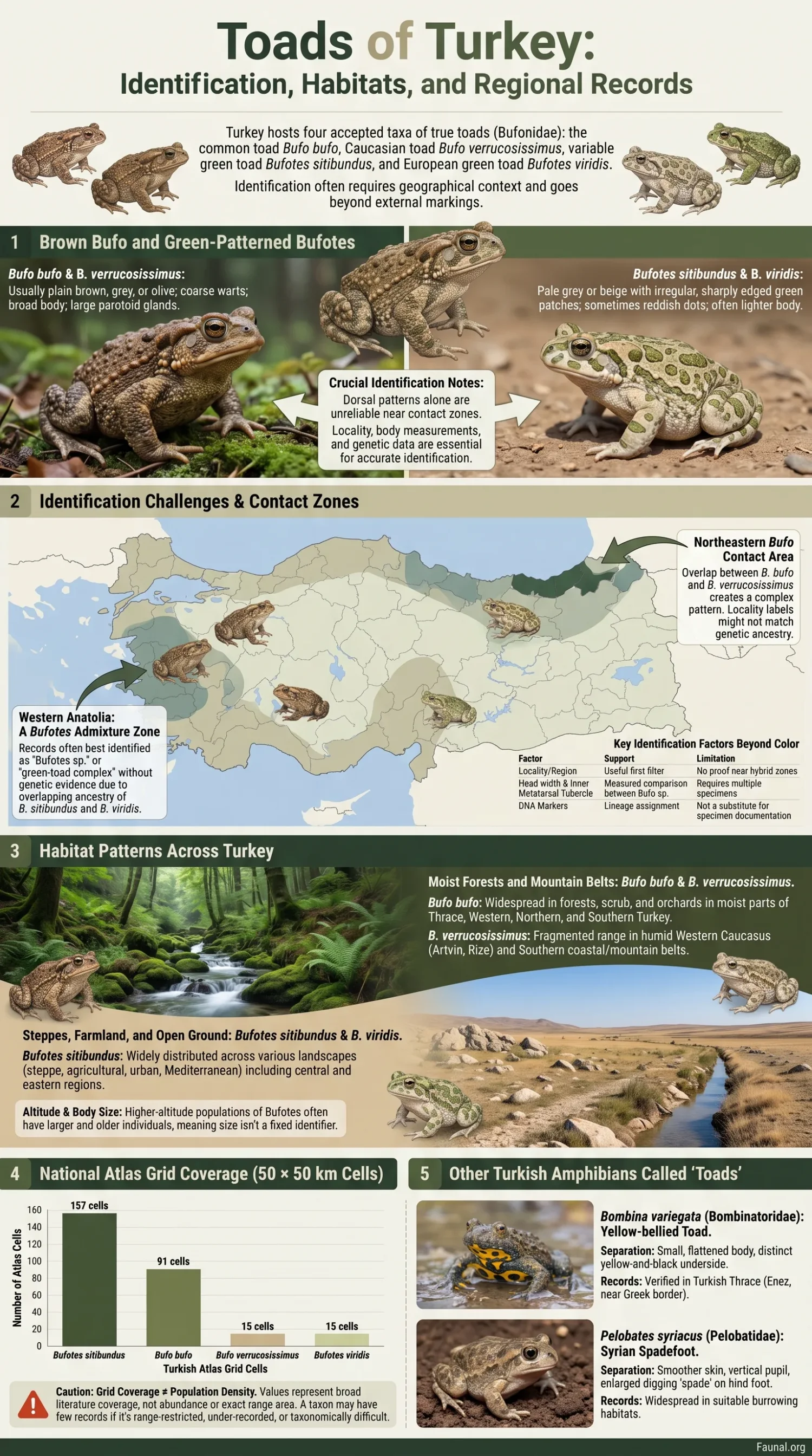
Turkey’s source-based true-toad list contains four taxa in the family Bufonidae: the common toad Bufo bufo, Caucasian toad Bufo verrucosissimus, variable green toad Bufotes sitibundus, and European green toad Bufotes viridis. Their identification is shaped by geography as much as appearance. The two brown Bufo species meet in northeastern Turkey, while the two green-toad lineages form an admixed zone across western Anatolia.
A green-spotted toad photographed in central or eastern Anatolia can usually be assigned to the Bufotes group, but a dorsal photograph alone does not establish whether it is genetically pure B. sitibundus, B. viridis, or an admixed individual from western Turkey.
Four True Toads Recorded in Turkey
Current amphibian taxonomy recognizes Bufotes viridis as a valid species and treats the historically used name variabilis as part of a difficult synonym history rather than a simple substitute for all Anatolian green toads. Modern treatments commonly place most Anatolian populations under Bufotes sitibundus, with B. viridis retained in Thrace and contributing ancestry to western Anatolian populations. [a]
The national distribution synthesis published in 2021 records all four Bufonidae taxa separately. Its maps combine literature and locality evidence available through December 2020 and place records in 50 × 50 km grid cells. The resulting checklist is a practical national reference, but the cells do not describe continuous occupation within each square. [b]
| Accepted working name | Practical English name | Typical field appearance | Source-based Turkish pattern | Main identification limit |
|---|---|---|---|---|
| Bufo bufo | Common toad | Usually brown, grey-brown, olive-brown, or reddish brown; coarse warts; broad body; large parotoid glands behind the eyes | Recorded widely in forested and relatively moist parts of Thrace, western and northern Anatolia, and southern mountain belts | Can overlap in color, size, and parotoid form with B. verrucosissimus |
| Bufo verrucosissimus | Caucasian toad | Large brown toad with coarse dorsal warts; often broad-headed and heavy-bodied | Northeastern records linked to the Caucasus, plus a separate southern coastal and montane lineage | External characters vary and are not dependable enough for every photograph or isolated animal |
| Bufotes sitibundus | Variable green toad | Pale grey, cream, or beige ground color with irregular green patches; reddish or orange dots may occur | The main green-toad taxon across most of Anatolia, including steppe, agricultural, urban, Mediterranean, and eastern landscapes | Western populations may carry mixed sitibundus and viridis ancestry |
| Bufotes viridis | European green toad | Pale body with contrasting green patches, often closely resembling B. sitibundus | Clearly supported in European Turkey; its ancestry extends into the western Anatolian contact zone | Color pattern does not reliably separate it from B. sitibundus |
Brown Bufo and Green-Patterned Bufotes
The first useful field division separates the usually plain brown members of Bufo from the green-patterned members of Bufotes. This distinction works for many adults, but it is not absolute. Juveniles may show atypical contrast, lighting can change apparent color, mud can hide the dorsal pattern, and some green toads are weakly marked.
Common Toad and Caucasian Toad
A Turkish study combining mitochondrial DNA, nuclear markers, and morphology supported two main common-toad lineages: Bufo bufo and B. verrucosissimus. The Caucasian toad samples formed northern and southern geographic groups rather than one uninterrupted Turkish population. The study found larger head dimensions and longer inner metatarsal tubercles in B. verrucosissimus, but parotoid angle and the development of keratinized dorsal warts did not provide a clean field boundary. [c]
These differences are most useful when several measured specimens can be compared. A single brown toad from Rize, Artvin, Antalya, Mersin, Osmaniye, or Hatay should not be named solely from its apparent size or wartiness. Locality, body proportions, and the known contact zones must be considered together.
European and Variable Green Toads
Green toads usually have a pale dorsal ground color crossed by sharply edged green patches. Red or orange tubercles may be scattered between the patches. The body is often more lightly built than in the two brown Bufo species, and males may develop a darker throat during the breeding period.
Genetic sampling around the Aegean found B. viridis ancestry in Thrace and B. sitibundus across Anatolia, with a broad area of admixture in western Anatolia. The boundary is therefore not a narrow provincial line. Naming every western Turkish green toad from external markings creates a level of certainty that the available evidence does not support. [d]
Western Anatolia Is a Green-Toad Contact Zone
For records from the Aegean coast, Marmara region, and western interior, “Bufotes sp.” or “green-toad complex” may be the most defensible identification when locality data, call evidence, measurements, or genetic results are unavailable.
| Observed character | What it can support | What it cannot establish alone |
|---|---|---|
| Green dorsal patches on a pale background | Placement in the Turkish Bufotes group in many cases | B. viridis versus B. sitibundus in western Anatolia |
| Plain brown or reddish-brown dorsal color | Placement in the Bufo bufo–B. verrucosissimus group when combined with body form | A secure species name inside northeastern or southern overlap areas |
| Large parotoid glands | Support for a true-toad identification | Reliable separation of the two Turkish Bufo species |
| Head width and inner metatarsal tubercle length | Measured comparison between B. bufo and B. verrucosissimus | Fast identification from an angled or unscaled photograph |
| Province or broad region | A useful first filter for likely taxa | Proof of species identity near a hybrid or contact zone |
| DNA markers | Lineage assignment and detection of introgression | A substitute for accurate locality, specimen, and sampling documentation |
Habitat Patterns Across Turkey
Moist Forests and Mountain Belts
Bufo bufo is most closely associated with the moister portion of Turkey’s landscape. National records occur in Balkan mixed forest, Aegean and western Turkish woodland, Anatolian conifer–deciduous forest, the Euxine–Colchic belt, and southern Anatolian mountain forest. Adults spend much of the year on land in woodland, scrub, orchards, gardens, and shaded field margins, returning to ponds, reservoirs, quiet stream margins, and other standing water for reproduction.
Bufo verrucosissimus has a more fragmented Turkish pattern. Its northern populations belong to the humid western Caucasian landscape of Artvin and neighboring parts of Rize. Southern records occur in Mediterranean and Taurus landscapes from the Antalya region eastward through Mersin, Osmaniye, and Hatay. The current taxonomic account treats the western Caucasus, northeastern Turkey, and isolated southern coastal populations as parts of the species’ recorded range. [e]
Steppes, Farmland, Settlements, and Open Ground
Bufotes sitibundus occupies a wider environmental span than either brown toad. The national atlas records it in 13 of the 14 mapped terrestrial ecoregions, including central and eastern steppe, dry woodland, agricultural plains, Mediterranean landscapes, mountain steppe, and urbanized ground. It can breed in shallow ponds, flooded depressions, irrigation features, quarry pools, reservoirs, and other still or slow-water sites when hydroperiod and water quality permit larval development.
A study of 308 adult green toads from eight Turkish populations found that altitude and local ecological conditions were associated with differences in body size, age, and mass. Higher-altitude populations tended to contain larger and older animals, showing why measurements from one region should not be applied as fixed identification thresholds throughout Turkey. [h]
Bufotes viridis is best supported in the open lowlands and mixed agricultural landscapes of Thrace. Similar-looking green toads east of the Bosporus should not automatically receive the same name because the Anatolian lineage pattern changes across the contact zone.
Regional Record Pattern
| Region | Source-backed toad pattern | Record caution |
|---|---|---|
| Turkish Thrace | Bufotes viridis and Bufo bufo; localized Bombina variegata records near Enez | A European-Turkish green toad can be consistent with B. viridis, but exact locality remains necessary |
| Marmara and northwestern Anatolia | Bufo bufo and green-toad records near the western genetic transition | The straits do not form a complete biological boundary for every lineage |
| Aegean and western Anatolia | Bufo bufo in suitable woodland and mountain habitat; widespread Bufotes records with mixed ancestry | Green pattern alone cannot resolve B. viridis, B. sitibundus, and admixed individuals |
| Central Anatolia | Bufotes sitibundus is the principal documented true toad of open steppe, agricultural land, settlements, and scattered wetlands | Published amphibian records are sparse relative to Turkey’s other regions, so blank areas may reflect limited survey effort |
| Mediterranean coast and Taurus Mountains | Bufotes sitibundus in open and modified landscapes; Bufo bufo in suitable mountain and forest habitat; southern B. verrucosissimus lineage | Large brown toads from Antalya eastward require more than color-based identification |
| Western and central Black Sea | Bufo bufo is the main brown toad; Bufotes sitibundus occurs in suitable open landscapes | Coastal humidity does not mean that every locality has suitable breeding water |
| Rize and Artvin | Bufo bufo and B. verrucosissimus approach or meet; the Caucasian toad is well supported toward Artvin | This is a contact and introgression area rather than a clean range boundary |
| Eastern and southeastern Anatolia | Bufotes sitibundus is recorded across steppe, mountain-steppe, agricultural, and settlement landscapes | Provincial presence does not imply occupation of every dry plateau or basin |
The Rize–Artvin Bufo Contact
Field and genetic work places Bufo bufo from İyidere eastward toward Çayeli in Rize, while B. verrucosissimus records extend from Şavşat in Artvin westward toward Ardeşen. This produces a narrow northeastern contact area in which locality labels alone may not match genetic ancestry. [f]
Later genetic analysis found restricted introgression across the contact and detected Caucasian-toad mitochondrial ancestry farther west than the main contact area. A possible B. bufo enclave was also reported near Borçka. These findings show that a simple line drawn between Rize and Artvin would hide the biological pattern. [g]
National Atlas Grid Coverage
The 2021 atlas reported Bufotes sitibundus in 157 grid cells, Bufo bufo in 91, and both B. verrucosissimus and B. viridis in 15 cells each. Every cell covers 2,500 km², so these values measure broad literature coverage rather than the number of localities, observations, breeding populations, or animals.
Turkish Atlas Grid Cells Containing True-Toad Records
Number of 50 × 50 km cells with source records compiled through December 2020.
Source: Yaşar et al. (2021), national amphibian and reptile distribution synthesis. Values represent occupied atlas cells, not abundance or exact range area.
Grid Coverage Is Not Population Density
A taxon may have many records because it is widespread, easy to detect, frequently studied, or present near research centers. A taxon recorded in only a few cells may be range-restricted, under-recorded, taxonomically difficult, or affected by more than one of these conditions.
Other Turkish Amphibians Commonly Called Toads
English common names do not follow family boundaries. Two Turkish anurans outside Bufonidae are regularly described with the word “toad.” They should not be inserted into the four-species true-toad checklist, but they matter when identifying an animal from a photograph or locality report.
| Taxon | Family | Separation from true toads | Turkish record context |
|---|---|---|---|
| Bombina variegata | Bombinatoridae | Small, flattened amphibian with a dark upper surface and contrasting yellow-and-black underside; more aquatic in body form than Bufo or Bufotes | First formally reported from Kurtkaya near Enez, Edirne, about 10 km from the Greek border; later work added nearby Thracian localities |
| Pelobates syriacus | Pelobatidae | Smoother skin, vertically slit pupil, enlarged digging “spade” on the hind foot, and a burrowing life associated with workable soils | Recorded from Turkey under the accepted Syrian spadefoot name; locality and hind-foot structure separate it from true green toads |
The first verified Turkish population of the yellow-bellied toad was published from Kurtkaya–Enez in 2016. Its restricted Thracian evidence should not be expanded to Anatolia without additional records. [j]
Pelobates syriacus belongs to a separate burrowing-toad lineage. Its vertical pupil and hardened inner metatarsal spade distinguish it from the horizontal-pupilled, parotoid-bearing members of Bufonidae. The current taxonomic account includes documented Turkish populations. [k]
Why Regional Records Remain Uneven
A national amphibian database published in 2024 assembled 5,611 occurrence entries for 37 Turkish amphibian species from 436 literature sources. The occurrence collection included coordinates reported directly in publications and locality descriptions later georeferenced by the compilers. It covers scientific literature available through February 2023. [i]
Only 8% of the database’s amphibian occurrence entries came from Central Anatolia. The lower density of mapped points in that region cannot be read as an equivalent reduction in real amphibian presence. Steppe basins, temporary wetlands, agricultural pools, and remote uplands may remain poorly represented when surveys are infrequent or locality descriptions are imprecise.
A defensible regional toad record should retain the observation date, precise locality, elevation when available, habitat description, breeding-water context, and photographs showing the dorsal surface, side of the head, parotoid glands, and hind foot. In western Anatolia and northeastern Turkey, a record can remain useful even when the individual cannot be assigned below genus or species group.
Sources and Verification
- [a] Amphibian Species of the World: Bufotes viridis — Used to verify the currently accepted name, synonym history, and distinction between viridis, sitibundus, and older uses of variabilis.
- [b] Yaşar et al. (2021), The Distribution and Biogeography of Amphibians and Reptiles in Turkey — Used for the four-taxon Bufonidae list, ecoregion coverage, national distribution synthesis, and 50 × 50 km atlas-cell values.
- [c] Özdemir et al. (2020), Taxonomic Assessment and Distribution of Common Toads in Turkey — Used for molecular separation of Bufo bufo and B. verrucosissimus, Turkish lineage structure, and measured morphological differences.
- [d] Dufresnes et al. (2021), A Reassessment of the Diversity of Green Toads in the Circum-Aegean Region — Used for the separation of Thracian and Anatolian green-toad lineages and the admixed zone across western Anatolia.
- [e] Amphibian Species of the World: Bufo verrucosissimus — Used to verify the accepted Caucasian-toad name and its northeastern and isolated southern Turkish distribution.
- [f] Easternmost Distribution of Bufo bufo and Its Contact with Bufo verrucosissimus — Used for the İyidere–Çayeli and Şavşat–Ardeşen record pattern in Rize and Artvin.
- [g] Genetic Evidence from the Bufo bufo–Bufo verrucosissimus Hybrid Zone — Used for restricted introgression, westward mitochondrial ancestry, and the possible common-toad enclave near Borçka.
- [h] Altunışık et al. (2021), Ecological Parameters and Life-History Characteristics of Turkish Green Toads — Used for regional variation in age, body size, mass, and altitude-related life-history patterns.
- [i] Arslan et al. (2024), An Extensive Database on the Traits and Occurrences of Amphibian Species in Turkey — Used for the literature cutoff, source total, occurrence total, georeferencing method, and limited record coverage in Central Anatolia.
- [j] Bülbül et al. (2016), First Record of Bombina variegata from Turkey — Used for the first verified Turkish yellow-bellied-toad locality at Kurtkaya, Enez, Edirne.
- [k] Amphibian Species of the World: Pelobates syriacus — Used to verify the accepted Syrian-spadefoot taxonomy and the existence of documented Turkish populations outside Bufonidae.