Complete guides: •Regional Fauna Guides•Wildlife Habitat Guides•Mammals•Fauna of Turkey
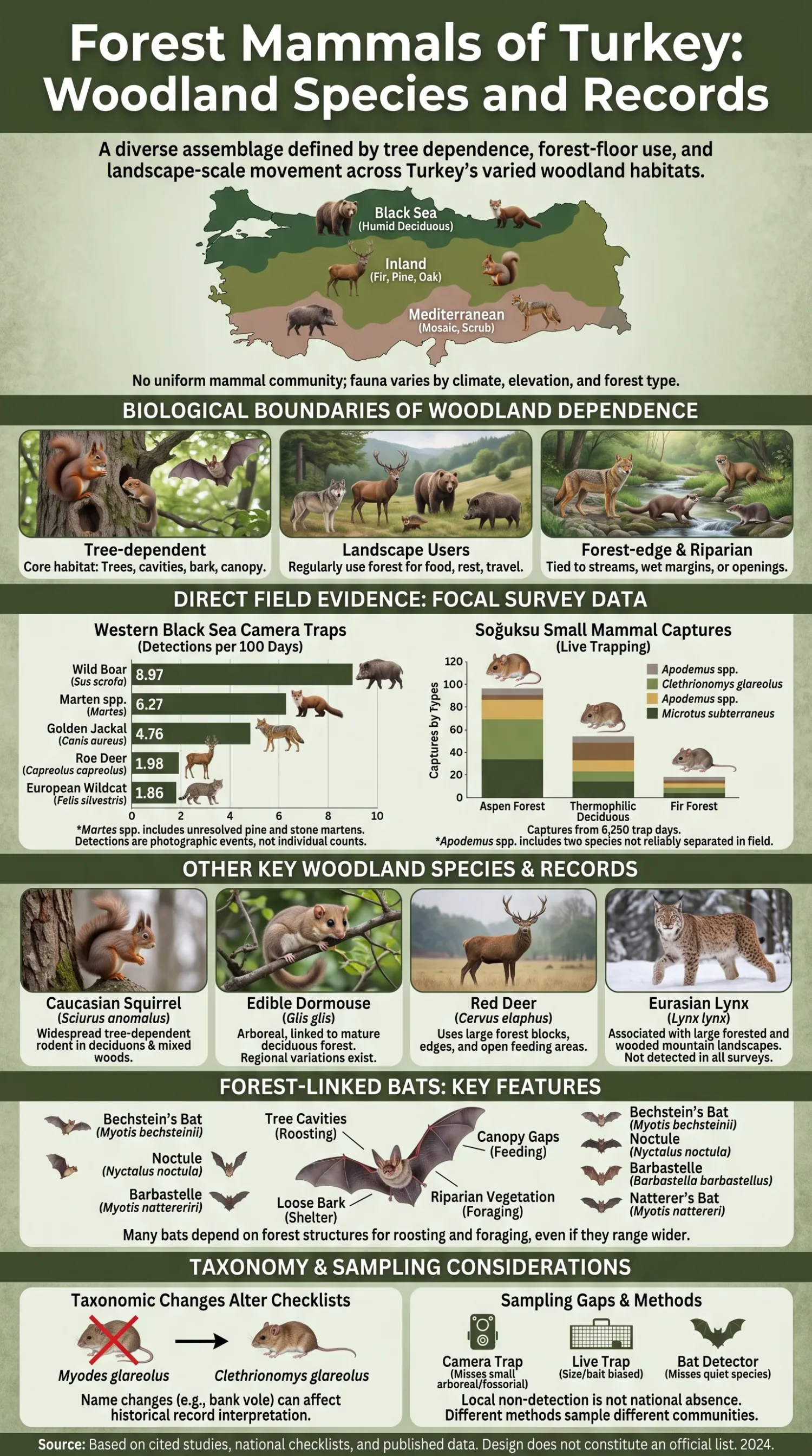
Turkey’s forest mammal fauna includes tree-dwelling rodents, forest-floor mice and shrews, tree-roosting bats, deer, wild boar, carnivores, and mammals that move between woodland, streams, scrub, and forest openings. There is no single official national checklist labeled “forest mammals of Turkey,” so a defensible list must separate direct records from Turkish forests, country-level occurrence, and broader evidence of woodland dependence.
Turkey’s woodland habitats do not support one uniform mammal community
Current forest-management data reported by Turkey’s General Directorate of Forestry place the country’s forest area at 23,375,331 hectares. That total covers forests with very different climates, tree composition, elevation, canopy structure, and levels of human alteration.[a]
Humid deciduous and mixed forests along the Black Sea can support brown bear, wolf, red deer, roe deer, European wildcat, pine marten, squirrels, dormice, voles, shrews, and woodland bats. Thracian deciduous woodland has a partly European mammal assemblage. Inland mountain forests combine fir, pine, oak, beech, open slopes, and rocky ground. Mediterranean woodland is often a mosaic of pine, oak, scrub, farmland, ravines, and burned or regenerating stands rather than closed forest alone.
A national occurrence record does not prove that a species inhabits every Turkish forest, while a camera-trap photograph proves presence only at the sampled place and time.
The biological boundary of a woodland mammal list
Forest association occurs at several levels. The strongest cases are mammals that use trees, cavities, bark, canopy, leaf litter, or mature woodland as core habitat. Other species regularly feed, rest, breed, or travel in forests but also use grassland, farmland, scrub, or rocky terrain. A third group is tied to wooded streams, wet forest margins, or openings within a forest landscape.
- Tree- and woodland-dependent mammals: squirrels, dormice, several forest mice, pine marten, European wildcat, and tree-roosting bats.
- Regular forest-landscape users: brown bear, wolf, red deer, roe deer, wild boar, badgers, foxes, and least weasel.
- Forest-edge and riparian mammals: golden jackal, brown hare, Eurasian otter, some shrews, and bats using wooded streams or canopy gaps.
Turkey’s updated 2025 national checklist recognized 177 wild mammal species, including 165 terrestrial and 12 marine species. That country total is broader than the woodland list because it also contains steppe, alpine, desert-edge, cave, wetland, coastal, and marine taxa.[b]
The live Mammal Diversity Database country account currently lists 181 living species for Turkey. The difference reflects database timing and taxonomic treatment rather than four newly documented forest mammals.[c]
Mammals directly recorded in Turkish forest field studies
The following species were photographed in the western Black Sea deciduous-forest survey or captured in the Soğuksu National Park habitat study. The table includes every species-level taxon represented by those two focal datasets, rather than a selection of better-known animals.
| Order | Species | English name | Woodland relationship in the cited evidence | Direct Turkish field evidence |
|---|---|---|---|---|
| Lagomorpha | Lepus europaeus | European brown hare | Forest openings, tracks, clearings, and woodland edges | Western Black Sea camera traps |
| Rodentia | Sciurus anomalus | Caucasian squirrel | Arboreal use of deciduous and mixed woodland | Western Black Sea camera traps |
| Rodentia | Clethrionomys glareolus | Bank vole | Leaf litter, ground vegetation, and humid forest floor | Soğuksu live trapping; reported there as Myodes glareolus |
| Rodentia | Apodemus flavicollis | Yellow-necked field mouse | Deciduous forest floor and wooded understory | Soğuksu live trapping within a combined Apodemus unit |
| Rodentia | Apodemus witherbyi | Witherby’s field mouse | Woodland floor and dry forest-edge habitats | Soğuksu live trapping within a combined Apodemus unit |
| Rodentia | Mus macedonicus | Macedonian mouse | Forest edge, plantations, fir forest, and open habitat mosaics | Soğuksu live trapping |
| Rodentia | Microtus subterraneus | European pine vole | Ground vegetation in woodland, plantation, and adjoining open habitat | Soğuksu live trapping |
| Rodentia | Dryomys nitedula | Forest dormouse | Shrub layer, branches, and wooded understory | Soğuksu live trapping |
| Eulipotyphla | Crocidura gueldenstaedtii | Güldenstädt’s white-toothed shrew | Forest floor, edges, plantations, and adjacent grass cover | Soğuksu records published under Crocidura suaveolens |
| Eulipotyphla | Erinaceus concolor | Southern white-breasted hedgehog | Forest edge, scrub, villages, and agricultural openings | Western Black Sea camera traps |
| Artiodactyla | Sus scrofa | Wild boar | Forest floor, mast-producing woodland, thickets, and clearings | Western Black Sea camera traps |
| Artiodactyla | Capreolus capreolus | European roe deer | Woodland with dense cover and nearby feeding openings | Western Black Sea camera traps |
| Artiodactyla | Cervus elaphus | Red deer | Large forest blocks, edges, and open feeding areas | Western Black Sea camera traps |
| Carnivora | Felis silvestris | European wildcat | Woodland, dense cover, and forest-field mosaics | Western Black Sea camera traps |
| Carnivora | Canis lupus | Gray wolf | Large forested landscapes connected to open hunting ground | Western Black Sea camera traps |
| Carnivora | Canis aureus | Golden jackal | Forest edge, scrub, farmland, and human-modified woodland | Western Black Sea camera traps |
| Carnivora | Vulpes vulpes | Red fox | Generalist using forest, openings, farmland, and settlements | Western Black Sea camera traps |
| Carnivora | Ursus arctos | Brown bear | Extensive forest, shrub cover, feeding clearings, and mountain mosaics | Western Black Sea camera traps |
| Carnivora | Meles meles | European badger | Woodland edge, sloping ground, scrub, and agricultural mosaics | Western Black Sea camera traps |
| Carnivora | Martes foina | Stone marten | Woodland edge, rocky sites, villages, and buildings | Western Black Sea camera traps |
| Carnivora | Martes martes | European pine marten | Woodland canopy, cavities, deadwood, and forest understory | Western Black Sea camera traps |
| Carnivora | Mustela nivalis | Least weasel | Forest openings, ground cover, field margins, and prey-rich edges | Western Black Sea camera traps |
| Carnivora | Lutra lutra | Eurasian otter | Streams and rivers running through wooded landscapes | Western Black Sea camera traps |
Western Black Sea camera-trap records
A survey covering about 3,500 square kilometres in and around Zonguldak used 62 camera-trap stations between May 2014 and May 2015. The study accumulated 11,868 camera-trap days, produced 3,653 mammal records, and identified 16 species in Euxine-Colchic deciduous forest and adjoining human-modified land.[d]
| Recorded taxon | Camera stations | Photographic records | Detection rate per 100 camera-trap days |
|---|---|---|---|
| Sus scrofa | 47 | 1,064 | 8.97 |
| Martes spp. | 41 | 744 | 6.27 |
| Canis aureus | 43 | 565 | 4.76 |
| Erinaceus concolor | 26 | 261 | 2.20 |
| Capreolus capreolus | 23 | 235 | 1.98 |
| Felis silvestris | 32 | 221 | 1.86 |
| Meles meles | 22 | 218 | 1.84 |
| Vulpes vulpes | 30 | 129 | 1.09 |
| Sciurus anomalus | 13 | 127 | 1.07 |
| Ursus arctos | 16 | 39 | 0.33 |
| Lepus europaeus | 4 | 14 | 0.12 |
| Lutra lutra | 4 | 10 | 0.08 |
| Martes martes | 5 | 7 | 0.06 |
| Canis lupus | 5 | 6 | 0.05 |
| Cervus elaphus | 4 | 6 | 0.05 |
| Martes foina | 3 | 4 | 0.03 |
| Mustela nivalis | 2 | 3 | 0.03 |
Most marten photographs could not be identified to species
The 744 records labeled Martes spp. are not an additional species. Pine marten and stone marten could not be separated reliably in most photographs. Only seven records were assigned to Martes martes and four to Martes foina. Adding the unassigned category as a third marten would inflate both species richness and record totals.
Wild boar alone accounted for 1,064 records. That result shows photographic activity at the camera stations, not the number of individual boars in the forest. One animal can trigger a camera more than once, and record frequency is affected by trail placement, movement behaviour, body size, season, and detectability.
Red deer and brown hare were recorded only in the study’s less disturbed inland forest region. Roe deer, brown bear, and wolf were also concentrated there. Golden jackal, hedgehog, wild boar, and badger produced a larger share of their records in the coastal region containing villages, agricultural land, and fragmented forest.
Small mammals on the forest floor
Camera traps placed for medium and large mammals provide little evidence for mice, voles, shrews, and dormice. A separate mark-recapture study in Soğuksu National Park sampled aspen forest, thermophilic deciduous forest, steppe, conifer plantation, and fir forest during 2014 and 2015. It recorded 758 captures across 5,250 trap days.[e]
| Taxon used in the dataset | Aspen forest | Thermophilic deciduous forest | Steppe | Conifer plantation | Fir forest | Total captures |
|---|---|---|---|---|---|---|
| Apodemus spp. | 139 | 154 | 29 | 53 | 41 | 416 |
| Mus macedonicus | 24 | 6 | 12 | 34 | 39 | 115 |
| Clethrionomys glareolus | 57 | 13 | 16 | 9 | 2 | 97 |
| Microtus subterraneus | 19 | 9 | 46 | 11 | 3 | 88 |
| Crocidura suaveolens sensu study | 7 | 6 | 15 | 4 | 1 | 33 |
| Dryomys nitedula | 2 | 7 | 0 | 0 | 0 | 9 |
| All recorded units | 248 | 195 | 118 | 111 | 86 | 758 |
The largest number of captures came from aspen forest, followed by thermophilic deciduous forest. The result does not mean aspen forest holds the largest small-mammal population in Turkey. It describes one study area, one trapping design, and the seasons sampled.
The Apodemus total represents two species
The researchers could not separate Apodemus flavicollis and Apodemus witherbyi reliably from external morphology in every live capture. They therefore reported 416 individuals as Apodemus spp. The row is one identification unit but represents two species in the study.
The bank vole was reported in the paper as Myodes glareolus. Current Mammal Diversity Database treatment uses Clethrionomys glareolus. The white-toothed shrew was published as Crocidura suaveolens, while the current country account lists Crocidura gueldenstaedtii for Turkey. Historical records should retain the study’s original identification while also noting the later taxonomic treatment.
Woodland rodents documented beyond the two focal surveys
A rodent inventory conducted at 33 localities in Zonguldak Province between 2009 and 2016 evaluated 427 specimens from 15 species. The study covered several habitat types, so provincial occurrence should not be treated automatically as a forest-only record. Caucasian squirrel, yellow-necked field mouse, and edible dormouse were the most widely recorded species, occurring at 13, 12, and 9 surveyed localities respectively.[f]
| Species | Reason for inclusion in the woodland account | Evidence boundary |
|---|---|---|
| Sciurus vulgaris | Tree-dependent squirrel associated with woodland | The national checklist treats it as native in Turkish Thrace and introduced in northeastern Anatolia; regional status must be stated |
| Glis glis | Arboreal dormouse linked to deciduous and mixed forest | Recorded in the Zonguldak provincial inventory; locality-level habitat must be checked before assigning each record to forest |
| Muscardinus avellanarius | Dormouse using shrubs, woodland edges, and connected woody vegetation | Recorded by the Zonguldak inventory, but the provincial paper sampled more than one habitat type |
| Apodemus sylvaticus | Woodland and forest-edge mouse | National and provincial occurrence does not establish presence in every forest region |
| Apodemus uralensis | Mouse recorded in wooded and mixed habitats in northern Turkey | Some records may come from nonforest habitat within the same provincial survey |
| Apodemus mystacinus | Mouse associated with rocky woodland, scrub, and forest-edge mosaics | It should not be described as a closed-forest specialist |
| Dama dama | Deer using woodland and Mediterranean scrub mosaics | Nationally listed but not detected in the focal western Black Sea camera survey |
| Lynx lynx | Large felid associated with forested and wooded mountain landscapes | National occurrence is accepted, but absence from one camera survey is not national absence |
| Mustela putorius | Mustelid associated with wet woodland, riparian cover, and dense vegetation | Nationally listed; direct evidence should be checked for each Turkish forest region |
| Meles canescens | Second badger species recognized in current national datasets | Older records labeled only Meles meles may require geographic or taxonomic reassessment |
The edible dormouse has also been examined across northern Turkey using genetic and dental-morphology data. The study found geographic phenotypic differentiation along the Black Sea coast and interpreted the pattern in relation to postglacial isolation and forest fragmentation.[h]
Forest-linked bats documented in Turkey
Ground-level camera traps and Sherman traps leave most bats unrecorded. The species below are listed for Turkey by the Mammal Diversity Database and have strong or regular woodland associations in European bat ecology. EUROBATS identifies tree cavities, woodpecker holes, hollow branches, loose bark, old trees, deadwood, canopy gaps, and semi-open mature stands as important forest features for bat roosting and feeding.[g]
| Species | Main woodland connection | Record limitation |
|---|---|---|
| Barbastella barbastellus | Roosts beneath bark or in tree features and forages in woodland | Country-level presence does not identify occupied Turkish forest stands |
| Myotis alcathoe | Humid mature deciduous and riparian woodland | Small size and acoustic similarity can complicate field identification |
| Myotis bechsteinii | Mature deciduous woodland and networks of tree cavities | Local breeding requires roost or repeated acoustic evidence |
| Myotis brandtii | Woodland, wet forest, and tree-rich landscapes | Identification within the whiskered-bat group may require close examination or genetics |
| Myotis daubentonii | Wooded rivers, ponds, lakes, and riparian corridors | Its presence is tied as much to water as to forest cover |
| Myotis mystacinus | Woodland edge, hedgerows, and mixed forest landscapes | National listing alone does not confirm use of a named forest |
| Myotis nattereri | Woodland foraging and tree or cavity roosts | The wider species complex has undergone taxonomic revision |
| Nyctalus lasiopterus | Tree-roosting bat using mature woodland and open airspace above the canopy | Wide-ranging flight can place detections far from the roost tree |
| Nyctalus leisleri | Tree cavities, woodland edges, and canopy-level feeding | Acoustic activity does not by itself prove a local maternity roost |
| Nyctalus noctula | Tree cavities and aerial feeding over woodland and openings | Migratory movement can produce seasonal records |
| Pipistrellus nathusii | Riparian woodland, forest edges, and tree roosts | Seasonal migration must be separated from resident occurrence |
| Pipistrellus pipistrellus | Woodland edge, canopy gaps, settlements, and water margins | A generalist rather than a forest-dependent species |
| Pipistrellus pygmaeus | Riparian woodland and water-associated feeding habitat | Acoustic separation from related pipistrelles requires suitable recordings |
| Plecotus auritus | Woodland understory, foliage gleaning, and tree or building roosts | Quiet calls can make acoustic surveys underestimate activity |
These bats form a source-backed forest-linked subset, not a claim that Turkey’s other bat species never use trees or woodland edges. Cave-roosting species may forage in forest, while tree-roosting species may also feed over pasture, wetlands, orchards, or settlements.
Taxonomic changes alter woodland checklists
A forest checklist can change even when no animal has newly arrived or disappeared. A genus may be renamed, a former subspecies may be raised to species level, two names may be synonymized, or a widespread taxon may be divided into regional species.
| Name found in records or older literature | Current or later treatment | Effect on forest records |
|---|---|---|
| Myodes glareolus | Clethrionomys glareolus in the current Mammal Diversity Database | Both names may refer to the same bank-vole records; databases should not count them twice |
| Crocidura suaveolens in the Soğuksu study | Crocidura gueldenstaedtii in the current Turkey country account | The original study name should remain visible while later identification is stated cautiously |
| Microtus levis | Microtus rossiaemeridionalis in newer treatments | Historical and current provincial lists may appear to contain two voles when they refer to one taxonomic lineage |
| Martes spp. | Martes martes or Martes foina when photographs allow separation | Unresolved images must not be converted into a third marten species |
| Meles meles used broadly | Both Meles meles and Meles canescens are listed for Turkey | Regional badger records may need reassessment rather than automatic assignment |
| Two forest dormice in older national lists | Dryomys anatolicus was added as a separate species in 2025 | Older records may not contain the measurements or genetic data needed for retrospective identification |
Species totals depend on the taxonomic date
The 177-species total in the 2025 Turkish checklist and the 181-species total in the live Mammal Diversity Database should not be combined or averaged. A forest checklist should record the source, version or publication year, and accepted name used for each taxon.
Sampling gaps across Turkish woodland mammals
No single field method can document the whole woodland community. Camera traps favour medium and large animals moving on the ground. Sherman traps sample only animals small enough to enter them and are sensitive to bait, trap placement, season, and individual behaviour. Bat detectors record calls rather than bodies, and some quiet-calling species are less detectable than open-air hunters.
- Arboreal dormice and squirrels may spend much of their time above ground-level cameras.
- Shrews may be poorly represented by rodent-oriented live traps.
- Moles can remain absent from camera and small-box trap datasets despite occupying suitable soil.
- Bats require acoustic detectors, roost inspection, harp traps, mist nets, or genetic confirmation.
- Otter evidence is often better obtained from tracks, spraints, den surveys, or river cameras.
- Rare carnivores may remain undetected even during long camera deployments.
- Repeated photographs measure recording events, not the number of individual animals.
The absence of lynx, fallow deer, polecat, or another nationally listed mammal from one woodland survey is therefore a local non-detection. It is not evidence that the species is absent from Turkey or from all forests in the same region.
Forest structure supports different mammal groups
Old trees, cavities, loose bark, standing deadwood, and connected canopy provide roost and nesting sites for bats, squirrels, and dormice. Leaf litter, fallen branches, shrubs, fungi, seeds, and ground vegetation support mice, voles, shrews, and their predators. Forest openings can provide feeding areas for deer, wild boar, brown hare, fox, wolf, and bear.
Wooded streams add another mammal layer. Otters depend on aquatic prey and secure banks, while several bats feed above water or follow riparian vegetation. Removing streamside cover can affect a different set of mammals from those affected by the loss of mature upland trees.
Forest continuity also operates at a larger scale. Brown bear, wolf, red deer, roe deer, and lynx move across landscapes that include forest, scrub, pasture, roads, farms, and settlements. Their occurrence cannot be explained by canopy cover alone. Patch size, disturbance, road access, hunting pressure, food availability, and connections between forest blocks can change where records are obtained.
Sources and Verification
- [a] 2025 General Directorate of Forestry Activity Report — Used for the forest-area figure reported from current forest-management planning data.
- [b] An updated checklist of the mammals of Türkiye — Used for the 2025 national species total, native and introduced designations, taxonomic discussion, and accepted taxa at publication.
- [c] Mammal Diversity Database: Turkey — Used for the live country total and current taxonomic names for rodents, insectivores, bats, carnivores, and ungulates.
- [d] Camera trapping of medium and large-sized mammals in western Black Sea deciduous forests in Turkey — Used for the Zonguldak study area, survey effort, complete species detections, photographic record counts, detection rates, and unresolved marten identifications.
- [e] Habitat selection of small mammals in a mixed forest in Turkey — Used for live-trapping effort, habitat-specific capture totals, small-mammal composition, and the combined identification of two Apodemus species.
- [f] Distribution of Rodent Species in Zonguldak Province, Turkey — Used for the 2009–2016 provincial rodent inventory, specimen total, species composition, and locality frequencies.
- [g] EUROBATS guidance on bat conservation and forest management — Used for the relationship between woodland bats, tree cavities, loose bark, old trees, deadwood, canopy structure, and forest feeding habitat.
- [h] Morphometric and genetic structure of the edible dormouse: a consequence of forest fragmentation in Turkey — Used for geographic differentiation and forest-fragmentation evidence concerning northern Turkish populations of Glis glis.
Related Topics
- → Mammals of Turkey: Native Species, Habitats, and Distribution
- → Mountain Mammals of Turkey: Species of High Elevation Habitats
- → Wild Ungulates of Turkey: Deer, Goats, Sheep, and Wild Boar
- → Large Carnivores of Turkey: Wolves, Bears, Lynx, and Wild Cats
- → Mammal Tracks and Signs in Turkey: Field Identification Basics