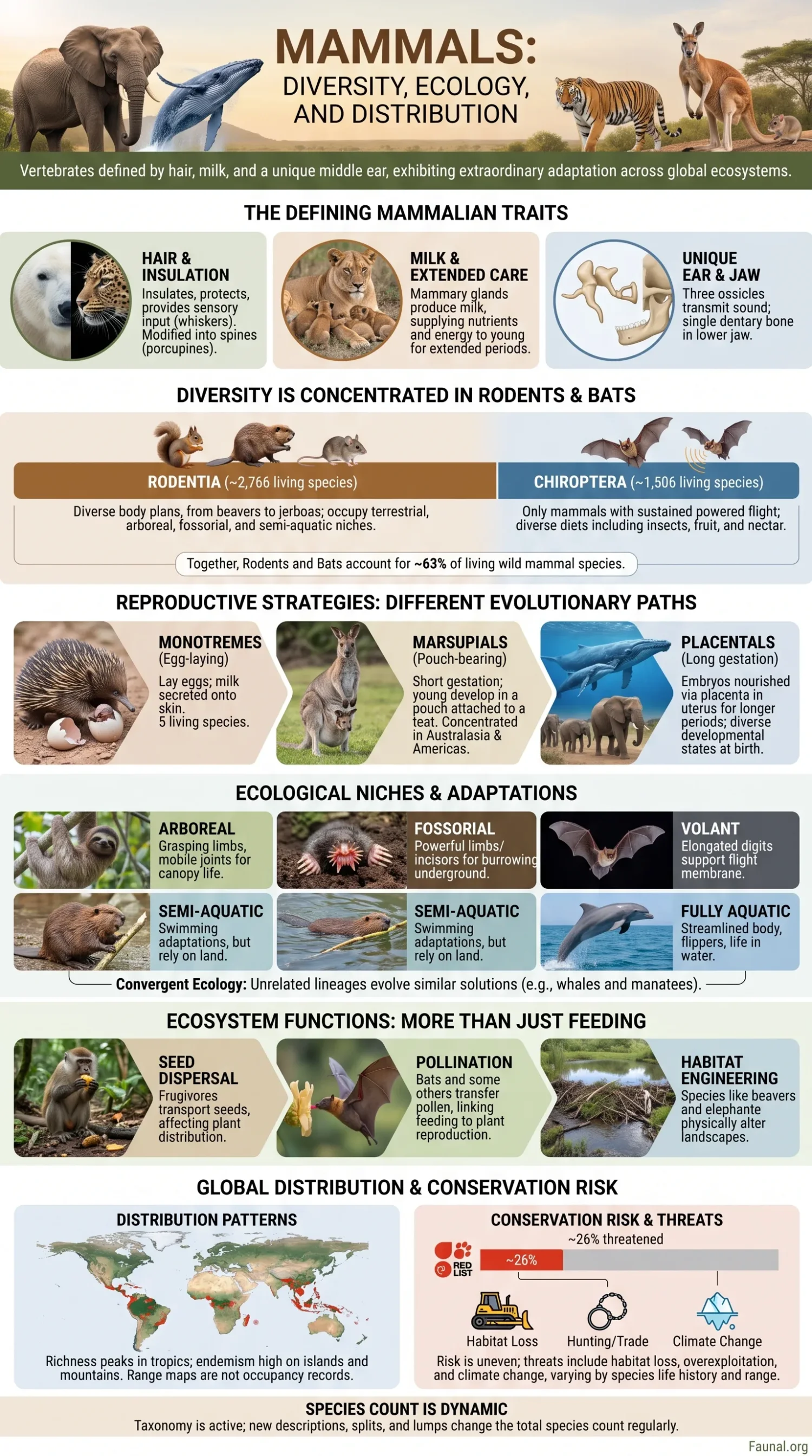
Mammals are vertebrates defined by hair, milk production from mammary glands, and a distinctive middle ear with three ossicles, yet those shared traits support an unusually wide range of body plans and ecological strategies. The American Society of Mammalogists’ Mammal Diversity Database version 2.5 recognizes 6,904 living and recently extinct species, including 6,774 living wild species, arranged in 27 orders and 169 families. Species richness is strongly concentrated in small-bodied lineages: rodents and bats together make up close to two-thirds of living mammal species in the current taxonomy.
Recognized species
6,904
Living and recently extinct species in MDD v2.5.
Living wild species
6,774
Domestic taxa are counted separately by MDD.
Orders
27
Current order-level treatment in MDD v2.5.
Families
169
Current family-level treatment in MDD v2.5.
The Traits That Define Mammalia
Mammals cannot be identified by one visible feature alone. Hair may be dense, sparse, modified into spines or reduced to a few sensory hairs. Endothermy is widespread in mammals, but it is also present in birds. Live birth is common, but monotremes lay eggs. The combination of hair, milk production and the mammalian middle ear provides a more reliable biological definition. The University of Michigan’s Animal Diversity Web Mammalia account identifies hair, mammary glands and the three middle-ear bones as features shared across the class.
Hair Can Insulate, Protect, Signal, or Sense
Hair performs different jobs in different lineages. Dense fur limits heat loss in many terrestrial mammals. Guard hairs help protect the skin, whiskers act as tactile sensors, and modified hairs form structures such as porcupine quills and hedgehog spines. Cetaceans show why absence of an obvious fur coat does not exclude an animal from Mammalia: hair is greatly reduced in adults, while the deeper anatomical and reproductive traits remain mammalian.
Milk Production Links Reproduction to Extended Parental Care
Mammary glands supply milk after birth or hatching. This allows young mammals to obtain energy and nutrients directly from the mother during a period when feeding independently may be difficult. The delivery system differs among lineages. Monotremes produce milk but lack nipples; milk is released onto specialized skin areas and taken up by the young. Marsupials and placental mammals use nipples, although gestation length, developmental state at birth and duration of lactation vary widely.
The Ear and Jaw Preserve a Distinctive Evolutionary Pattern
The mammalian middle ear contains three ossicles: the malleus, incus and stapes. The lower jaw is dominated by a single dentary bone that articulates with the squamosal region of the skull. These features are especially useful in evolutionary anatomy because bones that served jaw functions in earlier synapsid relatives became part of the mammalian sound-transmission system.
Living Mammal Diversity Is Concentrated in Rodents and Bats
Large mammals dominate wildlife imagery, but they do not dominate the species count. The current MDD taxonomy table lists 2,766 living species in Rodentia and 1,506 in Chiroptera. Together they account for about 62.9% of the 6,791 living mammal species recognized in the database when domestic species are included.
Rodents and Bats Dominate the Living Species Count
Rodentia and Chiroptera are compared with the other 25 mammalian orders combined under MDD v2.5.
Rodentia: 2,766 living species
American Society of Mammalogists, Mammal Diversity Database v2.5 (2026). Values represent living species in the order table; the remaining 25 orders are aggregated for comparison.
Rodentia Is a Radiation of Many Body Plans, Not Just Rats and Mice
Rodents include squirrels, beavers, porcupines, capybaras, dormice, jerboas, mole-rats, voles, hamsters and many other lineages. Their incisors grow continuously and are maintained by gnawing, but the order has diversified far beyond one feeding style. Rodents occupy trees, grasslands, deserts, wetlands, rocky slopes, underground burrow systems and human-modified habitats. Some are seed predators, some cache and disperse seeds, some graze, and some feed heavily on leaves, roots, bark or invertebrates.
Chiroptera Is the Only Mammalian Lineage with Sustained Powered Flight
Bats use elongated finger bones to support a flight membrane and are the only mammals capable of sustained powered flight. Gliding mammals such as flying squirrels move through the air without generating powered wingbeats. Bat diets include insects and other arthropods, fruit, nectar, vertebrates, fish and, in three living vampire bat species, blood. Echolocation is widespread but not universal across all bats. The Smithsonian’s bat biology resource distinguishes true bat flight from mammalian gliding.
Monotremes, Marsupials, and Placentals Follow Different Reproductive Paths
The living mammal tree contains three familiar reproductive patterns, but they are not stages on a ladder from primitive to advanced. Monotremes represent an egg-laying lineage. Marsupials give birth after relatively short gestation and continue much of early development during lactation, often with the young attached to a teat. Placental mammals usually retain embryos in the uterus for longer periods and exchange materials with the mother through a placenta, although gestation length and developmental state at birth differ greatly among species.
MDD v2.5 recognizes five living monotreme species in the order Monotremata. Marsupials are concentrated in Australasia and the Americas, with very different radiations on each side of the Pacific. Placental mammals contain most living mammal species and include rodents, bats, primates, carnivorans, eulipotyphlans, ungulates, cetaceans, elephants, hyraxes, sirenians and several smaller orders.
Reproductive Mode Does Not Rank Mammals by Complexity
Egg laying, marsupial development and prolonged placental gestation are different evolutionary solutions. None should be used as a simple scale of how “advanced” a living mammal is.
Mammals Occupy Subterranean, Arboreal, Aerial, Freshwater, and Marine Niches
Mammalian ecology is better described by the problems animals solve than by a short habitat list. Species must move, obtain food, reproduce, regulate temperature, avoid predators and find shelter. Similar ecological problems have produced repeated anatomical solutions in unrelated lineages.
| Ecological mode |
Common adaptations |
Representative mammals |
Ecological constraint |
| Arboreal |
Grasping feet, mobile joints, balance adaptations, and in some lineages prehensile tails |
Primates, tree squirrels, sloths, tree-dwelling marsupials |
Canopy continuity and access to suitable food or resting sites |
| Fossorial |
Powerful digging limbs or incisors, compact bodies, reduced external projections |
Moles, mole-rats, pocket gophers, some armadillos |
Soil depth, texture, oxygen conditions, and underground food supply |
| Volant |
Elongated digits supporting a wing membrane, high maneuverability, specialized respiration and circulation |
Bats |
Roost availability, weather, prey or plant resources, and airspace |
| Semi-aquatic |
Swimming adaptations combined with continued use of land or banks |
Otters, beavers, platypuses, hippos |
Water access plus suitable terrestrial or shoreline habitat |
| Fully aquatic |
Streamlined bodies, flippers, diving physiology, and loss of normal terrestrial locomotion |
Cetaceans and sirenians |
Marine, coastal, estuarine or freshwater conditions, food distribution, and breeding ecology |
Convergent Ecology Can Hide Deep Evolutionary Distance
Aquatic mammals provide a clear example. Otters, beavers, platypuses, hippos, seals, whales and manatees all interact strongly with water, but they belong to distant branches of Mammalia and differ in how dependent they are on aquatic environments. Streamlined bodies, webbed feet, dense fur, blubber, modified limbs and diving physiology evolved in different combinations. Ecological similarity therefore does not imply close taxonomic relationship.
Feeding Ecology Connects Mammals to Vegetation, Prey, Seeds, and Nutrient Flow
Mammals occupy many trophic positions. Grazers remove grasses and other low vegetation; browsers select leaves, shoots and woody plant material; predators consume vertebrate or invertebrate prey; scavengers exploit carrion; frugivores move seeds; nectar-feeders can transfer pollen; and omnivores switch among food types as availability changes. Dental form, digestive anatomy, body size, sensory systems and behavior all affect which resources a species can use.
Herbivores Can Alter Vegetation Structure and Nutrient Distribution
Large herbivores can change plant height, woody cover and the balance between grazing-resistant and browsing-sensitive plants. Trampling opens or compacts ground depending on soil and intensity, while dung and urine return nutrients at different locations from where plant material was eaten. Smaller herbivores can also shape vegetation, especially where burrowing, clipping or seed consumption is concentrated.
Seed Predation and Seed Dispersal Can Be Performed by the Same Mammal
A rodent that eats seeds may reduce recruitment in one context but disperse seeds in another when cached food is moved away from the parent plant and not recovered. Primates, fruit bats and many other frugivorous mammals transport seeds after eating fruit. The ecological effect depends on seed survival, travel distance, deposition site and whether the animal destroys or passes the seed intact.
Bats Link Nocturnal Feeding to Pollination, Seed Movement, and Arthropod Consumption
A global review of bat ecosystem functions documented research on insect consumption, native and introduced seed dispersal, pollination and guano-mediated nutrient transfer. The review of bat ecosystem services also shows why the ecological role of Chiroptera cannot be reduced to insect control alone.
Some Mammals Physically Rebuild Habitat
Beavers alter stream flow, sediment movement, pond formation and wetland structure by building dams and cutting vegetation. Burrowing mammals mix soil and create underground refuges that can later be used by other organisms. Elephants can break woody vegetation, dig for water and move large quantities of plant material. A Journal of Mammalogy review of mammalian ecological functions describes seed dispersal, pollination, predation, soil disturbance and habitat engineering across the class.
Mammalian Life Histories Range from Rapid Turnover to Multi-Decade Reproduction
Body size is associated with many life-history differences, but it does not create a rigid rule. Small mammals often mature sooner, reproduce more frequently and have shorter generation times. Many large mammals mature later, produce fewer young at a time and invest in prolonged care. Bats are an important reminder that body size alone is not enough: many small bats live much longer and reproduce more slowly than similarly sized terrestrial rodents.
Parental investment also varies in form. Some young are mobile soon after birth, while others are born blind or poorly coordinated and remain dependent for long periods. Social systems range from largely solitary adults to pairs, herds, troops, colonies and cooperative family groups. These differences affect population recovery after mortality: a rapidly reproducing rodent population and a slowly reproducing elephant, whale or great ape population cannot respond to the same loss rate in the same way.
Global Mammal Distribution Reflects Climate, Isolation, Barriers, and Evolutionary History
Mammals occur on every continent and in every ocean, but species richness is far from evenly distributed. A global analysis of nonmarine mammals published in the Proceedings of the National Academy of Sciences found the highest concentrations of mammal species in tropical regions, including northern South America, the Andes, East Africa and Southeast Asia. Temperature and productivity matter, but present-day patterns also reflect mountain building, island isolation, past climate, dispersal barriers and the evolutionary history of regional lineages.
Tropical Richness Is Not the Same as Endemism
A place with many mammal species is not automatically the place with the largest concentration of narrow-range species. The same PNAS analysis found limited overlap among hotspots of species richness, restricted-range mammals and threatened mammals. This distinction matters because a broad continental lowland can contain many species while an island or mountain range can contain fewer species but a larger share found nowhere else.
Islands and Mountains Create Restricted Ranges
Ocean channels restrict movement for most terrestrial mammals, while elevational belts can isolate populations on mountain systems. Isolation can preserve old lineages or allow populations to diverge. A global study of ecological rarity found concentrations of ecologically unusual mammals in tropical and Southern Hemisphere regions, with strong representation on islands; the Nature Communications analysis identified peaks in areas including Indonesian islands and Madagascar.
Marine Mammals Make Coastline-Only Thinking Incomplete
Cetaceans can cross ocean basins, pinnipeds may forage far from haul-out or breeding sites, and sirenians follow warm shallow-water habitats with suitable vegetation. A country list may therefore contain residents, seasonal visitors, migrants, offshore species or rare records under different rules. The presence of a marine mammal in national waters does not by itself establish a permanent local population.
A Range Map and an Occurrence Record Answer Different Questions
Distribution data become misleading when range, occurrence, occupancy and abundance are treated as synonyms. The current Darwin Core standard defines an occurrence as an event establishing the state of an organism at a particular place and time. That is evidence tied to a record. It is not a statement that the species occupies every suitable-looking location around that point.
| Measure |
What it describes |
What it does not establish by itself |
| Species richness |
Number of species within a defined spatial and taxonomic scope |
Population size, endemism, habitat condition, or local encounter rate |
| Geographic range |
Broad area in which a species is considered native or present under the mapping method used |
Continuous occupancy of every location inside the mapped boundary |
| Occurrence record |
Documented detection, observation, specimen, or other record tied to place and time |
Complete distribution, abundance, residency, or breeding population |
| Abundance |
Number or density of individuals under a defined survey design and area |
Range size or species richness |
Range, Occupancy, and Abundance Are Not Interchangeable
A mammal can have a broad mapped range while occurring at low density, being absent from large areas inside the polygon, or appearing only seasonally in part of that range. Record density can also reflect sampling effort: accessible roads, research stations, caves and protected areas are often surveyed more heavily than remote terrain.
GBIF’s technical documentation notes that occurrence datasets can contain museum specimens, field observations, camera-trap records and other evidence, with spatial precision ranging from general locality descriptions to coordinates. Different record types and sampling histories therefore need to remain visible when mammal distributions are evaluated.
Movement Makes Mammal Distribution Seasonal and Scale-Dependent
A species range, an individual’s home range and a migration route describe different spatial scales. An individual may use only a small part of the species’ geographic range. Migratory populations can connect distant seasonal areas through narrow corridors or recurring stopover zones. Caribou and reindeer, wildebeest, some bats, seals and many whales show that mammal distributions can change strongly through the year.
Seasonality also changes the meaning of presence. A whale recorded during migration, a bat recorded at a seasonal roost and an ungulate recorded on a wintering range all provide valid occurrence evidence, but none should automatically be labeled a year-round resident. Reproduction adds another layer: feeding habitat, mating areas, maternity sites and nursery areas may be geographically separated.
Different Mammals Leave Different Kinds of Distribution Evidence
Detection method affects which mammals enter a dataset. Large diurnal species may be recorded directly, while nocturnal, subterranean, canopy-dwelling or low-density mammals often require indirect or automated methods. No single survey technique samples the entire class equally well.
| Method |
Useful for |
Evidence produced |
Common limitation |
| Camera traps |
Medium and large terrestrial mammals, some small mammals |
Photographic detections, activity timing, repeated site records |
Detection varies with placement, body size, behavior and distance from the camera |
| Acoustic detectors |
Many bat communities |
Ultrasonic activity and, where calls are diagnostic, taxonomic detections |
Call overlap and regional variation can prevent confident species-level identification |
| Tracks, scat and hair |
Elusive terrestrial mammals |
Indirect evidence of recent presence |
Similar traces can be difficult to assign to species without added evidence |
| Genetic samples and eDNA |
Cryptic, rare or difficult-to-observe taxa |
Taxonomic detection from tissue, hair, feces, water or other material |
Contamination, reference-library gaps and transport of DNA can complicate interpretation |
| GPS or satellite telemetry |
Tagged individuals from mobile species |
Movement paths, seasonal ranges, corridor use and site fidelity |
A tracked sample represents tagged individuals rather than every member of the species |
Conservation Risk Is Uneven Across Mammalia
The IUCN Red List 2026-1 summary statistics give mammals a 26% best estimate for the proportion of extant species considered threatened, with a lower estimate of 23% and an upper estimate of 36% when uncertainty from Data Deficient species is incorporated. The threatened categories are Vulnerable, Endangered and Critically Endangered; the estimate should not be read as though every unassessed or Data Deficient species were secure.
The Mammal Threat Estimate Includes Uncertainty
Best estimate: 26%. IUCN reports a 23-36% range because Data Deficient species cannot simply be assigned to either threatened or non-threatened categories. Data Deficient is an information category, not a low-risk category.
Threat Processes Differ by Habitat and Life History
Forest conversion can remove feeding and denning habitat for terrestrial and arboreal mammals. Wetland drainage can affect semi-aquatic species. Roads can add mortality and divide populations that otherwise exchange individuals. Hunting and wildlife trade act directly on targeted species. Fisheries can kill marine mammals through entanglement or other interactions. Introduced predators and competitors can have severe effects on island mammals that evolved in isolation. Climate change can alter snow cover, vegetation, water availability, fire regimes, sea ice, prey distribution and the timing of seasonal resources.
Risk also depends on reproductive pace and range structure. A widespread species with several productive populations can respond differently to local losses than a narrow-range species confined to one island or mountain. Slow reproduction can make adult mortality harder to replace. Small geographic range, habitat specialization and low dispersal capacity can interact, but none of these traits alone automatically determines an IUCN category.
Why the Mammal Species Count Keeps Changing
Mammal taxonomy is an active research field rather than a permanently fixed inventory. The MDD v2.5 release notes record 79 taxonomic changes between versions 2.4 and 2.5. The release recognized 38 species additions through 27 de novo descriptions and 11 splits, while six species-level lumps combined previously recognized taxa. The net change was 33 additional recognized species.
A Higher Species Total Does Not Mean Every Addition Was Newly Found in the Field
De novo description adds a species that is newly described in the taxonomic literature. A split divides a previously recognized species into two or more accepted species. A lump combines taxa judged not to warrant separate species status. Genus transfers and name changes can alter classification without changing the total number of species.
This is why mammal totals from older books cannot be compared with a current database as though every numerical increase represented a newly discovered animal. MDD lists 5,416 total species under the Mammal Species of the World 2005 treatment and 6,904 under v2.5. Part of that difference comes from newly described species, but part comes from revised species boundaries, nomenclatural decisions and accumulated taxonomic research.
Mammal diversity is therefore both biological and evidential: the animals occupy real ecological and geographic ranges, while the names, species limits, maps and records used to describe that diversity change as new specimens, genetic data, field surveys and taxonomic revisions become available.
Sources and Verification
- American Society of Mammalogists — Mammal Diversity Database v2.5 — Taxonomic total, living-wild total, number of orders, number of families, historical species totals and current database scope.
- Mammal Diversity Database — Taxonomy Table — Living species counts for Rodentia, Chiroptera and Monotremata used in the taxonomic comparison.
- Mammal Diversity Database — Release Notes — Version 2.5 taxonomic changes, de novo descriptions, splits, lumps and net species change from v2.4.
- IUCN Red List — Summary Statistics, version 2026-1 — Best, lower and upper estimates for the proportion of mammal species considered threatened.
- University of Michigan Museum of Zoology — Animal Diversity Web: Mammalia — Shared mammalian traits, including hair, mammary glands and the three middle-ear ossicles.
- Smithsonian Institution — Bat Facts — Powered flight in bats and the distinction between flight and mammalian gliding.
- Ramírez-Fráncel et al. — Bats and their vital ecosystem services: a global review — Evidence for bat roles in arthropod consumption, seed dispersal, pollination and nutrient transfer.
- Lacher et al. — The functional roles of mammals in ecosystems — Ecological functions including seed dispersal, predation, pollination, soil disturbance and habitat engineering.
- Ceballos and Ehrlich — Global mammal distributions, biodiversity hotspots, and conservation — Global patterns of mammal species richness, restricted ranges and threatened-species hotspots.
- Loiseau et al. — Global distribution and conservation status of ecologically rare mammal and bird species — Geographic concentration of ecologically rare mammals and island patterns.
- Biodiversity Information Standards — Darwin Core List of Terms — Definition of an occurrence as an organism-related event at a particular place and time.
- GBIF — Dataset Classes Technical Documentation — Occurrence dataset types, record evidence and variation in geographic precision.