Complete guides: •Regional Fauna Guides•Mammals•Fauna of Europe
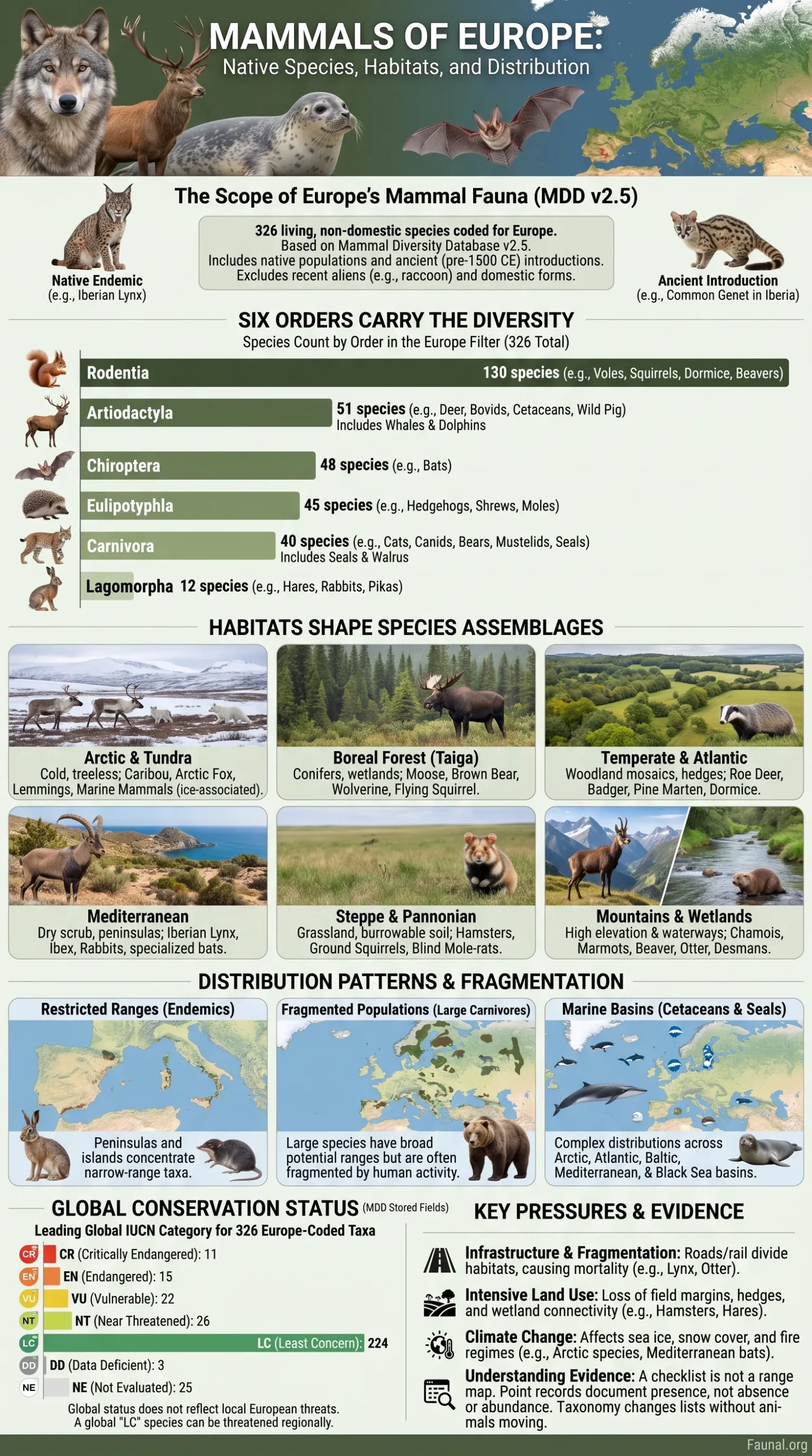
Europe supports native mammals from Arctic cetaceans and tundra reindeer to Mediterranean rabbits, blind mole-rats, forest bats and large carnivores. A reproducible filter of the Mammal Diversity Database v2.5 returns 326 living, non-domestic species coded for Europe, arranged in six orders. That figure is a source-defined working count rather than a claim that 326 species breed permanently in every conventional definition of Europe. [a]
Taxonomic release
MDD v2.5
Released 28 July 2026.
Europe-coded working list
326 species
Living, wild and non-domestic records after the stated filter.
Living orders represented
6
Cetaceans are placed within Artiodactyla; seals and walrus within Carnivora.
The European Boundary Changes the Species Count
The working list uses the current MDD CSV and keeps rows where continentDistribution contains Europe, extinct equals 0 and domestic equals 0. The result contains 326 taxa: 130 rodents, 51 artiodactyls, 48 bats, 45 eulipotyphlans, 40 carnivorans and 12 lagomorphs. [b]
This method covers the European mainland, European Russia, islands and European coastal waters as coded by MDD. It also exposes a boundary problem. Russia and Turkey are transcontinental, marine species cross ocean basins, and a country-level record may represent only a small edge of a species’ range. Some cetaceans in the list are regular residents or migrants; others are marginal, uncertain or documented mainly through occasional records.
Why “native” needs a date boundary
MDD distribution fields include native ranges and ancient human introductions dating from before 1500 CE, while recent introductions are excluded. Iberian populations of the common genet are a stated example of an ancient introduction retained in the database. The checklist therefore represents native and ancient-established occurrence under the MDD rule, not a list restricted to fauna untouched by people.
Recent introductions, globally extinct mammals and domestic forms are outside the filter. This is why established alien mammals such as the American mink, coypu, muskrat, raccoon and raccoon dog do not become part of the native working count merely because they now occur in Europe. [c]
Six Orders Carry Europe’s Living Mammal Diversity
Modern mammal classification does not place whales and dolphins in a separate order beside even-toed hoofed mammals. Cetaceans sit within Artiodactyla. Seals and the walrus sit within Carnivora. The result is a six-order European list rather than the seven-group arrangement still seen in older summaries.
Species count by mammal order in the MDD v2.5 Europe filter
The bars use accepted taxa coded as living, non-domestic and present in Europe.
Source: Mammal Diversity Database v2.5 current CSV. The count follows MDD continent coding rather than a breeding-only regional list.
Source-Defined Checklist of Europe-Coded Mammals
The tables below retain every species returned by the stated v2.5 filter. Common names, accepted scientific names, families and the leading global IUCN category stored by MDD are shown. NE means Not Evaluated and DD means Data Deficient. Four MDD rows retain an IUCN category matched through an earlier scientific combination; the table displays the category itself so that taxonomy and risk class remain separate.
A checklist is not a range map
Inclusion means that MDD codes the species to Europe under its geographic rules. It does not show where within a country the species occurs, whether it breeds there, how abundant it is, or whether a marine record is regular rather than exceptional.
Lagomorpha
12 species are included in this MDD v2.5 filter. The order covers hares, rabbits and pikas.
| Common name | Accepted scientific name | Family | Global IUCN field |
|---|---|---|---|
| Broom Hare | Lepus castroviejoi | Leporidae | VU |
| Corsican Hare | Lepus corsicanus | Leporidae | VU |
| European Hare | Lepus europaeus | Leporidae | LC |
| Iberian Hare | Lepus granatensis | Leporidae | LC |
| Manchurian Hare | Lepus mandshuricus | Leporidae | LC |
| Mediterranean Hare | Lepus mediterraneus | Leporidae | NE |
| Mountain Hare | Lepus timidus | Leporidae | LC |
| Tolai Hare | Lepus tolai | Leporidae | LC |
| Iberian Rabbit | Oryctolagus algirus | Leporidae | NE |
| European Rabbit | Oryctolagus cuniculus | Leporidae | EN |
| Northern Pika | Ochotona hyperborea | Ochotonidae | LC |
| Steppe Pika | Ochotona pusilla | Ochotonidae | LC |
Rodentia
130 species are included in this MDD v2.5 filter. The order covers dormice, squirrels, beavers, hamsters, voles, mice, birch mice, jerboas, porcupines and blind mole-rats.
| Common name | Accepted scientific name | Family | Global IUCN field |
|---|---|---|---|
| Crested Porcupine | Hystrix cristata | Hystricidae | LC |
| Indian Crested Porcupine | Hystrix indica | Hystricidae | LC |
| European Fat Dormouse | Glis glis | Gliridae | LC |
| Eurasian Forest Dormouse | Dryomys nitedula | Gliridae | LC |
| European Garden Dormouse | Eliomys quercinus | Gliridae | VU |
| Hazel Dormouse | Muscardinus avellanarius | Gliridae | LC |
| Roach's Mouse-tailed Dormouse | Myomimus roachi | Gliridae | VU |
| Siberian Flying Squirrel | Pteromys volans | Sciuridae | LC |
| Caucasian Squirrel | Sciurus anomalus | Sciuridae | LC |
| Calabrian Black Squirrel | Sciurus meridionalis | Sciuridae | NT |
| Eurasian Red Squirrel | Sciurus vulgaris | Sciuridae | LC |
| Bobak Marmot | Marmota bobak | Sciuridae | LC |
| Black-capped Marmot | Marmota camtschatica | Sciuridae | LC |
| Forest Steppe Marmot | Marmota kastschenkoi | Sciuridae | NE |
| Alpine Marmot | Marmota marmota | Sciuridae | LC |
| European Ground Squirrel | Spermophilus citellus | Sciuridae | EN |
| Yellow Ground Squirrel | Spermophilus fulvus | Sciuridae | LC |
| Russet Ground Squirrel | Spermophilus major | Sciuridae | NT |
| Caucasian Mountain Ground Squirrel | Spermophilus musicus | Sciuridae | LC |
| Podolian Ground Squirrel | Spermophilus odessanus | Sciuridae | NE |
| Little Ground Squirrel | Spermophilus pygmaeus | Sciuridae | LC |
| Speckled Ground Squirrel | Spermophilus suslicus | Sciuridae | CR |
| Siberian Chipmunk | Eutamias sibiricus | Sciuridae | LC |
| Eurasian Beaver | Castor fiber | Castoridae | LC |
| Great Jerboa | Allactaga major | Dipodidae | LC |
| Dwarf Fat-tailed Jerboa | Pygeretmus pumilio | Dipodidae | LC |
| Northern Small Five-toed Jerboa | Scarturus elater | Dipodidae | LC |
| Northern Three-toed Jerboa | Dipus sagitta | Dipodidae | LC |
| Thick-tailed Three-toed Jerboa | Stylodipus telum | Dipodidae | LC |
| Northern Birch Mouse | Sicista betulina | Sminthidae | LC |
| Caucasian Birch Mouse | Sicista caucasica | Sminthidae | NT |
| Long-tailed Birch Mouse | Sicista caudata | Sminthidae | LC |
| Tsimlyansk Birch Mouse | Sicista cimlanica | Sminthidae | NT |
| Kazbeg Birch Mouse | Sicista kazbegica | Sminthidae | VU |
| Kluchor Birch Mouse | Sicista kluchorica | Sminthidae | LC |
| Nordmann's Birch Mouse | Sicista loriger | Sminthidae | CR |
| Severtzov's Birch Mouse | Sicista severtzovi | Sminthidae | CR |
| Strand's Birch Mouse | Sicista strandi | Sminthidae | LC |
| Southern Birch Mouse | Sicista subtilis | Sminthidae | LC |
| Hungarian Birch Mouse | Sicista trizona | Sminthidae | EN |
| Eurasian Water Vole | Arvicola amphibius | Cricetidae | LC |
| Italian Water Vole | Arvicola destructor | Cricetidae | NT |
| Southwestern Water Vole | Arvicola sapidus | Cricetidae | NT |
| Middendorff's Vole | Alexandromys middendorffii | Cricetidae | LC |
| Root Vole | Alexandromys oeconomus | Cricetidae | LC |
| Gudaur Snow Vole | Chionomys gud | Cricetidae | LC |
| European Snow Vole | Chionomys nivalis | Cricetidae | LC |
| Robert's Snow Vole | Chionomys roberti | Cricetidae | LC |
| Short-tailed Field Vole | Microtus agrestis | Cricetidae | LC |
| Common Vole | Microtus arvalis | Cricetidae | LC |
| Calabria Pine Vole | Microtus brachycercus | Cricetidae | LC |
| Cabrera's Vole | Microtus cabrerae | Cricetidae | NT |
| Caucasian Pine Vole | Microtus daghestanicus | Cricetidae | LC |
| Mediterranean Pine Vole | Microtus duodecimcostatus | Cricetidae | LC |
| Balkan Pine Vole | Microtus felteni | Cricetidae | LC |
| Harting's Vole | Microtus hartingi | Cricetidae | NE |
| Mediterranean Field Vole | Microtus lavernedii | Cricetidae | LC |
| Liechtenstein's Pine Vole | Microtus liechtensteini | Cricetidae | LC |
| Lusitanian Pine Vole | Microtus lusitanicus | Cricetidae | LC |
| Major's Pine Vole | Microtus majori | Cricetidae | LC |
| Alpine Pine Vole | Microtus multiplex | Cricetidae | LC |
| Sicilian Pine Vole | Microtus nebrodensis | Cricetidae | LC |
| Altai Vole | Microtus obscurus | Cricetidae | LC |
| Pyrenean Pine Vole | Microtus pyrenaicus | Cricetidae | LC |
| East European Gray Vole | Microtus rossiaemeridionalis | Cricetidae | LC |
| Portuguese Field Vole | Microtus rozianus | Cricetidae | LC |
| Savi's Pine Vole | Microtus savii | Cricetidae | LC |
| Social Vole | Microtus socialis | Cricetidae | LC |
| Common Pine Vole | Microtus subterraneus | Cricetidae | LC |
| Tatra Pine Vole | Microtus tatricus | Cricetidae | LC |
| Thomas's Pine Vole | Microtus thomasi | Cricetidae | LC |
| Narrow-headed Vole | Stenocranius gregalis | Cricetidae | LC |
| Bank Vole | Clethrionomys glareolus | Cricetidae | LC |
| Northern Red-backed Vole | Clethrionomys rutilus | Cricetidae | LC |
| Gray Red-backed Vole | Craseomys rufocanus | Cricetidae | LC |
| Palearctic Collared Lemming | Dicrostonyx torquatus | Cricetidae | LC |
| Northern Mole Vole | Ellobius talpinus | Cricetidae | LC |
| Steppe Vole | Lagurus lagurus | Cricetidae | LC |
| Norway Brown Lemming | Lemmus lemmus | Cricetidae | LC |
| West Siberian Brown Lemming | Lemmus sibiricus | Cricetidae | LC |
| Wood Lemming | Myopus schisticolor | Cricetidae | LC |
| Martino's Dinaric Vole | Dinaromys bogdanovi | Cricetidae | VU |
| Western Dinaric Vole | Dinaromys longipedis | Cricetidae | NE |
| Long-clawed Mole Vole | Prometheomys schaposchnikowi | Cricetidae | LC |
| Eversmann's Hamster | Allocricetulus eversmanni | Cricetidae | LC |
| Common Hamster | Cricetus cricetus | Cricetidae | CR |
| Gray Hamster | Nothocricetulus migratorius | Cricetidae | LC |
| Brandt's Golden Hamster | Mesocricetus brandti | Cricetidae | NT |
| Romanian Golden Hamster | Mesocricetus newtoni | Cricetidae | VU |
| Radde's Golden Hamster | Mesocricetus raddei | Cricetidae | LC |
| Northeast African Spiny Mouse | Acomys cahirinus | Muridae | LC |
| Dahl's Jird | Meriones dahli | Muridae | CR |
| Central Midday Jird | Meriones meridianus | Muridae | LC |
| Tamarisk Jird | Meriones tamariscinus | Muridae | LC |
| Great Gerbil | Rhombomys opimus | Muridae | LC |
| Striped Field Mouse | Apodemus agrarius | Muridae | LC |
| Alpine Field Mouse | Apodemus alpicola | Muridae | LC |
| Western Broad-toothed Field Mouse | Apodemus epimelas | Muridae | LC |
| Yellow-necked Field Mouse | Apodemus flavicollis | Muridae | LC |
| Eastern Broad-toothed Field Mouse | Apodemus mystacinus | Muridae | LC |
| Caucasus Field Mouse | Apodemus ponticus | Muridae | LC |
| Long-tailed Field Mouse | Apodemus sylvaticus | Muridae | LC |
| Herb Field Mouse | Apodemus uralensis | Muridae | LC |
| Steppe Field Mouse | Apodemus witherbyi | Muridae | LC |
| Eurasian Harvest Mouse | Micromys minutus | Muridae | LC |
| Macedonian Mouse | Mus macedonicus | Muridae | LC |
| House Mouse | Mus musculus | Muridae | LC |
| Mound-building Mouse | Mus spicilegus | Muridae | LC |
| Western Mediterranean Mouse | Mus spretus | Muridae | LC |
| Brown Rat | Rattus norvegicus | Muridae | LC |
| Roof Rat | Rattus rattus | Muridae | LC |
| Bulgarian Blind Mole-rat | Nannospalax bulgaricus | Spalacidae | NE |
| Hellenic Blind Mole-rat | Nannospalax hellenicus | Spalacidae | NE |
| Hungarian Blind Mole-rat | Nannospalax hungaricus | Spalacidae | NE |
| Limnos Blind Mole-rat | Nannospalax insularis | Spalacidae | NE |
| Lesser Blind Mole-rat | Nannospalax leucodon | Spalacidae | LC |
| Central Serbian Blind Mole-rat | Nannospalax montanoserbicus | Spalacidae | NE |
| North Serbian Blind Mole-rat | Nannospalax montanosyrmiensis | Spalacidae | NE |
| Montane Blind Mole-rat | Nannospalax monticola | Spalacidae | NE |
| South Serbian Blind Mole-rat | Nannospalax serbicus | Spalacidae | NE |
| Thracean Blind Mole-rat | Nannospalax turcicus | Spalacidae | NE |
| Western Anatolian Blind Mole-rat | Nannospalax xanthodon | Spalacidae | LC |
| Mehely's Blind Mole-rat | Spalax antiquus | Spalacidae | EN |
| Sandy Blind Mole-rat | Spalax arenarius | Spalacidae | EN |
| Giant Blind Mole-rat | Spalax giganteus | Spalacidae | LC |
| Bukovina Blind Mole-rat | Spalax graecus | Spalacidae | VU |
| Oltenia Blind Mole-rat | Spalax istricus | Spalacidae | CR |
| Lyapunova’s Blind Mole-rat | Spalax lyapunovae | Spalacidae | NE |
| Greater Blind Mole-rat | Spalax microphthalmus | Spalacidae | LC |
| Podolsk Blind Mole-rat | Spalax zemni | Spalacidae | EN |
Eulipotyphla
45 species are included in this MDD v2.5 filter. The order covers hedgehogs, shrews, moles and desmans.
| Common name | Accepted scientific name | Family | Global IUCN field |
|---|---|---|---|
| North African Hedgehog | Atelerix algirus | Erinaceidae | LC |
| Southern White-breasted Hedgehog | Erinaceus concolor | Erinaceidae | LC |
| West European Hedgehog | Erinaceus europaeus | Erinaceidae | NT |
| Northern White-breasted Hedgehog | Erinaceus roumanicus | Erinaceidae | LC |
| Common Long-eared Hedgehog | Hemiechinus auritus | Erinaceidae | LC |
| South European White-toothed Shrew | Crocidura fimbriata | Soricidae | NE |
| Güldenstädt's White-toothed Shrew | Crocidura gueldenstaedtii | Soricidae | LC |
| Iberian White-toothed Shrew | Crocidura iculisma | Soricidae | NE |
| Bicolored White-toothed Shrew | Crocidura leucodon | Soricidae | LC |
| North African White-toothed Shrew | Crocidura pachyura | Soricidae | LC |
| Greater White-toothed Shrew | Crocidura russula | Soricidae | LC |
| Sicilian White-toothed Shrew | Crocidura sicula | Soricidae | LC |
| Lesser White-toothed Shrew | Crocidura suaveolens | Soricidae | LC |
| Cretan White-toothed Shrew | Crocidura zimmermanni | Soricidae | EN |
| Piebald Shrew | Diplomesodon pulchellus | Soricidae | LC |
| Etruscan Shrew | Suncus etruscus | Soricidae | LC |
| Iberian Water Shrew | Neomys anomalus | Soricidae | LC |
| Eurasian Water Shrew | Neomys fodiens | Soricidae | LC |
| Mediterranean Water Shrew | Neomys milleri | Soricidae | LC |
| Transcaucasian Water Shrew | Neomys teres | Soricidae | LC |
| Alpine Shrew | Sorex alpinus | Soricidae | NT |
| Valais Shrew | Sorex antinorii | Soricidae | LC |
| Common Shrew | Sorex araneus | Soricidae | LC |
| Laxmann's Shrew | Sorex caecutiens | Soricidae | LC |
| Crowned Shrew | Sorex coronatus | Soricidae | LC |
| Iberian Shrew | Sorex granarius | Soricidae | LC |
| Taiga Shrew | Sorex isodon | Soricidae | LC |
| Eurasian Least Shrew | Sorex minutissimus | Soricidae | LC |
| Eurasian Pygmy Shrew | Sorex minutus | Soricidae | LC |
| Radde's Shrew | Sorex raddei | Soricidae | LC |
| Apennine Shrew | Sorex samniticus | Soricidae | LC |
| Caucasian Shrew | Sorex satunini | Soricidae | LC |
| Tundra Shrew | Sorex tundrensis | Soricidae | LC |
| Caucasian Pygmy Shrew | Sorex volnuchini | Soricidae | LC |
| Russian Desman | Desmana moschata | Talpidae | CR |
| Pyrenean Desman | Galemys pyrenaicus | Talpidae | EN |
| Aquitanian Mole | Talpa aquitania | Talpidae | LC |
| Blind Mole | Talpa caeca | Talpidae | LC |
| Caucasian Mole | Talpa caucasica | Talpidae | LC |
| European Mole | Talpa europaea | Talpidae | LC |
| Martinos' Mole | Talpa martinorum | Talpidae | LC |
| Iberian Mole | Talpa occidentalis | Talpidae | LC |
| Roman Mole | Talpa romana | Talpidae | LC |
| Balkan Mole | Talpa stankovici | Talpidae | LC |
| Transcaucasian Mole | Talpa transcaucasica | Talpidae | NE |
Chiroptera
48 species are included in this MDD v2.5 filter. The order covers horseshoe bats, vesper bats, the European free-tailed bat and Schreibers’s long-fingered bat.
| Common name | Accepted scientific name | Family | Global IUCN field |
|---|---|---|---|
| Schreibers's Long-fingered Bat | Miniopterus schreibersii | Miniopteridae | VU |
| European Free-tailed Bat | Tadarida teniotis | Molossidae | LC |
| Alcathoe Whiskered Myotis | Myotis alcathoe | Vespertilionidae | DD |
| Bechstein's Myotis | Myotis bechsteinii | Vespertilionidae | NT |
| Lesser Myotis | Myotis blythii | Vespertilionidae | LC |
| Brandt's Myotis | Myotis brandtii | Vespertilionidae | LC |
| Long-fingered Myotis | Myotis capaccinii | Vespertilionidae | VU |
| Cryptic Myotis | Myotis crypticus | Vespertilionidae | NT |
| Pond Myotis | Myotis dasycneme | Vespertilionidae | NT |
| Daubenton's Myotis | Myotis daubentonii | Vespertilionidae | LC |
| David's Myotis | Myotis davidii | Vespertilionidae | LC |
| Geoffroy's Myotis | Myotis emarginatus | Vespertilionidae | LC |
| Escalera's Myotis | Myotis escalerai | Vespertilionidae | NT |
| Greater Myotis | Myotis myotis | Vespertilionidae | LC |
| Common Whiskered Myotis | Myotis mystacinus | Vespertilionidae | LC |
| Natterer's Myotis | Myotis nattereri | Vespertilionidae | LC |
| Corsican Myotis | Myotis nustrale | Vespertilionidae | CR |
| Maghreb Myotis | Myotis punicus | Vespertilionidae | DD |
| Tschuli Myotis | Myotis tschuliensis | Vespertilionidae | NE |
| Anatolian Serotine | Cnephaeus anatolicus | Vespertilionidae | LC |
| Meridional Serotine | Cnephaeus isabellinus | Vespertilionidae | LC |
| Northern Serotine | Cnephaeus nilssonii | Vespertilionidae | LC |
| Eurasian Serotine | Cnephaeus serotinus | Vespertilionidae | LC |
| Azores Noctule | Nyctalus azoreum | Vespertilionidae | VU |
| Greater Noctule | Nyctalus lasiopterus | Vespertilionidae | VU |
| Leisler's Noctule | Nyctalus leisleri | Vespertilionidae | LC |
| Common Noctule | Nyctalus noctula | Vespertilionidae | LC |
| Crete Pipistrelle | Pipistrellus creticus | Vespertilionidae | NE |
| Kuhl's Pipistrelle | Pipistrellus kuhlii | Vespertilionidae | LC |
| Madeira Pipistrelle | Pipistrellus maderensis | Vespertilionidae | EN |
| Nathusius's Pipistrelle | Pipistrellus nathusii | Vespertilionidae | LC |
| Common Pipistrelle | Pipistrellus pipistrellus | Vespertilionidae | LC |
| Soprano Pipistrelle | Pipistrellus pygmaeus | Vespertilionidae | LC |
| Western Barbastelle | Barbastella barbastellus | Vespertilionidae | NT |
| Caspian Barbastelle | Barbastella caspica | Vespertilionidae | NE |
| Brown Long-eared Bat | Plecotus auritus | Vespertilionidae | LC |
| Gray Long-eared Bat | Plecotus austriacus | Vespertilionidae | NT |
| Gaisler's Long-eared Bat | Plecotus gaisleri | Vespertilionidae | NE |
| Mediterranean Long-eared Bat | Plecotus kolombatovici | Vespertilionidae | LC |
| Alpine Long-eared Bat | Plecotus macrobullaris | Vespertilionidae | LC |
| Sardinian Long-eared Bat | Plecotus sardus | Vespertilionidae | CR |
| Savi's Pipistrelle | Hypsugo savii | Vespertilionidae | LC |
| Eurasian Particolored Bat | Vespertilio murinus | Vespertilionidae | LC |
| Blasius's Horseshoe Bat | Rhinolophus blasii | Rhinolophidae | LC |
| Mediterranean Horseshoe Bat | Rhinolophus euryale | Rhinolophidae | NT |
| Greater Horseshoe Bat | Rhinolophus ferrumequinum | Rhinolophidae | LC |
| Lesser Horseshoe Bat | Rhinolophus hipposideros | Rhinolophidae | LC |
| Mehely's Horseshoe Bat | Rhinolophus mehelyi | Rhinolophidae | VU |
Carnivora
40 species are included in this MDD v2.5 filter. The order covers mustelids, cats, canids, bears, seals, the walrus, the common genet and the Egyptian mongoose.
| Common name | Accepted scientific name | Family | Global IUCN field |
|---|---|---|---|
| Wolverine | Gulo gulo | Mustelidae | LC |
| Stone Marten | Martes foina | Mustelidae | LC |
| European Pine Marten | Martes martes | Mustelidae | LC |
| Sable | Martes zibellina | Mustelidae | LC |
| Marbled Polecat | Vormela peregusna | Mustelidae | VU |
| Eurasian Otter | Lutra lutra | Mustelidae | NT |
| Caucasian Badger | Meles canescens | Mustelidae | NE |
| Asian Badger | Meles leucurus | Mustelidae | LC |
| European Badger | Meles meles | Mustelidae | LC |
| Beringian Ermine | Mustela erminea | Mustelidae | LC |
| Steppe Polecat | Mustela eversmanii | Mustelidae | LC |
| European Mink | Mustela lutreola | Mustelidae | CR |
| Least Weasel | Mustela nivalis | Mustelidae | LC |
| European Polecat | Mustela putorius | Mustelidae | LC |
| Siberian Weasel | Mustela sibirica | Mustelidae | LC |
| Walrus | Odobenus rosmarus | Odobenidae | VU |
| Mediterranean Monk Seal | Monachus monachus | Phocidae | VU |
| Hooded Seal | Cystophora cristata | Phocidae | EN |
| Bearded Seal | Erignathus barbatus | Phocidae | NT |
| Harp Seal | Pagophilus groenlandicus | Phocidae | NT |
| Gray Seal | Halichoerus grypus | Phocidae | LC |
| Harbor Seal | Phoca vitulina | Phocidae | LC |
| Caspian Seal | Pusa caspica | Phocidae | EN |
| Ringed Seal | Pusa hispida | Phocidae | LC |
| Saimaa Seal | Pusa saimensis | Phocidae | NE |
| Brown Bear | Ursus arctos | Ursidae | LC |
| Polar Bear | Ursus maritimus | Ursidae | VU |
| Golden Jackal | Canis aureus | Canidae | LC |
| Gray Wolf | Canis lupus | Canidae | LC |
| Corsac Fox | Vulpes corsac | Canidae | LC |
| Arctic Fox | Vulpes lagopus | Canidae | LC |
| Red Fox | Vulpes vulpes | Canidae | LC |
| Jungle Cat | Felis chaus | Felidae | LC |
| African Wildcat | Felis lybica | Felidae | LC |
| European Wildcat | Felis silvestris | Felidae | LC |
| Eurasian Lynx | Lynx lynx | Felidae | LC |
| Iberian Lynx | Lynx pardinus | Felidae | VU |
| Leopard | Panthera pardus | Felidae | VU |
| Egyptian Mongoose | Herpestes ichneumon | Herpestidae | LC |
| Common Genet | Genetta genetta | Viverridae | LC |
Artiodactyla
51 species are included in this MDD v2.5 filter. The order covers whales, dolphins, porpoises, bovids, deer and the wild pig.
| Common name | Accepted scientific name | Family | Global IUCN field |
|---|---|---|---|
| Bowhead Whale | Balaena mysticetus | Balaenidae | LC |
| North Atlantic Right Whale | Eubalaena glacialis | Balaenidae | CR |
| Common Minke Whale | Balaenoptera acutorostrata | Balaenopteridae | LC |
| Sei Whale | Balaenoptera borealis | Balaenopteridae | EN |
| Blue Whale | Balaenoptera musculus | Balaenopteridae | EN |
| Fin Whale | Balaenoptera physalus | Balaenopteridae | VU |
| Humpback Whale | Megaptera novaeangliae | Balaenopteridae | LC |
| Panglobal Common Dolphin | Delphinus delphis | Delphinidae | LC |
| Fraser's Dolphin | Lagenodelphis hosei | Delphinidae | LC |
| Indian Humpback Dolphin | Sousa plumbea | Delphinidae | EN |
| Striped Dolphin | Stenella coeruleoalba | Delphinidae | LC |
| Atlantic Spotted Dolphin | Stenella frontalis | Delphinidae | LC |
| Common Bottlenose Dolphin | Tursiops truncatus | Delphinidae | LC |
| Pygmy Killer Whale | Feresa attenuata | Delphinidae | LC |
| Short-finned Pilot Whale | Globicephala macrorhynchus | Delphinidae | LC |
| Long-finned Pilot Whale | Globicephala melas | Delphinidae | LC |
| Risso's Dolphin | Grampus griseus | Delphinidae | LC |
| Melon-headed Whale | Peponocephala electra | Delphinidae | LC |
| False Killer Whale | Pseudorca crassidens | Delphinidae | NT |
| Rough-toothed Dolphin | Steno bredanensis | Delphinidae | LC |
| White-beaked Dolphin | Lagenorhynchus albirostris | Delphinidae | LC |
| Atlantic White-sided Dolphin | Leucopleurus acutus | Delphinidae | LC |
| Common Killer Whale | Orcinus orca | Delphinidae | DD |
| Beluga | Delphinapterus leucas | Monodontidae | LC |
| Narwhal | Monodon monoceros | Monodontidae | LC |
| Harbor Porpoise | Phocoena phocoena | Phocoenidae | LC |
| Pygmy Sperm Whale | Kogia breviceps | Kogiidae | LC |
| Dwarf Sperm Whale | Kogia sima | Kogiidae | LC |
| Sperm Whale | Physeter macrocephalus | Physeteridae | VU |
| Northern Bottlenose Whale | Hyperoodon ampullatus | Ziphiidae | NT |
| Sowerby's Beaked Whale | Mesoplodon bidens | Ziphiidae | LC |
| Blainville's Beaked Whale | Mesoplodon densirostris | Ziphiidae | LC |
| Gervais's Beaked Whale | Mesoplodon europaeus | Ziphiidae | LC |
| True's Beaked Whale | Mesoplodon mirus | Ziphiidae | LC |
| Cuvier's Beaked Whale | Ziphius cavirostris | Ziphiidae | LC |
| Saiga | Saiga tatarica | Bovidae | NT |
| Wild Goat | Capra aegagrus | Bovidae | NT |
| Kuban Tur | Capra caucasica | Bovidae | EN |
| Daghestan Tur | Capra cylindricornis | Bovidae | NT |
| Alpine Ibex | Capra ibex | Bovidae | LC |
| Iberian Ibex | Capra pyrenaica | Bovidae | LC |
| Southern Chamois | Rupicapra pyrenaica | Bovidae | LC |
| Northern Chamois | Rupicapra rupicapra | Bovidae | LC |
| Wisent | Bos bonasus | Bovidae | NT |
| Moose | Alces alces | Cervidae | LC |
| Western Roe Deer | Capreolus capreolus | Cervidae | LC |
| Eastern Roe Deer | Capreolus pygargus | Cervidae | LC |
| Caribou | Rangifer tarandus | Cervidae | VU |
| Western Red Deer | Cervus elaphus | Cervidae | LC |
| Common Fallow Deer | Dama dama | Cervidae | LC |
| Eurasian Wild Pig | Sus scrofa | Suidae | LC |
Habitats Divide Europe More Clearly Than Country Borders
European mammal distributions follow climate, relief, vegetation, water networks and access to the sea. The European Environment Agency separates the continent into Arctic, Boreal, Atlantic, Continental, Alpine, Pannonian, Steppic, Black Sea, Mediterranean, Macaronesian and adjoining regions. These zones are useful for habitat-scale comparisons, but they are not hard biological walls. [d]
| Habitat region | Ecological structure | Representative mammals | Distribution pattern |
|---|---|---|---|
| Arctic and sub-Arctic tundra | Sea ice, treeless plains, short summers and long seasonal darkness | Caribou, Arctic fox, collared and brown lemmings, bowhead whale, narwhal and walrus | Many ranges extend across Fennoscandia, European Russia, Svalbard, Greenland or the North Atlantic rather than fitting a single country. |
| Boreal forest and taiga | Conifer forest, peatland, lakes, fire-created openings and deep winter snow | Moose, brown bear, wolf, wolverine, sable, Siberian flying squirrel, forest lemmings and northern bats | Large species need connected forest or wetland mosaics; small mammals often track ground cover, snow and forest age. |
| Atlantic and temperate lowlands | Deciduous or mixed woodland, hedgerows, pasture, heath, dunes and river valleys | Western roe deer, European badger, pine marten, hedgehogs, dormice, field mice and many vesper bats | Agriculture and settlement can support edge-adapted species while removing old trees, dense cover and quiet roosts. |
| Mediterranean peninsulas and islands | Dry woodland, scrub, rocky slopes, seasonal streams, caves and cultivated mosaics | Iberian lynx, Iberian rabbit, Broom hare, Corsican hare, Iberian ibex, Mediterranean horseshoe bats and island shrews | Peninsulas and islands contain narrow-range taxa shaped by isolation, dry summers and long human land use. |
| Pannonian and steppe landscapes | Open grassland, loess soils, saline flats, field margins and burrowable ground | European hamster, ground squirrels, birch mice, steppe pika, blind mole-rats and saiga at the eastern edge | Ploughing depth, crop timing, grazing, abandonment and soil disturbance can alter habitat within a few seasons. |
| Alpine and other high mountains | Rock faces, scree, subalpine forest, snow beds and short grassland | Alpine ibex, chamois, marmots, snow voles, mountain hares and high-elevation bats | Elevation creates compressed climate belts; isolated massifs can divide populations even when lowland distance is small. |
| Rivers, marshes and floodplains | Flowing water, riparian woodland, reedbeds, banks, oxbows and wet meadows | Beavers, Eurasian otter, Pyrenean and Russian desmans, water voles and water shrews | Continuity of banks and channels matters as much as water quality; dams, hard banks and road crossings can divide ranges. |
| European seas | Arctic shelf, North Atlantic, North Sea, Baltic, Mediterranean and Black Sea waters | Baleen whales, beaked whales, dolphins, porpoises, seals and walrus | Resident populations, seasonal migrants, wide-ranging oceanic visitors and uncertain edge records must be separated. |
Northern Forests and Tundra Hold the Cold-Adapted Fauna
The far north supports mammals able to use snow, frozen ground, seasonal productivity and long-distance movement. Caribou range across tundra and open boreal country; mountain hares change pelage with season in much of their range; lemmings occupy tundra and wet ground; wolverines use large, sparsely settled northern and mountain landscapes. Arctic marine mammals add another layer: bowhead whales, narwhals, belugas, ringed seals, bearded seals and walrus are tied to sea ice, cold shelf waters or high-latitude feeding areas.
The boreal belt is not continuous old forest. It is a shifting mixture of conifers, peatlands, young stands, burned areas, lakes and river systems. Moose browse woody plants around wetlands and regenerating forest. Flying squirrels depend more closely on wooded structure and nest sites. Brown bears and wolves can cross several habitat types, but roads and dense settlement can divide otherwise suitable land.
Temperate Europe Favors Mosaics, Edges and Old Structures
Western and central Europe contain some of the continent’s most altered landscapes, yet many mammals use the remaining mix of woodland, hedges, pasture, gardens, rivers and buildings. Red foxes, western roe deer, wild pigs and stone martens can occupy human-shaped mosaics. Dormice, forest bats and pine martens depend more strongly on connected woody cover, cavities or mature trees.
A species can remain widely mapped while losing local continuity. A country shaded as occupied may contain isolated colonies, seasonal records or large gaps between habitat patches. This is especially relevant to bats, whose feeding areas, maternity roosts, swarming sites and winter shelters may lie in different places.
Mediterranean Peninsulas and Islands Concentrate Narrow Ranges
Iberia, Italy, the Balkans and Mediterranean islands act as both refuges and filters. During cold periods, southern peninsulas retained populations that later expanded north or remained isolated. Mountain chains, dry basins and sea channels then limited contact. The result is a high share of mammals confined to one peninsula, island or mountain sector.
| Restricted-range example | Scientific name | Core European area | Why its distribution is narrow |
|---|---|---|---|
| Broom hare | Lepus castroviejoi | Northern Spain | A mountain and upland hare with a one-country MDD distribution field. |
| Corsican hare | Lepus corsicanus | Italy | A peninsula-and-island taxon whose present occurrence includes a complex history of isolation and introductions. |
| Sardinian long-eared bat | Plecotus sardus | Sardinia, Italy | An island bat with a very small known range and a global CR category stored in MDD. |
| Crete pipistrelle | Pipistrellus creticus | Crete, Greece | A recently recognized island taxon listed as NE in the current MDD field. |
| Calabrian black squirrel | Sciurus meridionalis | Southern Italy | A restricted Italian squirrel separated taxonomically from the red squirrel. |
| Cretan white-toothed shrew | Crocidura zimmermanni | Crete, Greece | An island endemic whose range cannot be represented well by a country-wide presence label. |
| Iberian lynx | Lynx pardinus | Spain and Portugal | A peninsula endemic with a range strongly linked to rabbit availability and connected Mediterranean habitat. |
| Pyrenean desman | Galemys pyrenaicus | Iberian and Pyrenean streams | A semi-aquatic specialist restricted to cool, flowing catchments. |
Open Ground Supports Mammals That Forest Lists Miss
European steppe and farmland mammals are easy to underrepresent because many are small, subterranean or active for limited periods. Ground squirrels, European hamsters, blind mole-rats, birch mice, voles and jerboas respond to soil texture, vegetation height, crop sequence, grazing and the timing of disturbance. Several have distributions centered on the Pannonian Basin, the Pontic steppe, the lower Danube, Ukraine, southern Russia or the Caucasus edge.
Blind mole-rats show how recent taxonomy changes a regional fauna list. Closely related lineages can occupy small areas defined by soil and geography, and species boundaries may be revised after chromosome, genomic and morphological work. A single English label such as “blind mole-rat” therefore hides many accepted species with very different ranges.
Mountains Create Vertical Ranges and Isolated Populations
The Alps, Pyrenees, Apennines, Carpathians, Dinaric Alps, Balkan ranges and Caucasus divide mammals by elevation as well as distance. Alpine ibex and chamois use cliffs, scree and alpine grassland. Marmots and snow voles occupy cooler uplands. Mountain hares and several bats shift habitat with season. Forested slopes can connect populations, while valleys, highways and densely settled basins act as breaks.
Warming does not move every mountain species north in a simple line. Many can move uphill only until suitable climate, snow cover, food or rock structure ends. Separate massifs may hold isolated populations that cannot reach a cooler mountain without crossing unsuitable lowland.
Rivers Function as Habitat and Movement Corridors
European beavers reshape channels and wetlands by cutting vegetation and building dams. Eurasian otters use rivers, lakes, marshes and coasts, but need food, cover and safe movement routes. Desmans are much less flexible: the Pyrenean desman is tied to flowing water in southwestern Europe, while the Russian desman occupies lowland river and wetland systems farther east. Water voles and water shrews depend on bank structure, vegetation and prey at a finer scale.
EU reporting under Article 17 evaluates listed species through range, population, habitat and future prospects at national biogeographical or marine-region level. It does not assess every European mammal, and its current public dataset covers the 2013–2018 reporting period. [e]
EUNIS links European species, habitat types and protected sites, which helps connect taxon records with habitat and legal datasets. A database association still does not replace a verified local survey. [f]
Large Carnivores Have Broad Species Ranges but Fragmented Populations
Europe’s large-carnivore set includes the brown bear, grey wolf, wolverine, golden jackal, Eurasian lynx and Iberian lynx. Their mapped species ranges cross national borders, yet populations differ in size, connectivity and habitat use. A continuous country list can therefore conceal isolated bear or lynx populations, expanding wolf fronts and areas where suitable habitat remains unoccupied. [g]
| Species | Main European habitat setting | Distribution issue |
|---|---|---|
| Grey wolf | Forests, shrublands, mountains, steppe and mixed rural landscapes | Long-distance dispersal can reconnect regions, but roads, persecution and low acceptance can interrupt expansion. |
| Brown bear | Large forest–mountain mosaics with seasonal foods and secure refuge | European populations range from broad northern distributions to small, isolated southern groups. |
| Eurasian lynx | Wooded and rocky landscapes with adequate prey | Some populations are native remnants; others stem from reintroduction or later recolonisation. |
| Iberian lynx | Mediterranean scrub and open woodland linked to European rabbit populations | Its range is restricted to Iberia and remains dependent on prey recovery, habitat links and low road mortality. |
| Wolverine | Tundra, taiga and northern mountain country | Low density and large home ranges make landscape continuity important. |
| Golden jackal | Open woodland, wetlands, farmland mosaics and scrub | Natural expansion has altered its European distribution without making it an introduced species. |
The Iberian lynx moved from Endangered to Vulnerable on the global IUCN Red List in 2024 after sustained recovery work. The change records lower extinction risk; it does not mean that prey dependence, road mortality, habitat separation or genetic management have ceased to matter. [h]
Marine Mammals Need Basin-Level Distribution Categories
Europe’s marine mammals occur across the Arctic Ocean, North Atlantic, Baltic, North Sea, Mediterranean and Black Sea. The working checklist includes baleen whales, sperm and beaked whales, oceanic dolphins, coastal dolphins, porpoises, nine true seals and the walrus. These taxa cannot be reduced to a single resident/non-resident label.
| Marine occurrence type | Examples | Distribution meaning |
|---|---|---|
| Regular coastal or shelf occurrence | Harbor porpoise, common bottlenose dolphin, grey seal, harbor seal | Local populations may still be separated among the Baltic, North Sea, Atlantic, Mediterranean or Black Sea. |
| High-latitude and ice-associated | Bowhead whale, narwhal, beluga, ringed seal, bearded seal, walrus | European occurrence is concentrated in Arctic islands, northern Russia, Greenland-associated waters and the far North Atlantic. |
| Seasonal or wide oceanic movement | Fin whale, humpback whale, common minke whale, common dolphin, pilot whales | Feeding, breeding and transit areas can occur in different ocean regions. |
| Deep-water specialists | Sperm whale, Cuvier’s beaked whale, northern bottlenose whale and other beaked whales | Shelf breaks and deep basins matter more than distance from a national coastline. |
| Marginal, uncertain or rare records | Several warm-water dolphins and small whales in the broad MDD filter | A stranding or isolated report can document occurrence without establishing a regular European population. |
Regional marine work separates abundance, distribution, mortality, habitat use and population identity. ASCOBANS covers small cetaceans in the Baltic, North-East Atlantic, Irish and North Seas, while Mediterranean and Black Sea populations require their own regional evidence. [i]
Native, Reintroduced and Alien Are Different Labels
| Status | Meaning | European examples |
|---|---|---|
| Native range | The species reached and persisted in the region without recent human release. | West European hedgehog, red fox, western roe deer |
| Ancient introduction retained by MDD | Human movement before 1500 CE is included in the distribution coding. | Common genet in Iberia; some island or commensal histories need taxon-level review |
| Reintroduced native species | A native species restored after local loss; the species remains native even when a particular population was released. | Wisent, Eurasian beaver, Alpine ibex and some Eurasian lynx populations |
| Natural recolonisation | A species returns through dispersal rather than release. | Wolf, golden jackal and some otter or beaver expansions |
| Recent introduction | Post-1500 establishment outside the source-defined native range; excluded from the 326-species filter. | American mink, raccoon, raccoon dog, coypu, muskrat |
| Feral population | Free-living descendants of domestic stock rather than a wild native taxon in the checklist. | Feral goats and horses |
Alien status also differs from invasive impact. An introduced species becomes invasive when its spread causes ecological or other harm under the relevant assessment or legal list. The EU Union List is therefore not a catalogue of every non-native mammal in Europe. [j]
Global Risk Categories Do Not Describe Every European Population
The IUCN fields stored in the 326-row MDD filter contain 11 CR, 15 EN, 22 VU, 26 NT, 224 LC, 3 DD and 25 NE taxa after older-name matches are reduced to their leading category. These are global species categories. A species listed as LC globally may be threatened in one country or biogeographical region, while a globally threatened species may have a locally recovering population. [k]
Global IUCN fields stored for the Europe-coded working set
The values show the leading global category attached to each MDD v2.5 row, not a new European risk assessment.
Source: Mammal Diversity Database v2.5 current CSV. NE means Not Evaluated; DD means Data Deficient.
The first continent-wide European Mammal Assessment was published in 2007 and remains a historical regional baseline rather than a current taxonomic checklist. Its scope and categories should not be copied onto the v2.5 species set without fresh species-level checks. [l]
Occurrence Points Record Evidence, Not Complete Ranges
Museum specimens, acoustic bat detections, camera traps, field observations, strandings and citizen-science reports can all support occurrence evidence. Their geographic density is shaped by roads, research projects, reporting habits, coast access and observer skill. Dense clusters may show intense sampling rather than high animal abundance; empty areas may show low survey effort rather than absence.
The iMammalia dataset published through GBIF is one example of structured European mammal observations. Such records can confirm that an observation was reported at a place and time, but they do not by themselves define a species’ full range or establish a breeding population. [m]
- Country presence is coarser than an expert range polygon.
- A range polygon describes expected occurrence, not uniform occupancy.
- An occurrence point records evidence at one place and time.
- A population assessment requires abundance, trend, demographic or repeated-survey evidence.
- A habitat association identifies suitable ecological settings but does not prove current presence.
Pressures Differ Among Forest, Steppe, River and Marine Mammals
| Pressure | Mammals most directly exposed | Likely distribution effect |
|---|---|---|
| Road and rail networks | Hedgehogs, badgers, otters, lynx, wolves and other mobile terrestrial mammals | Direct mortality; barriers between feeding, breeding and refuge areas |
| Forest simplification | Dormice, flying squirrels, forest bats, pine martens and some shrews | Loss of cavities, dead wood, dense understorey and connected canopy |
| Intensive farming | Hamsters, hares, ground squirrels, birch mice and field voles | Removal of field margins, altered crop timing, pesticides and repeated soil disturbance |
| River engineering | Desmans, water voles, beavers, otters and water shrews | Hard banks, blocked movement, altered flow and reduced riparian cover |
| Cave and roost disturbance | Horseshoe bats, myotis bats and long-fingered bats | Loss or disturbance of maternity, swarming and winter sites |
| Fire and prolonged drought | Mediterranean rabbits, shrews, bats and carnivores dependent on scrub mosaics | Rapid shifts in cover, prey and water availability; effects vary with fire pattern and recovery |
| Fishing bycatch and vessel activity | Porpoises, dolphins, seals and large whales | Direct mortality, injury, displacement and noise exposure |
| Sea-ice loss and Arctic warming | Ice-associated seals, walrus, polar bear and Arctic cetaceans | Changes in resting, breeding, prey and movement habitat |
| Introduced competitors or predators | European mink, island mammals and native rodents | Competition, predation, disease transfer or habitat displacement |
The same pressure can produce different outcomes. A road may kill a dispersing lynx, divide a dormouse population, or concentrate otter mortality at a bridge. Conservation evidence is strongest when the pressure, species life history, habitat and observed response are linked rather than treated as a continent-wide slogan.
Taxonomy Can Change the List Without a Range Expansion
MDD v2.5 added two net Europe-coded living wild taxa compared with the equivalent v2.4 filter. Three changes illustrate why the total moved from 324 to 326: Oryctolagus algirus is recognized as the Iberian rabbit after a split from O. cuniculus; Spalax lyapunovae appears as a recently described blind mole-rat; and the Italian water vole is listed as Arvicola destructor rather than the v2.4 name A. italicus. No animal needed to cross a border for those checklist changes to occur.
The 2026 rabbit split changes both names and counts
Oryctolagus algirus is marked NE in MDD v2.5, while Oryctolagus cuniculus retains its own accepted row and global EN field. Older European rabbit totals may therefore combine populations that the current database separates.
Future revisions may split populations, unite previously accepted species, change a genus, correct priority between names or add new distribution evidence. A defensible European mammal reference therefore needs a named taxonomic release, an explicit geographic filter and a record of whether recent introductions, ancient introductions, extinct taxa and marginal marine records are included.
Sources and Verification
- [a]Mammal Diversity Database — current release and database statistics — Used to verify MDD v2.5, its 28 July 2026 release date and the database’s current taxonomic role.
- [b]Mammal Diversity Database v2.5 current CSV — Filtered for Europe-coded, living and non-domestic taxa; used for the 326-species checklist, order counts and stored global IUCN fields.
- [c]Mammal Diversity Database 2.0: taxonomy, nomenclature and geographic coding — Used for distribution-field rules, including native ranges, ancient pre-1500 introductions and exclusion of recent introductions.
- [d]European Environment Agency: biogeographical regions in Europe — Used for the named European terrestrial regions and their spatial context.
- [e]EEA Article 17 species and habitat reporting dataset, 2013–2018 — Used to describe the reporting scope for range, population, habitat and future prospects of listed species.
- [f]European Nature Information System — Used for the link between European species, habitat types and protected-site information.
- [g]European Commission: large carnivores in Europe — Used to verify the principal large-carnivore species treated at EU scale.
- [h]IUCN: Iberian lynx category change in 2024 — Used for the move from Endangered to Vulnerable and the continuing recovery constraints.
- [i]ASCOBANS: European whales, dolphins and porpoises — Used for basin-level treatment of European cetacean distribution, ecology and conservation.
- [j]European Commission: invasive alien species — Used to separate alien occurrence, invasive impact and the EU list of species of Union concern.
- [k]IUCN Red List of Threatened Species — Used for the meaning and scale of global extinction-risk categories shown in the checklist and chart.
- [l]The Status and Distribution of European Mammals — Used as the dated 2007 continent-wide regional assessment baseline.
- [m]GBIF: iMammalia occurrence dataset — Used to distinguish documented observation records from complete distribution or abundance estimates.
Related Topics
- → Small Mammals of Europe: Rodents, Shrews, Hedgehogs, and Dormice
- → Wild Ungulates of Europe: Deer, Bison, Boar, Goats, and Sheep
- → Large Carnivores of Europe: Wolves, Bears, Lynx, and Wolverines
- → Alpine Mammals of Europe: Species of High Mountain Habitats
- → Forest Mammals of Europe: Woodland Species and Habitat Use