Updated: September 16, 2026 What changed?
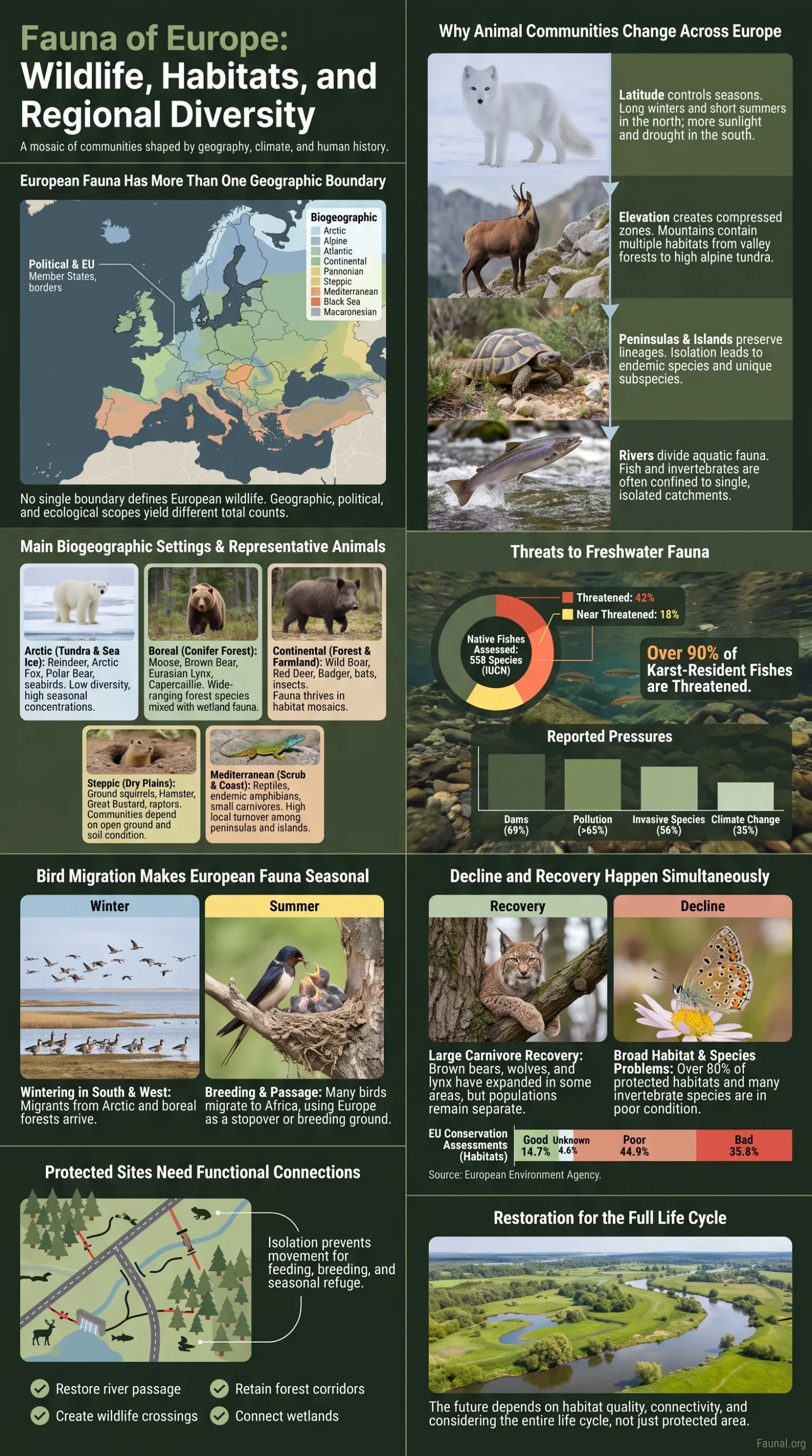
The fauna of Europe is a mosaic of animal communities shaped by latitude, elevation, peninsulas, islands, mountain barriers, river basins, regional seas and a long history of human land use. Arctic foxes and seabirds occupy the continent’s northern edge, large herbivores and carnivores range through boreal and temperate forests, burrowing mammals and open-country birds inhabit steppe landscapes, while Mediterranean islands, mountain streams and isolated freshwater basins hold animals with very restricted ranges.
No single group of animals can represent European wildlife. Mammals may be the most visible part of the fauna, but much of the continent’s ecological activity depends on fish, amphibians, reptiles, insects, molluscs, crustaceans and other invertebrates. Their distribution often follows habitat boundaries more closely than political borders.
European Fauna Has More Than One Geographic Boundary
Europe, the European Union and the European biogeographic assessment area are not interchangeable. A continental wildlife account may include European Russia, Iceland, Svalbard, the British Isles, Mediterranean islands and Atlantic island groups. EU conservation reports cover the Member States and the species or habitats listed under particular laws. Pan-European maps may add Arctic and Anatolian zones or use separate layers for Russia, Georgia and neighbouring areas.
The Geographic Scope Changes the Answer
A species total for the EU will not match a total for geographic Europe. Counts also change when marine animals, migratory visitors, introduced populations, subspecies or recently revised taxa are included. For this reason, there is no single fixed number that can be presented as the complete total of European animal species.
The European Environment Agency’s pan-European mapping separates land into regions such as Arctic, Alpine, Atlantic, Black Sea, Boreal, Continental, Macaronesian, Mediterranean, Pannonian and Steppic areas. These regions describe broad ecological conditions rather than animal ranges with hard edges.[a]
Within those regions, the European Nature Information System classifies habitats from tundra and forests to grasslands, inland waters, coastal habitats and marine seabeds. Habitat classes provide a more useful starting point for fauna than a map divided only by country.[b]
Why Animal Communities Change Across Europe
Latitude controls season length and winter survival
Northern Europe has long winters, short breeding seasons and strong seasonal changes in food supply. Animals living there may migrate, store fat, change coat colour, reduce activity or depend on pulses of summer insects and vegetation. Farther south, cold becomes less restrictive, but summer drought and heat can limit daytime activity and access to surface water.
Elevation creates compressed climate zones
A mountain can contain several fauna zones within a short horizontal distance. Valleys may support broadleaf forest animals, higher slopes may hold conifer-associated species, and terrain above the tree line may favour cold-adapted grazers, marmots, snow voles, ptarmigan and cliff-nesting birds. Separate mountain ranges can isolate populations even when the climates appear similar.
Peninsulas and islands preserve isolated lineages
The Iberian, Italian and Balkan peninsulas acted as refugial areas during cold phases of the Quaternary. Animals later expanded northward from these southern areas, while other populations remained separated by mountains, seas or unsuitable lowlands. On islands, isolation can produce endemic species, distinctive subspecies, reduced dispersal and very small ranges.
Rivers divide freshwater fauna differently from land fauna
A terrestrial mammal may cross several national borders and watersheds. A small freshwater fish may remain confined to one river system, spring complex or karstic basin. Drainage history, waterfalls, salinity barriers and connections formed during former geological periods can therefore create sharply different fish and aquatic invertebrate communities in neighbouring catchments.
The Main Biogeographic Settings of European Wildlife
| Region | Fauna-forming conditions | Representative animal groups | Distribution pattern |
|---|---|---|---|
| Arctic | Tundra, sea ice, polar coasts, long winters and a short summer pulse | Reindeer, Arctic fox, polar bear, ptarmigan, seabirds, seals and cold-water marine fauna | Low year-round land diversity with strong seasonal bird and marine concentrations |
| Boreal | Conifer forest, peatlands, lakes, snow cover and large forest tracts | Moose, brown bear, grey wolf, Eurasian lynx, wolverine, capercaillie, beaver and wetland birds | Wide-ranging forest species mixed with animals tied to bogs, dead wood and inland waters |
| Atlantic | Mild oceanic climate, estuaries, cliffs, heathland, wet grassland and tidal shores | Seabirds, shorebirds, seals, otters, migratory fish, heathland reptiles and wet-meadow insects | Strong coastal and estuarine influence, with wintering and passage migrants |
| Continental | Broadleaf and mixed forest, large river plains, farmland and settled landscape mosaics | Wild boar, red deer, roe deer, badger, fox, bats, woodpeckers, owls and saproxylic insects | Fauna often occupies mixed networks of woodland, farmland, wetlands and urban edges |
| Pannonian | Lowland basin, dry grassland, saline habitats, marshes and river floodplains | European ground squirrel, European hamster, great bustard, birds of prey and wetland birds | Open-land fauna survives in separated grassland and agricultural habitat patches |
| Steppic | Dry open plains, sparse woody cover, burrowing habitat and strong temperature variation | Ground squirrels, steppe polecat, hamsters, bustards, larks, raptors and grassland insects | Animal communities depend on open structure, soil condition and grazing patterns |
| Alpine | Steep elevation gradients, rocky ground, alpine grassland, snow fields and isolated valleys | Ibex, chamois, marmot, snow vole, ptarmigan, golden eagle, bearded vulture and mountain amphibians | Species change rapidly with elevation; isolated ranges may hold endemic populations |
| Mediterranean | Hot dry summers, mild winters, scrub, open woodland, seasonal water and extensive coastlines | Reptiles, bats, endemic amphibians, rabbits, small carnivores, raptors, insects and cave fauna | High local turnover between peninsulas, mountains, islands and short coastal catchments |
| Black Sea | Deltas, coastal lagoons, steppe margins, brackish water and a partly enclosed sea | Pelicans, cormorants, sturgeons, pond turtles, otters, porpoises and migratory waterbirds | River, wetland and marine fauna meet at deltas and estuaries |
| Macaronesian | Oceanic islands, volcanic terrain, laurel forest, sea cliffs and long isolation | Endemic lizards, land snails, bats, seabirds and island-restricted forest birds | Small ranges and high endemism make island populations sensitive to habitat change and introduced species |
Arctic and Subarctic Fauna Lives Around Seasonal Extremes
The European Arctic includes northern Fennoscandia, Svalbard and the far north of European Russia. Its terrestrial food webs are restricted by cold, snow cover and a short growing season. Reindeer (Rangifer tarandus), Arctic fox (Vulpes lagopus), rock ptarmigan (Lagopus muta) and lemmings are adapted to long winters and rapidly changing food conditions.
Summer changes the apparent abundance of wildlife. Migratory waders, geese, ducks and seabirds arrive to breed during the brief period of high insect production and open water. Cliffs and offshore islands may support dense nesting colonies even where the surrounding land has few resident vertebrate species.
The marine system is inseparable from Arctic land fauna. Polar bears (Ursus maritimus), seals and seabirds depend on marine prey and sea-ice or coastal conditions. Nutrients carried from sea to nesting cliffs can also affect terrestrial vegetation and invertebrate communities near colonies.
Boreal Forests Are Forest–Wetland Systems
Northern conifer forests are interspersed with peatlands, lakes, streams, burned areas and deciduous regeneration. Their fauna cannot be understood by treating the landscape as an unbroken block of mature conifers.
Moose (Alces alces) browse young trees and wetland vegetation. Brown bears (Ursus arctos), grey wolves (Canis lupus), Eurasian lynx (Lynx lynx) and wolverines (Gulo gulo) occupy parts of the northern forest region, although their local distributions differ. Western capercaillie (Tetrao urogallus) use forest structures that supply ground vegetation, shelter and display areas.
Dead wood supports a separate animal community
Standing dead trees, fallen trunks, loose bark and decaying wood provide feeding and breeding sites for beetles, flies, ants and other invertebrates. Woodpeckers excavate cavities that may later be used by owls, passerines, bats, insects and small mammals. Removing dead wood can therefore alter several connected animal groups rather than only the organisms living inside the timber.
Peatlands add open-water and wet-ground fauna
Bogs and fens support breeding waders, cranes, dragonflies, aquatic beetles and amphibians. Small pools may contain fauna absent from the surrounding forest. Drainage changes water levels, vegetation and prey availability, so an apparently wooded region can lose wetland animals without losing its tree cover.
Atlantic Europe Is Defined by Coasts, Estuaries and Mild Winters
Atlantic-facing Europe includes exposed coasts, drowned river valleys, mudflats, salt marshes, heathlands and wet grasslands. Mild winters allow some animals to remain active for longer periods, while estuaries receive migrants from inland rivers, offshore waters and distant breeding grounds.
Estuaries concentrate prey
Tidal mud and shallow water can support dense invertebrate communities used by sandpipers, plovers, ducks and other waterbirds. Estuaries also connect river and sea habitats used by Atlantic salmon (Salmo salar) and European eel (Anguilla anguilla). Barriers or degraded water quality far upstream can therefore affect fauna observed near the coast.
Sea cliffs function as vertical breeding habitat
Atlantic puffins (Fratercula arctica), northern gannets (Morus bassanus), auks, fulmars and other seabirds use cliffs, ledges, burrows and offshore islands. Grey seals (Halichoerus grypus) and harbour seals (Phoca vitulina) use selected shores, sandbanks or rocky sites for resting and breeding. These coastal animals remain dependent on conditions beyond the visible nesting or haul-out site, including prey availability and disturbance at sea.
Temperate Europe Is a Human-Shaped Habitat Mosaic
Much of central and western Europe consists of woodland fragments, managed forest, pasture, arable land, hedgerows, villages, reservoirs, drainage channels and transport corridors. The fauna of this region often depends on the arrangement of habitat features rather than one large area of untouched vegetation.
Wild boar (Sus scrofa), roe deer (Capreolus capreolus), red deer (Cervus elaphus), European badger (Meles meles) and red fox (Vulpes vulpes) can use mixed landscapes, though tolerance of roads, settlement and intensive farming varies by species and locality. Bats may roost in buildings or old trees while feeding over rivers, woodland edges and pasture.
Farmland structure matters as much as farmland area
A field bordered by hedges, ponds, grassy margins and mature trees offers different feeding and breeding conditions from a large uniform field. Open-ground birds may need short vegetation, while pollinators depend on flower continuity and nesting substrates. Amphibians may use a farm pond for breeding but require terrestrial shelter during the rest of the year.
Habitat can remain visible while losing ecological function. A woodland cut into small pieces by roads may retain trees but no longer provide safe movement for all forest animals. A river can retain water while dams prevent migratory fish from completing their life cycle.
Pannonian and Steppe Fauna Depends on Open Ground
The Pannonian Basin and the steppes of eastern and south-eastern Europe support animals adapted to open visibility, dry soils, sparse woody cover and seasonal extremes. Burrowing is common among small mammals because underground chambers offer shelter from predators and temperature changes.
The European ground squirrel (Spermophilus citellus), European hamster (Cricetus cricetus) and steppe polecat (Mustela eversmanii) represent different parts of this open-land community. Great bustards (Otis tarda), larks and birds of prey require suitable combinations of feeding areas, display grounds, nesting sites and low disturbance.
Grazing can maintain habitat structure
Open grassland fauna does not always benefit when grazing stops. Without grazing, mowing or natural disturbance, some sites become dominated by tall vegetation and shrubs. This can remove bare soil, short turf and mixed-height patches used by ground squirrels, grasshoppers, ground-nesting birds and hunting raptors. Excessive grazing can also damage nests, soil and plant cover, so the ecological effect depends on timing, intensity and site conditions.
Mountain Fauna Changes with Elevation and Isolation
The Alps, Pyrenees, Carpathians, Apennines, Dinaric Alps, Balkan ranges and Scandinavian Mountains do not form one continuous mountain habitat. Each system has a different geological history, climate, degree of isolation and connection to surrounding lowlands.
| Mountain zone | Typical habitat structure | Faunal response |
|---|---|---|
| Valley and lower slopes | Rivers, farms, settlements and broadleaf woodland | High contact between wildlife, transport routes and human activity |
| Montane forest | Mixed or conifer forest, rocky slopes and forest openings | Forest mammals, owls, woodpeckers, bats and deadwood invertebrates |
| Tree-line zone | Broken woodland, scrub and sheltered grassland | Overlap between forest and open-mountain species |
| Alpine grassland | Low vegetation, snow-free summer ground and exposed slopes | Grazers, marmots, mountain hares, ground-nesting birds and insects with short activity seasons |
| Rock and high summit | Cliffs, scree, snow fields and sparse vegetation | Cold-adapted specialists, cliff-nesting birds and small isolated populations |
Alpine ibex (Capra ibex), Alpine chamois (Rupicapra rupicapra), Alpine marmot (Marmota marmota), bearded vulture (Gypaetus barbatus) and golden eagle (Aquila chrysaetos) are associated with mountain terrain, but they use different elevation bands and habitat structures.
Some mountain animals have much narrower distributions. The Pyrenean desman (Galemys pyrenaicus) depends on suitable flowing-water habitats in the Iberian Peninsula and Pyrenees. Mountain salamanders and cave invertebrates may be restricted to one range, karst system or set of catchments.
Upslope movement does not create unlimited refuge
Warmer conditions may shift suitable climate zones toward higher elevations. For animals already living close to summits, the amount of available ground can contract as lower boundaries move upward. Roads, ski infrastructure, reservoirs and separated mountain massifs can further limit movement between suitable areas.
Mediterranean Fauna Is Divided Among Peninsulas, Islands and Seasonal Waters
Mediterranean Europe contains dry scrub, evergreen and deciduous woodland, mountain forest, steppe-like plains, agricultural mosaics, caves, temporary ponds, rivers, islands and long coastlines. It should not be treated as one uniform warm habitat.
Reptiles are prominent because long warm seasons support extended activity, although many species avoid the hottest part of the day. Hermann’s tortoise (Testudo hermanni), the ocellated lizard (Timon lepidus) and numerous wall lizards occupy different parts of the region. Bats use caves, buildings, woodland and open feeding areas. Amphibians may depend on springs, streams or temporary pools that remain suitable only during part of the year.
The Iberian Peninsula holds distinct mammal relationships
The Iberian lynx (Lynx pardinus) and European rabbit (Oryctolagus cuniculus) illustrate how a predator’s distribution can be linked to the condition of a particular prey base and its habitat. The rabbit is native to the Iberian region and parts of nearby southern Europe, even though human introductions later spread it far beyond that natural range.
Temporary water can support permanent lineages
Seasonal ponds and intermittent streams may dry during summer but remain necessary breeding habitat for amphibians and aquatic invertebrates. Animals using these waters may survive the dry period as terrestrial adults, buried larvae, resistant eggs or dormant stages. Converting a temporary pond into a permanent ornamental water body can also change its fauna by introducing fish or altering its drying cycle.
Island isolation produces narrow ranges
Mediterranean and Atlantic islands support animals found nowhere else. Examples include the Corsican nuthatch (Sitta whiteheadi), Balearic shearwater (Puffinus mauretanicus), Madeira firecrest (Regulus madeirensis) and several island lineages of the lizard genus Gallotia. Restricted range does not automatically mean that every population is declining, but it leaves fewer alternative habitats when fire, development, disease or introduced predators affect an island.
Europe’s Rivers and Lakes Contain Highly Localised Fauna
Freshwater animals are often underrepresented in accounts of European wildlife even though rivers, springs, lakes, floodplains and karst waters contain many restricted species. A fish confined to one catchment may have a much smaller usable range than a land animal recorded across several countries.
Native Fishes Assessed
558 species
European Red List of Freshwater Fishes, 2026.
Threatened
42%
Species assessed as Vulnerable, Endangered or Critically Endangered.
Near Threatened
18%
Additional species close to a threatened category.
Karst-Resident Fishes
Over 90%
Share reported as threatened in the assessed karst systems.
The 2026 European assessment found that almost six in ten native freshwater fish species were either threatened or Near Threatened. It also identified particularly high risk in karst systems, springs and intermittent rivers, many of which occur in southern Europe.[c]
| Pressure reported in the 2026 assessment | Share of assessed species affected | Faunal effect |
|---|---|---|
| Dams and other physical habitat modification | 69% | Blocks movement, changes flow, alters sediment and separates populations |
| Pollution | More than 65% | Changes water chemistry, oxygen, food webs and breeding habitat |
| Invasive species | 56% | Adds predation, competition, disease and genetic mixing |
| Climate change | 35% | Changes flow, temperature, drought frequency and seasonal water availability |
Migratory fishes require connected catchments
Atlantic salmon move between rivers and the sea. European eel move across marine and freshwater environments during their life cycle. Sturgeons may require access between marine feeding areas and river spawning habitat. A protected river section cannot support these movements when barriers remain elsewhere in the route.
Aquatic invertebrates record different habitat conditions
Crayfish, freshwater mussels, aquatic snails, caddisflies, mayflies, dragonflies and other invertebrates respond to flow, substrate, oxygen, pollution and channel structure. Some mussels also depend on fish hosts during part of their development, linking the condition of two animal groups.
The Seas Around Europe Form Separate Faunal Systems
European marine fauna occupies waters ranging from the cold Arctic Ocean to the enclosed and warm Mediterranean. Salinity, depth, temperature, oxygen, tidal range, seabed type and connection to the Atlantic create different animal communities. The European Environment Agency treats the Baltic Sea, North-East Atlantic, Mediterranean Sea and Black Sea as separate marine regions, with additional subregional divisions.[d]
| Marine region | Physical setting | Faunal features |
|---|---|---|
| European Arctic waters | Cold water, seasonal sea ice and strong seasonal production | Ice-associated mammals, cold-water fish, seabirds and benthic invertebrates |
| North-East Atlantic | Open-ocean connection, deep basins, shelves, rocky coasts and strong currents | Cetaceans, seals, pelagic fish, deep-water fauna and large seabird colonies |
| North Sea | Shallow shelf sea, tidal coasts and heavily used marine space | Flatfish, forage fish, seals, porpoises, seabirds and estuarine nursery fauna |
| Baltic Sea | Brackish, relatively enclosed and strongly influenced by river inflow | Mixture of marine and freshwater-tolerant animals with lower salinity limits |
| Mediterranean Sea | Warm, saline, semi-enclosed and highly varied in depth and coastal habitat | Seagrass-associated fauna, reef and cave animals, turtles, cetaceans and the Mediterranean monk seal |
| Black Sea | Enclosed basin with strong vertical oxygen differences and major river inputs | Coastal fish, porpoises, benthic fauna in oxygenated waters and delta-linked migratory species |
Coastal nurseries connect land and sea
Lagoons, estuaries, seagrass beds, salt marshes and shallow bays provide feeding or juvenile habitat for fish and invertebrates. Their fauna may be affected by river pollution, dredging, coastal construction, altered sediment movement and marine heat.
Marine range does not follow national waters
Whales, dolphins, porpoises, turtles, seabirds and migratory fish may cross several jurisdictions. Protection at one breeding or feeding site cannot remove threats encountered along the rest of a migration route.
Bird Migration Makes European Fauna Seasonal
The animals present in a European wetland, forest or coast can change greatly during the year. Some birds breed in the Arctic or northern forests and winter in western or southern Europe. Others breed in Europe and migrate to Africa. A third group passes through European stopover sites without spending the full breeding or winter season there.
Migration places distant habitats in one biological system. A waterbird population may depend on northern breeding ground, central European staging wetlands and southern winter habitat. Damage at any one of these areas can affect numbers observed elsewhere.
Not all seasonal movement crosses continents
Mountain animals may move between high summer ground and lower winter habitat. Bats can shift between breeding roosts, feeding areas and hibernation sites. Amphibians migrate short distances between terrestrial shelter and breeding water. These movements may be small on a map but still cross roads, fences and developed land.
Invertebrates Carry Much of Europe’s Ecological Work
Invertebrates make up most animal diversity, yet broad wildlife accounts often reduce them to a short reference to insects. European animal communities depend on many distinct invertebrate roles.
| Ecological role | European animal groups involved | Habitat effect |
|---|---|---|
| Pollination | Wild bees, hoverflies, butterflies, moths and beetles | Supports reproduction of wild plants and many crops |
| Decomposition | Beetles, fly larvae, springtails, mites and other soil animals | Processes wood, dung, carrion and leaf litter |
| Soil mixing | Earthworms, ants and burrowing invertebrates | Changes soil structure, aeration and nutrient movement |
| Water filtration | Freshwater and marine bivalves, sponges and other filter feeders | Removes suspended particles and transfers material through food webs |
| Herbivory | Grasshoppers, caterpillars, snails and plant-feeding beetles | Influences vegetation composition and provides prey for other animals |
| Predation | Dragonflies, spiders, ground beetles, mantises and predatory aquatic insects | Regulates smaller animal populations in terrestrial and aquatic habitats |
The 2025 European assessments reported that at least 172 of 1,928 assessed wild bee species faced extinction risk. They also placed 65 of 442 assessed butterfly species in threatened categories. More than 20% of assessed species in some groups, including bumblebees and cellophane bees, were threatened.[e]
Assessment Coverage Is Not a Total Fauna Count
The European Red List contains regional extinction-risk assessments for selected taxonomic groups. It does not contain every European invertebrate species. IUCN reports 15,060 assessed European species across all vertebrates and several fully or partly assessed plant and invertebrate groups.[f]
Endemic, Native, Migratory and Introduced Are Different Statuses
| Status | Meaning in a European fauna account | Common source of error |
|---|---|---|
| Native | Occurs within its natural range without human introduction | Treating every long-established population as native |
| Endemic | Naturally restricted to Europe or to a defined European region | Using endemic as another word for rare |
| Migratory | Uses Europe during only part of its annual or life-cycle movement | Counting passage records as permanent residence |
| Reintroduced | Released into part of a former native range after local loss | Assuming release means a self-sustaining population is established |
| Natural recoloniser | Returns through its own movement from an existing population | Describing every return as a reintroduction project |
| Introduced | Moved outside its natural range through human activity | Automatically calling every introduced species invasive |
| Invasive alien | Introduced outside its natural range and causes ecological harm | Applying the label without evidence of impact |
Occurrence evidence does not prove a complete range
Museum specimens, survey observations, acoustic detections, camera-trap records and citizen-science observations can document that an animal was reported at a place and time. Record density may also reflect where people searched, which taxa were easy to identify and whether historical collections have been digitised.
A mapped occurrence is evidence of a reported record, not a complete boundary around the animal’s distribution. A single old or unverified record is also insufficient to establish a current regional population.
Invasive Animals Follow Transport and Water Networks
Introduced animals reach Europe through shipping, aquaculture, ornamental trade, pet releases, stocking, bait movement and accidental transport. Rivers, canals, ports, reservoirs and connected urban areas can then assist further spread.
The pond slider (Trachemys scripta), signal crayfish (Pacifastacus leniusculus) and pumpkinseed (Lepomis gibbosus) were among the widely reported animals in the EU’s 2019–2024 reporting for invasive alien species of Union concern. That reporting covered 87 listed plant, animal and other species rather than every non-native organism in Europe. This reporting cohort should not be confused with the current Union List, which contains 114 invasive alien species of Union concern: 65 animal species and 49 plant species. The fourth update of the Union List entered into force on 7 August 2025.[n] More than 300 rapid eradication actions were reported, with 60% described as fully, partly or temporarily successful.[g]
Introduced Does Not Automatically Mean Invasive
An introduced animal must be evaluated by its establishment, spread and ecological effects. Some introduced populations remain local or poorly established, while others alter food webs, transmit disease, compete with native species or change habitat structure.
Decline and Recovery Occur at the Same Time
Europe contains populations that are shrinking, stable, expanding, recolonising or recovering after targeted action. These conditions can occur within the same species in different regions. A growing population in one country does not establish a favourable condition across the continent.
Large carnivore recovery is uneven
Brown bears, wolves and Eurasian lynx have returned to or expanded within parts of their former European range. The Iberian lynx (Lynx pardinus), Balkan lynx population and wolverine remain separate conservation cases with different ranges and pressures. Expansion can also increase contact with livestock, roads and settlements, making coexistence measures part of population management.[h]
Protected status is not the same as recovery
Legal protection can reduce direct killing or habitat damage, but population recovery also depends on breeding success, habitat quality, prey, movement routes, genetic exchange and mortality outside protected areas. The EU Habitats Directive covers more than one thousand listed animal and plant species and 230 habitat types, but its assessment categories apply to listed features within the EU rather than all European fauna.[i]
EU Assessments Show Broad Habitat and Species Problems
The European Environment Agency reports that 81% of protected habitat assessments, 39% of bird assessments and 62% of other protected species assessments were in poor or bad condition. These figures refer to species and habitats of community interest under EU reporting systems, not to every animal population in geographic Europe.[j]
EU Conservation Assessments by Reported Category
Percentages from EU-level Habitats Directive assessments for protected habitat types and listed animal and plant species, based on 2013–2018 reporting.
Source: European Environment Agency. Habitat assessments: Good 14.7%, Unknown 4.6%, Poor 44.9%, Bad 35.8%. Species assessments: Good 27.5%, Unknown 10.2%, Poor 41.8%, Bad 20.6%.[k]
Land and sea use, extraction of biological resources, pollution, invasive alien species and climate change often act together. The pressure combination differs by habitat: river barriers affect fish movement, drainage removes wetland breeding sites, uniform forestry reduces old-tree and deadwood habitat, and intensive land management can remove both feeding resources and movement cover.
Protected Sites Need Functional Connections
A protected site can retain breeding habitat while remaining isolated from feeding grounds, seasonal refuges or neighbouring populations. Animal movement may depend on river continuity, hedgerows, forest belts, stepping-stone wetlands, road crossings, unlit corridors or undisturbed coastal sections.
| Connection problem | Animals commonly affected | Habitat response |
|---|---|---|
| Dam or weir | Migratory fish and river mammals | Remove obsolete barriers, restore passage and recover natural flow where possible |
| Road through breeding habitat | Amphibians, reptiles and small mammals | Use correctly placed crossings, guiding structures and seasonal protection |
| Separated forest blocks | Large mammals, bats and forest invertebrates | Retain woodland corridors, old trees, riparian strips and low-disturbance links |
| Isolated wetland | Waterbirds, amphibians and aquatic insects | Restore groups of wetlands with suitable hydrology rather than one ornamental pond |
| Intensive open farmland | Pollinators, farmland birds and small mammals | Restore flower resources, field margins, ponds, hedges and mixed vegetation heights |
| Disturbed coastal breeding site | Seabirds, seals and shorebirds | Protect breeding periods while retaining connected feeding habitat |
Restoration Must Match the Animal’s Full Habitat Cycle
Restoring vegetation alone may not recover fauna when water flow, soil condition, prey, nesting substrate or migration access remains unsuitable. A river project must consider upstream and downstream movement. A meadow project must provide flowers across the activity season as well as nesting ground. A forest project may need old trees, cavities, dead wood, canopy gaps and links to nearby stands.
Regulation (EU) 2024/1991 has applied since 18 August 2024. It sets an EU target for restoration measures to cover at least 20% of land and at least 20% of sea areas by 2030, followed by all ecosystems needing restoration by 2050.[l] The 1 September 2026 deadline for draft national restoration plans has passed. The drafts set out how Member States intend to meet restoration targets up to 2030 and provide a strategic overview of planned targets and actions for 2040 and 2050. Over the coming months, the European Commission, supported by the European Environment Agency, will assess the drafts and provide observations before final national restoration plans are completed.[m]
The future composition of European fauna will depend on more than the area labelled as protected. Habitat quality, river continuity, seasonal movement, genetic exchange, water availability, disturbance and the arrangement of land and sea uses determine whether animal populations can feed, breed and move across their full life cycle.
Sources and Verification
- [a] European Environment Agency — Biogeographical regions in Europe — Used for the pan-European biogeographic region names and the distinction between ecological regions and political borders.
- [b] European Nature Information System — About EUNIS — Used for the scope of the pan-European habitat classification across terrestrial, freshwater, marine, natural and artificial habitats.
- [c] IUCN — Almost half of European freshwater fishes at risk of extinction — Used for the 2026 assessment scope, threatened and Near Threatened shares, habitat findings, migration trends and reported pressure percentages.
- [d] European Environment Agency — Regional seas surrounding Europe — Used for the separation of Europe’s surrounding waters into distinct marine regions.
- [e] IUCN — Mounting risks threaten survival of wild European pollinators — Used for the 2025 wild bee and butterfly assessment totals and threatened-species shares.
- [f] IUCN — European Biodiversity Conservation — Used for the stated coverage of 15,060 European Red List assessments and the taxonomic groups represented.
- [g] European Environment Agency — EU makes progress against invasive alien species, but spread continues — Used for 2019–2024 reporting coverage, widely reported invasive animals and rapid eradication results.
- [h] Council of Europe, Bern Convention — Conservation of Large Carnivores — Used for the differing recovery and threat conditions among wolves, bears, Eurasian lynx, Iberian lynx, Balkan lynx and wolverines.
- [i] European Commission — Habitats Directive — Used for the legal assessment scope covering more than one thousand listed species and 230 habitat types.
- [j] European Environment Agency — State of Europe’s biodiversity — Used for the reported condition of protected habitats, birds and other protected species and for the principal pressure groups.
- [k] European Environment Agency — Conservation status of protected habitats and species — Used for the exact Good, Unknown, Poor and Bad percentages presented in the chart.
- [l] EUR-Lex — Regulation (EU) 2024/1991 on nature restoration — Used for the application date and the EU restoration targets for 2030 and 2050.
- [m] European Commission — EU countries submit draft plans on restoring nature — Used for the 1 September 2026 draft-plan submission stage, the 2030 targets and 2040–2050 strategic overview, and the Commission and EEA assessment phase.
- [n] European Commission — Invasive Alien Species — Used for the current Union List total of 114 species, its animal and plant composition, and the fourth update entering into force on 7 August 2025.
Alpine and Mountain Reptiles of Europe: Cold-Adapted Species
For Europe’s alpine and mountain reptiles, the focus is cold-adapted species, organizing the account around adaptation to the...
Alpine Mammals of Europe: Species of High Mountain Habitats
Species of high mountain habitats frame the treatment of Europe’s alpine mammals, framing the topic through the ecosystems...
Birds of Europe: Species Diversity, Habitats, and Biogeographic Regions
For Europe’s birds, the focus is species diversity, habitats, and biogeographic regions, keeping habitat use central to the...
Endemic Animals of Europe: Species with Restricted Ranges
For Europe’s endemic animals, the focus is species with restricted ranges, keeping geographic restriction central to the species...
Endemic Reptiles of Europe: Islands, Peninsulas, and Restricted Ranges
Europe’s endemic reptiles are organized by islands, peninsulas, and restricted ranges, keeping geographic restriction central.
Farmland Birds of Europe: Species Decline and Habitat Change
Europe’s farmland birds link species decline and habitat change, relating the species account to the environments named.
Forest Birds of Europe: Woodland Species and Breeding Habitats
Woodland species and breeding habitats frame the treatment of Europe’s forest birds, organizing the topic around habitat relationships.
Forest Mammals of Europe: Woodland Species and Habitat Use
Europe’s forest mammals are organized around woodland species and habitat use, keeping habitat use central to the species...
Large Carnivores of Europe: Wolves, Bears, Lynx, and Wolverines
Europe’s large carnivores link wolves, bears, lynx, and wolverines, grouping the named animals within the regional fauna.
Lizards of Europe: Common Groups, Habitats, and Distribution
Common groups, habitats, and distribution frame the treatment of Europe’s lizards, keeping occurrence and habitat context within the...
Mammal Reintroductions in Europe: Species Recovery and Monitoring
Mammal reintroductions in Europe link species recovery and monitoring, organizing the subject within its stated geographic boundaries.
Mammals of Europe: Native Species, Habitats, and Distribution
Native species, habitats, and distribution frame the treatment of Europe’s mammals, keeping occurrence and habitat context within the...
Marine Mammals of Europe: Seals, Dolphins, Whales, and Porpoises
Europe’s marine mammals are described through seals, dolphins, whales, and porpoises, connecting each animal group with the regional...
Migratory Birds of Europe: Flyways, Seasons, and Stopover Habitats
Europe’s migratory birds are organized by flyways, seasons, and stopover habitats, linking movement timing with key resting areas.
Raptors of Europe: Eagles, Hawks, Falcons, and Vultures
Europe’s raptors are organized around eagles, hawks, falcons, and vultures, keeping attention on the animal groups named.
Reptiles of Europe: Snakes, Lizards, Turtles, and Tortoises
Europe’s reptiles are described through snakes, lizards, turtles, and tortoises, keeping the list anchored to the area named.
Seabirds of Europe: Coastal Colonies and Marine Habitats
For Europe’s seabirds, the focus is coastal colonies and marine habitats, keeping habitat use central to the species...
Small Mammals of Europe: Rodents, Shrews, Hedgehogs, and Dormice
Europe’s small mammals are grouped as rodents, shrews, hedgehogs, and dormice, with the focus kept on regional species...
Snakes of Europe: Venomous and Non-Venomous Species
Europe’s snakes are organized around venomous and non-venomous species, keeping the taxonomic groups tied to their regional setting.
Threats to European Reptiles: Habitat Loss, Roads, and Climate Change
European reptiles are assessed through habitat loss, roads, and climate change, connecting each pressure with the reptiles and...
Turtles and Tortoises of Europe: Freshwater, Marine, and Land Species
Europe’s turtles and tortoises link freshwater, marine, and land species, framing the listed species groups within the regional...
Urban Birds of Europe: Common Species in Towns and Cities
For Europe’s urban birds, common species in towns and cities are brought together, keeping the topic tied to...
Wetland Birds of Europe: Ducks, Herons, Waders, and Waterbirds
Europe’s wetland birds are described through ducks, herons, waders, and waterbirds, framing the listed species groups within the...
Wild Ungulates of Europe: Deer, Bison, Boar, Goats, and Sheep
For Europe’s wild ungulates, the focus is deer, bison, boar, goats, and sheep, connecting each animal group with...
Wildlife of Eastern Europe: Forests, Wetlands, and Steppe Species
Eastern Europe’s wildlife is described through forests, wetlands, and steppe species, keeping habitat differences central to the regional...
Wildlife of Northern Europe: Boreal Forests, Tundra, and Coasts
Northern Europe’s wildlife is organized across boreal forests, tundra, and coasts, linking species groups with their habitats.
Wildlife of Western Europe: Landscapes, Species, and Conservation
Western Europe’s wildlife is organized around landscapes, species, and conservation, keeping the geographic and ecological scope clearly defined.
27 articles in Fauna of Europe