Complete guides: •What Is Fauna?
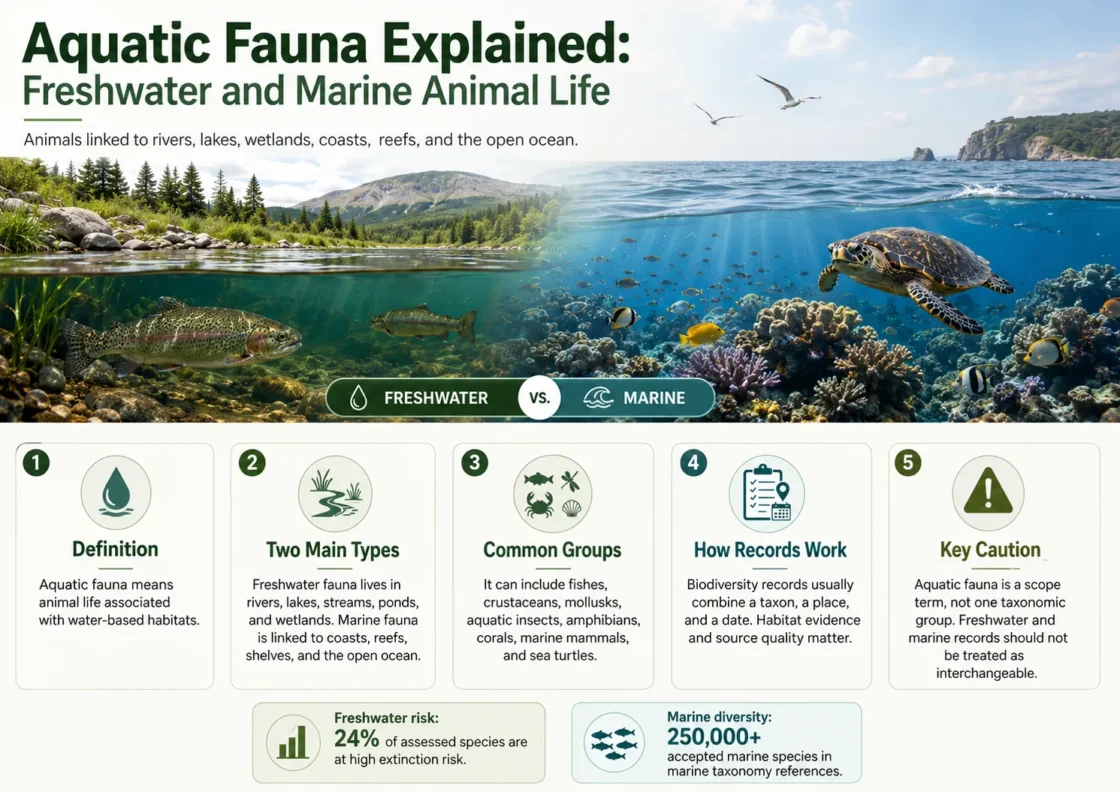
Aquatic fauna is the animal life that depends on water for all or a defined part of its life cycle. It includes freshwater animals in rivers, lakes, wetlands and groundwater; marine animals in coastal waters, open oceans and the seafloor; animals of brackish estuaries; and species whose aquatic dependence is limited to feeding, breeding, migration or an immature life stage.
Aquatic Fauna Is Defined by Dependence on Water
The word fauna refers to animals. Aquatic fauna therefore excludes aquatic plants, algae, fungi and microorganisms unless they are being discussed as food, habitat or ecological partners of animals. It includes members of many unrelated branches of Animalia rather than one evolutionary lineage.
Fish, crustaceans, molluscs, aquatic insects, sponges, corals, worms, echinoderms, amphibians, reptiles, birds and mammals can all form part of aquatic fauna. Their relationship with water differs. A coral polyp remains submerged, a dragonfly is aquatic mainly as a nymph, a sea turtle breathes air but feeds and travels at sea, and an otter divides its activity between water and land. NOAA’s marine-life resources similarly treat ocean, coastal and estuarine animals as a varied biological community rather than a fish-only category.[a]
A Species Can Be Aquatic Without Breathing Water
Whales, dolphins, seals, sea turtles, crocodilians and diving birds obtain oxygen from air. They still belong within aquatic fauna when water is the main setting for feeding, movement, reproduction or survival. Respiratory method and habitat dependence are separate biological traits.
A regional fauna inventory must state its inclusion boundary. A list restricted to permanently submerged animals will differ from one that includes wetland birds, amphibians, semiaquatic mammals, parasitic animals and insects with aquatic larvae. Without that boundary, two published totals can describe the same region yet count very different biological communities.
Fresh Water, Seawater and the Brackish Middle
Freshwater and marine habitats are separated partly by dissolved salt, but the division is not a simple line. Fresh water has very low salinity, average ocean water is about 35 parts per thousand, and estuaries commonly contain brackish mixtures ranging from about 0.5 to 35 parts per thousand. Estuarine salinity can change with tides, rainfall, river discharge, evaporation and the position of an animal within the estuary.[c]
| Aquatic setting | Examples | Physical filters on animal life | Faunal patterns |
|---|---|---|---|
| Running fresh water | Rivers, streams, springs and channels | Current speed, discharge, oxygen, substrate, floods and seasonal drying | Streamlined fish, clinging insect larvae, burrowing animals, crayfish and freshwater mussels |
| Standing fresh water | Lakes, ponds and reservoirs | Depth, temperature layering, shoreline structure, oxygen cycles and nutrient supply | Zooplankton, fish, snails, bivalves, aquatic insects and bottom-dwelling worms |
| Wetlands and floodplains | Marshes, swamps, peatlands and seasonally flooded land | Hydroperiod, vegetation, shallow-water temperature and fluctuating oxygen | Amphibians, insects, crustaceans, fish, reptiles, birds and semiaquatic mammals |
| Groundwater | Aquifers, caves, wells and subterranean channels | Darkness, low food input, stable temperature and slow water exchange | Small crustaceans, worms, molluscs and specialized cave or groundwater fish |
| Estuaries | River mouths, tidal creeks, lagoons and salt marsh channels | Changing salinity, tides, sediment, turbidity and freshwater inflow | Euryhaline fish, crabs, shrimps, oysters, worms and migratory species moving between rivers and sea |
| Intertidal coast | Rocky shores, mudflats, sandy shores and tide pools | Immersion and exposure, wave force, temperature change and desiccation | Barnacles, mussels, crabs, anemones, snails, worms and tide-pool fish |
| Coastal and shelf waters | Coral reefs, seagrass beds, kelp forests and continental shelves | Light, depth, currents, substrate, nutrients and wave exposure | Reef fish, corals, sponges, crustaceans, molluscs, echinoderms and marine reptiles |
| Open ocean | Surface waters and the pelagic water column beyond the coast | Currents, temperature zones, food patches, light depth and vertical movement | Zooplankton, gelatinous animals, squid, pelagic fish, turtles and cetaceans |
| Deep sea and seafloor | Abyssal plains, trenches, slopes, seeps and hydrothermal vents | High pressure, darkness, low temperature and limited food away from local chemical-energy sources | Deposit feeders, scavengers, predators, deep-sea corals, sponges, worms, crustaceans and specialized fish |
Salinity alone does not determine which animals can persist. Dissolved oxygen, water temperature, flow, depth, light, pH, sediment and nutrient conditions also filter aquatic communities. Cold water can hold more dissolved oxygen than warm water, while decomposition and stagnant conditions can reduce the oxygen available to fish, zooplankton and other animals.[b]
Fish Are Only One Part of Aquatic Animal Diversity
Aquatic fauna crosses much of the animal tree. Some groups have many freshwater and marine representatives, some are concentrated in one environment, and others enter water during only one stage of development.
| Animal group | Freshwater representation | Marine representation | Biological detail |
|---|---|---|---|
| Sponges | Freshwater sponges occur in lakes, rivers and wetlands | Marine sponges occupy coastal waters, reefs and the deep seafloor | Adults are attached filter feeders; their larvae can disperse through water |
| Cnidarians | Hydras and freshwater jellyfish represent a small freshwater component | Corals, sea anemones, hydroids and jellyfish are widespread at sea | Many alternate between attached polyps and free-swimming stages |
| Worm-shaped invertebrates | Flatworms, annelids, nematodes and other small groups occupy sediments, plants and animal hosts | Marine sediments and hosts support many free-living and parasitic forms | “Worm” is a body-form description, not one taxonomic group |
| Molluscs | Freshwater snails and bivalves occur in rivers, lakes, springs and wetlands | Marine snails, bivalves, chitons, tusk shells and cephalopods occupy coastal and oceanic habitats | Feeding modes include grazing, filtering, scavenging and predation |
| Crustaceans | Crayfish, freshwater crabs, shrimps, copepods, amphipods and water fleas | Crabs, shrimps, lobsters, krill, barnacles, copepods, amphipods and isopods | Many species change form, habitat or diet between larval and adult stages |
| Insects | Mayflies, stoneflies, caddisflies, dragonflies, mosquitoes and many beetles have aquatic stages | Truly marine insects are comparatively scarce, although some occupy shores and tidal surfaces | Emerging adults transfer aquatic production into terrestrial food webs |
| Echinoderms | No living freshwater echinoderm fauna | Sea stars, brittle stars, sea urchins, sand dollars, sea cucumbers and crinoids | Living members are marine and mainly associated with the seafloor |
| Fish and jawless vertebrates | Rivers, lakes, wetlands, caves and estuaries support freshwater residents and migrants | Coastal, pelagic and deep-sea waters support cartilaginous and bony fishes | Some species move between fresh water and sea during their life cycle |
| Tetrapods | Amphibians, turtles, crocodilians, waterbirds and semiaquatic mammals | Sea turtles, marine iguanas, seabirds, pinnipeds, sirenians and cetaceans | Most breathe air even when feeding, travelling or resting in water |
The Freshwater Animal Diversity Assessment reviewed vertebrates, insects, crustaceans, molluscs and several smaller phyla, while also reporting uneven geographic and taxonomic knowledge. Marine taxonomy is similarly distributed across many specialist registers rather than represented by a single list of familiar animals.[g]
Freshwater and Marine Teleosts Face Opposite Osmotic Pressures
Water and dissolved ions move across permeable body surfaces. Teleost fishes maintain internal body fluids within a narrower range than the waters around them, but freshwater and marine species must compensate in opposite directions.
| Teleost setting | Passive pressure | Main compensatory responses |
|---|---|---|
| Fresh water | Water enters the body while ions tend to diffuse outward | Active ion uptake across the gills, ion gain from food and excretion of large volumes of dilute urine |
| Seawater | Water tends to leave the body while ions enter | Drinking seawater, absorbing water through the intestine, secreting sodium and chloride across the gills and producing relatively small volumes of urine |
| Changing salinity | The direction and strength of water and ion movement change with the surroundings | Adjustment of gill ion transport, kidney and intestinal function, drinking rate, behaviour and habitat position |
Most freshwater teleosts are hyper-osmotic to their surroundings, while most marine teleosts are hypo-osmotic. Euryhaline fishes can adjust to a broad salinity range; stenohaline fishes tolerate a narrower range. The capacity can also change during development, so eggs, larvae, juveniles and adults may not share the same salinity tolerance.[d]
These teleost patterns should not be applied to every aquatic animal. Sharks, rays, crustaceans, molluscs, amphibians and marine mammals use different combinations of osmotic regulation, ion storage, excretion, impermeable surfaces and behaviour.
Some Animals Spend Only Part of Their Lives in Water
Aquatic dependence is a gradient. Restricting the term to animals that remain underwater from birth to death excludes major parts of wetland, river, coastal and ocean food webs.
| Dependence pattern | Examples | Relationship with aquatic habitat |
|---|---|---|
| Permanently submerged | Most fish, corals, sea cucumbers and many aquatic worms | Feeding, respiration, movement and reproduction occur underwater |
| Aquatic juvenile stage | Mayflies, dragonflies, mosquitoes and many caddisflies | Eggs and larvae or nymphs develop in water; adults disperse through air or land |
| Aquatic breeding stage | Frogs, toads and many salamanders | Adults may live partly on land, while eggs and larvae depend on ponds, streams or wetlands |
| Air-breathing aquatic life | Whales, dolphins, sirenians, seals and sea turtles | Animals surface to breathe but obtain most food or complete most movement in water |
| Semiaquatic life | Otters, beavers, hippopotamuses, crocodilians and many waterbirds | Water is used for feeding, refuge, transport or breeding, while resting or nesting may occur on land |
| Aquatic parasite or commensal | Parasitic worms, crustaceans and molluscs associated with aquatic hosts | Dependence may be indirect because survival follows the habitat and movement of the host |
Life-stage information can therefore change whether a species appears in an aquatic fauna dataset. A record labelled only “terrestrial adult” may hide an obligate aquatic larval period, while a sighting beside a river may not prove that the animal is biologically dependent on the water.
Animal Migration Connects Rivers, Estuaries and Oceans
Some fishes cross the freshwater–marine boundary as a normal part of development or reproduction. These migrations transfer animals, nutrients and energy among river, estuarine and marine food webs. Barriers in one habitat can therefore affect a species that spends much of its life somewhere else.[h]
| Movement category | Definition | Typical examples |
|---|---|---|
| Potamodromous | Migration occurs entirely within fresh water | River and lake fishes moving among feeding, refuge and spawning habitats |
| Oceanodromous | Migration occurs entirely within marine waters | Pelagic or coastal fishes moving between feeding, nursery and spawning areas |
| Anadromous | Adults spend much of their growth period at sea and enter fresh water to reproduce | Many salmon, shads, sturgeons and some lampreys |
| Catadromous | Animals grow mainly in fresh or brackish water and migrate to sea to reproduce | Freshwater eels of the genus Anguilla |
| Amphidromous | Movement between fresh water and sea occurs during development but is not chiefly a spawning migration | Many island-stream gobies whose larvae develop at sea before juveniles return to fresh water |
These labels describe life-history patterns rather than fixed taxonomic groups. Closely related species may follow different routes, and separate populations of one species can differ in their dependence on the ocean.[i]
Position in the Water Can Matter More Than Body Form
Aquatic animals are also grouped by where and how they live. These ecological categories cut across taxonomy: a crustacean can be planktonic, benthic or actively swimming, and one species may occupy different positions as it develops.
| Ecological position | Description | Animal examples | Ecological activity |
|---|---|---|---|
| Zooplankton | Animals and animal stages carried mainly by currents | Copepods, water fleas, rotifers, krill and many larvae | Graze microorganisms, consume smaller animals and provide prey for larger fauna |
| Nekton | Animals able to swim against ordinary water movement | Fish, squid, turtles and marine mammals | Move among feeding, refuge, nursery and breeding areas |
| Benthos | Animals living on, attached to or within the bottom | Mussels, corals, sponges, worms, crabs, sea stars and insect larvae | Filter water, graze surfaces, process sediment, scavenge or hunt |
| Infauna | Animals living within sediment | Burrowing worms, clams and small crustaceans | Mix sediment, consume deposited material and alter oxygen penetration |
| Epifauna | Animals living on top of rock, vegetation, shells or sediment | Barnacles, limpets, sea anemones and many snails | Attach, graze, filter or prey on exposed surfaces |
| Surface fauna | Animals associated with the air–water boundary | Water striders, floating hydrozoans and surface-dwelling larvae | Use surface tension, floating material or prey concentrated at the boundary |
These categories describe movement and habitat position, not ancestry. Plankton is not synonymous with microscopic life, benthos is not synonymous with immobility, and nekton is not limited to fish.
A Single Global Aquatic-Animal Total Is Not Defensible
An exact total for all aquatic animal species would require a shared date, accepted-name standard and inclusion rule across fresh, brackish and marine waters. No static number resolves all of those conditions.
Why Published Totals Differ
One estimate may include only accepted living species permanently associated with water. Another may include synonyms, undescribed operational taxa, aquatic parasites, brackish species, animals with aquatic larvae, wetland-dependent tetrapods or fossil taxa. Geographic and taxonomic sampling also remain uneven.
The World Register of Marine Species provides an expert-edited taxonomic backbone for marine life, documents relationships among names and links names to taxonomic literature. WoRMS also states that gaps remain across taxa, places and time periods.[e]
Catalogue of Life is updated monthly and distinguishes accepted names from synonyms. Its records may also carry marine, freshwater, terrestrial or brackish environment labels, but environmental information is not available for every taxon.[f]
A source date and taxonomic scope are therefore more informative than an unsupported claim to list every aquatic animal species.
Freshwater and Marine Fauna Face Different Pressure Patterns
The 2025 Freshwater Assessment Covered Selected Major Groups
A 2025 IUCN-led analysis assessed 23,496 freshwater fishes, odonates and decapod crustaceans. Its best estimate classified 24% as threatened with extinction. The estimated proportions differed among the assessed groups: 30% for decapods, 26% for fishes and 16% for dragonflies and damselflies. Freshwater molluscs were excluded from the main analysis because assessment coverage was incomplete and geographically uneven.[j]
The 24% Figure Does Not Represent Every Freshwater Animal
The assessment covered fishes, odonates and decapod crustaceans. It should not be presented as a measured percentage for all freshwater molluscs, worms, insects, amphibians, reptiles, birds, mammals or microscopic animal groups.
Freshwater conservation assessments commonly examine fishes, molluscs, crabs, crayfishes, shrimps, dragonflies and damselflies separately because their distributions, habitat needs and available evidence differ.[k]
Marine Risk Cannot Be Reduced to One Global Percentage
Marine animals encounter fishing mortality, bycatch, seabed disturbance, coastal habitat loss, pollution, warming, oxygen loss and changing seawater chemistry. Exposure differs among coral communities, open-ocean fish, deep-sea invertebrates, turtles, seabirds and marine mammals, so a percentage from one taxonomic group should not be treated as the condition of all marine fauna.
Bycatch can include non-target fish, dolphins, whales, sea turtles and seabirds. Gear contact can also damage corals, sponges and fish habitat, linking direct animal mortality with physical habitat alteration.[l]
Ocean acidification is a long-term reduction in ocean pH driven mainly by carbon dioxide uptake. Animals that form calcium-carbonate shells or skeletons, including corals and many molluscs, can be affected through changes in the chemistry needed to build and maintain those structures.[m]
An Aquatic Fauna Record Needs More Than a Species Name
A usable aquatic fauna record separates taxonomy, habitat evidence, geographic evidence and conservation assessment. Combining these fields into a single undocumented presence claim can turn an old name, larval record or unverified observation into a misleading distribution statement.
| Record field | Information needed | Reason for inclusion |
|---|---|---|
| Accepted scientific name | Current accepted name, authorship when relevant and linked taxonomic source | Separates the accepted taxon from synonyms and historical combinations |
| Taxonomic source and date | Register, checklist or revision and the version or access date | Shows which taxonomic opinion was followed |
| Environmental category | Freshwater, marine, brackish, estuarine, semiaquatic or multi-realm | Prevents a broad aquatic label from hiding habitat differences |
| Aquatic life stage | Egg, larva, juvenile, adult or entire life cycle | Distinguishes permanent aquatic residence from stage-limited dependence |
| Habitat evidence | River, lake, wetland, groundwater, reef, pelagic water, seafloor or another defined setting | Connects the animal to a biological environment rather than water in general |
| Occurrence evidence | Specimen, observation, survey, acoustic record, environmental DNA or published report | Identifies what kind of evidence supports the record |
| Location and date | Georeferenced locality when available, event date and source institution | Separates recent evidence from historical or poorly localized reports |
| Origin status | Native, endemic, introduced, invasive, vagrant or uncertain | Prevents recorded presence from being mistaken for native distribution |
| Conservation assessment | Assessment system, category, geographic scale and assessment year | Separates global status from national, regional or legal status |
| Verification limits | Identification uncertainty, sampling gaps, excluded groups and unresolved names | Shows where available records do not support a complete distribution or inventory |
Occurrence records document reported evidence at particular places and times. They do not by themselves establish an animal’s complete range, abundance, breeding status or continuous presence. A defensible account of aquatic fauna keeps those claims separate.
Sources and Verification
- [a] NOAA Marine Life Education — Used for the biological breadth of marine, coastal and estuarine animal life.
- [b] USGS: Dissolved Oxygen and Water — Used for dissolved oxygen, temperature, flow and decomposition effects in aquatic habitats.
- [c] NOAA: What Is an Estuary? — Used for freshwater, seawater and brackish-water salinity ranges and estuarine variability.
- [d] Ontogeny of the Osmoregulatory Capacity of Teleosts and the Role of Ionocytes — Used for freshwater and marine teleost osmoregulation and life-stage differences.
- [e] World Register of Marine Species: About WoRMS — Used for marine taxonomic names, expert editing, literature links and remaining coverage gaps.
- [f] Catalogue of Life: Access Data — Used for accepted names, synonyms, update frequency and environmental record fields.
- [g] The Freshwater Animal Diversity Assessment: An Overview of the Results — Used for the taxonomic breadth of freshwater fauna and documented knowledge gaps.
- [h] NOAA Fisheries: Habitat Matters—Fish Passage — Used for anadromous and catadromous migration and river–estuary–ocean connectivity.
- [i] Investigating Diadromy in Fishes and Its Loss in an -Omics Era — Used for diadromous categories and variation among species and populations.
- [j] One-quarter of Freshwater Fauna Threatened with Extinction — Used for the 23,496-species assessment, threat proportions and the exclusion of incompletely assessed molluscs.
- [k] IUCN: Freshwater Species — Used for the freshwater animal groups assessed through dedicated conservation work.
- [l] NOAA Fisheries: Understanding Bycatch — Used for non-target animal mortality and fishing-gear damage to marine fauna and habitat.
- [m] NOAA: What Is Ocean Acidification? — Used for the definition of ocean acidification and its relevance to shell- and skeleton-forming animals.
Related Topics
- → Terrestrial Fauna Explained: Land Animals and Their Habitats
- → Regional Fauna Explained: How Animal Life Changes by Geography
- → What Is Fauna? Meaning, Examples, and Scientific Use
- → Fauna vs Flora: Key Differences in Biology
- → Urban Fauna Explained: Animals Living in Cities
- → Endemic Fauna Explained: Why Some Animals Live Only in One Region