Complete guides: •What Is Fauna?
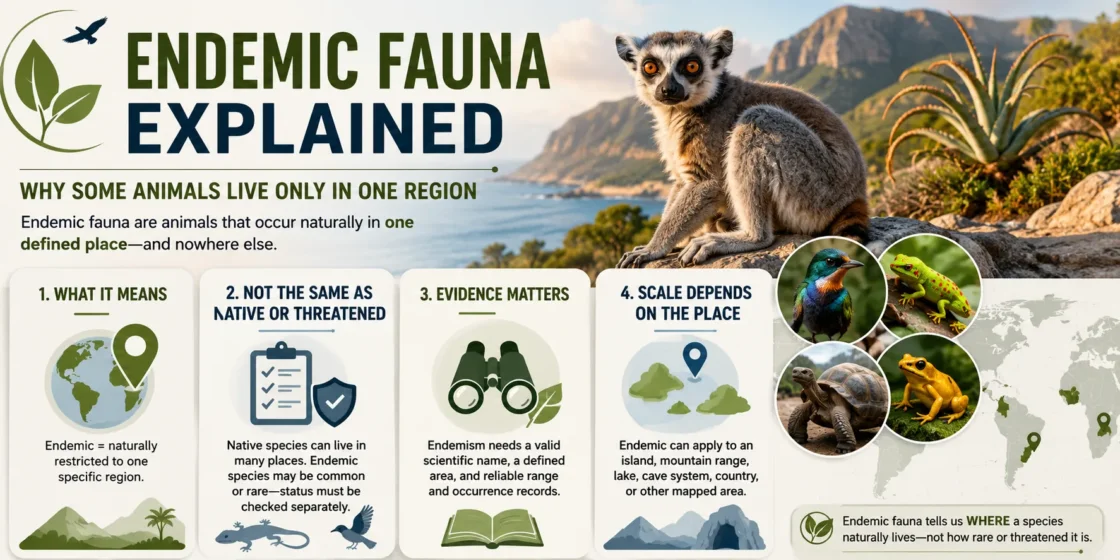
Endemic fauna are animal taxa whose natural global range is confined to a defined geographic area. That area may be a single cave, lake, island, archipelago, mountain system, watershed, country, or biogeographic region. Some endemic animals evolved after populations became isolated; others are surviving remnants of lineages that once occupied a wider range.
Endemism Connects a Taxon to a Named Geographic Boundary
The IUCN standard for identifying Key Biodiversity Areas defines an endemic species as one whose global range is wholly restricted to a defined geographic area such as a region, country, or site.[a] The geographic unit is therefore part of the claim. Saying that an animal is “endemic” without naming the area leaves the statement incomplete.
A species may be endemic to an archipelago without being confined to one island. Another may be endemic to a watershed that crosses a political border. A country endemic has a natural range contained within that country, but its occupied habitat may cover only a small part of the national territory.
Endemism normally concerns the natural range. A zoo population, escaped individual, accidental transport, vagrant record, or human-established population outside that range does not automatically show that the species is naturally distributed there. The origin and reliability of an outside record must be checked before the endemic claim is revised.
Endemic, Native, Rare, and Threatened Are Different Terms
| Term | What the term describes | What the term does not establish |
|---|---|---|
| Endemic to an area | The taxon’s natural global range is contained within the named area. | It does not by itself show low abundance, population decline, or threatened status. |
| Native to an area | The taxon occurs there naturally rather than through human introduction. | A native species may also occur naturally in many other regions. |
| Range-restricted | The taxon has a small global range under a stated spatial method or threshold. | Its range may cross several countries or regions, so it need not be endemic to one political unit. |
| Rare | The animal has low abundance, occurs infrequently, occupies few sites, or is seldom detected under the measure being used. | Rarity does not reveal whether the species has a narrow or broad geographic range. |
| Threatened | The taxon has been assessed as Vulnerable, Endangered, or Critically Endangered under defined criteria. | Endemism alone does not assign a threat category. |
| Introduced | The taxon occurs outside its native range because of direct or indirect human movement. | An introduced population does not necessarily enlarge the species’ natural range. |
Geographic Separation Can Start the Formation of an Endemic Species
A widespread ancestral population exchanges genes when individuals move and reproduce across its range. If a barrier divides that population, gene flow may fall. The separated populations can then accumulate genetic differences through mutation, natural selection, genetic drift, and sexual selection.
When the differences become strong enough to maintain separate evolutionary lineages, the populations may be recognized as different species. Speciation initiated by geographic separation is called allopatric speciation. The barrier may be an ocean, river, desert, glacier, mountain ridge, unsuitable lowland, or a long distance that animals rarely cross.[b]
The newly formed species is endemic when its natural distribution remains inside the isolated area. Endemism is therefore a possible geographic result of speciation, not a separate mode of evolution.
Colonization Can Be Followed by Divergence
Many island lineages begin with dispersal rather than permanent isolation from the start. One or more ancestors reach an island by flying, swimming, rafting, drifting, or being carried by storms. Once established, their descendants may exchange few genes with the source population.
Different islands, elevations, food resources, predators, breeding sites, or microclimates may then favor different traits. A colonizing lineage can remain one endemic species or divide into several endemic species. When one ancestral lineage diversifies while occupying different ecological roles, the process is described as adaptive radiation.
Vicariance Divides a Population That Was Already Present
Endemism does not always begin with an animal crossing into an isolated place. Geological or climatic change can divide an existing distribution. Mountain uplift may separate drainage basins, a river may change course, sea level may fragment land, or drying may divide one wet habitat into disconnected remnants.
This division of a former range by a new barrier is called vicariance. If the separated lineage later becomes a distinct species and remains confined to one fragment, it becomes endemic to that area.
The Main Geographic Settings That Produce Endemic Fauna
Endemic animals occur on continents as well as islands. The recurring feature is restricted biological exchange: an animal can survive and reproduce inside an area but rarely establish natural populations beyond its boundaries.
| Geographic setting | Source of isolation | How endemic fauna can develop |
|---|---|---|
| Oceanic islands and archipelagos | Open sea separates island populations from continents and from other islands. | Rare colonization, reduced gene flow, founder effects, local adaptation, and diversification among islands can produce endemic lineages. |
| Mountains and high-elevation “sky islands” | Warm valleys, dry lowlands, ridges, glaciers, and separate elevation zones divide cool-adapted populations. | Populations isolated on different peaks or slopes may diverge, while narrow climate belts limit later expansion. |
| Ancient lakes and isolated drainage basins | Freshwater animals cannot usually cross land, seawater, waterfalls, or watershed divides. | Long isolation, depth zones, water chemistry, feeding niches, and breeding behavior can generate endemic fishes and invertebrates. |
| Caves, karst systems, and aquifers | Subterranean passages may be disconnected or separated by unsuitable rock and surface habitat. | Low dispersal and adaptation to darkness, water chemistry, food scarcity, or underground flow systems can confine lineages to one cave network. |
| Desert springs and isolated wetlands | Dry land surrounds small patches of permanent aquatic habitat. | Aquatic populations remain separated in individual springs or spring complexes and can diverge over time. |
| Climatic refugia | Local topography or stable conditions preserve habitat while surrounding areas become unsuitable. | Older lineages may survive in one refuge after disappearing from most of their former distribution. |
| Habitat islands within continents | A specialized habitat is surrounded by a matrix the animal cannot occupy. | Forest fragments, limestone outcrops, dunes, volcanic soils, salt marshes, or isolated host organisms can function as biological islands. |
Ocean Isolation Favors Distinct Island Lineages
The Convention on Biological Diversity notes that islands contain high concentrations of endemic species and that endemism tends to rise with isolation, island area, and topographic variety.[c] Isolation reduces repeated immigration, while varied terrain can create separate habitats within the same island or archipelago.
A global comparison of island and mainland regions found that islands hold disproportionately high endemic richness in both plants and vertebrates.[d] This pattern does not mean every island species is endemic. Migratory birds, highly mobile marine animals, and species repeatedly arriving from nearby land may retain broad ranges.
Mountains Create Barriers, Refuges, and Short Environmental Gradients
Mountain systems divide populations horizontally and vertically. An animal adapted to a cold summit may be unable to survive in the warm valley separating it from the next mountain. Deep valleys and separate watersheds can also restrict mammals, birds, amphibians, fishes, and invertebrates that otherwise occur within the same broad region.
Research comparing mammal and bird diversification worldwide has linked topographic uplift with geographic variation in speciation. Uplift can form barriers, create new habitats, and reorganize climate and drainage systems, producing new opportunities for isolated lineages to diverge.[e]
Freshwater Habitats Can Function as Islands on Land
Freshwater fishes, molluscs, crustaceans, aquatic insects, and fully aquatic amphibians are often limited by drainage boundaries. A species adapted to one lake, spring, cave pool, or headwater stream may have no natural route to another suitable site.
Isolation can be especially persistent in closed basins and ancient lakes. Different depths, substrates, temperatures, oxygen levels, food sources, and breeding sites can reduce contact even within the same lake. Endemic radiations may therefore develop at a spatial scale much smaller than a country or continent.
Isolation Does Not Automatically Produce a New Species
A population can remain isolated without becoming taxonomically distinct. The result depends on how long separation lasts, how much gene flow continues, the strength of genetic drift, local selection, population size, breeding biology, and whether the separated animals develop reproductive barriers.
- Isolation may be too recent. The populations may differ slightly but still belong to the same species.
- The barrier may be permeable. Occasional migrants can maintain enough gene flow to limit divergence.
- The population may disappear. Small colonizing or isolated populations can become extinct before a new lineage forms.
- Environmental conditions may remain similar. Geographic separation does not guarantee different selective pressures.
- Taxonomic evidence may be incomplete. Differences in color, size, or locality alone may not justify species recognition.
Endemic status should therefore be attached to a recognized taxon, not assumed for every isolated population. Some geographically distinct populations are treated as subspecies, evolutionarily separate populations, or unresolved species complexes rather than accepted species.
Dispersal Ability Shapes Which Animals Become Endemic
Animals differ greatly in their ability to cross barriers. A migratory bird, pelagic fish, or wind-transported insect may maintain contact across long distances. A cave crustacean, spring snail, stream fish, soil invertebrate, or high-elevation amphibian may be unable to cross a short stretch of unsuitable habitat.
Mobility alone does not determine endemism. Flying animals can still become endemic when they show strong site fidelity, depend on a localized habitat, lose dispersal ability, or remain separated long enough for reproductive isolation to develop. Conversely, a poorly dispersing animal can retain a broad range if suitable habitat has remained connected over a long period.
The relevant question is not simply whether an animal can move. It is whether individuals regularly cross the boundary, survive beyond it, find suitable habitat and mates, reproduce, and maintain gene flow with populations on the other side.
New Endemics and Surviving Relicts Have Different Histories
Neoendemism Follows Recent Diversification
A neoendemic is a comparatively young lineage that originated in a limited area and has not spread beyond it. Geographic isolation, ecological specialization, adaptive radiation, or a combination of these processes may produce neoendemic fauna.
An island chain with several closely related species confined to different islands may represent recent diversification. Similar patterns can occur among separate mountain peaks, lake basins, river headwaters, caves, or host species.
Paleoendemism Follows the Loss of a Formerly Wider Range
A paleoendemic is an older lineage whose present range is only a remnant of a wider historical distribution. Climate shifts, geological change, habitat loss, altered drainage, competition, predation, or other ecological changes may eliminate the lineage from much of its former range while a population survives in a refuge.
Research on centers of endemism links many of them with climatically stable refugia. Such areas can act as places where older lineages persist while surrounding regions undergo stronger environmental change. Other centers contain young endemics generated by isolation and local diversification.[f]
The Same Distribution Can Hide Two Evolutionary Histories
Two animals may now occupy equally small ranges, yet one may be a recently formed species while the other is the last surviving branch of an old lineage. Present-day range size alone cannot distinguish neoendemism from paleoendemism; phylogeny, fossils, genetics, geology, and historical biogeography may be needed.
An Endemic Species Does Not Always Have a Tiny Range
Endemism is defined by exclusivity to a stated area, whereas range restriction concerns the size or shape of the distribution under a stated method. The two ideas often overlap, but they are not identical.
A species naturally distributed across a large island may be endemic to that island even when its range covers thousands of square kilometers. A species occupying a smaller cross-border mountain belt may be range-restricted but not endemic to either country. The selected boundary changes the wording of the claim, while the animal’s actual distribution remains the same.
Scale also affects comparisons among studies. One analysis may measure endemism within countries, another within ecoregions, and another within grid cells. Their endemic-species totals cannot be treated as equivalent unless the taxonomic scope, geographic boundary, source date, and treatment of subspecies are aligned.
Endemic Does Not Mean Endangered
The IUCN Red List assigns extinction-risk categories by evaluating evidence under criteria covering population reduction, geographic range, population size and decline, very small or restricted populations exposed to plausible threats, and quantitative extinction analysis.[g] A taxon is not classified as threatened merely because it is endemic.
Some endemic animals may be locally numerous, occupy several secure sites, or face no identified rapid threat. Others may qualify as threatened because nearly their entire range can be affected by one habitat change, invasive predator, disease outbreak, hydrological alteration, pollution event, storm, fire, or other disturbance.
Restriction Creates Exposure, Not an Automatic Red List Category
A narrow range can increase extinction risk because the species has fewer unaffected populations and fewer places to retreat. A formal category still requires evidence that the relevant IUCN criteria and conditions are met.
Climate Change Can Remove the Conditions That Define the Range
An endemic animal may depend on a narrow temperature zone, rainfall pattern, stream flow, snow regime, cloud layer, or water chemistry. As those conditions shift, the species may have no equivalent habitat nearby. High-elevation animals can run out of cooler terrain, while island and freshwater animals may be unable to cross the surrounding sea or land.
A meta-analysis covering more than 8,000 climate-risk projections across 273 areas of exceptional biodiversity found that endemic species were consistently projected to be more adversely affected than non-endemic native species.[h] Risk still varies among taxa, places, emissions pathways, dispersal assumptions, and conservation responses.
Endemic Status Depends on Taxonomy and Distribution Evidence
Declaring an animal endemic requires two linked conclusions: the taxon is valid under the taxonomy being followed, and its verified natural range lies inside the stated boundary. Uncertainty in either conclusion weakens the endemic claim.
An Occurrence Record Is Evidence From One Place and Time
Darwin Core defines an occurrence as an event establishing the state of an organism at a particular place and time.[i] Museum specimens, photographs, acoustic detections, field observations, environmental samples, and survey records can all contribute occurrence evidence when their identity, locality, date, and basis of record are documented.
Occurrence records do not by themselves describe every occupied site or the complete limits of a species’ range. Areas with many researchers, roads, museums, or citizen-science participants may contain more records than equally suitable but poorly sampled areas. Missing records can reflect low survey effort rather than true absence.
Range Maps Combine Records With Ecological Evidence
Species range limits may be represented by points, polygons, or a combination of both. Guidance used for IUCN mapping explains that range polygons draw on known occurrences together with habitat preferences, remaining suitable habitat, elevation limits, and expert knowledge. A species is not assumed to occupy every place inside a polygon.[j]
A record outside the accepted endemic boundary requires examination. It may represent a genuine native population, a misidentified specimen, a coordinate error, an introduced population, a vagrant individual, an old record from a now-extirpated population, or an unresolved taxon. Only a verified native record from outside the boundary directly challenges the geographic claim.
Taxonomic Revision Can Create or Remove an Endemic Taxon
A formerly widespread species may be split into several species after genetic, morphological, behavioral, or ecological study. One or more of the newly recognized species may then have endemic ranges. The reverse can occur when two named species are combined, causing a former endemic name to become a synonym of a taxon with a wider distribution.
Catalogue of Life assembles taxonomic sources that include accepted names, synonyms, regional and national checklists, molecular resources, and policy-relevant lists, while applying editorial decisions during integration.[k] An endemic-fauna checklist should state which taxonomic source and release date it follows because accepted names and species limits can change.
Why Endemic Fauna Carry High Conservation Irreplaceability
When a widespread species disappears from one region, populations may remain elsewhere. When an endemic species disappears from its only natural range, the loss is global. This makes the occupied habitat irreplaceable even when the species is not currently listed in a threatened category.
Conservation needs differ according to the system that maintains the endemic range. Island fauna may require strict biosecurity and control of invasive predators or pathogens. Spring fauna may depend on groundwater levels and water quality beyond the visible spring outlet. Mountain species may require connected elevational habitat, while cave species may depend on an entire underground drainage network rather than the cave entrance alone.
- Confirm the accepted taxon and resolve uncertain synonyms or species complexes.
- Document the native range using verified records, field surveys, habitat evidence, and dated range assessments.
- Protect every known population when the taxon occupies very few sites.
- Manage the ecological process that maintains the habitat, including hydrology, disturbance regimes, host availability, and connectivity.
- Screen transport routes and human activities that can introduce predators, competitors, pathogens, or hybridizing relatives.
- Monitor overlooked sites so that apparent endemism is not merely a result of uneven sampling.
- Reassess the range after taxonomic revision, new surveys, habitat change, or verified records outside the accepted boundary.
Endemic fauna record two forms of biological history: lineages that originated within isolated places and lineages that survived there after disappearing elsewhere. Protecting them preserves species whose entire natural existence is tied to one geographic system.
Sources and Verification
- [a] IUCN — A Global Standard for the Identification of Key Biodiversity Areas, Version 1.0 — Used for the formal definition of an endemic species and the distinction between endemism and restricted range.
- [b] University of California, Berkeley — Allopatric Speciation — Used for the explanation of geographic isolation, reduced gene flow, and species formation.
- [c] Convention on Biological Diversity — What Is Island Biodiversity? — Used for island isolation, endemic-species concentration, and the roles of island size and topographic variety.
- [d] Kier et al. — A Global Assessment of Endemism and Species Richness Across Island and Mainland Regions — Used for the global comparison of endemic richness in island and mainland regions.
- [e] Igea and Tanentzap — Global Topographic Uplift Has Elevated Speciation in Mammals and Birds — Used for the relationship between topographic change, habitat formation, isolation, and vertebrate speciation.
- [f] Harrison and Noss — Endemism Hotspots Are Linked to Stable Climatic Refugia — Used for climatic refugia and the distinction between recent diversification and survival of older restricted lineages.
- [g] IUCN Red List — Categories and Criteria, Version 3.1 — Used to separate endemic status from assessed global extinction-risk categories.
- [h] Manes et al. — Endemism Increases Species’ Climate Change Risk in Areas of Global Biodiversity Importance — Used for the meta-analysis comparing projected climate effects on endemic, non-endemic native, and introduced species.
- [i] TDWG — Darwin Core List of Terms — Used for the formal meaning of an occurrence as evidence associated with an organism, place, and time.
- [j] GBIF — Mapping Standards for IUCN Red List Assessments — Used for the distinction between occurrence points, distribution polygons, suitable habitat, and expert-supported range limits.
- [k] Catalogue of Life — Constructing the Catalogue — Used for accepted names, synonyms, source integration, checklist coverage, and continuing taxonomic updates.
Related Topics
- → Regional Fauna Explained: How Animal Life Changes by Geography
- → Native Fauna Explained: Meaning and Examples
- → What Is Fauna? Meaning, Examples, and Scientific Use
- → How Scientists Classify Fauna by Region, Habitat, and Taxonomy
- → Terrestrial Fauna Explained: Land Animals and Their Habitats
- → Aquatic Fauna Explained: Freshwater and Marine Animal Life