Complete guides: •What Is Fauna?
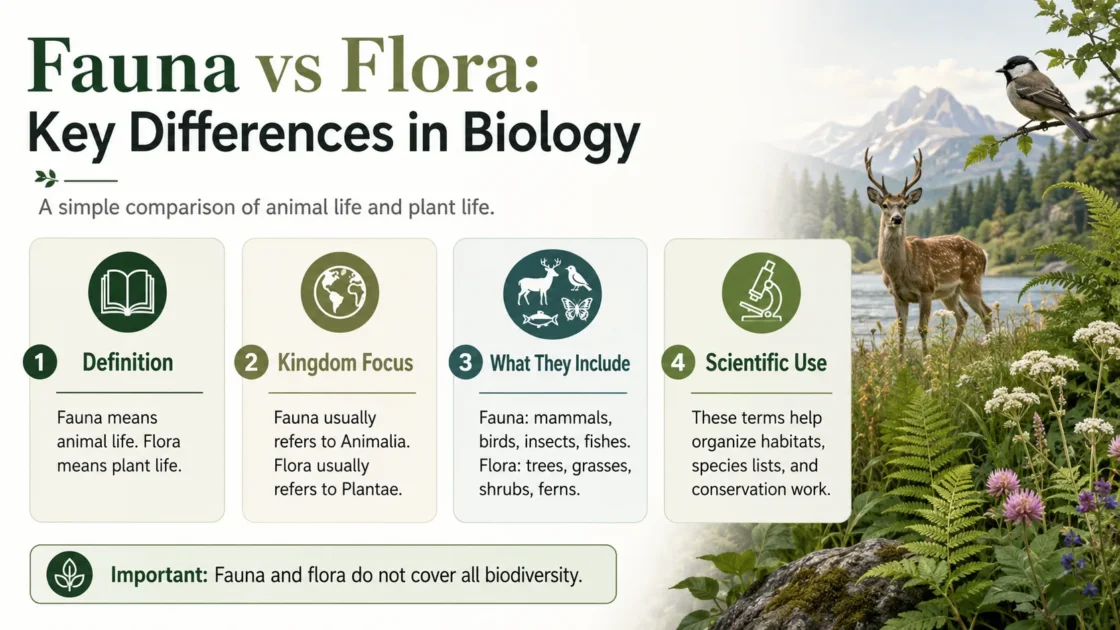
Fauna is the animal life associated with a particular place, habitat, geological period, or other defined scope. Flora is the corresponding plant life. A wetland’s frogs, fish, insects, mollusks, birds, and mammals form part of its fauna, while its reeds, sedges, mosses, shrubs, and trees form part of its flora.
The Difference Is Which Organisms Are Included
Fauna refers collectively to animals rather than to one species or animal group. The term can describe all animal life on Earth, but biologists more often attach it to a boundary such as the fauna of an island, river basin, soil layer, cave system, fossil deposit, or historical period. A faunal account may include vertebrates and invertebrates, from mammals and birds to nematodes, rotifers, insects, corals, and sponges. [a]
Flora works in the same collective way for plants. It may describe the plants growing within a region or habitat, but the capitalized word Flora can also mean a publication or digital resource that identifies and documents the plants of a defined area. A regional Flora may provide accepted names, identification keys, descriptions, habitat information, distributions, and specimen references. [b]
The simplest distinction is therefore correct but incomplete: fauna means animals, while flora means plants. The scientific value of either term depends on the geographic, temporal, taxonomic, and evidence boundaries attached to it.
Flora and Fauna Are Not Taxonomic Ranks
Neither flora nor fauna is a formal rank such as kingdom, phylum, class, order, family, genus, or species. They are collective biological terms used to group organisms by place, time, habitat, research scope, or shared environment. Modern taxonomic systems instead organize named organisms within classifications that distinguish Animalia, Plantae, Fungi, and other lineages. [c]
A Faunal or Floral Boundary Must Be Named
“The fauna of a forest” may mean every documented animal, only vertebrates, only soil invertebrates, or only native species, depending on the study. “The flora of a country” may cover all plants, vascular plants only, flowering plants only, native plants, or both native and introduced plants. A scientifically useful list states these limits rather than relying on the collective term alone.
Fauna and Flora Compared in Biology
| Biological feature | Fauna | Flora |
|---|---|---|
| Basic meaning | The animal life within a defined place, time, habitat, or study scope | The plant life within a defined place, time, habitat, or study scope |
| Broad taxonomic association | Animals classified within Animalia | Plants classified within Plantae, subject to the exact botanical scope used |
| Cell type | Eukaryotic cells without cellulose cell walls or chloroplasts | Eukaryotic cells typically associated with cellulose walls, plastids, and large central vacuoles |
| Carbon and energy | Animals are heterotrophs and obtain organic material from other organisms | Most plants are photoautotrophs, although parasitic and mycoheterotrophic plants are exceptions |
| Movement | Many animals use muscles, cilia, or other structures for locomotion, but some are sessile as adults | Most plants remain rooted or attached, but their organs can grow or move in response to light, gravity, touch, water, and other stimuli |
| Growth pattern | Growth is usually more limited after maturity, although patterns vary widely among animal groups | Growth commonly continues through meristems at roots, shoots, buds, and other growing regions |
| Life-cycle pattern | Most animals have a multicellular diploid body, with the haploid stage mainly restricted to gametes | Plants alternate between multicellular haploid and diploid generations |
| Typical ecosystem positions | Herbivores, predators, parasites, scavengers, filter feeders, pollinators, seed dispersers, burrowers, and ecosystem engineers | Primary producers, habitat-forming organisms, structural cover, food sources, hosts, and regulators of water, soil, and microclimate |
| Common survey evidence | Observations, specimens, tracks, calls, nests, environmental DNA, camera records, acoustic records, and fossils | Living observations, herbarium specimens, vegetation plots, seeds, pollen, environmental DNA, and fossils |
| Groups not automatically included | Plants, fungi, bacteria, archaea, and non-animal protists | Animals, fungi, bacteria, archaea, and organisms outside the stated botanical scope |
The Cell-Level Difference Behind the Terms
Fauna and flora describe groups of organisms, not cell types. Even so, the contrast between typical animal and plant cells explains many of their visible biological differences. Both are eukaryotic and contain a nucleus, plasma membrane, mitochondria, ribosomes, cytoplasm, endoplasmic reticulum, and other shared structures. Typical plant cells also have a cellulose-rich cell wall, plastids such as chloroplasts, and a large central vacuole. Animal cells lack those three defining structures. [d]
Plant Structure Supports Stationary Growth
The plant cell wall resists deformation and provides support. Water entering the central vacuole generates pressure against that wall, helping non-woody tissues remain firm. Because adjacent cells are held within walls, plants usually change position through growth, changes in water pressure, or movement of particular organs rather than whole-body locomotion.
Chloroplasts capture light energy in photosynthetic tissues, but they are not present in every cell of every plant. Root cells, internal storage tissues, and some reproductive tissues may contain other plastid forms instead. A comparison based on “every plant cell has chloroplasts” would therefore be inaccurate.
Animal Cells Permit Flexible Tissues
Without a rigid cellulose wall, animal cells can form flexible membranes, contractile tissues, nerves, digestive surfaces, sensory structures, and moving appendages. Animals still require structural support, but it can come from an extracellular matrix, fluid-filled body cavity, shell, exoskeleton, internal skeleton, or a combination of these systems.
Nutrition Separates Typical Flora from Fauna
Most flora captures energy through photosynthesis. Photosynthetic organisms use light energy to build organic molecules from carbon dioxide and water, making plants primary producers in most terrestrial ecosystems. Animals cannot manufacture organic carbon in this way. Every animal is a heterotroph that obtains carbon and energy directly or indirectly from other organisms. [e]
Herbivorous fauna consumes plants or algae. Carnivores consume other animals. Omnivores use both plant and animal material. Detritivores ingest dead organic matter, while parasites obtain resources from hosts. These feeding categories describe ecological strategies within fauna; they do not move an animal outside Animalia. Animalia remains a multicellular heterotrophic lineage even when a species eats only plant material or carries photosynthetic symbionts. [f]
Not Every Plant Is Self-Feeding
Photosynthesis is a strong general contrast, but it is not an exception-free definition of flora. Some parasitic plants retain chlorophyll and produce part of their own carbon while drawing water or nutrients from host plants. Others lack chlorophyll and obtain organic carbon through direct parasitism or through fungal connections to photosynthetic hosts. They remain plants because classification is based on evolutionary relationships and inherited traits, not on one feeding behavior. [g]
Movement Is a Pattern, Not a Definition
Whole-body movement is common in fauna, but “animals move and plants do not” fails as a strict biological rule. Adult sponges are animals even though they normally remain attached to a substrate. Corals, sea anemones, bryozoans, and many other aquatic animals also spend much or all of adult life fixed in one place. Mobile larvae may provide dispersal before the sessile adult stage begins. [h]
Plants are generally rooted or attached, yet they actively sense and respond to their surroundings. Shoots can grow toward light, roots respond to gravity and moisture, climbing plants coil around supports, flowers open and close, and leaves may change position after touch or changes in light. These are biological movements produced through growth, altered cell pressure, or tissue mechanics rather than animal-style locomotion. [i]
Taxonomy, cellular organization, development, and evolutionary ancestry provide safer distinctions than visible movement alone.
Plant and Animal Life Cycles Follow Different Patterns
Most animals have a diploid-dominant life cycle. The multicellular animal body carries paired chromosome sets, while meiosis produces haploid gametes. Fertilization joins two gametes and restores the diploid condition in the zygote, which develops into another multicellular animal.
Plants alternate between two multicellular generations. The diploid sporophyte produces haploid spores by meiosis. Spores grow into haploid gametophytes, which produce gametes. Fertilization then creates a new diploid sporophyte. The relative size and independence of the two generations differ among mosses, ferns, gymnosperms, and flowering plants, but alternation of generations remains part of the plant life-cycle pattern. [j]
Flora and Fauna Depend on Each Other
The two categories are biologically distinct but ecologically linked. Plants convert incoming energy into organic material that supports herbivores and, through food webs, predators and scavengers. Plant bodies also create nesting surfaces, shade, shelter, water-retaining ground layers, woody cavities, root systems, and three-dimensional habitat.
Animals alter flora through herbivory, pollination, seed transport, trampling, burrowing, nutrient movement, and selective feeding. Some fauna consumes seeds, seedlings, leaves, roots, wood, nectar, pollen, sap, or fruit. Other animals move pollen or seeds between separated plants. The outcome may benefit a plant, damage it, or vary with animal density, season, and environmental conditions.
At ecosystem scale, photoautotrophs provide much of the energy entering food webs. Animals then transfer matter and energy among trophic levels through feeding, digestion, movement, excretion, reproduction, and death. Flora and fauna are therefore not independent lists placed side by side; they are interacting parts of the same biological community. [k]
Fungi and Microorganisms Do Not Fit the Traditional Pair
The phrase “flora and fauna” does not cover all life. Fungi are neither plants nor animals in modern biological classification. They form a separate evolutionary lineage with their own cellular, nutritional, reproductive, and ecological traits. Treating mushrooms, molds, and other fungi as flora preserves an older convention rather than current taxonomy.
The term funga is increasingly used for the fungal diversity of a place, parallel to flora and fauna. IUCN fungal specialists and partner organizations have supported language that explicitly names fungi instead of allowing them to disappear inside a plant-and-animal description of biodiversity. [l]
Bacteria and archaea also fall outside fauna and flora. The older term microflora may still appear in medicine, food science, or historical literature, but microbiota is more accurate for a community of microorganisms because bacteria are not plants. Protozoan and algal groups require their own stated taxonomic treatment rather than automatic placement in fauna or flora.
Biota Is the Broader Collective Term
When the intended scope includes animals, plants, fungi, microorganisms, and other living groups, biota is broader than either fauna or flora. Biodiversity extends further by including variation within species, among species, and across ecosystems.
The Meaning Changes With Place, Time, and Evidence
Fauna and flora are incomplete terms until their boundaries are supplied. The same landscape can have a native flora, introduced flora, vascular flora, bryophyte flora, breeding-bird fauna, freshwater fauna, cave fauna, soil fauna, or fossil fauna. Each phrase selects a different part of the living or historical community.
Geographic Scope
A boundary may follow a political unit, island, watershed, mountain range, protected area, marine zone, elevation band, soil horizon, or habitat patch. Political and ecological boundaries do not always match. A national fauna may combine organisms from several biomes, while a river fauna may cross several administrative regions.
Temporal Scope
The organisms present in a place change through migration, colonization, local extinction, climate shifts, habitat conversion, introductions, and taxonomic revision. Paleontologists can describe the fauna or flora of a fossil formation, while ecologists may compare historical records with a present-day survey. A list without a date or period cannot show which biological community it represents.
Taxonomic Scope
A study labeled “fauna” may cover every animal group or only mammals, birds, fishes, insects, soil invertebrates, or another selected assemblage. A flora may include all accepted plants within its chosen classification or restrict itself to vascular plants, flowering plants, trees, aquatic plants, or another botanical group. The title and methods should make the selection explicit.
Evidence Scope
A regional list may combine preserved specimens, literature records, verified observations, environmental DNA, acoustic detections, photographs, fossils, and historical collections. These evidence types do not have equal spatial or temporal precision. An occurrence record documents reported evidence of an organism at a place and usually a date; it does not by itself prove continuous presence throughout the surrounding region. [m]
Why the Distinction Matters in Biological Surveys
Separating fauna from flora allows researchers to use methods suited to different organisms. Plants can often be documented through fixed plots, transects, herbarium vouchers, leaf or flower characters, and repeated vegetation measurements. Animals may require camera traps, nets, traps, visual counts, call surveys, tracks, scat, underwater sampling, or nocturnal observations.
Detection also differs. A rooted plant may remain observable for a season or many years, while an animal may migrate, hide underground, become active only at night, or avoid observers. Plant detectability changes with flowering, leaf emergence, dormancy, and life stage. These differences affect how complete a flora or fauna inventory can be.
Taxonomic updates can alter both lists without any ecological change. A species may be split, merged, renamed, moved to another genus, or treated as a synonym. A defensible flora or fauna therefore records the taxonomic source, version or access date, geographic boundary, evidence rules, and treatment of native, introduced, extinct, doubtful, and unverified records.
Sources and Verification
- [a] Australian Museum — What is fauna? — Used for the definition of fauna as animal life associated with a region or time and its use for animal assemblages.
- [b] Royal Botanic Gardens, Kew — Minting a new Flora — Used to distinguish the plant life of an area from a capitalized Flora that documents its plant species.
- [c] Catalogue of Life — Used to verify that Animalia, Plantae, Fungi, and other lineages are handled as separate taxonomic groups rather than as the collective terms fauna and flora.
- [d] OpenStax Biology 2e — Eukaryotic Cells — Used for the shared features of eukaryotic cells and the cell wall, plastid, chloroplast, and central-vacuole differences between typical plant and animal cells.
- [e] OpenStax Biology 2e — Overview of Photosynthesis — Used for photoautotrophic energy capture and the heterotrophic dependence of animals on organic material produced by other organisms.
- [f] Animal Diversity Web — Animalia — Used for the multicellular, heterotrophic, wall-free cellular traits associated with Animalia.
- [g] USDA Forest Service — What Are Mycotrophic Wildflowers? — Used for non-photosynthetic parasitic and mycoheterotrophic plants that obtain organic carbon from other organisms.
- [h] OpenStax Biology 2e — Phylum Porifera — Used to verify that adult sponges are animals despite normally remaining attached to a fixed substrate.
- [i] OpenStax Biology 2e — Plant Sensory Systems and Responses — Used for plant detection of light, gravity, temperature, and touch and for growth responses such as phototropism.
- [j] NCBI Bookshelf — Plant Life Cycles — Used for alternation between multicellular haploid gametophyte and diploid sporophyte generations in plants.
- [k] OpenStax Biology 2e — Energy Flow through Ecosystems — Used for the entry of photoautotrophic energy into food webs and its transfer among organisms and trophic levels.
- [l] IUCN — Recognition of Fungi Alongside Fauna and Flora — Used for the separation of fungi from plants and animals and the adoption of funga-inclusive conservation language.
- [m] GBIF IPT User Manual — Occurrence Data — Used for the definition of occurrence data as evidence of an organism at a stated place and normally a stated date.
Related Topics
- → What Is Fauna? Meaning, Examples, and Scientific Use
- → Wildlife vs Fauna: What Is the Difference?
- → Native Fauna Explained: Meaning and Examples
- → Regional Fauna Explained: How Animal Life Changes by Geography
- → Aquatic Fauna Explained: Freshwater and Marine Animal Life
- → Terrestrial Fauna Explained: Land Animals and Their Habitats