Complete guides: •What Is Fauna?
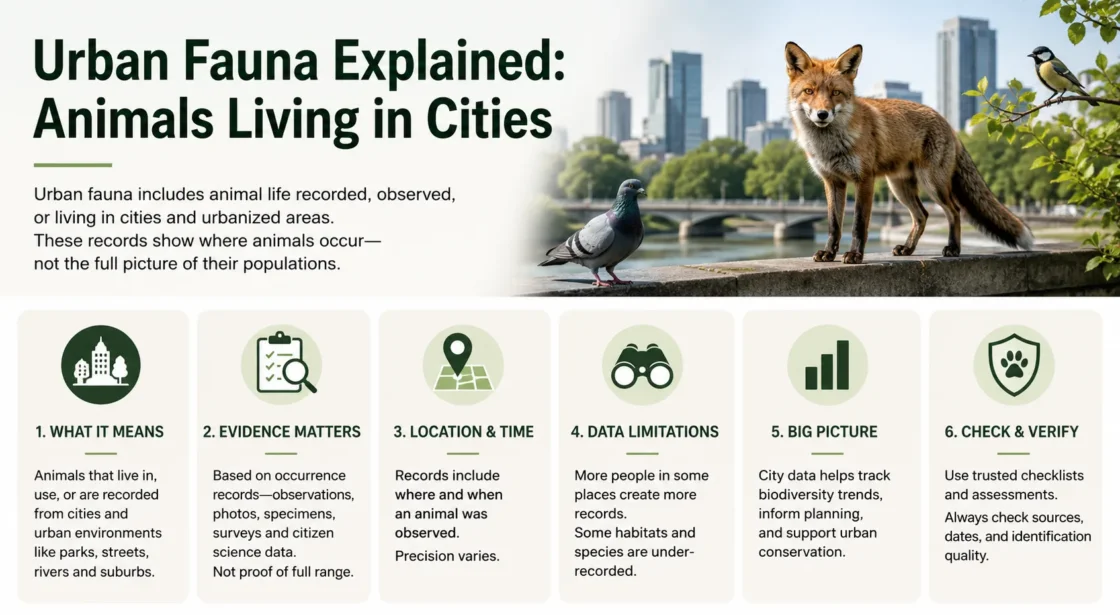
Urban fauna is the community of wild, introduced and free-ranging animals that uses a city for food, shelter, movement, breeding or seasonal passage. It includes far more than pigeons, rats and foxes: insects in street-tree canopies, bats in bridge joints, fish in restored rivers, amphibians in stormwater wetlands and migratory birds stopping in small parks may all belong to a city’s fauna. The composition is local, changes over time and cannot be represented by one universal list of “city animals.”
What Belongs in Urban Fauna
The term is ecological rather than taxonomic. An urban-fauna inventory may include mammals, birds, reptiles, amphibians, fish, mollusks, crustaceans, spiders, insects and other invertebrates. The defining question is not whether an animal looks wild, but how its presence relates to the city and what evidence supports that relationship.
| Record category | Relationship to the city | Evidence that supports inclusion | Frequent classification error |
|---|---|---|---|
| Resident wild population | Feeds, shelters and reproduces within the urban boundary. | Repeated observations across seasons, nests or dens, juveniles, acoustic detections, camera records or specimens. | Treating a familiar species as present without a dated local record. |
| Seasonal or migratory user | Uses city habitats during migration, winter, drought, flooding or another recurring period. | Dated observations showing a seasonal pattern or repeated use of stopover habitat. | Calling a passage migrant a breeding resident. |
| Urban-edge visitor | Enters neighborhoods from nearby forest, grassland, coast, farmland or wetland but may not maintain an urban population. | Verified observations paired with habitat context and, where possible, movement evidence. | Assuming one sighting proves permanent establishment. |
| Introduced or naturalized population | Maintains a self-sustaining population outside its native range. | Repeated records, breeding evidence and an accepted regional status source. | Using “introduced” and “invasive” as synonyms. |
| Feral or free-ranging domestic population | Domestic ancestry, but individuals live partly or fully outside direct human control. | Field observations that distinguish owned, unowned, colony-managed and feral animals where possible. | Combining pets, strays and established feral populations into one ecological category. |
| Captive or managed animal | Kept in a zoo, collection, farm, aquarium or enclosed display. | Management records rather than wild-occurrence evidence. | Adding captive animals to a city wildlife checklist unless escapes or free-living populations are the subject. |
“Synanthropic” describes animals that live in close association with people and benefit from human-made conditions. Some are strongly dependent on buildings, refuse, stored food or heated spaces; others merely tolerate these features. Synanthropy is therefore one relationship within urban fauna, not a replacement term for every animal recorded in a city.
A City Is a Habitat Mosaic, Not a Single Habitat
City boundaries contain habitat remnants, managed vegetation, buildings, transport corridors, waterways, gardens and neglected land. These places differ in temperature, moisture, vegetation structure, pollution, disturbance and connectivity. A species may fail in the paved center yet persist in a cemetery, rail verge, river corridor or old industrial site a few blocks away.
A review of urban refugia reported animals using urban forests and grasslands, parks, cemeteries, abandoned land, railway vegetation, water bodies and built areas across more than one hundred cities. The review also found that animal studies were concentrated in some habitat types and taxonomic groups, so the published record should not be treated as equal coverage of all city fauna.[a]
| Urban habitat | Animal use | Fauna commonly detected | Conditions that change its value |
|---|---|---|---|
| Remnant forest, grassland or scrub | Breeding habitat, cover, foraging and movement between larger natural areas. | Woodland and grassland birds, small mammals, reptiles, soil fauna, pollinators and predatory arthropods. | Patch size, native vegetation, edge exposure, isolation, mowing and invasive plants. |
| Parks, cemeteries and institutional grounds | Tree cover, lawns, flower resources, ponds and relatively stable open space. | Birds, bats, squirrels and other small mammals, bees, butterflies, beetles and earth-dwelling invertebrates. | Pesticides, irrigation, deadwood removal, lighting, visitor pressure and planting choices. |
| Gardens, street trees and courtyards | Fine-scale stepping stones for feeding, nesting and refuge. | Small birds, urban-tolerant bats, lizards, spiders, pollinators and leaf-feeding insects. | Plant diversity, structural layers, pruning, pet access and connection to nearby vegetation. |
| Buildings, roofs, bridges and walls | Artificial cliffs, cavities, ledges, warm roosts and protected nest sites. | Cliff-nesting birds, crevice-roosting bats, geckos, wall lizards, spiders and cavity-using insects. | Renovation timing, sealed openings, surface temperature, façade design and nighttime lighting. |
| Rivers, canals, ponds and stormwater systems | Drinking, breeding, aquatic habitat and linear movement through the city. | Fish, amphibians, aquatic insects, mollusks, waterbirds and semi-aquatic mammals where regional ranges allow. | Water quality, bank structure, flow alteration, barriers, fish stocking and hydroperiod. |
| Vacant lots, brownfields and rail corridors | Early-successional vegetation, warm bare ground, low-intensity refuge and movement routes. | Ground-nesting insects, spiders, reptiles, seed-eating birds and small mammals. | Soil contamination, redevelopment, vegetation age, disturbance frequency and corridor continuity. |
| Indoor and underground spaces | Stable temperature, food, moisture and shelter from weather or predators. | Commensal rodents, cockroaches, flies, moths, silverfish, mites, spiders and sewer-associated invertebrates. | Building condition, sanitation, heating, drainage and access points. |
Cities Filter the Regional Species Pool
Every city begins with a regional species pool shaped by climate, geography and evolutionary history. Urban development then filters that pool. Habitat specialists may lose nesting sites or food plants; mobile generalists may cross fragmented landscapes; cavity users may substitute buildings for cliffs or old trees; species sensitive to people, traffic or light may retreat to the edge.
Ecologists often describe these responses as urban avoidance, adaptation or exploitation. The terminology is useful for comparing patterns, but later research has warned that labels can hide variation among cities, seasons and spatial scales.[b]
| Response pattern | Typical urban pattern | Traits often associated with the response | What the label cannot prove |
|---|---|---|---|
| Urban avoider | Declines or disappears as built cover and disturbance rise. | Narrow habitat needs, specialized diet, large area requirements, low tolerance of people or dependence on sensitive breeding sites. | That the species never enters cities or cannot use a well-connected urban refuge. |
| Urban adapter | Persists mainly in suburbs, parks, gardens, waterways or mixed low-density development. | Some flexibility in food and shelter, moderate mobility and ability to use both natural and human-made features. | That the species benefits from the most densely built parts of a city. |
| Urban exploiter | Can reach high densities in heavily modified places and may depend on human resources. | Broad diet, flexible nesting or denning, rapid reproduction in some taxa, tolerance of disturbance and use of buildings or waste. | That the species is native, harmless, equally successful in every city or free from urban mortality. |
Urban Response Labels Are Context Dependent
A species may act as an adapter in one city and an avoider in another because climate, building form, vegetation, predators, food subsidies and management differ. Classification should be based on measured response along a stated urban gradient, not reputation.
There Is No Single Trait for Urban Success
A global study assembled records for 5,302 species from more than 70,000 plots in 379 cities across 48 countries. It covered amphibians, bats, bees, birds, carabid beetles and reptiles. Rather than finding one universal urban type, the researchers identified several combinations of traits associated with persistence under different urban conditions.[c]
Flexible Resources
Animals that can switch foods, forage in several vegetation layers or use both natural and artificial shelters may cope with rapid changes in resource availability. Flexibility does not mean that all human food is beneficial. Refuse and deliberate feeding can produce dense aggregations, poor nutrition, altered movement and conflict.
Movement at the Right Scale
Flight can help birds, bats and insects cross roads and buildings, but mobility alone does not guarantee persistence. A highly mobile animal still needs feeding and breeding sites within reachable distance. Less mobile reptiles, amphibians and ground invertebrates can survive where small habitat patches remain connected and road barriers are limited.
Tolerance, Learning and Timing
Individuals may learn traffic schedules, shift activity toward quieter hours, use new structures or tolerate closer human approach. These responses can reduce some costs while creating others. Nocturnal activity may avoid people but expose animals to artificial light; bold foraging may secure food but increase collision or control risk.
Reproduction and Shelter
Species that can breed in small territories, use cavities or exploit repeated structural features may find many urban nest or den sites. Other animals need seasonal wetlands, mature tree hollows, quiet colonies, host plants or large connected territories. For them, abundant food cannot compensate for the loss of a required breeding feature.
High Species Counts Do Not Mean an Intact Fauna
Cities can retain native species and sometimes support locally high richness, especially where parks, gardens, waterways and habitat remnants create varied conditions. A global analysis of birds and plants nevertheless found that urbanization alters biodiversity and community composition even where many regional species remain.[d]
Species richness also depends on the taxonomic group, the size of the study area and the intensity of development. A review of 105 non-bird studies found that extreme urbanization generally reduced richness, while moderate urbanization produced mixed responses among plants, invertebrates and vertebrates.[e]
The number of species is only one measure. A city may gain introduced generalists while losing native specialists, producing a longer list but a less distinctive community. This process is often described as biotic homogenization: distant cities become more similar because the same adaptable species recur while locally characteristic fauna declines. U.S. Forest Service research also emphasizes that habitat removal and fragmentation filter many specialists while urban outcomes remain highly variable.[f]
An urban-fauna assessment should report native status, habitat dependence, breeding evidence and community composition alongside the raw species total.
Behavioral Change Is Not Automatically Evolution
City animals often change when they feed, how far they flee, where they nest or which routes they use. These shifts may be learned behavior, short-term physiological adjustment, developmental change, sorting of tolerant individuals into cities or inherited genetic change. Observing a behavioral difference between urban and rural animals does not by itself identify the mechanism.
Urban evolution research examines whether repeated city pressures alter heritable traits across generations. Conflict management can become part of that pressure: removing the boldest, most visible or most conflict-prone individuals may change which animals survive and reproduce. A cross-disciplinary review links human decisions, wildlife management and urban evolutionary processes while stressing that outcomes differ by species, place and policy.[g]
Light, Noise, Heat and Pollution Alter Daily Life
Urban animals experience environmental conditions that differ from nearby rural habitats. Artificial light extends illuminated periods and can change orientation, activity, migration, predator–prey encounters and reproduction. Traffic and machinery mask acoustic signals. Heat-retaining surfaces alter thermal refuges and water demand. Chemical pollution can affect physiology directly or change prey and plant communities.
Responses are not identical across taxa. Some predators forage around lights where insects gather; other species avoid lit areas or become disoriented. A National Park Service synthesis describes effects of artificial light across animals, plants, soils and ecological interactions, including cases where the response of a pest or disease vector differs from that of other wildlife.[h]
Roads, Glass, Drainage and Waste Reshape Survival
Built infrastructure affects fauna through more than habitat loss. Roads divide territories, restrict dispersal and cause direct mortality. Transparent or reflective glass creates collision hazards, especially for birds that perceive reflections or a view through glass as open habitat. U.S. Geological Survey guidance identifies window collisions as a major source of bird mortality in both urban and non-urban buildings.[n] Smooth-walled drains can trap amphibians, reptiles and small mammals. Channelized streams remove shallow margins and refuge. Roofs and paved surfaces accelerate runoff, changing flow and water quality downstream.
Even familiar urban exploiters remain exposed. A study along a United Kingdom urban–rural gradient found that road density strongly influenced roadkill risk and that pigeons and gulls had more urban roadkill risk than their mapped live distributions predicted. The result is regional and taxon-specific, but it shows why urban abundance should not be confused with safety from infrastructure.[i]
Human food changes city fauna at several levels. Accessible refuse, outdoor pet food, feeding stations and poorly secured compost can increase carrying capacity for a few adaptable species. Their higher density may then affect nesting birds, small vertebrates, invertebrates, disease transmission, property damage and public tolerance. Removing attractants usually addresses the cause more directly than repeatedly removing animals after conflict occurs.
Urban Wildlife, Health and Conflict
Wildlife presence is not the same as disease transmission. Health risk depends on the host, pathogen, route of exposure, animal density, sanitation, vectors and human behavior. Urbanization can reduce some parasites while increasing transmission among certain urban-adapted hosts. A review of urban wildlife disease ecology found both patterns and cautioned against treating all city wildlife as a uniform disease threat.[j]
Conflict is equally context dependent. The same species may be valued as a pollinator, predator or cultural symbol in one setting and treated as a nuisance in another. Common triggers include unsecured waste, feeding, access to roof voids, denning under structures, predation on pets or poultry, vehicle collisions and fear generated by close encounters.
- Confirm the species and whether animals are breeding, passing through or using a temporary food source.
- Remove or secure attractants before using population-control measures.
- Block building access only after checking for dependent young, seasonal roosts and legal protection.
- Use barriers, crossing design, speed reduction and vegetation placement to address collision sites.
- Separate verified health guidance from assumptions based on an animal’s presence.
- Monitor results because animals may shift routes or activity after management changes.
Small and Unplanned Spaces Can Hold Distinct Fauna
Large protected areas usually provide habitat that small patches cannot replace, especially for disturbance-sensitive species. Small sites can still add different resources and improve movement through a city. Their value often comes from variation: one park may contain mature trees, another wet ground, another open flowers and bare soil.
A multi-city bird study found that collections of small urban parks could support more species in total, greater turnover among parks and more rare species than a single park with the same combined area. That result does not mean small parks always replace large ones; it shows that habitat complementarity across several sites can add fauna that one uniform space may not hold.[k]
Vacant lots, old cemeteries, railway margins, drainage channels and brownfields are often omitted from public biodiversity maps. Some support early-successional plants, warm microhabitats, nesting substrate or low-disturbance cover that is scarce in highly managed parks. Their fauna should be surveyed before redevelopment rather than inferred from land-use labels alone.
How Urban Fauna Is Documented
No single survey method detects every animal group. Bird point counts miss many nocturnal mammals; camera traps miss small insects and most canopy fauna; acoustic monitors favor animals that vocalize; pitfall traps sample only part of the ground-active community; environmental DNA can detect biological material without proving the number of living individuals present.
- Direct observation: timed counts, transects, nest searches, spotlight surveys and visual encounter surveys.
- Remote sensing of animals: camera traps, passive acoustic recorders, bat detectors and thermal imaging.
- Capture or collection: live traps, pitfall traps, light traps, nets and voucher specimens under suitable permits.
- Trace evidence: tracks, droppings, pellets, hair, shells, burrows, feeding marks and environmental DNA.
- Historical evidence: museum specimens, archived surveys, ringing or banding records and dated photographs.
- Public observations: verified citizen-science records, local monitoring projects and structured bioblitzes.
GBIF defines an occurrence record as evidence that a taxon occurred at a particular place on a specified date. Its data requirements emphasize fields such as scientific name, event date, basis of record, coordinates and coordinate uncertainty. An occurrence is evidence of a reported event; it is not automatically a population estimate, breeding record or complete distribution map.[l]
Dense Records May Reflect Dense Observation
Parks, wealthy neighborhoods, university grounds and easily identified birds may receive more attention than industrial land, private property, nocturnal invertebrates or difficult taxa. GBIF documentation identifies taxonomic, geographic, temporal and environmental bias as recurring limitations in primary biodiversity data.[m]
Fields Needed for a Defensible City Checklist
| Field | Why it matters | Minimum useful form |
|---|---|---|
| Accepted scientific name | Connects common names and older records to a defined taxon. | Name matched to a stated taxonomic source and date. |
| Record date or interval | Separates historical presence from current evidence and reveals seasonality. | Exact date where available; otherwise the narrowest supported interval. |
| Location and uncertainty | Shows whether the record falls inside the stated urban boundary and how precise it is. | Coordinates or mapped locality with coordinate uncertainty or locality precision. |
| Basis of record | Distinguishes observation, specimen, sound, image, DNA detection and literature record. | A standard record type linked to its evidence. |
| Identification support | Allows difficult or unusual records to be checked. | Voucher, photograph, sound file, diagnostic description or qualified determination. |
| Urban relationship | Separates resident, breeding, seasonal, transient, edge-visitor and captive records. | One evidence-based category with notes where status is uncertain. |
| Biogeographic status | Prevents native, endemic, introduced, naturalized, feral and invasive from being merged. | Status from a regional authority, with assessment scope and date. |
| Breeding evidence | Distinguishes reproduction within the city from presence alone. | Nest, eggs, dependent young, larval habitat, maternity roost or another taxon-appropriate sign. |
| Habitat association | Connects the animal to the feature it actually used. | Observed substrate, vegetation, water body, building feature or land-cover context. |
| Verification status | Keeps uncertain reports visible without presenting them as confirmed. | Verified, provisional, rejected or awaiting review, with reviewer or rule recorded. |
Why One Global List of City Animals Would Be Misleading
A tropical coastal city, an inland desert city and a northern industrial city do not draw from the same regional fauna. Building materials, winter heating, rainfall, river condition, tree cover, age of development and surrounding land use further change which animals can enter and persist. The same common name may also refer to different species in different regions.
City boundaries create another problem. Administrative limits may include reservoirs, farmland, coastal marshes or mountain slopes that are not urbanized, while the ecological urban area may extend across several municipalities. A checklist must therefore state whether it covers the legal city, the built footprint, a metropolitan region, an urban–rural gradient or selected habitat patches.
Time matters as much as space. Redevelopment can remove a breeding site in one season; river restoration can allow aquatic fauna to return; a newly introduced species may establish; migration conditions can produce an unusual influx; taxonomy may split one listed species into several. A credible urban-fauna page needs a date range and update rule rather than presenting the list as permanent.
Managing Cities for More Than a Few Urban Exploiters
Urban fauna becomes more diverse when planning protects the ecological requirements of species that cannot live on refuse, buildings and lawns alone. The first priority is retaining existing habitat remnants, mature trees, wetlands, river margins and breeding structures. Newly planted habitat takes time to develop and may not replace old tree cavities, intact soil or long-established aquatic communities.
- Connect habitat patches with vegetated streets, riparian corridors, rail margins, culverts and safe crossings suited to the target taxa.
- Use regionally appropriate native plants that provide host relationships, seeds, fruit, nectar and layered cover across seasons.
- Retain some deadwood, leaf litter, bare ground, dense vegetation and natural bank structure where safety allows.
- Reduce unnecessary nighttime lighting, shield required lights and avoid illuminating nesting, roosting, migration and wetland habitat.
- Lower collision risk through bird-safe glass, road design, crossing structures, speed management and drain escape features.
- Improve waste storage and limit deliberate feeding that concentrates adaptable animals.
- Manage free-ranging cats and dogs in ways that reduce predation and disturbance around wildlife habitat.
- Monitor mammals, birds, reptiles, amphibians, fish and invertebrates rather than using one familiar group as a proxy for all fauna.
- Publish dated records with methods, taxonomic references and uncertainty so changes can be measured rather than assumed.
The goal is not to maximize every animal population. It is to retain native ecological relationships, reduce avoidable mortality, prevent harmful concentrations and give regionally characteristic species enough connected habitat to complete their life cycles within or through the city.
Sources and Verification
- [a] Urban refugia sheltering biodiversity across world cities — Used for the range of urban habitat types reported as biodiversity refuges and the uneven research coverage among taxa and habitats.
-
[b]
Categorizing wildlife responses
Urban fauna is the community of wild, introduced and free-ranging animals that uses a city for food, shelter, movement, breeding or seasonal passage. It includes far more than pigeons, rats and foxes: insects in street-tree canopies, bats in bridge joints, fish in restored rivers, amphibians in stormwater wetlands and migratory birds stopping in small parks may all belong to a city’s fauna. The composition is local, changes over time and cannot be represented by one universal list of “city animals.”
What Belongs in Urban Fauna
The term is ecological rather than taxonomic. An urban-fauna inventory may include mammals, birds, reptiles, amphibians, fish, mollusks, crustaceans, spiders, insects and other invertebrates. The defining question is not whether an animal looks wild, but how its presence relates to the city and what evidence supports that relationship.
Record category Relationship to the city Evidence that supports inclusion Frequent classification error Resident wild population Feeds, shelters and reproduces within the urban boundary. Repeated observations across seasons, nests or dens, juveniles, acoustic detections, camera records or specimens. Treating a familiar species as present without a dated local record. Seasonal or migratory user Uses city habitats during migration, winter, drought, flooding or another recurring period. Dated observations showing a seasonal pattern or repeated use of stopover habitat. Calling a passage migrant a breeding resident. Urban-edge visitor Enters neighborhoods from nearby forest, grassland, coast, farmland or wetland but may not maintain an urban population. Verified observations paired with habitat context and, where possible, movement evidence. Assuming one sighting proves permanent establishment. Introduced or naturalized population Maintains a self-sustaining population outside its native range. Repeated records, breeding evidence and an accepted regional status source. Using “introduced” and “invasive” as synonyms. Feral or free-ranging domestic population Domestic ancestry, but individuals live partly or fully outside direct human control. Field observations that distinguish owned, unowned, colony-managed and feral animals where possible. Combining pets, strays and established feral populations into one ecological category. Captive or managed animal Kept in a zoo, collection, farm, aquarium or enclosed display. Management records rather than wild-occurrence evidence. Adding captive animals to a city wildlife checklist unless escapes or free-living populations are the subject. “Synanthropic” describes animals that live in close association with people and benefit from human-made conditions. Some are strongly dependent on buildings, refuse, stored food or heated spaces; others merely tolerate these features. Synanthropy is therefore one relationship within urban fauna, not a replacement term for every animal recorded in a city.
A City Is a Habitat Mosaic, Not a Single Habitat
City boundaries contain habitat remnants, managed vegetation, buildings, transport corridors, waterways, gardens and neglected land. These places differ in temperature, moisture, vegetation structure, pollution, disturbance and connectivity. A species may fail in the paved center yet persist in a cemetery, rail verge, river corridor or old industrial site a few blocks away.
A review of urban refugia reported animals using urban forests and grasslands, parks, cemeteries, abandoned land, railway vegetation, water bodies and built areas across more than one hundred cities. The review also found that animal studies were concentrated in some habitat types and taxonomic groups, so the published record should not be treated as equal coverage of all city fauna.[a]
Urban habitat Animal use Fauna commonly detected Conditions that change its value Remnant forest, grassland or scrub Breeding habitat, cover, foraging and movement between larger natural areas. Woodland and grassland birds, small mammals, reptiles, soil fauna, pollinators and predatory arthropods. Patch size, native vegetation, edge exposure, isolation, mowing and invasive plants. Parks, cemeteries and institutional grounds Tree cover, lawns, flower resources, ponds and relatively stable open space. Birds, bats, squirrels and other small mammals, bees, butterflies, beetles and earth-dwelling invertebrates. Pesticides, irrigation, deadwood removal, lighting, visitor pressure and planting choices. Gardens, street trees and courtyards Fine-scale stepping stones for feeding, nesting and refuge. Small birds, urban-tolerant bats, lizards, spiders, pollinators and leaf-feeding insects. Plant diversity, structural layers, pruning, pet access and connection to nearby vegetation. Buildings, roofs, bridges and walls Artificial cliffs, cavities, ledges, warm roosts and protected nest sites. Cliff-nesting birds, crevice-roosting bats, geckos, wall lizards, spiders and cavity-using insects. Renovation timing, sealed openings, surface temperature, façade design and nighttime lighting. Rivers, canals, ponds and stormwater systems Drinking, breeding, aquatic habitat and linear movement through the city. Fish, amphibians, aquatic insects, mollusks, waterbirds and semi-aquatic mammals where regional ranges allow. Water quality, bank structure, flow alteration, barriers, fish stocking and hydroperiod. Vacant lots, brownfields and rail corridors Early-successional vegetation, warm bare ground, low-intensity refuge and movement routes. Ground-nesting insects, spiders, reptiles, seed-eating birds and small mammals. Soil contamination, redevelopment, vegetation age, disturbance frequency and corridor continuity. Indoor and underground spaces Stable temperature, food, moisture and shelter from weather or predators. Commensal rodents, cockroaches, flies, moths, silverfish, mites, spiders and sewer-associated invertebrates. Building condition, sanitation, heating, drainage and access points. Cities Filter the Regional Species Pool
Every city begins with a regional species pool shaped by climate, geography and evolutionary history. Urban development then filters that pool. Habitat specialists may lose nesting sites or food plants; mobile generalists may cross fragmented landscapes; cavity users may substitute buildings for cliffs or old trees; species sensitive to people, traffic or light may retreat to the edge.
Ecologists often describe these responses as urban avoidance, adaptation or exploitation. The terminology is useful for comparing patterns, but later research has warned that labels can hide variation among cities, seasons and spatial scales.[b]
Response pattern Typical urban pattern Traits often associated with the response What the label cannot prove Urban avoider Declines or disappears as built cover and disturbance rise. Narrow habitat needs, specialized diet, large area requirements, low tolerance of people or dependence on sensitive breeding sites. That the species never enters cities or cannot use a well-connected urban refuge. Urban adapter Persists mainly in suburbs, parks, gardens, waterways or mixed low-density development. Some flexibility in food and shelter, moderate mobility and ability to use both natural and human-made features. That the species benefits from the most densely built parts of a city. Urban exploiter Can reach high densities in heavily modified places and may depend on human resources. Broad diet, flexible nesting or denning, rapid reproduction in some taxa, tolerance of disturbance and use of buildings or waste. That the species is native, harmless, equally successful in every city or free from urban mortality. Urban Response Labels Are Context Dependent
A species may act as an adapter in one city and an avoider in another because climate, building form, vegetation, predators, food subsidies and management differ. Classification should be based on measured response along a stated urban gradient, not reputation.
There Is No Single Trait for Urban Success
A global study assembled records for 5,302 species from more than 70,000 plots in 379 cities across 48 countries. It covered amphibians, bats, bees, birds, carabid beetles and reptiles. Rather than finding one universal urban type, the researchers identified several combinations of traits associated with persistence under different urban conditions.[c]
Flexible Resources
Animals that can switch foods, forage in several vegetation layers or use both natural and artificial shelters may cope with rapid changes in resource availability. Flexibility does not mean that all human food is beneficial. Refuse and deliberate feeding can produce dense aggregations, poor nutrition, altered movement and conflict.
Movement at the Right Scale
Flight can help birds, bats and insects cross roads and buildings, but mobility alone does not guarantee persistence. A highly mobile animal still needs feeding and breeding sites within reachable distance. Less mobile reptiles, amphibians and ground invertebrates can survive where small habitat patches remain connected and road barriers are limited.
Tolerance, Learning and Timing
Individuals may learn traffic schedules, shift activity toward quieter hours, use new structures or tolerate closer human approach. These responses can reduce some costs while creating others. Nocturnal activity may avoid people but expose animals to artificial light; bold foraging may secure food but increase collision or control risk.
Reproduction and Shelter
Species that can breed in small territories, use cavities or exploit repeated structural features may find many urban nest or den sites. Other animals need seasonal wetlands, mature tree hollows, quiet colonies, host plants or large connected territories. For them, abundant food cannot compensate for the loss of a required breeding feature.
High Species Counts Do Not Mean an Intact Fauna
Cities can retain native species and sometimes support locally high richness, especially where parks, gardens, waterways and habitat remnants create varied conditions. A global analysis of birds and plants nevertheless found that urbanization alters biodiversity and community composition even where many regional species remain.[d]
Species richness also depends on the taxonomic group, the size of the study area and the intensity of development. A review of 105 non-bird studies found that extreme urbanization generally reduced richness, while moderate urbanization produced mixed responses among plants, invertebrates and vertebrates.[e]
The number of species is only one measure. A city may gain introduced generalists while losing native specialists, producing a longer list but a less distinctive community. This process is often described as biotic homogenization: distant cities become more similar because the same adaptable species recur while locally characteristic fauna declines. U.S. Forest Service research also emphasizes that habitat removal and fragmentation filter many specialists while urban outcomes remain highly variable.[f]
An urban-fauna assessment should report native status, habitat dependence, breeding evidence and community composition alongside the raw species total.
Behavioral Change Is Not Automatically Evolution
City animals often change when they feed, how far they flee, where they nest or which routes they use. These shifts may be learned behavior, short-term physiological adjustment, developmental change, sorting of tolerant individuals into cities or inherited genetic change. Observing a behavioral difference between urban and rural animals does not by itself identify the mechanism.
Urban evolution research examines whether repeated city pressures alter heritable traits across generations. Conflict management can become part of that pressure: removing the boldest, most visible or most conflict-prone individuals may change which animals survive and reproduce. A cross-disciplinary review links human decisions, wildlife management and urban evolutionary processes while stressing that outcomes differ by species, place and policy.[g]
Light, Noise, Heat and Pollution Alter Daily Life
Urban animals experience environmental conditions that differ from nearby rural habitats. Artificial light extends illuminated periods and can change orientation, activity, migration, predator–prey encounters and reproduction. Traffic and machinery mask acoustic signals. Heat-retaining surfaces alter thermal refuges and water demand. Chemical pollution can affect physiology directly or change prey and plant communities.
Responses are not identical across taxa. Some predators forage around lights where insects gather; other species avoid lit areas or become disoriented. A National Park Service synthesis describes effects of artificial light across animals, plants, soils and ecological interactions, including cases where the response of a pest or disease vector differs from that of other wildlife.[h]
Roads, Glass, Drainage and Waste Reshape Survival
Built infrastructure affects fauna through more than habitat loss. Roads divide territories, restrict dispersal and cause direct mortality. Transparent or reflective glass creates collision hazards, especially for birds that perceive reflections or a view through glass as open habitat. U.S. Geological Survey guidance identifies window collisions as a major source of bird mortality in both urban and non-urban buildings.[n] Smooth-walled drains can trap amphibians, reptiles and small mammals. Channelized streams remove shallow margins and refuge. Roofs and paved surfaces accelerate runoff, changing flow and water quality downstream.
Even familiar urban exploiters remain exposed. A study along a United Kingdom urban–rural gradient found that road density strongly influenced roadkill risk and that pigeons and gulls had more urban roadkill risk than their mapped live distributions predicted. The result is regional and taxon-specific, but it shows why urban abundance should not be confused with safety from infrastructure.[i]
Human food changes city fauna at several levels. Accessible refuse, outdoor pet food, feeding stations and poorly secured compost can increase carrying capacity for a few adaptable species. Their higher density may then affect nesting birds, small vertebrates, invertebrates, disease transmission, property damage and public tolerance. Removing attractants usually addresses the cause more directly than repeatedly removing animals after conflict occurs.
Urban Wildlife, Health and Conflict
Wildlife presence is not the same as disease transmission. Health risk depends on the host, pathogen, route of exposure, animal density, sanitation, vectors and human behavior. Urbanization can reduce some parasites while increasing transmission among certain urban-adapted hosts. A review of urban wildlife disease ecology found both patterns and cautioned against treating all city wildlife as a uniform disease threat.[j]
Conflict is equally context dependent. The same species may be valued as a pollinator, predator or cultural symbol in one setting and treated as a nuisance in another. Common triggers include unsecured waste, feeding, access to roof voids, denning under structures, predation on pets or poultry, vehicle collisions and fear generated by close encounters.
- Confirm the species and whether animals are breeding, passing through or using a temporary food source.
- Remove or secure attractants before using population-control measures.
- Block building access only after checking for dependent young, seasonal roosts and legal protection.
- Use barriers, crossing design, speed reduction and vegetation placement to address collision sites.
- Separate verified health guidance from assumptions based on an animal’s presence.
- Monitor results because animals may shift routes or activity after management changes.
Small and Unplanned Spaces Can Hold Distinct Fauna
Large protected areas usually provide habitat that small patches cannot replace, especially for disturbance-sensitive species. Small sites can still add different resources and improve movement through a city. Their value often comes from variation: one park may contain mature trees, another wet ground, another open flowers and bare soil.
A multi-city bird study found that collections of small urban parks could support more species in total, greater turnover among parks and more rare species than a single park with the same combined area. That result does not mean small parks always replace large ones; it shows that habitat complementarity across several sites can add fauna that one uniform space may not hold.[k]
Vacant lots, old cemeteries, railway margins, drainage channels and brownfields are often omitted from public biodiversity maps. Some support early-successional plants, warm microhabitats, nesting substrate or low-disturbance cover that is scarce in highly managed parks. Their fauna should be surveyed before redevelopment rather than inferred from land-use labels alone.
How Urban Fauna Is Documented
No single survey method detects every animal group. Bird point counts miss many nocturnal mammals; camera traps miss small insects and most canopy fauna; acoustic monitors favor animals that vocalize; pitfall traps sample only part of the ground-active community; environmental DNA can detect biological material without proving the number of living individuals present.
- Direct observation: timed counts, transects, nest searches, spotlight surveys and visual encounter surveys.
- Remote sensing of animals: camera traps, passive acoustic recorders, bat detectors and thermal imaging.
- Capture or collection: live traps, pitfall traps, light traps, nets and voucher specimens under suitable permits.
- Trace evidence: tracks, droppings, pellets, hair, shells, burrows, feeding marks and environmental DNA.
- Historical evidence: museum specimens, archived surveys, ringing or banding records and dated photographs.
- Public observations: verified citizen-science records, local monitoring projects and structured bioblitzes.
GBIF defines an occurrence record as evidence that a taxon occurred at a particular place on a specified date. Its data requirements emphasize fields such as scientific name, event date, basis of record, coordinates and coordinate uncertainty. An occurrence is evidence of a reported event; it is not automatically a population estimate, breeding record or complete distribution map.[l]
Dense Records May Reflect Dense Observation
Parks, wealthy neighborhoods, university grounds and easily identified birds may receive more attention than industrial land, private property, nocturnal invertebrates or difficult taxa. GBIF documentation identifies taxonomic, geographic, temporal and environmental bias as recurring limitations in primary biodiversity data.[m]
Fields Needed for a Defensible City Checklist
Field Why it matters Minimum useful form Accepted scientific name Connects common names and older records to a defined taxon. Name matched to a stated taxonomic source and date. Record date or interval Separates historical presence from current evidence and reveals seasonality. Exact date where available; otherwise the narrowest supported interval. Location and uncertainty Shows whether the record falls inside the stated urban boundary and how precise it is. Coordinates or mapped locality with coordinate uncertainty or locality precision. Basis of record Distinguishes observation, specimen, sound, image, DNA detection and literature record. A standard record type linked to its evidence. Identification support Allows difficult or unusual records to be checked. Voucher, photograph, sound file, diagnostic description or qualified determination. Urban relationship Separates resident, breeding, seasonal, transient, edge-visitor and captive records. One evidence-based category with notes where status is uncertain. Biogeographic status Prevents native, endemic, introduced, naturalized, feral and invasive from being merged. Status from a regional authority, with assessment scope and date. Breeding evidence Distinguishes reproduction within the city from presence alone. Nest, eggs, dependent young, larval habitat, maternity roost or another taxon-appropriate sign. Habitat association Connects the animal to the feature it actually used. Observed substrate, vegetation, water body, building feature or land-cover context. Verification status Keeps uncertain reports visible without presenting them as confirmed. Verified, provisional, rejected or awaiting review, with reviewer or rule recorded. Why One Global List of City Animals Would Be Misleading
A tropical coastal city, an inland desert city and a northern industrial city do not draw from the same regional fauna. Building materials, winter heating, rainfall, river condition, tree cover, age of development and surrounding land use further change which animals can enter and persist. The same common name may also refer to different species in different regions.
City boundaries create another problem. Administrative limits may include reservoirs, farmland, coastal marshes or mountain slopes that are not urbanized, while the ecological urban area may extend across several municipalities. A checklist must therefore state whether it covers the legal city, the built footprint, a metropolitan region, an urban–rural gradient or selected habitat patches.
Time matters as much as space. Redevelopment can remove a breeding site in one season; river restoration can allow aquatic fauna to return; a newly introduced species may establish; migration conditions can produce an unusual influx; taxonomy may split one listed species into several. A credible urban-fauna page needs a date range and update rule rather than presenting the list as permanent.
Managing Cities for More Than a Few Urban Exploiters
Urban fauna becomes more diverse when planning protects the ecological requirements of species that cannot live on refuse, buildings and lawns alone. The first priority is retaining existing habitat remnants, mature trees, wetlands, river margins and breeding structures. Newly planted habitat takes time to develop and may not replace old tree cavities, intact soil or long-established aquatic communities.
- Connect habitat patches with vegetated streets, riparian corridors, rail margins, culverts and safe crossings suited to the target taxa.
- Use regionally appropriate native plants that provide host relationships, seeds, fruit, nectar and layered cover across seasons.
- Retain some deadwood, leaf litter, bare ground, dense vegetation and natural bank structure where safety allows.
- Reduce unnecessary nighttime lighting, shield required lights and avoid illuminating nesting, roosting, migration and wetland habitat.
- Lower collision risk through bird-safe glass, road design, crossing structures, speed management and drain escape features.
- Improve waste storage and limit deliberate feeding that concentrates adaptable animals.
- Manage free-ranging cats and dogs in ways that reduce predation and disturbance around wildlife habitat.
- Monitor mammals, birds, reptiles, amphibians, fish and invertebrates rather than using one familiar group as a proxy for all fauna.
- Publish dated records with methods, taxonomic references and uncertainty so changes can be measured rather than assumed.
The goal is not to maximize every animal population. It is to retain native ecological relationships, reduce avoidable mortality, prevent harmful concentrations and give regionally characteristic species enough connected habitat to complete their life cycles within or through the city.
Sources and Verification
- [a] Urban refugia sheltering biodiversity across world cities — Used for the range of urban habitat types reported as biodiversity refuges and the uneven research coverage among taxa and habitats.
-
[b]
Categorizing wildlife responses
Related Topics
- → Regional Fauna Explained: How Animal Life Changes by Geography
- → Wildlife vs Fauna: What Is the Difference?
- → Aquatic Fauna Explained: Freshwater and Marine Animal Life
- → Terrestrial Fauna Explained: Land Animals and Their Habitats
- → Fauna vs Flora: Key Differences in Biology
- → Endemic Fauna Explained: Why Some Animals Live Only in One Region