Complete guides: •What Is Fauna?
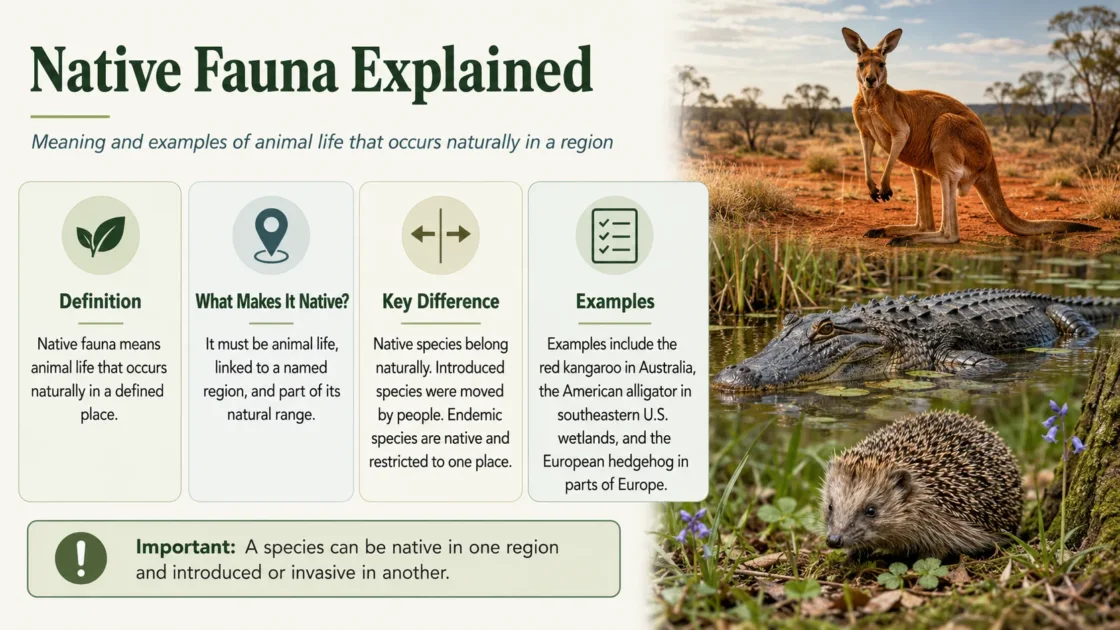
Native fauna is the animal life that occurs within its natural geographic range, including places it occupies now, occupied historically, or could reach through natural dispersal without direct or indirect human introduction. The term describes an animal’s geographic origin and relationship to a defined place; it does not describe how rare, threatened, abundant or ecologically beneficial that animal is.
Native Fauna Is Defined by Natural Range
Fauna means the animals associated with a place, habitat, geological period or other defined scope. Native fauna narrows that meaning to animals whose presence falls within their natural range. It may refer to one species, a subspecies, a regional population or the combined animal assemblage of an island, river basin, country, biome or continent.
IUCN terminology defines a native or indigenous taxon as one occurring within its past or present natural range and dispersal potential. That range includes areas the taxon occupies naturally or could occupy without human introduction or care.[a] Native status therefore depends on four connected elements:
- The animal or population being classified.
- The geographic area against which its origin is assessed.
- The historical and present evidence for its natural distribution.
- Whether its arrival resulted from natural dispersal or human activity.
Presence answers whether an animal has been recorded in a place. Native status answers how that animal came to occur there.
Geographic Scale Can Change the Classification
No species is simply “native” without a geographic reference. It is native to a particular natural range. A species may be native to a continent, native to only part of a country, introduced on an island within that country and absent from another nearby region.
Political boundaries often divide continuous ecosystems, while a single country may contain several biogeographic regions separated by mountains, deserts, ocean channels or drainage divides. Nationality alone is therefore an imperfect test. Movement within one country can still be an introduction when humans transport animals beyond their natural dispersal boundary.
An Endemic Animal Can Be Introduced Locally
The koala is endemic to Australia, yet Australian conservation advice also documents human-established populations outside parts of its natural local distribution. “Endemic to Australia” and “native at this particular Australian locality” are separate claims requiring different geographic evidence.
Natural Range Is Not the Same as Home Range
A species’ natural range is the broad geographic area in which the species occurs or occurred naturally. An individual animal’s home range is the smaller area it regularly uses for feeding, shelter, breeding or movement. A koala may have an individual home range measured within one woodland landscape, while the species’ natural range extends across large parts of eastern and southern Australia.
Historical Absence Does Not Always Remove Native Status
An animal can disappear from a locality while that locality remains part of its historical natural range. Local extinction, also called extirpation, describes loss from an area rather than loss of the entire species. A later conservation release into that former range may be classified as native reintroduction rather than a non-native introduction.
Historical range claims still require evidence. Fossils, museum specimens, dated observations, government surveys, archaeological material and published distribution accounts may all contribute, but the strength and relevance of those records must be evaluated for the taxon and location concerned.
Migration Does Not Require Year-Round Residence
A migratory animal may form part of the native fauna of several regions used during its natural life cycle. Breeding grounds, migration corridors, feeding areas and overwintering sites can all lie within a species’ natural range. Native does not mean permanently resident.
A rare visitor is different. An animal displaced by storms, unusual currents or navigational error may be recorded far beyond its regular natural range. Such an occurrence may be classified as vagrant rather than evidence that the species belongs to the locality’s established native fauna.
Native, Endemic and Introduced Are Not Interchangeable
Biodiversity datasets separate geographic origin from persistence, spread and ecological effect. The Darwin Core `establishmentMeans` vocabulary records whether organisms at a given place and time arrived through direct or indirect modern human activity. Its controlled concepts include native, native endemic, native reintroduced, introduced, vagrant and uncertain.[b]
| Term | Meaning in a Defined Area | What the Term Does Not Establish |
|---|---|---|
| Native or indigenous | The taxon occurs within its natural past or present range or reached the area through natural dispersal. | It does not show that the animal is endemic, common, harmless or secure from extinction. |
| Endemic | The taxon is native to the area and naturally restricted to that defined area. | It does not mean every population within the area is naturally located or that the taxon occurs throughout the area. |
| Introduced or non-native | Human activity moved the taxon beyond its natural range, deliberately or accidentally. | It does not by itself show that the introduced population is established or harmful. |
| Naturalized | An introduced population persists and reproduces without continual release or care. | Long-term establishment does not convert the population into native fauna. |
| Invasive | A non-native organism spreads or produces defined environmental, economic or health harm under the terminology used by the assessing authority. | It is not a synonym for every non-native animal. The U.S. National Park Service also separates non-native status from invasive harm.[j] |
| Native reintroduced | The taxon has been returned through conservation action to an area within its historical natural range. | The present population did not arrive unaided, but its geographic origin differs from an introduction beyond natural range. |
| Vagrant | An individual occurs outside its normal range through occasional natural movement. | A record of a vagrant does not establish a regular native population. |
| Uncertain or cryptogenic | Available evidence does not resolve whether the taxon is native or introduced. | Uncertainty should not be replaced with a confident status merely because the species has been present for a long time. |
Examples of Native Fauna Across Animal Groups
The examples below illustrate different forms of native status. The geographic scopes are deliberately stated because the same animal may have another establishment status elsewhere.
| Animal | Scientific Name | Native-Fauna Scope | What the Example Demonstrates |
|---|---|---|---|
| Koala | Phascolarctos cinereus | Australia, with a natural range centered on eastern and southern Australian forests and woodlands | The species is endemic to Australia, but its distribution is patchy and some Australian island or mainland populations resulted from documented introductions. Endemism at national scale does not prove local nativeness.[d] |
| American bison | Bison bison | North America | The National Park Service identifies bison as native to the North American continent and distinguishes the historical ranges of plains bison and wood bison. Native status can be described below species level when subspecies have different natural ranges.[e] |
| Atlantic salmon | Salmo salar | The North Atlantic and naturally connected river systems in North America and Europe | A species can remain native to a historical river system after local populations disappear. NOAA reports that Atlantic salmon were formerly native to many northeastern U.S. rivers, although remaining wild U.S. populations are now confined to rivers in Maine.[f] |
| Monarch butterfly | Danaus plexippus | North America as the species’ original native region | The monarch dispersed or was transported to other parts of the globe, where non-migratory populations now occur. A species can be native in one region and non-native or naturalized elsewhere.[g] |
| Axolotl | Ambystoma mexicanum | The Valley of Mexico, with surviving wild occurrence in remnants of Lake Xochimilco | Amphibian Species of the World records the axolotl as a natural resident endemic to Mexico and describes a far narrower remaining wild distribution. Captive animals held worldwide do not enlarge the species’ native range.[h] |
| Emperor penguin | Aptenodytes forsteri | Antarctica and the surrounding marine areas used during its natural life cycle | Emperor penguins breed during the Antarctic winter and use marine habitats beyond their breeding colonies. Native-fauna membership can include animals that move between terrestrial, ice and ocean environments rather than remaining in one locality.[i] |
Natural Dispersal and Human-Assisted Movement Produce Different Statuses
Animals regularly expand, contract or shift their ranges. Birds reach new breeding areas, marine animals follow changing currents, insects cross land naturally and freshwater species enter connected drainage systems. A naturally colonizing population may become part of a region’s native fauna when it reaches the area through its own dispersal capacity.
The classification changes when modern human activity carries the animal across a barrier it would not otherwise have crossed. Common pathways include ship ballast water, hull fouling, aquaculture escapes, pet releases, game introductions, livestock movement, biological control, transported soil, cargo and deliberate stocking.
Direct release is not required. An accidental passenger transported in freight is still introduced because the movement depended on a human delivery system. A species intentionally released into a new watershed and one accidentally carried there may share the same non-native origin even though their pathways differ.
A Wildlife Record Does Not Establish Native Origin
Occurrence data document evidence that an organism or taxon was recorded at a stated place and date. GBIF describes occurrence records in precisely this evidentiary sense.[c] A georeferenced specimen, photograph, acoustic record or observation can support presence, but the record alone may not explain the origin of that presence.
A record may represent:
- A naturally occurring native animal.
- An introduced population living in the wild.
- An escaped captive or domestic animal.
- A zoo, aquarium or managed collection specimen.
- A migratory individual using the site seasonally.
- A vagrant outside its regular range.
- A historical museum specimen collected before local disappearance.
- A misidentified organism or a record with uncertain coordinates.
Assigning native status usually requires evidence beyond mapped points. Useful information includes an authoritative regional checklist, historical distribution literature, establishment status, introduction history, taxonomic identification, dates, habitat context and the natural dispersal barriers surrounding the locality.
Dense Records Can Still Describe an Introduced Population
Many observations in one region may show that an animal is established or frequently reported. Record density does not reveal whether its founding population arrived naturally or through human activity. Sampling effort can also create apparent centers and gaps that do not match the animal’s actual abundance.
Native Status Does Not Measure Conservation Risk
Native, endemic and introduced describe geographic origin or establishment. Conservation categories describe extinction risk or legal protection. These are different dimensions of biodiversity information.
- A native species may be widespread or restricted.
- A native population may be stable in one region and depleted in another.
- An endemic animal is native, but a native animal need not be endemic.
- An introduced animal may remain localized without becoming invasive.
- A native animal cannot be classified as an invasive alien species within its natural range under definitions that require non-native origin.
- A species’ legal status may apply to only one country, subspecies or population rather than its entire global range.
The word “native” should therefore not be used as a substitute for protected, threatened, rare, beneficial or ecologically harmless. Those claims require separate evidence.
Evidence Needed for a Defensible Native-Fauna Classification
A source-backed classification should identify the taxon, place and time period before assigning status. The strongest assessments commonly combine several forms of evidence rather than relying on a single modern sighting.
- Taxonomic identity: an accepted scientific name or a documented synonym linked to the correct species, subspecies or population.
- Defined geography: a named island, drainage, ecoregion, country, sea, continent or other boundary precise enough for the claim.
- Historical evidence: dated specimens, surveys, literature or archaeological material supporting past natural occurrence.
- Present distribution evidence: verified records or current checklists showing where the taxon is documented now.
- Dispersal evidence: an assessment of whether the animal could reach the locality through its own movement or connected natural processes.
- Introduction history: records of releases, escapes, stocking, trade, transport or other human-mediated movement.
- Establishment status: separation of casual occurrence, reproduction, self-sustaining establishment and geographic spread.
- Uncertainty: an explicit uncertain classification when origin cannot be resolved from the available evidence.
When the Origin of a Population Remains Uncertain
Some animals have occupied ports, agricultural landscapes, islands or human settlements for centuries without a clear record of first arrival. Early trade may have moved them before naturalists documented local fauna, while natural dispersal may also be plausible. These taxa are sometimes described as cryptogenic: their native or introduced origin cannot be established with confidence.
Age of residence alone does not settle the question. A population introduced hundreds of years ago remains outside its natural range unless the classification system applies a stated historical convention. Conversely, a newly arriving population is not automatically non-native when the animals reached the area through natural range expansion.
The defensible result in an unresolved case is “uncertain,” accompanied by the geographic scope and evidence checked. That preserves the distinction between documented occurrence and demonstrated native origin.
Sources and Verification
- [a] IUCN Guidelines for the Prevention of Biodiversity Loss Caused by Alien Invasive Species — Used for the definition of a native taxon based on past or present natural range, dispersal potential and absence of human-assisted introduction.
- [b] Establishment Means Controlled Vocabulary List of Terms — Used for standardized biodiversity-data concepts separating native, endemic, reintroduced, introduced, vagrant and uncertain establishment status.
- [c] GBIF Data Quality Requirements: Occurrence Datasets — Used to distinguish evidence of a taxon at a place and date from a separate determination of native origin.
- [d] Conservation Advice for Phascolarctos cinereus (Koala) — Used for the koala’s accepted scientific name, Australian endemism, patchy natural range and documented introductions to additional Australian localities.
- [e] National Park Service: About Bison — Used for the American bison’s native continental scope and the different historical ranges of plains and wood bison.
- [f] NOAA Fisheries: Atlantic Salmon — Used for the species’ North Atlantic native range and the distinction between historical U.S. range and remaining wild populations in Maine.
- [g] U.S. Fish and Wildlife Service: Monarch (Danaus plexippus) — Used for the monarch’s original North American range and non-migratory populations occurring beyond that native region.
- [h] Amphibian Species of the World: Ambystoma mexicanum — Used for the accepted axolotl name, Mexican endemism, original lake distribution and remaining documented wild range in Xochimilco.
- [i] Australian Antarctic Program: Emperor Penguin — Used for the accepted scientific name and the species’ Antarctic breeding ecology.
- [j] National Park Service: What Are Invasive Species? — Used for the distinction between non-native animals generally and non-native species that meet an invasive-harm definition.
Related Topics
- → Regional Fauna Explained: How Animal Life Changes by Geography
- → What Is Fauna? Meaning, Examples, and Scientific Use
- → Fauna vs Flora: Key Differences in Biology
- → Endemic Fauna Explained: Why Some Animals Live Only in One Region
- → Terrestrial Fauna Explained: Land Animals and Their Habitats
- → Wildlife vs Fauna: What Is the Difference?