Complete guides: •What Is Fauna?
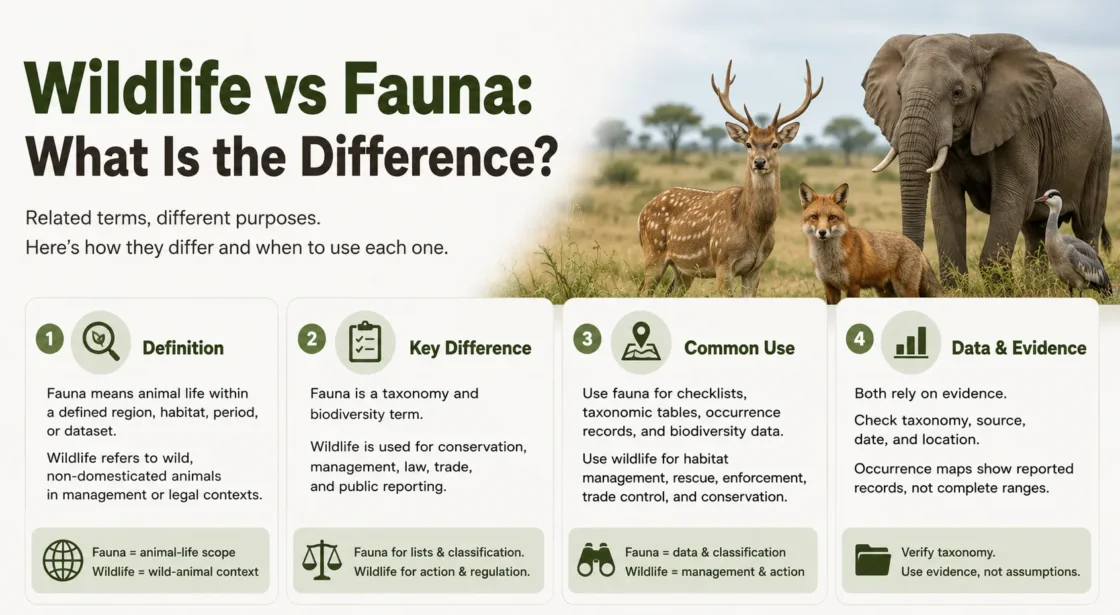
Wildlife and fauna overlap, but they are not interchangeable. Fauna is the collective animal life within a stated place, habitat, taxonomic scope, or period.[a] Wildlife usually refers to organisms understood as living wild rather than domesticated, although institutions may restrict the word to selected animal groups or extend it beyond animals.[b] A free-living fox in a city is urban wildlife and part of the city’s fauna. A fossil animal assemblage is fauna but not living wildlife. A wild plant may count as wildlife under a broad definition, but it is not fauna.
The Difference Is Animal Scope Versus Wild Status
The central distinction is the type of boundary created by each word. Fauna groups animals by place, environment, taxonomic group, or time. Wildlife groups organisms by their wild condition or by a conservation, management, health, trade, or legal context.
| Point of comparison | Fauna | Wildlife |
|---|---|---|
| Basic meaning | The animal life included within a defined scope | Organisms or animal populations treated as wild rather than domesticated |
| Must the subjects be animals? | Yes. Fauna refers to animals. | Usually in everyday speech, but broad institutional definitions may also include plants, fungi, or other undomesticated organisms. |
| Typical boundary | Region, habitat, ecosystem, taxonomic group, depth zone, or geological period | Wild status, management responsibility, legal protection, trade, disease, conflict, or conservation action |
| Does the word mean native? | No. Native, introduced, endemic, and vagrant status must be stated separately. | No. An introduced free-living population may still be described as wildlife. |
| Can it describe fossils? | Yes. Paleontologists use fauna for animal assemblages from a stated geological period or deposit. | Not normally. Wildlife usually concerns living organisms or specimens of wild species. |
| Is it a taxonomic rank? | No. It is a collective ecological or geographic term. | No. It is a biological, practical, or legal category whose scope must be defined. |
| Typical scientific phrases | Marine fauna, soil fauna, cave fauna, insect fauna, fossil fauna, regional faunal checklist | Wildlife management, wildlife disease, wildlife trade, wildlife corridor, human–wildlife conflict |
Fauna Names the Animals Within a Defined Boundary
The word fauna becomes precise when its boundary is stated. The fauna of an island means the animal taxa included within that island scope. Freshwater fauna refers to animals associated with rivers, lakes, springs, wetlands, or other inland waters. Soil fauna may include mites, springtails, nematodes, earthworms, insect larvae, and other animals living in or on soil.
The boundary can also be taxonomic. Avifauna refers to birds, entomofauna to insects, herpetofauna commonly to reptiles and amphibians, and fish fauna to fishes. These labels describe an assemblage. They do not by themselves report how many species are native, threatened, abundant, breeding, migratory, or recently recorded.
Time can form part of the boundary. A Pleistocene fauna, cave-deposit fauna, or fossil marine fauna may consist entirely of extinct animals. This use has no direct equivalent in ordinary wildlife terminology because wildlife normally refers to living wild organisms or current conservation subjects.
Native Status Is a Separate Field
A regional fauna is not automatically a list of native animals. A source-based faunal inventory may include native, endemic, introduced, reintroduced, vagrant, or uncertain taxa if its stated rules permit them. Darwin Core treats these as separate establishment categories rather than meanings contained within the word fauna.[e]
Wildlife Changes Scope Across Institutions and Laws
Wildlife has no single universal biological boundary. In ordinary use, it usually means free-living wild animals. In broader environmental use, it may include every undomesticated organism. A project may then narrow the term to the organisms it actually manages or studies.
The Food and Agriculture Organization provides a clear example of this contextual narrowing. One FAO wildlife-management resource begins with all living undomesticated organisms but limits its working focus to terrestrial vertebrates. A separate FAO wildlife and protected-area programme defines wildlife specifically as terrestrial vertebrate animals across protected and unprotected areas.[c]
Legal scope can differ even more. A law may protect only named mammals and birds, include reptiles and amphibians, cover plants and fungi, exclude certain pest species, or regulate captive specimens belonging to wild species. A peer-reviewed comparison of wildlife definitions found marked differences in species coverage, wording, and human–animal relationships across legal systems.[d]
When wildlife appears in a law, treaty, management plan, dataset, or institutional report, the document’s own definition controls its meaning.
Where Wildlife and Fauna Overlap
- A wild deer population in a forest: wildlife because the animals are free-living, and part of the forest fauna because they occur within the stated animal assemblage.
- Introduced rabbits living without direct human care: wildlife in normal ecological use and part of the local fauna, but not native fauna.
- Urban pigeons nesting on buildings: urban wildlife and part of the city’s avifauna, regardless of whether their regional origin is native or introduced.
- Soil mites and microscopic nematodes: soil fauna, although ordinary conversation rarely labels them wildlife.
- Wild orchids: wildlife under definitions that include wild plants, but flora rather than fauna.
- Fossil trilobites in a rock formation: part of a fossil fauna, but not present-day wildlife.
- Domestic cattle in a pasture: animals, but not wildlife. They are also normally excluded from a wild-fauna checklist unless the inventory explicitly includes domestic animals.
These examples show why replacing one word with the other can change the biological scope. Wildlife adds an idea of wildness, management, or legal treatment. Fauna adds an animal-only boundary tied to a place, environment, group, or period.
Neither Term Is a Taxonomic Rank
Animals are formally classified within taxonomic ranks such as kingdom, phylum, class, order, family, genus, and species. Animalia is a kingdom. Fauna is not another name for that kingdom, and wildlife is not a branch within it.
Taxonomic systems such as the GBIF Backbone Taxonomy organize scientific names and connect records from multiple nomenclatural and taxonomic resources. They classify organisms through accepted names, synonyms, ranks, and parent taxa rather than assigning a formal rank called fauna or wildlife.[f]
A Biodiversity Database Needs More Precise Fields
A biodiversity record does not become scientifically precise merely because it is labelled wildlife or fauna. Darwin Core separates concepts such as Taxon, Organism, Occurrence, Event, Location, Identification, and MaterialEntity. An occurrence represents evidence involving an organism at a place and time; it is not the same thing as the species’ full range or the complete fauna of that location.[g]
A defensible faunal query normally needs an Animalia filter, a geographic boundary, accepted taxonomic names, a time range, record-quality rules, and decisions about native, introduced, captive, fossil, doubtful, or vagrant records. The phrase “wildlife records” is even less exact unless the dataset defines which kingdoms, animal groups, record types, and establishment categories are included.
Recorded Species Are Not the Complete Fauna
A database species count reflects names linked to available records and the taxonomy used to process them. GBIF states that such counts can indicate recorded richness but do not represent true species totals. Sampling effort, unresolved synonyms, identification quality, inaccessible habitats, and unpublished observations can all affect the apparent fauna.[h]
Biodiversity Is Broader Than Wildlife or Fauna
Fauna covers the animal component of a defined biological setting. Wildlife may cover wild animals alone or a broader set of wild organisms, depending on the source. Biodiversity has a different purpose: it includes variation among species, genetic variation within species, and the diversity of ecosystems, with animals, plants, fungi, and microorganisms all contributing to that scope.[i]
A region may therefore have a documented fauna, a set of wildlife-management priorities, and a wider biodiversity profile. These are related descriptions, but they do not measure or classify the same thing.
Which Term Fits the Intended Meaning?
- Use fauna for the collective animal life of a country, island, habitat, water body, geological deposit, or stated taxonomic group.
- Use wildlife when the subject is wild status, population management, conservation action, trade, health, law, conflict, or habitat protection.
- Use wild fauna when the wording must identify animals specifically while also excluding domesticated forms.
- Use flora and fauna when the scope covers plants and animals but does not claim to include every form of life.
- Use biota for the organisms of a defined area when animals, plants, fungi, microorganisms, and other life forms are included.
- Use biodiversity when the subject includes variation within species, between species, or among ecosystems.
- Use animal occurrence records or faunal occurrence records for documented observations, specimens, fossils, or other record-based evidence rather than calling a record set the complete fauna.
Use fauna when the defining boundary is which animals belong to a place, habitat, group, or period. Use wildlife when the defining boundary is wild status or the way organisms are managed, protected, regulated, traded, or studied.
Sources and Verification
- [a] Australian Museum — What is fauna? — Used for the definition of fauna as animal life associated with a particular region or time.
- [b] Food and Agriculture Organization — Wildlife Management Module — Used for the broad definition of wildlife as living undomesticated organisms and the narrower operational focus adopted in wildlife management.
- [c] Food and Agriculture Organization — Wildlife and Protected Area Management — Used for the programme-specific definition limiting wildlife to terrestrial vertebrate animals.
- [d] Tian, M. — What Is “Wildlife”? Legal Definitions That Matter to Conservation — Used for differences in wildlife terminology and species coverage across legal systems.
- [e] Darwin Core — Establishment Means Controlled Vocabulary — Used to distinguish native, endemic, introduced, reintroduced, vagrant, and uncertain establishment categories.
- [f] GBIF Secretariat — GBIF Backbone Taxonomy — Used for the treatment of scientific names, synonyms, taxonomic ranks, and integrated taxonomic resources.
- [g] Darwin Core — Quick Reference Guide — Used for the distinctions among Taxon, Organism, Occurrence, Event, Identification, and material evidence.
- [h] GBIF — About Species Counts — Used for the limits of deriving true species totals or complete faunal inventories from available occurrence records.
- [i] Food and Agriculture Organization — Biodiversity Overview — Used for the broader scope of biodiversity across species, genetic variation, microorganisms, and ecosystems.
Related Topics
- → Fauna vs Flora: Key Differences in Biology
- → What Is Fauna? Meaning, Examples, and Scientific Use
- → Urban Fauna Explained: Animals Living in Cities
- → Regional Fauna Explained: How Animal Life Changes by Geography
- → Native Fauna Explained: Meaning and Examples
- → Aquatic Fauna Explained: Freshwater and Marine Animal Life