Complete guides: Birds of Turkey•Regional Fauna Guides
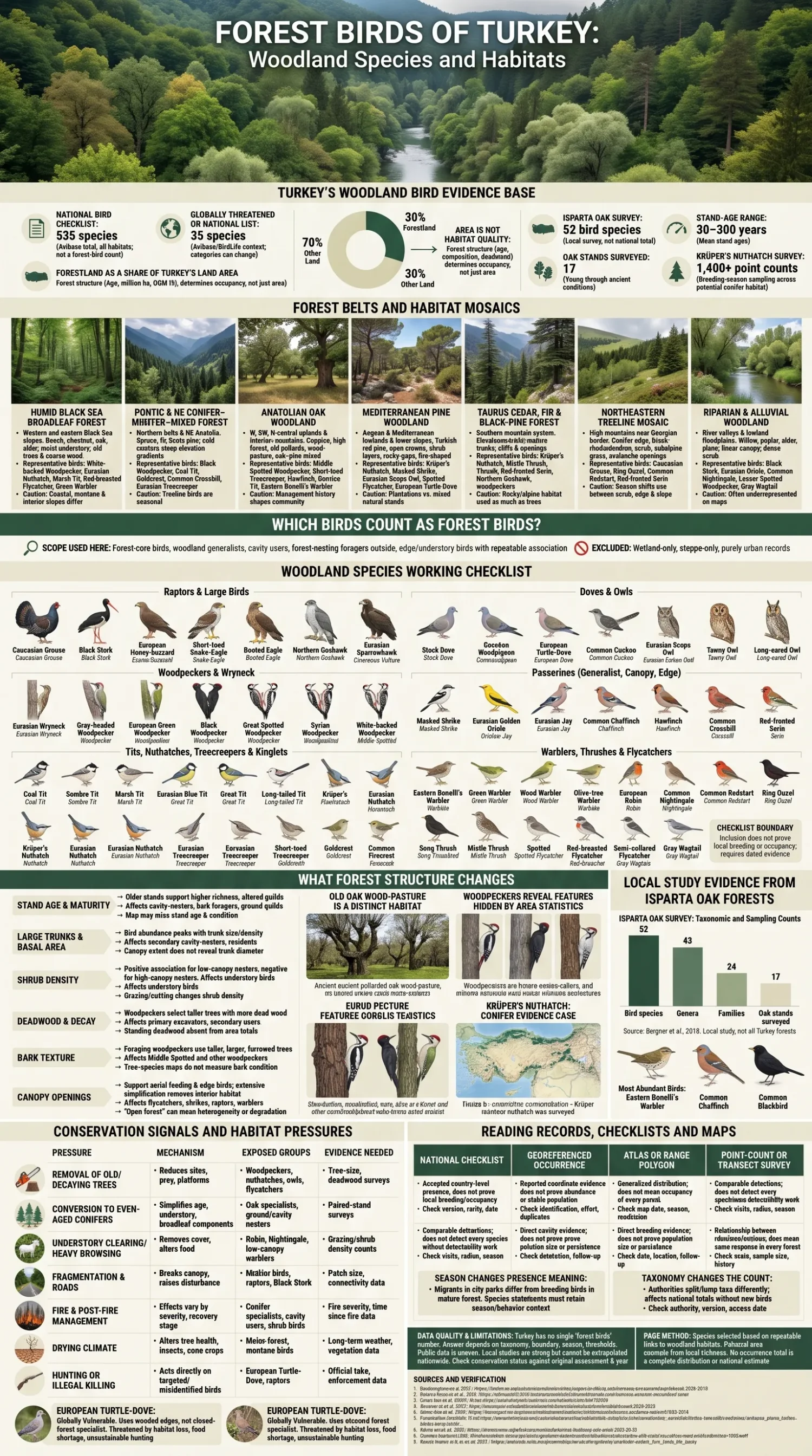
Turkey’s forest birds range from woodpeckers, nuthatches, flycatchers, tits, owls, and woodland raptors to species that depend on oak clearings, conifer treelines, riparian thickets, or seasonally flooded forest. There is no single official category called “forest birds of Turkey,” because species differ in how they use trees: some breed inside mature forest, some require cavities or deadwood, some occupy scrubby woodland edges, and others appear mainly during migration or winter.
A Habitat-Defined Working List
The species tables on this page are based on birds recorded for Turkey and supported by published evidence of regular use of forest, woodland, treeline, wooded pasture, forest edge, or riparian tree cover. They are not presented as a complete official inventory of every bird ever reported inside a forest boundary. Accidental records and species associated only with open habitats near forests are excluded.
Turkey’s Forest Bird Habitats Are Not One Ecological Unit
Turkey lies across several climatic and biogeographic zones. Its wooded habitats include humid Black Sea broadleaf forest, Caucasian spruce and fir stands, Mediterranean pine and cedar forest, dry Anatolian oak woodland, juniper woodland, lowland floodplain forest, riparian corridors, wooded pasture, and urban forest remnants. The national forestry authority recognizes a wide range of native tree groups, including pines, firs, cedar, spruce, beech, oak, chestnut, hornbeam, juniper, and riparian trees.[b]
| Forest setting | Main vegetation and structure | Characteristic bird relationships | Representative species |
|---|---|---|---|
| Humid Black Sea broadleaf and mixed forest | Oriental beech, hornbeam, chestnut, oak, fir, spruce, dense understorey, shaded streams, and locally abundant deadwood | Mature-tree cavities, bark foraging, moist leaf litter, shaded understorey, and high-canopy feeding | White-backed Woodpecker, Black Woodpecker, Grey-headed Woodpecker, Eurasian Nuthatch, Red-breasted Flycatcher, Semicollared Flycatcher, Marsh Tit |
| Eastern Black Sea conifer forest and treeline | Caucasian spruce, fir, Scots pine, rhododendron scrub, subalpine meadow, and broken treeline | Conifer feeding, treeline nesting, montane scrub cover, and movement between forest and alpine openings | Caucasian Grouse, Green Warbler, Ring Ouzel, Red-fronted Serin, Coal Tit, Goldcrest, Eurasian Treecreeper |
| Mediterranean and Taurus conifer forest | Turkish pine, black pine, cedar, Cilician fir, juniper, rocky clearings, and dry forest edge | Conifer-cone feeding, bark gleaning, open-canopy nesting, nocturnal use of clearings, and shrub-edge feeding | Krüper’s Nuthatch, Crested Tit, Coal Tit, Short-toed Treecreeper, Eastern Bonelli’s Warbler, European Nightjar |
| Anatolian oak woodland and wood-pasture | Young coppice, mature oak stands, old pollarded trees, grazed clearings, shrubs, and scattered orchards | Oak-canopy feeding, cavity nesting, shrub nesting, seed feeding, and hunting from exposed perches | Middle Spotted Woodpecker, Sombre Tit, Eastern Orphean Warbler, Rüppell’s Warbler, Masked Shrike, Cirl Bunting |
| Thrace and Marmara lowland forest | Deciduous forest, oak–hornbeam woodland, reservoir margins, wetlands, and wooded agricultural mosaics | Lowland breeding forest, migration stopover, floodplain nesting, and winter use by northern species | Black Stork, Stock Dove, Lesser Spotted Woodpecker, Eurasian Golden Oriole, Hawfinch, Wood Warbler |
| Floodplain and riparian forest | Alder, willow, poplar, ash, seasonally flooded forest, riverbank scrub, pools, and reed-fringed woodland | Feeding over water, nesting in tall trees, dense riparian understorey, and movement along river corridors | Black Stork, Grey Wagtail, Common Nightingale, Cetti’s Warbler, Lesser Spotted Woodpecker, Eurasian Golden Oriole |
| Urban and peri-urban woodland | Remnant natural forest, planted groves, old park trees, fragmented canopy, paths, roads, and dense human use | Use by adaptable woodland birds, with fewer disturbance-sensitive and mature-forest species than in natural stands | Eurasian Jay, Great Tit, Eurasian Blue Tit, Common Chiffchaff, Eurasian Wren, Short-toed Treecreeper |
The İğneada forest complex near the Bulgarian border illustrates how several habitats can occur within one woodland landscape. Its seasonally flooded forest, freshwater lakes, swamps, and coastal dunes create breeding, feeding, and passage conditions that differ from those in dry inland oak or high Taurus conifer forest.[g]
Tree Age, Cavities, Deadwood, and Shrubs Shape the Bird Community
Tree species alone do not determine which birds occupy a forest. The age of the stand, trunk diameter, quantity of deadwood, number of cavities, canopy openness, shrub density, grazing history, and distance from forest edge can alter the breeding community within the same broad forest type.
A breeding-season survey of 17 oak forests in Isparta Province recorded 52 bird species. Eastern Bonelli’s Warbler, Common Chaffinch, and Common Blackbird accounted for the largest shares of mapped territories. Young, shrub-like oak stands supported warblers and shrikes associated with low vegetation, while older oak stands held more trunk-foraging and cavity-using birds.[c]
A separate study of ancient oak wood-pasture mapped 355 territories belonging to 27 species. Larger trunks, higher basal area, tree density, cavity size, and shrub cover affected different nesting groups in different ways. Secondary cavity nesters responded positively to basal area, while low-canopy nesters were more closely associated with dense shrubs.[d]
A forest can retain its tree cover while losing part of its bird community if old trunks, dead branches, cavities, understorey, wet ground, or open feeding patches disappear.
Forest Interior, Mature Trees, Cavities, and Deadwood
The following species have regular associations with mature broadleaf or mixed forest, tree cavities, large trunks, deadwood, shaded understorey, or forest-floor feeding. Taxonomy follows the IOC World Bird Names 15.2 treatment presented in the Turkey checklist hosted by Avibase.[a] Placement in one table describes the species’ strongest relationship for this page; many also use other wooded habitats.
| Common name | Scientific name | Woodland relationship in Turkey |
|---|---|---|
| Black Stork | Ciconia nigra | Nests in secluded mature forest, often near rivers, marshes, reservoirs, or floodplain feeding grounds. |
| Stock Dove | Columba oenas | Uses cavities in old trees and occurs in mature broadleaf or mixed woodland with nearby feeding areas. |
| Common Wood Pigeon | Columba palumbus | Occupies woodland canopy, forest edge, wooded farmland, parks, and winter feeding flocks. |
| Eurasian Woodcock | Scolopax rusticola | Feeds in damp leaf litter and uses forest openings, young growth, and moist woodland floor. |
| European Honey Buzzard | Pernis apivorus | Nests in woodland and forages across forest openings for social wasp and bee nests. |
| Eurasian Sparrowhawk | Accipiter nisus | Breeds in wooded landscapes and hunts small birds along rides, edges, and under the canopy. |
| Eurasian Goshawk | Astur gentilis | Associated with extensive mature forest and quieter woodland blocks containing large nest trees. |
| Tawny Owl | Strix aluco | Uses mature broadleaf and mixed forest, wooded valleys, old parks, and natural or enlarged cavities. |
| Eurasian Wryneck | Jynx torquilla | Breeds in tree holes within open woodland, orchards, wooded pasture, and forest edge rich in ants. |
| Grey-headed Woodpecker | Picus canus | Favours humid broadleaf and mixed forest, especially stands with old trees and open feeding ground. |
| European Green Woodpecker | Picus viridis | Uses open deciduous woodland, old orchards, wooded pasture, and forest margins with ant-rich ground. |
| Black Woodpecker | Dryocopus martius | Requires large trunks for excavation and uses mature conifer, broadleaf, and mixed forest with deadwood. |
| Great Spotted Woodpecker | Dendrocopos major | Occurs across broadleaf, mixed, conifer, riparian, and urban woodland and excavates its own nest cavity. |
| Syrian Woodpecker | Dendrocopos syriacus | Most typical of open woodland, orchards, gardens, poplar stands, and tree-rich settlements. |
| Middle Spotted Woodpecker | Dendrocoptes medius | Closely associated with mature oak-rich broadleaf woodland containing rough bark and decaying branches. |
| White-backed Woodpecker | Dendrocopos leucotos | Linked to old, relatively open broadleaf or mixed forest with abundant dead and dying deciduous wood. |
| Lesser Spotted Woodpecker | Dryobates minor | Uses light broadleaf woodland, riverine trees, orchards, parks, and stands with small dead branches. |
| Wood Warbler | Phylloscopus sibilatrix | Associated with mature broadleaf forest where the canopy is developed and the lower layer remains relatively open. |
| Eurasian Blackcap | Sylvia atricapilla | Uses dense shrub layers in moist forest, riparian woodland, gardens, and wooded edge. |
| Garden Warbler | Sylvia borin | Occurs in dense, leafy understorey and moist scrub within or beside broadleaf woodland. |
| Marsh Tit | Poecile palustris | Favors mature, moist deciduous woodland and uses natural cavities or softened decaying wood. |
| Eurasian Blue Tit | Cyanistes caeruleus | Common in broadleaf and mixed woodland, orchards, parks, and other habitats with small cavities. |
| Great Tit | Parus major | A flexible cavity nester occurring from natural forest to orchards, parks, and urban woodland. |
| Long-tailed Tit | Aegithalos caudatus | Uses broadleaf and mixed woodland, dense edge shrubs, river corridors, and wooded gardens. |
| Eurasian Nuthatch | Sitta europaea | Feeds on trunks and branches in mature broadleaf or mixed forest and nests in existing cavities. |
| Short-toed Treecreeper | Certhia brachydactyla | Forages on bark in lowland and montane broadleaf, pine, mixed, riparian, and park woodland. |
| Semicollared Flycatcher | Ficedula semitorquata | Breeds in mature deciduous forest, especially oak and other cavity-rich broadleaf stands. |
| Red-breasted Flycatcher | Ficedula parva | Uses humid mature woodland during breeding or passage, often near shaded openings and streams. |
| Spotted Flycatcher | Muscicapa striata | Hunts from exposed branches in open forest, wooded gardens, orchards, clearings, and edges. |
| Eurasian Golden Oriole | Oriolus oriolus | Occupies the upper canopy of mature deciduous woods, poplar groves, orchards, and riparian forest. |
| Eurasian Jay | Garrulus glandarius | Widespread in oak, broadleaf, conifer, and mixed forest; transports and caches acorns. |
| European Robin | Erithacus rubecula | Uses shaded understorey, dense shrubs, stream banks, woodland floor, and wooded gardens. |
| Eurasian Wren | Troglodytes troglodytes | Occupies dense low cover, fallen branches, root plates, rocky woodland, and streamside vegetation. |
| Common Blackbird | Turdus merula | Feeds in leaf litter and nests in shrubs across natural woodland, forest edge, parks, and gardens. |
| Song Thrush | Turdus philomelos | Uses wooded ground, leaf litter, forest clearings, dense cover, and winter fruiting vegetation. |
| Hawfinch | Coccothraustes coccothraustes | Associated with mature deciduous canopy and feeds on hard seeds, kernels, buds, and invertebrates. |
Conifer Forest, Montane Woodland, and Treeline Birds
Conifer-associated birds are unevenly distributed because Turkey’s pine, fir, cedar, spruce, and juniper forests are separated by climate and mountain systems. The humid eastern Black Sea, western and central Black Sea ranges, Taurus Mountains, and high eastern mountains do not hold identical communities.
| Common name | Scientific name | Woodland relationship in Turkey |
|---|---|---|
| Caucasian Grouse | Lyrurus mlokosiewiczi | Occupies the eastern Black Sea treeline mosaic, where subalpine meadow, rhododendron scrub, birch, and conifer forest meet. |
| Cinereous Vulture | Aegypius monachus | Nests in large trees in quiet forested mountains but ranges widely over open country while foraging. |
| Lesser Spotted Eagle | Clanga pomarina | Uses humid woodland mosaics with nearby meadows, wetlands, or farmland for feeding. |
| Booted Eagle | Hieraaetus pennatus | Nests in wooded hills and mature stands while hunting across clearings, scrub, and open country. |
| Common Buzzard | Buteo buteo | Breeds in woodland and hunts across forest margins, pasture, farmland, and mountain clearings. |
| Long-eared Owl | Asio otus | Uses conifer stands, shelterbelts, woodland edge, and old nests built by crows or other large birds. |
| Krüper’s Nuthatch | Sitta krueperi | A conifer specialist associated mainly with pine, fir, and cedar forests in western and southern Turkey. |
| Coal Tit | Periparus ater | Commonly linked to conifer and mixed forest, feeding among needles, cones, and small branches. |
| Crested Tit | Lophophanes cristatus | A localized conifer bird in Turkey, using pine-dominated stands and mature wooded mountain landscapes. |
| Goldcrest | Regulus regulus | Feeds within conifer foliage and occurs in spruce, fir, pine, and mixed forest, including winter movements. |
| Common Firecrest | Regulus ignicapilla | Uses conifer and mixed woodland, often where evergreen foliage is combined with broadleaf cover. |
| Eurasian Treecreeper | Certhia familiaris | Associated mainly with cooler humid conifer and mixed forests, where it searches trunks for arthropods. |
| Common Redstart | Phoenicurus phoenicurus | Breeds in open mature woodland and montane forest containing cavities and exposed hunting perches. |
| Mistle Thrush | Turdus viscivorus | Uses conifer forest, open woodland, upland clearings, and wooded pasture. |
| Ring Ouzel | Turdus torquatus | Associated with montane scrub, rocky slopes, open conifer forest, and treeline habitats. |
| Mountain Chiffchaff | Phylloscopus sindianus | Occurs in high montane shrubs and broken woodland near treeline in eastern mountain systems. |
| Green Warbler | Phylloscopus nitidus | Associated with humid northeastern forest, wooded valleys, and tall montane vegetation. |
| Dunnock | Prunella modularis | Uses dense montane shrubs, forest margins, young conifers, and treeline cover. |
| Tree Pipit | Anthus trivialis | Breeds in open forest, regenerating stands, wooded pasture, clearings, and treeline mosaics. |
| Red Crossbill | Loxia curvirostra | Closely linked to cone crops in pine, spruce, fir, and other conifer forests; local abundance varies between years. |
| Eurasian Bullfinch | Pyrrhula pyrrhula | Localized in northern and montane woodland, dense shrubs, young forest, and wooded valleys. |
| Red-fronted Serin | Serinus pusillus | Uses high mountain conifers, treeline scrub, rocky slopes, and alpine-edge vegetation. |
| Eurasian Siskin | Spinus spinus | Associated with conifers and alder or birch stands, with numbers changing through migration and winter. |
| Twite | Linaria flavirostris | More closely tied to alpine grass and scrub than closed forest, but regularly occupies the upper treeline mosaic. |
| Grey Wagtail | Motacilla cinerea | Uses shaded rocky streams running through forested valleys and wooded mountain ravines. |
Oak Woodland, Mediterranean Scrub, and Forest Openings
Many woodland birds avoid a uniformly closed canopy. They need scattered old trees, sunny glades, coppice, grazed woodland, maquis, orchards, rocky clearings, or a dense shrub layer. These habitats can support cavity nesters and canopy feeders alongside warblers, shrikes, buntings, and aerial insect hunters.
| Common name | Scientific name | Woodland relationship in Turkey |
|---|---|---|
| European Turtle Dove | Streptopelia turtur | Uses open woodland, wooded farmland, orchards, riparian trees, maquis, and scrub-rich forest edge. |
| Common Cuckoo | Cuculus canorus | Occurs across woodland, scrub, wetlands, and forest clearings where suitable host species breed. |
| European Nightjar | Caprimulgus europaeus | Breeds on dry open ground in pine forest, young plantations, clearings, burned areas, and scrubby woodland. |
| Eurasian Scops Owl | Otus scops | Uses tree cavities in open woodland, orchards, wooded villages, river groves, and Mediterranean landscapes. |
| Common Hoopoe | Upupa epops | Requires cavities and open feeding ground, linking it to old orchards, wooded pasture, and open oak woodland. |
| European Roller | Coracias garrulus | Uses open woodland and large tree cavities while hunting from exposed branches or utility lines. |
| Woodlark | Lullula arborea | Occupies open pine and oak woodland, burned ground, scrub, sandy clearings, and lightly wooded slopes. |
| Common Nightingale | Luscinia megarhynchos | Breeds in dense low shrubs along woodland edge, streams, hedges, clearings, and coppice. |
| Eastern Bonelli’s Warbler | Phylloscopus orientalis | A frequent breeding bird of dry oak and pine woodland, particularly stands with a developed canopy and open lower layer. |
| Eastern Olivaceous Warbler | Iduna pallida | Uses open riparian trees, orchards, woodland edge, gardens, and tall scrub rather than closed forest. |
| Olive-tree Warbler | Hippolais olivetorum | Associated with Mediterranean woodland, olive groves, maquis, open oak stands, and tall scrub. |
| Barred Warbler | Curruca nisoria | Uses tall dense scrub, hedgerows, woodland edge, and regenerating woody vegetation. |
| Lesser Whitethroat | Curruca curruca | Occupies shrubs, young woodland, forest margins, hedges, and montane scrub. |
| Eastern Orphean Warbler | Curruca crassirostris | Breeds in open oak woodland, wooded pasture, maquis, orchards, and tall Mediterranean scrub. |
| Rüppell’s Warbler | Curruca ruppeli | Uses Mediterranean maquis, pine edge, rocky scrub, and oak woodland with a dense low layer. |
| Sardinian Warbler | Curruca melanocephala | Associated with evergreen scrub, coastal woodland edge, maquis, gardens, and shrubby clearings. |
| Eastern Subalpine Warbler | Curruca cantillans | Breeds in Mediterranean scrub, open woodland, maquis, and young woody growth. |
| Sombre Tit | Poecile lugubris | Characteristic of dry oak and open broadleaf woodland, wooded pasture, orchards, and rocky wooded slopes. |
| Red-backed Shrike | Lanius collurio | Uses thorny forest edge, clearings, regenerating stands, wooded pasture, and scrub-rich farmland. |
| Masked Shrike | Lanius nubicus | Breeds in open woodland, orchards, olive groves, forest margins, and scattered trees with clear hunting space. |
| Lesser Grey Shrike | Lanius minor | Associated with very open tree cover, shelterbelts, poplar rows, wooded farmland, and broad clearings. |
| Woodchat Shrike | Lanius senator | Uses open oak woodland, maquis, orchards, wooded pasture, and scattered mature trees. |
| Common Starling | Sturnus vulgaris | Nests in cavities in old woodland trees, orchards, poplars, parks, cliffs, and buildings while feeding in open ground. |
| Eurasian Chaffinch | Fringilla coelebs | One of the most widespread canopy and edge birds across broadleaf, conifer, mixed, and urban woodland. |
| European Greenfinch | Chloris chloris | Uses open woods, woodland edge, orchards, gardens, hedges, and tree-rich farmland. |
| European Goldfinch | Carduelis carduelis | Most typical of forest edge, orchards, clearings, scrub, and open land with nearby trees. |
| Common Linnet | Linaria cannabina | Occupies scrubby clearings, woodland margins, young plantations, hedges, and open dry slopes. |
| European Serin | Serinus serinus | Uses open pine woods, orchards, parks, cemeteries, wooded settlements, and forest edge. |
| Yellowhammer | Emberiza citrinella | Associated mainly with woodland margins, hedges, clearings, and wooded farmland in northern and western areas. |
| Rock Bunting | Emberiza cia | Uses rocky wooded slopes, open pine and oak forest, scrub, and mountain clearings. |
| Ortolan Bunting | Emberiza hortulana | Occurs in open woodland, forest-steppe, burned or cleared ground, orchards, and scattered trees. |
| Cretzschmar’s Bunting | Emberiza caesia | Uses dry open pine and oak woodland, maquis, rocky slopes, and shrub-dominated clearings. |
| Cirl Bunting | Emberiza cirlus | Associated with open woods, orchards, wooded farmland, hedges, and sunny forest margins. |
Riparian, Passage, and Winter Woodland Users
A woodland checklist changes with season. Some northern thrushes and finches are most visible in winter, while several warblers and flycatchers use wooded corridors during migration. A two-year study in Belgrad Forest recorded 146 bird species and confirmed nesting by 51, but the full total also included migrants, waterbirds, open-country birds, and species passing over the forest. The result describes the wider forest mosaic rather than 146 forest specialists.[e]
| Common name | Scientific name | Typical woodland use |
|---|---|---|
| Cetti’s Warbler | Cettia cetti | Resident in dense riparian scrub, wet woodland margins, lake-edge thickets, and stream corridors. |
| Common Chiffchaff | Phylloscopus collybita | Uses woodland canopy, scrub, riparian trees, and gardens during breeding, migration, or winter depending on region. |
| Willow Warbler | Phylloscopus trochilus | Mainly a passage bird in leafy woodland, scrub, orchards, and river corridors. |
| Icterine Warbler | Hippolais icterina | Recorded mainly during migration in tall deciduous trees, wooded gardens, riparian cover, and forest edge. |
| European Pied Flycatcher | Ficedula hypoleuca | Uses broadleaf woodland and wooded stopover sites during migration. |
| Collared Flycatcher | Ficedula albicollis | Occurs mainly as a migrant in mature deciduous woodland, parks, orchards, and tree-rich coastal stopovers. |
| Redwing | Turdus iliacus | A winter and passage visitor using woodland floor, berry-bearing shrubs, orchards, and forest edge. |
| Fieldfare | Turdus pilaris | Forms winter flocks in open woodland, orchards, wooded farmland, and fruiting tree stands. |
| Brambling | Fringilla montifringilla | A winter visitor to beech, oak, mixed forest, woodland clearings, and seed-rich farmland near trees. |
| Common Rosefinch | Carpodacus erythrinus | A localized summer bird of moist scrub, riparian woodland, young growth, and forest-edge thickets. |
Four Birds That Mark Different Forest Conditions
White-backed Woodpecker and Deadwood-Rich Broadleaf Forest
White-backed Woodpecker is associated with old or overmature broadleaf and mixed forest containing a high proportion of dead deciduous wood. Its presence is more informative about forest structure than simple tree-cover percentage. Forests composed mainly of young, evenly spaced, healthy trunks provide fewer feeding and excavation sites for this species.[l]
Krüper’s Nuthatch and Mediterranean Conifers
Krüper’s Nuthatch is one of the birds most closely associated with Turkey’s conifer forests. It occurs mainly in pine, fir, and cedar landscapes and is non-migratory, making the continuity and condition of local forest stands especially relevant.[i] A range-wide survey used more than 1,400 point counts in Turkey and Greece to examine distribution, density, and potential habitat, showing why records from isolated sites cannot be treated as a complete national map.[j]
Semicollared Flycatcher and Mature Deciduous Cavities
Semicollared Flycatcher breeds in mature deciduous woodland and is strongly associated with natural or previously excavated cavities. Oak belts and other old broadleaf stands provide nesting sites, while open spaces beneath the canopy supply aerial insect-feeding opportunities.[k]
Caucasian Grouse and the Eastern Black Sea Treeline
Caucasian Grouse is not a closed-forest bird. In Turkey it belongs to the high-elevation boundary between forest, rhododendron scrub, birch growth, and subalpine meadow in the Eastern Black Sea Mountains. Treating treeline as unused space between forest and alpine grassland would overlook the species’ actual habitat mosaic.[o]
Natural Forest and Urban Woodland Hold Different Assemblages
Urban woodland can retain tits, treecreepers, woodpeckers, jays, wrens, chiffchaffs, robins, and other adaptable species, but it does not automatically replace natural forest. A 2022–2023 İstanbul study used 900 point counts across the urban center, three urban woodlands, and a natural area, recording 72 species. The natural area held the highest richness and diversity, while its bird composition differed sharply from the city center and remained distinct from the urban woodland sites.[f]
Long-established urban woods can still provide old trunks, cavities, dead branches, dense shrubs, and stepping-stone habitat. Their value depends on stand age, vegetation layers, connectivity, disturbance, lighting, traffic, and the extent to which fallen or decaying wood is retained.
Global Conservation Categories Among Turkey’s Woodland Birds
A global IUCN category describes extinction risk across a species’ full range. It does not by itself establish the size or trend of the population in Turkey. National or regional conclusions require Turkish survey data collected for the relevant period and geographic scope.
| Species | Current global category | Forest relationship relevant to Turkey | Interpretive boundary |
|---|---|---|---|
| European Turtle Dove Streptopelia turtur |
Vulnerable | Open woodland, orchards, riparian trees, maquis, and wooded agricultural mosaics | The global decline does not provide a measured Turkish population trend without national monitoring data.[m] |
| Caucasian Grouse Lyrurus mlokosiewiczi |
Near Threatened | Eastern Black Sea treeline, subalpine scrub, meadow, and broken forest | The category applies across the species’ Caucasian range; Turkish sites form only part of that range.[h] |
| Cinereous Vulture Aegypius monachus |
Near Threatened | Large nest trees in forested mountains, with foraging extending far beyond the nesting stand | Forest protection around nests addresses only one part of the species’ much larger spatial requirements.[n] |
Forest Features That Support the Broadest Bird Assemblage
- Old and large trees: supply nest platforms, bark surfaces, broken limbs, natural hollows, and future deadwood.
- Standing and fallen deadwood: supports insects, fungi, woodpecker feeding, cavity excavation, and shelter near the forest floor.
- Natural cavities: provide nest sites for owls, tits, nuthatches, flycatchers, doves, rollers, hoopoes, and other secondary cavity users.
- Several vegetation layers: allow canopy, trunk, shrub, ground, and aerial-feeding birds to occupy the same woodland.
- A retained shrub layer: supports nightingales, blackcaps, wrens, robins, several Curruca warblers, and low-canopy nesters.
- Openings within woodland: provide feeding ground for nightjars, pipits, shrikes, buntings, woodlarks, raptors, and insect-hunting flycatchers.
- Riparian continuity: connects wooded habitats and supports species dependent on streams, wet soil, dense bankside cover, or floodplain trees.
- Mixed stand ages: retain young scrub, middle-aged canopy, mature trunks, and decaying trees rather than concentrating every stand in one age class.
- Low disturbance near nests: is especially relevant for large forest raptors, Black Stork, owls, and other species using secluded breeding sites.
- Connections between forest blocks: reduce isolation and allow movement between feeding, nesting, wintering, and stopover habitat.
Forest area alone therefore gives an incomplete account of habitat quality. Two woodlands of equal size can support different bird communities when one contains mature trees, cavities, deadwood, shrubs, streams, and clearings while the other is young, uniform, fragmented, or heavily disturbed.
Sources and Verification
- [a] Avibase Bird Checklists of the World: Turkey, IOC 15.2 — Used to verify accepted common names, scientific names, national checklist presence, and current IOC treatment.
- [b] General Directorate of Forestry: Main Tree Species of Türkiye — Used to identify the native tree groups forming Turkey’s principal forest environments.
- [c] Bird Communities of Oak Forests in Isparta, Turkey — Used for the 17-forest survey, 52 recorded species, territory composition, and changes between young and mature oak stands.
- [d] Fine-Scale Bird–Habitat Associations in Ancient Oak Wood-Pasture — Used for the 355 mapped territories, 27 species, and relationships involving basal area, trunk size, cavities, tree density, and shrubs.
- [e] Bird Species and Their Status in Belgrad Forest, İstanbul — Used for the two-year forest-mosaic survey, total recorded species, and confirmed nesting total.
- [f] Bird Diversity Across Urban Woodlands and Natural Forest in İstanbul — Used for the 900 point counts, 72 recorded species, and comparison of natural forest, urban woodland, and city-center assemblages.
- [g] BirdLife DataZone: İğneada Forests — Used to verify the site’s combined seasonally flooded forest, swamp, freshwater lake, and dune habitat complex.
- [h] BirdLife DataZone: Caucasian Grouse — Used for the current global Near Threatened category and the species’ treeline and subalpine habitat context.
- [i] BirdLife DataZone: Krüper’s Nuthatch — Used for accepted taxonomy, non-migratory status, and the species’ close association with conifer forest.
- [j] Distribution, Density, and Population Hotspots of Krüper’s Nuthatch — Used for the range-wide point-count survey in Turkey and Greece and its habitat-based distribution analysis.
- [k] BirdLife DataZone: Semicollared Flycatcher — Used for the species’ mature deciduous forest, oak-belt, and cavity-nesting associations.
- [l] BirdLife DataZone: White-backed Woodpecker — Used for the association with old broadleaf or mixed forest and high quantities of dead deciduous wood.
- [m] BirdLife DataZone: European Turtle Dove — Used for the current global Vulnerable category and the distinction between global status and a Turkish population trend.
- [n] BirdLife DataZone: Cinereous Vulture — Used for the current global Near Threatened category and the species’ forest-nesting habitat relationship.
- [o] Distribution and Conservation of Caucasian Grouse in Turkey — Used for the Turkish range and the eastern Black Sea treeline habitat mosaic.
Related Topics
- → Steppe Birds of Turkey: Open-Country Species
- → Birdwatching Regions in Turkey: Important Bird Areas and Habitats
- → Common Birds of Turkey: Species Often Seen Across the Country
- → Birds of Turkey: Native, Migratory, and Rare Species
- → Raptors of Turkey: Eagles, Hawks, Falcons, and Vultures
- → Birds of Turkish Wetlands: Lakes, Deltas, and Marshes