Complete guides: Birds of Turkey•Regional Fauna Guides
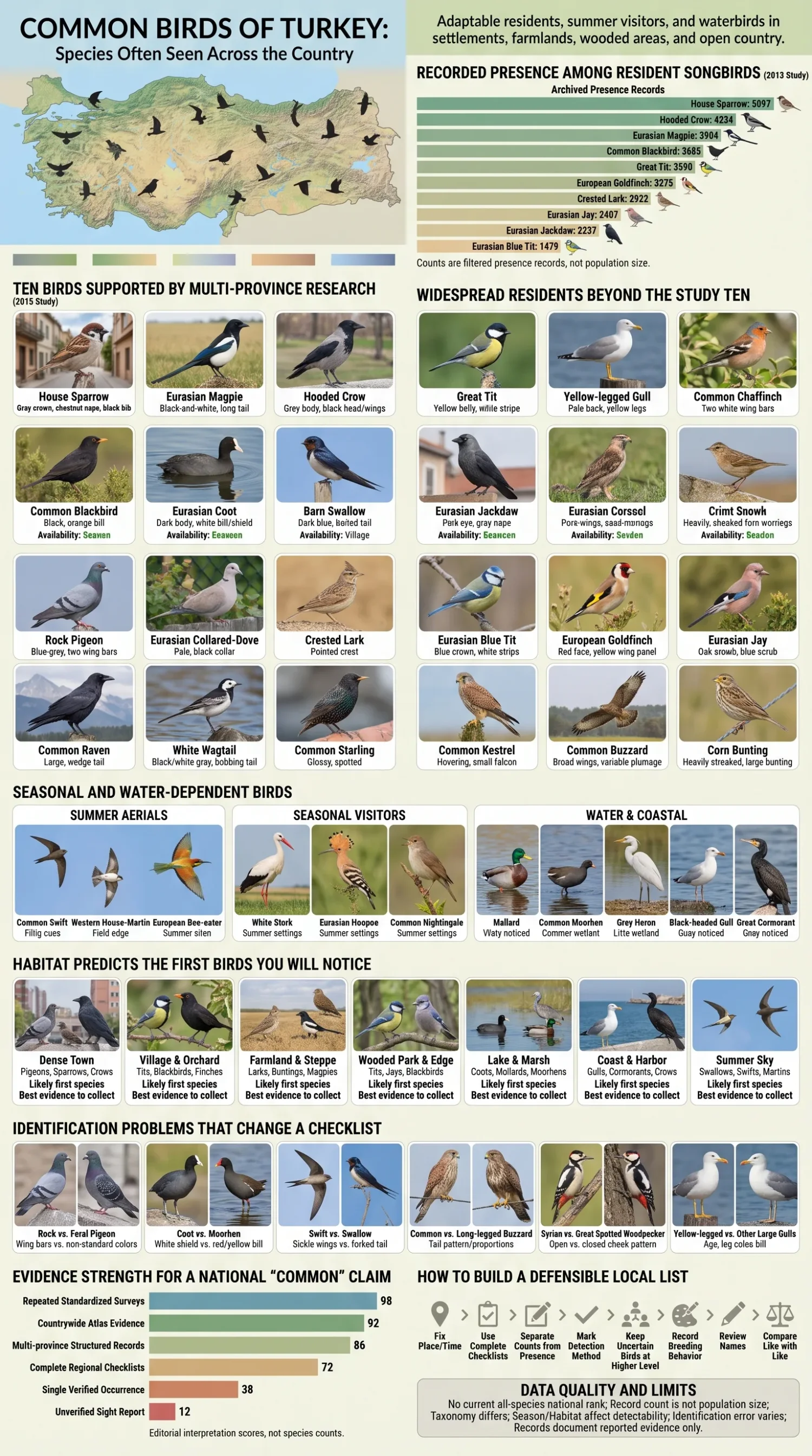
Turkey’s most regularly encountered birds include House Sparrows around buildings, Eurasian Collared Doves on wires, Hooded Crows in towns, Crested Larks beside open fields, Great Tits in wooded parks, Barn Swallows over farmland and Eurasian Coots on lakes. The 60 species listed here have broad Turkish ranges, recur in survey and atlas evidence, or are familiar birds within habitats that occur across much of the country. No species should be expected in every province, habitat or month.
A Countrywide Core Shaped by Habitat and Season
Turkey includes humid Black Sea forests, central steppe, Mediterranean scrub, eastern highlands, river valleys, wetlands, agricultural plains and densely built cities. A bird may therefore be widespread nationally without being evenly distributed. Crested Larks are associated with open ground, Great Spotted Woodpeckers require trees, and Eurasian Coots depend on water. Habitat availability determines where each becomes common.
The Turkish Breeding Bird Atlas was established to document breeding distribution through a systematic national grid rather than through isolated notable sightings.[f] In the atlas project’s standardized 2016 fieldwork, the ten most frequently recorded birds were Common Blackbird, Great Tit, Barn Swallow, House Sparrow, European Goldfinch, Corn Bunting, Eurasian Jay, Eurasian Chaffinch, Common Nightingale and Red-backed Shrike.[a]
An earlier common-bird monitoring pilot conducted across Ankara, İzmir, İstanbul, Diyarbakır, Eskişehir and Kırşehir also repeatedly recorded House Sparrow, Barn Swallow, Crested Lark, Common Blackbird, Corn Bunting, Great Tit and several other species included below. The limited number of provinces and survey sites means that the pilot supports recurring presence rather than a permanent national ranking.[b]
Observation frequency is also sensitive to date, location and observer effort. In eBird terminology, frequency is the percentage of completed checklists from a defined region and period that report a species. It is not a direct measure of population size and cannot establish that a bird is equally abundant throughout Turkey.[c]
No Species Is Uniformly Common
“Across Turkey” identifies birds encountered over broad parts of the country or repeatedly within widely available habitat. A wetland bird may be common at lakes yet absent from dry districts. A summer breeder may occur from western Turkey to eastern Anatolia but be absent in winter. Local elevation, climate, land use and migration routes all change the species visible at one site.
English and scientific names below follow the IOC 15.2 treatment represented in the current Avibase checklist for Turkey.[d] The IOC list is used to resolve current names and recent splits rather than preserve every name found in older field reports.[e]
Birds Around Towns, Villages and Buildings
Built environments combine nesting ledges, roof spaces, ornamental trees, lawns, waste food and artificial water. Several native birds have adapted well to these conditions, while feral Rock Doves descend from domesticated forms of a naturally cliff-nesting species.
| Common name | Scientific name | Typical presence in Turkey | Where it is often encountered | Useful recognition clue |
|---|---|---|---|---|
| House Sparrow | Passer domesticus | Resident | Buildings, courtyards, village streets, farms and transport areas | Male has a grey crown and black throat; female is plain brown with a pale eyebrow. |
| Rock Dove | Columba livia | Resident; many urban birds are feral | City squares, roofs, bridges, cliffs and grain-handling sites | Typical wild-coloured birds are blue-grey with two dark wing bars. |
| Eurasian Collared Dove | Streptopelia decaocto | Resident | Towns, villages, gardens, orchards and roadside trees | Pale grey-beige plumage with a narrow black collar on the rear neck. |
| Common Wood Pigeon | Columba palumbus | Resident with local and seasonal movement | Wooded parks, mature gardens, forest edges and cultivated land | Large pigeon with white neck patches and a white band across each wing. |
| Eurasian Magpie | Pica pica | Resident | Urban fringes, villages, farmland, river valleys and open woodland | Black-and-white body, very long tail and a direct, conspicuous flight. |
| Hooded Crow | Corvus cornix | Resident | Cities, coastlines, farmland, rubbish sites and open country | Grey body contrasts with a black head, bib, wings and tail. |
| Western Jackdaw | Coloeus monedula | Resident; larger gatherings may form outside breeding season | Historic buildings, towns, cliffs, fields and communal roosts | Small compact crow with a grey nape and pale eye. |
| Common Starling | Sturnus vulgaris | Resident and winter visitor | Lawns, orchards, farmland, roof cavities and evening roosts | Dark glossy plumage is finely spotted outside the breeding season. |
| Common Blackbird | Turdus merula | Resident; numbers and visibility may rise in winter | Gardens, parks, woodland edges, orchards and shaded streets | Adult male is black with a yellow-orange bill; female is dark brown. |
| Great Tit | Parus major | Resident | Parks, gardens, orchards, broadleaf woodland and village trees | Black head, broad black belly stripe, white cheeks and yellow underparts. |
| Eurasian Blue Tit | Cyanistes caeruleus | Resident | Wooded parks, gardens, orchards and deciduous woodland | Small tit with a blue crown, blue wings and yellow underparts. |
| European Goldfinch | Carduelis carduelis | Resident with local movement | Gardens, roadside trees, weedy ground, orchards and farmland | Red face, black-and-white head and a bright yellow wing band. |
| White Wagtail | Motacilla alba | Present through much of the year; local movements vary | Pavements, lawns, roofs, riverbanks, reservoirs and farmyards | Slender black, white and grey bird that repeatedly pumps its long tail. |
| Common Kestrel | Falco tinnunculus | Mainly resident | City towers, cliffs, roadsides, farmland and open hills | Often hovers in one place while searching the ground for prey. |
| Little Owl | Athene noctua | Resident | Village roofs, stone walls, orchards, ruins and open farmland | Small, broad-headed owl with pale eyebrows and an alert upright posture. |
Open Farmland, Dry Plains and Steppe
Central Anatolia contains extensive open country, but similar bird habitat also occurs on cultivated plains, grazed slopes, fallow fields and dry plateaus elsewhere. Many species in these landscapes nest on or near the ground, use scattered bushes as song posts, or hunt over short vegetation.
| Common name | Scientific name | Typical presence in Turkey | Where it is often encountered | Useful recognition clue |
|---|---|---|---|---|
| Crested Lark | Galerida cristata | Resident | Dry fields, tracks, roadside verges, industrial edges and village margins | Streaked brown lark with a pointed crest that is often visible even when lowered. |
| Eurasian Skylark | Alauda arvensis | Resident, passage migrant and winter visitor | Grassland, cereal fields, upland pastures and open plateaus | Known for a prolonged song flight high above open ground. |
| Greater Short-toed Lark | Calandrella brachydactyla | Mainly summer breeder and passage migrant | Dry steppe, sparse fields, salt flats and semi-arid plains | Small pale lark with a short bill and dark patches at the sides of the neck. |
| Corn Bunting | Emberiza calandra | Mainly resident | Cereal fields, pasture, scrubby farmland and roadside wires | Large grey-brown bunting with a heavy bill and a jangling song from exposed perches. |
| Black-headed Bunting | Emberiza melanocephala | Summer breeder | Farmland, scrub, field margins, vineyards and warm open valleys | Breeding male has a black head, yellow underparts and a chestnut back. |
| Spanish Sparrow | Passer hispaniolensis | Mainly summer breeder; locally present for longer periods | Farmland, reed edges, orchards and colonies in large trees | Male has a chestnut crown and heavier black streaking than a male House Sparrow. |
| European Bee-eater | Merops apiaster | Summer breeder and passage migrant | River valleys, farmland, quarries, sand banks and overhead wires | Long pointed wings, narrow central tail feathers and bright blue, yellow and chestnut plumage. |
| Common Hoopoe | Upupa epops | Mainly summer breeder; some remain in warmer southern districts | Orchards, pasture, village edges, open woodland and short grass | Long curved bill, broad crest and black-and-white barred wings. |
| Red-backed Shrike | Lanius collurio | Summer breeder | Hedgerows, thorn scrub, field edges, upland pasture and open woodland | Male has a grey head, black eye-mask and reddish-brown back. |
| Northern Wheatear | Oenanthe oenanthe | Summer breeder and passage migrant | Rocky grassland, high plateaus, fields, quarries and open mountain slopes | White rump and black terminal tail pattern are conspicuous in flight. |
| Isabelline Wheatear | Oenanthe isabellina | Summer breeder | Dry steppe, grazed plains, burrow-rich ground and bare agricultural land | Pale sandy wheatear with an upright stance and a broad dark tail band. |
| White Stork | Ciconia ciconia | Summer breeder and passage migrant | Agricultural plains, river valleys, wetlands, villages and nesting platforms | Very large white bird with black flight feathers, red bill and red legs. |
| Common Buzzard | Buteo buteo | Resident and winter visitor | Farmland, woodland edges, hills, poles and roadside trees | Broad-winged raptor with a short rounded tail; plumage ranges from pale to dark brown. |
Woodland, Orchards and Scrub
Turkey’s wooded bird communities change between humid northern forests, Mediterranean pinewoods, oak scrub, mountain woodland and cultivated orchards. The species below are not restricted to undisturbed forest. Many use parks, gardens, fruit trees, river corridors and wooded farmland.
| Common name | Scientific name | Typical presence in Turkey | Where it is often encountered | Useful recognition clue |
|---|---|---|---|---|
| Eurasian Jay | Garrulus glandarius | Resident | Broadleaf and mixed woodland, parks, orchards and wooded valleys | Pinkish-brown crow relative with a white rump and blue-barred wing panel. |
| Great Spotted Woodpecker | Dendrocopos major | Resident | Woodland, parks, orchards and mature roadside trees | Black-and-white woodpecker with red under-tail coverts and a large white shoulder patch. |
| Syrian Woodpecker | Dendrocopos syriacus | Resident | Orchards, village trees, gardens, open woodland and cultivated valleys | Closely resembles Great Spotted Woodpecker but usually lacks the complete black cheek-to-nape connection. |
| Common Nightingale | Luscinia megarhynchos | Summer breeder | Dense riverside growth, thickets, scrub, gardens and woodland understorey | Plain warm-brown bird with a reddish tail; its strong song is more noticeable than its plumage. |
| European Robin | Erithacus rubecula | Resident and winter visitor | Woodland, parks, gardens, shaded gullies and dense scrub | Adult has an orange face and breast bordered by grey. |
| Song Thrush | Turdus philomelos | Winter visitor, passage migrant and local breeder | Woodland, orchards, parks, gardens and damp scrub | Warm-brown upperparts and neat dark arrow-shaped spots on pale underparts. |
| Mistle Thrush | Turdus viscivorus | Resident with local movement | Open woodland, orchards, upland forest and large parks | Larger and greyer than Song Thrush, with bold round spots and pale underwings. |
| Eurasian Chaffinch | Fringilla coelebs | Resident and winter visitor | Woodland, orchards, parks, gardens and tree-lined farmland | Two clear white wing bars; male has a blue-grey crown and reddish underparts. |
| European Greenfinch | Chloris chloris | Resident | Gardens, orchards, woodland edges, cemeteries and farmland | Heavy-billed greenish finch with bright yellow panels in wings and tail. |
| Common Linnet | Linaria cannabina | Resident with local and seasonal movement | Scrub, rough fields, upland slopes, orchards and weedy ground | Slim brown finch; breeding male develops red on the forehead and breast. |
| European Serin | Serinus serinus | Resident or short-distance migrant depending on region | Parks, gardens, orchards, conifer edges and warm cultivated slopes | Small yellow-streaked finch with a short bill and a rapid tinkling song. |
| European Stonechat | Saxicola rubicola | Resident, passage migrant and winter visitor | Scrub, reed edges, rough pasture, dunes and farmland margins | Frequently sits upright on a stem or fence; male has a black head and orange breast. |
Lakes, Rivers, Marshes and Coasts
Waterbirds are habitat-bound rather than uniformly distributed, but reservoirs, village ponds, rivers, irrigation channels, coastal lagoons and urban waterfronts make several species familiar across Turkey. Winter often increases the number of gulls, ducks, coots and cormorants visible at suitable sites.
| Common name | Scientific name | Typical presence in Turkey | Where it is often encountered | Useful recognition clue |
|---|---|---|---|---|
| Mallard | Anas platyrhynchos | Resident and winter visitor | Lakes, ponds, rivers, reservoirs, canals and sheltered coastal water | Male has a green head and chestnut breast; female is mottled brown with an orange-marked bill. |
| Little Grebe | Tachybaptus ruficollis | Resident with local movement | Small lakes, reed-fringed ponds, slow rivers and sheltered reservoirs | Compact diving bird with a short bill and rounded rear; breeding adults show a chestnut neck. |
| Common Moorhen | Gallinula chloropus | Resident | Reed beds, ponds, canals, marshes and slow-moving streams | Dark body, red-and-yellow bill and white flank stripe; tail flicks to expose white undertail marks. |
| Eurasian Coot | Fulica atra | Resident and winter visitor | Lakes, reservoirs, marshes, park ponds and sheltered bays | Dark slate body with a white bill and white frontal shield. |
| Grey Heron | Ardea cinerea | Resident with seasonal movement | Rivers, lakeshores, fish ponds, wetlands, farmland ditches and coasts | Large grey heron that flies with its neck folded into an S-shape. |
| Little Egret | Egretta garzetta | Resident and seasonal visitor | Shallow wetlands, river mouths, lagoons, fish ponds and coastal flats | Small white heron with a black bill, black legs and yellow feet. |
| Great Cormorant | Phalacrocorax carbo | Resident and winter visitor | Large lakes, reservoirs, rivers, harbours and marine coasts | Large dark waterbird that swims low and often rests with wings spread. |
| Black-headed Gull | Chroicocephalus ridibundus | Mainly winter visitor and passage migrant; local breeding occurs | Coasts, lakes, reservoirs, river mouths, parks and urban waterfronts | Adult has a dark brown hood in breeding plumage and a dark ear spot in winter. |
| Yellow-legged Gull | Larus michahellis | Resident | Sea coasts, harbours, islands, reservoirs, rooftops and refuse sites | Large gull with a yellow bill, yellow legs and a dark grey mantle. |
| Common Kingfisher | Alcedo atthis | Resident with local movement | Rivers, streams, ponds, canals, lagoons and sheltered shores | Small, fast-flying bird with electric-blue upperparts and orange underparts. |
| Grey Wagtail | Motacilla cinerea | Resident, passage migrant and winter visitor | Rocky streams, rivers, weirs, fountains and waterside structures | Very long tail, grey back and bright yellow under-tail area. |
| Common Reed Warbler | Acrocephalus scirpaceus | Summer breeder | Reed beds around lakes, marshes, canals and slow rivers | Plain warm-brown warbler usually detected by its repetitive song from dense reeds. |
Warm-Season Arrivals Seen or Heard Across Broad Regions
Several familiar Turkish birds spend the non-breeding season farther south. Their spring return changes towns, farmland, wetlands and woodland edges. Swallows and swifts become conspicuous in the air, while cuckoos, scops owls and reed-dwelling species may first be detected by voice.
| Common name | Scientific name | Typical presence in Turkey | Where it is often encountered | Useful recognition clue |
|---|---|---|---|---|
| Barn Swallow | Hirundo rustica | Summer breeder and passage migrant | Villages, farms, wetlands, fields, wires and open water | Dark blue upperparts, reddish throat and long deeply forked tail streamers. |
| Western House Martin | Delichon urbicum | Summer breeder and passage migrant | Towns, villages, cliffs, bridges and open countryside | Blue-black above with white underparts and a clear white rump. |
| European Red-rumped Swallow | Cecropis rufula | Summer breeder and passage migrant | Villages, rocky valleys, bridges, coastlines and dry open country | Pale or rusty rump, buff underparts and a dark undertail; lacks the Barn Swallow’s red throat. |
| Common Swift | Apus apus | Summer breeder and passage migrant | City centres, old buildings, cliffs, reservoirs and open airspace | Dark, sickle-winged bird that spends long periods flying and rarely perches visibly. |
| Common Cuckoo | Cuculus canorus | Summer breeder and passage migrant | Woodland edges, wetlands, scrub, upland valleys and farmland | Slender grey bird with pointed wings and barred underparts; often heard before it is seen. |
| Eurasian Scops Owl | Otus scops | Summer breeder | Village trees, orchards, parks, open woodland and warm valleys | Small owl with ear tufts; its repeated single-note call is the usual sign of presence. |
| Western Yellow Wagtail | Motacilla flava | Summer breeder and passage migrant | Wet meadows, pasture, cultivated fields, marsh edges and migration stopovers | Yellow underparts, olive-toned back and a tail shorter than that of White Wagtail. |
| European Turtle Dove | Streptopelia turtur | Summer breeder and passage migrant | Open woodland, orchards, scrubby farmland and wooded river valleys | Smaller and darker than Eurasian Collared Dove, with patterned chestnut wings and a striped neck patch. |
The Shortlist Changes Through the Year
Birds Present in Every Season
House Sparrow, Eurasian Collared Dove, Eurasian Magpie, Hooded Crow, Great Tit, Crested Lark and many other residents can be found throughout the year. Their detectability still changes with breeding behaviour, flock formation, weather and food availability. A species that is quiet and concealed in late summer may become conspicuous in winter flocks.
Spring and Summer
Barn Swallows, Western House Martins, European Bee-eaters, Common Nightingales, Red-backed Shrikes, Black-headed Buntings and White Storks are among the birds that make the warm-season community visibly different. Arrival and departure dates vary between the Mediterranean coast, central plateaus, northern Turkey and the eastern highlands.
Autumn and Winter
Winter can increase the visibility of European Robins, Song Thrushes, Common Buzzards, Common Starlings, Eurasian Coots, Black-headed Gulls and Great Cormorants. Some are Turkish residents joined by migrants from farther north, while others are much more numerous or widespread during the non-breeding season.
Fast Separations Among Similar Birds
Several common Turkish birds occur together and can be confused during brief views. Shape, rump pattern, bill size and habitat are often more dependable than a single colour patch.
| Species group | First bird | Second bird | Most useful separation |
|---|---|---|---|
| Common sparrows | House Sparrow | Spanish Sparrow | Male Spanish Sparrow has a chestnut crown and extensive black streaking on the breast and flanks. Male House Sparrow has a grey crown and plainer underparts. |
| Spotted woodpeckers | Great Spotted Woodpecker | Syrian Woodpecker | Great Spotted usually shows a black connection from the cheek area toward the nape. Syrian generally has a more open white cheek and plainer outer tail. |
| Aerial insect hunters | Barn Swallow | Western House Martin | Barn Swallow has a reddish throat and long tail streamers. Western House Martin has white underparts, a white rump and a shorter forked tail. |
| Swallows with pale rumps | Western House Martin | European Red-rumped Swallow | Western House Martin has a bright white rump. European Red-rumped Swallow has a buff or rusty rump and warmer-toned underparts. |
| Urban corvids | Hooded Crow | Western Jackdaw | Hooded Crow is much larger and grey-bodied. Western Jackdaw is compact, mostly dark, with a grey nape and pale eye. |
| Large and small common gulls | Yellow-legged Gull | Black-headed Gull | Yellow-legged Gull is much larger with a heavy yellow bill. Black-headed Gull has red legs and a dark hood in breeding plumage. |
| Open-country wheatears | Northern Wheatear | Isabelline Wheatear | Northern Wheatear usually has stronger contrast in the face, wings and tail. Isabelline Wheatear is more uniformly sandy and often stands more upright. |
| Common doves | Eurasian Collared Dove | European Turtle Dove | Eurasian Collared Dove is pale and plain with a black collar. European Turtle Dove has strongly patterned chestnut wings and a striped neck patch. |
A Familiar Species May Still Be Declining
Geographic range, local familiarity and conservation status measure different things. European Turtle Dove remains a widespread summer visitor across parts of Turkey, but BirdLife’s current global assessment lists the species as Vulnerable. A bird can therefore retain a broad range while becoming less numerous, less dependable at former sites or concentrated in better remaining habitat.[g]
Repeated observations from many places establish that a species is broadly encountered. They do not prove equal abundance, population stability or presence in every part of Turkey.
Sources and Verification
- [a] The Turkish Breeding Bird Atlas project report — Used for the standardized 2016 survey scope, atlas coverage and the ten species reported most frequently during that field season.
- [b] Türkiye’nin Yaygın Kuşları 2007–2008 report — Used to identify species recurring across the project’s survey areas and to retain the geographic limits of the six-province pilot.
- [c] eBird Glossary — Used for the definition of checklist frequency and the distinction between reporting frequency and population size.
- [d] Avibase Bird Checklist of Turkey using IOC taxonomy — Used to verify occurrence within the national checklist and align the common and scientific names with IOC 15.2.
- [e] IOC World Bird List — Used as the taxonomic reference for accepted English names, scientific names and recent nomenclatural treatments.
- [f] WWF Türkiye Kuş Atlası project page — Used for the atlas project’s national breeding-distribution purpose and systematic mapping context.
- [g] BirdLife International European Turtle Dove species factsheet — Used for the current global Vulnerable category of European Turtle Dove and the distinction between a broad range and conservation security.
Related Topics
- → Steppe Birds of Turkey: Open-Country Species
- → Forest Birds of Turkey: Woodland Species and Habitats
- → Birds of Turkish Wetlands: Lakes, Deltas, and Marshes
- → Migratory Birds in Turkey: Major Flyways and Seasonal Patterns
- → Birdwatching Regions in Turkey: Important Bird Areas and Habitats
- → Raptors of Turkey: Eagles, Hawks, Falcons, and Vultures