Complete guides: Birds of Turkey•Regional Fauna Guides
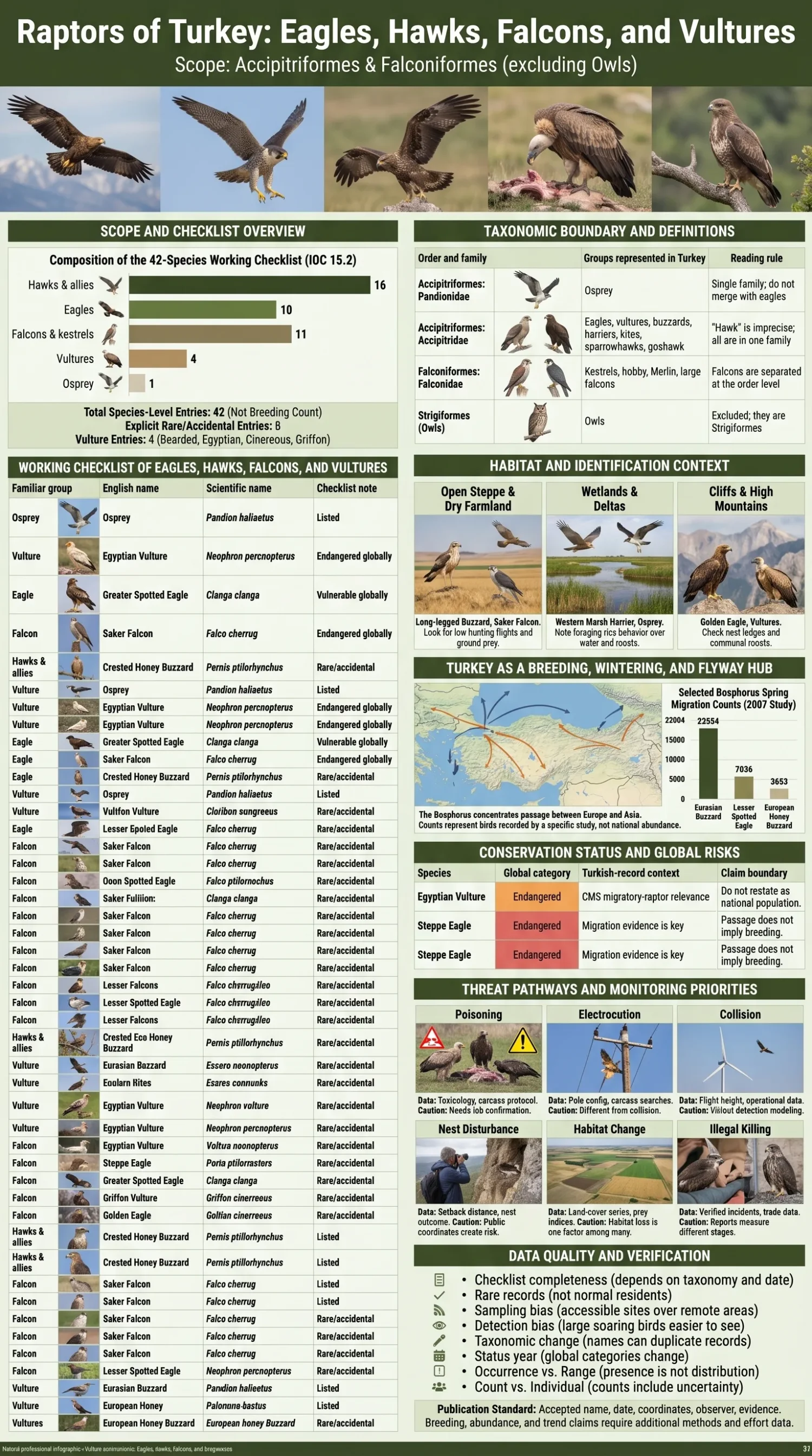
The Clements 2025-based Turkey checklist contains 42 diurnal raptor species: one member of Pandionidae, 30 members of Accipitridae and 11 falcons. The total includes resident birds, breeding visitors, passage migrants, winter visitors and five rare or accidental records. It is not a count of 42 regularly breeding raptors.[a]
The 42-Species Boundary Includes Exceptional Records
A species can enter a national checklist through an accepted record without becoming a regular part of the country’s breeding or wintering fauna. Turkey’s five raptors marked rare or accidental are the Oriental Honey-buzzard, Bateleur, Shikra, Amur Falcon and Sooty Falcon. Their inclusion documents reported national occurrence; it does not imply stable populations or predictable annual presence.
The remaining 37 species also do not share one occurrence pattern. Golden Eagles and Eurasian Goshawks may occupy territories throughout the year, while European Honey-buzzards and Levant Sparrowhawks are strongly associated with seasonal movement. Rough-legged Hawks are mainly linked with the colder part of the year, and species such as Steppe Eagle can occur as migrants while also having a much smaller breeding connection to Turkey.
Diurnal Raptors Listed
42 species
Clements 2025-based Turkey checklist.
Families Represented
3 families
Pandionidae, Accipitridae and Falconidae.
Exceptional Records
5 species
Marked rare or accidental in the checked list.
NT, VU or EN Globally
11 species
Global categories, not Turkish national assessments.
Why Falcons Sit Outside the Eagle-and-Hawk Branch
The everyday term “raptor” describes predatory birds rather than a single taxonomic rank. On the checklist used here, the Osprey, eagles, Old World vultures, kites, harriers, sparrowhawks and buzzards belong to Accipitriformes. Falcons belong to the separate order Falconiformes. Owls belong to Strigiformes and are outside this page’s diurnal scope.
Bird taxonomy is not fixed permanently. BirdLife maintains its own conservation taxonomy and notes that global lists may differ over species limits, English names and genus placement. BirdLife is also moving toward the unified AviList system, although conservation reassessments make that transition gradual.[b]
This checklist follows Clements version 2025.[c] Names were also checked against the IOC World Bird List.[d] Recent genus arrangements place the Shikra and Levant Sparrowhawk in Tachyspiza, while the Eurasian Goshawk is placed in Astur. Older books and databases may retain all three within a broader Accipiter.
Every Diurnal Raptor on the Turkey Checklist
The following tables contain all 42 species in the checked Turkey list. “Checklist record” means that the species is included for Turkey. “Rare/accidental” reproduces the source treatment for an exceptional national record. The conservation column gives the global category displayed through the BirdLife-linked checklist rather than a Turkish population category.
Vultures Recorded in Turkey
| Common name | Scientific name | Turkey checklist treatment | Global category |
|---|---|---|---|
| Bearded Vulture | Gypaetus barbatus | Checklist record | NT |
| Egyptian Vulture | Neophron percnopterus | Checklist record | EN |
| Cinereous Vulture | Aegypius monachus | Checklist record | NT |
| Eurasian Griffon | Gyps fulvus | Checklist record | LC |
Osprey and Eagles
| Common name | Scientific name | Turkey checklist treatment | Global category |
|---|---|---|---|
| Osprey | Pandion haliaetus | Checklist record | LC |
| Bateleur | Terathopius ecaudatus | Rare/accidental | EN |
| Short-toed Snake-Eagle | Circaetus gallicus | Checklist record | LC |
| Lesser Spotted Eagle | Clanga pomarina | Checklist record | LC |
| Greater Spotted Eagle | Clanga clanga | Checklist record | VU |
| Booted Eagle | Hieraaetus pennatus | Checklist record | LC |
| Steppe Eagle | Aquila nipalensis | Checklist record | EN |
| Eastern Imperial Eagle | Aquila heliaca | Checklist record | VU |
| Golden Eagle | Aquila chrysaetos | Checklist record | LC |
| Bonelli’s Eagle | Aquila fasciata | Checklist record | LC |
| White-tailed Eagle | Haliaeetus albicilla | Checklist record | LC |
Kites and Honey-buzzards
| Common name | Scientific name | Turkey checklist treatment | Global category |
|---|---|---|---|
| Black-winged Kite | Elanus caeruleus | Checklist record | LC |
| European Honey-buzzard | Pernis apivorus | Checklist record | LC |
| Oriental Honey-buzzard | Pernis ptilorhynchus | Rare/accidental | LC |
| Red Kite | Milvus milvus | Checklist record | LC |
| Black Kite | Milvus migrans | Checklist record | LC |
Sparrowhawks, Shikra and Goshawk
| Common name | Scientific name | Turkey checklist treatment | Global category |
|---|---|---|---|
| Shikra | Tachyspiza badia | Rare/accidental | LC |
| Levant Sparrowhawk | Tachyspiza brevipes | Checklist record | LC |
| Eurasian Sparrowhawk | Accipiter nisus | Checklist record | LC |
| Eurasian Goshawk | Astur gentilis | Checklist record | LC |
Harriers of Wetlands, Grasslands and Steppe
| Common name | Scientific name | Turkey checklist treatment | Global category |
|---|---|---|---|
| Western Marsh Harrier | Circus aeruginosus | Checklist record | LC |
| Hen Harrier | Circus cyaneus | Checklist record | LC |
| Pallid Harrier | Circus macrourus | Checklist record | NT |
| Montagu’s Harrier | Circus pygargus | Checklist record | LC |
The Three Buteo Buzzards
| Common name | Scientific name | Turkey checklist treatment | Global category |
|---|---|---|---|
| Rough-legged Hawk / Buzzard | Buteo lagopus | Checklist record | LC |
| Common Buzzard | Buteo buteo | Checklist record | LC |
| Long-legged Buzzard | Buteo rufinus | Checklist record | LC |
Falcons Recorded in Turkey
| Common name | Scientific name | Turkey checklist treatment | Global category |
|---|---|---|---|
| Lesser Kestrel | Falco naumanni | Checklist record | LC |
| Eurasian Kestrel | Falco tinnunculus | Checklist record | LC |
| Red-footed Falcon | Falco vespertinus | Checklist record | VU |
| Amur Falcon | Falco amurensis | Rare/accidental | LC |
| Eleonora’s Falcon | Falco eleonorae | Checklist record | LC |
| Sooty Falcon | Falco concolor | Rare/accidental | VU |
| Merlin | Falco columbarius | Checklist record | LC |
| Eurasian Hobby | Falco subbuteo | Checklist record | LC |
| Lanner Falcon | Falco biarmicus | Checklist record | LC |
| Saker Falcon | Falco cherrug | Checklist record | EN |
| Peregrine Falcon | Falco peregrinus | Checklist record | LC |
Four Vultures Divide the Carrion Resource
Turkey’s four established vulture species do not use every carcass in the same way. Differences in body size, bill structure and feeding behaviour allow several species to share a carcass, although competition becomes stronger when food is limited. Studies of the European vulture guild found that Griffon and Cinereous Vultures were more likely to dominate restricted carrion resources than the smaller Egyptian Vulture or the more specialised Bearded Vulture.[f]
| Species | Feeding emphasis | Ecological separation |
|---|---|---|
| Bearded Vulture | Bones, bone fragments and remains left after soft tissue has been removed | Its strong dependence on skeletal material separates it from flesh-focused scavengers. |
| Egyptian Vulture | Small carcasses, scraps and pieces accessible around larger scavengers | Small size allows use of food portions that are less accessible or less profitable to large vultures. |
| Eurasian Griffon | Soft tissue from medium and large carcasses, often through group feeding | Social searching and feeding allow rapid exploitation of an opened carcass. |
| Cinereous Vulture | Tough tissue, skin and material handled with a deep, powerful bill | Large body size often gives it priority during direct competition at a carcass. |
These roles overlap. Carcass size, decomposition stage, the number and age of birds present, disturbance and the arrival order can all change which species feeds first and which parts remain available.
Anatolia Compresses Migration into Narrow Corridors
Many broad-winged raptors reduce flight costs by circling in rising air and gliding between thermals. Because sustained thermal lift forms more reliably over land than open sea, migrating eagles, buzzards, kites and vultures tend to concentrate near straits, coastlines, valleys and mountain passes. Turkey lies between breeding areas in Europe and western Asia and non-breeding areas farther south, placing several narrow passages within the same country.
Belen Pass Connects Anatolia with the Levant
A spring survey at Belen Pass in Hatay monitored migration between 6 March and 20 May 2015. Observers recorded 50,082 soaring migrants from 29 species, including 619 Lesser Spotted Eagles. White Storks accounted for 46,525 birds, so the study total must not be reported as a raptor count. The highest one-day total was 7,160 soaring birds, and the largest share passed at an estimated height of 400–500 metres.[g]
Belen lies beside the Amanos Mountains and the Gulf of İskenderun. Terrain and coast geometry compress northbound and southbound movements into a narrower airspace, making the area valuable for migration monitoring but also sensitive to poorly placed turbines, power lines and other tall structures.
The Bosphorus Funnels Birds Around the Black Sea
Spring monitoring over the Bosphorus from 18 March to 31 May recorded 100,051 soaring birds. White Stork, Common Buzzard, Lesser Spotted Eagle and European Honey-buzzard were among the most numerous species. As at Belen, the total included non-raptors and represented birds passing the observation area during one season rather than the size of a national population.[h]
Wind direction, cloud cover and the position of rising air can shift flight lines across different parts of Istanbul. Counts made from one station may therefore sample only part of the visible passage. Comparable multi-station and repeated-season monitoring is needed before count changes can be treated as population trends.
Borçka Receives the Caucasus Route
Borçka in Artvin is another recognised corridor in Turkish migration literature. The Çoruh Valley and surrounding mountain topography provide a land route between the Caucasus and northeastern Anatolia. This corridor is especially relevant to species moving along the eastern Black Sea rather than crossing broad stretches of open water.
Mountains, Forests, Steppe and Wetlands Sort the Assemblage
Rocky Mountains and Cliff Systems
High relief and exposed rock provide nesting ledges, rising air and access to open hunting grounds. Golden Eagles, Bonelli’s Eagles, Bearded Vultures, Eurasian Griffons, Egyptian Vultures, Peregrine Falcons and Lanner Falcons can all be associated with rocky landscapes, but they differ in elevation, prey, territory size and dependence on cliffs. The presence of suitable rock alone does not establish that every one of these species occurs at a site.
Forest Interiors and Wooded Edges
Eurasian Goshawks and Eurasian Sparrowhawks hunt within or beside woodland, using short bursts of flight and cover rather than prolonged open-country soaring. European Honey-buzzards depend on wooded breeding landscapes but often forage across clearings and edges. Booted Eagles also combine wooded nesting areas with open feeding habitat. Cinereous Vultures differ from cliff-nesting Griffons by commonly placing nests in mature trees within broad forest landscapes.
Steppe, Dry Farmland and Open Plateaus
Open central and eastern landscapes support a different hunting structure. Long-legged Buzzards search for rodents, reptiles and other ground prey from the air or raised perches. Lesser Kestrels can forage communally over grassland and agricultural mosaics. Eastern Imperial Eagles, Saker Falcons and several harriers also depend on open feeding areas, although their nesting requirements and seasonal presence differ.
Agricultural land can provide prey while simultaneously reducing nesting cover, natural grassland and prey diversity. The effect depends on crop type, harvest timing, pesticide use, field margins, grazing intensity and the survival of old trees or structures used for nesting.
Wetlands, River Basins and Coasts
Ospreys are tied to waters that provide accessible fish and suitable perches. White-tailed Eagles use large wetlands, lakes, rivers and coastal systems. Western Marsh Harriers hunt low above reedbeds and marsh vegetation, while Greater Spotted Eagles are often associated with wet grasslands, floodplains and wooded wetland mosaics during parts of their annual cycle.
Coastal cliffs and islands also support falcons with very different strategies. Eleonora’s Falcon times much of its breeding ecology around the passage of small migratory birds across the Mediterranean. The Sooty Falcon, by contrast, remains only an exceptional Turkey record in the checklist used here.
Migration Airspace Is Habitat Too
A migration corridor is not merely empty space between breeding and wintering areas. Ridge lift, thermal formation, safe roosts, stopover feeding areas and low-risk passage around infrastructure all affect whether birds can complete a route. European Honey-buzzards, Lesser Spotted Eagles, Levant Sparrowhawks, Black Kites and Booted Eagles can occur in concentrated passage even where the surrounding landscape supports few breeding pairs.
Identification Problems That Need Multiple Field Marks
Raptors change appearance with age, sex, moult, viewing angle and light. Pale and dark morphs can differ more within one species than two distant birds of different species appear to differ from each other. A single plumage patch is rarely enough for a difficult record.
| Confusion group | Useful evidence | Frequent source of error |
|---|---|---|
| Common, Long-legged and Rough-legged Buzzards | Tail pattern, wing proportions, carpal markings, flight action and feathering on the lower legs | Common Buzzards vary greatly in colour; distant pale birds are often assigned by colour alone. |
| Lesser and Greater Spotted Eagles | Wing and tail proportions, primary shape, age-related upperwing pattern and several photographs | Juvenile plumage, wear and hybrids can weaken otherwise familiar field marks. |
| Levant and Eurasian Sparrowhawks | Wing-tip shape, tail proportion, underwing pattern, sex, age and migration behaviour | A distant female or juvenile can lack the obvious pattern expected from an adult male. |
| Lesser and Eurasian Kestrels | Head and tail pattern in males, claw colour when visible, upperpart spotting and wing structure | Females and juveniles are much harder than breeding-plumaged adult males. |
| Saker, Lanner and Peregrine Falcons | Body bulk, wing breadth, tail length, head pattern, flight style and age | Juveniles, worn plumage and distant views can make facial markings appear stronger or weaker. |
| Eurasian Griffon and Cinereous Vulture | Wing outline, tail shape, neck profile, underwing contrast and behaviour around other vultures | Backlighting can remove the colour contrast normally used to separate the species. |
| Pallid, Montagu’s and Hen Harriers | Age and sex first, followed by wing-tip structure, underwing pattern, collar and rump | Juveniles and transitional plumages cannot be identified reliably from one pale collar or rump patch. |
A record that would alter the known national status of a species needs more evidence than an ordinary observation: photographs from several angles, date and location, age and sex assessment, written field notes and independent review where possible.
Global Risk Categories Across the Checklist
BirdLife acts as the IUCN Red List Authority for birds and links recognised taxa to global threat assessments.[e] Across the 42-species Turkey checklist, 31 species are listed as Least Concern, three as Near Threatened, four as Vulnerable and four as Endangered.
Global Red List Categories Across Turkey’s 42-Species Raptor Checklist
Counts use the global categories displayed for species in the Clements 2025-based Turkey checklist.
Source: Avibase Turkey checklist with BirdLife global categories. Counts include five rare or accidental species and do not represent a Turkish national population assessment.
The 11 species above Least Concern are not equivalent to 11 threatened breeding raptors in Turkey. Bateleur and Sooty Falcon are rare or accidental national records, yet they still contribute one Endangered and one Vulnerable species to the chart. Conversely, a globally Least Concern species may be scarce, localised or poorly monitored within Turkey.
The four Endangered species in the checklist are Egyptian Vulture, Bateleur, Steppe Eagle and Saker Falcon. The four Vulnerable species are Greater Spotted Eagle, Eastern Imperial Eagle, Red-footed Falcon and Sooty Falcon. Bearded Vulture, Cinereous Vulture and Pallid Harrier are Near Threatened.
The Steppe Eagle Is Not Only a Passage Record
The 2026 Global Action Plan for the Steppe Eagle reports that a satellite breeding population in Turkey was confirmed during work beginning in the mid-2010s. This does not make the species a widespread Turkish breeder, but it means that descriptions limited to migration and winter occurrence are incomplete.[k]
Power Lines Are a Documented Turkish Threat
A flyway-wide study centred on the Endangered Egyptian Vulture combined satellite tracking of 71 birds, surveys of 4,216 kilometres of power lines, 910 interviews about poison use and assessments of direct persecution. Electrocution on small, poorly designed pylons was ranked as the priority threat in Turkey, as well as in Jordan, Egypt and Ethiopia.[i]
Electrocution occurs when a bird simultaneously contacts energised and grounded components or two conductors. Large raptors are exposed because their wingspan can bridge unsafe gaps and because poles provide elevated perches in otherwise open landscapes. The risk is shaped by pole design, conductor spacing, insulation, surrounding prey abundance and the number of birds using the area.
Collision Is a Separate Infrastructure Risk
A line can be safe from electrocution yet remain difficult to see in poor light or during rapid flight. Collision risk is influenced by wire visibility, topography, weather and whether a route crosses a feeding area, wetland, ridge or migration bottleneck. Wind turbines create another form of collision risk when placed within concentrated flight paths or close to nesting and feeding areas.
Poisoning Can Affect Species That Were Not Targeted
Poison intended for carnivores can kill vultures and eagles that feed on treated carcasses. Veterinary medicines, pesticides and contaminated prey can create additional exposure routes. One poisoned carcass may affect several scavengers because vultures gather communally and move across wide areas while searching for food.
Nest Disturbance and Habitat Change Act at Different Scales
Cliff recreation, road construction, forestry near nest trees, quarrying and repeated close approach can cause breeding failure without removing the nest structure itself. Across open landscapes, conversion of steppe, loss of field margins, pesticide use and changes in grazing can reduce prey even where nesting sites remain intact.
The CMS action plan for migratory African-Eurasian raptors calls for safer energy infrastructure, control of poisoning and illegal killing, protection of breeding and migration sites, and coordinated monitoring across national borders.[j] Retrofitting hazardous poles is most effective when carcass surveys, nest locations, migration counts and tracking data are used to identify high-risk sections rather than treating every line as equally dangerous.
Breeding, Passage and Vagrant Records Need Separate Counts
A defensible national account of Turkey’s raptors cannot be reduced to one species total. Breeding pairs, non-breeding summer birds, passage migrants, winter visitors and exceptional records describe different biological relationships with the country. Combining them hides changes that may be occurring in only one part of the annual cycle.
Migration counts measure passage through a defined observation window. Nest surveys measure occupied territories or breeding attempts. Satellite tracking reveals routes and mortality locations for tagged individuals. Carcass searches document mortality evidence along surveyed infrastructure. Checklist records establish accepted occurrence. None of these sources alone provides complete national abundance or exact distribution.
The strongest future assessment would keep these evidence types separate while connecting them by species, season, location, observation effort and date. That structure would allow changes in breeding occupancy, migration volume, winter distribution and infrastructure mortality to be tested without treating every reported sighting as equivalent evidence.
Sources and Verification
- [a] Avibase Bird Checklist: Turkey — Used for the complete Clements 2025-based species roster, family placement, rare or accidental flags and displayed global categories.
- [b] BirdLife International Taxonomy — Used to explain BirdLife’s conservation taxonomy, checklist differences and the continuing alignment with AviList.
- [c] Clements Checklist v2025 Update — Used to verify the taxonomic edition followed by the Turkey checklist.
- [d] IOC World Bird List — Used to cross-check current English names, scientific names and recent genus placement.
- [e] BirdLife International and the IUCN Red List — Used to verify BirdLife’s role as the Red List Authority for birds and the global scale of the categories.
- [f] Dominance and Resource Partitioning in the European Vulture Guild — Used for differences in carcass use and competitive dominance among Europe’s four vulture species.
- [g] Soaring Bird Migration in 2015 Spring at Belen Pass, Hatay, Turkey — Used for Belen survey dates, observation scope, species totals, Lesser Spotted Eagle count, flight heights and Turkey’s named migration corridors.
- [h] Spring Migration of Soaring Birds over the Bosphorus, Turkey — Used for the Bosphorus monitoring period, total soaring-bird count and prominent migrant raptor groups.
- [i] Major Threats to a Migratory Raptor Vary Geographically Along the Eastern Mediterranean Flyway — Used for satellite-tracking scope, power-line survey effort and the prioritisation of electrocution risk in Turkey.
- [j] CMS Raptors Action Plan — Used for coordinated measures addressing poisoning, illegal killing, energy infrastructure, migration sites and monitoring.
- [k] Global Action Plan for the Conservation of the Steppe Eagle — Used for the recently documented satellite breeding population and breeding-survey context in Turkey.
Related Topics
- → Birds of Turkey: Native, Migratory, and Rare Species
- → Steppe Birds of Turkey: Open-Country Species
- → Migratory Birds in Turkey: Major Flyways and Seasonal Patterns
- → Forest Birds of Turkey: Woodland Species and Habitats
- → Common Birds of Turkey: Species Often Seen Across the Country
- → Birds of Turkish Wetlands: Lakes, Deltas, and Marshes