Complete guides: Birds of Turkey•Regional Fauna Guides
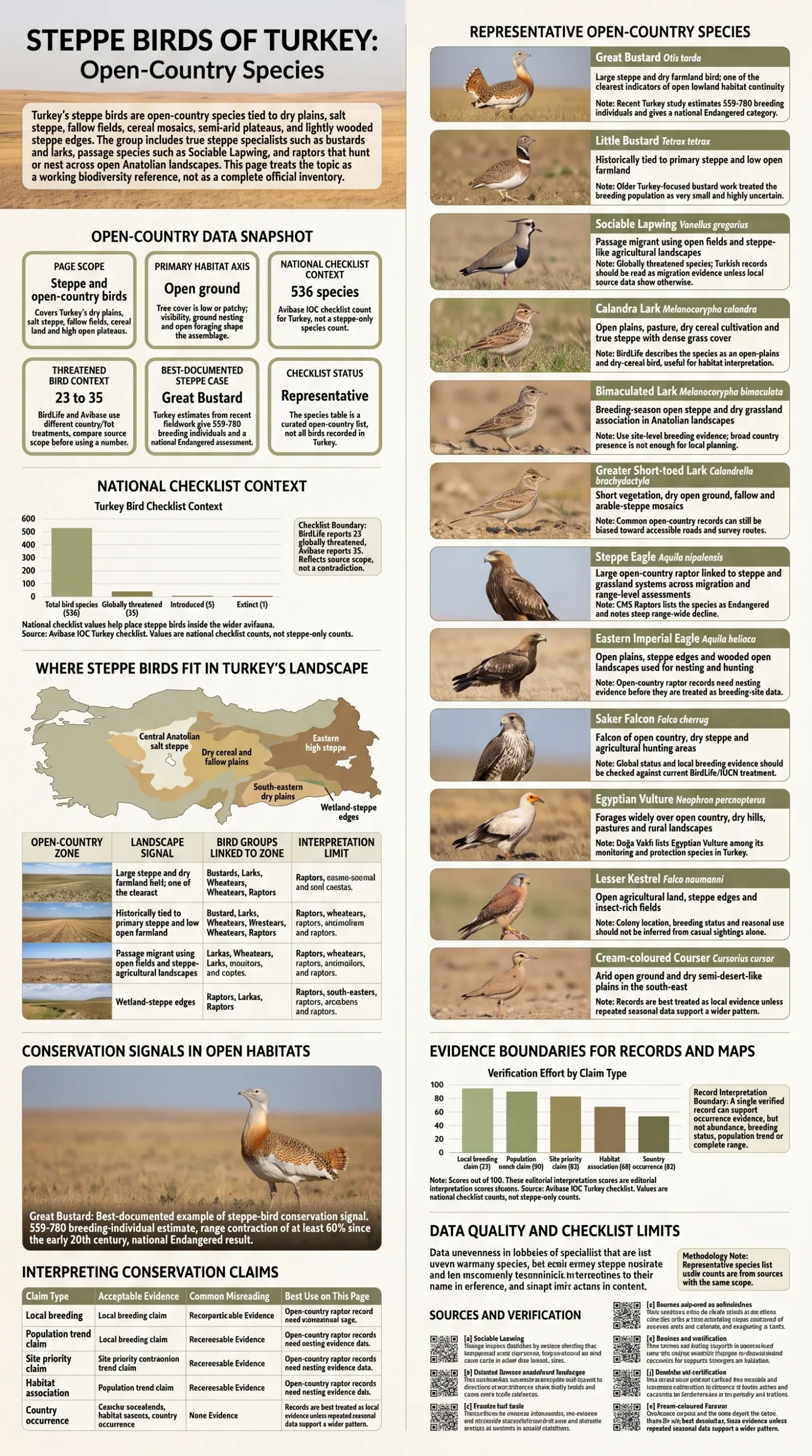
Turkey’s steppe bird community includes species that breed, feed, migrate or winter in treeless grassland, dry shrub-steppe, saline flats, high plateaus, fallow and broad cereal mosaics. The strongest habitat specialists are larks, bustards, sandgrouse, wheatears, pipits and open-country buntings. Raptors, shrikes, rollers and owls form a second group whose nests may be on cliffs, trees or buildings but whose feeding grounds depend on open landscapes.
There is no single official checklist titled “steppe birds of Turkey.” The boundary is ecological rather than administrative: some birds depend on natural steppe, some use both steppe and low-intensity farmland, and others appear mainly during migration or winter. The checklist on this page therefore separates core steppe species, regular open-country associates and seasonal visitors instead of treating every bird seen over a field as a steppe bird.
Taxonomic baseline
eBird/Clements v2025
Current English and scientific names were checked against the 2025 checklist release.[a]
Steppe extent reference
Nearly 40% of Turkey
This is the approximate national coverage stated in the FAO project description, not a new GIS calculation.[b]
Core habitat study
32 Inner Anatolian sites
The field study covered about one million hectares and ranked birds by dependence on steppe habitat.[c]
National breeding evidence
2014–2017 field period
The Turkish Breeding Bird Atlas provides the national atlas reference for recent breeding evidence.[d]
What Counts as Steppe Habitat for Birds
For birds, Anatolian steppe is a set of open vegetation structures rather than one uniform plant community. It ranges from short, heavily exposed plains and saline basins to taller herbaceous steppe, dwarf-shrub country, rocky uplands, alpine grassland and long-established agricultural mosaics. Soil, rainfall, altitude, grazing, fallow age and the amount of scattered woody cover all change which species can use a site.
Central Anatolian grasslands should not automatically be described as ruined forest. Palaeoecological and vegetation evidence supports their treatment as old-growth grassland and forest-steppe systems that have persisted under climate and disturbance over long periods. Planting trees into naturally open grassland can therefore replace, rather than restore, habitat for treeless-country birds.[e]
Open farmland is not automatically steppe habitat
A cereal field can support larks, buntings, quail or harriers, but its value depends on crop type, field size, pesticide use, fallow, grazing, field margins and nearby natural vegetation. Intensive irrigated monoculture and diverse dry-farming mosaics should not be placed in the same habitat category.
Open-Country Regions and Their Bird Assemblages
Turkey’s open-country birds turn over along strong gradients of altitude, winter severity, summer drought and land use. The assemblage of a saline Central Anatolian basin differs from that of an eastern plateau or a stony plain in the southeast. The examples in the table indicate characteristic combinations, not exclusive ranges.
| Open-country zone | Dominant structure | Characteristic assemblage examples |
|---|---|---|
| Central plateau and closed basins | Natural and semi-natural steppe, saline flats, fallow, dry cereal plains | Calandra Lark, Greater Short-toed Lark, Turkestan Short-toed Lark, Crested Lark, Isabelline Wheatear, Corn Bunting, Great Bustard |
| Eastern high plateaus | Treeless uplands, cool grassland, rocky plateau and broad valleys | Bimaculated Lark, Horned Lark, Eurasian Skylark, Northern Wheatear, Gray Partridge, Great Bustard, Long-legged Buzzard |
| Southeastern arid steppe | Low-rainfall plains, stony ground, dwarf-shrub steppe and rocky escarpments | Black-bellied Sandgrouse, Greater Short-toed Lark, Isabelline Wheatear, Finsch’s Wheatear, Cinereous Bunting, Lesser Kestrel |
| Agricultural-steppe mosaics | Cereal fields, fallow, pasture, field margins, villages and scattered trees | Common Quail, Corn Bunting, Black-headed Bunting, Lesser Gray Shrike, European Roller, Lesser Kestrel, Montagu’s Harrier |
| Wet and saline steppe margins | Seasonally damp grassland, shallow basin edges, salt meadows and irrigated field margins | Western Yellow Wagtail, Collared Pratincole, Meadow Pipit, Water Pipit, Sociable Lapwing during passage |
Central Anatolian Plateau and Basin Steppe
The central plateau contains broad dry-farming landscapes, natural steppe remnants, salt basins and abandoned fields. Calandra Lark, Greater Short-toed Lark, Crested Lark, Tawny Pipit, Isabelline Wheatear and Corn Bunting occupy different combinations of vegetation height, bare ground and disturbance. Great Bustard and Black-bellied Sandgrouse require much larger, quieter open landscapes and are far more localized.
Eastern High Plateaus
Eastern Anatolia adds cold, treeless uplands and broad high-elevation valleys. Bimaculated Lark, Horned Lark, Eurasian Skylark, Northern Wheatear, Gray Partridge and Golden Eagle are more closely tied to these cooler or rockier settings than to the low, dry central plains. Snow cover and severe winters create stronger seasonal movement than in much of central and southeastern Turkey.
Southeastern Arid Steppe
Şanlıurfa, Mardin, Diyarbakır and neighboring districts contain low-rainfall plains, rocky escarpments and dwarf-shrub steppe with a stronger Middle Eastern element. Black-bellied Sandgrouse, Isabelline Wheatear, Finsch’s Wheatear, Cinereous Bunting and Lesser Kestrel are among the birds associated with this arid open-country belt. FAO-backed conservation planning in Şanlıurfa has focused on Kızılkuyu Wildlife Development Area, Tek Tek Mountains National Park and the Karacadağ steppes.[f]
Agricultural Mosaics and Steppe Margins
Dry cereal fields, fallow, pasture, village edges, orchards and scattered trees expand the usable landscape for quail, Corn Bunting, Black-headed Bunting, shrikes, European Roller and Lesser Kestrel. The same woody elements that provide nest sites for rollers, shrikes and eagles can reduce habitat suitability for birds that require uninterrupted treeless ground. Conservation at landscape scale therefore needs both open cores and selected nesting structures.
Source-Based Working Checklist
The following list combines habitat-dependence evidence from Inner Anatolia, breeding-atlas context, current taxonomy and country-level conservation records. BirdLife’s Türkiye factsheet was used as a country and threat-status cross-check rather than as a stand-alone definition of steppe habitat.[g]
This is a source-based working list, not a complete official inventory. It excludes accidentals, primarily forest or wetland specialists, and widespread urban generalists even when they occasionally feed in open land. Seasonal phrases describe broad national patterns; local timing and breeding status can differ by region and year.
Bustards, Gamebirds, Sandgrouse, Larks and Pipits
| Common name | Scientific name | Relationship to steppe | Seasonal pattern in Turkey | Main open-country use |
|---|---|---|---|---|
| Great Bustard | Otis tarda | Core steppe species | Resident breeder with seasonal movements; also forms winter concentrations | Large treeless plains, fallow, cereal-steppe mosaics |
| Little Bustard | Tetrax tetrax | Core steppe species | Extremely scarce breeder; migrant and winter visitor | Short grassland, dry farmland, fallow and coastal winter fields |
| Chukar | Alectoris chukar | Core rocky-steppe species | Resident | Rocky slopes, broken steppe and dry uplands |
| Gray Partridge | Perdix perdix | Core cool-steppe species | Localized resident | Cooler plateau grasslands, field edges and eastern uplands |
| Common Quail | Coturnix coturnix | Core grassland species | Summer breeder and passage migrant | Tall grass, hayfields, cereal crops and lightly grazed steppe |
| Black-bellied Sandgrouse | Pterocles orientalis | Core arid-steppe species | Localized resident and breeder | Dry plains, semi-desert, stony steppe and sparse farmland |
| Eurasian Thick-knee | Burhinus oedicnemus | Core bare-ground species | Summer breeder; locally present longer | Dry open ground, stony fields, fallow and sparse grass |
| Sociable Lapwing | Vanellus gregarius | Seasonal open-country visitor | Scarce passage migrant | Short grass, grazed plains and recently worked fields |
| Collared Pratincole | Glareola pratincola | Open-country associate | Summer breeder and migrant | Bare or short-vegetated ground near shallow wetlands and irrigated plains |
| Calandra Lark | Melanocorypha calandra | Core steppe species | Resident or locally dispersive | Lowland steppe, pasture and broad cereal plains |
| Bimaculated Lark | Melanocorypha bimaculata | Core steppe species | Summer breeder and passage migrant | Upland dry grassland, plateau steppe and open cultivation |
| Greater Short-toed Lark | Calandrella brachydactyla | Core steppe species | Summer breeder and passage migrant | Dry plains, sparse grass, fallow and saline-steppe margins |
| Turkestan Short-toed Lark | Alaudala heinei | Core short-steppe species | Localized breeder and partial migrant | Short, sparse steppe and saline or semi-arid flats |
| Eurasian Skylark | Alauda arvensis | Core grassland species | Breeder, migrant and winter visitor depending on region | Plateau grassland, pasture and open arable land |
| Crested Lark | Galerida cristata | Core disturbed-open-ground species | Resident | Roadside steppe, dry farmland, village margins and bare ground |
| Horned Lark | Eremophila alpestris | Core alpine-steppe species | Localized resident and breeder | Treeless high plateaus, alpine turf and wind-exposed ground |
| Wood Lark | Lullula arborea | Forest-steppe associate | Resident or partial migrant | Open woodland-steppe, scrub clearings and dry grassland |
| Tawny Pipit | Anthus campestris | Core dry-open-ground species | Summer breeder and passage migrant | Bare soil, sparse grass, dry pasture and open cultivation |
| Red-throated Pipit | Anthus cervinus | Seasonal open-country visitor | Passage migrant | Short pasture, damp fields and open grassland during migration |
| Meadow Pipit | Anthus pratensis | Seasonal open-country visitor | Mainly winter visitor and passage migrant | Pasture, wet grassland and open fields |
| Water Pipit | Anthus spinoletta | High-country open-land species | Breeder in uplands; widespread in winter | Alpine meadow, wet plateau grassland and lowland winter fields |
| Western Yellow Wagtail | Motacilla flava | Open-country associate | Summer breeder and passage migrant | Wet pasture, crop margins, irrigated fields and marshy steppe edges |
Raptors and Owls That Depend on Open Hunting or Foraging Ground
| Common name | Scientific name | Relationship to steppe | Seasonal pattern in Turkey | Main open-country use |
|---|---|---|---|---|
| Egyptian Vulture | Neophron percnopterus | Open-country scavenger | Summer breeder and migrant | Feeds over steppe, pasture and farmland; nests on cliffs |
| Bearded Vulture | Gypaetus barbatus | Highland open-country scavenger | Resident | Mountain steppe and open slopes around cliff nesting areas |
| Eurasian Griffon | Gyps fulvus | Open-country scavenger | Resident with wide-ranging movements | Pasture, plateau and steppe around communal cliff roosts and colonies |
| Cinereous Vulture | Aegypius monachus | Open-country scavenger | Resident and dispersive | Forages over open uplands and steppe; usually nests in trees |
| Short-toed Snake-Eagle | Circaetus gallicus | Open-country raptor | Summer breeder and migrant | Dry grassland, scrub-steppe and open rocky country |
| Eastern Imperial Eagle | Aquila heliaca | Open-country raptor | Localized breeder, migrant and winter visitor | Steppe and farmland with nesting trees or woodland edges |
| Golden Eagle | Aquila chrysaetos | Highland open-country raptor | Resident | Mountain steppe, plateaus, cliffs and broad open valleys |
| Steppe Eagle | Aquila nipalensis | Seasonal steppe raptor | Passage migrant; occasional winter records | Open plains, ridges and migration corridors |
| Long-legged Buzzard | Buteo rufinus | Core open-country raptor | Resident, breeder and migrant | Dry steppe, farmland, plateaus and rocky plains |
| Pallid Harrier | Circus macrourus | Seasonal steppe raptor | Passage migrant and winter visitor | Short grassland, cereal fields and open plains |
| Montagu’s Harrier | Circus pygargus | Open-country raptor | Summer breeder and passage migrant | Grassland, cereal fields, fallow and wet-steppe margins |
| Hen Harrier | Circus cyaneus | Seasonal open-country raptor | Winter visitor and passage migrant | Open farmland, pasture, marsh edge and steppe |
| Lesser Kestrel | Falco naumanni | Core open-country raptor | Summer breeder and migrant | Steppe and cereal plains near colonies in cliffs or buildings |
| Common Kestrel | Falco tinnunculus | Regular open-country raptor | Resident, breeder and migrant | Farmland, grassland, steppe and settlement edges |
| Red-footed Falcon | Falco vespertinus | Seasonal open-country raptor | Passage migrant; local breeding evidence varies | Open farmland, grassland and tree-lined plains |
| Saker Falcon | Falco cherrug | Core steppe falcon | Localized breeder, resident or migrant | Broad plains, plateaus and open country with suitable nest sites |
| Merlin | Falco columbarius | Seasonal open-country raptor | Winter visitor and passage migrant | Open fields, grassland and treeless plains |
| Little Owl | Athene noctua | Regular open-country owl | Resident | Dry farmland, rocky steppe, ruins and village margins |
| Short-eared Owl | Asio flammeus | Seasonal open-country owl | Irregular winter visitor and passage migrant; local breeder in some years | Open grassland, marshy plains, fallow and rough fields |
| Eurasian Eagle-Owl | Bubo bubo | Open-country predator from rocky sites | Resident | Cliffs, quarries and rocky steppe overlooking open hunting ground |
Wheatears, Shrikes, Buntings and Other Open-Country Passerines
| Common name | Scientific name | Relationship to steppe | Seasonal pattern in Turkey | Main open-country use |
|---|---|---|---|---|
| Isabelline Wheatear | Oenanthe isabellina | Core steppe species | Summer breeder and passage migrant | Dry plains, grazed steppe, burrow-rich pasture and fallow |
| Northern Wheatear | Oenanthe oenanthe | Core upland-open-country species | Summer breeder and passage migrant | High plateaus, rocky grassland and alpine steppe |
| Eastern Black-eared Wheatear | Oenanthe melanoleuca | Core rocky-open-country species | Summer breeder and migrant | Rocky steppe, dry slopes, quarries and open scrub |
| Finsch’s Wheatear | Oenanthe finschii | Core arid-rocky-steppe species | Winter visitor and localized breeder depending on region | Barren slopes, stony plains and sparse scrub |
| Kurdish Wheatear | Oenanthe xanthoprymna | Core eastern rocky-steppe species | Localized breeder and migrant | Rocky highlands, scree and dry eastern plateaus |
| Pied Wheatear | Oenanthe pleschanka | Seasonal open-country visitor | Passage migrant; localized in the east | Rocky plains, short grass and dry slopes |
| Whinchat | Saxicola rubetra | Open-grassland associate | Passage migrant and localized summer breeder | Meadows, rank grass, field edges and wet-steppe margins |
| European Stonechat | Saxicola rubicola | Open-country associate | Resident, breeder and migrant depending on region | Rough pasture, scrub-steppe and field margins |
| Rufous-tailed Scrub-Robin | Cercotrichas galactotes | Dry scrub-steppe associate | Summer breeder and migrant | Open scrub, hedges, dry orchards and semi-arid field edges |
| Red-backed Shrike | Lanius collurio | Open-country edge species | Summer breeder and migrant | Pasture and steppe with scattered shrubs, hedges or small trees |
| Lesser Gray Shrike | Lanius minor | Open-country edge species | Summer breeder and migrant | Broad farmland and dry grassland with scattered trees or wires |
| Woodchat Shrike | Lanius senator | Open-country edge species | Summer breeder and migrant | Open scrub, orchards, pasture and lightly wooded steppe |
| Masked Shrike | Lanius nubicus | Open-country edge species | Summer breeder and migrant | Dry scrub, open woodland and rocky agricultural margins |
| European Roller | Coracias garrulus | Open-country edge species | Summer breeder and migrant | Steppe and farmland with nest cavities, poles or scattered trees |
| European Bee-eater | Merops apiaster | Open-country aerial feeder | Summer breeder and migrant | Open farmland and steppe near earthen nesting banks |
| Common Hoopoe | Upupa epops | Open-country ground feeder | Summer breeder; resident locally | Short grass, pasture, orchards and village-steppe mosaics |
| Corn Bunting | Emberiza calandra | Core agricultural-steppe species | Resident, breeder and partial migrant | Cereal fields, fallow, pasture and open steppe |
| Ortolan Bunting | Emberiza hortulana | Core open-country species | Summer breeder and migrant | Dry farmland, steppe slopes and scattered scrub |
| Black-headed Bunting | Emberiza melanocephala | Core open-country species | Summer breeder and migrant | Tall steppe herbs, field margins and open scrub |
| Rock Bunting | Emberiza cia | Rocky-steppe associate | Resident or partial migrant | Rocky slopes, open scrub and mountain steppe |
| Cretzschmar’s Bunting | Emberiza caesia | Dry rocky-open-country species | Summer breeder and migrant | Dry slopes, open scrub, stony steppe and terraces |
| Cinereous Bunting | Emberiza cineracea | Localized arid-steppe species | Summer breeder and migrant | Dry rocky slopes, sparse scrub and southeastern open country |
| Gray-necked Bunting | Emberiza buchanani | Eastern open-country species | Localized breeder and passage migrant | Barren hills, rocky steppe and sparse mountain scrub |
| Rock Sparrow | Petronia petronia | Core rocky-steppe species | Resident or partial migrant | Rocky grassland, ruins, cliffs and open farmland |
| Pale Rockfinch | Carpospiza brachydactyla | Core dry-upland species | Summer breeder and migrant | Barren uplands, rocky steppe and sparse highland grass |
| Eurasian Linnet | Linaria cannabina | Open-country associate | Resident, breeder and migrant | Dry grassland, fallow, scrub-steppe and weedy fields |
| Crimson-winged Finch | Rhodopechys sanguineus | High rocky-steppe species | Resident or locally dispersive | Rocky high plateaus, scree and sparse alpine-steppe vegetation |
| Spanish Sparrow | Passer hispaniolensis | Agricultural-steppe associate | Summer breeder, migrant and local resident | Cereal plains, pasture and open country near colony sites |
| Rose-colored Starling | Pastor roseus | Irruptive open-country visitor | Irregular summer migrant and breeder | Grasshopper-rich steppe, pasture and agricultural plains |
Names That Need Current Taxonomic Treatment
Taxonomic change affects search results, older field records and population estimates. The current nomenclature used here follows the 2025 eBird/Clements baseline.[a] Older Turkish literature remains valuable, but names must be mapped to current taxa before records are combined.
| Current name | Current scientific name | Older or alternative label | Why the distinction matters |
|---|---|---|---|
| Eastern Black-eared Wheatear | Oenanthe melanoleuca | Older sources often used Black-eared Wheatear, O. hispanica, for a broader species. | The 2021 eBird treatment split Western and Eastern Black-eared Wheatears. Turkish breeding birds are normally treated as Eastern, while uncertain records should not be forced to species.[h] |
| Turkestan Short-toed Lark | Alaudala heinei | Many older records were filed under Lesser Short-toed Lark or a broad A. rufescens treatment. | Current species treatment recognizes Turkestan Short-toed Lark. BirdLife notes that older Turkish estimates may have included birds assigned to a neighboring taxon, so historical totals need taxonomic review.[i] |
| Pale Rockfinch | Carpospiza brachydactyla | Older literature may use Pale Rock Sparrow or Petronia brachydactyla. | Current nomenclature places the species in Carpospiza; searches should include both older and current names. |
| Eastern Imperial Eagle | Aquila heliaca | Some global lists shorten the English name to Imperial Eagle. | The scientific name identifies the same species; English-name differences should not be treated as a taxonomic split. |
The Steppe Community Changes Through the Year
A spring visit, a winter survey and a breeding atlas can produce very different lists from the same plain. Summer brings quail, short-toed larks, wheatears, buntings, rollers and Lesser Kestrels. Passage periods add Sociable Lapwing, Steppe Eagle, Pallid Harrier, Red-footed Falcon and Red-throated Pipit. Winter shifts many birds toward lower plains and cultivated basins, while Hen Harrier, Merlin, Meadow Pipit and Short-eared Owl become more visible.
| Seasonal group | Pattern | Examples |
|---|---|---|
| Resident and locally dispersive birds | Present through much of the year, although snow, drought and food can drive movements | Chukar, Crested Lark, Long-legged Buzzard, Little Owl, Rock Sparrow |
| Spring and summer breeders | Arrive to breed in grassland, dry farmland or rocky steppe, then leave or move south | Common Quail, Bimaculated Lark, Tawny Pipit, Isabelline Wheatear, Black-headed Bunting, Lesser Kestrel |
| Passage migrants | Use short grass, fields, ridges and plateaus while crossing Anatolia | Sociable Lapwing, Steppe Eagle, Pallid Harrier, Red-footed Falcon, Red-throated Pipit |
| Winter and irregular visitors | Concentrate in open fields, pasture and lowland plains outside the breeding season | Hen Harrier, Merlin, Meadow Pipit, Short-eared Owl, Finsch’s Wheatear in parts of the country |
| Irruptive open-country users | Numbers vary sharply between years in response to food and movements outside Turkey | Rose-colored Starling and some wintering raptors |
Presence during migration does not establish breeding. The Turkish Breeding Bird Atlas used possible, probable and confirmed breeding evidence during its 2014–2017 field period, a distinction that should be retained when regional lists are updated.[d]
Treelessness, Vegetation Height and Fallow Age Shape the Assemblage
In the 32-site Inner Anatolian study, bird composition was best explained by altitude and human land use. Sites near rural settlements and trees could hold more bird species in total, yet treeless high-altitude steppe supported a larger proportion of steppe-dependent birds. Total richness and specialist richness therefore measured different ecological outcomes.[c]
More bird species does not always mean better steppe habitat
Trees, buildings and gardens add woodland-edge and settlement birds, raising total richness while reducing the share of birds tied to open, treeless ground. A steppe assessment should track specialists separately from the full bird list.
The same study found steppe birds most often in long-abandoned cropland, especially fields abandoned for roughly 20–50 years where erect leafy plants had developed. Horned Lark and Northern Wheatear were associated with high, treeless sites, whereas Crested Lark, Tawny Pipit and Isabelline Wheatear were linked to lower, drier and more disturbed ground. Steppe-dependent richness ranged from zero to five species per sampled site, with a mean of 2.7.[c]
Grazing cannot be reduced to a simple present-or-absent rule. Moderate grazing can maintain short vegetation, bare patches and plant heterogeneity needed by some larks and wheatears. Heavy, uniform pressure can remove nesting cover and simplify the plant structure required by quail, buntings and other taller-vegetation birds. The useful target is a mosaic of grazing intensities rather than one vegetation height across the landscape.
Bustards and Migratory Raptors Reveal Different Risk Scales
Global Red List category, national status and seasonal use in Turkey answer different questions. A globally threatened migrant may pass through Turkey without breeding, while a species with a lower global category can be near loss as a Turkish breeder. The evidence must be kept at the scale at which it was assessed.
| Species | Scientific name | Use of Turkey’s open country | Turkey-specific evidence used here | Global category |
|---|---|---|---|---|
| Great Bustard | Otis tarda | Resident breeder with regional movements and winter concentrations | The cited national analysis estimated 559–780 breeding and 593–775 wintering individuals.[j] | Endangered in the current BirdLife factsheet.[k] |
| Little Bustard | Tetrax tetrax | Very rare breeder; also a migrant and winter visitor | A 2025 assessment estimated 10–20 breeding individuals, 250–400 migrants and 100–200 winterers; it also retained the national Critically Endangered assessment.[l] | Near Threatened globally.[m] |
| Sociable Lapwing | Vanellus gregarius | Scarce passage migrant using short grass and cultivated plains | Turkey is part of the migration landscape; the checked sources do not support a national population total for this page. | Critically Endangered globally.[n] |
| Steppe Eagle | Aquila nipalensis | Passage migrant over open country and migration corridors | Records document seasonal use rather than a Turkish breeding population. | Endangered globally.[o] |
| Saker Falcon | Falco cherrug | Localized breeder, resident or migrant in broad open landscapes | National presence must be separated from the species’ global trend; no national total is assigned here. | Endangered globally.[p] |
The contrast between Great and Little Bustards is especially sharp. Great Bustard still has resident breeding populations in Turkey, although the national study reports a rapid decline and a wide threat set. Little Bustard is now estimated to retain only a few breeding birds in the east, while larger numbers pass through or winter, especially in coastal regions.[j][l]
Pressures Act Differently Across the Open-Country Mosaic
Intensification Removes Fallow, Margins and Structural Variety
Large irrigated fields, repeated tillage, early harvest, pesticide use and removal of uncultivated margins reduce the mix of bare ground, short grass, tall herbs and seed-rich fallow used by different species. The effect is not identical for every bird: Crested Lark can persist in disturbed ground, while Great Bustard, Little Bustard, quail and many buntings need larger or more varied patches with less disturbance.
Loss of Treeless Habitat Can Occur Through Planting as Well as Ploughing
Afforestation is harmful where naturally open old-growth grassland is treated as empty or degraded land. Trees can displace the open sight lines and low vegetation needed by larks, bustards and sandgrouse, while also increasing perches for predators. Restoration in these places should protect grassland processes and native plant communities rather than pursue tree cover as a universal target.[e]
Infrastructure and Direct Mortality Affect Large and Wide-Ranging Birds
Power-line collision, electrocution, illegal hunting, disturbance near display and nesting areas, and pesticide exposure act beyond the boundaries of any single steppe patch. The Great Bustard assessment identifies illegal hunting, agricultural intensification, disturbance, power-line collision, overgrazing and pesticide use among the threats in Turkey.[j] The Little Bustard assessment identifies agricultural expansion and intensification, overgrazing and hunting as current or inferred pressures.[l]
The Wider European Pattern Is Also Concentrated in Open Habitats
Birds in Europe 4 classified 207 of 546 assessed species, or 38%, as Species of European Conservation Concern and identified many farmland and steppe birds among the affected groups.[q] The European Red List of Birds also reported that open-habitat groups such as larks, shrikes and buntings contained more declining species than in the previous assessment.[r] These European patterns do not replace Turkish monitoring, but they show why open-country birds need separate tracking.
Why This Checklist Must Remain a Working List
“Steppe bird” is a habitat-use category, not a formal taxonomic rank. The boundary shifts with season, altitude and the amount of cultivation or woody cover. A species such as European Roller may depend on open feeding ground but require a tree, cliff or building cavity for nesting; a vulture may nest outside the steppe yet range over it daily; a pipit recorded during passage may have no breeding connection to the site.
Atlas maps and occurrence records document evidence at particular places and times. They do not prove continuous occupancy between records, and sparse records can reflect low survey effort as well as true rarity. A single unverified observation is not enough to add an accidental species to a national habitat checklist. Breeding evidence, repeated seasonal records, habitat association and current taxonomy should be checked together.
Future revisions may alter names, national breeding status or the placement of borderline species. The stable part of the page is the ecological filter: regular dependence on treeless or sparsely wooded land, clear use of Turkey’s steppe and dry-farming landscapes, and separation of resident breeders from migrants and winter visitors.
Sources and Verification
- [a] The eBird/Clements Checklist v2025: citation and downloads — Used for the current taxonomic and nomenclatural baseline.
- [b] New FAO project protects Turkey’s unique steppe lands and biodiversity — Used for FAO’s approximate statement that Anatolian steppes cover nearly 40% of Turkey.
- [c] Ambarlı and Bilgin: bird communities in Inner Anatolian steppes — Used for the 32-site survey, steppe-dependence groups and relationships with altitude, trees, disturbance, grazing and fallow age.
- [d] EBBA2 national atlases: Turkey — Used for the Turkish Breeding Bird Atlas reference and its 2014–2017 breeding field period.
- [e] Old-growth grasslands of Central Anatolia require better conservation and management — Used for the old-growth grassland interpretation and the warning that unsuitable afforestation can damage open ecosystems.
- [f] Şanlıurfa Steppe Conservation Strategy and Action Plan — Used for the named conservation landscapes in Kızılkuyu, Tek Tek Mountains and Karacadağ.
- [g] BirdLife DataZone country factsheet: Türkiye — Used as a country-level cross-check for species occurrence, threatened birds and site-based conservation context.
- [h] 2021 eBird Taxonomy Update — Used for the split of Western and Eastern Black-eared Wheatears.
- [i] Turkestan Short-toed Lark species factsheet — Used for the accepted species treatment and the caution attached to older Turkish population estimates.
- [j] Current status of Great Bustard in Turkey — Used for Turkey’s breeding and wintering estimates, movements and documented threats.
- [k] Great Bustard species factsheet — Used for the current global Endangered category.
- [l] Türkiye’s Little Bustards in decline: distribution, trends and threats — Used for the breeding, migration and winter estimates, national status and pressures reported in the 2025 assessment.
- [m] Little Bustard species factsheet — Used for the current global Near Threatened category.
- [n] Sociable Lapwing species factsheet — Used for the current global Critically Endangered category and migratory context.
- [o] Steppe Eagle species factsheet — Used for the current global Endangered category.
- [p] Saker Falcon species factsheet — Used for the current global Endangered category.
- [q] Birds in Europe 4 assessment — Used for the 546-species assessment, the 38% conservation-concern result and the wider pressure on farmland and steppe birds.
- [r] European Red List of Birds 2021 — Used for the European trend context affecting open-habitat groups such as larks, shrikes and buntings.
Related Topics
- → Forest Birds of Turkey: Woodland Species and Habitats
- → Common Birds of Turkey: Species Often Seen Across the Country
- → Raptors of Turkey: Eagles, Hawks, Falcons, and Vultures
- → Birdwatching Regions in Turkey: Important Bird Areas and Habitats
- → Birds of Turkey: Native, Migratory, and Rare Species
- → Birds of Turkish Wetlands: Lakes, Deltas, and Marshes