Complete guides: Birds of Turkey•Regional Fauna Guides
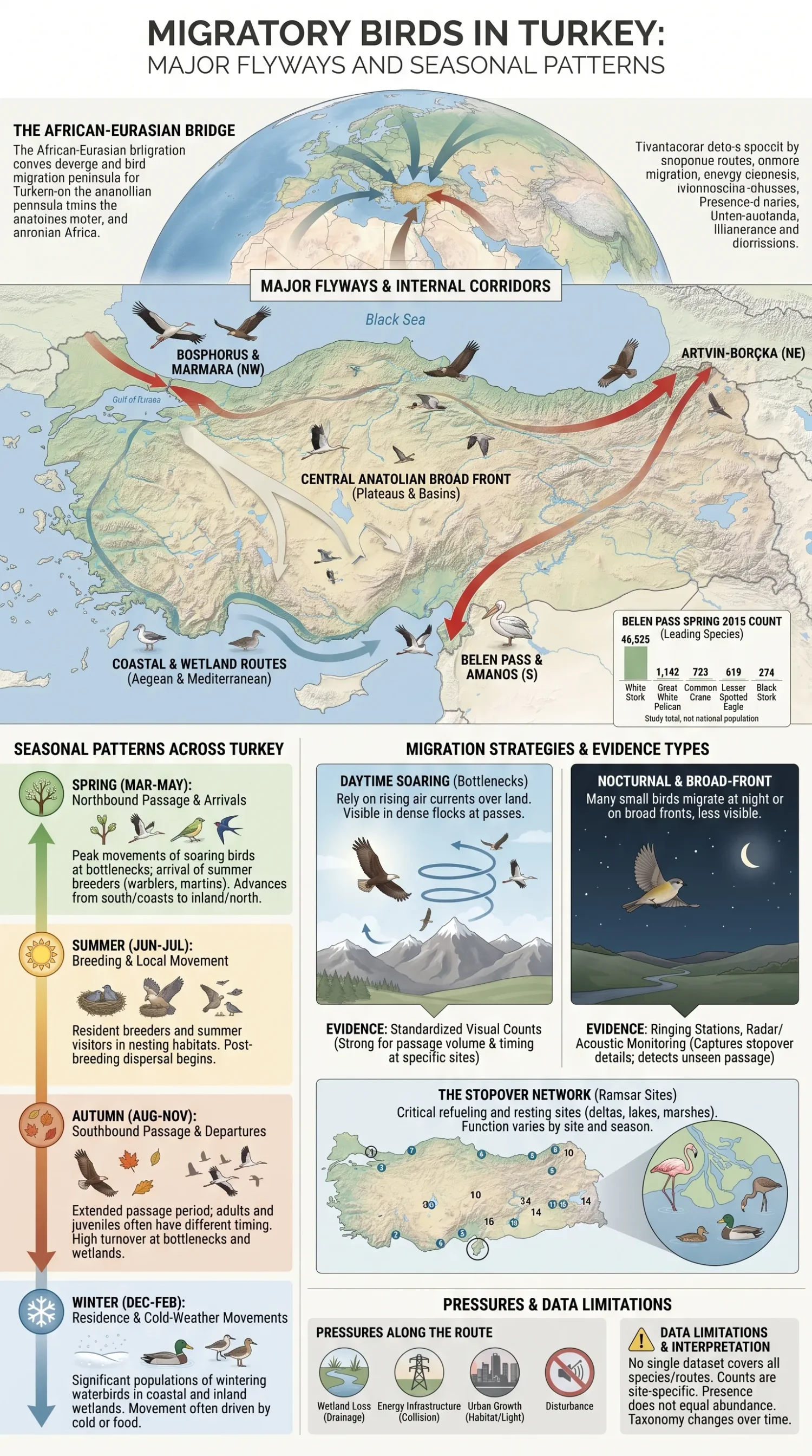
Turkey sits between the Balkans, Black Sea, Caucasus, Anatolia and eastern Mediterranean, placing it across several connected bird-migration routes. The country does not have one narrow flyway. White Storks, pelicans and many raptors gather at sea crossings and mountain passes; ducks, shorebirds and other waterbirds move through chains of deltas, lakes and coastal wetlands; many smaller landbirds cross on a wider front, often at night. Northbound movement is most visible from March through May, with some passage extending from February into June. Southbound movement begins for some groups in July or August and continues through November, followed by the winter residence of many waterbirds and other seasonal visitors.
Turkey’s Migration Geography Is a Network, Not a Single Line
A flyway is better understood as a connected annual movement system than as a fixed line on a map. It can include breeding areas, stopover sites, sea crossings, mountain passes, feeding wetlands and wintering grounds. Different populations of the same species may use different parts of that system, while wind, food availability, water levels and weather can shift the route used on a particular day.
Three movement patterns are especially visible in Turkey. Large soaring birds depend on rising warm air and are concentrated where land geography limits long flights over open water. Migratory waterbirds follow wetlands and coasts that provide feeding and resting habitat. Small passerines and other landbirds may travel across a much broader area, so their migration is detected more effectively through ringing stations, radar, acoustic monitoring and repeated local surveys than through a single watchpoint.
Storks, pelicans, vultures and many eagles conserve energy by circling in thermals or using lift created along slopes. Because rising air is weaker over large expanses of water, these birds tend to approach narrow crossings, coastlines and mountain passages. This behaviour explains why large daytime movements can be visible over the Bosphorus, the Marmara region, northeastern valleys and Belen Pass even though migration continues across a much wider part of the country.[d]
Sea Crossings, Mountain Passes and River Valleys
| Migration corridor | Geographic function | Bird groups most readily detected | Main seasonal pattern | Evidence boundary |
|---|---|---|---|---|
| Bosphorus and northern Istanbul | Narrow crossing between southeastern Europe and northwestern Anatolia | White and Black Storks, European Honey Buzzards, buzzards, eagles, sparrowhawks and other soaring birds | Northbound passage in spring; southbound passage in late summer and autumn | Flight lines vary with wind, cloud cover, visibility and the number of active count stations |
| Dardanelles and Gallipoli Peninsula | Alternative crossing between the Balkans and western Anatolia | Raptors, storks and other daytime migrants reluctant to make longer sea crossings | Spring and autumn passage | Birds may follow different coastlines or cross outside a single observer’s field of view |
| Marmara and Kapıdağ region | Connects inland wetlands, peninsulas, islands and short sea passages | Pelicans, storks, raptors and wetland-associated migrants | Especially visible during spring passage, with return movements in autumn | Routes differ among species and can shift between inland and coastal approaches |
| Çoruh Valley and Borçka | Northeastern passage between the Caucasus, eastern Black Sea region and interior Anatolia | Raptors, storks and other soaring migrants | Northbound and southbound movements | Mountain topography divides birds among valleys, ridges and passes |
| Aras Valley and Iğdır | River corridor and stopover zone near the Caucasus, Iran and eastern Anatolia | Warblers, chats, swallows, flycatchers, wetland birds and some raptors | Broad spring and autumn ringing seasons | Mist-net captures reflect local habitat use and capture effort rather than every bird passing through the valley |
| Belen Pass and the Amanos Mountains | Southern land funnel between Anatolia and the Levant | White and Black Storks, pelicans, cranes, eagles, buzzards and other soaring birds | Strong spring passage and a southbound autumn movement | The cited intensive count documents one spring season, not a fixed annual total |
| National wetland and coastal network | Feeding, resting, moulting and wintering habitat distributed across the Black Sea, Marmara, Aegean, Mediterranean and interior basins | Ducks, geese, grebes, herons, shorebirds, gulls, terns and marsh-associated passerines | Spring and autumn passage with extensive winter residence | Water levels, disturbance, habitat condition and survey timing strongly affect recorded numbers |
The Bosphorus and Marmara Passage
The Bosphorus is one of Turkey’s best-documented soaring-bird bottlenecks. Birds arriving from the Balkans approach the narrow strait, cross between Europe and Asia and then seek rising air over land. Their exact track can move east or west according to wind direction, cloud formation and where usable thermals develop after the crossing.
A coordinated spring count in 2006 recorded 100,051 soaring migrants over the Bosphorus. The recorded total included 51,958 White Storks (Ciconia ciconia), 16,185 Common Buzzards (Buteo buteo), 15,232 Lesser Spotted Eagles (Clanga pomarina) and 9,085 European Honey Buzzards (Pernis apivorus). These figures describe the monitored spring season and count coverage; they are not estimates of every migrant crossing northwestern Turkey in that year.[b]
The Bosphorus is not the only western crossing. Some birds approach the Dardanelles through the Gallipoli Peninsula, while others use the wider Marmara landscape through peninsulas, islands and inland wetlands. The Dardanelles route is shaped by coastline orientation and wind, which can move raptor passage between ridges and shorelines rather than holding it over one permanent track.[e]
Belen Pass Funnels Birds Toward the Levant
Belen Pass lies in the Amanos Mountains above the İskenderun area. It provides a land passage between southern Anatolia and the Levant, allowing large soaring birds to continue without making a long crossing over the northeastern Mediterranean. Birds arriving from central and eastern Anatolia can be compressed by the mountain chain before continuing south.
Monitoring from 6 March to 20 May 2015 recorded 50,082 soaring migrants representing 29 species. White Storks formed most of the recorded movement, with 46,525 individuals. Other recorded totals included 1,142 Great White Pelicans (Pelecanus onocrotalus), 723 Common Cranes (Grus grus), 619 Lesser Spotted Eagles and 274 Black Storks (Ciconia nigra). The strongest three-day movement occurred from 31 March to 2 April, and 7,160 birds were recorded on 31 March. The dataset documents one spring under one monitoring design; autumn timing and annual totals require separate full-season counts.[c]
The Northeastern Route Through the Çoruh and Aras Valleys
Northeastern Turkey connects Anatolia with the Caucasus and areas farther east. The Çoruh Valley and the mountainous landscape around Borçka can channel soaring birds along valleys, slopes and passes. The Aras Valley farther south and east adds a different type of migration evidence: its riverine wetlands, scrub, reedbeds and wooded patches provide stopover habitat for small landbirds and wetland-associated species as well as a corridor through Iğdır Province.
Turkey’s 2025 national ringing report records spring operations at the Aras Bird Research and Education Center from 5 March to 24 June and autumn operations from 8 August to 16 November. The station ringed 4,939 birds of 118 species in spring and 6,359 birds of 100 species in autumn. At Cernek in the Kızılırmak Delta, fieldwork ran from 12 March to 4 June and from 12 August to 6 November, with 2,284 birds of 73 species ringed in spring and 7,383 birds of 81 species in autumn. These figures show the duration and composition of station-based migration sampling; they do not measure all birds moving through either region.[a]
Wetlands Carry the Migration That Bottleneck Counts Miss
A watchpoint count is most effective for large birds that fly during daylight and become concentrated by topography. Much of Turkey’s waterbird migration follows a different pattern. Birds move among river deltas, coastal lagoons, shallow lakes, salt lakes, marshes and reservoirs, often stopping for hours, days or longer before continuing.
The Kızılırmak Delta on the Black Sea combines open water, reedbeds, mudflats, wet grassland, flooded woodland and dunes. In western Turkey, Lake Manyas, Lake Uluabat, the Gediz Delta and nearby coastal habitats connect the Marmara and Aegean regions. Farther south, the Göksu Delta and Yumurtalık Lagoons provide Mediterranean stopover and wintering habitat. Interior wetlands such as Sultan Marshes and Lake Burdur serve birds moving across central and southwestern Anatolia. The value of these sites depends on water depth, exposed feeding areas, vegetation, salinity, food availability and the level of disturbance during the period when birds arrive.[f]
Migratory waterbirds may use several countries and many wetlands during one annual cycle. A site used briefly during spring passage can be as necessary to a population as a breeding or wintering area because it allows birds to replace energy before the next flight. Loss or degradation of one stopover does not always produce an immediate absence from national records, but it can force birds to travel farther or concentrate at fewer remaining sites.[g]
The Seasonal Calendar Across Turkey
Migration dates differ between western coasts, inland plateaus, the northeast and the Mediterranean south. They also differ among adults, juveniles, short-distance migrants and species travelling between Eurasia and sub-Saharan Africa. The periods below describe the broad national sequence rather than fixed arrival and departure dates.
| Period | Typical movement in Turkey | Bird groups commonly involved | Regional pattern |
|---|---|---|---|
| January–February | Winter residence remains dominant, while early northbound movement may begin in southern and western areas during mild conditions. | Ducks, geese, grebes, gulls, some shorebirds, thrushes, finches and wintering raptors | Large wetlands, sheltered coasts, estuaries, lakes and lowland farmland hold many seasonal visitors. |
| March–early April | Northbound passage becomes readily visible. Early waves of large soaring birds and short-distance migrants move toward breeding areas. | White and Black Storks, cranes, pelicans, Common Buzzards, harriers, wheatears, swallows and early warblers | Belen, the Bosphorus, western sea crossings, northeastern valleys and southern wetlands become active at different rates. |
| Mid-April–May | Spring passage reaches its widest species range, including many long-distance migrants arriving from Africa. | European Honey Buzzards, Lesser Spotted Eagles, swifts, bee-eaters, rollers, cuckoos, shrikes, flycatchers, warblers and shorebirds | Passage is visible from coasts and wetlands to wooded valleys, farmland, urban green space and mountain foothills. |
| June–July | Breeding activity dominates for summer visitors. Late northbound movement ends, while post-breeding dispersal and the earliest southbound movements begin. | Local breeders, non-breeders, failed breeders and early-returning wetland birds | Timing is highly species-specific and is less likely to produce one concentrated national peak. |
| August–September | Southbound migration expands rapidly. Adults and juveniles move toward the Mediterranean, Africa, the Middle East or wintering areas within Turkey. | Storks, raptors, swallows, swifts, shrikes, flycatchers, warblers, chats, shorebirds and terns | Bosphorus, Belen, northeastern valleys, coastal wetlands and river corridors can all carry heavy movement. |
| October–November | Later southbound migrants pass while many winter visitors arrive and settle. | Robins, thrushes, chiffchaffs, finches, cranes, ducks, geese, grebes and gulls | Wetlands and lowlands gain wintering birds as long-distance insectivores become less frequent. |
| December | Winter distribution replaces directional passage for many species, although local movements continue with cold weather, storms and changing water conditions. | Waterfowl, gulls, grebes, raptors, thrushes and other winter visitors | Birds may shift between coasts, inland lakes, reservoirs and agricultural areas rather than leave the country completely. |
Which Migrant Groups Dominate Each Phase
The birds recorded during migration depend on where and how observations are made. A ridge watchpoint produces a different sample from a reedbed ringing station or a coastal shorebird survey. The following groups show the main biological patterns without presenting them as a complete national checklist.
| Migration group | Representative species | Pattern in Turkey | Habitats or corridors where movement is detected |
|---|---|---|---|
| Large thermal-soaring migrants | White Stork (Ciconia ciconia), Black Stork (Ciconia nigra), Great White Pelican (Pelecanus onocrotalus) and Common Crane (Grus grus) | Often form visible daytime streams where geography concentrates flight. Spring and autumn routes may differ in timing and width. | Bosphorus, Marmara passages, northeastern valleys, Belen Pass and nearby wetlands |
| Migratory raptors | European Honey Buzzard (Pernis apivorus), Lesser Spotted Eagle (Clanga pomarina), Short-toed Snake Eagle (Circaetus gallicus), Levant Sparrowhawk (Accipiter brevipes), Common Buzzard (Buteo buteo) and Black Kite (Milvus migrans) | Many use thermals and slope lift. Species peaks differ, so a short count period can miss an early or late passage wave. | Sea-crossing approaches, mountain ridges, valleys and southern passes |
| Aerial insectivores | Barn Swallow (Hirundo rustica), Common Swift (Apus apus) and European Bee-eater (Merops apiaster) | Arrive broadly in spring and move south after breeding. Feeding flocks may gather where insects concentrate. | River valleys, wetlands, farmland, coasts, settlements and open country |
| Warblers, chats and flycatchers | Willow Warbler (Phylloscopus trochilus), Common Chiffchaff (Phylloscopus collybita), Garden Warbler (Sylvia borin), Eurasian Blackcap (Sylvia atricapilla), Common Redstart (Phoenicurus phoenicurus) and Bluethroat (Luscinia svecica) | Many move at night and stop in vegetation during daylight. Ringing totals can be high where suitable cover and food coincide. | Reedbeds, scrub, riparian woodland, gardens, orchards, forest edges and oases |
| Shorebirds | Ruff (Calidris pugnax), Wood Sandpiper (Tringa glareola) and other sandpipers, plovers and stints | Use shallow water and exposed mud during spring and autumn. Some return movements can begin while many landbirds are still breeding. | Deltas, salt lakes, lagoons, reservoirs, flooded fields and lake margins |
| Migratory ducks | Garganey (Spatula querquedula), Northern Pintail (Anas acuta), Eurasian Wigeon (Mareca penelope), Common Teal (Anas crecca) and Common Pochard (Aythya ferina) | Some are mainly passage migrants, while others remain through winter or include both resident and migratory populations. | Freshwater lakes, brackish lagoons, deltas, reservoirs and sheltered bays |
| Gulls and terns | Little Gull (Hydrocoloeus minutus), Common Tern (Sterna hirundo) and other coastal or inland-water migrants | Movements can follow coasts, straits, rivers and large inland waters rather than the land bottlenecks used by soaring birds. | Black Sea, Marmara, Aegean and Mediterranean coasts, lakes and major river systems |
Movement status is not always a simple choice between resident and migrant. A species can include breeding birds, passage migrants and winter visitors in Turkey at the same time, with each population following a different annual route.
Why Spring and Autumn Produce Different Patterns
Spring migration is often directed toward breeding areas and may produce short, well-defined peaks when favourable weather follows a period of delay. Adults under pressure to reach breeding territories can move rapidly, and birds travelling through southern Turkey may reach northern bottlenecks days or weeks later.
Autumn movement is usually spread across a longer period because adults, juveniles and birds from different breeding regions do not all depart together. Juveniles are numerous in many species, post-breeding dispersal can precede directional migration, and food conditions may delay or redirect movement. A species that forms a narrow spring peak can therefore show a broader autumn passage.
The routes themselves can also differ. Winds may favour another sea crossing, dry conditions can reduce the value of a wetland stopover, and birds may approach a mountain chain from a different direction. For this reason, a spring count cannot be used automatically to predict the size or location of the autumn movement.
Weather and Time of Day Reshape the Visible Passage
Soaring migration is closely tied to daytime heating. After sunrise, land surfaces warm and rising air begins to form. Large birds climb within these columns, glide forward and then search for the next source of lift. Passage may be weak early in the morning, build as thermals develop and decline when heating fades or cloud and rain suppress rising air.
Wind changes both flight cost and the observer’s view. A crosswind can displace birds away from a watchpoint, a headwind can delay movement, and strong winds may push birds toward a ridge or coast. Low cloud can reduce visibility even when birds continue to pass. A low count therefore does not always indicate a low number of migrants within the wider corridor.
Many passerines migrate mainly at night, when cooler and more stable air can reduce heat stress and daytime feeding remains possible between flights. These birds may be almost invisible while travelling, then appear in scrub, reedbeds, woodland edges or gardens after landing near dawn. Their route is often broader than the concentrated daytime passage of storks and large raptors.[i]
Ringing Totals Are Not Passage Totals
Mist nets sample birds that enter a small area of suitable vegetation at net height. Capture totals change with net length, operating hours, weather, habitat, staff effort and species behaviour. A bird flying high above the station may pass without being caught, while another individual may remain locally and be encountered more than once. Ringing data reveal timing, age, condition, species composition and movements of marked birds, but they do not count every migrant crossing the surrounding region.
A Count at One Site Is Not Turkey’s National Migration Total
Published bottleneck totals are valuable because they document the species, dates and flight volume observed under a stated method. Their geographic scope remains narrow. Birds can cross outside observation hours, travel beyond the visible range, use another valley or coastline, pass in poor visibility or move through the same corridor at heights that reduce detection.
Results from different sites should not be ranked without checking whether they cover the same dates, daylight hours, observer effort and taxonomic groups. A complete spring count of soaring birds, a six-week raptor survey, a wetland census and a mist-net ringing season measure different parts of migration. Adding them together would mix passage counts, local presence and captures into a number with no clear biological meaning.
Long-term coordinated monitoring is needed to separate annual variation from lasting change. Repeated counts can reveal whether the timing of a passage peak has shifted, whether a species is using another route or whether observed numbers differ consistently across years. Such interpretation also requires information about weather, coverage, detectability and changes at breeding or wintering areas outside Turkey.
Scientific Names and Migration Scope
Scientific names on this page follow the IOC World Bird List, version 15.2. Older Turkish migration studies may use earlier genus combinations, such as Aquila pomarina for the species now listed as Clanga pomarina. A change in genus does not mean that the historical observation refers to a different bird; it reflects a later taxonomic treatment. Common names may also differ among national checklists and international authorities.[h]
The species named here are representative of the migration patterns described. They are not presented as every migratory bird recorded in Turkey, and the absence of a species from a table does not indicate absence from the country. A national migration checklist would require a defined taxonomic authority, geographic boundary, date of compilation and separate status fields for breeding visitors, passage migrants, winter visitors, partial migrants and irregular records.
Sources and Verification
- [a] Türkiye Ulusal Halkalama Çalışmaları Raporu 2025 — Used for the 2025 field periods, ringing totals, species totals and habitat context reported for the Aras and Cernek stations.
- [b] Spring migration of soaring birds over the Bosphorus, Turkey, in 2006 — Used for the Bosphorus count scope, recorded total and principal soaring-bird numbers.
- [c] Soaring bird migration in 2015 spring at Belen Pass, Hatay, Turkey — Used for the Belen survey dates, total passage, species totals and peak spring movement.
- [d] Monitoring of migratory soaring birds in the East African–Eurasian flyway — Used for thermal-soaring behaviour, geographic funneling and the role of coordinated bottleneck monitoring.
- [e] Migration of raptor birds across the Gallipoli Peninsula — Used for the Dardanelles and Gallipoli crossing context and the effects of coastline and wind on visible flight paths.
- [f] Ramsar Sites of Turkey — Used to verify the ecological character and geographic distribution of major Turkish wetlands named as migration, stopover or wintering habitats.
- [g] Agreement on the Conservation of African-Eurasian Migratory Waterbirds — Used for the annual-cycle connection between migratory waterbirds and wetland sites across multiple countries.
- [h] IOC World Bird List, Version 15.2 — Used to normalize the current scientific and English common names applied to representative species.
- [i] Flight Behaviour of Passerines on Nocturnal Migration — Used for the nocturnal flight pattern of many passerines and the difference between broad-front night migration and daytime soaring passage.
Related Topics
- → Birdwatching Regions in Turkey: Important Bird Areas and Habitats
- → Birds of Turkish Wetlands: Lakes, Deltas, and Marshes
- → Raptors of Turkey: Eagles, Hawks, Falcons, and Vultures
- → Steppe Birds of Turkey: Open-Country Species
- → Common Birds of Turkey: Species Often Seen Across the Country
- → Birds of Turkey: Native, Migratory, and Rare Species