Complete guide: Regional Fauna Guides
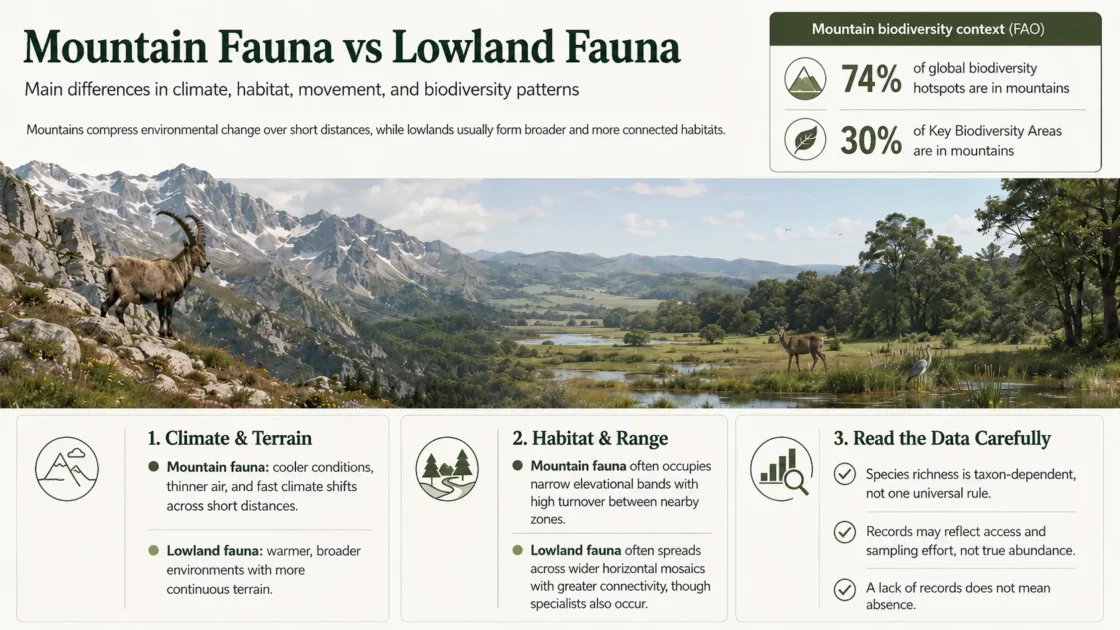
Mountain fauna differs from lowland fauna mainly because elevation and rugged terrain compress changes in temperature, air pressure, moisture, vegetation, and season length into short distances. Animals living higher on a mountain more often face cold, reduced oxygen pressure, strong wind, short feeding seasons, and isolated habitat belts. Lowland animals more often live in warmer settings shaped by canopy layers, rivers, flood cycles, dry seasons, and broad horizontal habitat mosaics. These are ecological tendencies rather than fixed rules: species richness may fall, remain level, or peak at middle elevations, and many animals use both mountain and lowland zones.
The Boundary Is Ecological, Not a Fixed Elevation
“Mountain fauna” and “lowland fauna” are not taxonomic groups. They describe animal communities associated with different terrain and environmental settings. A universal altitude threshold would misclassify low coastal mountains, high plateaus, polar ranges, tropical cloud forests, and valleys already situated far above sea level.
The Global Mountain Biodiversity Assessment separates elevation from ruggedness when mapping mountain land. Its terrain-based method identifies mountainous cells through local elevation contrast rather than a single height above sea level. Under that method, a cell is classed as rugged when the difference between the lowest and highest of nine sampled points exceeds 200 metres. The method shows why “high altitude” and “mountainous terrain” are related but not identical concepts.[a]
Altitude Alone Cannot Assign an Animal Community
A species recorded at 1,500 metres may be a high-mountain animal in one region, a valley animal on a plateau, or a low-elevation forest species in a taller tropical range. Regional relief, treeline position, latitude, slope exposure, and habitat must accompany the elevation value.
Mountain and Lowland Fauna Compared
| Ecological feature | Mountain fauna | Lowland fauna |
|---|---|---|
| Spatial pattern | Often divided into narrow elevational belts, separate valleys, ridges, slopes, and summit habitats. | Often arranged across broad plains, forest blocks, river basins, wetlands, coasts, or open grasslands. |
| Temperature | Generally cooler, with rapid changes over short vertical distances and frequent freeze–thaw exposure at high elevations. | Generally warmer, though daily heat, shade, humidity, drought, and seasonal variation differ greatly among biomes. |
| Oxygen pressure | Falls with elevation and can restrict sustained activity, development, and aerobic performance. | Usually imposes little altitude-related limitation on terrestrial animals. |
| Moisture | Strongly controlled by slope direction, clouds, snow, rain shadows, drainage, and wind. | Often controlled by rainfall seasonality, flooding, soil drainage, groundwater, rivers, and coastal influence. |
| Vegetation structure | May change rapidly from foothill forest to montane forest, shrubland, alpine grassland, scree, or snow-edge habitat. | May form deep forest strata, savanna mosaics, wetlands, dry forest, mangroves, floodplains, or desert margins. |
| Productive season | Frequently shortened by snow cover, cold nights, delayed plant growth, and brief insect emergence. | May be long in warm regions but constrained by drought, flood timing, storms, or seasonal food pulses. |
| Connectivity | Ridges, valleys, cliffs, glaciers, and isolated peaks can separate populations over short map distances. | Large continuous habitats may permit wider movement, while rivers, farms, roads, dams, and urban areas can divide them. |
| Range form | Often narrow in elevation or restricted to scattered habitat patches; some species move seasonally between belts. | Often wider horizontally, although peat swamps, caves, islands, floodplain forests, and other lowland habitats can hold narrow-range specialists. |
| Common environmental filters | Cold, hypoxia, wind, short breeding windows, low plant productivity, steep terrain, and patch isolation. | Heat, water balance, canopy position, flooding, fire, drought, dense vegetation, and human land conversion. |
| Survey pattern | Records often cluster along trails, passes, roads, lodges, and research stations because access is uneven. | Records often cluster near roads, settlements, rivers, reserves, and long-running field sites. |
A Mountain Slope Compresses Climate into Vertical Belts
Temperature commonly declines as elevation rises, while air pressure also falls. A widely used ecological reference gives an average decrease of about 0.6°C per 100 metres for moist air, with the actual rate varying by latitude, weather, mountain form, and humidity. Precipitation is less predictable: it may rise toward cloud belts, decline in rain shadows, or peak at middle elevations. These interacting gradients produce rapid changes in food supply, cover, nesting sites, and water availability.[b]
Slope direction can create different animal communities at the same elevation. A sun-exposed slope may support warm, dry grassland and heat-tolerant reptiles, while a shaded slope nearby retains snow, moist soil, and cool forest invertebrates. Elevation therefore acts through local climate and habitat rather than as an independent biological force.
Vegetation belts reinforce the separation. Treeline, cloud forest, alpine meadow, talus, and headwater streams provide different foods and shelter. Animals may track these belts closely: a pollinator can follow flowering plants, an herbivore can follow new growth, and an insectivore can follow seasonal emergence. The vertical distance may be small while the ecological change is large.
Species Richness Does Not Follow One Uphill Rule
The familiar claim that lowlands always contain more animal species is too broad. Elevational studies have documented several patterns: richness may decline steadily, remain high through lower belts before falling, rise to a middle-elevation peak, or differ among animal groups on the same mountain. Small non-flying mammals often show middle-elevation peaks in compiled studies, while birds, bats, reptiles, amphibians, and insects display more varied responses.
Global scale also changes the answer. One worldwide analysis reported that mountains occupied 28.5% of emerged land under its selected definition but contained 39% of terrestrial vertebrate diversity, equivalent to about 1.6 times more species per unit area than lowlands. This does not mean that every mountain plot is richer than a nearby lowland plot. It reflects the combined effect of many mountain ranges, steep environmental gradients, geographic turnover, and different regional species pools.[c]
Local richness, regional richness, and species turnover answer different questions. Two elevational belts can contain similar numbers of species yet share few of the same species.
Cold and Thin Air Filter Animal Groups Differently
Mammals and Birds
High elevation lowers the partial pressure of oxygen, so each breath supplies less oxygen to the lungs even though the proportion of oxygen in air remains nearly unchanged. Mammals and birds can respond through short-term acclimatization, inherited adaptation, or both. Documented responses include changes in ventilation, heart and lung performance, blood oxygen transport, haemoglobin–oxygen affinity, capillary supply, muscle diffusion, and cellular metabolism. No single response characterizes every mountain species, and a higher red-cell count is not a universal solution because thicker blood can also raise circulatory costs.[d]
Birds begin with a respiratory system that moves air through rigid lungs in one direction and supports efficient gas exchange. High-flying and high-resident birds can add further adjustments across the oxygen transport pathway, including ventilation, cardiac output, blood transport, and oxygen delivery to flight muscle. These traits are especially demanding during flight because aerobic work rises while available oxygen falls.[e]
Cold adds another cost. Fur, feathers, fat, communal roosting, shelter use, torpor, hibernation, and seasonal descent can reduce heat loss or energy demand. Mountain mammals are not automatically larger, hairier, or more metabolically active than lowland relatives; body form and physiology depend on lineage, diet, wind exposure, and the local thermal environment.
Reptiles, Amphibians, and Invertebrates
Ectotherms depend heavily on environmental heat. At higher elevations, cold can shorten daily activity, slow digestion and development, delay reproduction, and reduce the time available for feeding. Sunlit rocks, dark body surfaces, sheltered crevices, warm soil, and behavioural basking can partly offset these limits. Moisture may be equally restrictive for amphibians and many invertebrates, especially where snowmelt, stream flow, or cloud immersion controls breeding habitat.
Insects do not show a single response to elevation. Research across terrestrial insects records changes in species composition, development rate, voltinism, wing form, body size, pigmentation, dispersal, and seasonal timing, but the direction varies among groups and mountain systems. Because many insects have short life cycles and close ties to host plants or soil conditions, the animal boundary may shift when vegetation or snow cover shifts.[f]
Lowlands Contain Vertical and Seasonal Faunal Zones of Their Own
Low elevation does not mean flat, uniform, or easy habitat. Tropical forests can divide vertebrate communities among the ground layer, understory, mid-canopy, and upper canopy. A synthesis of 62 tropical studies found recurring vertical stratification in vertebrate abundance and richness, showing that a lowland forest can contain several stacked animal communities without a large change in ground elevation.[g]
Other lowland systems are structured horizontally. Floodplain animals respond to inundation depth and timing; savanna fauna responds to rainfall, fire, grazing, and water points; dry-forest fauna responds to heat and seasonal water shortage; mangrove and estuarine fauna responds to tides, salinity, and sediment. The main lowland filters are therefore not merely “warm temperature” but the combination of heat, water, vegetation architecture, disturbance, and connectivity.
Warm lowlands can support year-round activity, but they can also impose narrow thermal margins. Shade use, nocturnal activity, burrowing, evaporative cooling, seasonal dormancy, and movement toward water are common ways animals avoid heat or dehydration. Humid forests reduce desiccation but may limit heat loss; dry lowlands create the opposite problem.
Range Shape, Isolation, and Species Turnover
Mountain topography can place suitable habitat in bands or islands. A cool forest may occur on one slope but not another; alpine grassland may be separated by deep warm valleys; a stream specialist may be confined to one drainage. Over long periods, these barriers can limit gene flow and allow populations to diverge. Vertical gradients also bring closely spaced climates into contact, creating sharp replacement of species along a single slope.[h]
Lowland populations may be connected across larger areas, but this is not assured. Major rivers can separate terrestrial animals, dry corridors can divide humid-forest species, and wetlands can occur as isolated basins. Lowland endemism can be high where habitat is old, geographically restricted, or separated by strong barriers. “Mountain specialist” and “lowland generalist” are therefore poor default labels.
Breeding and Feeding Seasons Follow Different Clocks
At high elevation, snowmelt, soil thaw, plant growth, flowering, and insect emergence may occur within a brief interval. Mountain breeders often need to match nesting, birth, larval development, or migration with this short pulse. Bad weather during a narrow breeding window can have a larger effect than the same event in a habitat with a longer productive season.
Lowland timing is often driven by rainfall, flood pulses, fruiting, leaf flush, fire, or the persistence of water holes. A warm climate does not remove seasonality; it changes the environmental cue. Some lowland frogs breed after heavy rain, fish enter newly flooded habitat, and mammals or birds track fruit across large horizontal areas.
Animals that move between elevations blur the categories. Seasonal altitudinal migrants may breed in montane forest and spend the non-breeding season lower down. Large herbivores may follow new vegetation uphill and descend before deep snow. A record from one season cannot establish the species’ full elevational role.
Conservation Pressure Follows the Shape of the Landscape
Mountain species with narrow climatic bands can lose area as suitable conditions move uphill, especially near summits. Yet rugged terrain can also retain cool gullies, shaded slopes, and other local refuges. The outcome depends on whether an animal can disperse, whether habitat remains connected, and whether the next suitable belt contains the required food, shelter, and breeding sites.
Mountain landscapes should not be treated as remote wilderness above an untouched base. A global analysis of 1,010 mountain ranges found that nearly 60% of mountainous area was under intense human pressure, concentrated mainly at lower elevations and mountain bases. These foothill zones can be movement corridors between lowland and highland habitats, so their loss may isolate both communities.[i]
Lowland fauna often faces a different spatial problem: extensive habitat conversion can remove large continuous areas, alter flood regimes, fragment migration routes, and leave protected uplands disconnected from the plains below. Protecting only the highest or least accessible terrain can therefore miss lowland specialists and species that require an intact elevational route.
When a Species Belongs to One Zone—or Both
A defensible mountain or lowland classification needs more than a common name or a single observation. The strongest evidence combines repeated georeferenced records, verified elevation, habitat descriptions, breeding or residency information, seasonal dates, and an accepted taxonomic name. Range maps can add context but may hide fine elevational separation inside broad polygons.
- Mountain resident: repeated records, breeding evidence, or year-round presence are concentrated in montane, subalpine, alpine, or other rugged high-elevation habitat.
- Lowland resident: the main population, breeding range, or habitat association lies in low-elevation plains, basins, floodplains, coastal belts, or lowland forest.
- Elevational generalist: the species regularly occupies a broad vertical range and is not restricted to one zone.
- Seasonal connector: the species moves between mountain and lowland habitats during migration, breeding, winter, drought, or food tracking.
- Unresolved: available records are too sparse, seasonally biased, old, or geographically clustered to support a firm label.
Occurrence records document reported evidence, not complete distribution. A trail-side cluster may reflect observer access, and the absence of lowland records may reflect habitat loss or limited surveys rather than a natural elevational boundary. Mountain–lowland classification is strongest when terrain, climate, habitat use, season, and population evidence point in the same direction.
Sources and Verification
- [a] Global Mountain Biodiversity Assessment — Mountain definition — Used for the distinction between elevation and ruggedness and for the terrain-based 200-metre local-relief criterion.
- [b] McCain and Grytnes — Elevational Gradients in Species Richness — Used for temperature, air-pressure, precipitation, sampling, and taxon-dependent richness patterns along elevation gradients.
- [c] Tenorio and colleagues — Mountains exhibit a stronger latitudinal diversity gradient than lowland regions — Used for the global comparison of mountain land area, terrestrial vertebrate diversity, and species density per unit area.
- [d] Storz, Scott, and Cheviron — Phenotypic plasticity and genetic adaptation to high-altitude hypoxia in vertebrates — Used for acclimatization, inherited adaptation, and oxygen-transport responses in high-altitude mammals and birds.
- [e] Laguë and colleagues — High-altitude champions: birds that live and migrate at high altitude — Used for avian respiratory design and the oxygen-transport demands of high-altitude residence and flight.
- [f] Hodkinson — Terrestrial insects along elevation gradients — Used for insect development, life-history, morphology, dispersal, and community responses to altitude.
- [g] Basham and colleagues — Vertical stratification patterns of tropical forest vertebrates — Used for the separation of lowland tropical vertebrate communities among forest layers.
- [h] Xing and colleagues — Ecological patterns and processes in the vertical dimension of terrestrial ecosystems — Used for vertical environmental gradients, species replacement, population separation, and evolutionary processes.
- [i] Elsen and colleagues — Topography and human pressure in mountain ranges alter expected species responses to climate change — Used for the global mountain-range analysis of human pressure and its concentration at lower elevations and mountain bases.
Related Topics
- → Coastal Fauna vs Inland Fauna: Species and Habitat Patterns
- → Steppe Birds of Turkey: Open-Country Species
- → Why Islands Often Have Unique Fauna
- → How Climate Zones Influence Regional Animal Diversity
- → How Habitat Diversity Shapes Regional Fauna
- → Mountain Mammals of Turkey: Species of High Elevation Habitats