Complete guide: Regional Fauna Guides
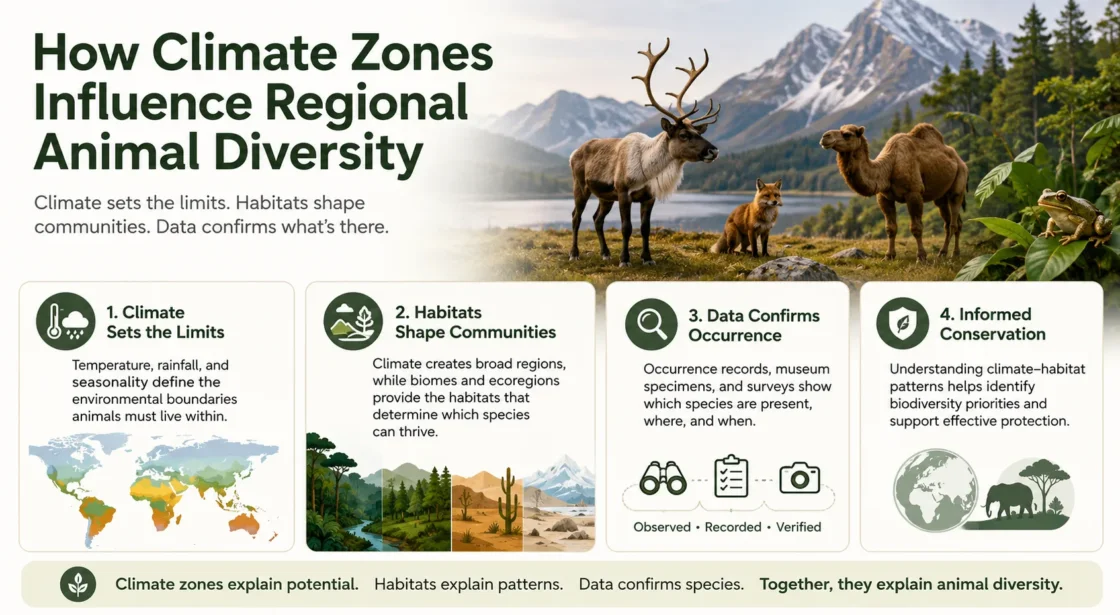
Climate zones influence regional animal diversity by controlling the heat, water, seasonal timing, and biological production available to animal communities. These conditions affect which species can survive, reproduce, find food, avoid thermal stress, and complete seasonal life cycles. Climate does not create a fixed fauna boundary, however. Two regions with similar temperatures and rainfall can contain very different animals because their evolutionary histories, landforms, habitats, barriers, and opportunities for colonization are different.
Climate Zones Describe Environmental Limits, Not Species Lists
A climate zone summarizes long-term atmospheric conditions across a geographic area. It does not confirm that any particular animal occurs there. The Köppen–Geiger system, one of the most widely used global classifications, divides climate into five main classes and 30 sub-types using thresholds and seasonal patterns in monthly air temperature and precipitation.[a]
Broad classes such as tropical, arid, temperate, continental or cold, and polar are useful because they identify recurring combinations of heat and water. Animal distributions often respond to finer climatic measurements, including temperature seasonality, minimum temperature during the coldest period, precipitation during the driest quarter, and the difference between wet and dry seasons. WorldClim derives such bioclimatic variables from monthly temperature and rainfall data for ecological and species-distribution research.[b]
Climate determines many of the environmental conditions an animal may encounter. Regional fauna is the result of climate acting together with habitat, geography, evolutionary history, dispersal, species interactions, and human land use.
The Climatic Controls That Reshape Animal Communities
Animals experience climate through several connected pathways. Some are direct, such as overheating, freezing, dehydration, or loss of breeding water. Others operate through vegetation, prey, competitors, predators, parasites, and habitat structure.
| Climatic control | Direct biological effect | Indirect effect on regional fauna | Patterns that annual averages may hide |
|---|---|---|---|
| Ambient temperature | Sets thermal limits for activity, development, metabolism, egg survival, and overwintering. | Changes plant growth, prey availability, disease dynamics, and the length of the active season. | Heatwaves, freezes, warm nights, cold snaps, and short periods above physiological limits. |
| Rainfall and water availability | Controls hydration, drinking water, aquatic breeding sites, stream flow, and wet soil conditions. | Shapes vegetation density, insect production, wetlands, shelter, and food-web structure. | Long dry seasons, irregular storms, drought sequences, flood pulses, and rainfall timing. |
| Temperature seasonality | Determines when activity, migration, hibernation, diapause, and reproduction are possible. | Creates seasonal peaks and shortages in nectar, seeds, fruit, leaves, insects, and prey. | Rapid spring warming, delayed snowmelt, false springs, and unusually long autumn conditions. |
| Rainfall seasonality | Concentrates breeding and feeding activity into wet periods in monsoon, savanna, and dry-forest regions. | Produces temporary wetlands, seasonal rivers, plant growth pulses, and moving concentrations of prey. | A normal annual rainfall total can still include a severe breeding-season drought. |
| Solar radiation and biological production | Affects body temperature in basking animals and the energy available to primary producers. | Supports larger or more complex food webs where water and nutrients do not impose stronger limits. | Cloud cover, canopy shade, slope exposure, and seasonal differences in day length. |
| Snow, frost, and ice duration | Restricts access to soil, vegetation, open water, nesting ground, and terrestrial prey. | Controls the timing and location of migration, breeding colonies, grazing, and predator activity. | Rain-on-snow events, unstable ice, early thaw, and repeated freeze–thaw cycles. |
| Extreme events | Can cause mortality, reproductive failure, displacement, or short-term loss of suitable habitat. | May alter fires, floods, vegetation structure, prey populations, and competitive relationships. | Short events may produce stronger biological effects than gradual changes in mean climate. |
Why Warm and Wet Regions Often Hold More Animal Species
Many animal groups show a broad decline in species richness from tropical latitudes toward the poles. Warmth and water can support longer growing seasons, greater plant production, more continuous insect activity, layered vegetation, permanent freshwater breeding sites, and a wider range of feeding opportunities. A global synthesis found that measures of energy, water, or their combined balance explained broad geographic variation in species richness better than many alternative climatic and non-climatic measurements.[c]
Present-day productivity is only part of the pattern. Tropical and other productive bioregions have differed in age, area, and environmental continuity over geological time. Research covering birds, mammals, amphibians, and reptiles found that regional richness was best explained by combining current temperature with the historical area and productivity available for diversification.[d]
The geographic arrangement of climate also matters. A 2023 analysis of more than 30,000 terrestrial tetrapod species found that climate conditions and the area and isolation of those conditions jointly explained nearly 90% of global richness variation in the four groups studied. Larger climate spaces can support larger regional species pools. When similar climatic conditions are separated among continents, islands, valleys, or mountain systems, isolated populations and independently evolved faunas can increase species replacement among regions.[e]
Warmth Alone Does Not Produce High Diversity
Very hot environments can exclude animals that cannot tolerate dehydration, limited surface water, low plant cover, or extreme body temperatures. Warm tropical deserts and warm humid forests therefore support very different regional species pools even when their mean temperatures overlap.
Broad Fauna Patterns Across the Main Köppen–Geiger Groups
The five main climate groups provide a broad environmental context for regional fauna. Each group contains several sub-types, and every sub-type can include different elevations, vegetation formations, water bodies, soils, and land-use histories. The patterns below are ecological tendencies rather than inventories of animals that must occur in every region.
| Main climate group | Dominant constraint or opportunity | Common regional fauna pattern | Variation within the group |
|---|---|---|---|
| Tropical (A) | Warm temperatures throughout the year; rainfall amount and dry-season length separate humid, monsoon, and savanna settings. | Humid tropical regions often support high richness of insects, amphibians, reptiles, birds, and mammals through long activity seasons and complex vegetation. | Rainforest, seasonal forest, mangrove, savanna, floodplain, and tropical highland fauna may differ sharply. |
| Arid (B) | Water deficit is stronger than the influence of temperature alone. | Animal communities often contain drought-tolerant reptiles, burrowing mammals, nocturnal predators, mobile birds, seed consumers, and invertebrates adapted to short resource pulses. | Hot desert, cold desert, steppe, rocky plateau, dune field, oasis, and temporary river systems support different specialists. |
| Temperate (C) | Moderate winters or seasonal temperature changes combined with varied rainfall regimes. | Breeding, migration, insect emergence, flowering, fruit production, and dormancy often follow strong seasonal cycles. | Mediterranean, humid subtropical, oceanic, dry-summer coastal, and upland temperate regions do not share one fauna type. |
| Continental or cold (D) | Large annual temperature range, cold winters, and a shorter productive season. | Regional communities may include migratory birds, hibernating mammals, cold-tolerant insects, seasonal grazers, and predators that follow summer prey concentrations. | Snow depth, forest cover, wetlands, mountain ranges, and distance from oceans produce strong internal differences. |
| Polar (E) | Low temperatures, short ice-free periods, low terrestrial plant growth, and long seasonal changes in daylight. | Resident terrestrial richness is often limited, while coasts, open water, sea-ice edges, and breeding grounds may hold dense seasonal concentrations of birds and marine mammals. | Tundra, polar desert, glacier margins, coastal cliffs, pack ice, and subpolar islands support distinct assemblages. |
The arid group requires special care because it is defined through precipitation relative to potential moisture loss rather than by heat alone. Both hot and cold deserts can belong to the same main group. Their animals may share water-saving strategies while differing greatly in winter survival, activity periods, and thermal physiology.
The Same Climate Can Support Different Regional Faunas
A climate label identifies environmental similarity, not biological identity. Mediterranean-type climates occur in parts of Europe, North Africa, western North America, central Chile, southern Africa, and southwestern Australia. Their seasonal rainfall patterns may be comparable, but their native reptiles, mammals, birds, insects, and evolutionary lineages are not interchangeable.
Climate Area and Geographic Isolation
A climatic condition covering a large connected area can contain more habitats, larger populations, and more opportunities for range expansion. The same climatic condition scattered among isolated regions can produce high species turnover because separate populations encounter different barriers, competitors, and evolutionary histories.
Isolation does not always reduce diversity. At a local scale, a remote climate fragment may contain fewer colonizing species. Across a whole region or continent, isolation can preserve distinct lineages and produce a larger combined species pool. Local richness and regional uniqueness therefore need not follow the same pattern.
Continental History and Dispersal Barriers
Oceans, deserts, ice sheets, mountain chains, major rivers, and former land bridges determine which lineages can reach a suitable climate. South American tropical forests contain animal groups that evolved under a different continental history from comparable forests in Africa or Southeast Asia. Similar rainfall and temperature can support similar ecological roles while the species performing those roles remain unrelated or only distantly related.
Past climates also leave biological legacies. Regions that remained suitable during glacial or dry periods may preserve older lineages, while recently deglaciated or newly formed habitats may contain communities assembled mainly through colonization. Present climate cannot reveal those histories on its own.
Mountains Stack Several Climates Into Short Distances
Elevation can compress tropical, temperate, subalpine, and polar-like conditions into a short horizontal distance. Temperature usually falls with elevation, while rainfall, cloud cover, wind, slope exposure, vegetation, and snow duration change unevenly. Valleys, ridges, forest belts, cliffs, streams, and isolated summits can each support different animal communities.
Mountain regions occupy about one quarter of the planet’s land surface yet contain more than 85% of the world’s amphibian, bird, and mammal species. Their high contribution reflects climatic turnover, topographic variation, refuges during past climate shifts, and isolation among valleys and summits rather than elevation alone.[f]
Species richness does not always decline steadily uphill. Some animal groups peak at lower elevations, others at middle elevations, and narrow-range specialists may occur near either end of a gradient. Mountain size, latitude, habitat area, moisture, productivity, and sampling design all influence the observed pattern.
Microclimates Change the Conditions Animals Actually Experience
Regional climate maps describe conditions across broad grid cells, but animals occupy nests, burrows, tree hollows, caves, leaf litter, shaded streams, rock crevices, canopy layers, and exposed slopes. These places may be warmer, cooler, wetter, drier, or less variable than the mapped regional climate.
Topography, vegetation, and soil can generate sharp microclimatic differences over short distances. Such conditions act directly on animal physiology and indirectly on populations and communities, while remaining partly hidden in coarse macroclimate data.[g]
A forest canopy may reduce daytime heat and retain humidity for moisture-sensitive amphibians and invertebrates. A sun-facing rocky slope can provide basking sites for reptiles within an otherwise cool region. Deep snow can insulate small mammals from colder air above it. Climate-zone maps cannot represent all of these refuges and exposure points.
Animal Groups Respond to Different Parts of the Climate Signal
Regional diversity does not rise or fall uniformly across all animal groups. Physiology, reproduction, mobility, body size, diet, and dependence on water determine which climatic variables exert the strongest pressure.
Amphibians Combine Thermal and Moisture Limits
Many amphibians depend on humid shelter, permeable skin, wet soil, streams, ponds, tree holes, or temporary pools. Rainfall amount alone is not enough to predict their diversity. The timing of rain must overlap with breeding, egg development, larval growth, and the persistence of aquatic habitat. A region with high annual precipitation may still provide poor breeding conditions if most rain falls outside the reproductive season or runs rapidly from altered land.
Cool, wet mountain forests can support narrow-range amphibians even when the surrounding lowlands are warmer and drier. These species may occupy small climatic envelopes and have limited routes for moving uphill when conditions change.
Reptiles Depend Strongly on Usable Thermal Space
Reptiles obtain much of their body heat from the environment. Regional temperature can expand or restrict the hours and seasons available for feeding, digestion, movement, courtship, egg development, and escape from predators. Habitat structure determines whether suitable body temperatures are actually available: shade, open ground, rocks, burrows, woody debris, and vegetation edges create different thermal opportunities.
Arid regions can support varied reptile communities because different species divide activity by time of day, soil type, prey, body size, shelter, and preferred temperature. Extreme heat can still close activity windows or make exposed habitat unusable, so hotter conditions do not produce an unlimited rise in reptile diversity.
Birds Track Seasons, Food Pulses, and Movement Routes
Bird diversity reflects both resident species and seasonal arrivals. Temperature and rainfall affect insect emergence, flowering, fruiting, seed availability, wetland depth, nesting dates, and the duration of snow cover. Migratory species may use several climate zones during a single annual cycle, linking tropical wintering grounds, temperate stopover sites, and continental or polar breeding areas.
A region can therefore have high summer bird richness but a much smaller winter community. A climate-zone comparison based on one season may misrepresent the annual fauna unless breeding, passage, wintering, and resident status are separated.
Mammals Are Buffered Unevenly From Regional Climate
Mammals generate internal body heat, but they are not independent of climate. Cold affects energy demand and access to food beneath snow. Heat affects water balance, activity time, reproduction, and the need for shade or burrows. Vegetation and prey often transmit climate effects more strongly than air temperature alone.
Large mobile mammals may move between seasonal ranges, while small mammals with limited dispersal may depend on local shelter and snow conditions. Hibernation, torpor, migration, nocturnal activity, dense fur, fat storage, and social behavior provide different forms of climatic buffering.
Freshwater Animals Respond to Climate Through the Water System
Freshwater fish, crustaceans, molluscs, aquatic insects, and other river or lake animals experience regional climate through water temperature, flow, depth, dissolved oxygen, ice cover, flood timing, and drought. Two watersheds in the same terrestrial climate zone can contain different faunas because of drainage history, barriers, stream gradient, water chemistry, and connection to other basins.
Air temperature and rainfall are therefore upstream controls rather than complete descriptions of freshwater habitat. Dams, extraction, pollution, channel alteration, invasive species, and groundwater loss can reshape aquatic communities even when the broad climate classification remains unchanged.
Climate Alters Local Richness, Species Turnover, and the Regional Species Pool
Animal diversity can be measured at more than one spatial level. Climate may affect each level differently:
- Local richness is the number of species recorded within one site or sampling area.
- Species turnover is the replacement of species between sites, elevations, habitats, or climate fragments.
- Regional richness is the combined species pool across the full geographic boundary.
A humid tropical lowland site may contain many species locally. A tropical mountain region may gain additional diversity through rapid replacement between lowland forest, cloud forest, shrubland, and high-elevation grassland. A large desert may have modest richness at individual sites but a broad regional pool of animals specialized for dunes, rocky slopes, salt flats, springs, dry rivers, and cold uplands.
This distinction explains why the phrase “a diverse climate zone” can be ambiguous. It may describe many species living together, strong differences among local communities, or a large total species pool spread across the region. Those are related but separate properties.
Seasonality and Extremes Can Matter More Than the Annual Mean
Mean annual temperature and annual precipitation compress a full year into two values. Animals respond to when heat and water occur, how long difficult periods last, and whether extreme conditions overlap with sensitive life stages.
- A dry season can reduce amphibian breeding habitat even where annual rainfall is high.
- A brief heatwave can exceed the thermal limits of animals that tolerate the regional average.
- Early snowmelt can change the timing of vegetation growth, insect emergence, migration, and nesting.
- A false spring can trigger activity before later freezing conditions return.
- Repeated drought years can have different effects from one isolated dry year.
- Rainfall arriving as intense storms may produce less persistent surface water than the same total spread across several months.
The IPCC assessment documents climate-linked changes in animal ranges, seasonal timing, abundance, and ecological processes, while also showing that movement rates and directions vary among species and regions. Warming does not cause every animal to move poleward or uphill at the same pace.[h]
Terrestrial Climate Classes Do Not Define Marine Fauna
Köppen–Geiger classes describe land climates and should not be treated as a marine biodiversity classification. Coastal weather can influence estuaries, mangroves, salt marshes, beaches, and seabird colonies, but offshore animal diversity depends on ocean conditions that require separate measurements.
Sea-surface and bottom-water temperature, salinity, dissolved oxygen, acidity, depth, currents, nutrient supply, sea ice, upwelling, and seabed structure shape marine species distributions. Ocean warming, acidification, deoxygenation, sea-level rise, and other climate-linked changes can act together and differ by region and depth.[i]
A tropical coastal climate can border a warm coral system, a cool upwelling zone, a deep shelf, a turbid estuary, or a mangrove lagoon. The nearby land climate provides context, but it cannot identify the marine animal community.
Moving Climate Boundaries Reshape Regional Fauna Unevenly
As temperature and rainfall regimes change, climate zones can expand, contract, fragment, merge, or shift across latitude and elevation. The biological result depends on whether animals can reach newly suitable areas and whether those areas still contain usable habitat.
Mobile species may extend one edge of their range while remaining absent from apparently suitable regions separated by cities, farms, dams, open ocean, dry valleys, or mountain barriers. Less mobile species may persist temporarily in cool ravines, caves, deep forests, springs, or north-facing slopes even after the surrounding regional climate becomes less suitable.
Community change is rarely a synchronized movement of all species. Predators, prey, parasites, pollinators, competitors, and host plants may respond at different rates. This can create new species combinations, break former interactions, or increase contact among animals that previously occupied separate climatic regions.
Climate also operates alongside land- and sea-use change, direct exploitation, pollution, and invasive alien species. The IPBES global assessment identifies climate change as a direct driver that can intensify the effects of these other pressures.[j]
A Climate Shift Does Not Predict One Universal Faunal Response
Some regional populations may expand, others may contract, and others may remain temporarily stable. Outcomes depend on exposure, physiological sensitivity, habitat continuity, dispersal ability, species interactions, extreme events, and non-climatic pressures.
Climate Sets the Possibilities; Regional History Selects the Fauna
Climate zones help explain why humid tropical forests, seasonal savannas, deserts, temperate woodlands, continental grasslands, tundra, and polar coasts support different animal communities. Temperature, water availability, seasonality, and biological production define broad physiological and ecological possibilities.
The animals actually present depend on more than those possibilities. Climate area and isolation influence the size and differentiation of species pools. Mountains create short, steep environmental gradients. Microclimates provide local refuges and exposure points. Oceans, rivers, deserts, and historical climate shifts control colonization. Habitat condition and human pressures determine whether climatically suitable areas remain usable.
A climate classification can therefore support an explanation of regional animal diversity, but it cannot replace a defined geographic boundary, taxonomically reviewed records, habitat evidence, field surveys, or source-based conservation assessments.
Sources and Verification
- [a] Present and future Köppen–Geiger climate classification maps at 1-km resolution — Used for the five main climate classes, 30 sub-types, monthly temperature and precipitation criteria, and the ecological scope of Köppen–Geiger mapping.
- [b] WorldClim bioclimatic variables documentation — Used for climate variables describing annual trends, seasonality, and limiting temperature and rainfall conditions in ecological research.
- [c] Energy, water, and broad-scale geographic patterns of species richness — Used for the relationship between energy, water balance, and broad geographic variation in species richness.
- [d] Global gradients in vertebrate diversity predicted by historical area-productivity dynamics and contemporary environment — Used for the combined influence of historical climate area, productivity, temperature, and evolutionary time on vertebrate richness.
- [e] The geography of climate and the global patterns of species diversity — Used for climate area, climate isolation, species turnover, and the global analysis of more than 30,000 terrestrial tetrapod species.
- [f] Humboldt’s enigma: What causes global patterns of mountain biodiversity? — Used for the disproportionate share of amphibian, bird, and mammal diversity associated with mountain regions.
- [g] Microclimate, an important part of ecology and biogeography — Used for the effects of topography, vegetation, soil, and fine-scale climatic variation on organisms, populations, and communities.
- [h] IPCC AR6 Chapter 2: Terrestrial and Freshwater Ecosystems and Their Services — Used for observed climate-linked changes in species ranges, seasonal timing, abundance, and ecological processes, including variation among taxa and regions.
- [i] IPCC AR6 Chapter 3: Oceans and Coastal Ecosystems and Their Services — Used to separate terrestrial climate classification from marine controls such as ocean warming, oxygen, salinity, acidification, sea level, and regional ocean processes.
- [j] IPBES Global Assessment Report: Summary for Policymakers — Used for the interaction of climate change with land- and sea-use change, direct exploitation, pollution, and invasive alien species.
Related Topics
- → Why Islands Often Have Unique Fauna
- → Coastal Fauna vs Inland Fauna: Species and Habitat Patterns
- → How Habitat Diversity Shapes Regional Fauna
- → Native, Introduced, and Invasive Animals in Regional Fauna Lists
- → Birdwatching Regions in Turkey: Important Bird Areas and Habitats
- → Fauna of Turkey: Wildlife, Habitats, and Regional Diversity