Complete guides: Mammals of Turkey•Regional Fauna Guides
Turkey’s high-elevation mammal fauna includes far more than wild goats, chamois, bears, and wolves. Its most mountain-dependent members include endemic ground squirrels and dormice, several rock-dwelling snow voles, a subterranean mole known from the Hakkari highlands, and a long-eared bat strongly associated with mountain environments. A reliable account must separate these alpine, subalpine, cliff, scree, and upland-steppe specialists from widespread mammals that merely enter mountain landscapes.
A Mountain Locality Does Not Automatically Make a Mountain Mammal
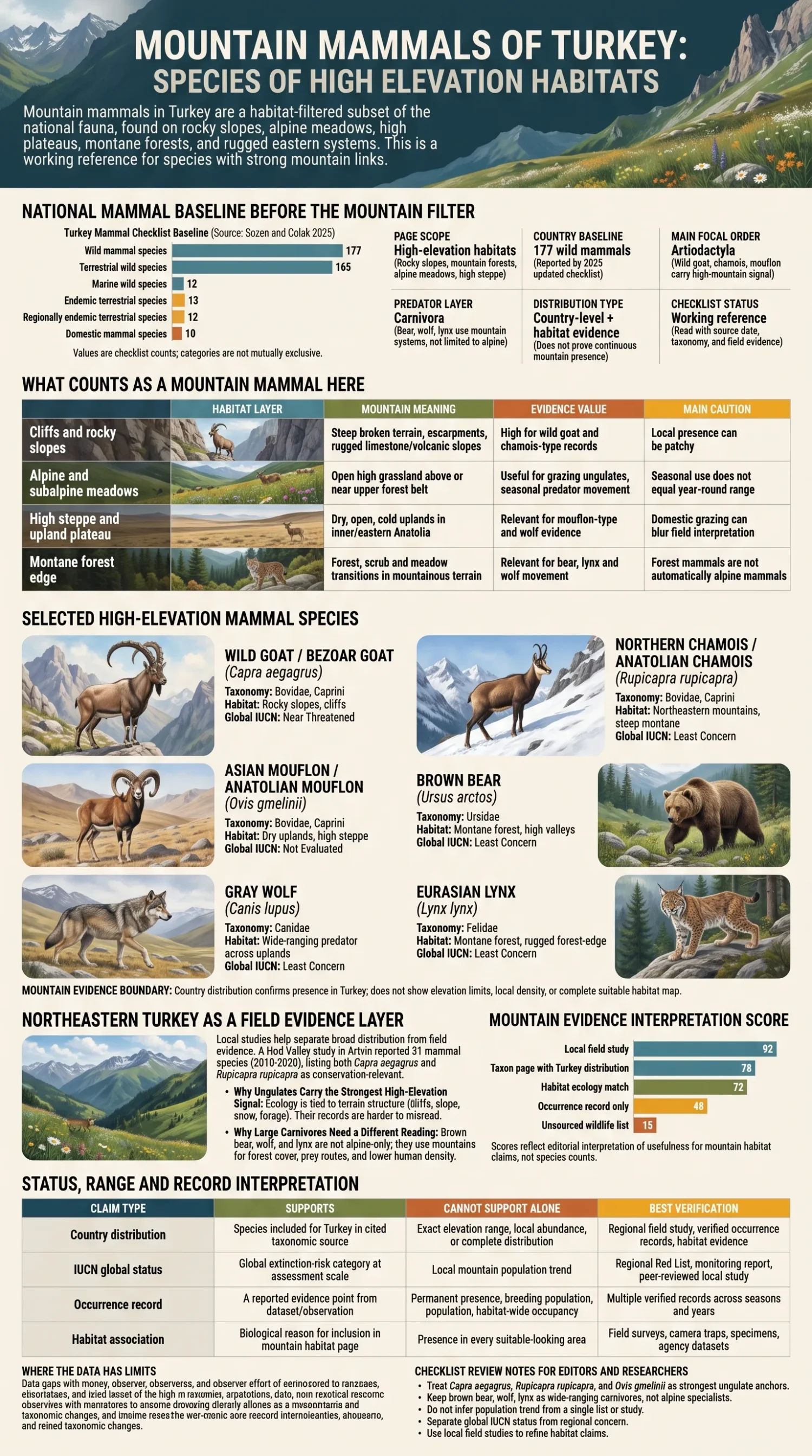
The 2025 national checklist reports 177 wild mammal species in Türkiye, including 165 terrestrial and 12 marine species. It also identifies 13 terrestrial endemics and 12 terrestrial mammals described as regionally endemic. The checklist is national in scope and does not classify species by elevation or produce a separate mountain-mammal total.[a]
The Mammal Diversity Database provides a current country-level taxonomic list that includes recently accepted taxa such as Dryomys anatolicus, Chionomys stekolnikovi, and Talpa hakkariensis. It does not present an altitude-filtered inventory. It also does not include any species of Marmota in its current Turkey list, so the alpine marmot should not be inserted into a modern Turkish mountain checklist without new verified evidence.[b]
No National Elevation Threshold Defines the List
High elevation is an ecological relationship rather than one fixed number. A wet subalpine meadow in the Eastern Black Sea mountains, a limestone plateau in the Taurus range, and a continental mountain steppe in Eastern Anatolia can support different mammals at similar elevations. Species are included here when the checked evidence links them regularly to alpine grassland, subalpine meadow, scree, cliffs, rocky uplands, high plateaus, or mountain-steppe systems.
The Mountain Systems Behind Turkey’s High-Elevation Fauna
Taurus limestone, scree, and upland plateaus
The Taurus Mountains contain steep limestone walls, broken cliffs, karstic plateaus, boulder fields, dry alpine grassland, and transitions from cedar, juniper, fir, and pine woodland to open terrain above the main forest belt. These discontinuous rocky habitats support the wild goat and several small mammals with restricted Anatolian ranges.
The Taurus ground squirrel is confined to this southern mountain system. The woolly dormouse occupies isolated rocky localities across southern and central Anatolian mountains, while the recently described Chionomys stekolnikovi is known from the Aladağlar section of the central Taurus. Their distributions are not interchangeable: a record from one plateau cannot be extended automatically to every neighbouring massif.
Eastern Black Sea and Kaçkar alpine belts
The Eastern Black Sea mountains combine humid spruce and fir forests with rocky forest edges, subalpine shrub zones, wet meadows, avalanche corridors, alpine grasslands, and long-lasting seasonal snow. This habitat sequence supports the Lazistan snow vole, long-clawed mole vole, northern chamois, Alpine long-eared bat, and several wider-ranging carnivores.
Species can move between elevation belts during the year. Chamois may use alpine grasslands during snow-free periods and descend or shift toward more sheltered terrain during severe winter weather. Forest-associated mammals may also cross the treeline while feeding or moving between valleys, but such seasonal use does not turn every montane forest species into an alpine specialist.
Munzur, Palandöken, and the Eastern Anatolian highlands
Eastern Anatolia contains cold continental plateaus, volcanic uplands, steep valleys, alpine steppe, exposed rock fields, and meadow systems that remain snow-covered for long periods. The 2025 dormouse revision places the newly described Dryomys anatolicus in this eastern highland context, including the Munzur Mountains and a sampled locality in the Palandöken system.
Rock-dwelling voles, Anatolian ground squirrels, wild goats, chamois, and wide-ranging predators also occur in parts of this broad region. Their presence is patchy and tied to local terrain, vegetation, snow conditions, prey, and human land use rather than to the name “Eastern Anatolia” alone.
Hakkari’s alpine soils and broken relief
The Hakkari highlands contain deeply dissected mountains, steep rocky slopes, high pastures, snow beds, and soil pockets capable of supporting subterranean mammals. The Hakkari mole was described from this setting at a type locality reported between 2,700 and 2,980 metres. That record shows a direct high-elevation association, although it does not establish the species’ complete elevational or geographic range.
Central Anatolian upland steppe
Central Anatolia lacks the continuous humid alpine belts of the Kaçkar Mountains, but its elevated steppe, volcanic slopes, rolling uplands, and rocky escarpments form a separate mountain-fauna setting. The Asia Minor ground squirrel occupies both lower steppe and alpine meadow, while the Anatolian mouflon is associated with open upland and steppe terrain rather than with narrow scree fields or permanent snow zones.
Source-Backed Working List of High-Elevation Mammals
The following list combines accepted taxonomy with documented habitat or elevation evidence. It is a source-based working list rather than a complete official inventory. “Mountain associate” identifies a species that regularly uses uplands but also occupies lower or broader habitat belts.
| Common and scientific name | Relationship to high elevation | Turkish habitat or locality evidence | Taxonomic or assessment note |
|---|---|---|---|
| Wild goat Capra aegagrus |
Strong mountain and cliff associate | Steep rock faces, broken slopes, escarpments, and nearby feeding areas in suitable Turkish mountain systems | Accepted wild species occurring in Turkey; Mammal Diversity Database reports a global Near Threatened category.[c] |
| Northern chamois Rupicapra rupicapra |
Alpine and subalpine specialist in Turkey | Alpine grassland and rugged mountain terrain in northeastern and eastern sectors, with seasonal movement during snow | Mammal Diversity Database includes asiatica within R. rupicapra and reports Least Concern at species level.[d] Research focused on the Anatolian population treats its regional condition separately and links it mainly to alpine grasslands.[e] |
| Asian mouflon Ovis gmelinii |
Upland-steppe and rocky-hill associate | Open, dry, rolling uplands and steppe–rock mosaics rather than only high alpine scree | Mammal Diversity Database uses O. gmelinii, treats O. orientalis as a synonym, includes Turkey in the range, and lists the taxon as Not Evaluated.[f] |
| Taurus ground squirrel Spermophilus taurensis |
Taurus upland-grassland specialist | Open plateau and grassland systems in the Taurus Mountains; type locality near Akseki at 1,542 metres | Turkey-endemic accepted species; Spermophilus torosensis is treated as a synonym; global category reported as Least Concern.[g] |
| Asia Minor ground squirrel Spermophilus xanthoprymnus |
Mountain-steppe associate, not a strict alpine specialist | Steppe and alpine meadow across central lowland and eastern highland Anatolia; published preferred elevation approximately 800–2,900 metres | Diurnal, burrow-forming, and obligately hibernating; elevation use varies across its broad Anatolian range.[h] |
| Woolly dormouse Dryomys laniger |
Rock-dwelling alpine specialist | High, rocky, often sparsely vegetated localities in southern and central Anatolian mountains, mainly within revised Taurus lineages | The 2025 phylogeographic study restricted the name after separating eastern populations as a new species.[i] |
| East Anatolian forest dormouse Dryomys anatolicus |
Eastern Anatolian rocky-highland specialist | Described from populations sampled in the Munzur and Palandöken mountain systems; type locality at Eşekçayırı Plateau, Tunceli, at 1,800 metres | Turkey-endemic species described in 2025 from populations formerly assigned to D. laniger; Not Evaluated.[j] |
| European snow vole Chionomys nivalis |
Rock and scree specialist | Uses fissures, cracks, boulder fields, and other rocky substrates; Turkish records include several separated mountain regions | Its broad species range spans low rocky sites as well as very high mountains, so elevation alone should not be used for identification.[k] |
| Lazistan snow vole Chionomys lasistanius |
Eastern Black Sea alpine and rocky-forest specialist | Rocky alpine pastures and rocky sections of spruce or fir forest; type locality in Rize was reported at 3,000 metres | Accepted for Turkey and Georgia after separation from C. gud; Mammal Diversity Database lists it as Not Evaluated.[l] |
| Stekolnikov’s snow vole Chionomys stekolnikovi |
Range-restricted Taurus rock and meadow specialist | Known from two specimens collected in the Aladağlar area of the central Taurus at 1,648 and 1,709 metres, including a stony meadow-edge locality | Cryptic species described in 2022; its known sample is too small to define a complete range or population trend.[m] |
| Long-clawed mole vole Prometheomys schaposchnikowi |
Alpine and subalpine meadow specialist | Mesic mountain meadows, reported mainly from 1,500–2,800 metres where seasonal snow can persist for long periods | Accepted from Russia, Georgia, and Turkey; Mammal Diversity Database reports a global Least Concern category.[n] |
| Hakkari mole Talpa hakkariensis |
High-elevation subterranean specialist | Type locality at Cemşililan Plateau in Hakkari Province, reported between 2,700 and 2,980 metres | Turkey-endemic species described in 2023; Mammal Diversity Database lists it as Not Evaluated.[o] |
| Alpine long-eared bat Plecotus macrobullaris |
Mountain-linked aerial insectivore | Recorded in Turkey within a range centred strongly on mountainous terrain; foraging and roosting are not confined to one elevation or one habitat | Accepted species separated historically from the grey long-eared bat complex; global category reported as Least Concern.[p] |
Wild Goats, Chamois, and Mouflon Occupy Different Mountain Niches
Wild goat: cliffs and escape terrain
The wild goat is the most broadly distributed of Turkey’s three principal native mountain caprins. Its defining habitat is not simply “high altitude” but steep terrain that provides rapid escape routes, resting ledges, visual cover, and access to nearby feeding areas. Suitable landscapes may include limestone walls in the Taurus, dry canyons, forested escarpments, and broken slopes in eastern mountain systems.
Wild goats can move between cliffs, open grassland, shrub zones, and forest margins. A sighting on a lower rocky slope therefore does not contradict their mountain association. Relief and access to secure terrain can be more informative than elevation by itself.
Chamois: a closer link to alpine grassland
Turkey’s chamois populations have a tighter connection to northeastern and eastern alpine landscapes. Open grassland, steep rocky slopes, broken ridges, and the ability to move into sheltered terrain during snow define much of their habitat use. Regional research identifies elevation, terrain, temperature, and human disturbance among the variables related to suitable habitat.
Global and Anatolian Status Are Not the Same Measure
A Least Concern category attached to Rupicapra rupicapra at species level does not establish that the Anatolian population is secure. Local research may evaluate a smaller subspecies, population, or area of occupancy and reach a more severe regional finding. The taxonomic unit, geographic scale, and assessment date must be checked together.
Mouflon: upland steppe rather than narrow alpine rock
The Anatolian mouflon belongs in a mountain-mammal account because it uses elevated, rolling, open terrain, but it should not be portrayed as an animal confined to the highest alpine belt. Upland steppe, rocky hills, broad visibility, and dry grazing areas better describe its main ecological setting.
Its naming also requires care. Sources may use Ovis gmelinii, Ovis orientalis, or an Anatolian subspecies combination. The Mammal Diversity Database currently accepts Ovis gmelinii and places orientalis among its synonyms. Older conservation documents can therefore appear to refer to a different species when they are discussing the same Anatolian lineage under another treatment.
Small Mammals Hold Much of the High-Mountain Endemism
Two ground squirrels occupy different elevational patterns
Spermophilus taurensis is tied to the Taurus Mountains and represents a geographically restricted upland lineage. Spermophilus xanthoprymnus occupies a much wider Anatolian band that includes both central steppe and eastern alpine meadow. Listing both simply as “mountain ground squirrels” conceals this ecological difference.
Both species depend on open ground where burrows can be constructed and visibility around the colony can be maintained. Dense forest is unsuitable for the core colony system. Grazing can sometimes maintain short vegetation, but heavy soil disturbance, cultivation, construction, or loss of connected open habitat can remove usable colony ground.
The woolly dormouse is now two accepted species
The common name “forest dormouse” can be misleading for the highland members of this group. The woolly dormouse is primarily associated with rocky mountain habitat rather than with a closed tree canopy. Vegetation around occupied rock fields may include cedar, juniper, fir, pine, or oak, but crevices and boulder structure provide the central shelter system.
The 2025 revision found two deeply separated lineages. The name Dryomys laniger remains attached to southern and central Anatolian populations, including Taurus localities. Eastern samples from the Munzur and Palandöken systems were assigned to the newly described Dryomys anatolicus. Earlier maps and status summaries that place all of these records under D. laniger now require taxonomic rechecking.
Snow voles are separated by geography and genetics
Snow voles use rock fissures, scree, boulder fields, and stony meadow edges where stable cavities provide shelter from temperature extremes and predators. The name does not mean that every population lives beside permanent snow. Rock structure is often the more consistent feature.
Chionomys nivalis has a broad and taxonomically complex range. Chionomys lasistanius represents an Eastern Black Sea and Caucasian lineage formerly placed under C. gud. Chionomys stekolnikovi was separated from the nivalis complex after molecular and cranial analysis of two central Taurus specimens.
The two known specimens of Chionomys stekolnikovi establish the existence of a separate Taurus lineage; they do not establish its complete distribution, abundance, population trend, or conservation category.
The long-clawed mole vole depends on wet mountain meadows
Prometheomys schaposchnikowi differs from rock-dwelling snow voles. Its strongest habitat association is with moist alpine and subalpine meadow, deep soil, and long snow cover. It spends much of its life underground and may be overlooked by surveys aimed at visible mammals or camera-trap targets.
This habitat distinction matters. A rocky slope suitable for a snow vole may offer little usable soil for a mole vole, while a deep meadow supporting underground tunnels may lack the crevice network required by a rock specialist.
The Hakkari mole reveals hidden alpine diversity
Talpa hakkariensis shows why mountain inventories based only on large mammals are incomplete. Moles leave few direct visual records, and several Eurasian species are externally similar. Molecular, cranial, and anatomical evidence was needed to distinguish the Hakkari lineage and describe it formally in 2023.
Its high type locality provides firm evidence of alpine or subalpine occurrence. The checked sources do not yet support a precise total range, verified population size, or population trend. “Not Evaluated” means that a formal global category has not been assigned under the cited treatment; it does not mean that the species faces no threats.
A bat can be mountain-linked without being altitude-restricted
The Alpine long-eared bat belongs to a mountain account because much of its distribution follows major European and western Asian mountain systems. It can forage over alpine meadow, forest edge, shrubland, and open mountain terrain, while roosts may occur in buildings, caves, mines, or rock structures.
Its presence cannot be inferred from elevation alone. Long-eared bats are difficult to identify reliably from distant observation, photographs, or echolocation records without supporting measurements or genetic evidence. Records published under older names in the Plecotus austriacus complex may need reassessment.
Large Mammals Recorded in Mountains but Not Confined to the Alpine Belt
A camera-trap inventory in the Ilgaz Mountains documented European hare, brown bear, grey wolf, red fox, Eurasian lynx, European badger, wild boar, red deer, and roe deer. The study covered a mountain landscape extending through forest and higher terrain, but the records do not classify these nine mammals as alpine specialists. They show that mountain ranges also function as feeding areas, breeding habitat, seasonal refuges, and movement corridors for species with much broader ecological ranges.[q]
| Species | Role in mountain landscapes | Why it is not classed as a strict high-elevation specialist |
|---|---|---|
| Brown bear Ursus arctos |
Uses forested mountains, high meadows, fruiting areas, denning slopes, and corridors between valleys | Also occupies lower forest, woodland, agricultural edges, and other habitats where food and cover are available |
| Grey wolf Canis lupus |
Crosses ridges, plateaus, forests, and open highlands while following prey and maintaining large territories | Its range extends through steppe, forest, farmland mosaics, and lower terrain |
| Eurasian lynx Lynx lynx |
Uses montane forest, broken slopes, woodland edges, and prey-rich uplands | Dependence is generally on cover and prey rather than on alpine elevation itself |
| Red fox Vulpes vulpes |
Forages across alpine meadow, scree edges, pasture, forest margins, and settlements | Highly adaptable and widespread from lowlands to high mountains |
| European badger Meles meles |
May establish setts on sheltered mountain slopes and forage in meadow–forest mosaics | Commonly uses lowland woodland, farmland, scrub, and valley systems |
| Wild boar Sus scrofa |
Uses montane forest, wet meadow, shrub cover, and seasonal feeding grounds | Occurs across a wide elevational range and often shifts downward during severe winters |
| Red deer Cervus elaphus |
Uses mountain forests, openings, and seasonal grazing areas | Requires connected habitat more than a particular alpine zone |
| Roe deer Capreolus capreolus |
Occupies forest edges, young woodland, and sheltered montane clearings | Usually more closely tied to woodland structure than to exposed high elevations |
| European hare Lepus europaeus |
Uses open upland grassland, pasture, steppe, and mountain clearings | Also widespread in agricultural and lowland open habitats |
The Anatolian leopard is another broad-ranging mountain user rather than an alpine specialist. A northeastern Anatolian study recorded leopard evidence between 1,176 and 3,050 metres and found frequent use of sparse forest, rocky habitat, pasture, and agricultural areas. Those study records support local mountain use but do not define the species’ entire Turkish distribution.[r]
Recent Taxonomic Changes Alter the Mountain Checklist
Three recent changes have direct effects on a Turkish high-elevation species list. Chionomys stekolnikovi was described from central Taurus material in 2022. Talpa hakkariensis was described from Eastern Turkey in 2023. Dryomys anatolicus was separated from the woolly dormouse complex in 2025.
Older publications, museum labels, occurrence portals, and conservation assessments may still use broader names. A record identified as Dryomys laniger before 2025 may represent D. anatolicus if it came from the newly separated eastern lineage. A central Taurus specimen once assigned to Chionomys nivalis may require comparison with C. stekolnikovi.
Ungulate names also vary among references. The Mammal Diversity Database places Rupicapra asiatica within Rupicapra rupicapra and uses Ovis gmelinii rather than Ovis orientalis as the accepted species name. A conservation document using a different combination is not automatically incorrect; its publication date and taxonomic treatment must be identified before records are merged.
Recorded Elevations Are Not Complete Elevational Ranges
A type locality records where the name-bearing specimen originated. A sampling elevation records where researchers trapped, observed, photographed, or collected an animal. Neither value automatically defines the lowest or highest elevation occupied by the species.
- The 1,800-metre type locality of Dryomys anatolicus does not prove that the species is absent below 1,800 metres.
- The 2,700–2,980-metre Hakkari mole locality does not prove that its entire population occurs within that narrow band.
- The two known Chionomys stekolnikovi elevations describe the type series, not a verified minimum and maximum.
- A broad country-level range map cannot confirm that suitable habitat is occupied throughout every highlighted mountain region.
- Occurrence records document reported evidence and can reflect survey effort, road access, observer interest, and taxonomic knowledge.
A single mountain record can establish documented presence at one place and time. It cannot by itself establish continuous distribution, local abundance, breeding status, or a stable population.
Habitat Damage Can Affect Specialists and Wide-Ranging Mammals Differently
Rock extraction, roads, ski or tourism infrastructure, pasture conversion, intensive grazing, fencing, and settlement expansion can alter high-elevation habitat. The biological effect depends on the species. A cliff-dwelling wild goat may lose secure escape terrain; a ground-squirrel colony may lose deep open soil; a snow vole may lose connected scree; and a mole vole may lose moist meadow soil even when surrounding rock remains intact.
A western Taurus quarry study analysed 57,547 photographs and video images collected during 5,447 photo-trap days and identified 12 mammal species. Wolves, foxes, lynxes, and wild boar were recorded more often in control areas than in quarry areas. The study calculated that discarded quarry material occupied 79.7% of the total quarry-affected land in its sample, showing that waste disposal can enlarge the disturbed footprint well beyond the cut rock face.[s]
Large carnivores may sometimes move around disturbed sites, although added roads and fragmented corridors can alter travel routes. Restricted small mammals have fewer alternatives when a single isolated plateau, meadow, or boulder field holds a large share of their known habitat. This difference is one reason that high-elevation surveys should include live trapping, soil and burrow searches, acoustic bat work, genetic identification, and museum review rather than relying only on camera traps.
Where the Turkish Evidence Remains Thin
The visible ungulates and large carnivores receive more field attention than small nocturnal or subterranean mammals. Several highland taxa are known from few specimens, separated localities, or recently revised names. For these species, absence from an online map may indicate limited sampling or outdated identification rather than confirmed absence.
- Chionomys stekolnikovi needs surveys beyond its two-specimen type series in the central Taurus.
- Dryomys anatolicus requires new mapping under its 2025 name so that older eastern records can be reassessed.
- Talpa hakkariensis needs locality, habitat, and population work outside the known type area.
- The Anatolian chamois needs monitoring at a scale that distinguishes the regional population from the global status of Rupicapra rupicapra.
- Mountain bat records need identification methods capable of separating cryptic Plecotus species.
- Repeated surveys are needed to distinguish true changes in occupancy from differences in access, effort, season, and detection method.
Turkey’s high mountains therefore contain two overlapping mammal communities: a small set of habitat-restricted alpine, subalpine, rock, meadow, and upland-steppe specialists, and a larger group of adaptable mammals that use mountain belts as one part of broader ranges. Keeping those groups separate produces a more accurate account of mountain biodiversity and prevents a record from a mountain province from being mistaken for proof of high-elevation specialization.
Sources and Verification
- [a] Sözen and Çolak, An updated checklist of the mammals of Türkiye — Used for the 2025 national species total, terrestrial and marine breakdown, endemic totals, and national checklist scope.
- [b] Mammal Diversity Database: Turkey country list — Used to verify current accepted country-level taxa and the absence of a currently listed marmot taxon.
- [c] Mammal Diversity Database: Capra aegagrus — Used for the accepted wild-goat name, Turkey country occurrence, taxonomic treatment, and reported global category.
- [d] Mammal Diversity Database: Rupicapra rupicapra — Used for the accepted chamois name, inclusion of asiatica, Turkey occurrence, and species-level category.
- [e] Ambarli and Ambarlı, Has Endangered Anatolian Chamois a Future at Lesser Caucasus Alpine Grasslands? — Used for regional alpine-grassland use, geographic scope, seasonal habitat observations, and local pressure evidence.
- [f] Mammal Diversity Database: Ovis gmelinii — Used for accepted mouflon nomenclature, Turkey occurrence, synonyms, and assessment note.
- [g] Mammal Diversity Database: Spermophilus taurensis — Used for endemicity, type-locality elevation, accepted synonymy, and reported global category.
- [h] Kart Gür and Gür, Spermophilus xanthoprymnus (Rodentia: Sciuridae) — Used for Anatolian steppe and alpine-meadow habitat, elevation range, hibernation, and life-history context.
- [i] Çetintaş et al., Phylogeography of an Anatolian endemic and alpine specialist woolly dormouse — Used for rocky alpine habitat, sampled mountain localities, lineage separation, and the 2025 description of Dryomys anatolicus.
- [j] Mammal Diversity Database: Dryomys anatolicus — Used for accepted species status, Turkish endemicity, type locality, elevation, and Not Evaluated category.
- [k] Plazi TreatmentBank: Chionomys nivalis — Used for rock-fissure habitat, broad elevation context, and the distinction between rocky specialization and strict alpine confinement.
- [l] Mammal Diversity Database: Chionomys lasistanius — Used for accepted species status, Turkey–Georgia occurrence, Rize type locality, elevation, and separation from C. gud.
- [m] Golenishchev et al., Diversity of snow voles of the “nivalis” group — Used for the molecular and morphological description of Chionomys stekolnikovi, specimen count, Aladağlar localities, and collection elevations.
- [n] Plazi TreatmentBank: Prometheomys schaposchnikowi — Used for alpine and subalpine meadow habitat, reported elevation band, long snow-cover association, and range context.
- [o] Mammal Diversity Database: Talpa hakkariensis — Used for the accepted mole species, Turkish endemicity, 2023 description, type locality, elevation, and assessment note.
- [p] Mammal Diversity Database: Plecotus macrobullaris — Used for accepted taxonomy, Turkey occurrence, separation from the grey long-eared bat complex, and reported global category.
- [q] Akbaba and Bulut, Inventory of Large Mammal Species in the Ilgaz Mountains — Used for the verified Ilgaz large-mammal assemblage and the distinction between mountain occurrence and alpine specialization.
- [r] Sarı et al., Habitat preference by the Anatolian leopard in North-eastern Anatolia — Used for study-area elevation records, locally documented mountain habitat use, and prey relationships.
- [s] Gündoğdu et al., Marble Quarries Affect Wildlife in the Taurus Mountains — Used for photo-trap effort, recorded mammal totals, quarry-control comparisons, fragmentation findings, and the measured quarry-waste footprint.
Related Topics
- → Mammals of Turkey: Native Species, Habitats, and Distribution
- → Bats of Turkey: Diversity, Habitats, and Conservation
- → Wild Ungulates of Turkey: Deer, Goats, Sheep, and Wild Boar
- → Marine Mammals of Turkey: Dolphins, Porpoises, and Seals
- → Large Carnivores of Turkey: Wolves, Bears, Lynx, and Wild Cats
- → Raptors of Turkey: Eagles, Hawks, Falcons, and Vultures