Complete guide: Regional Fauna Guides
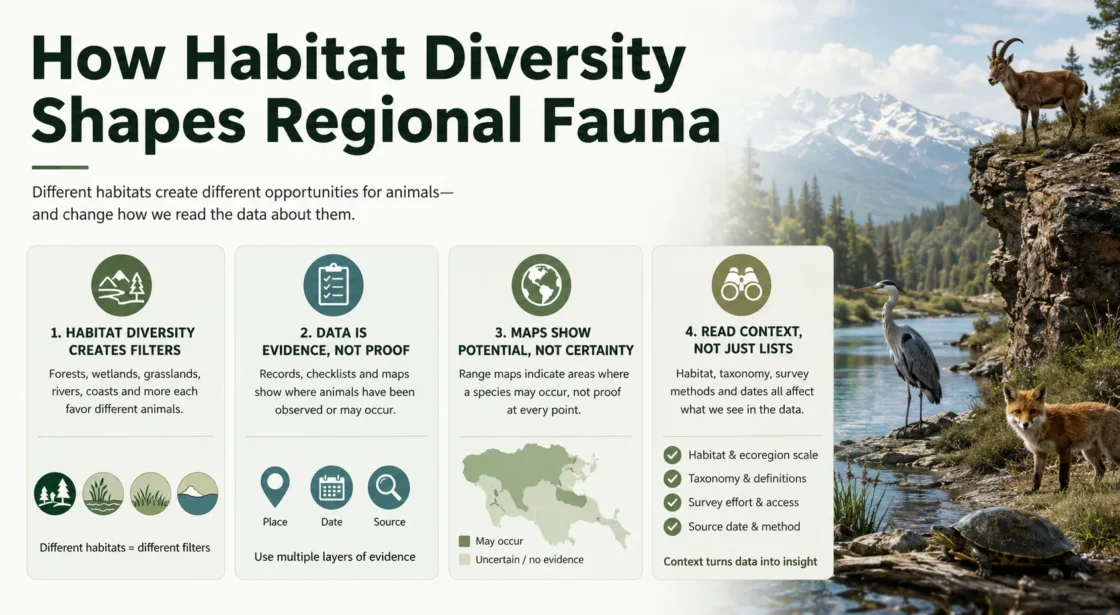
Habitat diversity shapes regional fauna by creating different combinations of food, shelter, breeding sites, microclimates and movement routes across a landscape. Its largest regional effect often comes not from making every site equally species-rich, but from allowing forests, wetlands, grasslands, rocky areas, rivers and other habitats to support different animal communities. The replacement of species from one habitat to another adds to the total fauna recorded across the region.
A region with several habitat types may therefore contain more animal species than a uniform region of similar size, even when individual sampling sites hold comparable numbers of species. The outcome still depends on habitat area, condition, connectivity, spatial arrangement, climate, evolutionary history and the ability of animals to reach suitable patches. Habitat variety alone does not guarantee a rich or intact native fauna.
Regional fauna is shaped by both the number of species within habitats and the degree to which species composition changes between habitats.
Regional Fauna Is Built at More Than One Spatial Scale
Ecologists separate diversity within a site from diversity between sites and total diversity across a region. These levels answer different questions. A woodland plot may contain many species locally, while a landscape containing woodland, marsh and dry grassland may gain additional species because each habitat supports a partly different assemblage.
| Diversity level | Ecological scope | What it reveals about fauna | Relationship with habitat diversity |
|---|---|---|---|
| Alpha diversity | A sampling site, habitat patch or local community | The animals recorded together at one defined location | May rise when local vegetation structure, substrate or microhabitats become more varied |
| Beta diversity | Differences among sites or habitat types | The degree of species replacement or compositional dissimilarity | Often rises when contrasting habitats support specialists with different ecological requirements |
| Gamma diversity | The full landscape, watershed, protected area or region | The combined animal diversity across all included sites | Can rise through higher local richness, stronger species turnover or both |
A global synthesis based on 1,148 data points from 192 studies found broadly positive relationships between environmental heterogeneity and species richness across terrestrial taxa, biomes and spatial scales. The strength of the relationship varied with the heterogeneity component measured, the organism group and the study scale. This means that habitat diversity is a widespread influence on animal diversity, but not a fixed rule with the same effect everywhere.[a]
Habitat Diversity Includes More Than a Count of Habitat Types
Two landscapes can contain the same number of mapped habitat categories and still provide very different conditions for animals. One may contain large, connected and structurally varied habitats. The other may contain narrow, degraded fragments separated by roads or intensive land use. A useful assessment must therefore consider what differs among habitats, what varies within them and how the patches are arranged.
Habitat complexity usually describes the physical structure available to organisms, while spatial heterogeneity describes how environmental attributes vary through space. They overlap but are not interchangeable. The relevant measurement may involve vegetation height, vertical layers, substrate roughness, water depth, canopy gaps, soil moisture, temperature, patch identity or the arrangement of habitat features at the scale perceived by the animal.[b]
| Dimension of habitat diversity | What varies across the region | Possible faunal response | What can weaken the benefit |
|---|---|---|---|
| Habitat-type composition | The presence and relative area of forests, wetlands, grasslands, rivers, dunes, reefs or other habitat classes | Addition of animals associated with different habitat types | Loss of rare habitats or replacement by low-quality artificial cover |
| Within-habitat structure | Canopy layers, vegetation height, dead wood, cavities, rock crevices, sediment relief or aquatic vegetation | More nesting, resting, feeding and refuge positions within the same habitat | Uniform management, removal of old structures or physical disturbance |
| Environmental gradients | Moisture, elevation, temperature, salinity, water depth, flow, exposure or soil conditions | Replacement of animals along changing physiological and resource conditions | Sharp human barriers that prevent movement along the gradient |
| Spatial configuration | Patch size, isolation, edge density, shape and distance between complementary habitats | Improved access to multiple resources or easier recolonization when patches remain connected | Fragmentation, road mortality, hostile matrix habitat or patches smaller than viable home ranges |
| Temporal variation | Seasonal flooding, drying, vegetation growth, fire cycles, tides or temporary food pulses | Seasonal arrival, migration, breeding or shifts in habitat use | Timing changes that separate animals from breeding sites or food availability |
| Biogenic structure | Habitat created or modified by trees, corals, kelps, mussels, oysters, burrowing animals or other organisms | New surfaces, cavities, shade, moisture retention and feeding opportunities | Loss of the habitat-forming organism even when the surrounding habitat category remains mapped |
Different Habitats Add Different Ecological Opportunities
More combinations of resources and physical conditions
Animal species differ in diet, body size, thermal tolerance, nesting behaviour, activity period and vulnerability to predators. A habitat mosaic offers more combinations of these conditions than a uniform surface. Wetland insects may require shallow water and emergent vegetation, while adjacent grassland predators use dry ground for hunting. Forest birds may separate vertically between the ground layer, understory and canopy even though they occupy the same mapped forest patch.
The number of habitat categories is therefore less informative than the ecological differences among them. Two grassland types separated only by a mapping convention may add little faunal turnover. A dry calcareous grassland beside a seasonally flooded meadow may support much more distinct invertebrate, amphibian and bird assemblages because moisture, vegetation, prey and breeding conditions differ.
Specialists can coexist at the regional scale
Habitat specialists occupy a narrower set of conditions than generalists. A region containing only one widespread habitat may exclude specialists associated with marsh edges, old trees, bare sand, caves, fast-flowing water or other uncommon settings. Retaining several habitat types allows these specialists to remain within the regional species pool without requiring them to coexist in every local community.
A review of 85 animal studies found that most reported a positive relationship between habitat heterogeneity and animal diversity, but it also identified strong biases toward vertebrates and human-influenced habitats. The review showed that the same structural feature may function as useful heterogeneity for one animal group and as fragmentation for another. It also emphasized the role of particular habitat features, such as old trees, cavities or distinct vegetation structures, that support many dependent species despite occupying little area.[c]
Animals often need several habitats during one life cycle
The habitat used for breeding may not supply all adult food, shelter or overwintering requirements. Amphibians can breed in ponds but spend much of the year in surrounding terrestrial habitat. Aquatic insects may develop in streams and feed or reproduce as adults in riparian vegetation. Migratory birds may depend on separate feeding, resting and nesting habitats during different parts of the annual cycle.
Such species are supported by functional connections among habitats rather than by habitat variety considered as isolated patches. A breeding pool without nearby refuge habitat, or a river without vegetated banks, may retain the name of the original habitat while losing part of its ecological value.
Microclimates provide refuges within broader climate zones
Topography, canopy cover, soil moisture, slope direction, water bodies and rock structure create local differences in temperature, humidity, wind and exposure. These microclimates can allow heat-sensitive, moisture-dependent or cold-adapted animals to persist within a region whose average climate would not describe their occupied conditions accurately.
Microclimatic diversity can also reduce the chance that every local population experiences the same extreme conditions at the same time. Its value depends on access: a cool ravine cannot function as a refuge for an animal that cannot cross the intervening land or whose required food and breeding structures are absent there.
Habitat-forming organisms multiply physical structure
Some habitat diversity is produced by organisms rather than geology or land cover. Trees create bark surfaces, cavities, canopy layers and shaded litter. Corals, mussels, oysters, kelps and seagrasses create three-dimensional structures that alter water movement, sediment, light and predator access. Secondary habitat-forming species may add another layer of surfaces and refuges within the first.
A coordinated set of 22 experiments across multiple ecosystems and biogeographic regions tested habitat amount, morphological complexity and resource provision within and among co-occurring foundation species. The study found that variation within and between these habitat-forming organisms increased associated biodiversity, showing that biological structure can shape faunal diversity even within a single broad habitat category.[g]
Regional Richness Can Rise Without Richer Local Sites
A common error is to judge the value of habitat diversity only by comparing species counts from individual plots. Two sites can contain the same number of species while sharing few of the same species. When this replacement occurs repeatedly across habitats, regional richness rises even though local richness remains stable.
Research on stream macroinvertebrates in New Zealand found that local environmental heterogeneity was the predominant influence on geographical patterns of beta diversity, while productivity had a smaller negative relationship. The result illustrates how changes in stream conditions can shape which invertebrate species occur from site to site rather than simply changing the number recorded at each site.[d]
A standardized survey of 45 sites across seven Cerrado localities recorded local small-mammal assemblages containing 12–21 species. Sites had similar local richness but high turnover among grasslands, savannas, forests and geographical portions of the biome. Forest dwellers, savanna specialists and grassland inhabitants contributed different parts of the regional fauna, while distance from neighbouring biomes and landscape history also helped explain compositional change.[e]
Equal local counts can conceal different communities
A forest site with 20 species and a grassland site with 20 species do not contribute the same regional information if their species lists differ. Species identity and turnover must be examined alongside local totals.
Animal Groups Do Not Respond to the Same Habitat Feature
Habitat diversity measured for one taxon cannot automatically be treated as habitat diversity for another. A beetle may respond to litter depth and soil moisture over a few metres. A bat may respond to forest edges, roost availability and feeding areas across kilometres. An aquatic invertebrate may perceive variation in current speed and substrate grain size that is invisible in a land-cover map.
A multi-taxon study in a wet–dry grassland mosaic in Hungary recorded 434 species, including 264 animal species. Positive responses occurred across the studied taxa, but different groups responded to different components and spatial scales of habitat diversity. Pooling all taxa removed a clear total relationship because no single habitat variable represented every group equally well.[f]
| Taxon or ecological group in the study | Habitat feature associated with species richness | Ecological meaning |
|---|---|---|
| Orthopterans and ground-dwelling arthropods | Wet–dry differences among habitat patches | Moisture and associated vegetation conditions separated suitable assemblages |
| Vegetation-dwelling arthropods | Richness of plant associations within patches | Plant-community patchiness altered food plants and above-ground living space |
| Ground-dwelling arthropods | Vegetation height | Vertical structure changed cover, microclimate and hunting conditions near the ground |
| Birds | Vegetation height and patch area | Both local structure and the amount of usable habitat influenced the recorded assemblage |
| Plants and true bugs | Management by grazing, mowing or absence of those treatments | Disturbance history altered vegetation composition and dependent fauna |
This taxon dependence explains why a region can appear heterogeneous in satellite land-cover data while remaining structurally uniform for cavity nesters, saproxylic insects or animals dependent on submerged vegetation. Habitat classifications should match the biological scale and resource requirements of the fauna being assessed.
More Habitat Types Can Also Mean Less Habitat per Specialist
Habitat diversity and habitat area can pull regional fauna in opposite directions. Adding environmental conditions may allow more species with different niches to colonize. Within a fixed total area, however, dividing the landscape among more habitat types leaves less area available for each type. Populations associated with the rarest or smallest patches may then become too small, isolated or unstable to persist.
Experimental work on the area–heterogeneity trade-off showed that heterogeneity can have both positive and negative effects and that the net outcome depends on spatial scale and species characteristics. Greater environmental variety may broaden the set of species able to find suitable conditions, while reduced effective area can raise local extinction risk for species restricted to particular conditions.[h]
Habitat variety is not a substitute for habitat area
A landscape containing many tiny habitat fragments may score highly for mapped variety while supporting fewer viable specialist populations than a landscape that retains large examples of its native habitats.
The balance differs among animals. Small, mobile generalists may use several patch types and cross disturbed land. Large mammals, interior-forest birds, flightless invertebrates and animals with narrow breeding requirements may need larger continuous areas. A configuration that benefits edge-associated species can therefore reduce habitat for interior specialists.
Land-Cover Variety Does Not Automatically Represent Native Habitat Quality
Regional analyses often use land-cover or land-use categories as proxies for habitat diversity. These measures can detect broad differences across large areas, but a forest plantation, old native forest and recently cleared woodland may not offer equivalent conditions even when each contributes another mapped category.
A global analysis of all extant bird species found that land-use diversity predicted regional taxonomic and functional richness in nearly all biogeographic realms after accounting for net primary productivity. The relationship was more consistent for functional richness, indicating that additional land-use types could add birds with different ecological traits. Richness reached its highest modelled levels at intermediate land-use diversity in the Palearctic and Afrotropic realms, consistent with a balance between added habitat types and fragmentation costs.[i]
This type of association should not be interpreted as evidence that converting native habitat into a mixture of farms, settlements and remnant vegetation improves conservation. Total richness may include widespread generalists or introduced species while native specialists lose area. Taxonomic richness also cannot reveal whether two landscapes retain the same ecological roles, evolutionary lineages or conservation priorities.
Topography, Connectivity and Seasonality Alter the Regional Pattern
Habitat diversity operates inside a broader biogeographic setting. Mountain ridges, deserts and ocean channels can prevent dispersal, while river systems, coastlines and connected vegetation can direct movement. The same set of habitats may therefore support different regional fauna depending on which species were historically able to reach the region and whether present-day connections allow populations to exchange individuals.
A global analysis of arthropod beta diversity found that regional topography can affect species turnover by changing habitat connectivity and dispersal. It also detected temporal species replacement across the examined regions, showing that regional composition changes not only between places but across seasons and sampling periods. Surveys restricted to one habitat, elevation or season can consequently miss part of the regional fauna.[j]
Permanent and seasonal diversity support different animals
Permanent habitat differences include geology, elevation, long-lived forest structure and enduring water bodies. Seasonal diversity arises from floodplains, temporary ponds, snow cover, tidal exposure, vegetation growth and recurring fire or grazing patterns. Animals may track these changes through migration, dormancy, emergence or movement between nearby habitats.
Removing a temporary habitat can affect species even when it occupies little area or exists for only part of the year. A short-lived pool may provide the only breeding period for an amphibian or aquatic invertebrate. A seasonally flooded meadow may provide concentrated food for migratory birds. Annual land-cover maps can overlook these brief but biologically necessary conditions.
Habitat Homogenization Changes Species Identity Before Totals Reveal the Loss
When several habitats are converted into one dominant land cover, regional fauna can become more uniform. Specialists associated with rare substrates, moisture regimes, vegetation layers or disturbance stages are lost first from affected sites. Widespread species capable of using the remaining habitat may continue to occur across many locations.
Local species counts can temporarily remain stable if generalists or newly arriving species replace disappearing specialists. Beta diversity then falls because sites become more alike. The regional species list may contract later, after the last populations of habitat-dependent species disappear from isolated remnants.
Protecting regional fauna therefore requires more than maximizing the number of habitat categories. Conservation must retain adequate area, ecological condition and connectivity for each native habitat; preserve uncommon structures within habitats; and account for the spatial and seasonal scales used by different animal groups.
Regional Habitat Mosaics Function as Interdependent Systems
A forest, wetland, grassland or river patch cannot always be evaluated independently from its surroundings. Animals cross habitat boundaries, move between seasonal resources and depend on processes originating outside the patch in which they are recorded. Pollinators may nest in bare ground and feed in flower-rich vegetation. Stream animals may depend on leaf litter supplied by riparian trees. Predators may shelter in one habitat and forage in another.
The faunal value of a region is therefore determined by which habitats remain, how different they are, whether they contain the structures required by dependent species, how much area each occupies and whether animals can move among them. Habitat diversity contributes most strongly when it preserves distinct native communities rather than dividing the landscape into a large number of small, degraded or ecologically interchangeable patches.
Sources and Verification
- [a] Stein, Gerstner and Kreft — Environmental heterogeneity as a universal driver of species richness across taxa, biomes and spatial scales — Used for the global meta-analysis of heterogeneity–richness relationships across studies, taxa, biomes and spatial scales.
- [b] Loke and Chisholm — Measuring habitat complexity and spatial heterogeneity in ecology — Used to distinguish physical habitat complexity from spatial environmental heterogeneity and their measurement.
- [c] Tews et al. — Animal species diversity driven by habitat heterogeneity/diversity: the importance of keystone structures — Used for animal-focused evidence, taxonomic and scale dependence, research biases and the role of particular habitat structures.
- [d] Astorga et al. — Habitat heterogeneity drives the geographical distribution of beta diversity: the case of New Zealand stream invertebrates — Used for evidence linking local environmental heterogeneity with geographical patterns of stream-invertebrate beta diversity.
- [e] Carmignotto, Pardini and de Vivo — Habitat heterogeneity and geographic location as major drivers of Cerrado small mammal diversity across multiple spatial scales — Used for the Cerrado evidence on habitat selectivity, similar local richness and high turnover among sites, habitats and localities.
- [f] Lengyel, Déri and Magura — Species richness responses to structural or compositional habitat diversity between and within grassland patches: a multi-taxon approach — Used for taxon-specific responses to wet–dry gradients, plant-association richness, vegetation structure, management and patch area.
- [g] Thomsen et al. — Heterogeneity within and among co-occurring foundation species increases biodiversity — Used for coordinated experimental evidence on habitat amount, morphology and resources created by foundation species.
- [h] Ben-Hur and Kadmon — An experimental test of the area–heterogeneity tradeoff — Used to explain why added environmental variety can increase niche availability while reducing effective area for specialist populations.
- [i] Martínez-Núñez, Martínez-Prentice and García-Navas — Land-use diversity predicts regional bird taxonomic and functional richness worldwide — Used for the worldwide relationship between land-use diversity and regional bird taxonomic and functional richness, including saturation and fragmentation trade-offs.
- [j] Seymour et al. — Global arthropod beta-diversity is spatially and temporally structured by latitude — Used for the roles of regional topography, dispersal connections and temporal species replacement in arthropod community variation.
Related Topics
- → How Climate Zones Influence Regional Animal Diversity
- → Wildlife of the Black Sea Region of Turkey
- → Mammals of Turkey: Native Species, Habitats, and Distribution
- → Birdwatching Regions in Turkey: Important Bird Areas and Habitats
- → Birds of Turkish Wetlands: Lakes, Deltas, and Marshes
- → Migratory Birds in Turkey: Major Flyways and Seasonal Patterns