Complete guide: Regional Fauna Guides
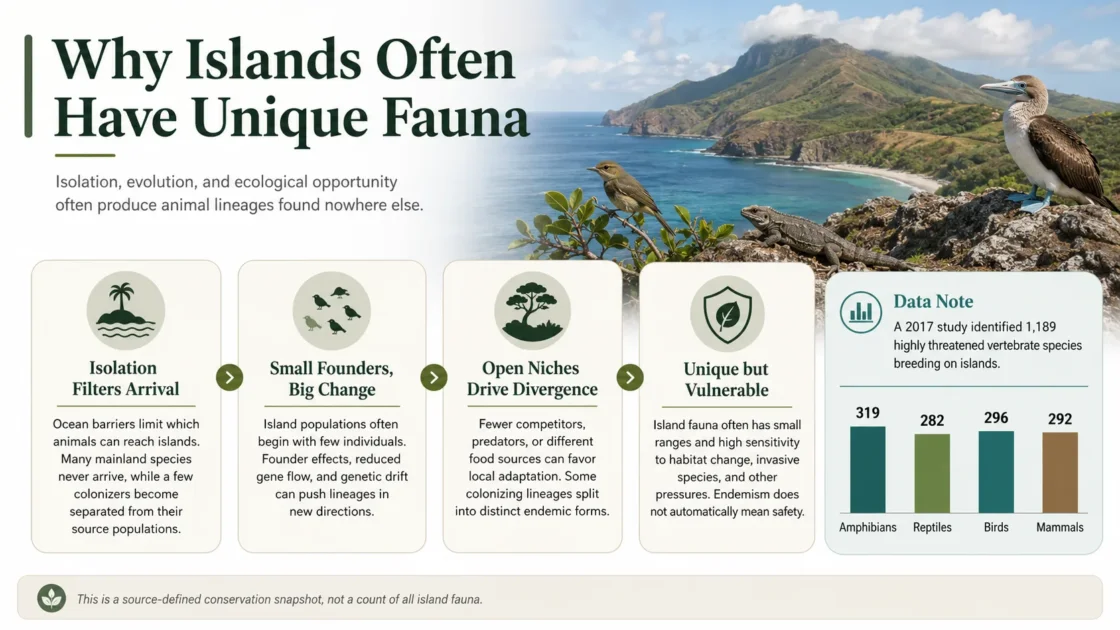
Islands often have unique fauna because the surrounding water performs two biological roles. It first filters which animals can arrive, then restricts movement and breeding between the animals that establish there and their relatives elsewhere. Over many generations, this combination of selective colonization, reduced gene flow, local environmental pressures, and unoccupied ecological roles can produce endemic species, unusual body forms, flightless birds, specialized diets, and animal communities unlike those on nearby mainlands.[a]
The Ocean Filters the Fauna Before Evolution Begins
A newly formed oceanic island does not begin with a complete mainland animal community. Its terrestrial fauna must arrive by flying, drifting, swimming, rafting on vegetation, attaching to floating material, or being transported by people. Each route favors different animals.
Birds, bats, and many insects can cross water under their own power. Spiders and small arthropods may travel on air currents. Reptiles, snails, and small mammals can occasionally survive transport on floating vegetation or storm debris. Large land mammals, strictly freshwater animals, and species dependent on several ecological partners face much stronger barriers.
The result is often a disharmonic fauna: an animal community containing an uneven sample of the groups found in the probable mainland source region. A remote island may contain many birds, insects, and land snails but lack native hoofed mammals, amphibians, or major terrestrial predators. This imbalance reflects both dispersal ability and the conditions animals encounter after arrival.[b]
| Island setting | Faunal starting point | Main route to distinctiveness | Expected relationship with mainland fauna |
|---|---|---|---|
| Oceanic island | Forms away from continental land and begins without an inherited terrestrial fauna. | Rare over-water colonization followed by local survival, divergence, and sometimes radiation. | Often taxonomically uneven and rich in island-restricted lineages despite having fewer major animal groups. |
| Continental fragment | Separates while carrying animals already present on the former landmass. | Long isolation, survival of older lineages, local extinction, later dispersal, and diversification. | May preserve deep evolutionary branches as well as younger island-derived species. |
| Continental-shelf or land-bridge island | Shares a recent connection with the mainland, often during periods of lower sea level. | Loss of mainland species, reduced gene flow, and gradual local divergence after separation. | Usually resembles the mainland more closely, especially when separation is recent or crossings remain frequent. |
| Multi-island archipelago | Contains islands of different ages, sizes, elevations, and distances from one another. | Repeated colonization and isolation between islands, sometimes through stepping-stone dispersal. | Can contain closely related species restricted to different islands or habitat zones. |
Reaching an island is only the first filter. Arriving animals must also find suitable food, shelter, mates, nesting sites, and climate conditions. A species that crosses the sea but fails to establish a breeding population leaves no continuing island lineage.
Isolation Turns Colonists into Separate Lineages
When only a few individuals establish an island population, they may carry only part of the genetic variation present in the source population. This is the founder effect. Random changes can then have a stronger influence in a small population, a process known as genetic drift.
Neither process automatically creates a new species. Lasting divergence is more likely when the island population persists, immigration remains limited, and island conditions favor traits different from those favored in the source population. Diet, rainfall, temperature, predators, competitors, nesting sites, parasites, and mate choice can all alter which traits are passed to later generations.
Reduced gene flow allows these differences to accumulate without being repeatedly diluted by breeding with outside populations. The lineage may first become genetically or morphologically distinct, later develop reproductive separation, and eventually be recognized as an island subspecies or species. Studies of island systems have been especially useful because colonization boundaries and related mainland or neighboring-island populations can often be compared directly.[c]
Endemism Describes Range, Not Abundance
An endemic animal is naturally restricted to a defined place, such as one island or one archipelago. The term does not state whether the animal is common, rare, stable, or threatened. An island endemic can be numerous within its small range, while a widespread animal can be scarce throughout a much larger range.
A global comparison of 90 terrestrial biogeographic regions found vertebrate endemism richness on islands to be 8.1 times the mainland value. Endemism richness is a range-weighted measure that gives more weight to narrowly distributed species. It does not mean that every island contains more vertebrate species than a comparable mainland area or that islands contain 8.1 times as many individual animals.[d]
Ecological Opportunity Can Produce Several Species from One Arrival
An animal lineage reaching an island may encounter food types, vegetation layers, nesting locations, or hunting roles that are occupied by other groups on the mainland but remain unused on the island. Reduced competition can permit the colonist to expand its habitat use or diet. Different populations may then specialize on separate resources.
When one ancestral lineage divides into multiple descendant species associated with different ecological roles, the pattern is called adaptive radiation. Islands do not cause every radiation, and open ecological space alone is insufficient. The colonizing lineage must possess usable variation, populations must become partly separated, and the new traits must improve survival or reproduction under local conditions.[e]
| Island radiation | Documented divergence | Evidence supporting a shared radiation |
|---|---|---|
| Darwin’s finches of the Galápagos | Related finch lineages differ in bill form, feeding behavior, diet, and habitat use. | Behavioral, ecological, morphological, and genetic studies connect the forms to a shared evolutionary radiation.[f] |
| Hawaiian honeycreepers | Descendant lineages evolved markedly different bills associated with nectar feeding, seed use, and insect feeding. | Multilocus phylogenetic work supports diversification from a colonizing songbird lineage within the Hawaiian Islands.[g] |
| Greater Antillean Anolis lizards | Species evolved combinations of limb proportions, body forms, and habitat use associated with trunks, twigs, crowns, grass, and other structural zones. | Comparative research tests repeated morphological diversification across both island and mainland Anolis lineages.[h] |
Visual difference alone does not prove adaptive radiation. Researchers must test whether the species share an ancestor, when their lineages separated, whether traits correspond to different resources or habitats, and whether diversification occurred within the island system rather than through repeated arrivals of unrelated mainland species.
Island Animals Often Change Direction, Size, and Behavior
Small Animals May Grow Larger and Large Animals May Shrink
The island rule describes a broad tendency for small-bodied mainland animals to evolve larger island forms and large-bodied animals to evolve smaller forms. Proposed causes include reduced predation, fewer competing species, restricted food supplies, starvation resistance, climate, and the energetic limits of living within a small area.
A phylogenetic meta-analysis using 2,479 island–mainland comparisons found the predicted direction in mammals, birds, and reptiles. Amphibians showed a weaker relationship and mostly tended toward larger island body size. The strength of the pattern also varied with island area, remoteness, and climate, so dwarfism and gigantism should not be treated as automatic outcomes of island residence.[i]
Flight Can Become Less Valuable
Flight requires large muscles, specialized bones, high energy expenditure, and continued maintenance of flight feathers. On an island with few terrestrial predators, no need for seasonal migration, and food available on or near the ground, the costs of flight may exceed its benefits.
Flightlessness has evolved repeatedly in birds rather than arising from one flightless ancestor. Research incorporating extinct species found that human-caused losses have concealed how often birds lost flight during their evolutionary history. Many flightless forms lived on islands and disappeared after hunting, habitat change, or the arrival of unfamiliar mammalian predators.[j]
Wariness Can Decline When Predator Communities Are Limited
Escape behavior consumes time and energy that could otherwise be used for feeding, courtship, territorial defense, or parental care. Where large predators are absent for many generations, animals that flee at every unfamiliar movement may gain no survival advantage.
Comparative work on lizards found shorter flight-initiation distances in island populations and a further decline with increasing distance from the mainland. This pattern is often called island tameness. It does not mean that island animals lack every defensive response: they may remain alert to native birds of prey, snakes, or other predators while failing to recognize newly introduced cats, rats, dogs, or pigs.[k]
| Recurring island change | Possible island pressures | Why it is not universal |
|---|---|---|
| Gigantism in smaller animals | Reduced predation, access to vacant feeding roles, lower competition from larger animals, or improved survival during food shortages. | Climate, productivity, ancestry, island size, and the available food web can favor a different outcome. |
| Dwarfism in larger animals | Limited food, smaller home ranges, reduced need for defensive size, and lower energy requirements. | Large islands or productive habitats may continue to support large-bodied forms. |
| Loss or reduction of flight | Few terrestrial predators, reduced need for dispersal, ground-based feeding, and the energetic cost of flight. | Migration, aerial feeding, inter-island movement, or continuing predator pressure can retain flight. |
| Reduced escape distance | Long exposure to a limited predator community and the cost of unnecessary fleeing. | Animals still exposed to effective native predators may retain strong avoidance behavior. |
| Broader diet or habitat use | Fewer competing species and unoccupied ecological roles. | Resource scarcity, physiological limits, and competition within the same species can restrict expansion. |
Remoteness Alone Does Not Determine Uniqueness
Two islands separated from a mainland by the same distance can develop very different faunas. Distance affects arrival rates, but island area, geological age, elevation, habitat variety, climate, sea-level history, and connections with neighboring islands alter what happens after arrival.
- Area: Larger islands can support bigger populations, more food-web levels, and more habitat types. These conditions reduce some local extinction risks and permit more species to coexist.
- Geological age: Young islands may not have existed long enough for many endemic species to evolve. Very old islands can lose area and habitat through erosion, subsidence, and environmental change.
- Elevation and terrain: Mountains, valleys, dry slopes, cloud forests, caves, wetlands, and isolated highlands can divide populations within the same island.
- Archipelago structure: Nearby islands may act as stepping stones, sources of new colonists, or barriers that repeatedly divide related populations.
- Climate history: Droughts, cyclones, glacial cycles, changing currents, and sea-level shifts can reconnect islands, remove habitats, or create new ones.
- Dispersal ability: A sea channel that isolates a land snail may present little barrier to a seabird, bat, or migratory insect.
Island isolation is therefore relative to the animal being studied. One island may function as a closed evolutionary system for a flightless insect but remain connected to several continents for a migratory bird. Island biology research treats geography, animal movement, habitat, evolutionary time, and geological change as interacting processes rather than relying on distance alone.
The history of the land itself also matters. An oceanic volcano receives its terrestrial animals after formation. A continental fragment may carry ancestral lineages during separation. A shelf island exposed during lower sea levels may begin with a broad mainland fauna and lose species after the sea returns. These starting conditions can produce very different levels and ages of endemism even where present-day island sizes appear similar.
Some Islands Remain Closely Connected to Mainland Fauna
Not every island develops a highly distinct animal community. Recently separated islands may retain nearly the same species as the adjacent mainland. Short channels can permit repeated immigration, preventing populations from becoming genetically isolated. Seasonal ice, exposed seabeds during low sea levels, strong fliers, rafting events, and chains of intermediate islands can also maintain biological connections.
An island may also contain a mixture of locally evolved and widespread animals. Seabirds can breed across several archipelagos while land snails on the same island remain restricted to one valley. Native bats may retain regional connections while flightless insects diverge between mountain slopes. The phrase “unique island fauna” therefore describes the composition and evolutionary history of the animal community, not a requirement that every species be endemic.
Human transport can reduce distinctiveness further. Ships, aircraft, agriculture, livestock movement, the pet trade, and cargo introduce animals that could not cross the ocean unaided. Repeated introductions can make island communities more similar to one another while native island lineages decline or disappear.
The Conditions That Produce Endemism Also Increase Extinction Risk
An animal confined to one island has no unaffected population elsewhere if its habitat is removed, a disease arrives, or a new predator spreads across the island. Small land area can also limit population size and prevent animals from shifting their ranges when fire, drought, storms, development, or climate change alters suitable habitat.
Endemic Does Not Automatically Mean Threatened
Conservation category must be checked separately for each species and assessment. Endemism describes geographic restriction. Threat status depends on population condition, range change, habitat quality, exploitation, introduced species, disease, climate exposure, and other documented pressures.
Introduced predators are especially damaging when native animals evolved without comparable mammals. A global synthesis identified cats, rodents, dogs, and pigs among the invasive predators with the widest effects and found endemic island fauna to be particularly exposed. Predation may affect adults, eggs, chicks, reptiles, amphibians, and large invertebrates that lack effective recognition or avoidance behavior.[l]
The geographical boundaries that make islands vulnerable can also make some restoration actions possible. When an invasive mammal population is confined by the sea, complete removal may be achievable in ways that are rarely possible across an open mainland landscape. A global review of island eradication projects documented recovery or improved conservation outcomes for many native animal populations after invasive mammals were removed.[m]
Long-term protection requires more than removal. Reinvasion prevention, port biosecurity, habitat restoration, disease control, genetic management, monitoring, and protection of several islands within an archipelago may all be needed. Preserving only one island can leave closely related island-specific species, distinct populations, and separate evolutionary histories unprotected elsewhere in the same chain.
Sources and Verification
- [a] Whittaker et al. — Island biogeography: Taking the long view of nature’s laboratories — Used for the combined roles of isolation, island area, geological development, colonization, extinction, and in-place evolution.
- [b] Matthews et al. — Island biogeography — Used for oceanic-island dispersal filters, environmental filters, and taxonomically uneven island biotas.
- [c] Warren et al. — Islands as model systems in ecology and evolution — Used for the study of colonization, isolation, ecological change, population divergence, and speciation in island systems.
- [d] Kier et al. — A global assessment of endemism and species richness across island and mainland regions — Used for the 90-region analysis and the reported 8.1-fold island-to-mainland difference in vertebrate endemism richness.
- [e] Losos and Ricklefs — Adaptation and diversification on islands — Used for ecological opportunity, adaptation, diversification, and the evidence needed to interpret island radiations.
- [f] Tebbich et al. — The tale of the finch: adaptive radiation and behavioural flexibility — Used for ecological, behavioral, and feeding divergence within the Darwin’s finch radiation.
- [g] Lerner et al. — Multilocus resolution of phylogeny and timescale in the Hawaiian honeycreepers — Used for the shared ancestry, phylogeny, and morphological diversification of Hawaiian honeycreepers.
- [h] Pinto et al. — Testing the island effect in adaptive radiation — Used for comparison of morphological diversification in Caribbean island and mainland Anolis lizards.
- [i] Benítez-López et al. — The island rule explains consistent patterns of body size evolution in terrestrial vertebrates — Used for the 2,479 island–mainland comparisons and the taxonomic and environmental limits of insular dwarfism and gigantism.
- [j] Sayol et al. — Anthropogenic extinctions conceal widespread evolution of flightlessness in birds — Used for repeated evolution of avian flightlessness and the distortion created by human-driven island extinctions.
- [k] Cooper et al. — Island tameness: living on islands reduces flight initiation distance — Used for the comparison of escape distances in mainland and island lizard populations.
- [l] Doherty et al. — Invasive predators and global biodiversity loss — Used for the documented impacts of introduced mammalian predators and the exposure of endemic island fauna.
- [m] Jones et al. — Invasive mammal eradication on islands results in substantial conservation gains — Used for native animal recovery and conservation outcomes following invasive-mammal removal from islands.
Related Topics
- → How Climate Zones Influence Regional Animal Diversity
- → Coastal Fauna vs Inland Fauna: Species and Habitat Patterns
- → Endemic Animals of Turkey: Species Found Nowhere Else
- → Mountain Fauna vs Lowland Fauna: Main Differences
- → How Habitat Diversity Shapes Regional Fauna
- → Mammals of Turkey: Native Species, Habitats, and Distribution