Complete guides: Fauna of Turkey•Regional Fauna Guides
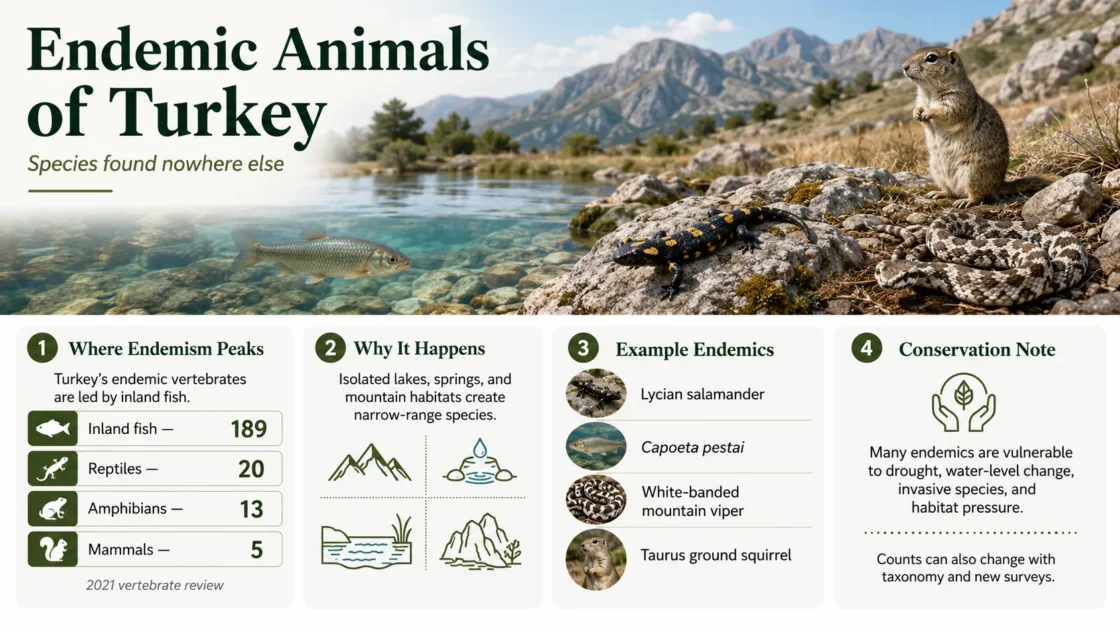
Turkey supports many animal species whose accepted natural ranges lie wholly within its borders. Most belong to freshwater-fish, rodent, shrew, mole, salamander, frog, lizard and snake lineages. There is no single enduring total for all endemic animals, because published counts change with taxonomic revisions, checklist dates, geographic rules and the treatment of subspecies.
A Turkey Endemic Must Have No Verified Natural Range Outside Turkey
A strict national endemic is naturally confined to Turkey. A species may be native to Anatolia, centred on Anatolia or restricted to the eastern Mediterranean without being endemic to the country. Any verified natural population in Greece, Bulgaria, Georgia, Armenia, Azerbaijan, Iran, Iraq or Syria removes it from the strict national category.
“Regionally endemic” is also a wider concept. A species confined to Anatolia and a neighbouring island or border drainage may be regionally restricted while failing the country-only test. Introduced populations require separate treatment: a human-mediated population outside the native range does not necessarily alter the origin of the taxon, but it must be identified rather than silently merged with natural distribution.
Why the National Total Changes
New species are described, older names become synonyms, populations are moved between species and subspecies, and border records are reassessed. Freshwater fishes and rock lizards are especially sensitive to these revisions. A total without a source, publication year and taxonomic scope is not reproducible.
What Recent Sources Support
| Animal group | Source-based treatment | Main limitation |
|---|---|---|
| Freshwater fishes | The 2026 checklist reports 202 endemic native species in its abstract and results, but 199 in its discussion. | The same publication contains conflicting totals, while earlier checklists used different taxonomic treatments. |
| Mammals | The 2025 national checklist recognizes 13 endemic terrestrial species. | Several additional mammals are regionally endemic rather than confined to Turkey. |
| Amphibians | A 2024 occurrence-and-trait dataset recognizes 13 endemic species; another 2024 analysis reports 12. | Newt, salamander and water-frog taxonomy differs among treatments. |
| Reptiles | Recent literature and the current Reptile Database support a source-based set of Turkey-restricted species. | No checked source supplies a stable, automatically updated national endemic total. |
| Birds | No strict Turkey-only bird species is supported by the checked national sources. | Names containing “Anatolian” or strong regional associations do not establish country endemism. |
| Invertebrates | An older national biodiversity profile cites about 4,000 endemic species and subspecies. | The figure combines taxonomic ranks and is not a current species-only checklist. |
Freshwater Fishes Form the Largest Documented Endemic Group
Turkey’s isolated lakes, springs and river basins have produced many fishes with very small natural ranges. The 2026 critical checklist recognizes 390 freshwater species in 37 families, including 367 native and 23 established non-native taxa. Its abstract and results classify 202 native species as endemic to Turkey. The discussion later gives 389 species, 366 native species and 199 endemics, so the publication does not support one internally consistent final number.[a]
The preceding 2023 annotated checklist reported 427 species, including 21 alien and 215 endemic species.[b] The decline between publications does not demonstrate biological loss of thirteen endemic species. The later work removed or revised names because of synonymy, unsupported Turkish records, changed species status and the exclusion of fishes outside its freshwater criteria.
The 2026 Fish Total Has an Internal Conflict
The reported 202 and 199 figures should not be averaged or converted into a range. They occur in different sections of the same paper. Until corrected by the authors or replaced by a later national checklist, both values need to remain attached to their locations in the source.
Families with the Strongest Concentration of Endemic Fishes
| Family | Reported national metric | Biological pattern |
|---|---|---|
| Leuciscidae | 113 species recorded in the 2026 checklist | The largest freshwater-fish family in the country, including many basin-restricted minnows, bleaks and chubs. |
| Nemacheilidae | 59 species; 72.9% reported as endemic | Stone and stream loaches often occupy isolated headwaters, springs and short drainage systems. |
| Cyprinidae | 53 species | A large assemblage of barbs, scrapers and related fishes, with both widespread and Turkey-restricted members. |
| Cobitidae | 74.1% reported as endemic | Spined loaches include species confined to individual lakes, wetlands or river sections. |
| Salmonidae | 87% reported as endemic | Many accepted Turkish trout species are assigned to short, isolated river systems. |
| Aphaniidae | 90.5% reported as endemic | Anatolian killifishes are concentrated in springs, closed lake basins and saline or brackish inland waters. |
Examples of Extremely Narrow Fish Ranges
Some accepted fish species are tied to one spring, lake or short drainage. Examples in the 2026 checklist include Anatolichthys saldae from Lake Salda, Anatolichthys irregularis from Kaklık Spring, Kosswigichthys asquamatus from Lake Hazar, Seminemacheilus attalicus from Kırkgöz Spring, Oxynoemacheilus hazarensis from the Lake Hazar Basin and Gobio maeandricus from the Lake Işıklı Basin.
Other endemics occupy several connected waters within one basin or a small group of neighbouring drainages. Their recorded localities document the evidence available to the checklist authors; they do not prove that every suitable reach has been surveyed or that every historical population still survives.
The 2026 fish paper is the correct taxonomic starting point, but its contradictory endemic totals make a copied “complete 202-species web list” less reliable than the dated checklist itself.
The 13 Endemic Mammals in the 2025 National Checklist
The updated 2025 checklist recognizes 177 wild mammal species in Turkey: 165 terrestrial and 12 marine. Thirteen terrestrial mammals are classified as endemic to the country, while twelve others are treated as regionally endemic.[c]
| Scientific name | Order | Family | Group |
|---|---|---|---|
| Nannospalax turcicus | Rodentia | Spalacidae | Blind mole-rat |
| Nannospalax cilicicus | Rodentia | Spalacidae | Blind mole-rat |
| Nannospalax tuncelicus | Rodentia | Spalacidae | Blind mole-rat |
| Chionomys stekolnikovi | Rodentia | Cricetidae | Snow vole |
| Microtus fingeri | Rodentia | Cricetidae | Vole |
| Microtus anatolicus | Rodentia | Cricetidae | Vole |
| Acomys cilicicus | Rodentia | Muridae | Spiny mouse |
| Spermophilus taurensis | Rodentia | Sciuridae | Ground squirrel |
| Dryomys laniger | Rodentia | Gliridae | Forest dormouse |
| Dryomys anatolicus | Rodentia | Gliridae | Forest dormouse |
| Crocidura arispa | Eulipotyphla | Soricidae | White-toothed shrew |
| Talpa hakkariensis | Eulipotyphla | Talpidae | Mole |
| Talpa levantis | Eulipotyphla | Talpidae | Mole |
Ten of the thirteen are rodents. The remaining three are a shrew and two moles. This pattern reflects repeated geographic isolation among mountain systems, plateaus, soils and underground habitats rather than an even distribution of endemicity across all mammal orders.
The list should not be expanded with every mammal described from Anatolia. Regionally endemic species may cross a political border, and some named forms have changed rank after genetic or morphological review.
Turkey-Restricted Salamanders, Newts and Frogs
A 2024 amphibian database assembled 5,611 occurrence records from 436 literature sources and recognized 37 species in Turkey, including 13 endemics.[d] The dataset includes 20 caudatans and 17 anurans. A separate 2024 analysis used 36 species and 12 endemics, showing that the national count depends on the taxonomic treatment applied.[f]
| Scientific name | Order | Source-based taxonomic note |
|---|---|---|
| Lissotriton kosswigi | Caudata | Turkey-restricted newt in the checked national source set. |
| Lyciasalamandra antalyana | Caudata | One of the southern Anatolian Lycian salamanders. |
| Lyciasalamandra atifi | Caudata | Accepted as a Turkey-restricted Lycian salamander. |
| Lyciasalamandra billae | Caudata | Some formerly separated local forms may appear under different ranks in older publications. |
| Lyciasalamandra fazilae | Caudata | Southwestern Anatolian endemic in the checked treatment. |
| Lyciasalamandra flavimembris | Caudata | Southwestern Anatolian endemic in the checked treatment. |
| Neurergus strauchii | Caudata | Eastern Anatolian mountain newt treated as endemic to Turkey. |
| Neurergus barani | Caudata | Its treatment contributes to differences among national totals. |
| Ommatotriton nesterovi | Caudata | Recognized as a separate Turkey-restricted newt in the checked dataset. |
| Triturus anatolicus | Caudata | Recognized as a distinct Anatolian crested-newt lineage. |
| Pelophylax caralitanus | Anura | Anatolian water frog whose rank and boundaries have varied among treatments. |
| Rana holtzi | Anura | Mountain frog associated with the Bolkar Mountains and the Karagöl area. |
| Rana tavasensis | Anura | Western Anatolian frog treated as a Turkey endemic. |
The 2021 national biogeographic review recorded 37 amphibian species and helped define their geographic associations.[e] It also shows why a species-level name alone is not enough: subspecies were outside that study’s scope, and later revisions may regroup local salamander populations.
Lyciasalamandra luschani is excluded from the strict Turkey-only list because its natural range also reaches Greece. Its close association with southwestern Anatolia does not override the cross-border record.
A Current Source-Based Set of Turkey-Only Reptiles
The current Reptile Database country search lists 154 reptile species for Turkey, but the search is a national occurrence list rather than an endemic checklist.[g] The table below retains accepted names treated as Turkey-restricted in the checked database ranges and recent country literature. It is a dated working set, not a permanent official inventory.
| Scientific name | Reptile group | Treatment in the checked sources |
|---|---|---|
| Acanthodactylus harranensis | Lizard | Restricted to southeastern Turkey in the current range treatment. |
| Acanthodactylus ilgazi | Lizard | Turkey-restricted species described from the Malatya area. |
| Anatololacerta ibrahimi | Lizard | Accepted Anatolian rock lizard with a Turkey-only range. |
| Asaccus barani | Gecko | Accepted Turkey-restricted leaf-toed gecko. |
| Darevskia bendimahiensis | Lizard | Restricted to eastern Turkey in the checked range treatment. |
| Darevskia josefschmidtleri | Lizard | Recently described rock-lizard species recorded from Turkey. |
| Darevskia mirabilis | Lizard | Accepted Turkey-restricted rock lizard. |
| Darevskia salihae | Lizard | Recently described and retained as a separate species. |
| Darevskia spitzenbergerae | Lizard | Eastern Anatolian rock lizard treated as Turkey-restricted. |
| Darevskia tuniyevi | Lizard | Recently described Turkey-restricted rock lizard. |
| Eirenis aurolineatus | Snake | Dwarf-snake species retained in the Turkey-only working set. |
| Eirenis eiselti | Snake | Turkey-restricted dwarf snake in the checked treatment. |
| Eirenis hakkariensis | Snake | Known from the Hakkâri area and retained as a separate species. |
| Eirenis thospitis | Snake | Eastern Anatolian dwarf snake treated as endemic to Turkey. |
| Lacerta pamphylica | Lizard | Pamphylian green lizard with a Turkey-restricted natural range. |
| Letheobia episcopus | Blind snake | Turkey-restricted blind snake in the checked sources. |
| Montivipera albizona | Viper | Mountain viper confined to Turkey in the checked range treatment. |
| Montivipera bulgardaghica | Viper | Taurus mountain viper treated as a Turkey endemic. |
| Montivipera wagneri | Viper | Eastern Turkish mountain viper with a restricted accepted range. |
| Muhtarophis barani | Snake | Turkey-restricted snake retained as the sole species of its genus. |
| Ophiomorus kardesi | Lizard | Turkey-restricted limbless skink described from southeastern Anatolia. |
| Vipera anatolica | Viper | Southwestern Anatolian viper treated as endemic to Turkey. |
The Rank of Vipera sakoi Is Disputed
The Reptile Database retains Vipera sakoi as a species, but recent work has proposed reducing it to a subspecies of Vipera darevskii. It is therefore not added to the fixed species table above.[h]
Several reptiles often associated with Anatolia fail the strict national test. Current ranges for Anatololacerta danfordi and Anatololacerta finikensis reach Greek territory. Darevskia bithynica is also not confined to Turkey under the current database treatment. These exclusions are necessary even when most records or the type locality lie within Turkey.
Turkey Has No Verified Strict National Bird Endemic
The checked Avibase country checklist contains 538 bird species under IOC taxonomy, but it does not identify a species whose accepted natural range is confined to Turkey.[i] Turkey’s national biodiversity strategy likewise states that the country has no endemic bird species.[j]
This does not mean the country lacks range-restricted, locally breeding or conservation-sensitive birds. It means their natural distributions cross at least one national boundary. Common names, regional population centres and strong associations with Anatolian habitats are not substitutes for a country-only global range.
Why the Invertebrate Total Cannot Be Added to the Vertebrate Lists
An older Convention on Biological Diversity country profile cites about 19,000 invertebrate taxa and about 4,000 endemic species and subspecies.[k] This is useful as historical evidence of high invertebrate endemism, but it is not a current species-only national checklist.
The figure cannot be combined directly with mammal, amphibian, reptile or fish species totals. It mixes species and subspecies, covers many unrelated phyla and predates later descriptions, synonymies and range revisions. A defensible modern inventory would require separate current registers for insects, spiders, molluscs, crustaceans, annelids, cave fauna and other groups.
Many Turkish invertebrate endemics are linked to caves, isolated mountains, freshwater springs, closed basins and short coastal drainages. Such habitats may contain highly localized lineages, but an occurrence from one Turkish locality is not by itself proof that the species occurs nowhere outside the country.
Endemic Does Not Mean Endangered
Endemicity describes geographic restriction. A conservation category describes assessed extinction risk under a stated method and date. The two fields must remain separate. A Turkey-only species may be assessed as Least Concern, threatened, extinct or not yet evaluated, depending on its population, habitat, pressures and available evidence.
Narrow distribution can increase exposure to local habitat loss, water extraction, pollution, dam construction, invasive species, fire or climate shifts. It does not prove that a population is declining. Decline, threat category and population trend require an identified assessment or study.
A reliable endemic checklist therefore needs four attached fields: the accepted taxon, the geographic rule, the source date and the evidence supporting absence beyond Turkey’s borders.
Sources and Verification
- [a] A Critical Checklist of Turkish Freshwater Fishes (2026) — Used for the current freshwater-fish scope, family composition, basin patterns, endemicity definition and the conflicting totals reported within the paper.
- [b] Freshwater lampreys and fishes of Türkiye: an annotated checklist, 2023 — Used for comparison with the preceding national checklist and its reported 2023 species, alien-species and endemic-species totals.
- [c] An Updated Checklist of the Mammals of Türkiye — Used for the 2025 national mammal total and the thirteen terrestrial species classified as endemic.
- [d] An Extensive Database on the Traits and Occurrences of Amphibian Species in Turkey — Used for the 2024 amphibian species total, endemic count, occurrence-record scope and literature coverage.
- [e] The Distribution and Biogeography of Amphibians and Reptiles in Turkey — Used for national herpetofaunal distributions, geographic classifications and the distinction between species-level and subspecies-level scope.
- [f] 2024 Amphibian Analysis for Turkey — Used to document the alternative treatment reporting 36 amphibian species and 12 national endemics.
- [g] The Reptile Database: Turkey Search — Used to verify currently accepted reptile names, country occurrence and stated distribution ranges.
- [h] The Reptile Database: Vipera sakoi — Used for the accepted database entry and the noted disagreement over whether the taxon should retain species rank.
- [i] Avibase Bird Checklist for Turkey — Used to check the current IOC-based country checklist and its treatment of the national bird fauna.
- [j] Turkey National Biodiversity Strategy and Action Plan — Used for the national statement that Turkey has no endemic bird species.
- [k] Convention on Biological Diversity: Turkey Country Profile — Used for the older national estimate of invertebrate diversity and its combined endemic species-and-subspecies figure.
Related Topics
- → Wildlife of the Black Sea Region of Turkey
- → Fauna of Turkey: Wildlife, Habitats, and Regional Diversity
- → Wildlife of the Mediterranean Coast of Turkey
- → Wildlife of Eastern Anatolia: Mountains, Steppes, and Wetlands
- → Birds of Turkey: Native, Migratory, and Rare Species
- → Large Carnivores of Turkey: Wolves, Bears, Lynx, and Wild Cats