Complete guides: Fauna of Turkey•Regional Fauna Guides
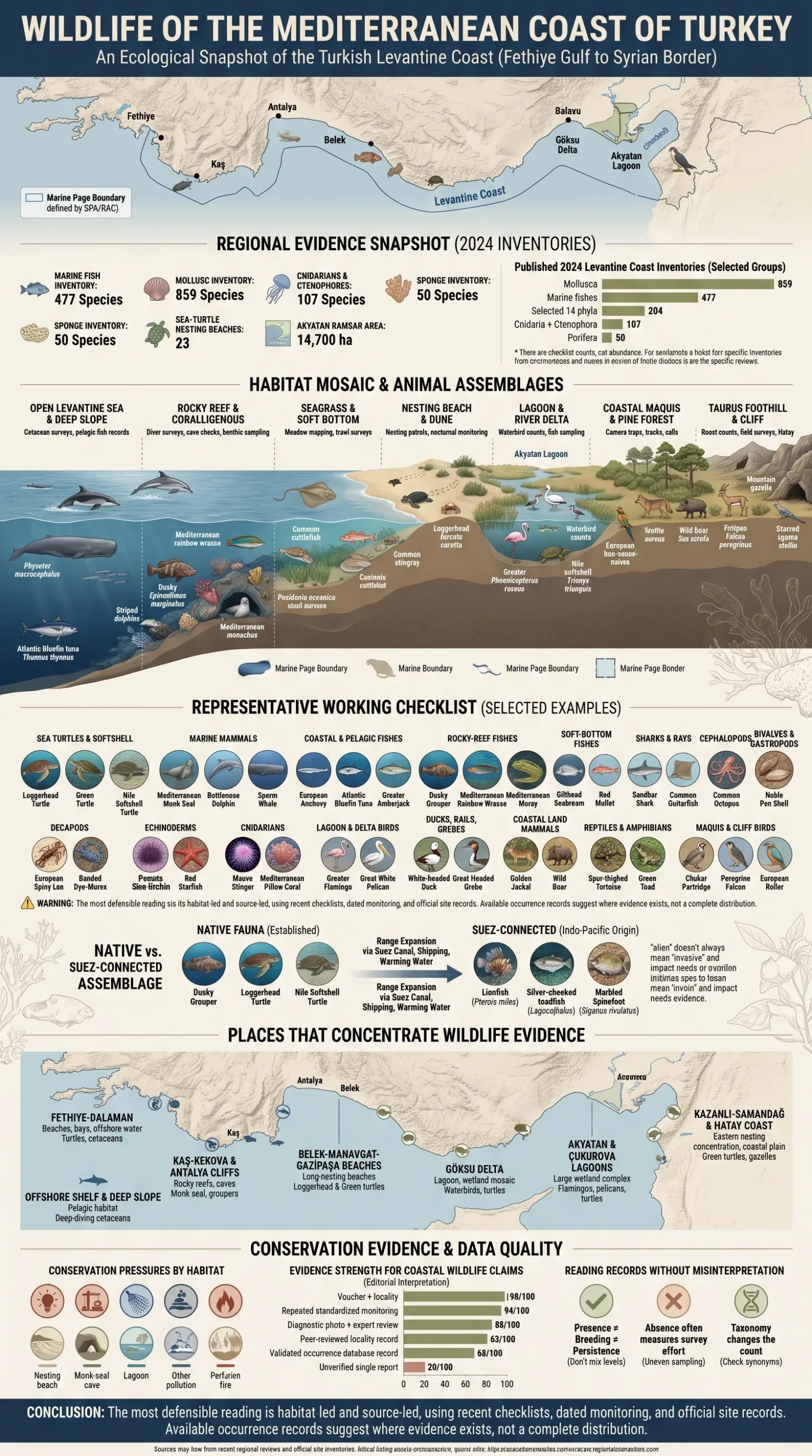
The Mediterranean coast of Turkey supports marine mammals, nesting sea turtles, lagoon fish, migratory waterbirds, wetland carnivores, maquis reptiles and mountain mammals within a narrow land-to-sea transition. Its fauna changes sharply between rocky bays, sandy nesting beaches, river deltas, salt marshes, coastal forests and the lower slopes of the Taurus and Amanos mountains.
The biological coast extends beyond the waterline
For this page, the Turkish Mediterranean coast extends from the Mediterranean-facing Fethiye–Göcek transition eastward through Antalya and Mersin to the Çukurova deltas and Hatay. The scope includes coastal waters, islands, sea caves, beaches, dunes, lagoons, river mouths, maquis, pine woodland and mountain foothills that remain ecologically connected to the coast.
This ecological boundary is not identical to Turkey’s administrative Mediterranean Region. Inland plateaus and provinces are excluded unless their watersheds, forests or animal populations connect directly with coastal systems. National biodiversity planning documents identify Mediterranean beaches, dunes, wetlands and coastal protected areas as linked habitats rather than isolated shoreline features.[a]
No synchronized survey has counted every animal taxon along the entire coast. Site inventories, provincial studies, nesting-beach monitoring and marine surveys therefore provide different kinds of evidence and cannot be merged into a defensible coast-wide species total.
The habitat sequence that structures coastal fauna
Animal distribution follows a repeated sequence from offshore water to mountains. Each habitat supplies a different combination of feeding grounds, shelter, nesting sites, freshwater access and seasonal refuge.
| Habitat | Physical setting | Characteristic fauna | Main biological role |
|---|---|---|---|
| Open coastal water | Continental shelf, pelagic water and deeper channels | Dolphins, sea turtles, pelagic fish, rays, sharks and gelatinous plankton | Feeding, migration and movement between offshore and coastal zones |
| Rocky reefs and sea caves | Cliffs, submerged rock, karst cavities and island shores | Mediterranean monk seal, groupers, moray eels, octopuses, sponges, sea urchins and reef fish | Resting caves, breeding cavities, fish shelter and hard-bottom feeding habitat |
| Seagrass and shallow soft bottom | Sheltered bays, sandy seabed and vegetated shallows | Juvenile fish, seabreams, pipefishes, crustaceans, molluscs and sea cucumbers | Nursery habitat, sediment stabilization and benthic feeding grounds |
| Sandy beaches and dunes | Open beaches backed by mobile or fixed dunes | Loggerhead turtle, green turtle, ghost crab, dune reptiles, ground-nesting birds and small mammals | Sea-turtle nesting, invertebrate feeding and movement between beach and dune vegetation |
| Lagoons and salt marshes | Brackish lakes, mudflats, salt pans and shallow channels | Flamingos, avocets, plovers, ducks, eels, mullets, gobies and terrapins | Fish nursery habitat, bird feeding grounds, winter refuge and migration stopover |
| Reed beds and river mouths | Freshwater channels, reed margins, pools and seasonally flooded ground | Herons, ibises, Eurasian otter, jungle cat, Nile softshell turtle, frogs and water snakes | Freshwater access, nesting cover, amphibian breeding and fish passage |
| Maquis and coastal pine woodland | Evergreen shrubland, rocky scrub and pine-covered slopes | Wild boar, red fox, golden jackal, European hare, tortoises, chameleons and lizards | Foraging cover, den sites, reptile basking habitat and links between wetlands and mountains |
| Taurus and Amanos foothills | Karst cliffs, forest, ravines, caves and rocky mountain slopes | Wild goat, caracal, striped hyena, roe deer, brown bear, raptors and cave-roosting bats | Large-mammal refuge, seasonal movement, cliff nesting and bat roosting |
Maquis is not merely degraded forest or empty scrub. It is a Mediterranean vegetation system of evergreen, drought-adapted shrubs and small trees that supplies cover, fruit, insects and rocky microhabitats for mammals, birds and reptiles. Its structure varies with soil, fire history, altitude and proximity to forest.[b]
Wildlife areas from Fethiye to Hatay
The coast is not biologically uniform. Western bays contain a stronger Aegean–Mediterranean transition, while the eastern Levantine sector has broader deltas, warmer water and greater exposure to species entering through the Suez Canal.
| Coastal sector | Main habitats | Faunal importance | Evidence boundary |
|---|---|---|---|
| Fethiye–Göcek | Sheltered bays, islands, rocky reefs, seagrass and pine-backed shores | Reef fish, sea turtles, cetaceans, benthic invertebrates and recorded non-indigenous marine species | Many records come from marine protected-area surveys rather than a single all-taxon inventory |
| Patara, Kaş and Kekova | Long sandy beach, dunes, rocky islands, sea caves and submerged reef | Loggerhead nesting, reef communities, marine mammals and cave-dependent fauna | Nesting evidence applies to monitored beaches; marine records vary with survey location and depth |
| Belek to the Antalya cliffs | Nesting beaches, river mouths, coastal dunes, cliffs and urbanized shore | Sea turtles, shorebirds, bats, cliff fauna and nearshore fish | Artificial lighting and dense coastal development create sharp differences between adjacent sites |
| Olympos, Çıralı and the western Taurus shore | Pebble and sand beaches, pine forest, maquis, streams and steep mountain slopes | Loggerhead nesting, tortoises, chameleons, forest mammals and raptors | Beach fauna and mountain fauna overlap but should not be treated as one habitat community |
| Göksu Delta and Taşucu | Lagoons, dunes, salt marsh, reed beds, river channels and adjacent sea | Waterbirds, sea turtles, Nile softshell turtle, lagoon fish and wetland mammals | Delta records provide strong site evidence but do not define distribution across all of Mersin |
| Aydıncık, Bozyazı and Anamur | Rocky Cilician shore, sea caves, small beaches and forested slopes | Mediterranean monk seal habitat, sea turtles, reef fish and cliff-associated birds | Cave and sighting records show use of particular coast sections, not continuous occupancy |
| Akyatan, Tuzla and Yumurtalık | Large lagoons, salt marshes, freshwater pools, dunes and flooded woodland | Green-turtle nesting, wintering waterbirds, lagoon fish, jungle cat and wetland reptiles | Published bird totals belong to stated survey years and site combinations |
| Samandağ and the Amanos coast | Nesting beach, Asi River mouth, agricultural plain, maquis and forested mountains | Green turtles, jackals, wetland birds, striped hyena, caracal, bats and mountain mammals | Some mammal evidence is provincial or mountain-based rather than restricted to the shoreline |
Ramsar documentation describes Akyatan as Turkey’s largest lagoon lake and records a mosaic of freshwater, coastal, salt-marsh, dune and woodland habitats. Historical surveys cited in the publication recorded 250 bird species at Akyatan in 1990, while combined Akyatan–Tuzla censuses recorded 152 species and 65,521 birds in 2009. These figures measure different survey scopes and should not be interpreted as a rise or decline.[c]
An official wetland publication reports 328 bird species recorded at Göksu Delta. It also identifies the delta’s fine dunes as nesting habitat for loggerhead and green turtles and reports the Nile softshell turtle from the wetland system.[d]
Sea turtles use the coast as a chain of breeding habitats
Loggerhead turtles and green turtles are the two regular nesting sea turtles on Turkey’s Mediterranean beaches. Their nesting distribution is not identical. Loggerheads use beaches across much of the coast, while green-turtle nesting is concentrated more strongly in the warmer eastern sector, including Akyatan, Kazanlı and Samandağ.
At Akyatan, monitoring cited by SPA/RAC recorded 1,335 green-turtle nests and 21 loggerhead nests between 2006 and 2011. The difference shows the site’s particular role for green turtles rather than a general abundance comparison between the two species throughout Turkey.[e]
A 2024 study describing the newly identified Yakacık nesting site referred to 23 recognized nesting beaches along Turkey’s Mediterranean coast. Small pocket beaches and previously inaccessible sections can still produce additional nesting evidence, so the number is tied to the study’s management context and publication date.[f]
| Species | Scientific name | Coastal relationship | Regional evidence |
|---|---|---|---|
| Loggerhead turtle | Caretta caretta | Nests on open sandy beaches; juveniles and adults forage in coastal and offshore waters | Nesting is documented at western, central and eastern Mediterranean beaches of Turkey |
| Green turtle | Chelonia mydas | Nests mainly on warm eastern beaches; later life stages feed in shallow marine habitat | Strong nesting evidence from the Çukurova and Hatay coasts |
| Leatherback turtle | Dermochelys coriacea | Occasional marine visitor rather than a regular Mediterranean nester | Reports at sea do not establish a Turkish nesting population |
| Nile softshell turtle | Trionyx triunguis | Uses river mouths, lower rivers, lagoons and brackish wetland margins | Reported from eastern Mediterranean river and delta systems, including Göksu |
| Balkan terrapin | Mauremys rivulata | Occupies slow water, canals, marsh edges and lowland streams | Associated with coastal freshwater and brackish wetland mosaics |
| European pond turtle | Emys orbicularis | Uses vegetated freshwater pools, drainage channels and marshes | Recorded from suitable coastal wetlands but not from every lagoon system |
| Spur-thighed tortoise | Testudo graeca | Terrestrial species of dunes, scrub, field margins and open maquis | Occurs behind the beach rather than in marine habitat |
IUCN treats the Mediterranean loggerhead population as a defined regional assessment unit rather than assuming that global and Mediterranean conditions are identical.[g] The Mediterranean green-turtle population is also assessed at subpopulation scale, which allows its restricted regional nesting system to be evaluated separately from populations in other oceans.[h]
A nest record is not a coast-wide population estimate
Nest totals depend on beach length, survey frequency, nesting season, track interpretation and whether repeated nesting by the same female is counted separately. Nest numbers describe reproductive activity at a monitored site; they do not equal the number of adult turtles in the sea.
The rocky Cilician shore remains monk-seal habitat
The Mediterranean monk seal, Monachus monachus, depends on quiet rocky shores with suitable caves, resting ledges and access to feeding water. Turkey’s Cilician coast contains long sections of karstic shoreline where caves occur beneath steep slopes and cliffs.
A published case report documented a monk seal in Yeşilovacık Bay in Mersin and assessed the record in relation to proposed coastal development. Such observations confirm use of particular bays but do not establish that seals occupy every cave or remain continually present in the area.[i]
Caves can serve different functions. Some provide temporary resting shelter, while a smaller number have interior beaches or chambers suitable for pupping. Boat entry, underwater noise, shoreline construction, cave illumination and repeated close approach can reduce the value of otherwise suitable habitat.
Bird communities change with water level and season
The largest coastal bird concentrations occur where shallow water, exposed mud, reed beds, salt marsh and open lagoon are present together. A species may breed at one site, winter at another and appear only during passage elsewhere. A regional list without seasonal status would therefore mix biologically different uses of the coast.
| Bird community | Representative species | Favored coastal feature | Typical seasonal role |
|---|---|---|---|
| Shallow-water feeders | Greater flamingo (Phoenicopterus roseus), pied avocet (Recurvirostra avosetta), black-winged stilt (Himantopus himantopus) | Saline shallows, mudflats and salt-pan margins | Wintering, passage and local breeding depending on site conditions |
| Small shorebirds | Kentish plover (Charadrius alexandrinus), little stint (Calidris minuta), curlew sandpiper (Calidris ferruginea), dunlin (Calidris alpina) | Exposed mud, wet sand and shallow lagoon margins | Migration passage, wintering and local breeding by Kentish plover |
| Larger waders | Ruff (Calidris pugnax), black-tailed godwit (Limosa limosa), common redshank (Tringa totanus), glossy ibis (Plegadis falcinellus) | Mudflats, flooded grassland and shallow freshwater pools | Mainly passage and winter use, with site-specific breeding |
| Lagoon ducks | Common shelduck (Tadorna tadorna), Eurasian wigeon (Mareca penelope), common pochard (Aythya ferina), white-headed duck (Oxyura leucocephala) | Open lagoon water, sheltered bays and vegetated margins | Wintering and passage; breeding status differs by species and wetland |
| Reed-bed and marsh birds | Purple heron (Ardea purpurea), squacco heron (Ardeola ralloides), black-crowned night-heron (Nycticorax nycticorax), marbled teal (Marmaronetta angustirostris) | Reed beds, shallow pools, canals and flooded vegetation | Breeding, feeding and migration stopover |
| Beach and island breeders | Collared pratincole (Glareola pratincola), little tern (Sternula albifrons), common tern (Sterna hirundo), stone-curlew (Burhinus oedicnemus) | Bare islands, sandy flats, gravel, dunes and sparsely vegetated ground | Local breeding during spring and summer |
| Scrub and agricultural-edge birds | Black francolin (Francolinus francolinus), European roller (Coracias garrulus), shrikes and buntings | Field margins, low scrub, hedges, orchards and dune vegetation | Resident or summer breeding, with additional migrants during passage |
| Soaring migrants | White stork (Ciconia ciconia), European honey-buzzard (Pernis apivorus), lesser spotted eagle (Clanga pomarina) and other raptors | Mountain passes, ridges and rising air near the Amanos range | Concentrated spring and autumn passage |
Waterbird abundance can change rapidly when lagoon depth, salinity, exposed mud area or food availability changes. The absence of a species during one visit is therefore not proof that the wetland lies outside its regional range. Conversely, a single passage record does not establish breeding.
Mammals from lagoon margins to the Amanos Mountains
The coast’s terrestrial mammals are most varied where wetlands, agricultural land, maquis, woodland and mountains meet. Lowland carnivores use reed beds and drainage corridors, while larger or more disturbance-sensitive mammals are associated with forest, cliffs and less accessible mountain terrain.
A peer-reviewed inventory reported 69 mammal species for Hatay Province. The total includes coastal lowlands, agricultural plains, steppe-like districts and the Amanos Mountains, so it must not be presented as a shoreline count. The study describes Hatay as a meeting area for African-linked, arid-region and Anatolian mountain fauna.[j]
| Mammal | Scientific name | Strongest coastal-hinterland association | Evidence scope |
|---|---|---|---|
| Jungle cat | Felis chaus | Reed beds, wet grassland, irrigation channels and lagoon margins | Wetland and lowland records, including the Çukurova lagoon system |
| Eurasian otter | Lutra lutra | Rivers, channels, freshwater pools, estuaries and fish-rich wetlands | Freshwater-linked coastal occurrence rather than open-sea habitat |
| Egyptian mongoose | Herpestes ichneumon | Dense riparian vegetation, field margins, scrub and wetland edges | Most strongly associated with warm southern lowlands |
| Golden jackal | Canis aureus | Wetlands, farmland, dunes, scrub and river corridors | Widely recorded in suitable coastal lowlands |
| Wild boar | Sus scrofa | Reed beds, forest, maquis, orchards and agricultural margins | Recorded across many terrestrial habitats behind the shore |
| Red fox | Vulpes vulpes | Dunes, farmland, maquis, woodland and upland slopes | Broad habitat use; local density is not established by presence records |
| European hare | Lepus europaeus | Open scrub, dunes, field margins and dry grassland | Terrestrial coastal plain and foothill species |
| Indian crested porcupine | Hystrix indica | Rocky slopes, scrub, orchards and agricultural mosaics | Southern lowlands and foothills |
| Stone marten | Martes foina | Rocky ground, woodland, villages and agricultural edges | Broadly distributed in terrestrial coastal landscapes |
| European badger | Meles meles | Woodland, scrub, farmland and soils suitable for sett excavation | More closely tied to inland cover than exposed beaches |
| Wild goat | Capra aegagrus | Steep Taurus and Amanos cliffs, rocky ravines and mountain scrub | Mountain and cliff habitat connected to the coast |
| Caracal | Caracal caracal | Dry scrub, rocky slopes, open woodland and low-density rural landscapes | Regional records are sparse and should not be read as continuous distribution |
| Striped hyena | Hyaena hyaena | Rocky dry country, scrub, agricultural margins and eastern coastal hinterland | Primarily associated with Hatay and neighboring southern landscapes |
| Roe deer | Capreolus capreolus | Forested Amanos slopes and woodland clearings | Mountain-forest evidence rather than lagoon or beach occurrence |
| Brown bear | Ursus arctos | Large forest blocks and remote mountain terrain | Restricted to suitable upland hinterland; not a characteristic beach mammal |
| Mountain gazelle | Gazella gazella | Dry plains and open landscapes of eastern Hatay | Provincial coastal-hinterland fauna, not a continuous Mediterranean shoreline species |
Hatay’s mammal total is provincial
The 69-species inventory includes habitats far beyond the beach, including the Amanos Mountains and inland districts. It provides evidence for the diversity of the eastern coastal hinterland but cannot be used as a count of mammals living directly beside the sea.
Reptiles and amphibians occupy the gaps between wet and dry habitat
Coastal reptiles are divided among marine water, freshwater wetlands, dunes, rocky scrub and forest edge. Amphibians are less visible during the dry season but breed in temporary pools, canals, marshes and slow-flowing freshwater.
| Species or group | Scientific name | Habitat association | Regional caution |
|---|---|---|---|
| Common chameleon | Chamaeleo chamaeleon | Dune scrub, orchards, hedges, maquis and low trees | Localized habitat use makes it easy to miss during short surveys |
| Starred agama | Stellagama stellio | Rock walls, cliffs, ruins, boulders and sun-exposed slopes | Common occurrence at rocky sites does not imply use of wetland habitat |
| Snake-eyed lizard | Ophisops elegans | Open dry ground, sparse scrub and rocky field margins | Associated mainly with terrestrial coastal plains and foothills |
| Kotschy’s gecko | Mediodactylus kotschyi | Rock faces, walls, trees and buildings | Older publications may place the species in a different genus |
| Ocellated skink | Chalcides ocellatus | Sandy soil, dunes, loose ground and low vegetation | Often concealed beneath soil or debris |
| Large whip snake | Dolichophis jugularis | Maquis, farmland, rocky slopes and field boundaries | Terrestrial predator with no direct marine association |
| Montpellier snake | Malpolon insignitus | Dry scrub, dunes, open woodland and cultivated land | Presence depends on warm, open terrestrial habitat |
| Dice snake | Natrix tessellata | Streams, canals, lagoons and freshwater margins | Most closely associated with fish-bearing water |
| Syrian spadefoot | Pelobates syriacus | Loose soil near temporary pools, marshes and lowland grassland | Above-ground activity is strongly seasonal |
| Tree frogs | Hyla species | Reed beds, shrubs beside water, canals and seasonal pools | Species-level identification should follow locality and current taxonomy |
| Green-toad complex | Bufotes species | Temporary water, irrigation systems, dunes and disturbed lowlands | Older sources often use the broad name Bufo viridis |
| Levant water frog | Pelophylax bedriagae | Ponds, slow streams, canals and permanent wetland water | Calling and breeding records are more informative than isolated visual sightings |
Lagoon fish connect rivers, wetlands and the sea
Coastal lagoons are not closed freshwater lakes. Their salinity changes with rainfall, evaporation, river flow and the opening or closure of channels to the sea. Some fish remain in brackish water, while others enter lagoons seasonally to feed, grow or reproduce.
| Recorded lagoon animal | Scientific name | Ecological relationship |
|---|---|---|
| European eel | Anguilla anguilla | Moves between marine and inland waters during its life cycle and uses lagoon channels as passage and feeding habitat |
| Big-scale sand smelt | Atherina boyeri | Forms schools in shallow coastal and brackish water |
| Flathead grey mullet | Mugil cephalus | Feeds in estuaries and lagoons and moves between marine and brackish habitats |
| Golden grey mullet | Chelon auratus | Uses coastal shallows and lagoon systems; older sources may list it as Liza aurata |
| Leaping mullet | Chelon saliens | Occurs in coastal and brackish water; older lists may use Liza saliens |
| Boxlip mullet | Oedalechilus labeo | Associated with shallow marine and lagoon-connected water |
| European seabass | Dicentrarchus labrax | Enters estuaries and lagoons, especially during juvenile growth stages |
| Gilthead seabream | Sparus aurata | Uses lagoon nursery and feeding habitat before returning to coastal marine water |
| Grass goby | Zosterisessor ophiocephalus | Lives in shallow brackish water with vegetation and soft sediment; older sources may use Gobius ophiocephalus |
| Blue crab | Callinectes sapidus | Non-native Atlantic crab established in eastern Mediterranean lagoons and estuaries |
The fish names above are based on species reported in Ramsar descriptions of Akyatan and Yumurtalık. Some genus combinations have changed since those wetland inventories were compiled. The table updates widely accepted combinations where the historical identity is clear rather than reproducing every older name unchanged.
The marine fauna is changing as the eastern Mediterranean warms
Turkey’s eastern Mediterranean coast is one of the first parts of the country reached by many Red Sea and Indo-Pacific species moving through the Suez Canal. Shipping, aquaculture, aquarium release and movement on vessel surfaces can provide additional pathways.
A study of long-term sea-surface temperature records found increasing trends at İskenderun, Mersin and Antalya and linked warmer conditions with changes in the composition and spread of marine species in Turkish seas.[k]
A national review reported 539 marine alien species from all Turkish coasts by the end of 2020, of which 404 were treated as established. These are national totals covering the Mediterranean, Aegean, Marmara and Black Sea; they are not counts for the Mediterranean coast alone.[l]
A 2025 survey and review for the Fethiye–Göcek Special Environmental Protection Area documented eight non-indigenous marine taxa. The animal records included the species below, while the full study also covered non-indigenous algae.[m]
| Recorded non-indigenous animal | Scientific name | Observed or expected habitat relationship | Why the record matters |
|---|---|---|---|
| Common lionfish | Pterois miles | Rocky reefs, caves and artificial structures | Predatory reef fish capable of consuming many small native fishes and crustaceans |
| Long-spined sea urchin | Diadema setosum | Rocky substrate and algal-covered reef | Dense grazing groups can alter algal cover and benthic structure |
| Yellowspotted puffer | Torquigener flavimaculosus | Sandy and mixed seabed in shallow coastal water | Shows continued spread of Indo-Pacific fishes into western parts of the Turkish coast |
| Nine-striped cardinalfish | Cheilodipterus novemstriatus | Rocky reef and sheltered coastal habitat | Provides evidence of westward expansion from the Levantine sector |
| Reciprocal sea cucumber | Synaptula reciprocans | Shallow hard bottom, reef surfaces and benthic habitat | Adds a non-indigenous deposit-feeding invertebrate to local benthic communities |
Non-indigenous does not automatically mean invasive
A non-indigenous species occurs outside its native range through human-assisted movement. It is described as invasive when establishment and spread produce documented ecological, economic or health effects. A new locality record alone is evidence of occurrence, not proof of measurable impact.
Threats follow the same habitat boundaries as the animals
A pressure affecting one part of the coast can alter several animal groups. Closing a lagoon channel changes fish movement and bird feeding habitat; dune construction affects turtle nesting and terrestrial reptiles; a road through maquis can fragment mammal movement between wetlands and mountain cover.
| Pressure | Most exposed habitat | Faunal effect | Evidence needed to assess local severity |
|---|---|---|---|
| Artificial lighting and night activity | Nesting beaches and coastal dunes | Can disorient sea-turtle hatchlings and disturb nesting females | Beach-specific light measurements, nesting tracks and hatchling-orientation records |
| Beach grooming, vehicles and fixed structures | Sand beach and foredune | Compacts nesting substrate, removes wrack fauna and interrupts dune habitat | Management records, substrate measurements and nest-location data |
| Wetland drainage and altered water flow | Lagoons, marshes and river mouths | Changes salinity, fish access, amphibian breeding pools and bird feeding depth | Water-level, salinity, channel and seasonal fauna monitoring |
| Agricultural runoff | Lowland rivers, canals and lagoons | Can alter oxygen conditions, plant growth and aquatic food webs | Water chemistry, sediment and biological-response measurements |
| Coastal construction and cave disturbance | Rocky shore and sea caves | Reduces quiet resting and breeding space for monk seals and cave-associated fauna | Cave structure surveys, camera records and disturbance monitoring |
| Fishing bycatch and abandoned gear | Coastal and offshore marine water | Can injure or kill sea turtles, marine mammals, sharks and diving birds | Fleet-specific observer records, strandings and gear-retrieval data |
| Quarries, roads and forest fragmentation | Maquis, cliffs and mountain foothills | Breaks movement routes and removes den, roost and feeding habitat | Before-and-after habitat mapping and species movement evidence |
| Wildfire and repeated vegetation clearance | Maquis and coastal pine woodland | Changes cover, prey availability and reptile microhabitats | Fire intensity, recovery stage and repeated fauna surveys |
| Marine warming and species introductions | Reefs, seagrass, soft bottom and lagoons | Changes competition, predation, grazing and seasonal occurrence | Repeated standardized marine surveys and verified taxonomic records |
Golden jackals and green-turtle nests at Samandağ
Predation is also part of the ecological relationship between terrestrial and marine-linked fauna. A Samandağ study examined 964 green-turtle nests between 2012 and 2017 and identified the golden jackal as the main mammalian nest predator. Metal screening increased hatching success in the monitored nests. The result does not make the jackal an introduced beach pest; it shows how a native generalist predator can affect a concentrated nesting resource in a modified coastal landscape.[n]
Why the coast has no reliable single species total
The available evidence was produced at different scales. Wetland publications list animals recorded within Ramsar boundaries. Nesting studies count reproductive activity on selected beaches. Provincial inventories include inland mountains and plains. Marine surveys differ in depth, gear, season and taxonomic coverage.
Taxonomy also changes over time. Older wetland lists may retain former genera for mullets, gobies, geckos, amphibians or birds. Updating a scientific combination does not create a new regional record, and an old name should not be counted as a second species when it refers to the same taxon.
Occurrence evidence is uneven. Wetlands with bird towers, protected beaches and accessible bays generate many observations, while military areas, cliffs, sea caves and deeper marine habitats are sampled less often. Record density can therefore reflect observer access and research effort as well as animal presence.
The species presented here form a source-based regional working list. They document characteristic and verified elements of the fauna, but they do not constitute a complete official inventory of every animal recorded between Fethiye and Hatay.
Sources and Verification
- [a] National Biological Diversity Strategy and Action Plan — Used to verify the national treatment of Mediterranean beaches, dunes, wetlands, protected coastal areas and sea-turtle breeding habitat.
- [b] Maquis vegetation in Mediterranean-climate region of Türkiye and recommendations for conservation and forestry practices — Used for the ecological definition, structure and conservation context of Turkish Mediterranean maquis.
- [c] Ramsar Sites of Turkey — Used for the habitat composition, dated bird surveys, lagoon fish and wetland-fauna records of Akyatan and Yumurtalık.
- [d] Türkiye’nin Önemli Sulak Alanları — Used for the official Göksu Delta bird total, breeding-bird examples and records of sea turtles and the Nile softshell turtle.
- [e] Türkiye: Conservation of Mediterranean Marine and Coastal Biodiversity by 2030 and Beyond — Used for protected coastal-area descriptions and the 2006–2011 green-turtle and loggerhead nest records from Akyatan.
- [f] Haplotype Analyses of Newly Identified Nesting Beach for Loggerhead Sea Turtle: Yakacık Beach, Türkiye — Used for the publication-date-specific count of recognized Mediterranean nesting beaches and evidence from the newly identified Yakacık site.
- [g] IUCN Red List assessment: Mediterranean loggerhead turtle subpopulation — Used to verify that Mediterranean loggerheads are evaluated as a defined regional subpopulation.
- [h] IUCN Red List assessment: Mediterranean green-turtle subpopulation — Used to verify the separate regional assessment scope applied to Mediterranean green turtles.
- [i] Occurrence of the Mediterranean Monk Seal Monachus monachus in Yeşilovacık Bay, Mersin, Turkey — Used for documented monk-seal occurrence and the relationship between seal habitat and coastal development assessment.
- [j] Mammalian Diversity of Hatay Province — Used for the 69-species provincial inventory, biogeographic context, selected mammal records and documented land-use pressures.
- [k] Climate Change and Biodiversity Effects in Turkish Seas — Used for the long-term warming trends reported at İskenderun, Mersin and Antalya and their relationship with marine-fauna change.
- [l] Current Status of Marine Alien Species in Turkey — Used for the end-of-2020 national inventory of reported and established marine alien species across all Turkish seas.
- [m] Alien-Invasive Marine Species in Warmer Conditions of a Mediterranean Region: Fethiye–Göcek SEPA — Used for the 2025 Fethiye–Göcek records of eight non-indigenous marine taxa and the listed animal species.
- [n] Temporal and Spatial Variation of Mammalian Predation on Green Sea Turtle Nests at Samandağ Beach — Used for the 2012–2017 nest sample, identification of golden jackal predation and the reported effect of protective screening.
Related Topics
- → Wildlife of Eastern Anatolia: Mountains, Steppes, and Wetlands
- → Wildlife of the Black Sea Region of Turkey
- → Fauna of Turkey: Wildlife, Habitats, and Regional Diversity
- → Endemic Animals of Turkey: Species Found Nowhere Else
- → Birdwatching Regions in Turkey: Important Bird Areas and Habitats
- → Migratory Birds in Turkey: Major Flyways and Seasonal Patterns