Complete guides: Fauna of Turkey•Regional Fauna Guides
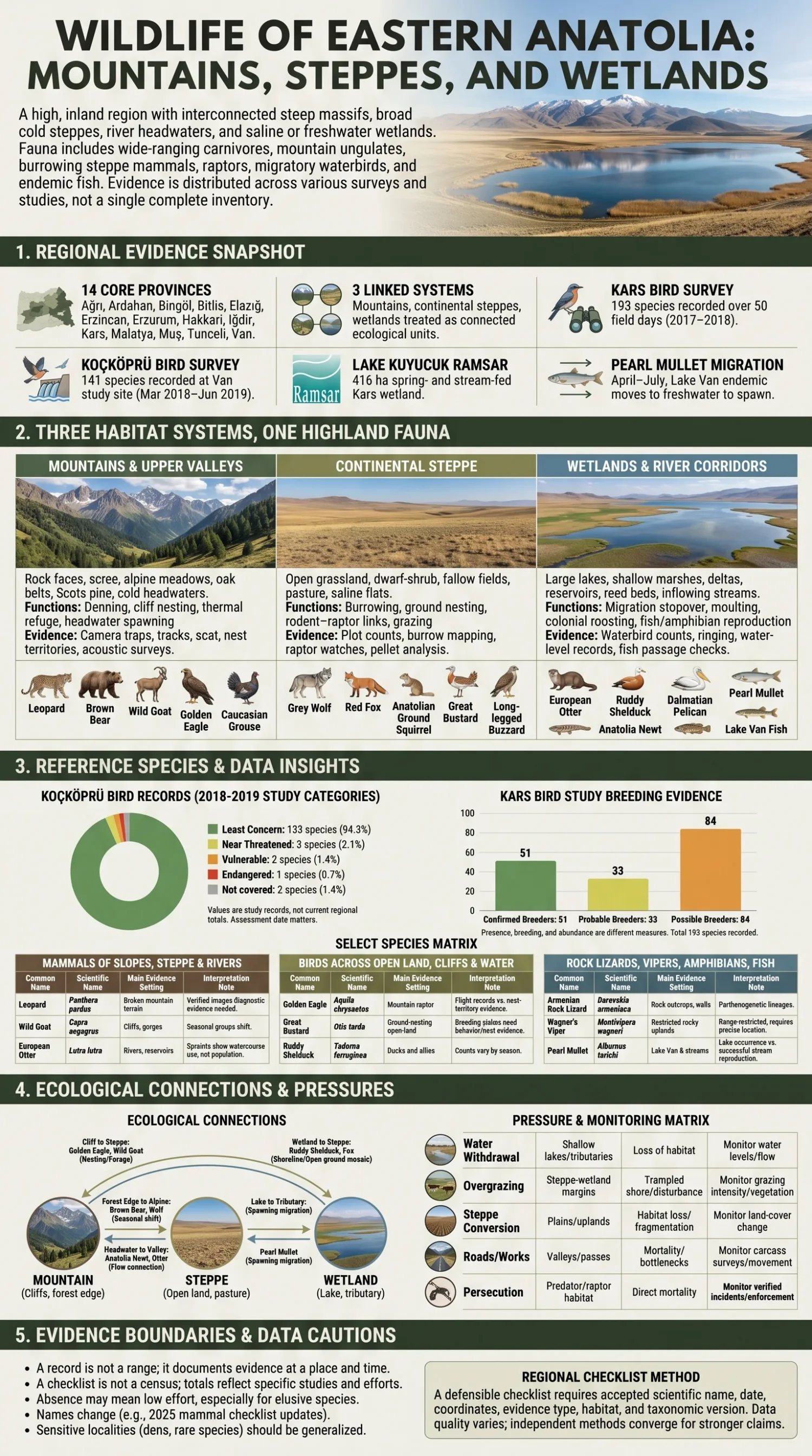
Eastern Anatolia supports mountain carnivores and ungulates, open-country mammals and birds, migratory waterbirds, rock-dwelling reptiles, stream-dependent amphibians and the Lake Van basin’s endemic pearl mullet. This fauna is shaped by the close contact between alpine ridges, rocky valleys, forest patches, high steppes, reservoirs, marshes and headwater streams. No checked source provides one complete official wildlife inventory for the entire region.
Eastern Anatolia Is a Connected Highland System
For this page, Eastern Anatolia is treated as a working geographic area centred on Ağrı, Ardahan, Bingöl, Bitlis, Elazığ, Erzincan, Erzurum, Hakkâri, Iğdır, Kars, Malatya, Muş, Tunceli and Van. Wildlife does not follow these administrative borders. Mountain chains continue into neighbouring regions and countries, river basins cross provincial lines, and migratory birds may use several wetlands during one season.
Türkiye’s national biodiversity strategy identifies the Hınzır, Tahtalı, Munzur, Palandöken, Allahüekber and Aras mountains among the major systems of central and eastern Anatolia. It also describes broad alpine and subalpine meadows in northern and northeastern Eastern Anatolia, steppe across much of the region, isolated high-mountain lakes and the volcanic landscapes of Ağrı, Tendürek, Nemrut and Süphan. These landforms place dry grassland, rocky shelter, summer meadow and inland water habitats within the movement range of many animals.[a]
| Landscape unit | Physical setting | Wildlife function | Source-backed examples |
|---|---|---|---|
| Alpine and subalpine ridges | Exposed peaks, scree, cliffs, snowfields and short summer vegetation | Rock shelter, nesting ledges, seasonal forage and movement routes between high valleys | Wild goat, brown bear, golden eagle, bearded vulture and rock lizards |
| Forest patches and wooded valleys | Scots pine in the northeast, dry oak formations farther south and west, riparian trees and shrub cover | Winter refuge, denning terrain, concealment and links between mountain blocks | Brown bear, Eurasian lynx, grey wolf, wildcat, wild boar and Caucasian squirrel |
| Mountain steppe and plateau meadow | Cold grasslands, grazed slopes, fallow fields and herb-rich high plateaus | Burrowing habitat, raptor hunting grounds, breeding cover and seasonal feeding areas | Anatolian ground squirrel, European hare, chukar, grey partridge and long-legged buzzard |
| Lakes, marshes and reservoirs | Freshwater lakes, saline or alkaline basins, reed margins, shallow shores and artificial impoundments | Breeding, staging, moulting, passage and wintering habitat for waterbirds | Ruddy shelduck, black-necked grebe, common crane, Armenian gull and lesser white-fronted goose |
| Headwaters and tributaries | Cold streams, snowmelt channels, river valleys and freshwater inflows to closed lake basins | Spawning habitat, amphibian reproduction and riparian movement corridors | Pearl mullet, Anatolia newt, Eurasian otter and stream-associated invertebrates |
Rock, Forest and Snow Shape the Mountain Mammals
A 2026 study compiled field observations, earlier research and local survey information from 327 localities in Bingöl Province. Fieldwork covered 55 days between 2016 and 2018 and recorded 18 medium- and large-sized wild mammal species. Nine were reported as additions to the provincial inventory. Bingöl is only one part of Eastern Anatolia, but its mixture of mountains, dry steppe, shrubs, forest remnants, cliffs and streams provides a documented example of how several mammal communities overlap.[b]
| Order | Common name | Scientific name | Bingöl evidence |
|---|---|---|---|
| Carnivora | Grey wolf | Canis lupus | Included in the 2016–2018 provincial inventory |
| Golden jackal | Canis aureus | Reported as a new provincial inventory record | |
| Red fox | Vulpes vulpes | Included in the provincial inventory | |
| Beech marten | Martes foina | Included in the provincial inventory | |
| Least weasel | Mustela nivalis | Reported as a new provincial inventory record | |
| Wildcat | Felis silvestris | Included in the provincial inventory | |
| Eurasian lynx | Lynx lynx | Reported as a new provincial inventory record | |
| Eurasian otter | Lutra lutra | Reported as a new provincial inventory record | |
| Eurasian badger | Meles meles | Reported as a new provincial inventory record | |
| Brown bear | Ursus arctos | Included in the provincial inventory | |
| Cetartiodactyla | Wild boar | Sus scrofa | Included in the provincial inventory |
| Wild goat | Capra aegagrus | Included in the provincial inventory | |
| Rodentia | Indian crested porcupine | Hystrix indica | Reported as a new provincial inventory record |
| Caucasian squirrel | Sciurus anomalus | Reported as a new provincial inventory record | |
| Anatolian ground squirrel | Spermophilus xanthoprymnus | Reported as a new provincial inventory record | |
| Lagomorpha | European hare | Lepus europaeus | Included in the provincial inventory |
| Eulipotyphla | Southern white-breasted hedgehog | Erinaceus concolor | Included in the provincial inventory |
| Long-eared hedgehog | Hemiechinus auritus | Reported as a new provincial inventory record |
The 18-species Bingöl list is a provincial study result, not a checklist for all of Eastern Anatolia. Failure to detect a species during one survey does not prove regional absence.
Leopard Evidence Comes from Signs, Images and Localized Surveys
A northeastern Anatolia leopard study sampled 11 areas between 2013 and 2017, with focused work in and around Sarıçiçek Mountain, the Sansa Strait and Yedisu Valley. Researchers documented 58 observations between 1,176 and 3,050 metres: six camera-trap photographs, three thermal-camera images, three local sightings, 28 track sets, 13 scat samples, two ground scrapes and three tree scratches. Sparse forest, rocky terrain, pasture and agricultural mosaics featured strongly in the recorded habitat use. The study associated leopard habitat selection with prey including wild boar, wild goat, chamois and roe deer.[c]
Leopard Signs Are Not a Population Count
The 58 observations represent several forms of direct and indirect evidence collected across selected study areas. They cannot be converted into 58 individual leopards or used as a population estimate for Eastern Anatolia.
Sarıkamış Bears Depend on Rocky Winter Shelter
GPS-based research in the Sarıkamış forest identified 43 brown bear winter dens and 12 day-beds. Eighty-three per cent of the winter dens were in rocky areas or cliffs; the remaining dens occurred in foothills, excavated ground, non-rocky sites or beneath tree roots. The result shows that forest cover alone does not describe bear winter habitat. Rocky cavities, slope form, low-disturbance resting places and routes between forest and open feeding areas are also part of the same habitat system.[d]
The Steppe Includes Burrows, Hunting Airspace and Breeding Ground
Eastern Anatolian steppe is not an empty surface between mountains and wetlands. Its grass cover, bare patches, stones, burrow systems, seasonal pools, field margins and low shrubs create different feeding and shelter conditions. An assessment of the wider Anatolian biogeographic region identified 1,130 taxa living mainly in steppe and classified as threatened, near threatened or data deficient at national or global scale. That figure covers the wider Anatolian region and must not be presented as an Eastern Anatolia species total.[e]
Below ground, Anatolian ground squirrels and other small mammals use burrows for shelter, reproduction and winter dormancy. Above ground, seeds, shoots and invertebrates support partridges, larks and other open-country birds. Raptors use the same plains and slopes as hunting areas. Pasture, fallow land, natural grassland and wet meadow therefore cannot be treated as interchangeable surfaces: vegetation height, grazing intensity, soil depth and proximity to water alter which animals can use them.
A 50-day Kars survey conducted during the 2017 and 2018 migration and breeding periods recorded 193 bird species. The study assigned breeding evidence codes rather than assuming that every observed bird bred locally. The selected records below show how wetland, steppe, cliff and wooded habitats occur within one provincial bird community.[f]
| Species | Scientific name | Habitat connection in Kars | Breeding evidence reported by the survey |
|---|---|---|---|
| Ruddy shelduck | Tadorna ferruginea | Open water, wet grassland and shore margins | Confirmed |
| Black-necked grebe | Podiceps nigricollis | Shallow lakes and vegetated wetland edges | Confirmed |
| Chukar | Alectoris chukar | Rocky steppe and dry slopes | Confirmed |
| Grey partridge | Perdix perdix | Open grassland, fields and meadow mosaics | Confirmed |
| Bearded vulture | Gypaetus barbatus | Mountain cliffs and wide-ranging upland foraging areas | Possible |
| Egyptian vulture | Neophron percnopterus | Cliffs, open country and livestock landscapes | Probable |
| Cinereous vulture | Aegypius monachus | Wooded uplands linked to open feeding ground | Confirmed |
| Golden eagle | Aquila chrysaetos | Mountain nesting terrain and open hunting ground | Probable |
| Long-legged buzzard | Buteo rufinus | Steppe, pasture and cultivated open land | Confirmed |
| Common crane | Grus grus | Wet meadow, marsh and open agricultural areas | Probable |
| Black-winged stilt | Himantopus himantopus | Shallow water and exposed wetland margins | Possible |
| Armenian gull | Larus armenicus | Lakes, islands, shorelines and nearby open ground | Confirmed |
| Black-bellied sandgrouse | Pterocles orientalis | Dry open steppe with access to drinking water | Probable |
| Lesser kestrel | Falco naumanni | Open feeding habitat near nesting structures or rock sites | Confirmed |
| Red-billed chough | Pyrrhocorax pyrrhocorax | Cliffs, upland pasture and rocky feeding ground | Confirmed |
These breeding classifications apply to the Kars survey period and provincial study area. They do not establish the same breeding status in every Eastern Anatolian province.
Wetlands Form a Seasonal Network Across the Plateau
Eastern Anatolia contains natural lakes, marshes, reedbeds, reservoir shores, flooded meadows and saline or alkaline basins. Their wildlife value changes through the year. A lake may hold breeding grebes and gulls in summer, passage shorebirds during migration and ducks or geese in winter. Counts from separate studies cannot be added because each survey used a different boundary, field period and level of effort.
In Elazığ, observations from October 2016 to May 2018 produced a list of 181 bird species: 61 residents, 81 summer visitors, 20 winter visitors and 19 passage migrants. The study linked provincial bird diversity closely to wetlands and examined birds using those areas for breeding or stopover.[g]
At Koçköprü Dam near Erciş in Van Province, fieldwork from March 2018 to June 2019 recorded 141 species. The study classified seven as winter visitors, 28 as passage migrants, 42 as residents and 64 as summer visitors. It reported that 94 resident or summer-visiting species reproduced in or around the reservoir study area.[h]
| Site or survey area | Documented scope | Reported result | Boundary of the evidence |
|---|---|---|---|
| Kars Province | Fifty field days during migration and breeding periods in 2017–2018 | 193 bird species; confirmed, probable and possible breeding evidence recorded separately | A provincial survey, not a count for all northeastern Anatolia |
| Elazığ Province | Observations from October 2016 to May 2018 | 181 bird species divided into resident, summer, winter and passage categories | Results depend on the wetlands and terrestrial sites covered during the study |
| Koçköprü Dam | Reservoir and surrounding habitats surveyed from March 2018 to June 2019 | 141 bird species, with 94 resident or summer-visiting species reported as reproducing locally | A reservoir study rather than a Van Province checklist |
| Lake Kuyucuk | Ramsar Site No. 1890 in Kars | Official Ramsar area of 416 hectares[i] | The Ramsar boundary does not include every surrounding feeding or movement area used by birds |
| Lake Erçek and Lake Haçlı | Filtered citizen-science records used to assess lesser white-fronted goose wintering distribution | Erçek identified as a regular wintering site; Haçlı as a potential regular site | Record density reflects observer coverage as well as bird presence |
| Lake Van and its inflowing streams | Closed alkaline lake basin connected to freshwater spawning tributaries | Adult pearl mullet live in the lake and enter tributaries during the reproductive season | Lake habitat and successful spawning habitat are not the same ecological unit |
Erçek and Haçlı Hold Different Levels of Goose Evidence
A 2025 assessment of citizen-science records for the lesser white-fronted goose, Anser erythropus, found confirmed observations at 26 Turkish wetlands. Within Eastern Anatolia, Lake Erçek was identified as the only regular wintering site in the dataset, while Lake Haçlı was treated as a potential regular site. A flock of 1,234 birds was reported at Haçlı in 2021, but the authors stated that monitoring remained insufficient to classify the lake as a regular wintering area. One large observation therefore does not establish repeated annual use.[j]
Lake Van’s Pearl Mullet Reproduces Outside the Lake
The pearl mullet, Alburnus tarichi, is restricted to the Lake Van basin and is adapted to the lake’s saline, highly alkaline water. Reproduction depends on a contrasting habitat. From April to July, adults migrate in schools into freshwater tributaries, spawn and return to the lake. The species therefore links the open lake to river mouths, stream channels and upstream spawning reaches. A barrier, altered discharge or degraded tributary can affect reproduction even when the main lake remains present.[k]
Reptiles, Amphibians and Insects Reveal a Less Complete Inventory
Regional wildlife accounts often give most attention to large mammals and birds, although localized surveys show that Eastern Anatolia also contains varied reptile, amphibian and insect communities. These groups are more easily missed because many species are seasonal, small, difficult to identify or restricted to particular rocks, soils and streams.
Four herpetological excursions covering 20 field days across Van Province in 2014 produced an inventory of six amphibians and 31 reptiles. The study included two salamanders, four frogs or toads, two turtles, 15 lizards and 14 snakes. It reported the first provincial records of Salamandra infraimmaculata, Heremites auratus, Dolichophis jugularis, Eirenis modestus and Telescopus fallax, together with the first published print record of Stellagama stellio for Van.[l]
A separate 2020 study reported four adult red-bellied lizards collected in 2016 at Çayırlı Village in Erzincan. The locality was described as the westernmost Turkish record then known for Darevskia parvula sensu lato. The “sensu lato” wording matters because the taxonomic limits within this rock-lizard group have been examined through morphological and molecular research.[m]
Fieldwork conducted between 2005 and 2017 added 32 localities for the Anatolia newt, Neurergus strauchii, across southern and eastern Anatolia. Such locality additions show why an older range outline may contain gaps: absence of a published point can reflect limited survey coverage rather than unsuitable habitat.[n]
Invertebrate work remains still more fragmented. Sampling in Elazığ, Erzincan, Malatya and Tunceli during 2007 and 2008 identified 17 species of Agathidinae parasitoid wasps. Agathis tatarica and Bassus tegularis were reported from Türkiye for the first time. A short regional animal list that omits invertebrates therefore describes only a small part of the fauna.[o]
| Taxon or survey | Source-based evidence | Habitat or research meaning |
|---|---|---|
| Van amphibians | Six species in the 2014 provincial inventory | Freshwater, moist terrestrial refuges and breeding sites must be considered alongside the dry regional climate |
| Van reptiles | Thirty-one species in the same survey | Rock, steppe, shrubland, wetland edge and agricultural habitats support different assemblages |
| Darevskia parvula sensu lato | Four adults from Çayırlı, Erzincan, reported as a westward locality extension | Rock-lizard distribution and taxonomy require locality-level evidence |
| Neurergus strauchii | Thirty-two added localities from fieldwork conducted in 2005–2017 | Stream and spring surveys can fill apparent gaps between known populations |
| Agathidinae parasitoid wasps | Seventeen species from four Eastern Anatolian provinces | Invertebrate inventories can add national records even after vertebrate fauna is relatively well known |
Habitat Damage Crosses the Mountain–Steppe–Wetland Boundaries
The region’s habitat types are connected, so pressure in one part of the landscape can affect animals using another. A raptor nesting on a cliff may feed over pasture. A bear denning in rocky forest may cross open land to forage. A goose using a lake at night may feed in nearby fields. Pearl mullet living in Lake Van must reach freshwater streams to reproduce.
| Pressure | Habitat connection affected | Wildlife evidence that should be monitored |
|---|---|---|
| Roads and new infrastructure | Forest–cliff, valley and mountain movement routes | Changes in mammal crossings, den disturbance, camera-trap detections and mortality records |
| Heavy grazing and steppe conversion | Natural grass cover, burrow systems, wet meadow margins and ground-nesting areas | Vegetation height, burrow occupancy, breeding territories and replacement of native steppe by fields |
| Wetland drainage or unstable water levels | Shallow feeding zones, islands, reed edges and exposed nesting areas | Seasonal bird counts, nest survival, shore exposure and the timing of water-level change |
| Tributary barriers and reduced stream flow | Lake Van–river spawning connection | Pearl mullet migration passage, spawning reach access and freshwater discharge during April–July |
| Pollution | Streams, reservoir margins, marshes and riparian food webs | Water quality, amphibian breeding sites, fish mortality and otter prey availability |
| Illegal killing and poisoning | Raptor feeding grounds, goose wintering sites and large-mammal ranges | Carcass examinations, poisoning incidents, shooting records and repeated loss at known sites |
| Disturbance at cliffs and dens | Breeding ledges, caves and rocky winter refuges | Nest occupancy, den reuse, abandonment and seasonal human activity near shelter sites |
A Regional Total Cannot Be Built by Adding Province Surveys
Kars’s 193 bird species, Elazığ’s 181 and Koçköprü Dam’s 141 are overlapping survey results rather than three separate sets. Many widespread birds appear in more than one study. Each project also used different dates, seasons, survey areas and breeding criteria. The same rule applies to mammals, reptiles, amphibians and insects.
The 2025 national mammal checklist reports 177 wild mammal species for Türkiye, comprising 165 terrestrial and 12 marine species. It does not provide a verified Eastern Anatolia total. Provincial mammal inventories can document local occurrence, but they cannot be subtracted from or added to the national list to create a reliable regional number.[p]
The Working Species Evidence Has Uneven Coverage
Birds and medium-sized mammals have received more field attention at several named sites than bats, small rodents, freshwater invertebrates and many insect groups. Recorded occurrences document reported evidence; they do not show complete distribution or prove absence from unsurveyed habitat.
Sources and Verification
- [a] The National Biological Diversity Strategy and Action Plan — Used for Eastern Anatolia’s mountain systems, alpine and subalpine meadows, steppe extent, volcanic mountains and inland-water context.
- [b] Effectiveness of Protected Areas in Conserving Mammalian Wildlife Diversity: A Case Study from Türkiye — Used for the 2016–2018 Bingöl mammal survey, its 18 recorded species, field coverage and additions to the provincial inventory.
- [c] Habitat preference by the Anatolian leopard in North-eastern Anatolia, Turkey — Used for leopard survey areas, altitude range, evidence types, habitat associations and reported prey relationships.
- [d] Brown bear denning habits in northeastern Türkiye — Used for the Sarıkamış winter-den and day-bed records and the proportion of dens located in rocky or cliff habitat.
- [e] An overview of biodiversity and conservation status of steppes of the Anatolian Biogeographical Region — Used for the wider Anatolian assessment of steppe-associated taxa and the warning that its totals are broader than Eastern Anatolia.
- [f] Breeding and passage migrant bird species in Kars province — Used for the 193-species Kars survey, field period, breeding-evidence categories and selected habitat-linked bird records.
- [g] Avifauna and Important Bird Areas of Elazığ Province — Used for the 181-species Elazığ inventory and its resident, summer, winter and passage classifications.
- [h] Ornithofauna of Koçköprü Dam, Erciş, Van — Used for the reservoir’s 141 recorded bird species, seasonal-use classes and locally reproducing resident or summer-visiting species.
- [i] Lake Kuyucuk Ramsar Site Information Service record — Used for the wetland’s Ramsar designation, site number, Kars location and official 416-hectare area.
- [j] Evaluating the Wintering Distribution of the Lesser White-fronted Goose in Türkiye Using Citizen Science Data — Used for the distinct evidence levels at Lake Erçek and Lake Haçlı and the 2021 Haçlı flock record.
- [k] Endemic Value of Lake Van: Pearl Mullet — Used for Alburnus tarichi, its Lake Van basin restriction and its April–July migration into freshwater tributaries.
- [l] Herpetofaunal inventory of Van Province, eastern Anatolia, Turkey — Used for the six amphibians, 31 reptiles, survey duration and first provincial or published records reported from Van.
- [m] New Locality Record of the Red-Bellied Lizard from eastern Anatolia, Turkey — Used for the Çayırlı, Erzincan locality, four collected adults and the sensu lato taxonomic wording.
- [n] Some new records of Anatolia Newt from Eastern Anatolia, Turkey — Used for the 32 added Neurergus strauchii localities documented from 2005–2017 fieldwork.
- [o] Contributions to the knowledge of Agathidinae fauna of the Eastern Anatolia Region of Turkey — Used for the 17 parasitoid-wasp species and two first records for Türkiye from four Eastern Anatolian provinces.
- [p] An updated checklist of the mammals of Türkiye — Used for the 2025 national total of 177 wild mammals and to separate a national checklist from unverified regional totals.
Related Topics
- → Wildlife of the Mediterranean Coast of Turkey
- → Wildlife of the Black Sea Region of Turkey
- → Fauna of Turkey: Wildlife, Habitats, and Regional Diversity
- → Endemic Animals of Turkey: Species Found Nowhere Else
- → Migratory Birds in Turkey: Major Flyways and Seasonal Patterns
- → Mountain Mammals of Turkey: Species of High Elevation Habitats