Complete guides: Mammals of Turkey•Regional Fauna Guides
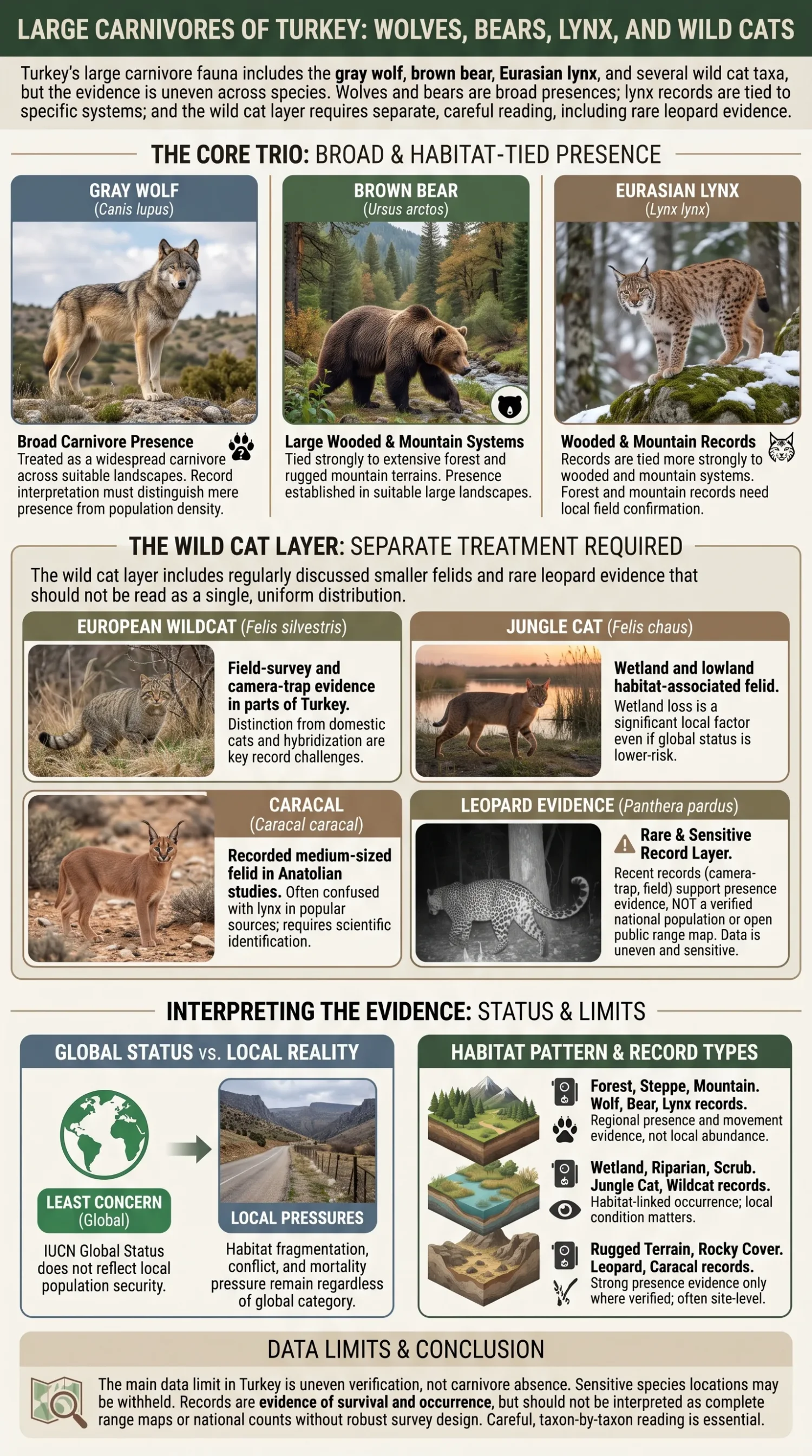
Turkey’s current national mammal checklist supports seven native species within the four groups named in this title: gray wolf, brown bear, Eurasian lynx, leopard, caracal, jungle cat, and European wildcat. They belong to three families and differ sharply in body size, habitat use, detectability, and the amount of field evidence available from Turkey. The same checklist also reports the striped hyena and golden jackal as native carnivores, but they fall outside the title’s wolf, bear, lynx, and wild-cat scope. [a]
“Large carnivore” is an ecological and management label rather than a taxonomic rank. A national checklist record confirms that a species belongs to the country’s documented fauna; it does not establish uniform distribution, local abundance, or a secure population in every region.
Seven Native Species Behind the Title
The wolf is a canid, the brown bear is an ursid, and the remaining five species are felids. The table uses species-level names from the 2025 national checklist. Global categories describe the species across its assessed range and must not be treated as Turkish national assessments.
| Common name | Accepted scientific name | Family | Habitat and evidence pattern in Turkey | Global IUCN category |
|---|---|---|---|---|
| Gray wolf | Canis lupus | Canidae | Recorded across forest, mountain, steppe, pastoral, and agricultural mosaics. Research coverage is wider than for the wild cats, but national abundance remains poorly resolved. | Least Concern [b] |
| Brown bear | Ursus arctos | Ursidae | Most closely associated with extensive forested and mountainous landscapes, especially in northern and eastern Turkey, while also using human-modified food landscapes. | Least Concern [c] |
| Eurasian lynx | Lynx lynx | Felidae | Documented in several separated Anatolian population areas. Turkish research links the species with rocky terrain, open woodland, conifer mosaics, and lagomorph prey. | Least Concern [d] |
| Leopard | Panthera pardus | Felidae | Supported by sparse and geographically localized records from eastern, northeastern, and Mediterranean Turkey. Available evidence does not define a continuous national range. | Vulnerable [e] |
| Caracal | Caracal caracal | Felidae | Best documented in dry southwestern landscapes containing Mediterranean scrub, rocky slopes, open woodland, and low-intensity rural land. | Least Concern [f] |
| Jungle cat | Felis chaus | Felidae | Closely tied to wetlands, reedbeds, riparian vegetation, lake margins, and nearby agricultural mosaics. Turkish studies are concentrated in a limited number of wetland systems. | Least Concern [g] |
| European wildcat | Felis silvestris | Felidae | Recorded mainly in forested northern landscapes. Identification can be complicated by resemblance to domestic cats and possible genetic introgression. | Least Concern [h] |
Wolf and Brown Bear Records Cover Broad but Uneven Landscapes
Gray wolves and brown bears have a broader documented presence in Turkey than the four non-lynx wild cats. A national review of bear and wild-canid evidence found both species across major Turkish ecosystems, while also reporting that precise distributions, population sizes, and trends remained uncertain because monitoring was not uniform. The review linked both species with recurring conflict around livestock, apiaries, crops, and other human-used resources. [i]
Gray Wolves Use Forest, Steppe, and Pastoral Mosaics
The gray wolf is the only wolf species accepted in the current Turkish mammal checklist. It can move through forested mountains, open steppe, cultivated country, grazing land, and the edges of settlements. This ecological flexibility helps explain why wolf evidence is geographically widespread, but it also places wolves in landscapes where domestic animals and wild prey occur together.
Records from separate provinces should not be converted into a national abundance estimate. Camera traps, tracks, genetic samples, carcasses, interviews, and livestock-loss reports measure different things. Some confirm presence at a place and time; others document human–wildlife interaction rather than the number of wolves occupying an area.
The name “Anatolian wolf” is sometimes used informally for wolves in Turkey, while older publications may assign regional subspecies. A country-level reference page is more stable when it uses the accepted species name Canis lupus unless a cited genetic or taxonomic study is discussing a narrower lineage.
Brown Bears Depend on Large Forested and Mountain Systems
Brown bears are most strongly associated with northern and eastern mountain systems where forests, alpine vegetation, shrublands, streams, and seasonal food resources occur in connected landscapes. They can also enter orchards, agricultural fields, refuse sites, settlements, and apiary areas. Such visits document access to food; they do not by themselves show that bear numbers are rising.
Bear detections may be concentrated near roads, villages, feeding sites, or camera stations because those places are easier to survey. Remote forest interiors can remain poorly sampled. A map based only on accessible observations may therefore exaggerate use of human-dominated sites while leaving gaps in less accessible habitat.
Eurasian Lynx Evidence Points to Separated Anatolian Populations
A genetic and spatial study of the Caucasian lynx, the regional form commonly identified as Lynx lynx dinniki in research literature, monitored a 396-square-kilometre area in northwestern Anatolia. Researchers collected 171 faecal samples and information from 12 captured individuals while examining 11 lynx territories. Their wider synthesis identified three broad population areas in Turkey: northwestern, southern, and northeastern Anatolia. The authors reported that the Central Anatolian Plateau, large rivers, reservoirs, settlements, and other landscape barriers may reduce movement between these areas. [j]
Eleven Territories Are Not a National Lynx Total
The territory count belongs to one monitored landscape in northwestern Anatolia. It cannot be multiplied across Turkey or presented as a national population estimate. The three reported population areas are broad research units rather than proof that every suitable habitat patch inside them is occupied.
Anatolian Lynx Ecology Differs from the Forest-Only Stereotype
Eurasian lynx are often described simply as forest cats. Turkish evidence shows a more varied pattern. Lynx use conifer stands and wooded mountain terrain, but they are also recorded in dry, open, rocky landscapes. In much of Anatolia, hares and other lagomorphs can be more relevant prey than the forest ungulates associated with northern European lynx populations.
This prey relationship means that apparently open terrain should not automatically be classified as unsuitable. Habitat assessments need to consider prey availability, rocky cover, resting sites, human disturbance, roads, and connections between breeding territories rather than tree cover alone.
Leopard Records Support Presence, Not a Continuous Turkish Range
The leopard is the rarest and least evenly documented species in this group. The 2025 national checklist accepts Panthera pardus as native, and peer-reviewed camera-trap evidence has confirmed living leopards in eastern Turkey. These records overturn claims that the species had certainly vanished from the country, but they do not supply a national population count or show an uninterrupted distribution. [k]
A separate study reported photographs and videos from Mediterranean Turkey between 2019 and 2020. The paper used the name Anatolian leopard and the subspecific form Panthera pardus tulliana. Together with eastern records, this provides evidence from more than one Turkish region, yet the sampling sites remain separated by large areas without equivalent survey coverage. [l]
A Leopard Photograph Is Not a Population Estimate
A verified photograph can establish that at least one leopard was present at the recorded location and time. Repeated photographs may still depict the same individual. Estimating abundance requires individual identification, defined survey effort, suitable spatial models, and enough detections to support the calculation.
Species Name and Regional Leopard Names
“Anatolian leopard,” “Persian leopard,” and “Caucasian leopard” have been used for regional leopard populations in and around Anatolia, Iran, and the Caucasus. Turkish field papers may retain P. p. tulliana, while the national checklist records the species as Panthera pardus. Using the species-level name avoids turning a regional label into an unsupported claim about the subspecific identity of every Turkish record.
Three Smaller Wild Cats Occupy Different Ecological Niches
Caracals, jungle cats, and European wildcats are much smaller than leopards and do not use the same landscapes in the same way. Treating them as a single generic “wild cat” group conceals the contrast between dry Mediterranean scrub, reed-fringed wetlands, and northern forest mosaics.
Caracal Evidence Is Strongest in Southwestern Drylands
A field study on the Datça and Bozburun peninsulas examined caracal status and activity in southwestern Turkey. That regional evidence places the species in dry Mediterranean landscapes containing scrub, rocky terrain, open woodland, rural fields, and relatively low settlement density. It supports a southwestern population but should not be expanded into an exact national range without equivalent surveys elsewhere. [m]
Caracals can be confused with domestic cats only at poor image quality or extreme distance because their long legs, short tail, reddish coat, and dark ear tufts are distinctive in clear photographs. The larger problem is low detection: a small number of camera-trap images may reflect wide-ranging behaviour, low survey effort, or genuinely low local density.
Jungle Cats Are Closely Linked to Wetland Vegetation
Despite its English name, the jungle cat is not a tropical-forest specialist. In Turkey it is associated with reedbeds, marsh edges, riparian vegetation, lake margins, drainage channels, and agricultural fields near water. A study conducted around Lake Eğirdir between 2002 and 2008 examined its local biology, distribution, population, behaviour, diet, and conservation problems. The findings document one wetland population rather than a current national estimate. [o]
Wetland alteration affects the jungle cat differently from the forest fragmentation that concerns bears and wildcats. Reed removal, shoreline construction, drainage, water diversion, pollution, traffic, and intensive land use can remove cover even when open water remains visible. A lake should not be counted as suitable jungle-cat habitat solely because water is present.
European Wildcats Are Difficult to Confirm from Appearance Alone
Camera trapping in northern Turkey has provided evidence for the European wildcat in forest landscapes. Typical field marks include a broad head, thick ringed tail with a blunt black tip, a dark dorsal stripe that stops before the tail, and a coat pattern less irregular than that of many domestic tabbies. Even clear photographs cannot establish genetic ancestry, and animals with intermediate features require cautious classification. [n]
The Felis Boundary Across Anatolia Remains Unsettled
The 2025 Turkish checklist accepts the European wildcat, Felis silvestris. The IUCN SSC Cat Specialist Group notes that the western boundary of the Afro-Asiatic wildcat, Felis lybica, is uncertain around Iran, the Caucasus, and Turkey, where coat patterns may overlap. The specialist account describes Turkish occurrence of F. lybica as possible rather than settled. It is therefore not appropriate to add a second wildcat species to the verified Turkish list solely from photographs. [q]
Domestic-cat introgression creates another layer of uncertainty. A cat can display a wild-type coat while carrying domestic ancestry, or show atypical markings without being a recent hybrid. Genetic material from hair, tissue, faeces, or saliva is more informative than coat pattern when taxonomic identity is central to the research question.
Regional Evidence Does Not Form a Single Carnivore Map
Turkey’s carnivore studies vary in target species, survey duration, equipment, season, geographic scale, and research question. A wolf questionnaire survey cannot be combined directly with a leopard camera-trap record, a lynx genetic sample, or a wetland jungle-cat study. Each source documents a different type of evidence.
| Evidence type | What it can support | What it cannot establish alone |
|---|---|---|
| Verified camera-trap image | Presence of a photographed species at a known station and date | National range, total population, or population trend |
| Track, scat, or hair record | Presence when identification is supported by morphology or genetics | Individual identity when no diagnostic genetic profile is available |
| Genetic sample | Species identity, sex, relatedness, or individual identity when laboratory quality is adequate | Complete local abundance without a structured sampling design |
| Interview or conflict report | Locations requiring field verification and patterns of human–carnivore interaction | Confirmed species presence when misidentification has not been excluded |
| Carcass or specimen | Physical evidence of occurrence, mortality, and potentially genetic identity | Continued occupation of the locality after the recorded event |
| Habitat model | Areas predicted to have environmental conditions associated with the species | Confirmed presence in every predicted cell |
Blank areas on a record map can represent unsuitable habitat, true absence, low detectability, restricted access, or lack of survey effort. Dense clusters may mark well-funded projects and accessible camera networks rather than the only places where a species occurs. These effects are especially strong for secretive felids.
Each Species Has a Different Conservation Pressure Point
The seven species share some pressures, including road development, settlement expansion, illegal killing, disturbance, and the loss of connected habitat. Their exposure is not identical, and a single national threat statement would hide the ecological differences.
- Gray wolf: livestock conflict, retaliatory killing, prey changes, road mortality, and barriers between breeding areas.
- Brown bear: forest fragmentation, road access, conflict around crops and apiaries, attractants near settlements, and direct killing.
- Eurasian lynx: separation of regional populations, road mortality, loss of prey-rich habitat, poaching, and barriers across open or developed landscapes.
- Leopard: sparse breeding evidence, low population connectivity, human-caused mortality, prey depletion, and disturbance in the few landscapes with verified records.
- Caracal: conversion of Mediterranean scrub, roads, persecution near poultry or small livestock, and weak monitoring outside known study areas.
- Jungle cat: wetland drainage, reedbed removal, water-management projects, pollution, traffic, trapping, and shoreline development.
- European wildcat: forest fragmentation, road mortality, hybridization with domestic cats, disease exchange, and uncertain identification from photographs.
These pressures should not be converted into unsupported claims that every Turkish population is declining. Demonstrating a trend requires repeated surveys with comparable effort, geographic coverage, and detection methods. A rise in reported observations can result from more cameras, greater public awareness, or easier image sharing rather than biological growth.
Global Red List Categories and Turkish Legal Rules Measure Different Things
The global IUCN categories in the species table apply to each species across its assessed range. A category of Least Concern does not mean that every Turkish population is large, connected, or free from local threats. The leopard’s global Vulnerable category likewise does not provide a verified Turkish population size or replace a national assessment.
Legal protection, hunting rules, damage procedures, international trade controls, and Red List assessment are separate systems. Turkey’s current hunting rules are set through the official 2026–2027 Central Hunting Commission decision and its attached schedules. The current decision should be checked directly when a question concerns whether a species may be hunted, the applicable season, restricted areas, or administrative conditions. [p]
For scientific reporting, the most defensible wording is scale-specific: a species can be native to Turkey, globally Least Concern, locally uncommon, poorly surveyed, legally protected, or affected by conflict at the same time. None of those labels automatically proves the others.
Sources and Verification
- [a] Sözen and Çolak, An updated checklist of the mammals of Türkiye — Used for the 2025 national mammal scope, accepted species-level names, and native occurrence classification.
- [b] IUCN Red List assessment for the gray wolf — Used for the global conservation category of Canis lupus.
- [c] IUCN Red List assessment for the brown bear — Used for the global conservation category of Ursus arctos.
- [d] IUCN SSC Cat Specialist Group Eurasian lynx account — Used for the global category and range-wide status context of Lynx lynx.
- [e] IUCN Red List assessment for the leopard — Used for the global Vulnerable category of Panthera pardus.
- [f] IUCN SSC Cat Specialist Group caracal account — Used for the global category and ecological context of Caracal caracal.
- [g] IUCN SSC Cat Specialist Group jungle cat account — Used for the global category and wetland associations of Felis chaus.
- [h] IUCN SSC Cat Specialist Group European wildcat account — Used for the global category, information gaps, and domestic-cat hybridization context of Felis silvestris.
- [i] Ambarlı, Ertürk, and Soyumert, Current status, distribution, and conservation of brown bear and wild canids in Turkey — Used for national-scale wolf and bear records, monitoring gaps, and conflict context.
- [j] Mengüllüoğlu and colleagues, Non-invasive sampling and spatial organization of Caucasian lynx — Used for the northwestern study area, sample totals, territory evidence, broad Turkish population areas, and possible landscape barriers.
- [k] Karataş, Bulut, and Akbaba, Camera trap records confirm the survival of the Leopard in eastern Turkey — Used for verified modern leopard evidence from eastern Turkey.
- [l] Ünal and colleagues, New records of the living Anatolian leopard in Mediterranean Turkey — Used for photographed and filmed leopard records from the Mediterranean region and the regional use of P. p. tulliana.
- [m] İlemin and Gürkan, Status and activity patterns of the Caracal in southwestern Turkey — Used for localized caracal evidence from the Datça and Bozburun peninsulas.
- [n] Can, Kandemir, and Togan, The wildcat in northern Turkey — Used for camera-trap evidence and identification context in northern forest landscapes.
- [o] Oğurlu, Gündoğdu, and Yıldırım, Population status of jungle cat in Lake Eğirdir — Used for the 2002–2008 wetland study scope and local jungle-cat evidence.
- [p] Republic of Türkiye, 2026–2027 Central Hunting Commission Decision — Used as the current official reference point for national hunting seasons, species schedules, restrictions, and administrative rules.
- [q] IUCN SSC Cat Specialist Group Afro-Asiatic wildcat account — Used for the unresolved western boundary of Felis lybica and its possible overlap with F. silvestris around Anatolia and the Caucasus.
Related Topics
- → Mammals of Turkey: Native Species, Habitats, and Distribution
- → Mountain Mammals of Turkey: Species of High Elevation Habitats
- → Bats of Turkey: Diversity, Habitats, and Conservation
- → Wild Ungulates of Turkey: Deer, Goats, Sheep, and Wild Boar
- → Marine Mammals of Turkey: Dolphins, Porpoises, and Seals
- → Birds of Turkey: Native, Migratory, and Rare Species