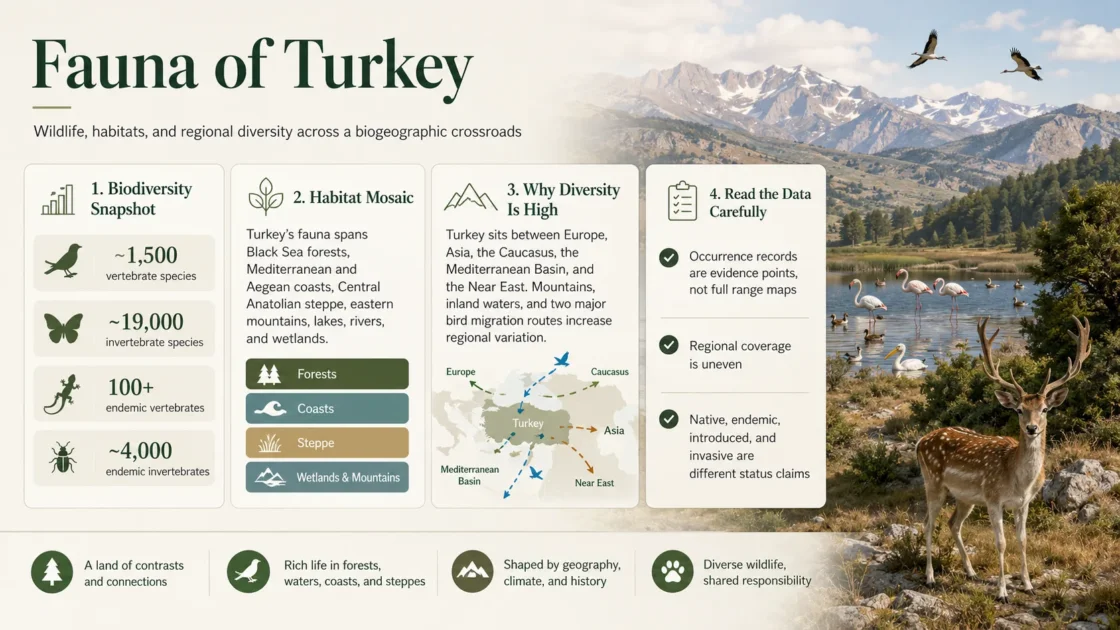
The fauna of Turkey reflects the meeting of European, Mediterranean, Caucasian, Middle Eastern and Central Asian biological communities. Forested mountains, interior steppe, high plateaus, river basins, saline lakes, coastal lagoons and four contrasting seas support more than 1,700 vertebrate species in one published national synthesis, together with a much larger and less completely inventoried invertebrate fauna.
Turkey, officially Türkiye, includes eastern Thrace in southeastern Europe and most of Anatolia in western Asia. Its fauna cannot be described by one species total without naming the source, publication date, taxonomic treatment and geographic scope. Some inventories include vagrant birds, introduced fishes or marine visitors; others restrict their counts to established native species. Taxonomic revisions and newly documented records continue to alter national lists.
Published Species Totals Are Not Interchangeable
A 2021 scholarly synthesis reported 1,728 vertebrate species: 894 fishes, 36 amphibians, 140 reptiles, 485 birds and 173 mammals. Its fish total combines lampreys, sharks, rays, chimaeras and ray-finned fishes, while avoiding double counting 38 species recorded in more than one aquatic environment.[a]
| Source and date | Reported scope | Published values | Reason the values differ |
| National vertebrate synthesis, 2021 | Species-level vertebrate checklist | 1,728 vertebrates: 894 fishes, 36 amphibians, 140 reptiles, 485 birds and 173 mammals | Uses a detailed taxonomic checklist and separates vertebrate classes. |
| Ministry project document, 2024 | Background biodiversity figures used in environmental planning | 460 birds, 161 mammals, 141 reptiles and amphibians, 480 marine fishes and 236 freshwater fishes | The document reproduces older national figures and combines amphibians with reptiles.[b] |
| CBD country profile | Broad national biodiversity summary | Nearly 1,500 vertebrates; about 19,000 identified invertebrates, including about 4,000 endemic species or subspecies | The profile is marked as draft and reflects an earlier inventory stage.[c] |
Why the National Total Changes
These values should not be added together. Marine and freshwater lists can overlap, bird totals may include rare visitors, and accepted scientific names can change after genetic or morphological studies. A defensible fauna total is therefore a dated checklist result rather than a permanent property of the country.
Three Biogeographic Regions Meet Across Anatolia and Thrace
Turkey contains the Euro-Siberian, Mediterranean and Irano-Turanian biogeographic regions, together with broad transition zones. Its national biodiversity strategy recognizes forest, mountain, steppe, wetland, coastal and marine ecosystems and the many local combinations formed where these systems meet.[d]
Biogeographic Regions
3
Euro-Siberian, Mediterranean and Irano-Turanian, with transition zones.
Published Vertebrate Baseline
1,728 species
Reported by the 2021 national vertebrate synthesis.
Endemic Vertebrates in the 2021 List
227 species
Mostly inland fishes, with amphibian, reptile and mammal endemics.
Internationally Listed Wetlands
14 Ramsar Sites
The current Ramsar country listing reports 14 designated sites.[e]
The three biological regions do not follow provincial or administrative boundaries. Humid Black Sea forests can change into dry interior woodland across a mountain ridge. Mediterranean scrub can meet alpine meadow within a short horizontal distance. Closed lake basins in Central Anatolia can contain isolated fish populations unrelated to fauna in a nearby river flowing toward the Black Sea or Mediterranean.
Regional Fauna from Thrace to the Upper Tigris
Turkey is commonly divided into seven geographic regions, but animal distributions are controlled more directly by elevation, climate, vegetation, drainage basin, soil, water chemistry and habitat continuity. The regions below describe broad assemblages rather than hard biological borders.
| Region | Main habitats | Characteristic fauna relationships | Selected species |
| Thrace and Marmara | Deciduous forest, agricultural mosaic, floodplain, coastal lagoon, strait and inland sea | European forest and wetland species mix with mobile carnivores and migratory waterbirds. The Bosphorus and Dardanelles connect marine basins and concentrate seasonal bird movement. | Golden jackal (Canis aureus), European otter (Lutra lutra), wild boar (Sus scrofa), Dalmatian pelican (Pelecanus crispus) |
| Black Sea and Pontic Mountains | Humid broadleaf forest, conifer forest, river valley, mountain meadow and rocky alpine ground | High rainfall supports forest-dependent mammals and amphibians. Eastern mountain habitats connect with Caucasian fauna. | Brown bear (Ursus arctos), Eurasian lynx (Lynx lynx), roe deer (Capreolus capreolus), Caucasian salamander (Mertensiella caucasica), Caucasian black grouse (Lyrurus mlokosiewiczi) |
| Central Anatolia | Dry steppe, salt lake, seasonal wetland, cereal farmland and isolated mountain | Open-country fauna depends on grassland structure, extensive farming, burrow systems and shallow wetland cycles. | Anatolian ground squirrel (Spermophilus xanthoprymnus), marbled polecat (Vormela peregusna), great bustard (Otis tarda), calandra lark (Melanocorypha calandra) |
| Aegean and Western Anatolia | Mediterranean scrub, pine and oak woodland, delta, river valley, rocky island and coastal cliff | Terrestrial Mediterranean fauna occurs beside major wetlands and marine breeding or resting habitat. | Caracal (Caracal caracal), wild goat (Capra aegagrus), spur-thighed tortoise (Testudo graeca), loggerhead turtle (Caretta caretta), Mediterranean monk seal (Monachus monachus) |
| Mediterranean Coast and Taurus Mountains | Coastal dune, lagoon, maquis, pine forest, karst, canyon, cedar forest and alpine zone | Sea-turtle nesting beaches occur below mountain systems containing forest, cliff and high-elevation specialists. Karst creates caves and isolated aquatic habitats. | Wild goat (Capra aegagrus), chukar (Alectoris chukar), Taurus frog (Rana holtzi), bearded vulture (Gypaetus barbatus) |
| Eastern Anatolia | High plateau, volcanic mountain, alpine grassland, large lake, marsh and river headwater | Cold winters and high relief favor wide-ranging carnivores, mountain ungulates and isolated freshwater fauna. | Gray wolf (Canis lupus), brown bear (Ursus arctos), Armenian mouflon (Ovis gmelini), Lake Van pearl mullet (Alburnus tarichi) |
| Southeastern Anatolia | Dry steppe, rocky hill, semi-desert, Euphrates and Tigris valleys, reservoir and irrigated plain | Middle Eastern dryland species occur beside river fauna and remnant steppe populations. Large dams and irrigation have altered many former river habitats. | Goitered gazelle (Gazella subgutturosa), striped hyena (Hyaena hyaena), Euphrates softshell turtle (Rafetus euphraticus), northern bald ibis (Geronticus eremita) |
Forest Fauna Changes Between the Black Sea and Mediterranean Mountains
Northern forests receive more moisture and retain a stronger Euro-Siberian character. Oriental beech, oak, hornbeam, fir, spruce and pine forests provide cover for brown bear, Eurasian lynx, gray wolf, red deer, roe deer, wild boar, pine marten and several forest bats. The eastern Pontic Mountains add Caucasian elements, including the Caucasian black grouse and Caucasian salamander.
Mediterranean and Aegean forests are generally warmer and more seasonal. Pine woodland, oak scrub, maquis, rocky slopes and karst support wild goat, caracal, golden jackal, stone marten, wild boar, tortoises, snakes, lizards and cliff-nesting raptors. Animal presence is rarely determined by tree cover alone. Forest age, understory density, dead wood, caves, water sources, grazing intensity and connection to nearby open habitats can alter the local community.
The same mammal may use forest for shelter, open ground for feeding and a river corridor for movement. Treating each habitat as an isolated unit can therefore hide the landscape connections needed by large carnivores and ungulates.
Mountain Elevation Creates Short-Distance Faunal Turnover
The Pontic and Taurus mountain systems create steep climatic gradients. Lower slopes may contain scrub or deciduous woodland, middle elevations may support conifer forest, and upper belts may shift to subalpine meadow, scree and exposed rock. Reptiles associated with warm rocky slopes can occur below cold-adapted amphibians and alpine birds within the same mountain system.
Cliffs and high ridges provide nesting or foraging habitat for golden eagle, bearded vulture, griffon vulture, peregrine falcon, alpine chough and wallcreeper. Mountain streams and seepages are especially important for narrowly distributed salamanders and frogs whose ranges may be limited to one mountain chain or drainage system.
Steppe Fauna Depends on More Than Treeless Ground
Central and eastern Anatolian steppe includes native grassland, saline plain, fallow field, pasture, dry cropland and low shrub communities. These habitats support burrowing rodents, small mustelids, reptiles, ground-nesting birds and wide-ranging predators. Anatolian ground squirrels modify soil and provide prey for raptors and carnivores. Their burrows can also be used by insects, reptiles and other small vertebrates.
Great bustard, little bustard, stone-curlew, calandra lark, short-toed lark, lesser kestrel and long-legged buzzard represent different parts of the open-country bird community. Some require broad grassland; others use traditional agricultural mosaics. A field that appears open may still be unsuitable when vegetation height, pesticide use, harvesting date, traffic, fencing or repeated disturbance removes feeding or nesting conditions.
Dry steppe continues into southeastern Anatolia, where goitered gazelle and striped hyena represent a stronger Middle Eastern faunal influence. Their surviving distribution is not continuous across every suitable-looking plain. Documented occurrence must be separated from habitat that only appears potentially suitable.
Wetlands Connect Resident Fauna with Continental Migration
Turkey lies within the Black Sea–Mediterranean migration system. BirdLife describes this flyway as supporting 316 migratory bird species across its full multinational extent.[f] Turkey’s position between breeding areas in Europe and western Asia and wintering areas farther south makes deltas, shallow lakes, salt marshes, reed beds, reservoirs and agricultural floodplains seasonally important.
The Kızılırmak Delta, Gediz Delta, Göksu Delta, Akyatan Lagoon, Lake Burdur, Lake Manyas, Lake Uluabat and Sultan Marshes are among the wetland systems used by waterbirds. Species composition changes through the year. Breeding herons and terns, passage shorebirds, wintering ducks and irregular visitors should not be merged into a single category of permanently resident birds.
| Species | Scientific name | Connection with Turkey | Global category used by the cited source |
| White-headed duck | Oxyura leucocephala | Breeds or winters in suitable shallow wetlands; presence and numbers vary by site and season. | Endangered[i] |
| Sociable lapwing | Vanellus gregarius | Passage migrant using steppe, pasture and agricultural landscapes, sometimes near wetlands. | Critically Endangered[j] |
| Great bustard | Otis tarda | Resident or locally mobile open-country bird with remnant breeding populations in Anatolian steppe and farmland. | Endangered[k] |
| Northern bald ibis | Geronticus eremita | Associated with the managed, free-flying breeding population at Birecik beside the Euphrates. | Endangered[l] |
Migration Records Are Seasonal Evidence
A bird recorded during spring or autumn passage belongs to Turkey’s documented avifauna, but that record does not establish breeding or year-round residence. National bird lists need separate codes for resident, breeding visitor, winter visitor, passage migrant and vagrant.
Freshwater Endemism Is the Strongest Vertebrate Pattern
The 2021 vertebrate synthesis identified 227 endemic vertebrate species. Inland fishes accounted for 189 of them, followed by 20 reptiles, 13 amphibians and five mammals. No bird species was treated as endemic to Turkey in that checklist. The concentration in fishes reflects the long isolation of lakes, springs and river basins.
Anatolian waters do not form one connected freshwater system. Rivers drain toward the Black Sea, Marmara, Aegean, Mediterranean, Persian Gulf or closed interior basins. Mountain uplift, changing lake levels, river capture and dry climatic periods have separated populations over evolutionary time. Fish in two nearby basins can therefore have different histories even where present-day climate and water appearance seem similar.
| Freshwater or wetland animal | Scientific name | Geographic association | Ecological point |
| Lake Van pearl mullet | Alburnus tarichi | Lake Van basin | Lives in the saline-soda lake but migrates into freshwater tributaries to reproduce. |
| Acıgöl killifish | Aphanius transgrediens | Acıgöl spring and wetland system | Represents the narrow ranges produced by isolated springs and closed basins. |
| Flathead trout | Salmo platycephalus | Upper Zamantı drainage | A stream fish associated with a limited headwater system rather than all Turkish mountain rivers. |
| Taurus frog | Rana holtzi | High-elevation Bolkar Mountain lakes | Shows how isolated alpine wetlands can support a narrowly distributed amphibian. |
| Anatolian mountain newt | Neurergus strauchii | Eastern Anatolian streams | Depends on clean flowing water and surrounding terrestrial shelter. |
| Euphrates softshell turtle | Rafetus euphraticus | Euphrates and Tigris river systems | A river specialist whose habitat crosses national borders and is altered by dams and channel modification. |
| European otter | Lutra lutra | Rivers, lakes, marshes and suitable coasts | Uses aquatic feeding habitat but also depends on vegetated banks, resting places and connected waterways. |
Freshwater-fish endemism also makes taxonomy central to conservation. Splitting one formerly widespread fish into several basin-restricted species can reveal that each lineage occupies a much smaller range than previously assumed. The reverse can occur when two named populations are later treated as one species. Checklist date and accepted taxonomic source must therefore accompany counts of endemic fishes.
Four Seas Create Different Marine Communities
The Black Sea, Sea of Marmara, Aegean Sea and Mediterranean Sea differ in salinity, temperature, depth, oxygen conditions and connection with neighboring waters. These differences prevent the phrase “marine fauna of Turkey” from describing one uniform community.
Black Sea and Marmara
The Black Sea has lower salinity than the Mediterranean and deep anoxic waters below its oxygenated surface layer. Its coastal fauna includes anchovy, turbot, gobies, sturgeons, harbor porpoise, short-beaked common dolphin and common bottlenose dolphin. River mouths, shallow shelves and migration corridors are more biologically active than the oxygen-poor deep basin.
The Sea of Marmara is a transition between the Black Sea and Aegean through the Bosphorus and Dardanelles. Its two-layer water structure and heavy maritime use create a setting in which species movement, pollution, fisheries and oxygen depletion interact.
Aegean and Mediterranean
The Aegean and Mediterranean coasts support rocky reefs, seagrass beds, sandy bottoms, submarine caves, coastal lagoons and nesting beaches. Mediterranean monk seal, loggerhead turtle, green turtle, dusky grouper, common dentex, moray eels, octopuses, sea urchins and many molluscs belong to different parts of this habitat mosaic.
The Mediterranean loggerhead turtle assessment illustrates why conservation scale matters. The Mediterranean subpopulation has been assessed separately from the global species and reported as Least Concern with an increasing trend, while nesting beaches and feeding areas still require local protection from development, disturbance, artificial lighting, fisheries interactions and marine debris.[n]
Mediterranean monk seal uses coastal waters and sheltered resting or pupping sites, often including sea caves. The IUCN status-change record for 2023 documents its reassessment from Endangered to Vulnerable at the global level. This improvement does not mean every local colony or coastal habitat is secure.[m]
Alien Marine Species Are Concentrated in Warmer Waters
The Suez Canal created a dispersal route between the Red Sea and Mediterranean. Species transported naturally through the canal or moved by ships, aquaculture and other pathways have become part of the recorded marine fauna. Their presence does not automatically make each species invasive. An alien species is considered invasive only when its establishment and spread cause documented ecological, economic or health effects.
Turkey’s introduced and invasive fauna should be checked against a versioned inventory rather than an undated web list. The GRIIS dataset for Turkey is designed as an expert-reviewed national checklist that can be updated as taxonomy, evidence and invasion status change.[h]
Invertebrates Form the Largest and Least Completely Inventoried Component
Mammals and birds receive more survey attention, but insects, arachnids, molluscs, crustaceans, annelids and other invertebrates contain most of Turkey’s animal diversity. The older CBD country profile estimated about 19,000 identified invertebrate species and subspecies, including about 4,000 endemics. The estimate should be treated as a historical national approximation rather than a current complete checklist.
Invertebrate diversity changes across soil, leaf litter, dead wood, cave, spring, river, lake, steppe, alpine meadow, dune, seagrass and deep-water habitats. A province-level insect survey cannot be extrapolated to the country, and a taxon recorded in a museum collection may have no recent field confirmation at the original locality.
Many invertebrates have small ranges because they disperse slowly or depend on one substrate, host plant, cave system, spring or soil type. Land snails, cave arthropods, freshwater molluscs and flightless insects can show local endemism at scales much smaller than those used for large mammals or migratory birds.
Native, Endemic, Introduced and Invasive Are Different Categories
| Term | Meaning in a national fauna inventory | What the term does not prove |
| Native | The species occurs within its natural range in Turkey without a human-mediated introduction establishing that presence. | Native status does not mean the species is common, secure or present in every region. |
| Endemic | The species’ accepted natural range is restricted to Turkey or to a geographic unit entirely within the country. | Endemism does not automatically indicate that the species is threatened. |
| Introduced or alien | Human activity moved the species beyond its natural range, intentionally or unintentionally. | An introduced species is not automatically invasive. |
| Invasive alien | An introduced species has established and spread with documented harmful effects. | A single escaped individual or isolated observation is not enough to establish invasion. |
| Vagrant | An animal, often a bird or marine species, appears outside its regular range without an established population. | A vagrant record does not show breeding, residence or stable distribution. |
| Reintroduced | A species has been deliberately returned or reinforced within part of its former range. | Reintroduced origin should not be confused with uninterrupted wild persistence. |
Occurrence Records Are Strongly Uneven Between Animal Groups
The GBIF country activity report generated in January 2026 listed 3,914,478 Animalia occurrence records available for Turkey. Birds accounted for most of these records, while mammals, amphibians, reptiles, fishes, molluscs and arachnids had far lower digital record totals.[g]
| Taxonomic group | GBIF-mediated occurrences listed in January 2026 | Coverage implication |
| Birds | 3,507,716 | High reporting volume reflects repeated observations, structured bird surveys and citizen-science activity. |
| Insects | 263,883 | Large record total but still low relative to the number of insect species and the country’s area. |
| Bony fishes | 31,560 | Records combine marine and inland contexts and cannot be treated as a basin-level checklist. |
| Molluscs | 27,868 | Coverage can be concentrated around surveyed coasts, wetlands, collections or research sites. |
| Reptiles | 18,815 | Spatial gaps may reflect survey effort, data publication and sensitive-record handling. |
| Mammals | 14,537 | Low detectability, broad home ranges and unpublished monitoring data reduce digital coverage. |
| Arachnids | 12,645 | The record count is small compared with the likely taxonomic and geographic diversity. |
| Amphibians | 5,925 | Records are often concentrated near accessible breeding waters and known research localities. |
Bird Records Dominate the Digital Evidence
The large difference between birds and other groups does not mean birds make up almost all Turkish fauna. It shows a difference in observation frequency, data-sharing systems, detectability and survey effort. Occurrence records document reported evidence, not complete distribution or population size.
Conservation Status Depends on Taxon, Scale and Assessment Year
A species may have one global IUCN category, another regional category and a different national legal status. A global Least Concern assessment does not guarantee that the Turkish population is stable. A globally threatened species may also be locally recovering at one managed site.
Assessment dates matter because categories can change after new population estimates, range data or threat analysis. Taxonomic change can also shift an assessment from a broad species to a newly recognized, smaller-range lineage.
| Species | Turkey-related habitat or occurrence | Conservation interpretation |
| Mediterranean monk seal (Monachus monachus) | Aegean and Mediterranean coastal waters, resting sites and pupping caves | Globally Vulnerable in the cited 2023 IUCN update; local habitat protection remains necessary. |
| Loggerhead turtle (Caretta caretta) | Mediterranean nesting beaches, coastal feeding areas and offshore waters | The Mediterranean subpopulation is assessed separately from other global populations. |
| Great bustard (Otis tarda) | Steppe and low-intensity agricultural mosaics | Global category does not replace field data on Turkey’s small and fragmented breeding populations. |
| White-headed duck (Oxyura leucocephala) | Shallow lakes, marshes and reed-fringed wetlands | Seasonal counts and breeding evidence are needed to distinguish wintering, passage and reproductive use. |
| Northern bald ibis (Geronticus eremita) | Birecik breeding station, surrounding fields and Euphrates landscape | The managed Turkish population should not be described as an uninterrupted wild migratory population. |
| Leopard (Panthera pardus) | Rare documented evidence from rugged and remote landscapes | Confirmed records support presence, but they do not establish a national population estimate or continuous range. |
Pressures Differ Between Forests, Steppe, Fresh Waters and Coasts
Habitat Conversion and Fragmentation
Settlement expansion, roads, intensive agriculture, quarrying, mining, energy infrastructure and other land-use changes can reduce habitat area or divide it into isolated patches. The effect depends on species ecology. A small reptile restricted to one rocky slope faces a different problem from a wolf that requires movement across a broad landscape.
Water Abstraction, Dams and Wetland Change
Freshwater fauna can be affected by altered flow, barriers, groundwater extraction, pollution, shoreline modification and introduced fishes. A dam may replace flowing habitat with reservoir habitat, block migration and change sediment, temperature and oxygen conditions. Closed-basin species face added risk because they cannot naturally recolonize from another drainage after local loss.
Agricultural Intensification
Conversion of mixed farmland and pasture into uniform production systems changes nesting cover, food supply and seasonal disturbance. Pesticide exposure can affect insects directly and reduce prey for birds, bats, reptiles and amphibians. Earlier harvesting can destroy nests or remove vegetation before young animals complete development.
Fisheries, Bycatch and Coastal Disturbance
Marine turtles, dolphins, porpoises, sharks, rays, seabirds and monk seals can interact with fishing gear. Coastal construction, vessel traffic, underwater noise, artificial lighting and entry into sensitive caves or nesting beaches affect different life stages. Local monitoring is needed because national presence alone does not reveal mortality rate or reproductive success.
Alien Species and Climate-Linked Range Change
Warmer marine conditions can support the establishment and northward spread of species entering from the Red Sea or other source regions. Terrestrial and freshwater invasions can follow trade, transport, aquaculture, ornamental releases and accidental escape. Turkey’s sixth national report records invasive-alien-species control, pathway management and national data systems as continuing policy needs.[o]
Climate change can also shift snow cover, stream temperature, wetland duration, drought frequency and marine temperature. Range expansion by one species and contraction by another should be established from repeated observations or population studies, not inferred from one unusual record.
A National Fauna Checklist Must Be Versioned
A reliable checklist for Turkey needs an accepted scientific name, taxonomic authority, higher classification, occurrence status, native or introduced status, endemism field, seasonal category where relevant, habitat evidence, geographic scope, record source and review date. Marine visitors, fossil taxa, domestic animals, escaped captives and doubtful historical records should be separated from established wild fauna.
Museum specimens, peer-reviewed surveys, national inventories, monitoring projects, verified photographs, acoustic records, environmental DNA and structured observation datasets can all contribute evidence. They do not have equal certainty or spatial precision. Sensitive localities may also be generalized or withheld to reduce collection, persecution or disturbance risk.
Turkey’s Ministry of Agriculture and Forestry reports continuing projects for steppe conservation and the management of invasive alien species in terrestrial, inland-water and marine environments.[p] Future national totals will change as these projects publish new records, older names are revised and under-sampled taxa receive wider survey coverage.
Sources and Verification
- [a] The Vertebrate Biodiversity of Turkey — Used for the 2021 vertebrate total, class-level counts and published endemic-vertebrate figures.
- [b] Türkiye Flood and Drought Management Project Environmental and Social Management Framework — Used to identify the vertebrate figures reproduced in a 2024 Ministry planning document.
- [c] Convention on Biological Diversity: Türkiye Country Profile — Used for the draft national estimates of vertebrate and invertebrate diversity and their stated limitations.
- [d] National Biological Diversity Strategy and Action Plan — Used for Turkey’s three biogeographic regions and its forest, mountain, steppe, wetland, coastal and marine ecosystem categories.
- [e] Ramsar Convention Contracting Parties: Türkiye — Used to verify the current national total of Ramsar Sites.
- [f] BirdLife Black Sea–Mediterranean Flyway Factsheet — Used for the flyway scope and its reported migratory-bird diversity.
- [g] GBIF Country Report: Türkiye, January 2026 — Used for Animalia and taxonomic-group occurrence-record totals available through GBIF.
- [h] Global Register of Introduced and Invasive Species: Turkey — Used for the scope and update model of the national introduced and invasive species checklist.
- [i] BirdLife Species Factsheet: White-headed Duck — Used for the cited global conservation category and breeding-range context.
- [j] BirdLife Species Factsheet: Sociable Lapwing — Used for the current global category and migratory status.
- [k] BirdLife Species Factsheet: Great Bustard — Used for the current global category and open-country habitat context.
- [l] BirdLife Species Factsheet: Northern Bald Ibis — Used for the global category, historical decline and range context.
- [m] IUCN Species Changing Red List Status, 2022–2023 — Used to verify the Mediterranean monk seal’s 2023 global category change.
- [n] IUCN Conservation of Marine Turtles in the Mediterranean Sea — Used for the regional assessment context of the Mediterranean loggerhead-turtle population.
- [o] CBD Sixth National Report: Turkey — Used for national invasive-alien-species objectives, pathway management and monitoring needs.
- [p] Nature Conservation Status Report: Türkiye 2022 — Used for Ministry-led steppe conservation and invasive-species management projects.