Complete guides: Fauna of Turkey•Regional Fauna Guides
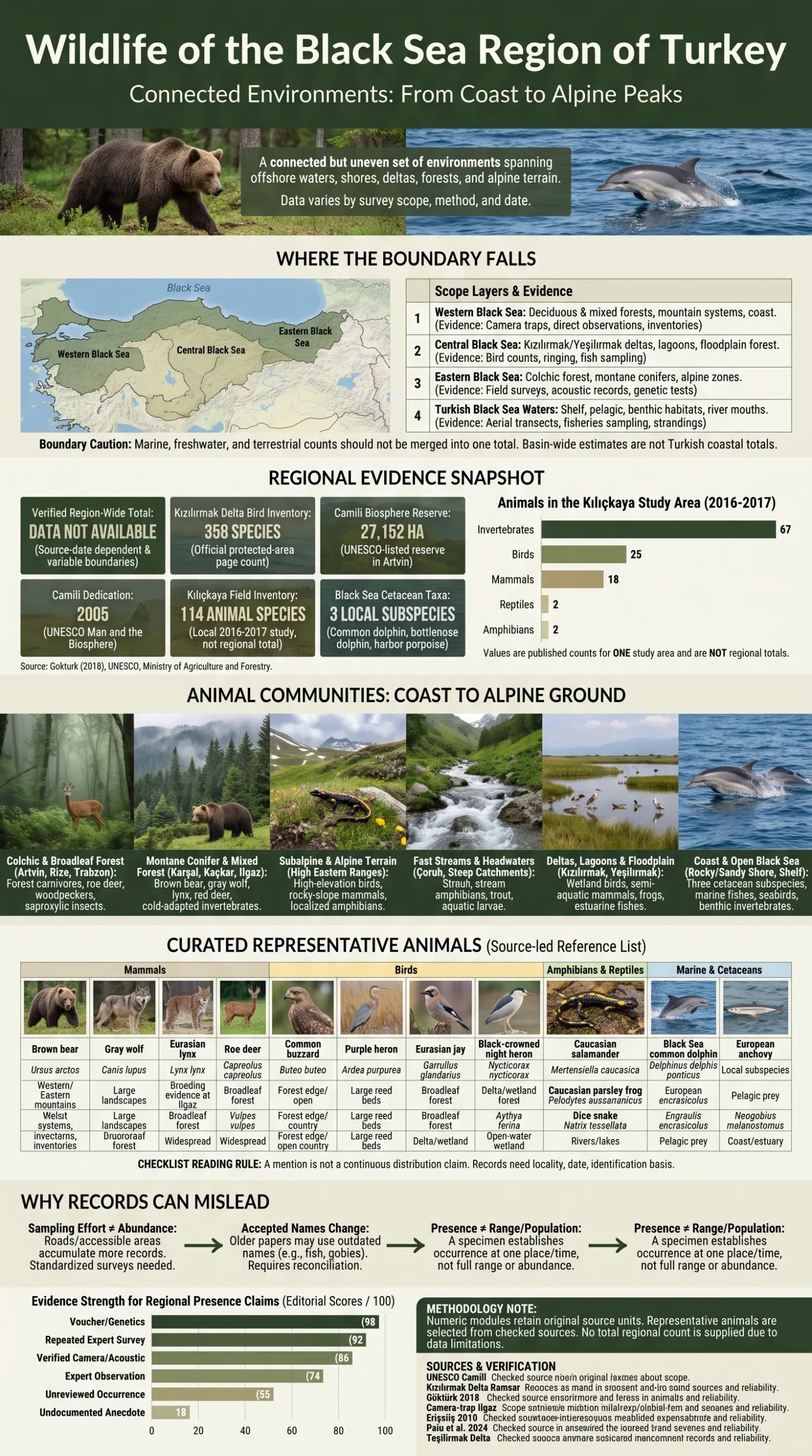
The wildlife of Turkey’s Black Sea Region belongs to a connected sequence of marine waters, coastal lagoons, river deltas, humid forests, deep valleys and high mountains. Brown bears, Eurasian lynx, roe deer and forest bats occur inland; large wetlands support breeding, migrating and wintering birds; separate river basins contain distinct fish communities; and the southern Black Sea supports three resident cetacean subspecies together with coastal, pelagic and bottom-dwelling fish.
There is no single verified species total for this entire area. The available evidence comes from protected-area records, province surveys, drainage-level fish studies, wetland inventories and marine monitoring programs with different boundaries and sampling methods. The figures below therefore describe their stated study areas rather than an additive total for northern Turkey.
Küre Mountains mammals
48 species
A national park record, not a total for the whole Black Sea Region. [b]
Ordu terrestrial vertebrates
219 species
A 2011–2015 survey and record compilation for the city and nearby habitats. [c]
A Faunal Region Extending from the Sea to Alpine Slopes
The Black Sea geographical region is broader than the immediate coastline. Its fauna includes animals in coastal waters, deltas and lagoons, north-flowing rivers, lowland agricultural mosaics, deciduous and mixed forests, rocky valleys, montane conifer stands and subalpine grasslands. Province boundaries do not always follow watersheds or ecological transitions, so a record from one province should not automatically be extended across the entire northern belt.
Rainfall, elevation and proximity to the Caucasus create a marked west-to-east change. Western ranges such as Küre, Yenice and Ilgaz retain large forest mammals. Central coastal plains contain the Kızılırmak and Yeşilırmak delta systems. Farther east, steep valleys rise quickly toward the Giresun, Rize and Artvin highlands, where Ponto-Caucasian reptiles, mountain birds and isolated freshwater fish populations become more prominent.
| Habitat system | Representative areas | Characteristic fauna | Main ecological connection |
|---|---|---|---|
| Western deciduous and mixed forests | Küre Mountains, Yenice forests, Ilgaz Mountains | Brown bear, Eurasian lynx, red deer, roe deer, grey wolf, wildcat, martens and forest bats | Continuous tree cover, rocky refuges, streams and low-disturbance interior habitat |
| Central deltas and lagoons | Kızılırmak Delta, Yeşilırmak Delta, Sarıkum and the Sinop coast | Grebes, herons, pelicans, ducks, rails, shorebirds, raptors, Eurasian otter and wetland fish | Feeding and resting habitat linking inland waters with Black Sea migration routes |
| Eastern humid valleys | Giresun, Trabzon, Rize and Artvin drainage systems | Brown bear, roe deer, Caucasian grouse, rock lizards, vipers, trout and stream invertebrates | Short elevational distances between coast, forest, mountain meadow and alpine terrain |
| Subalpine and alpine terrain | Kaçkar and adjoining eastern ranges | Caucasian grouse, montane reptiles, small mammals and high-elevation birds of prey | Treeline scrub, rocky slopes, snow-fed streams and seasonally productive meadows |
| Black Sea river networks | Filyos, Kızılırmak, Yeşilırmak, smaller coastal streams and Çoruh | Barbels, chubs, loaches, trout, shads, eel and historically river-migrating sturgeons | Movement between headwaters, lower channels, estuaries and marine feeding areas |
| Marine coast and continental shelf | Turkish southern Black Sea waters | Common dolphin, bottlenose dolphin, harbour porpoise, anchovy, sprat, turbot, whiting and gobies | Pelagic food webs, shallow benthic habitat, estuaries and seasonal fish movements |
Large Mammals Persist in the Northern Forest Belt
The western and central mountains contain some of the clearest official evidence for northern Turkey’s forest mammals. Ilgaz Mountain National Park records brown bear, red deer, roe deer, grey wolf, Eurasian lynx, red fox, wild boar, European hare, Caucasian squirrel and common pipistrelle. The same source also records common buzzard and lesser spotted eagle in the forest ecosystem. [e]
Yenice Wildlife Development Site adds golden jackal, wildcat, Eurasian otter, pine marten, stone marten, European badger, least weasel, dormice and lesser horseshoe bat. Its records show that the regional mammal community is not limited to conspicuous predators and ungulates; stream corridors, old trees, cavities, dead wood and dense understorey also support semi-aquatic mammals, bats and small nocturnal species. [f]
| Common name | Scientific name | Habitat association in the region | Regional evidence represented here |
|---|---|---|---|
| Brown bear | Ursus arctos | Large forest blocks, mountain valleys, forest edges and seasonal feeding areas | Küre, Yenice, Ilgaz, Sinop and eastern Black Sea records |
| Eurasian lynx | Lynx lynx | Wooded mountain landscapes with secluded cover and wild prey | Officially listed for Ilgaz Mountain National Park |
| Grey wolf | Canis lupus | Forests, upland pasture mosaics and connected mountain terrain | Repeated official records from western protected areas |
| Golden jackal | Canis aureus | Lower forest edges, river valleys, scrub and agricultural mosaics | Yenice, Sinop and Ordu records |
| Red fox | Vulpes vulpes | Forest edge, farmland, uplands and peri-urban habitat | Recorded across several western and central studies |
| European wildcat | Felis silvestris | Woodlands with dense cover, rocky refuges and low disturbance | Official Yenice and Küre records and the Ordu compilation |
| Red deer | Cervus elaphus | Large mixed forests, clearings and montane grazing areas | Küre, Yenice and Ilgaz records |
| Roe deer | Capreolus capreolus | Forest edges, young woodland, clearings and wooded farmland | Widespread in western and central protected-area records |
| Wild boar | Sus scrofa | Broadleaf forest, wet ground, scrub and cultivated land | Repeated throughout the checked regional sources |
| European hare | Lepus europaeus | Open woodland, field margins, pasture and upland grassland | Yenice, Ilgaz, Sinop and Ordu records |
| Caucasian squirrel | Sciurus anomalus | Broadleaf and mixed woodland | Ilgaz and Ordu records |
| Eurasian otter | Lutra lutra | Rivers, streams, lakes, lagoons and wooded banks | Yenice, Küre, Sinop and Ordu records |
| Pine marten | Martes martes | Mature forest and wooded mountain habitat | Yenice and Ordu records |
| Stone marten | Martes foina | Rocky ground, forest edge, villages and agricultural mosaics | Yenice, Sinop and Ordu records |
| European badger | Meles meles | Woodland edges, sloping farmland and ground suitable for setts | Yenice and Sinop records |
| Least weasel | Mustela nivalis | Grassland, farmland, scrub and forest-edge small-mammal habitat | Yenice, Sinop and Ordu records |
| Northern white-breasted hedgehog | Erinaceus concolor | Lowland woodland edge, gardens, fields and scrub | Yenice, Sinop and Ordu records |
| Hazel dormouse | Muscardinus avellanarius | Shrubby woodland, hazel growth and connected canopy edges | Yenice, Sinop and Ordu records |
| Lesser horseshoe bat | Rhinolophus hipposideros | Caves, buildings and sheltered roosts near woodland feeding habitat | Yenice and Ordu records |
| Common pipistrelle | Pipistrellus pipistrellus | Forest edges, river corridors, settlements and parkland | Ilgaz and Ordu records |
Protected-area lists confirm presence within their own boundaries. They do not establish equal abundance, continuous distribution or current population trend across the Black Sea Region.
Deltas and Lagoons Hold the Region’s Largest Bird Concentrations
The central coastline widens into alluvial plains and wetland complexes that differ sharply from the steep eastern shore. The 21,700-hectare Kızılırmak Delta Ramsar Area contains lagoons, reedbeds, wet meadows, flooded woodland, dunes, river channels and agricultural ground. It was designated as a Ramsar site in 1998. [g]
The delta’s official figure of 358 recorded bird species and 140 breeding species covers birds accumulated across seasons and years. It includes residents, summer breeders, winter visitors, passage migrants and occasional records. It should not be interpreted as 358 species simultaneously occupying the wetland or breeding there.
Farther west, the official Sinop-Bozburun Wildlife Development Site reports 149 bird species and names a mixture of divers, grebes, cormorants, bitterns and ducks. Its mammal list also includes Eurasian otter, roe deer, wild boar, wolf, jackal, martens and cetaceans recorded in the adjoining coastal setting. [h]
Source-Recorded Wetland and Coastal Birds
The following working list combines species named by the Sinop protected-area record with the broader Ordu survey. It illustrates the variety of waterbirds documented along the coast but is not the full 358-species Kızılırmak checklist.
| Common name | Scientific name | Regional habitat use |
|---|---|---|
| Red-throated loon | Gavia stellata | Marine inshore waters and sheltered wintering areas |
| Little grebe | Tachybaptus ruficollis | Small lakes, lagoons, reed-fringed pools and slow water |
| Great crested grebe | Podiceps cristatus | Larger lakes, lagoons and sheltered coastal water |
| Red-necked grebe | Podiceps grisegena | Mainly coastal and open-water winter habitat |
| Black-necked grebe | Podiceps nigricollis | Lagoons, lakes and coastal waters outside the breeding season |
| Great cormorant | Phalacrocorax carbo | Sea coast, estuaries, river mouths and larger inland waters |
| Pygmy cormorant | Microcarbo pygmaeus | Shallow wetlands, reedbeds and fish-rich lagoons |
| Eurasian bittern | Botaurus stellaris | Extensive reedbeds and flooded marsh vegetation |
| Little bittern | Ixobrychus minutus | Dense reed margins and vegetated freshwater channels |
| Black-crowned night heron | Nycticorax nycticorax | Wooded wetland margins, marshes and shallow feeding water |
| Squacco heron | Ardeola ralloides | Shallow marshes, wet meadows and reed edges |
| Cattle egret | Bubulcus ibis | Wet pasture, grazing areas and shallow marsh margins |
| Grey heron | Ardea cinerea | Rivers, lagoons, fish ponds, marshes and coast |
| Purple heron | Ardea purpurea | Large reedbeds and quiet shallow wetlands |
| Great egret | Ardea alba | Open shallows, wet grassland and lagoon margins |
| Little egret | Egretta garzetta | Shallow coastal water, river mouths and freshwater marshes |
| Glossy ibis | Plegadis falcinellus | Muddy shallows, flooded fields and wet meadows |
| Eurasian spoonbill | Platalea leucorodia | Shallow lagoons and broad wetland feeding areas |
| Great white pelican | Pelecanus onocrotalus | Large wetlands, river mouths and coastal passage habitat |
| Dalmatian pelican | Pelecanus crispus | Lagoons, lakes and fish-rich shallow waters |
| Mute swan | Cygnus olor | Lagoons, lakes and sheltered coastal water |
| Whooper swan | Cygnus cygnus | Wintering lakes, flooded plains and sheltered shallows |
| Greater white-fronted goose | Anser albifrons | Wintering fields, wet grassland and shallow wetlands |
| Ruddy shelduck | Tadorna ferruginea | Open wetlands, riverbanks and surrounding agricultural ground |
| Common shelduck | Tadorna tadorna | Brackish lagoons, mudflats and estuarine shore |
| Eurasian wigeon | Mareca penelope | Wintering lagoons, shallow lakes and wet grassland |
| Mallard | Anas platyrhynchos | Freshwater, brackish lagoons, channels and flooded fields |
| Northern shoveler | Spatula clypeata | Shallow plankton-rich water and open marsh pools |
| Northern pintail | Anas acuta | Open shallow wetlands during migration and winter |
| Garganey | Spatula querquedula | Shallow vegetated wetlands, mainly during passage and breeding season |
| Eurasian teal | Anas crecca | Shallow lagoons, marsh pools and sheltered channels |
| Red-crested pochard | Netta rufina | Open lakes and lagoons with submerged vegetation |
| Common pochard | Aythya ferina | Deeper lakes and lagoon basins |
| Ferruginous duck | Aythya nyroca | Vegetated freshwater pools, reedbeds and quiet marsh water |
| Tufted duck | Aythya fuligula | Open freshwater and sheltered coastal winter habitat |
| Common goldeneye | Bucephala clangula | Coastal and larger inland waters in winter |
| Smew | Mergellus albellus | Uncommon winter record on sheltered open water |
| Red-breasted merganser | Mergus serrator | Marine bays, river mouths and coastal winter habitat |
| Osprey | Pandion haliaetus | Fish-rich lakes, rivers and coastal migration habitat |
| Western marsh harrier | Circus aeruginosus | Reedbeds, marshes and wet agricultural plains |
| Water rail | Rallus aquaticus | Dense wetland vegetation and reed-fringed channels |
| Corn crake | Crex crex | Wet grassland and seasonally flooded meadow |
| Western swamphen | Porphyrio porphyrio | Large reedbeds and marsh vegetation |
| Eurasian coot | Fulica atra | Lakes, lagoons and open water beside reed cover |
| Common crane | Grus grus | Migration stopovers, wet plains and shallow marshes |
The Eastern Mountains Carry a Strong Caucasian Faunal Signal
Eastern Black Sea valleys rise from near sea level to montane forest and high grassland over short horizontal distances. This gradient allows lowland, forest, Ponto-Caucasian and alpine-associated animals to occur within adjoining elevation bands. Distribution is still uneven: steep terrain, seasonal snow and limited survey coverage leave some mountain areas less thoroughly inventoried than accessible valleys and protected sites.
Caucasian Grouse at the Upper Forest Edge
The Caucasian grouse, Lyrurus mlokosiewiczi, is one of the clearest bird links between northeastern Turkey and the wider Caucasus. BirdLife International currently classifies the species as Near Threatened. It is associated with mountain landscapes around the upper forest boundary rather than the low coastal plain. [i]
The National Action Plan Uses an Older Genus
Turkey’s species action plan presents the bird as Tetrao mlokosiewiczi. Current BirdLife treatment places it in Lyrurus. The two names refer to the same Caucasian grouse taxon in these sources, not two separate grouse species. The action plan documents its conservation focus in the Eastern Black Sea mountains. [j]
Small-Site Surveys Reveal the Missing Invertebrate Share
A survey around Kılıçkaya in Yusufeli recorded 114 animal taxa: 18 mammals, 25 birds, two reptiles, two amphibians and 67 invertebrates. The figure belongs to one study area and three field seasons in 2016–2017, but its composition demonstrates why a regional account based only on bears, deer and birds would omit much of the recorded fauna. Invertebrate totals are especially sensitive to sampling season, trap type and the specialists involved. [k]
Ordu’s Reptiles Mark the Transition Between Anatolia and the Caucasus
A province-wide Ordu field survey conducted from October 2016 to October 2018 compiled 165 occurrence records representing 15 reptile species in eight families. Six were lizards, seven were snakes and two were a tortoise or freshwater turtle. The records extended from coastal hills to montane forests and elevations above 2,000 metres within the province.
The table reproduces the full species set reported by that survey. Conservation categories are shown as reported in the paper and should be read with the study’s assessment date and taxonomic treatment in mind. The survey reported Darevskia clarkorum as Endangered, Testudo graeca as Vulnerable, and Emys orbicularis and Vipera meridionalis as Near Threatened. [l]
| Group | Scientific name | Status reported by the study | Occurrence context in Ordu |
|---|---|---|---|
| Rock lizard | Darevskia rudis | Least Concern | The most frequently encountered species, with 65 locality records across coastal hills and highland forests |
| Rock lizard | Darevskia clarkorum | Endangered | Recorded at two eastern localities; treated as a narrowly distributed Colchic endemic |
| Green lizard | Lacerta viridis | Least Concern | Recorded from 35 localities and several habitat types |
| Dwarf lizard | Parvilacerta parva | Least Concern | Two inland observation points in the survey |
| Slow worm | Anguis colchica | Not Evaluated in the paper | Sixteen locality records, often associated with humid ground and vegetation cover |
| Snake-eyed skink | Ablepharus chernovi | Least Concern | A single survey observation point |
| Grass snake | Natrix natrix | Least Concern | Recorded near freshwater and moist terrestrial habitat |
| Dice snake | Natrix tessellata | Least Concern | Thirteen locality records associated with aquatic habitat |
| Smooth snake | Coronella austriaca | Least Concern | Six observation points in the province |
| Caspian whipsnake | Dolichophis caspius | Least Concern | Two survey localities |
| Aesculapian snake | Zamenis longissimus | Least Concern | Two survey localities in wooded or vegetated terrain |
| Viper | Vipera meridionalis | Near Threatened | Three locality records under the taxonomic treatment used by the source |
| Common European adder | Vipera berus | Least Concern | Two records representing a restricted Anatolian occurrence |
| Spur-thighed tortoise | Testudo graeca | Vulnerable | Two lowland observation points; also listed in CITES Appendix II by the study |
| European pond turtle | Emys orbicularis | Near Threatened | Two freshwater-associated records |
The Ordu inventory is complete for the species accepted by that survey, not for every reptile that may occur elsewhere in Turkey’s Black Sea Region. Additional eastern and western provinces require their own locality-based treatment.
Each Black Sea River Basin Has Its Own Fish Community
The northern river system is not one continuous freshwater habitat. Coastal streams, the Filyos drainage, Kızılırmak, Yeşilırmak and Çoruh differ in channel size, gradient, temperature, geological history and connection to neighbouring basins. A study of the Anatolian midwestern Black Sea basin recorded 27 fish species in 18 genera and nine families. Its coastal-stream, Filyos and Kızılırmak samples formed three distinguishable groups based on species composition, with the Kızılırmak sample containing the highest richness in that study. [m]
A current national freshwater checklist provides basin-level distribution and taxonomic comments for species associated with Black Sea drainages. The entries below focus on fishes that illustrate endemism, estuarine use or movement between rivers and the sea. They are not a full list of every fish in every northern drainage. [n]
| Fish | Scientific name used here | Black Sea regional relationship | Evidence or caution |
|---|---|---|---|
| European eel | Anguilla anguilla | Uses coastal waters and connected inland waters; adults migrate to sea to reproduce | Reported as Critically Endangered in the 2026 Turkish freshwater checklist |
| Russian sturgeon | Acipenser gueldenstaedtii | Marine and brackish waters with historical river migration | Reported as Critically Endangered; current Turkish river occurrence should not be assumed from historical records |
| Beluga sturgeon | Huso huso | A very large anadromous sturgeon historically linked to Black Sea rivers | Reported as Critically Endangered; dams and loss of river access affect the migratory life cycle |
| Stellate sturgeon | Acipenser stellatus | Marine feeding habitat and historical spawning migration into large rivers | Reported as Critically Endangered |
| Persian sturgeon | Acipenser persicus | Associated in the checklist with the southeastern Black Sea basin and marine or brackish water | Reported as Critically Endangered; its relationship with proposed Black Sea forms remains taxonomically debated |
| Ship sturgeon | Acipenser nudiventris | Historically included in the Black Sea drainage fauna | The national checklist reports no occurrence in recent decades and considers it probably extirpated from the stated scope |
| European sturgeon | Acipenser sturio | Historical anadromous member of the Black Sea river fauna | The national checklist reports an absence of recent records and treats it as apparently extirpated from the stated scope |
| Çoruh trout | Salmo coruhensis | Eastern Black Sea drainage fish with migratory populations using river and marine habitat | Taxonomic literature separates it from other trout formerly grouped under broader Black Sea trout names |
| Rize trout | Salmo rizeensis | Upper sections of cold, fast-flowing eastern Black Sea streams | A resident mountain-stream form rather than a general name for every trout in the region |
| Anatolian barbel | Barbus anatolicus | Native to the Kızılırmak and Yeşilırmak systems | Treated as endemic to those drainage systems by the current checklist |
| Colchic barbel | Barbus rionicus | Çoruh drainage and adjoining Caucasian basin context | Its presence belongs to the eastern drainage rather than all Turkish Black Sea rivers |
| Crimean barbel | Barbus tauricus | Reported from Anatolian rivers flowing to the Black Sea | Drainage-specific records are still preferable to a coast-wide distribution assumption |
| Colchic nase | Chondrostoma colchicum | Eastern Black Sea river systems | A Ponto-Caucasian freshwater element tied to suitable flowing-water habitat |
| Black Sea roach | Rutilus frisii | Lower rivers, estuaries and connected Black Sea waters | Movement and habitat use vary among populations and river systems |
| Pontic shad | Alosa immaculata | Marine fish that migrates into rivers for reproduction | Requires an open route between coastal feeding grounds and spawning habitat |
| Black Sea pipefish | Syngnathus nigrolineatus | Coastal, estuarine and lower-river habitats | Demonstrates the overlap between marine, brackish and freshwater records |
River Barriers Break a Sea-to-Headwater Life Cycle
Sturgeons, migratory trout, shads and European eel depend on movement through more than one aquatic zone. A review of Turkey’s diadromous fish identifies dams, hydropower structures, weirs, channel modification, gravel extraction, pollution, water abstraction, habitat loss and overfishing among the pressures that interrupt river integrity. A species may remain present in marine water while losing access to former spawning habitat, so a coastal record alone does not confirm a functioning river population. [o]
Sturgeon Genera Differ Between Current Sources
The 2026 Turkish freshwater checklist applies Sterletus to several sturgeons traditionally placed in Acipenser or Huso. WoRMS continues to present Acipenser gueldenstaedtii as an accepted name and retains the established marine register treatment. This page uses the widely recognised Acipenser and Huso combinations while preserving the distribution and conservation comments of the Turkish checklist. [p]
Marine Wildlife of Turkey’s Southern Black Sea Coast
The marine fauna is shaped by coastal shallows, river plumes, sandy and rocky bottom habitat, the continental shelf and seasonally moving fish schools. It must be separated from the fauna of freshwater reaches even where the same species uses an estuary or lower river.
Three Resident Black Sea Cetaceans
Three cetacean species inhabit the Black Sea, each represented by a locally recognised subspecies: the Black Sea common dolphin, Black Sea bottlenose dolphin and Black Sea harbour porpoise. Basin-wide surveys document all three, but survey detections and abundance estimates for the whole Black Sea should not be presented as population totals for Turkish waters alone. [q]
| Common name | Scientific name | Main feeding and habitat relationship | Record caution |
|---|---|---|---|
| Black Sea common dolphin | Delphinus delphis ponticus | Pelagic and coastal waters associated with schooling fish | Mobile animals may cross national marine boundaries; sightings do not define a closed local population |
| Black Sea bottlenose dolphin | Tursiops truncatus ponticus | Coastal and shelf waters, including areas with demersal and migratory fish | Distribution varies with prey, season and survey coverage |
| Black Sea harbour porpoise | Phocoena phocoena relicta | Coastal and shelf habitat; frequently documented in Black Sea survey and bycatch work | Small body size and brief surfacing make detection sensitive to survey conditions |
The Revised Marine Goby Checklist
Published estimates for Black Sea gobies differed because some lists mixed basin-wide records, freshwater species and unverified Turkish marine occurrences. A 2024 review retained 16 species for Turkey’s marine Black Sea waters after excluding questionable or freshwater-only records. The table gives the full accepted set in that review.
| Scientific name | Evidence in the revised Turkish marine list | Habitat or taxonomic note |
|---|---|---|
| Aphia minuta | Retained | A small pelagic goby rather than a bottom-bound coastal form |
| Gobius cobitis | Retained | Associated with shallow rocky habitat |
| Gobius cruentatus | Retained | Rocky and structurally complex coastal bottom habitat |
| Gobius niger | Retained | Coastal and shelf-bottom habitats |
| Gobius paganellus | Retained | Shallow rocky shore habitat |
| Gobius xanthocephalus | Added through verified Turkish records | Yellow-headed goby recorded from the southern Black Sea coast |
| Mesogobius batrachocephalus | Retained | A large Ponto-Caspian goby of coastal bottom habitat |
| Neogobius melanostomus | Retained | Round goby; uses marine, brackish and connected lower-water habitats |
| Pomatoschistus marmoratus | Retained | Shallow sandy and brackish coastal habitat |
| Pomatoschistus microps | Retained | Very shallow coastal and estuarine habitat |
| Pomatoschistus minutus | Retained | Sandy coastal bottom habitat |
| Ponticola platyrostris | Retained | Ponto-Caspian coastal goby |
| Ponticola ratan | Retained | Bottom-associated Black Sea goby |
| Ponticola syrman | Retained | Coastal, estuarine and brackish habitat |
| Zebrus zebrus | Retained | Small cryptic goby associated with sheltered structure |
| Zosterisessor ophiocephalus | Listed by the study under Gobius ophiocephalus | WoRMS accepts Zosterisessor ophiocephalus as the current combination. [r] |
Fish of Coastal, Pelagic and Shelf Habitats
A Black Sea monitoring guideline separates representative fish according to coastal, pelagic and demersal survey settings. The resulting list includes commercially important schooling fish, rays and sharks, benthic predators, pipefish, seahorses, wrasses and flatfish. These are monitoring targets and representative records rather than a complete inventory of Turkish Black Sea fishes. [s]
| Common name | Scientific name | Marine zone represented |
|---|---|---|
| European anchovy | Engraulis encrasicolus | Pelagic schooling fish and major prey resource |
| European sprat | Sprattus sprattus | Pelagic shelf waters |
| European pilchard | Sardina pilchardus | Pelagic and coastal schooling habitat |
| Mediterranean horse mackerel | Trachurus mediterraneus | Pelagic and shelf waters |
| Bluefish | Pomatomus saltatrix | Mobile coastal and pelagic predator |
| Whiting | Merlangius merlangus | Demersal continental-shelf habitat |
| Red mullet | Mullus barbatus | Sandy and muddy shelf bottom |
| Turbot | Scophthalmus maximus | Demersal sandy-bottom habitat |
| European flounder | Platichthys flesus | Coastal, estuarine and lower-river habitat |
| Common sole | Solea solea | Soft-bottom coastal habitat |
| Thornback ray | Raja clavata | Demersal shelf habitat |
| Spiny dogfish | Squalus acanthias | Shelf and deeper demersal waters |
| Common stingray | Dasyatis pastinaca | Coastal and shelf-bottom habitat |
| Tub gurnard | Chelidonichthys lucerna | Demersal sandy and mixed bottom |
| Black scorpionfish | Scorpaena porcus | Rocky coastal bottom |
| Greater weever | Trachinus draco | Sandy coastal and shelf bottom |
| Stargazer | Uranoscopus scaber | Burrowing demersal habitat |
| Greater pipefish | Syngnathus acus | Vegetated and structurally complex coastal habitat |
| Long-snouted seahorse | Hippocampus guttulatus | Shallow vegetated or structured coastal habitat |
| Short-snouted seahorse | Hippocampus hippocampus | Coastal bottom habitat with shelter and attachment surfaces |
The Main Pressures Operate Across Habitat Boundaries
Forest mammals depend on connected cover rather than isolated protected patches. Wetland birds depend on water depth, reedbeds, open shallows, wet grassland and undisturbed feeding areas. Migratory fishes need passable rivers from the estuary toward spawning habitat. Cetaceans depend on prey availability and face entanglement risk in fishing gear. These links mean that a species can remain recorded in a region while losing part of the habitat required for feeding, reproduction or seasonal movement.
For Black Sea harbour porpoises, ACCOBAMS identifies fisheries bycatch as the most serious documented threat and reports basin-wide bycatch above probable sustainable levels. The report concerns the Black Sea population and fisheries across several countries; it should not be converted into an unsupported mortality estimate for Turkey alone. [t]
| Ecological connection | Animals affected | Pressure documented by the checked sources | Why a presence record is insufficient |
|---|---|---|---|
| Continuous forest and quiet refuges | Brown bear, Eurasian lynx, red deer, wildcat, martens and forest bats | Habitat fragmentation, disturbance and loss of mature woodland features | A record does not show whether breeding, shelter and movement habitat remain connected |
| Wetland water regime | Herons, ducks, rails, pelicans, amphibians, fish and Eurasian otter | Drainage change, pollution, shoreline alteration and disturbance | A bird sighting may represent temporary passage rather than a stable breeding population |
| River continuity | Sturgeons, shads, migratory trout and European eel | Dams, hydropower works, weirs, channel alteration and water abstraction | Marine survival does not prove access to former spawning reaches |
| Clean, structured stream habitat | Endemic barbels, trout, loaches and aquatic invertebrates | Pollution, sediment change, extraction and altered flow | A historical locality may no longer retain the conditions associated with the original record |
| Marine prey and safe movement | Common dolphin, bottlenose dolphin and harbour porpoise | Bycatch, prey depletion, disturbance and marine pollution | Mobile cetaceans can be detected in an area without forming a closed local population |
Why the Region Has No Defensible Single Species Total
The available figures measure different things. Kızılırmak’s 358 birds are accumulated records for one delta. Küre’s 48 mammals belong to one national park. The Ordu total combines terrestrial vertebrates recorded through fieldwork, photography, camera traps, earlier publications and qualified observations. The 15-reptile inventory covers one province and a defined field period. The 27-fish result covers selected midwestern drainage samples. The 16-goby list is restricted to Turkish marine Black Sea records after questionable entries were removed.
Adding these numbers would duplicate species, mix marine and terrestrial boundaries, combine local and regional scopes, and treat unequal sampling effort as though it were a single census. A defensible regional total would require an explicit geographic polygon, a fixed taxonomic backbone, dated occurrence filters, treatment of historical and doubtful records, separation of native and introduced taxa, and specialist review across vertebrates and invertebrates.
The source-based lists on this page establish documented components of the Black Sea Region’s fauna. They do not claim to be a complete official inventory of every animal recorded across northern Turkey.
Sources and Verification
- [a] Kızılırmak Delta official EkoTaban record — Used for the official count of 358 recorded bird species and 140 species breeding in the delta.
- [b] Küre Mountains National Park — Used for the park-level mammal count and examples of forest mammals recorded in the western Black Sea mountains.
- [c] Biodiversity in Urban Environments of Ordu City and Nearby Areas: Mammals, Birds, Reptiles and Amphibians — Used for the 2011–2015 Ordu survey scope, the 219-terrestrial-vertebrate total and regional species records.
- [d] Gobies on the Turkish Coast of the Black Sea, and First Records of the Yellow-Headed Goby — Used for the revised set of 16 gobiid species confirmed from Turkish marine Black Sea waters and the exclusion of questionable records.
- [e] Ilgaz Mountain National Park — Used for official records of Eurasian lynx, brown bear, deer, wolf, wild boar, squirrel, bat and forest birds.
- [f] Yenice Wildlife Development Site — Used for the western forest mammal list, including wildcat, Eurasian otter, martens, dormice and lesser horseshoe bat.
- [g] Kızılırmak Delta National Ramsar Area — Used for the 21,700-hectare Ramsar boundary and the 1998 designation date.
- [h] Sinop-Bozburun Wildlife Development Site — Used for the official 149-bird figure and named coastal birds and mammals.
- [i] BirdLife International: Caucasian Grouse Lyrurus mlokosiewiczi — Used for the accepted BirdLife name and current Near Threatened assessment.
- [j] Caucasian Grouse National Species Action Plan — Used for the Turkish conservation context and the historical combination Tetrao mlokosiewiczi.
- [k] Contributions to the Fauna of Kılıçkaya, Yusufeli, Artvin — Used for the study-area totals of mammals, birds, reptiles, amphibians and invertebrates recorded in 2016–2017.
- [l] Beyond the First Glimpse: A Comprehensive Reappraisal of Reptile Diversity in Ordu Province, Türkiye — Used for the complete 15-species Ordu reptile inventory, occurrence totals and statuses reported by the study.
- [m] Freshwater Fishes of the Anatolian Midwestern Black Sea Basin — Used for the 27-species study total and the separation of coastal-stream, Filyos and Kızılırmak fish assemblages.
- [n] A Critical Checklist of Turkish Freshwater Fishes (2026) — Used for current basin records, sturgeon comments, freshwater fish taxonomy and conservation categories reported by the checklist.
- [o] Current Status of Economically Important Diadromous Fish Species of Turkey — Used for river-connectivity pressures affecting sturgeons, European eel and migratory Black Sea trout.
- [p] WoRMS: Acipenser gueldenstaedtii — Used to verify the established accepted marine-register combination applied in the sturgeon table.
- [q] ACCOBAMS Black Sea Cetacean Survey Publication — Used to verify the three cetacean subspecies inhabiting the Black Sea and the basin-wide survey context.
- [r] WoRMS: Zosterisessor ophiocephalus — Used to update the accepted combination for the grass goby listed under Gobius ophiocephalus in the 2024 regional paper.
- [s] Black Sea Monitoring and Assessment Guideline — Used for representative Turkish coastal, pelagic and demersal fish selected for marine monitoring.
- [t] ACCOBAMS Report on the Conservation Status of Black Sea Cetaceans — Used for the current basin-wide assessment of harbour porpoise bycatch as the leading documented threat.
Related Topics
- → Wildlife of Eastern Anatolia: Mountains, Steppes, and Wetlands
- → Fauna of Turkey: Wildlife, Habitats, and Regional Diversity
- → Wildlife of the Mediterranean Coast of Turkey
- → Endemic Animals of Turkey: Species Found Nowhere Else
- → Birdwatching Regions in Turkey: Important Bird Areas and Habitats
- → Wild Ungulates of Turkey: Deer, Goats, Sheep, and Wild Boar