Complete guides: Mammals of Turkey•Regional Fauna Guides
Türkiye’s 2025 national mammal checklist records 43 native bat species in six families. The list spans fruit bats, horseshoe bats, tomb bats, free-tailed bats, long-fingered bats, and 33 vesper bats, but it should be treated as a dated, source-based inventory rather than a permanently fixed total because several Turkish bat groups are still being revised taxonomically.[a]
Species in the 2025 checklist
43
All are coded as native in the cited national checklist.
Families represented
6
Pteropodidae, Rhinolophidae, Emballonuridae, Molossidae, Miniopteridae, and Vespertilionidae.
Largest family
Vespertilionidae
33 of the 43 listed species belong to the vesper bat family.
Checklist-coded endemic bats
None
The checklist marks every listed bat as native rather than endemic to Türkiye.
Why older sources often report 39 species
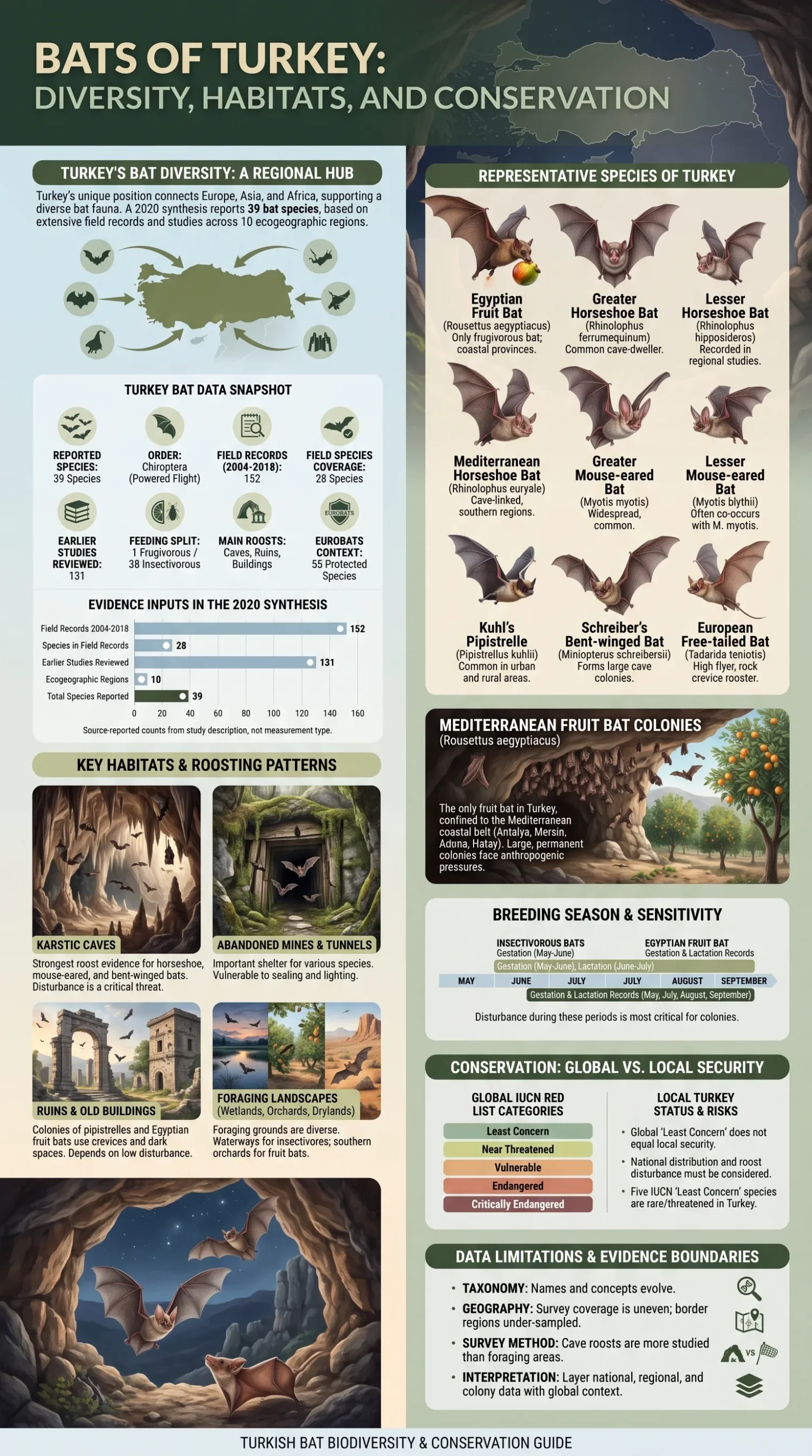
A nationwide synthesis published in 2020 reported 39 species after combining 152 field records gathered from 2004 to 2018 with records extracted from 131 earlier studies. That study was a major distributional baseline, but its total reflected the taxonomy and evidence available at the time.[b] The 2025 checklist reaches 43 through later taxonomic treatment and recognition of taxa such as Miniopterus pallidus, Myotis hoveli, Myotis tschuliensis, and Myotis schaubi.
The total is tied to a taxonomic date
A change from 39 to 43 does not mean four bats suddenly colonized Türkiye. Species totals can rise when formerly combined populations are separated, when historical material is reassessed, or when new records satisfy the evidence standard used by a checklist.
The 43 species listed for Türkiye in 2025
The table follows the names and family placement printed in the 2025 national checklist. English names are supplied as practical labels; scientific names should be used when comparing datasets because common names vary among publications.
| Family | Scientific name in the national checklist | English name |
|---|---|---|
| Pteropodidae | Rousettus aegyptiacus | Egyptian fruit bat |
| Rhinolophidae | Rhinolophus blasii | Blasius’s horseshoe bat |
| Rhinolophidae | Rhinolophus mehelyi | Mehely’s horseshoe bat |
| Rhinolophidae | Rhinolophus euryale | Mediterranean horseshoe bat |
| Rhinolophidae | Rhinolophus ferrumequinum | Greater horseshoe bat |
| Rhinolophidae | Rhinolophus hipposideros | Lesser horseshoe bat |
| Emballonuridae | Taphozous nudiventris | Naked-rumped tomb bat |
| Molossidae | Tadarida teniotis | European free-tailed bat |
| Miniopteridae | Miniopterus pallidus | Pallid long-fingered bat |
| Miniopteridae | Miniopterus schreibersii | Schreibers’s long-fingered bat |
| Vespertilionidae | Nyctalus lasiopterus | Greater noctule |
| Vespertilionidae | Nyctalus noctula | Common noctule |
| Vespertilionidae | Nyctalus leisleri | Leisler’s bat |
| Vespertilionidae | Pipistrellus pipistrellus | Common pipistrelle |
| Vespertilionidae | Pipistrellus pygmaeus | Soprano pipistrelle |
| Vespertilionidae | Pipistrellus nathusii | Nathusius’s pipistrelle |
| Vespertilionidae | Pipistrellus kuhlii | Kuhl’s pipistrelle |
| Vespertilionidae | Vespertilio murinus | Parti-coloured bat |
| Vespertilionidae | Hypsugo savii | Savi’s pipistrelle |
| Vespertilionidae | Eptesicus ognevi | Ognev’s serotine |
| Vespertilionidae | Eptesicus anatolicus | Anatolian serotine |
| Vespertilionidae | Eptesicus bottae | Botta’s serotine |
| Vespertilionidae | Eptesicus serotinus | Serotine bat |
| Vespertilionidae | Barbastella barbastellus | Western barbastelle |
| Vespertilionidae | Plecotus austriacus | Grey long-eared bat |
| Vespertilionidae | Plecotus kolombatovici | Kolombatović’s long-eared bat |
| Vespertilionidae | Plecotus macrobullaris | Alpine long-eared bat |
| Vespertilionidae | Plecotus auritus | Brown long-eared bat |
| Vespertilionidae | Otonycteris hemprichii | Desert long-eared bat |
| Vespertilionidae | Myotis brandti | Brandt’s bat |
| Vespertilionidae | Myotis emarginatus | Geoffroy’s bat |
| Vespertilionidae | Myotis alcathoe | Alcathoe bat |
| Vespertilionidae | Myotis mystacinus | Whiskered bat |
| Vespertilionidae | Myotis davidii | David’s myotis |
| Vespertilionidae | Myotis capaccinii | Long-fingered bat |
| Vespertilionidae | Myotis bechsteinii | Bechstein’s bat |
| Vespertilionidae | Myotis daubentonii | Daubenton’s bat |
| Vespertilionidae | Myotis blythii | Lesser mouse-eared bat |
| Vespertilionidae | Myotis myotis | Greater mouse-eared bat |
| Vespertilionidae | Myotis nattereri | Natterer’s bat |
| Vespertilionidae | Myotis hoveli | Hovel’s myotis |
| Vespertilionidae | Myotis tschuliensis | Tschuli myotis |
| Vespertilionidae | Myotis schaubi | Schaub’s myotis |
One family contains more than three quarters of the checklist
Vespertilionidae accounts for 33 species, or about 77% of the national total. The remaining ten species are divided among five families. This uneven composition helps explain why Turkish bat research repeatedly encounters difficult species complexes within Myotis, Eptesicus, Pipistrellus, and Plecotus.
Family composition of Türkiye’s 2025 bat checklist
Number of source-listed species in each of the six bat families.
Source: Sözen and Çolak, 2025 national mammal checklist; values represent listed species, not abundance or population size.
The same bat may appear under different names in current databases
The Mammal Diversity Database is updated as mammalian taxonomy changes and released version 2.4 in January 2026.[c] Its treatment does not match the 2025 Turkish checklist in every case. The checklist table above therefore preserves the national source’s names, while the crosswalk below shows selected differences that affect searches, dataset joins, and conservation records.
| Name in the 2025 Turkish checklist | Current MDD treatment | Why the difference matters |
|---|---|---|
| Eptesicus anatolicus | Cnephaeus anatolicus[d] | MDD moves the Anatolian serotine from Eptesicus to Cnephaeus and treats it as a species separated from the bottae complex. |
| Eptesicus bottae | Cnephaeus bottae[e] | MDD uses the revised genus but does not currently include Türkiye in its coded country distribution, creating a direct distributional conflict with the national checklist. |
| Miniopterus pallidus | Miniopterus pallidus[f] | Both sources recognize it as a species distinct from M. schreibersii; older literature may combine them, while MDD reports M. pallidus as globally Near Threatened. |
| Myotis hoveli | Myotis hoveli[g] | MDD recognizes a split from the M. nattereri complex and records the taxon as Not Evaluated by IUCN. |
| Myotis tschuliensis | Myotis tschuliensis[h] | This is another recognized split from the M. nattereri complex, also listed as Not Evaluated. |
| Myotis schaubi | Myotis schaubi[i] | MDD marks Turkish occurrence with uncertainty and notes unresolved relations with nearby members of the complex. |
Do not merge records by common name alone
A Turkish record filed under an older Eptesicus, Miniopterus, or Myotis name may refer to a different modern species concept. Reliable aggregation requires the scientific name as published, the identification date, geographic coordinates or locality, voucher or sequence evidence when available, and the taxonomic authority used by the dataset.
Roost habitat and feeding habitat are separate parts of a bat’s range
A cave record identifies a roost, not the whole habitat used by the colony. Bats may leave an underground site and forage over woodland, orchards, grazing land, rivers, reservoirs, wetlands, cliffs, or settlements. Conservation fails when it protects the entrance of a roost but removes the commuting corridor or feeding area that supports it.
| Habitat element | How bats use it | Turkish checklist examples | Main management concern |
|---|---|---|---|
| Caves, mines, tunnels, and underground chambers | Hibernation, maternity colonies, day roosts, seasonal gathering, and refuge from weather | Rhinolophus species, Miniopterus species, Myotis myotis, M. blythii, M. capaccinii, Rousettus aegyptiacus | Tourism, repeated entry, lighting, smoke, quarrying, unsuitable gates, and disturbance during winter or maternity periods |
| Mature woodland and old trees | Tree-cavity and bark roosts, sheltered flight routes, and insect-rich feeding areas | Barbastella barbastellus, Myotis bechsteinii, Nyctalus lasiopterus, N. noctula, Plecotus auritus | Removal of veteran trees, deadwood loss, short rotation forestry, and fragmentation between roosts and feeding sites |
| Rivers, canals, lakes, ponds, and riparian vegetation | Drinking, aquatic-insect feeding, navigation, and movement through dry landscapes | Myotis capaccinii, M. daubentonii, Pipistrellus pygmaeus, several horseshoe bats | Water pollution, hard engineering of banks, vegetation clearance, wetland drainage, and bright lighting |
| Cliffs, rock fissures, ravines, and scree | Crevice roosting and access to warm, open-air feeding space | Tadarida teniotis, Taphozous nudiventris, Hypsugo savii, Otonycteris hemprichii, Plecotus macrobullaris | Blasting, quarry expansion, climbing pressure at roost faces, road cuts, and loss of undisturbed crevices |
| Buildings, castles, bridges, ruins, and roof spaces | Day roosts, maternity sites, transitional shelter, and urban feeding access | Pipistrellus kuhlii, P. pipistrellus, Eptesicus serotinus, horseshoe bats, long-eared bats | Renovation during occupation, sealed access points, roof treatment chemicals, demolition, and exclusion without replacement roosts |
| Steppe, pasture, orchards, field margins, and woodland edges | Ground- and foliage-associated insect feeding across open or semi-open landscapes | Myotis myotis, M. blythii, Rhinolophus ferrumequinum, R. euryale, Otonycteris hemprichii | Broad-spectrum insecticide use, hedge removal, conversion to uniform land cover, over-lighting, and loss of grazing mosaics |
EUROBATS habitat guidance treats forests, water bodies, linear vegetation, feeding grounds, and commuting routes as connected conservation units rather than isolated patches.[j] For Türkiye, that landscape approach is especially relevant where cave-rich limestone, irrigated agriculture, orchards, river valleys, mountain forest, and dry steppe occur within a few kilometres of one another.
Regional studies reveal different parts of the national fauna
No single survey covers every season, habitat, and province. Three regional studies illustrate both the ecological breadth of Turkish bats and the strong effect of survey design on reported totals.
Thrace and northwestern underground sites
A survey of 32 underground sites in Turkish Thrace reported about 76,000 bats belonging to 13 species. Dupnisa Cave held an estimated 28,000 bats of five species during hibernation, while Koyunbaba Cave held an estimated 23,000 bats of six species in a nursery assemblage. These are historical survey estimates from the study period, not current colony counts. The work showed how a small number of caves can support large seasonal aggregations and how tourism or repeated entry can affect several species at once.[k]
Southeastern mountains, dry valleys, plains, and river systems
Fieldwork conducted from 2004 to 2017 documented 15 species in southeastern Türkiye across glaciated mountains, arid steppe, rocky valleys, plains, and river-linked habitats. The study added locality evidence for the naked-rumped tomb bat, including roost use in rock crevices. Its findings demonstrate why a cave-only inventory would underrepresent desert-edge and fissure-roosting taxa in the southeast.[l]
Central and eastern Mediterranean landscapes
A regional treatment based on 200 specimens recorded 20 species in the central and eastern Mediterranean part of Türkiye. The assemblage included the Egyptian fruit bat, all five nationally listed horseshoe bats, both large mouse-eared bats, the long-fingered bat, the Anatolian serotine, long-eared bats, pipistrelles, and the European free-tailed bat. Caves, ruins, buildings, orchards, wooded slopes, and warm coastal or subcoastal terrain all contribute to this regional mixture.[m]
Large colonies do not identify the most widespread species
A species that forms a dense cave colony can dominate a survey’s individual count while occupying relatively few known sites. A solitary tree-roosting species may be recorded less often even when it occurs across a broader area. Colony size, number of records, number of occupied grid cells, and national range are different measurements.
Anatolia holds conservation value below the species level
Species totals alone do not capture the genetic structure of Turkish bats. A phylogeographic study examined 33 Near Eastern bat species using mitochondrial markers and identified 15 genetically distinct populations within 12 species and the large Myotis complex. The authors highlighted the Balkans, the Caucasus, and southern Anatolia as areas containing divergent populations and argued that management should account for intraspecific lineages as well as named species.[n]
Protecting one population elsewhere in Europe does not automatically preserve the genetic variation held by an Anatolian population of the same named species.
Global categories identify only part of Türkiye’s conservation burden
The categories below are global IUCN statuses reported by the cited current taxonomic or species sources. They are not a national Red List for Türkiye, and they do not measure the condition of each Turkish population. A globally Least Concern species may still have few verified national sites, while a globally threatened species may depend on one or more large Turkish colonies.
| Species | Reported global category | Turkish conservation relevance |
|---|---|---|
| Rhinolophus mehelyi | Vulnerable[o] | Colonial underground roosts can concentrate a large share of local animals at a small number of disturbance-sensitive sites. |
| Rhinolophus euryale | Near Threatened[p] | Protection needs to connect underground roosts with wooded and semi-open feeding landscapes. |
| Miniopterus schreibersii | Vulnerable[q] | Large mobile colonies use networks of seasonal caves, so damage at one site can affect bats moving among several regions. |
| Nyctalus lasiopterus | Vulnerable[r] | Tree roosts, mature forest structure, and open-air flight expose this species to forestry and turbine-related risks. |
| Myotis capaccinii | Vulnerable[s] | Its dependence on underground shelter and aquatic feeding habitat links cave protection with river and wetland condition. |
| Myotis bechsteinii | Near Threatened[t] | Tree-hole roosting makes old forest stands, veteran trees, and roost continuity central to management. |
Threats act through different roosting and movement systems
Cave tourism and underground disturbance
Human entry can wake hibernating bats, separate mothers from dependent young, alter temperature and airflow, and cause a colony to abandon a chamber. Lighting, paved routes, amplified sound, smoke, and poorly designed entrance gates can extend the disturbance beyond the time visitors are physically present. A cave should therefore be assessed by season, chamber use, species, colony function, and connected feeding habitat before access is expanded.
Renovation and demolition of occupied structures
Roof repairs, insulation, bridge maintenance, restoration of castles, and demolition can remove roosts that have been reused for years. The biological risk depends on timing: closing an entrance during maternity season can trap adults or young, while winter work can expose torpid animals. Surveys should cover the season relevant to the suspected roost, and replacement structures should match the original crevice dimensions, temperature range, access height, and surrounding flight route.
Loss of veteran trees and forest continuity
Tree-roosting bats may switch among several cavities or loose-bark roosts within a season. Retaining a single known tree is therefore weaker protection than maintaining a network of mature trees, deadwood, layered woodland, and dark connections to feeding areas. Salvage felling after fire or storms can remove roost structures even when canopy cover appears little changed on a map.
Water alteration, insect decline, and pesticide exposure
Drainage, canalization, polluted runoff, removal of riparian vegetation, and reduced surface water can lower insect production and remove drinking sites. Broad-spectrum insecticides can reduce prey and may expose bats through contaminated insects. Effects can extend far from a roost when a colony depends on a river corridor, orchard belt, wetland, or grazing mosaic for nightly feeding.
Wind energy and illuminated airspace
High-flying and migratory bats can collide with turbine blades or die after rapid pressure changes near operating rotors. Risk varies by species, season, wind speed, topography, and movement route, so a short ground-level detector survey cannot define the full exposure of a project. EUROBATS work on wind turbines emphasizes pre-construction assessment, operational monitoring, mortality searches corrected for detection bias, and turbine curtailment when activity and risk are highest.[u] Artificial light can add another barrier by illuminating cave entrances, rivers, tree lines, and commuting corridors used by light-averse species.
Conservation measures should match the evidence type
| Evidence found | Immediate protection response | Follow-up evidence needed |
|---|---|---|
| Large hibernation or maternity colony in a cave | Prevent disturbance during the occupied season; retain airflow and access geometry; control tourism, blasting, and lighting within the disturbance zone. | Seasonal counts using a repeatable method, chamber temperature data, emergence monitoring, and identification of linked feeding areas. |
| Tree-roosting bats in mature woodland | Retain the roost tree and a surrounding network of cavity-bearing trees; avoid felling during occupation; keep dark woodland connections. | Radio tracking or repeated emergence checks to locate alternative roosts and core feeding areas. |
| Building or bridge roost | Delay works when animals or dependent young are present; maintain safe exits; incorporate a species-appropriate replacement roost before exclusion. | Pre-work seasonal survey, post-work occupation checks, and monitoring of replacement features. |
| Aquatic-feeding species beside a river or wetland | Protect water quality, bankside vegetation, dark flight space, and continuous access between roost and water. | Insect availability, acoustic activity across seasons, roost location, and effects of water-management changes. |
| High bat activity at a proposed wind site | Reassess turbine placement and movement corridors; apply season- and weather-based operating limits where risk cannot be avoided. | Height-stratified acoustic work, migration-season coverage, standardized carcass searches, scavenger trials, and detection-efficiency correction. |
| Record of a cryptic or recently split species | Preserve the site while identification is checked; do not merge it automatically with the former broad species concept. | Voucher review, diagnostic measurements, call files, genetic sequence, date, coordinates, and taxonomic reference. |
Why a national distribution map remains incomplete
Available occurrence records are concentrated around surveyed caves, accessible roads, universities, long-running field projects, and well-known colonies. Sparse records in another area may mean low survey effort rather than bat absence. The bias is stronger for tree-roosting, high-flying, quiet-calling, or cryptic species that are less likely to be found during cave inspections or identified from short acoustic recordings.
- Museum and literature records can preserve valuable historical evidence, but their names may require reinterpretation under current taxonomy.
- Acoustic records can document activity without locating a roost, and some species cannot be separated confidently from calls alone.
- Roost counts measure animals at one place and time; they do not equal national population size.
- Genetic records can resolve cryptic species but remain geographically uneven and depend on sample quality and reference sequences.
- Absence from a dataset is not evidence of national or regional absence unless survey design and detection probability support that conclusion.
A stronger national monitoring system needs compatible records
Repeatable monitoring should separate hibernation counts, maternity counts, emergence counts, acoustic activity, capture records, carcass records, and confirmed roost locations. Each record should retain the original scientific name, later taxonomic interpretation, date, coordinates, method, observer, identification confidence, life stage or colony function when known, and links to voucher, photograph, sound file, or sequence evidence.
EUROBATS monitoring guidance supports species-appropriate combinations of underground counts, emergence surveys, acoustic methods, capture, roost checks, and structured trend analysis rather than a single method for all bats.[v] In Türkiye, compatible long-term records would help distinguish true population change from changes in taxonomic naming, survey effort, detector technology, and access to known roosts.
Sources and Verification
- [a] Sözen, M. and Çolak, F. (2025), An updated checklist of the mammals of Türkiye — Used for the national total, native coding, family placement, and the 43-species checklist.
- [b] Yorulmaz, T. and Arslan, N. (2020), Current status of the bats in Turkey with their ecogeographic distributions and recommendations for national conservation status — Used for the earlier 39-species total, survey scope, and record-based national baseline.
- [c] American Society of Mammalogists, Mammal Diversity Database — Used for the current database release context and taxonomic cross-checking.
- [d] Mammal Diversity Database: Cnephaeus anatolicus — Used for the accepted genus, species treatment, Turkish distribution, and taxonomic note for the Anatolian serotine.
- [e] Mammal Diversity Database: Cnephaeus bottae — Used to document the revised genus and the current conflict between MDD country coding and the Turkish checklist.
- [f] Mammal Diversity Database: Miniopterus pallidus — Used for its separation from M. schreibersii, family placement, Turkish occurrence, and Near Threatened category.
- [g] Mammal Diversity Database: Myotis hoveli — Used for the recent species treatment, relation to the M. nattereri complex, and Not Evaluated category.
- [h] Mammal Diversity Database: Myotis tschuliensis — Used for the split from the M. nattereri complex and Not Evaluated category.
- [i] Mammal Diversity Database: Myotis schaubi — Used for the uncertain Turkish country coding, taxonomic caveat, and Not Evaluated category.
- [j] EUROBATS Publication Series No. 9, Guidance on the conservation and management of feeding areas and commuting routes — Used for connected management of forests, water, linear vegetation, feeding habitat, and flight routes.
- [k] Furman, A. and Özgül, A. (2004), The conservation value of cave-dwelling bats in northwestern Turkey — Used for the 32-site survey, historical colony estimates, species total, and cave-disturbance evidence.
- [l] Yorulmaz, T. and colleagues, Bats in Southeastern Turkey — Used for the 2004–2017 field scope, 15 recorded species, southeastern habitat breadth, and tomb-bat locality evidence.
- [m] Karataş, A. (2019), The Bats of the Central and Eastern Mediterranean Region — Used for the 20-species regional assemblage and Mediterranean specimen-based records.
- [n] Çoraman, E., Furman, A., Karataş, A. and Bilgin, R. (2013), Phylogeographic analysis of Anatolian bats — Used for the mitochondrial study scope, divergent population findings, and conservation value of Anatolian lineages.
- [o] Mammal Diversity Database: Rhinolophus mehelyi — Used for Turkish occurrence and the reported global Vulnerable category.
- [p] Mammal Diversity Database: Rhinolophus euryale — Used for Turkish occurrence and the reported global Near Threatened category.
- [q] Mammal Diversity Database: Miniopterus schreibersii — Used for the reported global Vulnerable category and current family placement.
- [r] Mammal Diversity Database: Nyctalus lasiopterus — Used for Turkish occurrence and the reported global Vulnerable category.
- [s] EUROBATS: Myotis capaccinii — Used for the Vulnerable category and the species’ linked dependence on underground roosts and aquatic feeding habitat.
- [t] Bat Conservation International: Myotis bechsteinii — Used for the global Near Threatened category and tree-hole, old-forest habitat association.
- [u] EUROBATS, Report of the Intersessional Working Group on Wind Turbines and Bat Populations — Used for wind-energy risk assessment, fatality monitoring, and operational mitigation.
- [v] EUROBATS, Guidelines for long-term monitoring of European bat populations — Used for species-appropriate survey methods and repeatable trend monitoring.
Related Topics
- → Mammals of Turkey: Native Species, Habitats, and Distribution
- → Mountain Mammals of Turkey: Species of High Elevation Habitats
- → Wild Ungulates of Turkey: Deer, Goats, Sheep, and Wild Boar
- → Large Carnivores of Turkey: Wolves, Bears, Lynx, and Wild Cats
- → Marine Mammals of Turkey: Dolphins, Porpoises, and Seals
- → Birds of Turkey: Native, Migratory, and Rare Species