Complete guides: Mammals of Turkey•Regional Fauna Guides
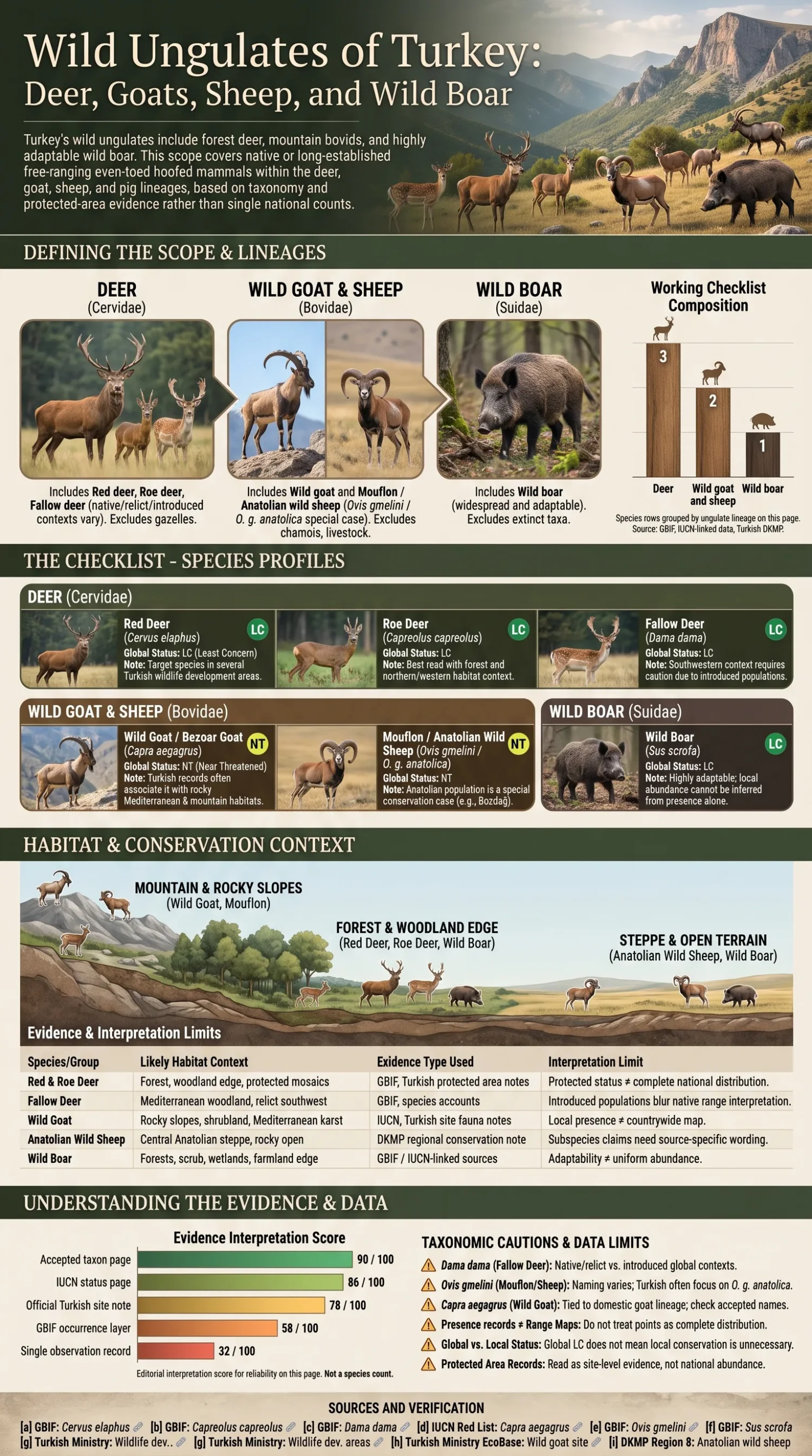
Turkey’s current source-based list contains nine living wild terrestrial ungulate species: three deer, two gazelles, one wild goat, one wild sheep, one chamois, and the wild boar. All belong to Artiodactyla, but they occupy sharply different settings, ranging from Mediterranean woodland and northern forests to Central Anatolian steppe, southeastern semi-desert, and the rocky high mountains of the Taurus and northeastern Black Sea region. The nine-species total is derived from the terrestrial artiodactyl entries in the 2025 updated checklist of Turkey’s mammals.[a]
Turkey’s Nine Living Wild Terrestrial Ungulates
The word ungulate describes hoofed mammals rather than a single close taxonomic unit. Turkey’s wild terrestrial species fall within three families: Cervidae, Bovidae, and Suidae. Deer grow antlers that are normally shed and regrown; bovids carry permanent horn cores covered by keratin; wild boar have neither antlers nor bovid-type horns.
| Group | Common name | Scientific name | Family | Main Turkish setting | Global IUCN category |
|---|---|---|---|---|---|
| Deer | Common fallow deer | Dama dama[b] | Cervidae | Native southwestern stronghold and managed populations | Least Concern |
| Deer | Western red deer | Cervus elaphus[c] | Cervidae | Patchy forest and forest-edge populations | Least Concern |
| Deer | Western roe deer | Capreolus capreolus[d] | Cervidae | Northern and western woodland mosaics, with scattered inland records | Least Concern |
| Gazelle | Sand gazelle | Gazella marica[e] | Bovidae | Southeastern dry steppe and semi-desert landscapes | Vulnerable |
| Gazelle | Mountain gazelle | Gazella gazella[f] | Bovidae | Narrow southern range centred in Hatay | Endangered |
| Wild goat | Wild goat | Capra aegagrus[g] | Bovidae | Rocky mountains, cliffs, broken slopes, and adjoining scrub | Near Threatened |
| Wild sheep | Asian mouflon | Ovis gmelinii | Bovidae | Central Anatolian steppe populations and eastern mountain-steppe populations | Near Threatened at species level; the Anatolian form is assessed separately as Endangered[h] |
| Chamois | Northern chamois | Rupicapra rupicapra[i] | Bovidae | Northeastern alpine grassland, rock, and high-elevation forest margins | Least Concern at species level |
| Pig | Wild boar | Sus scrofa[j] | Suidae | Forests, scrub, reedbeds, river valleys, farmland edges, and mixed landscapes | Least Concern |
Nine Species Does Not Mean Nine Uniform National Ranges
A species can be accepted as part of Turkey’s fauna while occurring only in a narrow region, a protected population, or a set of separated habitat patches. Country-level inclusion should not be converted into a claim that the species occupies the whole country. Release sites, fenced breeding populations, historical localities, and free-ranging native populations must also be kept separate.
Three Deer Occupy Different Forest and Woodland Niches
Turkey’s deer are not ecological substitutes for one another. Fallow deer are tied to a small native conservation history in the southwest. Red deer require larger forest and open-foraging landscapes. Roe deer are smaller browsers that can persist in finer-grained woodland, shrub, and agricultural mosaics. Their shared family membership therefore says little about the size, continuity, or security of their Turkish populations.
Fallow Deer: A Native Lineage Centred on Southwestern Turkey
The common fallow deer, Dama dama, is the deer most closely associated with Turkey’s role in the species’ native history. Modern taxonomic treatments separate it from the Persian fallow deer, Dama mesopotamica. Older publications that placed both forms under a broad Dama dama concept can therefore create false records when transferred directly into a current checklist.
Antalya’s Düzlerçamı–Eşenadası area is a central reference point for the surviving Anatolian fallow deer population and its managed breeding work. A camera-trap study at the Eşenadası breeding station illustrates why local population figures must remain attached to a named site, survey design, and study period rather than being presented as a national total.[k]
Fallow deer use woodland with openings, shrub cover, and accessible feeding grounds. Their ability to live in park-like woodland does not mean that every introduced or enclosed herd represents part of the native Turkish range. Records should distinguish the southwestern native lineage, conservation breeding units, later releases, and animals maintained in enclosed facilities.
Common Fallow Deer and Persian Fallow Deer Are Separate Species
Dama dama is included in Turkey’s current living mammal checklist. Dama mesopotamica is a separate species and should not be inserted into a modern list of living Turkish ungulates merely because historical literature used broader fallow deer classifications.
Red Deer: Large Deer in Fragmented Forest Landscapes
Cervus elaphus is Turkey’s largest living deer. It depends on landscapes that combine daytime cover with grassland, forest clearings, young vegetation, or other feeding areas. Mature males and female-led groups may use the same wider landscape differently, and seasonal movements can shift the locations where animals are detected.
Turkish populations are spatially separated rather than forming one continuous belt. Field studies and management projects have examined red deer in areas such as the Eskişehir forest region and the Türkmenbaba Wildlife Development Area. A 2025 Türkmenbaba study linked local density estimates to forest-stand structure, demonstrating that a density calculated for one managed landscape cannot be extended to all of Turkey.[l]
The species’ global Least Concern category reflects its broad international range. It does not establish that every Turkish population is large, connected, or free from local pressure. Habitat continuity, disturbance, road access, illegal killing, and the history of releases or breeding programs can produce very different conditions among Turkish sites.
Roe Deer: A Smaller Browser of Northern Woodland Mosaics
The western roe deer, Capreolus capreolus, is much smaller than red deer and often uses a finer mixture of forest, young woodland, shrubs, clearings, and field edges. Dense cover provides concealment, while nearby openings supply herbs, shoots, leaves, and other browse.
Published Turkish records place the species across the Marmara and Black Sea regions and in additional wooded pockets, including parts of western and eastern Anatolia. A Düzce camera-trap study recorded most detections in fir and beech forest and showed that habitat use within one province was not uniform. Another study documented an inland record near Kırıkkale, illustrating that new local evidence can refine an older range outline without proving continuous occupation between known sites.[m]
Fallow deer, red deer, and roe deer may all occur in wooded environments, but their Turkish conservation questions differ: fallow deer are tied to a restricted native lineage, red deer require large connected landscapes, and roe deer records must be evaluated against local woodland structure and expanding or isolated occurrences.
Rock, Scree, and Steppe Separate Turkey’s Three Caprines
The wild goat, Asian mouflon, and northern chamois all belong to the caprine branch of Bovidae, yet they are divided by terrain and regional ecology. Wild goats are strongly associated with cliffs and broken rocky slopes. Mouflon use open steppe, hill country, and mountain-steppe. Chamois are linked more closely to cool northeastern highlands, alpine grasslands, steep rock, and upper forest margins.
Wild Goat: The Broadly Distributed Cliff Specialist
The wild goat, Capra aegagrus, is also called the bezoar or bezoar goat. It is the wild form associated taxonomically with the domestic goat lineage, but wild populations should not be merged with free-ranging domestic goats or recent feral herds. Identification and occurrence datasets require evidence that the animals belong to wild populations.
In Turkey, the species is associated with the Taurus and Anti-Taurus systems and with additional rocky ranges in eastern and southeastern Anatolia. Escape terrain is a central habitat feature. Cliffs, ravines, ledges, broken slopes, scrub, open forest, and nearby feeding areas can all form parts of a seasonal home range. Elevation alone is not enough: ruggedness, access to secure rock, vegetation, snow conditions, and human disturbance alter habitat use.
A field survey in the Demirkazık Wildlife Development Area counted 1,358 wild goats during a December 2019 inventory and calculated 7.27 individuals per 100 hectares for that study area. Those values describe a named Niğde population surveyed with a point-count method; they are not an estimate for Turkey as a whole.[n]
The wild goat is globally Near Threatened. Turkish management must also account for road construction, quarrying, disturbance on escape terrain, hunting pressure, competition or contact with livestock, disease exchange, and the isolation of mountain populations. A locally high count does not remove those pressures from other ranges.
Asian Mouflon: One Species, Two Turkish Conservation Contexts
Current Mammal Diversity Database usage accepts Ovis gmelinii for the Asian mouflon and explains that the spelling was changed from gmelini to match the original description. The 2025 Turkish checklist and the 2020 IUCN assessment use Ovis gmelini. These spellings refer to the same species-level taxonomic problem rather than two separate Turkish wild sheep species.[o]
Turkey contains two geographic and conservation contexts within this complex. The Anatolian mouflon is associated with the dry Central Anatolian steppe, especially the long-managed Konya-Bozdağ population and populations founded through conservation releases. Eastern Turkey also lies within the range of Asian or Armenian mouflon populations connected biogeographically with the southern Caucasus and northwestern Iran.
The species was assessed globally as Near Threatened in 2020, while the geographically restricted Anatolian form was assessed as Endangered. This difference matters: presenting only the species-wide category would hide the much narrower risk faced by the Central Anatolian lineage. Genomic research on Anatolian and Cypriot mouflon also shows why managed populations, founder history, and genetic structure must be considered alongside head counts.[p]
Mouflon use open terrain where visibility, grasses, herbs, low shrubs, and access to broken ground occur together. They should not be described as forest deer or as animals confined only to high cliffs. Central Anatolian populations are especially tied to steppe and rolling upland habitats, while eastern populations occur in rougher mountain-steppe and semi-arid landscapes.
Northern Chamois: Turkey’s Northeastern High-Mountain Ungulate
Turkey’s chamois is treated as Rupicapra rupicapra. The name Rupicapra rupicapra asiatica remains common in regional conservation literature, while the Mammal Diversity Database includes asiatica within the northern chamois rather than accepting it as a separate species.
Its Turkish distribution is centred on the northeastern Black Sea mountains and adjoining eastern highlands, including alpine and subalpine zones near the Georgian border. Chamois use steep grasslands, rocky slopes, cliffs, avalanche corridors, and upper forest margins. Seasonal snow can push animals toward lower or less snow-covered slopes, so winter observations do not necessarily define the full annual habitat.
The northern chamois is globally Least Concern, but the Turkish population occupies only a small part of that broad species range. The country-level questions are population separation, disturbance in accessible valleys and mountain routes, hunting pressure, livestock contact, and the limited number of repeated surveys. A European species-wide assessment cannot replace population work in the Kaçkar and adjacent mountain systems.
Southeastern Turkey Holds Two Gazelle Species
A current Turkish ungulate list must include both the sand gazelle and the mountain gazelle. Treating all Turkish gazelles as Gazella subgutturosa, calling them all goitered gazelles, or assigning the Hatay population to Gazella dorcas reproduces older classifications that have been revised by genetic and morphological evidence.
Genetic work on southeastern Turkish populations distinguished Gazella marica from Gazella gazella. Samples from the Kızılkuyu and Erikçe conservation populations were assigned to G. marica, while animals sampled from Hatay represented G. gazella. The research also found low estimated effective population sizes in the sampled populations, showing that the number of visible or captive animals is not the same as the number effectively contributing genes to future generations.[q]
Sand Gazelle in the Southeastern Drylands
Gazella marica is associated with open, dry plains, semi-desert, sparse steppe vegetation, and gently rolling terrain. In Turkey it is most closely linked with the Şanlıurfa–Gaziantep part of the southeast, where wild, managed, breeding, and released populations must be distinguished in occurrence records.
The species was formerly treated as a subspecies of the goitered gazelle under the name Gazella subgutturosa marica. Current mammal taxonomy recognizes it as Gazella marica. Its global category is Vulnerable, but a Turkish assessment also requires information on local genetic diversity, habitat continuity, fencing, roads, irrigation development, agricultural conversion, and the origin of released animals.
Mountain Gazelle in Hatay
Gazella gazella has a much narrower Turkish distribution. The accepted range reaches south-central Turkey, and Turkish field and genetic evidence centres the population in Hatay. It should not be mapped across all of southeastern Anatolia simply because another gazelle species occurs farther east.
Mountain gazelles can use open hills, dry grassland, scrub, cultivated edges, and low rocky terrain. The species is globally Endangered. For the Turkish population, the narrow geographic extent makes habitat conversion, road mortality, barriers, disturbance, small-population genetics, and contact with managed herds especially relevant.
Gazelle Records Must Be Identified to the Correct Species
A record labelled only “gazelle” cannot automatically be assigned to Gazella marica or Gazella gazella. Locality, photographs, specimen evidence, genetic results, and the history of breeding or release programs may all be needed. The two species have different Turkish ranges and different global conservation categories.
Wild Boar Is the Only Non-Ruminant on the List
The wild boar, Sus scrofa, belongs to Suidae and differs anatomically and ecologically from Turkey’s deer and bovids. It is an omnivore with a flexible diet, a rooting feeding method, and a capacity to use forest, scrub, reedbed, wetland edge, agricultural land, orchard margins, and peri-urban cover.
This flexibility makes wild boar the most broadly distributed Turkish ungulate, but “widespread” should not be translated into equal density everywhere. Food availability, water, cover, hunting pressure, winter severity, crop cycles, predators, disease, and human disturbance can change local abundance and activity. Camera-trap research in an eastern Anatolian large-mammal community found seasonal differences in habitat use, reinforcing the need to treat detections as time- and place-specific evidence.[r]
Wild boar also create a different management problem from narrow-range gazelles or fallow deer. Crop damage, vehicle collisions, rooting, disease surveillance, and encounters near settlements can require local control, while the species remains an ecological prey resource and soil-disturbing mammal in natural systems. Management actions should therefore be based on local population and conflict evidence rather than the species’ global Least Concern category.
Taxonomic Names That Can Distort Turkish Ungulate Lists
Several names found in older Turkish reports, museum records, hunting documents, and wildlife articles do not align directly with the current species list. Some are former combinations, some are subspecies names, and others now refer to separate species. Retaining the original name in a historical record is useful, but the record should also be mapped to a current accepted concept when the evidence permits.
| Name found in sources | Current treatment used here | Why the distinction matters |
|---|---|---|
| Gazella subgutturosa marica | Gazella marica | The sand gazelle is now treated as a species rather than a Turkish population of the goitered gazelle. |
| Gazella dorcas for the Hatay population | Gazella gazella | Genetic and taxonomic work supports mountain gazelle for the surviving Hatay population. |
| Ovis gmelini | Ovis gmelinii in current MDD usage | The single-i spelling remains in the 2025 national checklist and the 2020 IUCN assessment; it does not identify a second species. |
| Ovis orientalis anatolica or Ovis gmelinii anatolica | Anatolian mouflon within the Ovis gmelinii complex | Subspecies and population terminology varies among authorities, while its restricted conservation unit still needs separate treatment. |
| Rupicapra rupicapra asiatica | Rupicapra rupicapra | asiatica remains useful for regional discussion, but current MDD treatment includes it within northern chamois. |
| Dama dama mesopotamica | Dama mesopotamica | Persian fallow deer is now treated as separate from the common fallow deer listed for living Turkish fauna. |
| Capra hircus aegagrus | Capra aegagrus | The wild goat is treated separately from the domestic goat, although their evolutionary and taxonomic histories are connected. |
| Sus domesticus or feral pig records | Sus scrofa only when wild-boar identity is supported | Domestic, hybrid, feral, and wild animals may be difficult to separate without suitable evidence. |
Habitat Patterns Across Turkey
Turkey’s ungulate diversity is produced by the meeting of forest, Mediterranean scrub, continental steppe, semi-desert, and high-mountain environments. The species list is national, but the ecological units supporting it are regional.
- Southwestern Mediterranean woodland: the native fallow deer stronghold, wild goat populations, and wild boar occur within a landscape of pine forest, maquis, rock, and open feeding areas.
- Northern forest belt: roe deer, red deer, and wild boar use Black Sea and Marmara woodland systems, although their records and densities are uneven.
- Central Anatolian steppe: Anatolian mouflon conservation populations depend on open steppe, rolling uplands, and managed refuge areas.
- Taurus and Anti-Taurus mountains: wild goats use rugged limestone, cliffs, ravines, scrub, and mountain forest edges.
- Northeastern high mountains: chamois occupy alpine grassland, steep rock, and upper forest zones, while wild goat may occur in lower or drier rocky sectors.
- Southeastern plains and dry hills: sand gazelle and mountain gazelle occupy different ranges within dry open landscapes; the former is associated mainly with the Şanlıurfa–Gaziantep region and the latter with Hatay.
- Mixed rural landscapes: wild boar can use woodland, crops, orchards, watercourses, and settlement edges, producing both ecological interactions and human conflict.
These boundaries are not absolute. Red deer can feed in open country, wild goats can enter woodland, chamois can descend below alpine grassland, and wild boar can occupy dry scrub. Habitat descriptions identify recurring associations, not rigid boxes.
Global Categories and Turkish Population Conditions Are Different Data
Five of the nine species are globally listed as Least Concern: fallow deer, red deer, roe deer, northern chamois, and wild boar. That category is calculated across each species’ global assessment range. It does not state that the Turkish population is large, stable, evenly distributed, or free from local threats.
The contrast is clearest in fallow deer and chamois. Common fallow deer has a broad global distribution that includes many introduced populations, while Turkey’s native Anatolian lineage is concentrated in a much narrower conservation setting. Northern chamois is widespread across several European mountain systems, while Turkey holds a peripheral and geographically restricted part of its range.
Mouflon requires an additional scale distinction. The species-level Asian mouflon assessment is Near Threatened, but the Anatolian form is Endangered. Sand gazelle is Vulnerable, mountain gazelle is Endangered, and wild goat is Near Threatened globally. These categories identify broad extinction risk; Turkish management still requires current local counts, age and sex structure, connectivity, mortality, habitat condition, release history, and genetic evidence.
Breeding, Release, Protection, and Hunting Records Must Remain Separate
Turkey has used breeding stations and releases for several large mammals, including Anatolian wild sheep, red deer, roe deer, fallow deer, and gazelles. Official wildlife material describes the production and release of animals into selected areas. A release record confirms a management action, but it does not by itself prove establishment, reproduction, long-term survival, or connection with a native population.[s]
Protected-species lists and controlled hunting documents are also management instruments rather than biological checklists. Turkish regulations may identify a large mammal as protected while allowing tightly controlled hunting under an approved plan and quota in specified circumstances. An official quota therefore should not be interpreted as evidence that the species is common throughout the country.
Official quota guidance describes wildlife development areas used for species such as red deer, wild goat, roe deer, wild sheep, gazelle, fallow deer, and chamois. The document links any permitted take to inventories, management plans, named areas, and administrative decisions. Its figures are planning inputs, not interchangeable national population estimates.[t]
A Hunting Record Is Not a Distribution Record by Itself
A licence, quota, trophy record, breeding-station record, or release notice may confirm that a species was managed at a named location. Establishing a free-ranging population requires additional evidence such as repeated field observations, camera-trap records, reproduction, carcasses, tracks, genetic samples, or a documented monitoring program.
Why a Complete National Range Map Is Not Yet Justified
The current checklist supports the presence of nine living species, but available evidence does not provide one equally current, equally sampled national range layer for all nine. Some species have focused camera-trap studies, some have managed population inventories, some are represented by genetic sampling, and others are known from scattered field records and administrative surveys.
Occurrence databases can add useful locality evidence, but their gaps may reflect difficult terrain, restricted access, uneven research, sensitive coordinates, or limited reporting. Dense records near roads, universities, protected-area offices, or long-running projects may represent sampling effort as much as animal density. Conversely, a blank map cell is not proof of absence.
Reliable national mapping would require taxonomically reviewed records, dates, coordinate quality checks, origin labels for released animals, separation of captive and free-ranging observations, and a defined time window. Historical locations should be displayed separately from recent evidence, particularly for fallow deer, mouflon, and gazelles.
The defensible national result is a nine-species working list. Distribution should remain species-specific and evidence-based rather than being converted into one visually complete but biologically unsupported map.
Sources and Verification
- [a] Sözen and Çolak — An updated checklist of the mammals of Türkiye — Used to establish the 2025 national mammal scope and the nine terrestrial artiodactyl species included in this page.
- [b] Mammal Diversity Database — Dama dama — Used for the accepted fallow deer name, separation from Dama mesopotamica, and global IUCN category.
- [c] Mammal Diversity Database — Cervus elaphus — Used for the accepted red deer treatment, Turkish country occurrence, and global IUCN category.
- [d] Mammal Diversity Database — Capreolus capreolus — Used for the accepted western roe deer name, broader range context, and global IUCN category.
- [e] Mammal Diversity Database — Gazella marica — Used for the sand gazelle’s accepted species treatment, split from Gazella subgutturosa, Turkish occurrence, and Vulnerable category.
- [f] Mammal Diversity Database — Gazella gazella — Used for the accepted mountain gazelle treatment, south-central Turkish range, and Endangered category.
- [g] Mammal Diversity Database — Capra aegagrus — Used for wild goat taxonomy, its relationship to the domestic goat lineage, Turkish occurrence, and Near Threatened category.
- [h] IUCN Red List — Ovis gmelini assessment, 2020 — Used for the species-level Near Threatened assessment and the separate Endangered treatment of the Anatolian population.
- [i] Mammal Diversity Database — Rupicapra rupicapra — Used for the accepted northern chamois treatment, inclusion of asiatica, and global IUCN category.
- [j] Mammal Diversity Database — Sus scrofa — Used for wild boar taxonomy, Turkish country occurrence, and global Least Concern category.
- [k] Ünal and Çulhacı — Investigation of fallow deer population densities in Antalya Düzlerçamı Eşenadası — Used for the Düzlerçamı–Eşenadası conservation setting and the local camera-trap population study.
- [l] Oruç and colleagues — Regional relationship between red deer population density and forest stands — Used for the 2025 Türkmenbaba Wildlife Development Area study and its site-specific density analysis.
- [m] Keten and colleagues — Distribution and habitat preference of roe deer in Düzce Province — Used for Turkish roe deer habitat evidence from camera-trap surveys in fir and beech forests.
- [n] Yiğen and Gündoğdu — Population size of the Wild Goat in the Demirkazık Wildlife Development Area — Used for the December 2019 local count, survey method, and calculated density in the named Niğde study area.
- [o] Mammal Diversity Database — Ovis gmelinii — Used for the current Asian mouflon spelling, accepted range, and explanation of older Ovis names.
- [p] Atağ and colleagues — Population Genomic History of the Endangered Anatolian and Cyprian Mouflon — Used for the genetic history, founder effects, and conservation context of the Anatolian mouflon.
- [q] Saatoğlu and colleagues — Genetic Diversity of Gazella marica and Gazella gazella in Southeast Turkey — Used for species identification of the Turkish gazelle populations and the reported effective population-size estimates.
- [r] Dağtekin and colleagues — Seasonal habitat-use patterns of large mammals in an eastern Anatolian landscape — Used for seasonally variable habitat evidence involving wild boar and other large mammals in Turkey.
- [s] General Directorate of Nature Conservation and National Parks — Türkiye’de Av ve Yaban Hayatı — Used for official documentation of breeding and release work involving Anatolian wild sheep, deer, and gazelles.
- [t] General Directorate of Nature Conservation and National Parks — Procedures for determining wildlife hunting quotas — Used to distinguish protected-species rules, wildlife development areas, inventories, management plans, and controlled quotas from biological population totals.
Related Topics
- → Mammals of Turkey: Native Species, Habitats, and Distribution
- → Mountain Mammals of Turkey: Species of High Elevation Habitats
- → Bats of Turkey: Diversity, Habitats, and Conservation
- → Large Carnivores of Turkey: Wolves, Bears, Lynx, and Wild Cats
- → Marine Mammals of Turkey: Dolphins, Porpoises, and Seals
- → Birdwatching Regions in Turkey: Important Bird Areas and Habitats