Complete guides: Mammals of Turkey•Regional Fauna Guides
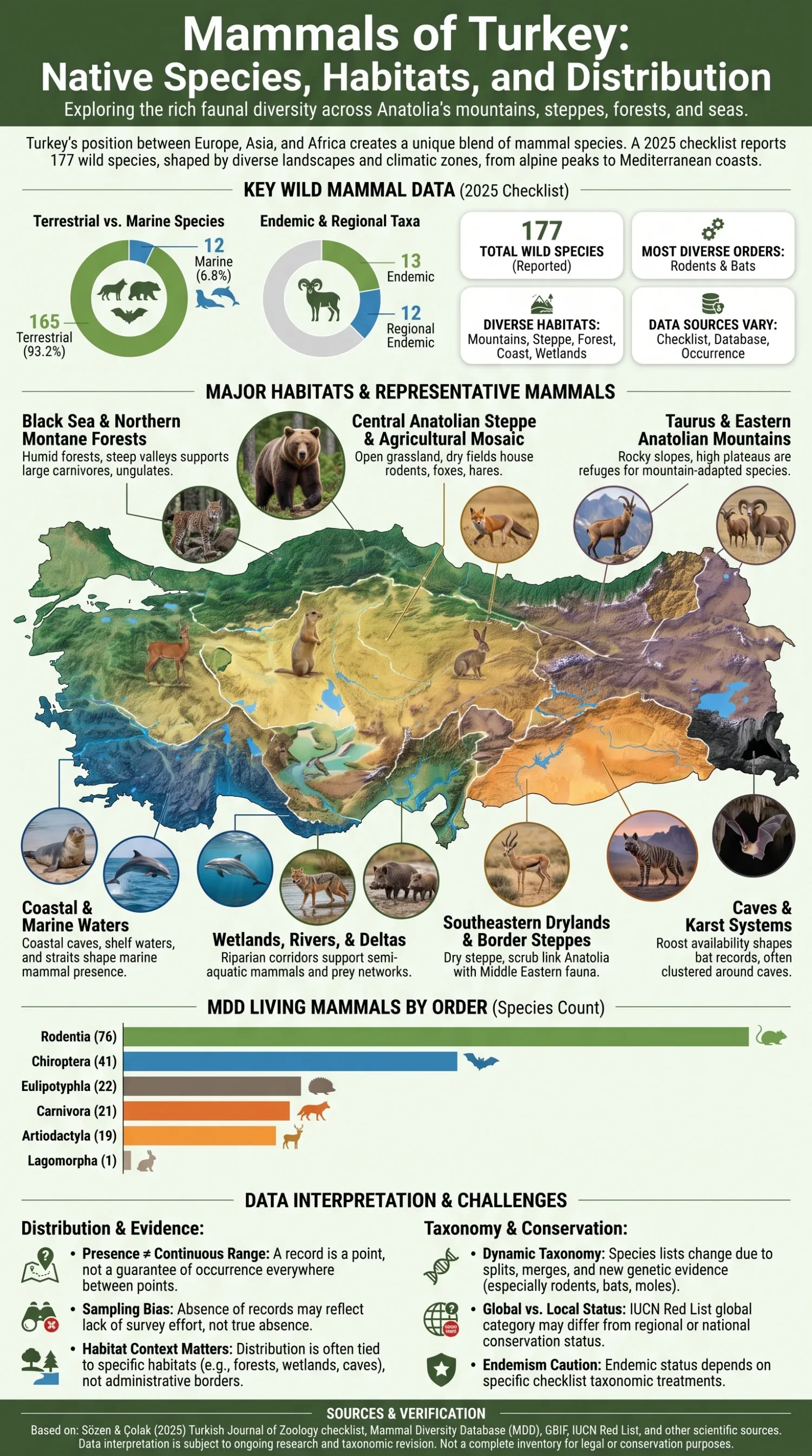
Türkiye supports mammal communities across Balkan forests, Anatolian steppe, the Taurus and eastern mountain systems, dry southeastern plains, rivers, caves, islands and four surrounding seas. A 2025 national checklist recognizes 177 wild species—165 terrestrial and 12 marine—but this figure combines native residents, four taxa coded alien or invasive, regular marine species and marine visitors. The red squirrel also has a mixed status: native in Thrace and introduced in northeastern Anatolia. [a]
Why Current Sources Produce Different Totals
The Mammal Diversity Database country page currently displays a headline total of 181 living species for Türkiye. Its visible order subtotals add to 180, while the 2025 national checklist totals 177. The difference is not a simple error margin: the sources apply different taxonomic treatments and different rules for alien species, marine visitors and country occurrence. [b]
Mammal Diversity Database version 2.4 was released on 2 January 2026 and records dozens of taxonomic changes since the preceding release. Country totals can therefore change when lineages are split, combined, moved to another genus or reassigned geographically even when no new field survey has taken place. [c]
| Order | 2025 national checklist | MDD v2.4 country page |
|---|---|---|
| Lagomorpha | 2 | 1 |
| Rodentia | 69 | 76 |
| Eulipotyphla | 22 | 22 |
| Chiroptera | 43 | 41 |
| Artiodactyla | 21 | 19 |
| Carnivora | 20 | 21 |
| Displayed total | 177 | 180; page headline 181 |
The Working Total Used on This Page
The 177-species national checklist is used for the full list below because it provides country-specific occurrence categories and explicitly separates native, alien, regular marine and visitor records. It is a source-based working list, not a claim that mammal taxonomy or national occurrence evidence is permanently settled.
Taxa Treated Differently in MDD v2.4
| Issue | 2025 national checklist | MDD v2.4 treatment | Effect on interpretation |
|---|---|---|---|
| Blind mole-rats | Five Nannospalax taxa | Eleven Nannospalax taxa | Fine-scale splitting raises the rodent subtotal. |
| Mouse-like hamsters | Calomyscus kiabii | C. bailwardi and C. urartensis | The country lists apply different species boundaries. |
| Jerboas | Includes Scarturus elater | Includes Scarturus indicus | The accepted country assignment changes. |
| Spiny mouse | Acomys cilicicus | Acomys cahirinus | The endemic label depends on the taxonomic treatment. |
| Bats | Several species retained in Eptesicus | Some are placed in Cnephaeus; the country subtotal is lower | Generic placement and species limits differ. |
| Marine mammals | Includes regular species and explicitly coded visitors | Uses its own country-occurrence set and includes Orcinus orca | A visitor record and a country-list record are not equivalent categories. |
| Alien mammals | Includes European rabbit, brown rat, black rat and coypu as alien/invasive | Some alien taxa are absent from the displayed country list | Scope rules alter the national total without changing native fauna. |
Mammal Distribution Follows Türkiye’s Habitat Belts
Türkiye lies across Mediterranean, Irano-Turanian and Euro-Siberian ecological zones. The national biodiversity strategy describes lowland and mountain steppe, humid Black Sea forests, drier inland forests, high alpine and subalpine grasslands, Mediterranean woodland and scrub, wetlands and marine coasts. These belts explain why Balkan and Caucasian forest mammals, Central Asian steppe rodents, Middle Eastern dryland mammals and Mediterranean marine species occur within one country. [d]
| Region or habitat | Ecological setting | Representative mammals | Distribution boundary |
|---|---|---|---|
| Thrace and Marmara | Deciduous woodland, agricultural mosaics, short grassland and wetlands | European ground squirrel, European hare, European mole, Roach’s mouse-tailed dormouse, red deer, roe deer, red squirrel | Balkan-linked taxa may be restricted to European Türkiye or the Marmara transition. |
| Western and central Black Sea | Humid forest, wooded mountains, river valleys and caves | Brown bear, gray wolf, Eurasian lynx, red deer, roe deer, pine marten, forest dormouse, horseshoe bats | Forest continuity, elevation and human land use shape local occupancy. |
| Eastern Black Sea and northeastern highlands | Dense forest below alpine and subalpine grassland | Caucasian shrews, snow voles, Robert’s snow vole, chamois, brown bear, gray wolf | Caucasian and high-mountain ranges often cross national borders. |
| Central Anatolian plateau | Open steppe, cereal fields, saline basins, rocky slopes and dry valleys | Anatolian ground squirrel, Brandt’s hamster, Günther’s vole, blind mole-rats, red fox, gray wolf | Rodent records are strongly affected by taxonomic identification and uneven survey coverage. |
| Taurus and Mediterranean Anatolia | Maquis, pine and cedar forest, limestone mountains, caves, rocky coast and dry scrub | Wild goat, Taurus ground squirrel, woolly dormouse, Egyptian fruit bat, caracal, striped hyena, Mediterranean monk seal | Mountain isolation and cave systems support narrow-range mammals and dense bat diversity. |
| Eastern Anatolian mountains | High plateaus, volcanic uplands, rocky alpine habitat and steppe | Armenian mouflon, chamois, wild goat, snow voles, long-clawed mole vole, brown bear, gray wolf | Elevation separates montane species from plateau and valley communities. |
| Southeastern Anatolia | Dry steppe, semi-desert plains, rocky escarpments and Euphrates–Tigris valleys | Mountain gazelle, Arabian sand gazelle, Euphrates jerboa, long-eared hedgehog, Indian gerbil, Egyptian mongoose | Irrigation, farming, roads and border geography affect present-day habitat continuity. |
| Rivers, lakes and marshes | Riparian cover, reedbeds, streams, reservoirs and wet meadows | Eurasian otter, water voles, water shrews, Daubenton’s bat, long-fingered bat, harvest mouse | Water quality and bank structure can matter more than broad regional labels. |
| Black Sea, Marmara, Aegean and Mediterranean | Continental shelf, deep basins, straits, islands, sea caves and rocky shore | Harbour porpoise, common dolphin, bottlenose dolphin, sperm whale, Cuvier’s beaked whale, Mediterranean monk seal | Regular occurrence, strandings and visitor records must be kept separate. |
An 11-year camera-trap study in northwestern Anatolia found that large mammals changed habitat use by season and in relation to human-dominated land cover. National range descriptions therefore cannot substitute for local surveys, and a species recorded in one forest-steppe mosaic should not be assumed to occupy every similar-looking site. [e]
Why a Habitat Belt Is Not a Range Map
The regional table summarizes recurring ecological associations. Actual presence depends on elevation, soil, water, vegetation structure, prey, disturbance, season and survey effort. Occurrence records document reported evidence; they do not define a complete distribution.
Source-Based Checklist of 177 Wild Mammals
The checklist below follows Sözen and Çolak (2025). “Native; endemic” reproduces taxa marked endemic in that source. “Regular marine species” and “marine visitor” describe the source’s occurrence class rather than breeding status or population size. Scientific names are retained as published in the national checklist so that its total remains internally consistent; the preceding table records major differences from MDD v2.4.
Lagomorphs (2 Species)
| No. | Family | Scientific name | Checklist status |
|---|---|---|---|
| 1 | Leporidae | Oryctolagus cuniculus | Alien/invasive |
| 2 | Leporidae | Lepus europaeus | Native |
Rodents (69 Species)
| No. | Family | Scientific name | Checklist status |
|---|---|---|---|
| 3 | Dipodidae | Scarturus williamsi | Native |
| 4 | Dipodidae | Scarturus aulacotis | Native |
| 5 | Dipodidae | Scarturus euphraticus | Native |
| 6 | Dipodidae | Scarturus elater | Native |
| 7 | Spalacidae | Nannospalax turcicus | Native; endemic |
| 8 | Spalacidae | Nannospalax xanthodon | Native |
| 9 | Spalacidae | Nannospalax cilicicus | Native; endemic |
| 10 | Spalacidae | Nannospalax tuncelicus | Native; endemic |
| 11 | Spalacidae | Nannospalax ehrenbergi | Native |
| 12 | Calomyscidae | Calomyscus kiabii | Native |
| 13 | Cricetidae | Mesocricetus auratus | Native |
| 14 | Cricetidae | Mesocricetus brandti | Native |
| 15 | Cricetidae | Nothocricetulus migratorius | Native |
| 16 | Cricetidae | Clethrionomys glareolus | Native |
| 17 | Cricetidae | Prometheomys schaposchnikowi | Native |
| 18 | Cricetidae | Bramus lutescens | Native |
| 19 | Cricetidae | Arvicola amphibius | Native |
| 20 | Cricetidae | Arvicola persicus | Native |
| 21 | Cricetidae | Chionomys nivalis | Native |
| 22 | Cricetidae | Chionomys lasistanius | Native |
| 23 | Cricetidae | Chionomys roberti | Native |
| 24 | Cricetidae | Chionomys stekolnikovi | Native; endemic |
| 25 | Cricetidae | Microtus majori | Native |
| 26 | Cricetidae | Microtus subterraneus | Native |
| 27 | Cricetidae | Microtus fingeri | Native; endemic |
| 28 | Cricetidae | Microtus daghestanicus | Native |
| 29 | Cricetidae | Microtus hartingi | Native |
| 30 | Cricetidae | Microtus guentheri | Native |
| 31 | Cricetidae | Microtus dogramacii | Native |
| 32 | Cricetidae | Microtus anatolicus | Native; endemic |
| 33 | Cricetidae | Microtus irani | Native |
| 34 | Cricetidae | Microtus obscurus | Native |
| 35 | Cricetidae | Microtus rossiaemeridionalis | Native |
| 36 | Muridae | Acomys cilicicus | Native; endemic |
| 37 | Muridae | Tatera indica | Native |
| 38 | Muridae | Gerbillus dasyurus | Native |
| 39 | Muridae | Meriones persicus | Native |
| 40 | Muridae | Meriones libycus | Native |
| 41 | Muridae | Meriones tristrami | Native |
| 42 | Muridae | Meriones crassus | Native |
| 43 | Muridae | Meriones vinogradovi | Native |
| 44 | Muridae | Meriones dahli | Native |
| 45 | Muridae | Micromys minutus | Native |
| 46 | Muridae | Nesokia indica | Native |
| 47 | Muridae | Rattus norvegicus | Alien/invasive |
| 48 | Muridae | Rattus rattus | Alien/invasive |
| 49 | Muridae | Apodemus witherbyi | Native |
| 50 | Muridae | Apodemus sylvaticus | Native |
| 51 | Muridae | Apodemus flavicollis | Native |
| 52 | Muridae | Apodemus uralensis | Native |
| 53 | Muridae | Apodemus mystacinus | Native |
| 54 | Muridae | Apodemus agrarius | Native |
| 55 | Muridae | Mus musculus | Native |
| 56 | Muridae | Mus macedonicus | Native |
| 57 | Hystricidae | Hystrix indica | Native |
| 58 | Echimyidae | Myocastor coypus | Alien/invasive |
| 59 | Sciuridae | Sciurus vulgaris | Native in Thrace; introduced in northeastern Anatolia |
| 60 | Sciuridae | Sciurus anomalus | Native |
| 61 | Sciuridae | Spermophilus citellus | Native |
| 62 | Sciuridae | Spermophilus taurensis | Native; endemic |
| 63 | Sciuridae | Spermophilus xanthoprymnus | Native |
| 64 | Gliridae | Glis glis | Native |
| 65 | Gliridae | Muscardinus avellanarius | Native |
| 66 | Gliridae | Myomimus roachi | Native |
| 67 | Gliridae | Myomimus setzeri | Native |
| 68 | Gliridae | Dryomys nitedula | Native |
| 69 | Gliridae | Dryomys laniger | Native; endemic |
| 70 | Gliridae | Dryomys anatolicus | Native; endemic |
| 71 | Gliridae | Eliomys melanurus | Native |
Hedgehogs, Shrews and Moles (22 Species)
| No. | Family | Scientific name | Checklist status |
|---|---|---|---|
| 72 | Erinaceidae | Erinaceus roumanicus | Native |
| 73 | Erinaceidae | Erinaceus concolor | Native |
| 74 | Erinaceidae | Hemiechinus auritus | Native |
| 75 | Soricidae | Sorex raddei | Native |
| 76 | Soricidae | Sorex araneus | Native |
| 77 | Soricidae | Sorex satunini | Native |
| 78 | Soricidae | Sorex minutus | Native |
| 79 | Soricidae | Sorex volnuchini | Native |
| 80 | Soricidae | Neomys milleri | Native |
| 81 | Soricidae | Neomys teres | Native |
| 82 | Soricidae | Suncus etruscus | Native |
| 83 | Soricidae | Crocidura gueldenstaedti | Native |
| 84 | Soricidae | Crocidura leucodon | Native |
| 85 | Soricidae | Crocidura arispa | Native; endemic |
| 86 | Soricidae | Crocidura mimula | Native |
| 87 | Talpidae | Talpa davidiana | Native |
| 88 | Talpidae | Talpa hakkariensis | Native; endemic |
| 89 | Talpidae | Talpa ognevi | Native |
| 90 | Talpidae | Talpa transcaucasica | Native |
| 91 | Talpidae | Talpa levantis | Native; endemic |
| 92 | Talpidae | Talpa martinorum | Native |
| 93 | Talpidae | Talpa europaea | Native |
Bats (43 Species)
| No. | Family | Scientific name | Checklist status |
|---|---|---|---|
| 94 | Pteropodidae | Rousettus aegyptiacus | Native |
| 95 | Rhinolophidae | Rhinolophus blasii | Native |
| 96 | Rhinolophidae | Rhinolophus mehelyi | Native |
| 97 | Rhinolophidae | Rhinolophus euryale | Native |
| 98 | Rhinolophidae | Rhinolophus ferrumequinum | Native |
| 99 | Rhinolophidae | Rhinolophus hipposideros | Native |
| 100 | Emballonuridae | Taphozous nudiventris | Native |
| 101 | Molossidae | Tadarida teniotis | Native |
| 102 | Miniopteridae | Miniopterus pallidus | Native |
| 103 | Miniopteridae | Miniopterus schreibersii | Native |
| 104 | Vespertilionidae | Nyctalus lasiopterus | Native |
| 105 | Vespertilionidae | Nyctalus noctula | Native |
| 106 | Vespertilionidae | Nyctalus leisleri | Native |
| 107 | Vespertilionidae | Pipistrellus pipistrellus | Native |
| 108 | Vespertilionidae | Pipistrellus pygmaeus | Native |
| 109 | Vespertilionidae | Pipistrellus nathusii | Native |
| 110 | Vespertilionidae | Pipistrellus kuhlii | Native |
| 111 | Vespertilionidae | Vespertilio murinus | Native |
| 112 | Vespertilionidae | Hypsugo savii | Native |
| 113 | Vespertilionidae | Eptesicus ognevi | Native |
| 114 | Vespertilionidae | Eptesicus anatolicus | Native |
| 115 | Vespertilionidae | Eptesicus bottae | Native |
| 116 | Vespertilionidae | Eptesicus serotinus | Native |
| 117 | Vespertilionidae | Barbastella barbastellus | Native |
| 118 | Vespertilionidae | Plecotus austriacus | Native |
| 119 | Vespertilionidae | Plecotus kolombatovici | Native |
| 120 | Vespertilionidae | Plecotus macrobullaris | Native |
| 121 | Vespertilionidae | Plecotus auritus | Native |
| 122 | Vespertilionidae | Otonycteris hemprichii | Native |
| 123 | Vespertilionidae | Myotis brandti | Native |
| 124 | Vespertilionidae | Myotis emarginatus | Native |
| 125 | Vespertilionidae | Myotis alcathoe | Native |
| 126 | Vespertilionidae | Myotis mystacinus | Native |
| 127 | Vespertilionidae | Myotis davidii | Native |
| 128 | Vespertilionidae | Myotis capaccinii | Native |
| 129 | Vespertilionidae | Myotis bechsteinii | Native |
| 130 | Vespertilionidae | Myotis daubentonii | Native |
| 131 | Vespertilionidae | Myotis blythii | Native |
| 132 | Vespertilionidae | Myotis myotis | Native |
| 133 | Vespertilionidae | Myotis nattereri | Native |
| 134 | Vespertilionidae | Myotis hoveli | Native |
| 135 | Vespertilionidae | Myotis tschuliensis | Native |
| 136 | Vespertilionidae | Myotis schaubi | Native |
Even-Toed Ungulates and Cetaceans (21 Species)
| No. | Family | Scientific name | Checklist status |
|---|---|---|---|
| 137 | Balaenopteridae | Balaenoptera physalus | Regular marine species |
| 138 | Balaenopteridae | Balaenoptera acutorostrata | Marine visitor |
| 139 | Ziphiidae | Ziphius cavirostris | Regular marine species |
| 140 | Physeteridae | Physeter macrocephalus | Regular marine species |
| 141 | Delphinidae | Grampus griseus | Regular marine species |
| 142 | Delphinidae | Pseudorca crassidens | Marine visitor |
| 143 | Delphinidae | Sousa plumbea | Marine visitor |
| 144 | Delphinidae | Tursiops truncatus | Regular marine species |
| 145 | Delphinidae | Stenella coeruleoalba | Regular marine species |
| 146 | Delphinidae | Delphinus delphis | Regular marine species |
| 147 | Delphinidae | Steno bredanensis | Marine visitor |
| 148 | Phocoenidae | Phocoena phocoena | Regular marine species |
| 149 | Cervidae | Dama dama | Native |
| 150 | Cervidae | Cervus elaphus | Native |
| 151 | Cervidae | Capreolus capreolus | Native |
| 152 | Bovidae | Gazella marica | Native |
| 153 | Bovidae | Gazella gazella | Native |
| 154 | Bovidae | Capra aegagrus | Native |
| 155 | Bovidae | Ovis gmelini | Native |
| 156 | Bovidae | Rupicapra rupicapra | Native |
| 157 | Suidae | Sus scrofa | Native |
Carnivorans (20 Species)
| No. | Family | Scientific name | Checklist status |
|---|---|---|---|
| 158 | Felidae | Panthera pardus | Native |
| 159 | Felidae | Caracal caracal | Native |
| 160 | Felidae | Lynx lynx | Native |
| 161 | Felidae | Felis chaus | Native |
| 162 | Felidae | Felis silvestris | Native |
| 163 | Herpestidae | Herpestes ichneumon | Native |
| 164 | Hyaenidae | Hyaena hyaena | Native |
| 165 | Canidae | Vulpes vulpes | Native |
| 166 | Canidae | Canis aureus | Native |
| 167 | Canidae | Canis lupus | Native |
| 168 | Ursidae | Ursus arctos | Native |
| 169 | Phocidae | Monachus monachus | Native marine species |
| 170 | Mustelidae | Meles meles | Native |
| 171 | Mustelidae | Meles canescens | Native |
| 172 | Mustelidae | Martes foina | Native |
| 173 | Mustelidae | Martes martes | Native |
| 174 | Mustelidae | Vormela peregusna | Native |
| 175 | Mustelidae | Mustela nivalis | Native |
| 176 | Mustelidae | Mustela putorius | Native |
| 177 | Mustelidae | Lutra lutra | Native |
Endemism Is Concentrated in Small Mammals
The 2025 checklist marks 13 terrestrial species as endemic to Türkiye. Ten are rodents, two are moles and one is a shrew. This pattern reflects geographic isolation in mountain systems, local soil-bound subterranean lineages and the fine-scale taxonomic separation of small mammals. Because several of these groups are still being revised, endemic totals can change when species limits change.
| No. | Family | Species | Order |
|---|---|---|---|
| 1 | Spalacidae | Nannospalax turcicus | Rodentia |
| 2 | Spalacidae | Nannospalax cilicicus | Rodentia |
| 3 | Spalacidae | Nannospalax tuncelicus | Rodentia |
| 4 | Cricetidae | Chionomys stekolnikovi | Rodentia |
| 5 | Cricetidae | Microtus fingeri | Rodentia |
| 6 | Cricetidae | Microtus anatolicus | Rodentia |
| 7 | Muridae | Acomys cilicicus | Rodentia |
| 8 | Sciuridae | Spermophilus taurensis | Rodentia |
| 9 | Gliridae | Dryomys laniger | Rodentia |
| 10 | Gliridae | Dryomys anatolicus | Rodentia |
| 11 | Soricidae | Crocidura arispa | Eulipotyphla |
| 12 | Talpidae | Talpa hakkariensis | Eulipotyphla |
| 13 | Talpidae | Talpa levantis | Eulipotyphla |
Selected Species with Elevated Global Risk Categories
The entries below are selected examples from the national checklist whose MDD species pages display an IUCN category above Least Concern. They are not a full national threatened-species inventory, and a global category does not replace a Türkiye-specific population assessment.
| Scientific name | Common name | Global category shown by MDD | Habitat association in Türkiye |
|---|---|---|---|
| Gazella gazella | Mountain gazelle | Endangered [f] | Dry southern plains, foothills and open scrub |
| Spermophilus citellus | European ground squirrel | Endangered [g] | Short grassland and steppe in Thrace |
| Myomimus roachi | Roach’s mouse-tailed dormouse | Vulnerable [h] | Thracean lowland grassland and agricultural mosaics |
| Vormela peregusna | Marbled polecat | Vulnerable [i] | Open steppe, dry grassland and farmland edges |
| Gazella marica | Arabian sand gazelle | Vulnerable [j] | Arid and semi-arid plains in southeastern Türkiye |
| Spermophilus xanthoprymnus | Anatolian ground squirrel | Near Threatened [k] | Central and eastern open steppe and plateau grassland |
Sources and Verification
- [a] Sözen, M. and Çolak, F. (2025), “An updated checklist of the mammals of Türkiye” — Used for the 177-species national checklist, terrestrial and marine totals, status codes, endemic designations and scientific names reproduced in the checklist.
- [b] Mammal Diversity Database: Türkiye country profile — Used for the current global taxonomic country treatment, the displayed 181-species headline, order subtotals and source-to-source taxonomic differences.
- [c] Mammal Diversity Database, version 2.4 — Used for the 2 January 2026 release date and the taxonomic-update context behind changing country totals.
- [d] National Biological Diversity Strategy and Action Plan — Used for Türkiye’s steppe, forest, alpine, wetland, Mediterranean and marine ecosystem structure; older species totals in the document were not used.
- [e] “Seasonal habitat-use patterns of large mammals in a human-dominated landscape” — Used for evidence that local habitat use by large mammals in northwestern Anatolia changes with season and land cover.
- [f] Mammal Diversity Database: Gazella gazella — Used for the global Endangered category displayed for the mountain gazelle.
- [g] Mammal Diversity Database: Spermophilus citellus — Used for the global Endangered category displayed for the European ground squirrel.
- [h] Mammal Diversity Database: Myomimus roachi — Used for the global Vulnerable category displayed for Roach’s mouse-tailed dormouse.
- [i] Mammal Diversity Database: Vormela peregusna — Used for the global Vulnerable category displayed for the marbled polecat.
- [j] Mammal Diversity Database: Gazella marica — Used for the global Vulnerable category displayed for the Arabian sand gazelle.
- [k] Mammal Diversity Database: Spermophilus xanthoprymnus — Used for the global Near Threatened category displayed for the Anatolian ground squirrel.
Related Topics
- → Wild Ungulates of Turkey: Deer, Goats, Sheep, and Wild Boar
- → Mountain Mammals of Turkey: Species of High Elevation Habitats
- → Bats of Turkey: Diversity, Habitats, and Conservation
- → Large Carnivores of Turkey: Wolves, Bears, Lynx, and Wild Cats
- → Marine Mammals of Turkey: Dolphins, Porpoises, and Seals
- → Fauna of Turkey: Wildlife, Habitats, and Regional Diversity