Complete guides: Mammals of Turkey•Regional Fauna Guides
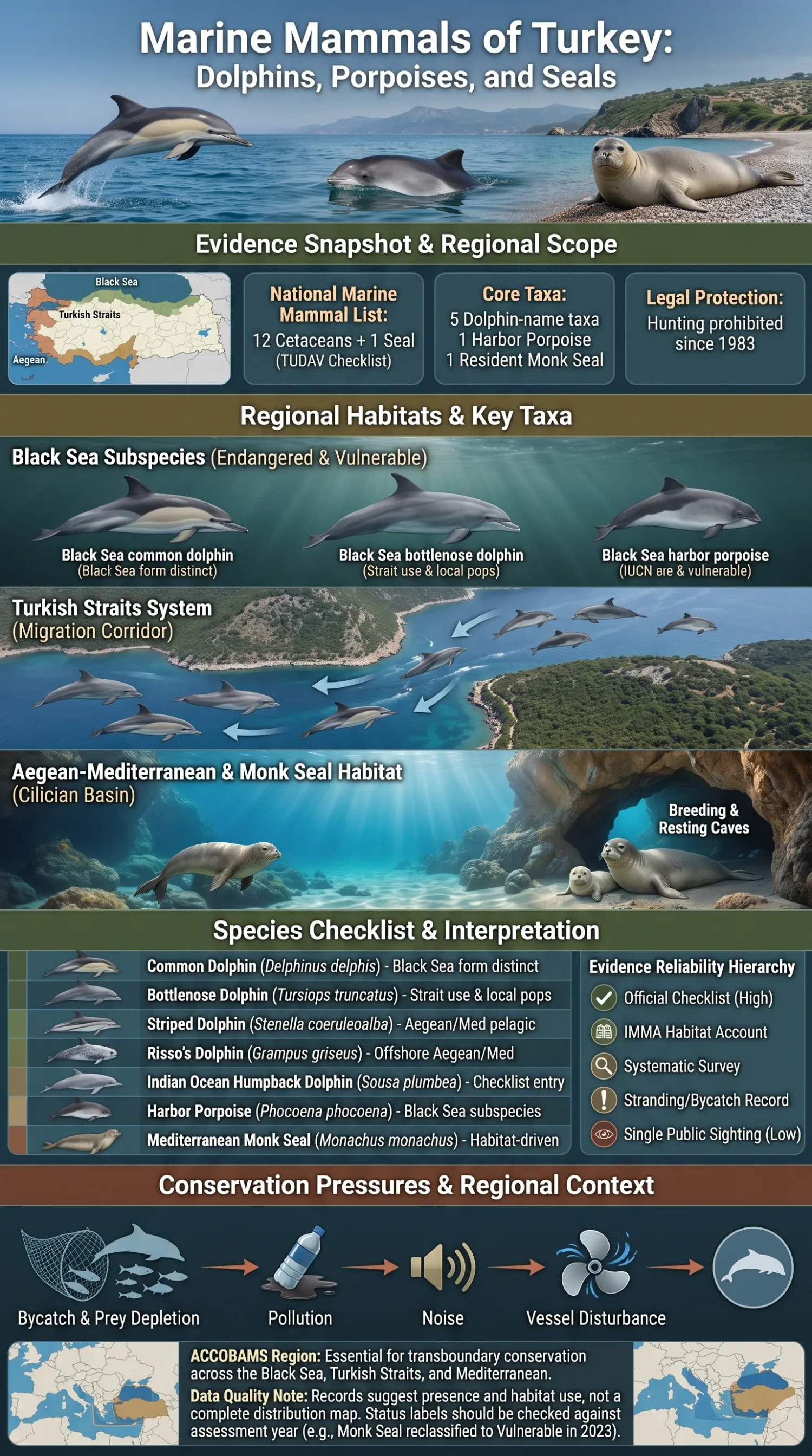
Turkey’s marine mammal fauna includes a recurring group of dolphins and harbour porpoises in the Black Sea, Marmara, Aegean and eastern Mediterranean, together with the Mediterranean monk seal along suitable Aegean and Mediterranean coasts. The most consistently documented focal species are the common bottlenose dolphin, short-beaked common dolphin, striped dolphin, Risso’s dolphin, harbour porpoise and Mediterranean monk seal. Rough-toothed dolphins and several other members of the dolphin family are supported by rarer, geographically limited or recently confirmed records.
Why Published Marine Mammal Totals for Turkey Differ
An updated national checklist published in 2025 reports 12 marine mammal taxa within Turkey’s wild mammal fauna.[a] That total is not a count of dolphins, porpoises and seals alone: it also covers whales accepted by the checklist. A separate TUDAV review published in 2019 discusses 13 cetacean species reported from Turkish seas, including regular species, rare visitors and historical records.[b]
The two figures should not be added together or treated as competing estimates. They were produced for different purposes and used different temporal, geographic and evidentiary boundaries. A national checklist may exclude a report that has not met its acceptance criteria, while a record-based marine review may retain an unusual sighting or stranding as evidence that a taxon has occurred in the country’s waters.
National Checklist Scope
12 marine mammals
Reported in the 2025 checklist of Turkey’s wild mammals, including marine taxa outside the dolphin–porpoise–seal focus of this page.
Black Sea Cetacean Core
3 regional taxa
Bottlenose dolphin, common dolphin and harbour porpoise populations are commonly treated under Black Sea subspecies names.
Regular Seal
Monachus monachus
The Mediterranean monk seal is the living seal regularly associated with Turkey’s Aegean and Mediterranean coasts.
Source-Based Checklist of Dolphins, Porpoises and Seals
The checklist below separates animals forming part of a repeatedly documented regional assemblage from taxa known through sparse, exceptional or recently published evidence. “Regular” describes the evidence used by the cited regional sources; it does not imply uniform abundance, year-round presence at every locality or a measured resident population throughout an entire sea.
| Common name | Scientific name | Family | Evidence class in Turkish waters | Principal documented areas |
|---|---|---|---|---|
| Common bottlenose dolphin | Tursiops truncatus; Black Sea animals commonly treated as T. t. ponticus | Delphinidae | Regular and widely recorded | Black Sea, Turkish Straits, Marmara, Aegean and Mediterranean |
| Short-beaked common dolphin | Delphinus delphis; Black Sea animals commonly treated as D. d. ponticus | Delphinidae | Regular, with strong regional differences in habitat use | Black Sea, Turkish Straits, Marmara, Aegean and Mediterranean |
| Striped dolphin | Stenella coeruleoalba | Delphinidae | Regular in deeper Aegean and Mediterranean waters; rare evidence in Marmara | Aegean and Mediterranean, with occasional Marmara records |
| Risso’s dolphin | Grampus griseus | Delphinidae | Regular in suitable deeper Aegean and Mediterranean habitat; rare in Marmara records | Aegean and Mediterranean, with isolated Marmara evidence |
| Harbour porpoise | Phocoena phocoena; Black Sea animals commonly treated as P. p. relicta | Phocoenidae | Regular in the Black Sea and Marmara; rare south of the Dardanelles | Black Sea, Bosphorus, Marmara and occasionally the northern Aegean |
| Mediterranean monk seal | Monachus monachus | Phocidae | Breeding and resting presence where undisturbed coastal habitat remains | Aegean and Mediterranean coasts |
| Rough-toothed dolphin | Steno bredanensis | Delphinidae | Recently confirmed; not established as a widespread Turkish population | Eastern Mediterranean waters of Turkey |
| False killer whale | Pseudorca crassidens | Delphinidae | Rare visitor supported by isolated sightings | Aegean and Mediterranean, including a northern Aegean record |
| Long-finned pilot whale | Globicephala melas | Delphinidae | Rare or historical record taxon | Aegean and Mediterranean |
| Humpback dolphin record | Sousa sp.; published as Sousa plumbea in one report | Delphinidae | Exceptional record requiring species-level caution | Mersin Bay, northeastern Mediterranean |
A Rare Record Is Not a Resident Population
A photograph, acoustic detection, stranding or short encounter can document occurrence without demonstrating breeding, seasonal residency or population size. The rarer taxa in the checklist should therefore be treated as documented evidence of presence rather than members of a confirmed, continuously resident national assemblage.
The Black Sea’s Three-Cetacean Assemblage
The modern Black Sea cetacean assemblage consists of the common bottlenose dolphin, short-beaked common dolphin and harbour porpoise. Regional conservation literature usually refers to the Black Sea forms as Tursiops truncatus ponticus, Delphinus delphis ponticus and Phocoena phocoena relicta. Their shared presence does not mean they occupy the same parts of the basin in the same way.
A basin-wide aerial survey found common dolphins concentrated mainly in deeper waters during summer, including southern survey sectors crossed by transects off Turkey. Bottlenose dolphins showed a stronger association with coastal and shallow shelf habitat along parts of the western Turkish Black Sea coast. Harbour porpoises occurred in coastal and shelf waters but were also recorded offshore and over deeper Turkish waters.[c]
These patterns are seasonal survey results rather than permanent range boundaries. Sea state, survey coverage, prey movements and the time of year can alter where animals are detected. Blank areas on a survey map may reflect limited observation effort as well as lower animal density.
Common Bottlenose Dolphin
Bottlenose dolphins use coastal waters, bays, shelf areas and the Turkish Straits System. Their ability to forage near shore and around human-modified seascapes makes them one of the cetaceans most likely to overlap with small-scale fisheries, vessel routes and heavily used coastal zones. Black Sea animals are assessed separately from the wider Mediterranean population because the regional population is biologically and geographically distinct.
Short-Beaked Common Dolphin
Common dolphins are documented in all four Turkish sea areas, but their ecology differs among basins. In the Black Sea they often occur farther offshore than bottlenose dolphins during summer surveys. In the Aegean and Mediterranean, records include coastal and open-water settings, and regional conservation assessments distinguish the inner Mediterranean subpopulation from the Black Sea population.
Black Sea Harbour Porpoise
The harbour porpoise is the only porpoise regularly documented in Turkish waters. Its main Turkish range lies in the Black Sea, Bosphorus and Marmara. Records farther into the Aegean are unusual and should not be interpreted as evidence of a continuous Aegean population. The species’ small body size, brief surfacing behaviour and limited visibility in rough water also make visual detection more difficult than for many dolphins.
Marmara and the Turkish Straits Connect Two Marine Faunas
The Bosphorus, Sea of Marmara and Dardanelles form a narrow marine connection between the Black Sea and Aegean. Bottlenose dolphins, common dolphins and harbour porpoises are all documented in this system. Animals observed in the straits may be feeding locally, moving between adjacent areas or using only part of the connected corridor.
Marmara records also include occasional taxa that are more characteristic of deeper Aegean or Mediterranean habitat. A rare stranding or sighting of Risso’s dolphin, for example, does not establish a regular Marmara population. The distinction between repeated local use and isolated entry is especially important in a narrow passage where cetaceans from two neighbouring faunal systems can occur.
Aegean and Eastern Mediterranean Dolphin Diversity
The Aegean and eastern Mediterranean support a broader dolphin assemblage than the Black Sea. Bottlenose and common dolphins use coastal and shelf waters, while striped and Risso’s dolphins are more strongly associated with open water, continental slopes, deep basins and submarine canyon systems. Offshore surveys have also produced records of rough-toothed dolphins and other rarely encountered delphinids.
Striped Dolphin
Striped dolphins are regular in the Aegean and Mediterranean but are not part of the Black Sea cetacean fauna. Their offshore habitat reduces the number of casual land-based observations, so survey routes, ferry observations, acoustic monitoring and strandings all contribute to the regional record. A Marmara occurrence is better treated as unusual evidence than as proof of a stable local group.
Risso’s Dolphin
Risso’s dolphins are associated mainly with deeper Aegean and Mediterranean waters. They can occur near steep coastal slopes where deep water approaches land, but that proximity should not be confused with a preference for shallow coastal habitat. Their distribution is linked partly to deep-diving cephalopod prey and the structure of continental slopes and canyons.
| Sea area | Repeatedly documented focal taxa | Additional or rare evidence | Main habitat pattern |
|---|---|---|---|
| Black Sea | Bottlenose dolphin, common dolphin, harbour porpoise | No additional dolphin forms established by the checked basin-wide sources | Coastal shallows, continental shelf and offshore waters are used differently by the three taxa |
| Bosphorus and Marmara | Bottlenose dolphin, common dolphin, harbour porpoise | Occasional Risso’s dolphin and other exceptional records | Narrow straits, productive passages, coastal waters and a semi-enclosed basin |
| Aegean Sea | Bottlenose dolphin, common dolphin, striped dolphin, Risso’s dolphin, Mediterranean monk seal | False killer whale, long-finned pilot whale and rare harbour porpoise evidence | Island coasts, shelves, deep channels, slopes, canyons and offshore basins |
| Eastern Mediterranean | Bottlenose dolphin, common dolphin, striped dolphin, Risso’s dolphin, Mediterranean monk seal | Rough-toothed dolphin, false killer whale, pilot whale and exceptional humpback dolphin evidence | Coastal shelves, deep Levantine waters, continental slopes, canyons and rocky seal habitat |
Mediterranean Monk Seals Depend on Undisturbed Coastal Refuges
The Mediterranean monk seal is not a cetacean. It is a true seal in the family Phocidae and must return to land for resting, giving birth and nursing. In the eastern Mediterranean, suitable habitat includes remote rocky shores, sea caves and, historically, open beaches. Marine caves now provide many of the least disturbed resting and pupping sites available to the species.[i]
Turkey’s Aegean and Mediterranean coasts contain breeding and resting habitat, but occupancy is highly uneven. The presence of a cave alone does not establish seal use. Entrance shape, internal beach or ledge structure, wave exposure, human access, fishing activity and the availability of quiet approaches all affect suitability.
Regional conservation planning calls for the protection and management of monk seal caves, haul-out sites and pupping areas along the Turkish Aegean and Mediterranean. Recommended measures include regulating human entry, reducing disturbance around occupied sites and protecting the surrounding marine area rather than treating only the cave chamber as habitat.[j]
Seal Locations Require Careful Disclosure
Exact pupping-cave locations can attract boat traffic, swimmers or photographers to sites where disturbance may cause a mother to abandon a resting place or separate from a pup. Public occurrence summaries should normally use a broader coastal scale unless a site is already managed and openly identified by the responsible conservation authority.
Rare Delphinids Recorded in Turkish Waters
Several animals with “whale” in their English names are taxonomically dolphins. False killer whales and pilot whales belong to Delphinidae, the same family as bottlenose, common and striped dolphins. Their larger body size does not place them among the baleen whales or sperm whales.
Rough-Toothed Dolphin
A published encounter provided the first confirmed documentation of rough-toothed dolphins in the eastern Mediterranean waters of Turkey.[f] ACCOBAMS reporting also records the species during expanded Turkish visual and acoustic survey work. The evidence establishes occurrence, but it is not yet a Turkey-wide abundance estimate or proof of a large resident population.
False Killer Whale
A group of false killer whales was observed approximately six nautical miles from Gökçeada on 21 January 2020. The record was reported as the first sighting for the northern Aegean Sea.[g] It broadens the documented occurrence area but remains an isolated observation rather than evidence of regular use around the island.
Long-Finned Pilot Whale
Long-finned pilot whales appear in historical and regional lists for the Aegean and eastern Mediterranean, where they are treated as rare. A record may represent a small travelling group, an animal outside the main population range or an isolated stranding. The checked sources do not provide evidence for a stable Turkish coastal population.
The Mersin Bay Humpback Dolphin Record
Two to four humpback dolphins were reported from Mersin Bay during observations in February and April 2016, and the publication identified them as Indian Ocean humpback dolphins, Sousa plumbea.[h] The underlying visual material has also been described as sufficient for identification to the genus Sousa but not necessarily for an uncontested species-level determination. The record is therefore best retained as exceptional evidence with its taxonomic qualification visible.
Conservation Status Depends on the Assessed Population
A species can receive different Red List categories at global, Mediterranean and Black Sea scales. The unit being assessed may be an entire species, a named subspecies or a regional subpopulation. Applying a Mediterranean category automatically to Black Sea animals, or describing a global category as Turkey’s national status, removes this biological distinction.
The table records categories published through an ACCOBAMS resolution compiling assessments completed from 2018 to 2021.[d] Several Black Sea entries were presented as provisional submissions awaiting completion of the IUCN review process. Later ACCOBAMS reporting stated that updated assessments for the three Black Sea cetaceans were still under review, so the dated categories below should not be presented as timeless labels.[k]
| Taxon or population unit | Assessment scale | Published category | Scope qualification |
|---|---|---|---|
| Black Sea bottlenose dolphin, T. t. ponticus | Black Sea subspecies | Endangered | Published as a provisional regional reassessment; not the category for every bottlenose dolphin in Turkish waters |
| Black Sea common dolphin, D. d. ponticus | Black Sea subspecies | Vulnerable | Published as a provisional regional reassessment |
| Black Sea harbour porpoise, P. p. relicta | Black Sea subspecies | Endangered | Published as a provisional regional reassessment |
| Common bottlenose dolphin | Mediterranean subpopulation | Least Concern | Does not replace the separate Black Sea assessment |
| Short-beaked common dolphin | Inner Mediterranean subpopulation | Endangered | Regional subpopulation category rather than a global species category |
| Striped dolphin | Mediterranean subpopulation | Least Concern | Population-level status does not imply freedom from local fisheries or pollution pressures |
| Risso’s dolphin | Mediterranean subpopulation | Endangered | Applies to the assessed Mediterranean population unit |
| Rough-toothed dolphin | Mediterranean subpopulation | Near Threatened | Regional category; Turkish occurrence evidence remains limited |
| Long-finned pilot whale | Inner Mediterranean subpopulation | Endangered | Does not demonstrate a resident population in Turkey |
| Mediterranean monk seal | Global species assessment | Vulnerable | Global 2023 assessment; local site occupancy and threats require separate evaluation |
A Red List category describes extinction risk for the defined assessment unit. It is not a measure of how easy the animal is to see, how many individuals occur in Turkey or whether every local group follows the same trend.
Bycatch Is the Clearest Measured Pressure in the Black Sea
Entanglement in fishing gear is one of the most direct causes of human-related cetacean mortality documented in the Black Sea. Harbour porpoises are particularly exposed because their habitat overlaps with fixed nets and other coastal fisheries. A recent ACCOBAMS scientific assessment reported that estimated Black Sea harbour porpoise bycatch exceeded the modelled sustainability threshold used in the analysis.[e]
Bycatch numbers cannot be recovered from observed carcasses alone. Some animals sink, decompose offshore, are removed from gear without being reported or strand beyond monitored coastlines. Conversely, not every stranded animal was killed in fishing gear. Reliable assessment combines carcass examination, fishing-effort data, onboard or electronic observation and uncertainty estimates.
What Western Black Sea Strandings Reveal
A TUDAV compilation recorded 1,243 cetacean strandings along the western Turkish Black Sea coast between 2003 and 2016. Harbour porpoises accounted for 77 percent, bottlenose dolphins 10 percent, common dolphins 7 percent and unidentified cetaceans 6 percent. The high porpoise share is evidence of mortality and carcass recovery along the monitored coast, not proof that porpoises formed exactly 77 percent of the living cetacean community.
Underwater Noise, Vessel Traffic and Coastal Disturbance
Cetaceans rely on sound for orientation, communication and foraging. Shipping, seismic exploration, construction, military sonar and other intense sound sources can mask biological signals or alter behaviour. ACCOBAMS reporting identifies oil and gas activity and military operations as underwater-noise concerns along the Turkish Mediterranean coast, with monitoring and mitigation treated as research and management priorities.
The Turkish Straits carry dense commercial vessel traffic through habitat used by dolphins and porpoises. Risk is not limited to direct collision. Repeated vessel approaches, propeller noise and disruption of feeding groups may affect how animals use narrow passages. The degree of effect depends on vessel type, speed, distance, repetition and the behaviour of the animals at the time.
For monk seals, disturbance occurs at the boundary between sea and land. Coastal construction, cave entry, boat anchoring near resting sites, deliberate harassment and fishing activity around cave approaches can reduce access to the quiet refuges needed for pupping and nursing. Protection restricted to the dry part of a cave does not address disturbance in the water immediately outside it.
Fishing Interactions Are Not All the Same
- Incidental capture: an animal becomes entangled or trapped in gear set for another species.
- Depredation: dolphins remove catch from fishing gear, sometimes damaging nets and increasing the chance of retaliation or entanglement.
- Prey competition: fishing and marine mammals use overlapping fish resources, although the scale and direction of competition must be tested rather than assumed.
- Gear modification: changes in net design, setting depth, soak time, season or fishing area may reduce capture risk when supported by trials and monitoring.
- Acoustic deterrents: devices may reduce some interactions but can also exclude animals from habitat or lose effectiveness, so deployment requires species- and fishery-specific assessment.
Why Sightings and Strandings Do Not Produce a National Population Estimate
Turkey-wide abundance cannot be calculated by adding sightings from research cruises, citizen observations, ferry routes, strandings and isolated publications. Each source measures a different process. A survey records animals available for detection inside a defined design; a stranding programme records carcasses that reach and are found on monitored shores; a first-record paper documents an unusual occurrence; and a checklist decides whether available evidence meets its inclusion rules.
Repeated records from the same well-watched bay may create a dense cluster without indicating higher abundance than an unsurveyed coast. The same individual can also be photographed on multiple days. Photo-identification can resolve some duplication by matching dorsal-fin markings, while line-transect surveys use detection models to estimate animals missed by observers.
Acoustic monitoring adds evidence for vocal species during darkness or poor weather, but detection distance varies by call type, depth, equipment and background noise. Monk seal monitoring requires another set of methods, including cave cameras, track or scat evidence, direct observation and genetic sampling. A reliable national account therefore retains the source type, date, location precision, identification confidence and survey effort attached to each record.
Recent Turkish programmes have expanded visual and acoustic work in the eastern Mediterranean, while Black Sea assessments continue to update distribution, bycatch and population-status evidence. The eastern Mediterranean remains unevenly surveyed, particularly across offshore and deep-water habitat, so future records may alter the known occurrence pattern without automatically indicating a recent range expansion.[l]
Sources and Verification
- [a] An updated checklist of the wild mammals of Türkiye — Used for the 2025 national total of terrestrial and marine mammal taxa.
- [b] Cetacean Studies in Turkey — Used for the historical Turkish-seas species table, regular and rare occurrence classifications, fishery history and western Black Sea stranding summary.
- [c] CeNoBS Black Sea Cetacean Survey Report — Used for summer aerial-survey evidence on bottlenose dolphin, common dolphin and harbour porpoise distribution and habitat use.
- [d] ACCOBAMS Resolution 8.12 on Red List Assessments of Cetaceans — Used for dated Black Sea and Mediterranean population-level conservation categories.
- [e] Report of the ACCOBAMS Scientific Committee — Used for recent Turkish visual and acoustic survey work, Black Sea harbour porpoise bycatch assessment and underwater-noise concerns.
- [f] First documentation of rough-toothed dolphins in the eastern Mediterranean Sea of Türkiye — Used for the first confirmed Turkish-waters record of Steno bredanensis.
- [g] First record of false killer whales in the northern Aegean Sea — Used for the dated Gökçeada observation and its northern Aegean record context.
- [h] Occurrence of humpback dolphins in Mersin Bay — Used for the 2016 Mersin Bay observations and the published Sousa plumbea identification.
- [i] IUCN Mediterranean Monk Seal Conservation Handbook — Used for monk seal resting, pupping and cave-habitat requirements and the 2023 global assessment context.
- [j] Regional Strategy for the Conservation of the Mediterranean Monk Seal — Used for management recommendations covering Turkish Aegean and Mediterranean caves, haul-out sites and pupping habitat.
- [k] Report on the Conservation Status of Cetaceans and Relevant Activities in the Black Sea — Used for the review status of updated Black Sea cetacean assessments and recent regional conservation work.
- [l] Report on the Conservation Status of Cetaceans and Relevant Activities in the Eastern Mediterranean — Used for recent survey coverage, research activity and remaining evidence gaps in the eastern Mediterranean.
Related Topics
- → Mountain Mammals of Turkey: Species of High Elevation Habitats
- → Mammals of Turkey: Native Species, Habitats, and Distribution
- → Bats of Turkey: Diversity, Habitats, and Conservation
- → Wild Ungulates of Turkey: Deer, Goats, Sheep, and Wild Boar
- → Large Carnivores of Turkey: Wolves, Bears, Lynx, and Wild Cats
- → Fauna of Turkey: Wildlife, Habitats, and Regional Diversity