Complete guides: Birds of Turkey•Regional Fauna Guides
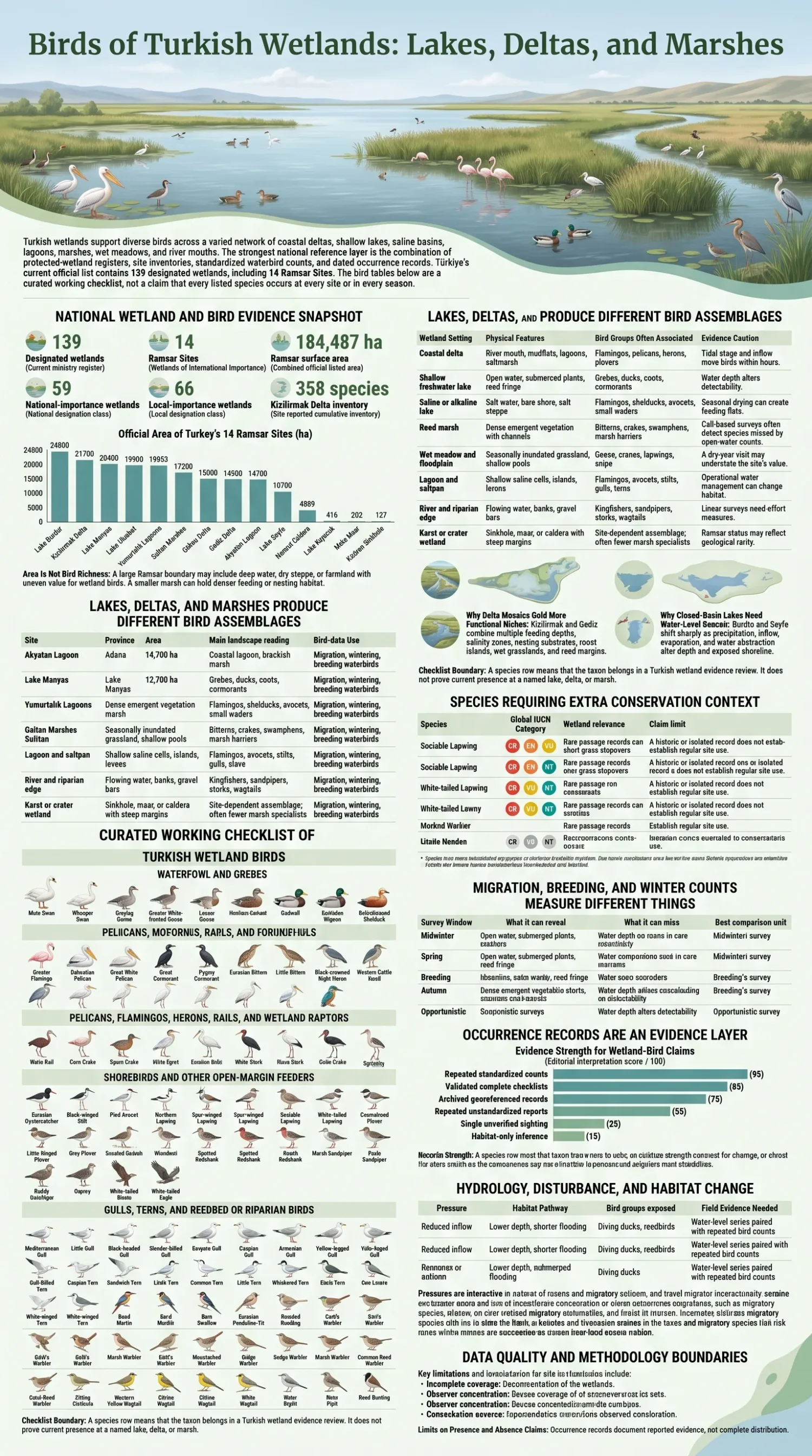
Turkish wetlands support different bird communities in open lakes, river deltas, coastal lagoons, saline basins, reed marshes, wet meadows, reservoirs, and shallow sea margins. The 2024 national Midwinter Waterbird Census recorded 1,684,756 waterbirds from 106 named species at 165 active sites; all 106 species are included below. This is a winter census, not a complete list of every bird that breeds, migrates through, or feeds in Türkiye’s wetlands during the year.[a]
A National Wetland Register and a Winter Census Measure Different Things
The Ministry’s wetland register currently states that Türkiye has 139 designated wetlands: 14 Ramsar Sites, 59 wetlands of national importance, and 66 wetlands of local importance.[b] The 2024 census visited 179 sites in 57 provinces, including reservoirs, coasts, river mouths, and other count units that do not all appear as separate entries in that designation register. Fourteen visited sites produced no waterbird observations because of freezing, snow, drying, or related field conditions, leaving 165 active count sites.
The census was carried out from 11 to 25 January 2024, close to the period when wintering waterbirds are least mobile and most concentrated. International Waterbird Census coverage includes grebes, cormorants, pelicans, herons, storks, ibises, spoonbills, flamingos, ducks, geese, swans, cranes, rails, shorebirds, gulls, and terns; wetland-dependent raptors and kingfishers may also be reported.[c] This explains why the national list contains Western Marsh Harrier, Osprey, White-tailed Eagle, Greater Spotted Eagle, and three kingfishers alongside ducks and waders.
Why the Named Rows Do Not Reconstruct the Grand Total
Observers sometimes cannot identify every bird in a distant, moving, or tightly packed flock. KOSKS retains such birds in aggregate records rather than forcing a species identification. The 2024 abundance chart includes 33,703 unidentified ducks, while the species table lists named taxa. The overall total therefore should not be recalculated by adding only the named rows below.
Deltas, Lakes, Saline Basins, and Marshes Select Different Birds
A wetland’s bird assemblage depends on water depth, salinity, exposed sediment, aquatic vegetation, fish supply, reed structure, nearby grassland, and seasonal flooding. Türkiye’s best-known wetland complexes often combine several of these conditions within one site. BirdLife describes the Gediz Delta as a mosaic of lagoons, reedbeds, fresh and saltwater marshes, salt meadows, wet and dry meadows, seasonally flooded ground, islets, farmland, and shrubland; its cumulative inventory includes 303 bird species.[d]
| Wetland form | Turkish examples | Bird-use pattern | Representative groups |
|---|---|---|---|
| Delta and lagoon mosaics | Kızılırmak, Gediz, Büyük Menderes, Göksu, Akyatan, Yumurtalık | Open lagoons, mudflats, saltmarsh, reedbeds, wet meadows, islands, and river mouths create feeding and roosting zones at several water depths. | Flamingos, spoonbills, pelicans, herons, shelducks, shorebirds, gulls, and terns |
| Large freshwater lakes | Beyşehir, Uluabat, Manyas, Eğirdir | Broad open water and vegetated margins support large flocks of coots and diving ducks, with grebes, cormorants, and pelicans using fish-rich sectors. | Coots, pochards, grebes, cormorants, pelicans, swans, and dabbling ducks |
| Saline and closed-basin waters | Burdur, Seyfe, Acıgöl, Arin, Erçek | Salinity, shallow margins, salt flats, and variable inflow favour birds able to exploit brackish water, invertebrate-rich shallows, and bare shorelines. | Flamingos, shelducks, avocets, plovers, gulls, and selected diving ducks |
| Reed marshes and wet meadows | Sultan Marshes, Hürmetçi Marsh, Karamık Marshes, Ereğli Marshes | Dense emergent vegetation, open reed channels, flooded pasture, and damp soil offer cover, nesting substrate, and invertebrate prey. | Rails, swamphens, bitterns, cranes, snipe, herons, and marsh harriers |
| Reservoirs and regulated waters | Hirfanlı, Sarıyar, Atatürk, Keban | Deep water, sheltered bays, dam forebays, and drawdown margins can hold wintering flocks even where natural marsh vegetation is limited. | Coots, ducks, grebes, cormorants, gulls, and occasional shorebirds |
| Coastal sea margins and river mouths | Black Sea coasts, Yeşilırmak Delta, Filyos Delta, İzmit Gulf | Nearshore feeding water, estuarine mixing, beaches, and breakwaters add marine and coastal species to the wetland count. | Loons, shags, Yelkouan Shearwaters, gulls, terns, and coastal waders |
Where the 2024 Winter Count Was Concentrated
The ten highest-count sites held both natural wetlands and human-regulated waters. Beyşehir Lake led with 249,113 recorded individuals, followed by Kızılırmak Delta with 158,903. High totals at Akyatan Lagoon, Uluabat Lake, Gediz Delta, Meriç Delta, Manyas Lake, and Büyük Menderes Delta show the importance of shallow lakes and delta mosaics, while Hirfanlı Reservoir shows that a reservoir can also hold a large midwinter concentration.
Wetlands Holding the Largest 2024 Midwinter Counts
Individuals recorded at the ten highest-count sites in the national survey.
Source: Türkiye Ministry of Agriculture and Forestry, 2024 Midwinter Waterbird Census. Values are counted individuals for the survey window, not resident population estimates.
One Winter Visit and a Cumulative Site Inventory Are Not Interchangeable
Kızılırmak Delta had the highest 2024 winter richness in the national count, with 64 named species, and Gediz Delta followed with 60. Those figures are much lower than their cumulative site inventories because a January count excludes many spring and autumn passage birds, summer breeders, scarce visitors, and species that are difficult to detect during a single survey window. The UNESCO tentative-list dossier reports 352 bird species recorded in Kızılırmak Delta across seasons and habitats.[e]
| Wetland | Cumulative inventory reported by site source | Species in the 2024 midwinter count | What the comparison shows |
|---|---|---|---|
| Kızılırmak Delta | 352 bird species in the UNESCO tentative-list dossier | 64 | The cumulative figure combines seasons and many years; the winter figure records one defined survey period. |
| Gediz Delta | 303 bird species on BirdLife’s landscape page | 60 | The delta’s habitat mosaic supports far more annual users than appear during one January count. |
The 106 Named Species Recorded in KOSKS 2024
The checklist below reproduces every named species in Table 3 of the 2024 national report. English common names are standardized for clarity, while the scientific-name column preserves the names printed in the source so the count remains auditable against the original document. “Status printed in the report” is the category carried by that 2024 table; it is not a substitute for checking a live Red List assessment. LC means Least Concern, NT means Near Threatened, VU means Vulnerable, and EN means Endangered.
Why Two Source Columns Are Not Repeated for Every Species
The report contains at least one internal mismatch in its site-detail fields: the Common Eider row gives one individual nationally but prints a highest-site value of 14. Rather than silently repairing source data, the complete tables below reproduce the unambiguous species name, scientific name, national individual count, and category printed in the report. Site peaks are quoted elsewhere only when the values are internally consistent.
Ducks, Geese, and Swans
| English common name | Scientific name in KOSKS 2024 | Individuals counted | Status printed in the report |
|---|---|---|---|
| Ruddy Shelduck | Tadorna ferruginea | 30,453 | LC |
| Greylag Goose | Anser anser | 1,157 | LC |
| Gadwall | Anas strepera | 5,602 | LC |
| Eurasian Teal | Anas crecca | 146,013 | LC |
| White-headed Duck | Oxyura leucocephala | 3,623 | EN |
| Common Pochard | Aythya ferina | 40,520 | VU |
| Eurasian Wigeon | Anas penelope | 23,680 | LC |
| Velvet Scoter | Melanitta fusca | 16 | VU |
| Common Scoter | Melanitta nigra | 2 | LC |
| Northern Shoveler | Anas clypeata | 48,707 | LC |
| Northern Pintail | Anas acuta | 19,111 | LC |
| Mute Swan | Cygnus olor | 595 | LC |
| Tundra Swan | Cygnus columbianus | 5,128 | LC |
| Lesser White-fronted Goose | Anser erythropus | 4 | VU |
| Red-crested Pochard | Netta rufina | 22,955 | LC |
| Whooper Swan | Cygnus cygnus | 1,704 | LC |
| Ferruginous Duck | Aythya nyroca | 684 | NT |
| Common Eider | Somateria mollissima | 1 | NT |
| Greater White-fronted Goose | Anser albifrons | 1,142 | LC |
| Red-breasted Goose | Branta ruficollis | 1 | VU |
| Common Shelduck | Tadorna tadorna | 11,237 | LC |
| Smew | Mergellus albellus | 136 | LC |
| Red-breasted Merganser | Mergus serrator | 170 | LC |
| Taiga Bean Goose | Anser fabalis | 2 | LC |
| Tufted Duck | Aythya fuligula | 27,045 | LC |
| Mallard | Anas platyrhynchos | 67,617 | LC |
Divers, Grebes, Cormorants, Pelicans, Herons, Rails, Cranes, Raptors, and Kingfishers
| English common name | Scientific name in KOSKS 2024 | Individuals counted | Status printed in the report |
|---|---|---|---|
| Great White Pelican | Pelecanus onocrotalus | 100 | LC |
| White-tailed Eagle | Haliaeetus albicilla | 5 | LC |
| Pied Kingfisher | Ceryle rudis | 63 | LC |
| Great Crested Grebe | Podiceps cristatus | 31,046 | LC |
| Eurasian Bittern | Botaurus stellaris | 8 | LC |
| Osprey | Pandion haliaetus | 13 | LC |
| Great Egret | Ardea alba | 3,170 | LC |
| Greater Spotted Eagle | Clanga clanga | 7 | VU |
| Glossy Ibis | Plegadis falcinellus | 26 | LC |
| Greater Flamingo | Phoenicopterus roseus | 69,791 | LC |
| Grey Heron | Ardea cinerea | 4,288 | LC |
| White-throated Kingfisher | Halcyon smyrnensis | 31 | LC |
| Black Stork | Ciconia nigra | 81 | LC |
| Great Cormorant | Phalacrocorax carbo | 49,498 | LC |
| Black-necked Grebe | Podiceps nigricollis | 6,491 | LC |
| Black-throated Loon | Gavia arctica | 3,064 | LC |
| Eurasian Spoonbill | Platalea leucorodia | 363 | LC |
| Red-necked Grebe | Podiceps grisegena | 3 | LC |
| Red-throated Loon | Gavia stellata | 2 | LC |
| Horned Grebe | Podiceps auritus | 3 | VU |
| Little Egret | Egretta garzetta | 1,104 | LC |
| Little Grebe | Tachybaptus ruficollis | 5,065 | LC |
| Pygmy Cormorant | Microcarbo pygmeus | 4,224 | LC |
| White Stork | Ciconia ciconia | 34 | LC |
| Eurasian Coot | Fulica atra | 671,675 | LC |
| Western Marsh Harrier | Circus aeruginosus | 864 | LC |
| Grey-headed Swamphen | Porphyrio porphyrio | 892 | LC |
| Western Cattle Egret | Bubulcus ibis | 382 | LC |
| Water Rail | Rallus aquaticus | 32 | LC |
| Common Moorhen | Gallinula chloropus | 874 | LC |
| European Shag | Phalacrocorax aristotelis | 346 | LC |
| Dalmatian Pelican | Pelecanus crispus | 1,338 | NT |
| Common Crane | Grus grus | 5,207 | LC |
| Common Kingfisher | Alcedo atthis | 156 | LC |
Plovers, Sandpipers, and Other Shorebirds
| English common name | Scientific name in KOSKS 2024 | Individuals counted | Status printed in the report |
|---|---|---|---|
| Sanderling | Calidris alba | 178 | LC |
| Kentish Plover | Charadrius alexandrinus | 997 | LC |
| European Golden Plover | Pluvialis apricaria | 1,953 | LC |
| Marsh Sandpiper | Tringa stagnatilis | 2 | LC |
| Red Knot | Calidris canutus | 26 | NT |
| Black-tailed Godwit | Limosa limosa | 546 | NT |
| Common Sandpiper | Actitis hypoleucos | 26 | LC |
| Ruff | Philomachus pugnax | 114 | LC |
| Grey Plover | Pluvialis squatarola | 1,172 | LC |
| Common Ringed Plover | Charadrius hiaticula | 73 | LC |
| Spotted Redshank | Tringa erythropus | 65 | LC |
| Dunlin | Calidris alpina | 17,010 | LC |
| Eurasian Curlew | Numenius arquata | 1,169 | NT |
| Pied Avocet | Recurvirostra avosetta | 2,811 | LC |
| Common Redshank | Tringa totanus | 1,434 | LC |
| Northern Lapwing | Vanellus vanellus | 10,475 | NT |
| Little Stint | Calidris minuta | 1,177 | LC |
| Spur-winged Lapwing | Vanellus spinosus | 1,435 | LC |
| Wood Sandpiper | Tringa glareola | 2 | LC |
| Eurasian Oystercatcher | Haematopus ostralegus | 70 | NT |
| Temminck’s Stint | Calidris temminckii | 1 | LC |
| Common Snipe | Gallinago gallinago | 358 | LC |
| Broad-billed Sandpiper | Limicola falcinellus | 1 | LC |
| Ruddy Turnstone | Arenaria interpres | 3 | LC |
| Black-winged Stilt | Himantopus himantopus | 16 | LC |
| Green Sandpiper | Tringa ochropus | 230 | LC |
| Common Greenshank | Tringa nebularia | 262 | LC |
Gulls, Terns, and Seabirds
| English common name | Scientific name in KOSKS 2024 | Individuals counted | Status printed in the report |
|---|---|---|---|
| Audouin’s Gull | Ichthyaetus audouinii | 1 | VU |
| Mediterranean Gull | Ichthyaetus melanocephalus | 290 | LC |
| White-winged Tern | Chlidonias leucopterus | 58 | LC |
| Pallas’s Gull | Ichthyaetus ichthyaetus | 2,442 | LC |
| Gull-billed Tern | Gelochelidon nilotica | 5 | LC |
| Yellow-legged Gull | Larus michahellis | 47,162 | LC |
| Caspian Gull | Larus cachinnans | 1,651 | LC |
| Caspian Tern | Hydroprogne caspia | 48 | LC |
| Slender-billed Gull | Chroicocephalus genei | 494 | LC |
| Black-legged Kittiwake | Rissa tridactyla | 2 | VU |
| Black-headed Gull | Chroicocephalus ridibundus | 78,146 | LC |
| Sandwich Tern | Thalasseus sandvicensis | 161 | LC |
| Lesser Black-backed Gull | Larus fuscus | 1 | LC |
| Parasitic Jaeger | Stercorarius parasiticus | 5 | LC |
| Common Gull | Larus canus | 132 | LC |
| Little Gull | Hydrocoloeus minutus | 128 | LC |
| Common Tern | Sterna hirundo | 81 | LC |
| Armenian Gull | Larus armenicus | 68,016 | LC |
| Yelkouan Shearwater | Puffinus yelkouan | 12,070 | VU |
Taxonomic Updates Should Not Be Mistaken for Different Count Records
Global bird lists change genera, species limits, and English names as evidence is reviewed. IOC World Bird List version 15.2 is a current global reference, but the KOSKS report predates that release and retains older combinations for several species.[f] BirdLife also maintains its own taxonomic treatment for Red List and conservation work, so a name may differ between a national report, IOC, BirdLife, and eBird/Clements without referring to a different field observation.[g]
| Species | Name printed in KOSKS 2024 | Current or corrected form used by major modern lists | Reason for retaining the report form above |
|---|---|---|---|
| Gadwall | Anas strepera | Mareca strepera | The count was published under the older genus. |
| Eurasian Wigeon | Anas penelope | Mareca penelope | The observation remains the same record despite the generic change. |
| Northern Shoveler | Anas clypeata | Spatula clypeata | The source table uses the former broad treatment of Anas. |
| Ruff | Philomachus pugnax | Calidris pugnax | Modern lists commonly place Ruff within Calidris. |
| Broad-billed Sandpiper | Limicola falcinellus | Calidris falcinellus | The record is retained under the name printed in the census. |
| Pygmy Cormorant | Microcarbo pygmeus | Microcarbo pygmaeus | The source spelling is preserved in the audit table; the accepted species epithet is pygmaeus. |
Breeding, Passage, and Secretive Marsh Birds Extend Beyond the January List
The winter checklist is strongest for conspicuous birds on open water and exposed shores. It is less suited to documenting the full annual use of reedbeds, wet grasslands, rice fields, seasonally flooded meadows, and migration stopovers. Dense vegetation reduces detection of rails, crakes, bitterns, and reedbed passerines; summer breeders may be absent in January; and many shorebirds pass through Türkiye mainly in spring or autumn.
Kızılırmak Delta illustrates the difference. Its cumulative dossier includes records such as Marbled Duck, Great Snipe, Aquatic Warbler, several Yellow Wagtail forms, and other passage or breeding birds that do not appear in the 106-species national winter table. The absence of a species from KOSKS 2024 therefore means it was not listed in that census result, not that it is absent from Turkish wetlands.
A Zero or Missing Winter Record Is Not a Distribution Statement
Frozen water, dry basins, access limits, weather, observer coverage, bird movement, and detectability affect a count. KOSKS records documented birds during a defined survey window. It does not establish the complete range of a species or prove year-round absence from an unsurveyed or inactive site.
Current Red List Checks Can Differ from the 2024 Report Column
The live BirdLife factsheet retains White-headed Duck as Endangered.[h] KOSKS counted 3,623 individuals, including 3,585 at Uluabat Lake, making that single-site result especially important within the national winter dataset. Common Pochard remains treated as Vulnerable in BirdLife’s assessment material; 40,520 were recorded nationally, with the largest reported site total at Uluabat Lake.[i]
The census table printed Grey Plover as Least Concern, but BirdLife’s live factsheet now lists it as Vulnerable after evidence of rapid declines.[j] Curlew Sandpiper, another shorebird now treated as Vulnerable, was not among the 106 named KOSKS 2024 species, although it can occur in Turkish wetland passage assemblages.[k] These examples show why the count value, source-table category, and current global assessment should be stored as separate fields.
| Species | KOSKS 2024 result | Current global category checked for this page | Evidence boundary |
|---|---|---|---|
| White-headed Duck | 3,623 individuals; 3,585 at Uluabat Lake | Endangered | The census measures a winter count, not the global population. |
| Common Pochard | 40,520 individuals; 14,639 at Uluabat Lake | Vulnerable | A large national winter count does not override the global assessment. |
| Grey Plover | 1,172 individuals; the report printed LC | Vulnerable | The live category changed after the source table was compiled. |
| Curlew Sandpiper | Not listed among the 106 named species | Vulnerable | Its absence from this winter table does not exclude passage records in Türkiye. |
Water Level and Shoreline Form Redistribute Birds Within the Same Wetland
Deep open water favours diving ducks, grebes, loons, and fish-eating cormorants, while shallow vegetated water supports many dabbling ducks, coots, swamphens, and herons. Falling water can expose mud that attracts plovers and sandpipers, yet prolonged drying may remove aquatic food, isolate reedbeds from open water, and eliminate secure roosts. A lower water level can therefore create short-lived shorebird habitat while reducing habitat for other groups.
Salinity also divides assemblages. Flamingos and several shorebirds exploit hypersaline or brackish shallows where invertebrate prey is concentrated, whereas many freshwater ducks depend on submerged plants, seeds, and freshwater invertebrates. At deltas, the meeting of river water, lagoons, saltmarsh, wet meadow, farmland, and the sea allows these groups to occur close together without using the same microhabitat.
For Turkish wetland birds, habitat labels such as “lake” or “delta” are only starting points. Water depth, hydroperiod, salinity, vegetation structure, exposed sediment, disturbance, and food availability determine which species can feed, roost, or breed at a site in a given season.
Sources and Verification
- [a] Türkiye Ministry of Agriculture and Forestry — 2024 Midwinter Waterbird Census Report — Used for the survey dates, site coverage, national total, site totals, all 106 named species, scientific names printed in the report, count values, and report-era status fields.
- [b] Türkiye Ministry of Agriculture and Forestry — Wetland Register — Used for the stated total and designation breakdown of Ramsar, nationally important, and locally important wetlands.
- [c] Wetlands International — International Waterbird Census — Used to define the bird groups normally covered by coordinated waterbird counts and the inclusion of other wetland-dependent birds.
- [d] BirdLife International — Gediz Delta — Used for the delta’s habitat mosaic and reported cumulative bird inventory.
- [e] UNESCO World Heritage Centre — Kızılırmak Delta Wetland and Bird Sanctuary — Used for the cumulative site inventory, habitat range, and examples of breeding and passage records beyond the winter census.
- [f] IOC World Bird List — Version 15.2 — Used as the current global naming reference for taxonomic comparison with the 2024 national report.
- [g] BirdLife DataZone — Taxonomy — Used to explain why conservation sources and other global checklists may apply different taxonomic treatments.
- [h] BirdLife DataZone — White-headed Duck — Used for the live global Red List category checked against the national winter count.
- [i] BirdLife DataZone — Common Pochard — Used for the live global conservation assessment associated with the KOSKS count record.
- [j] BirdLife DataZone — Grey Plover — Used to verify the current category that differs from the category printed in the 2024 census table.
- [k] BirdLife DataZone — Curlew Sandpiper — Used for the current global category of a passage shorebird not listed in the 2024 named-species table.
Related Topics
- → Birdwatching Regions in Turkey: Important Bird Areas and Habitats
- → Migratory Birds in Turkey: Major Flyways and Seasonal Patterns
- → Birds of Turkey: Native, Migratory, and Rare Species
- → Steppe Birds of Turkey: Open-Country Species
- → Common Birds of Turkey: Species Often Seen Across the Country
- → Forest Birds of Turkey: Woodland Species and Habitats