Complete guides: •Amphibians•Regional Fauna Guides•Fauna of Turkey
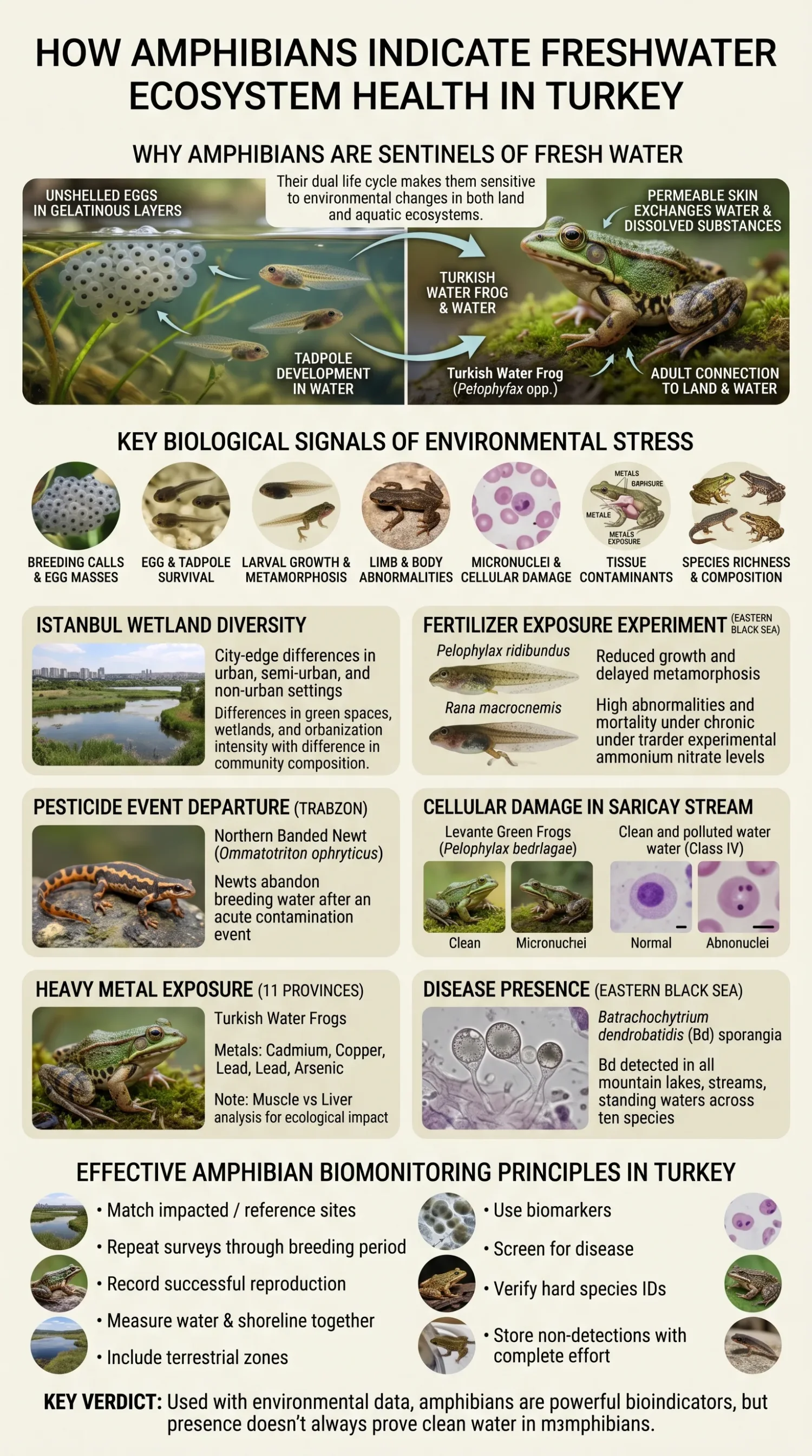
Amphibians indicate freshwater ecosystem health in Turkey because their eggs and larvae develop in water, their permeable skin exchanges water and dissolved substances with the surroundings, and many adults move between breeding water and nearby terrestrial habitat. Changes in breeding occupancy, larval survival, metamorphosis, body condition, tissue contaminants, cellular damage, or disease can reveal chemical pollution, altered hydroperiod, habitat fragmentation, or biological stress. A single frog record is not a water-quality verdict: the strongest diagnosis combines repeated amphibian surveys with water chemistry, sediment analysis, vegetation, hydrology, and land-use measurements.
Why Amphibians Register Changes in Fresh Water
An amphibian can encounter the same environmental pressure through several routes. Dissolved substances can cross the skin. Eggs are surrounded by gelatinous layers rather than a hard shell. Tadpoles feed, respire, grow, and complete metamorphosis in water. Adults may return to the same ponds, channels, springs, or wetland margins for breeding while depending on moist terrestrial cover during the rest of the year.
This life cycle connects water condition with the state of the surrounding catchment. A breeding pond may retain suitable water chemistry yet become unusable when roads, concrete surfaces, drainage, shoreline clearance, or loss of nearby vegetation prevent adults from reaching it. Conversely, adults may still arrive at a pond where larvae later experience fertilizer runoff, pesticides, metal exposure, low oxygen, rapid drying, or introduced predators.
Amphibian responses can therefore occur at several biological levels: behavior may change within hours or days, blood-cell or enzyme responses may appear after exposure, larval growth and metamorphosis may change within a breeding season, and community composition may shift over years. A 2026 review focused on Turkey describes this combination of dual habitat use, pollutant uptake, behavioral responses, tissue effects, and multi-biomarker measurements as the basis for amphibian biomonitoring.[a]
The Biological Signal and Its Possible Cause
| Amphibian measurement | Freshwater condition it may register | Evidence becomes stronger when | Other explanations that must be checked |
|---|---|---|---|
| Breeding calls, egg masses, or adults at water | Access to breeding habitat, seasonal water availability, shoreline condition, and local occupancy | The same sites are surveyed repeatedly under comparable weather and seasonal conditions | Survey timing, temperature, rainfall, calling behavior, observer effort, and temporary migration |
| Egg and tadpole survival | Acute toxicity, oxygen stress, rapid pond drying, predation pressure, or unsuitable temperature | Survival is compared among matched sites or controlled exposure treatments | Egg fertility, density, food supply, pathogens, predators, and developmental stage |
| Larval growth and time to metamorphosis | Nutrient pollution, chemical stress, food-web change, temperature, or shortened hydroperiod | Initial size, developmental stage, temperature, and food availability are controlled or recorded | Natural differences among species, populations, seasons, and pond types |
| Limb or body abnormalities | Developmental disruption associated with contaminants or interacting stressors | Abnormality rates exceed a matched reference and exposure pathways are tested | Injury, parasites, predation attempts, genetic effects, and handling damage |
| Micronuclei and abnormal blood-cell nuclei | Genotoxic or cellular stress associated with degraded water conditions | Water chemistry and organisms from contrasting sites are examined together | Age, sex, infection, season, nutrition, and unrelated physiological stress |
| Metals or other contaminants in tissues | Exposure accumulated through water, sediment, skin contact, and food | Water, sediment, liver, muscle, and species identity are analyzed at the same location | Diet, age, body size, mobility, sediment contact, and past exposure elsewhere |
| Species richness and community composition | Combined effects of wetland loss, isolation, hydroperiod, pollution, vegetation, and urban or agricultural land use | Detection probability and natural regional differences are incorporated into the survey design | Biogeography, elevation, climate, fish presence, historical colonization, and uneven sampling |
| Pathogen prevalence or infection load | Disease pressure that may alter survival, behavior, and local abundance | Pathogen tests accompany habitat and water measurements | Infection can occur without being caused by local chemical pollution |
Persistence Is Not the Same as Clean Water
A tolerant frog may remain present in a degraded pond while carrying accumulated contaminants or showing cellular stress. Presence confirms that an animal was detected; it does not prove that reproduction is successful, exposure is harmless, or the habitat can support the population over time.
Evidence from Turkish Fresh Waters
Community Turnover Across Istanbul’s Wetlands
A survey of 396 sites in Istanbul during 2016 and 2017 recorded seven amphibian species from four families at 151 stations. Anurans were found at 38.13% of the surveyed sites, while newts were found at 8.6%. Amphibian diversity differed among urban, semi-urban, and non-urban settings, with the semi-urban group producing the highest alpha-diversity values in that study.[b]
The result does not mean that intermediate urban development improves every wetland. Semi-urban areas may contain a mixture of remaining ponds, reservoirs, ditches, forest edges, gardens, and disturbed open land. Fully urban sites can lose breeding water and connecting vegetation, while non-urban sites can differ in agriculture, forest cover, wetland density, elevation, or natural water availability. Community composition is most informative when those habitat differences are measured rather than reduced to a single urbanization label.
Fertilizer Exposure During Tadpole Development
An Eastern Black Sea experiment exposed tadpoles of the marsh frog Pelophylax ridibundus, Iranian long-legged frog Rana macrocnemis, Caucasian parsley frog Pelodytes caucasicus, and variable green toad Bufotes variabilis to ammonium nitrate concentrations of 0, 5, 10, 15, 20, and 25 milligrams per liter from developmental stage 25 to stage 42.
Responses differed among species and between populations of the same species, but chronic exposure was associated with reduced growth, delayed metamorphosis, hind-limb abnormalities, and mortality. At 20 milligrams per liter, the reported mean across the tested populations was a 19% reduction in growth, a 46% rate of hind-limb abnormality, a 12-day delay in metamorphosis, and 46% mortality.[c]
These figures are experimental responses, not a national threshold that can be transferred unchanged to every Turkish pond. Water temperature, pH, exposure duration, developmental stage, species, population history, and the chemical form of nitrogen can alter toxicity. The study nevertheless shows why tadpole growth and metamorphosis can expose biological damage that a simple adult presence survey would miss.
Breeding-Site Abandonment After a Pesticide Event in Trabzon
Northern banded newts, Ommatotriton ophryticus, were observed active and breeding through the winter of 2017–2018 in a permanently water-filled channel in Trabzon. After an acute pesticide contamination event at the end of March 2018, the newts left the breeding water. Later visits did not relocate them at the site.[d]
Behavioral departure can act as a rapid warning signal, but this observation cannot establish that the animals died or that the local population disappeared. They may have moved to another aquatic or terrestrial refuge. A follow-up design would search nearby waters, test water and sediment, document the pesticide compound, and continue surveys through later breeding seasons.
Cellular Damage Along the Sarıçay Stream
Researchers compared Levant green frogs, Pelophylax bedriagae, from two sections of the Sarıçay Stream in Çanakkale that had different physicochemical water conditions. Frogs from the more polluted section, classified as water-quality class IV in the study, had higher frequencies of micronuclei and several abnormal nuclear forms. The cellular measurements separated the two sites even though the species occurred at both.[e]
This is an example of a biomarker revealing sublethal stress. The frogs did not need to vanish before degradation became detectable. Micronucleus and nuclear-abnormality tests can reveal damage associated with exposure, but they do not identify the responsible chemical by themselves. The diagnosis still requires paired water, sediment, and contaminant measurements.
Metal Exposure Recorded in Water-Frog Tissues
A study covering 11 provinces sampled water, sediment, muscle, and liver from Turkish water frogs identified as Pelophylax ridibundus, Pelophylax bedriagae, and Pelophylax caralitanus. Cadmium, copper, chromium, zinc, lead, and arsenic concentrations varied among sampling sites, tissues, and identified taxa.[f]
The study also calculated human dietary risk from frog-leg consumption, but a value below a human food-risk threshold is not evidence that the aquatic habitat is ecologically undamaged. Human consumption limits and amphibian biological effects answer different questions. Liver concentrations, reproductive effects, larval exposure, sediment contamination, and local population performance remain relevant even when edible muscle does not exceed a consumer-risk benchmark.
Disease Can Resemble Habitat Degradation
Testing at five Eastern Black Sea wetlands detected the amphibian pathogen Batrachochytrium dendrobatidis in 13 of 62 adults sampled from ten species. Positive animals included species associated with mountain lakes, wetland margins, streams, and standing breeding waters.[g]
A decline in calling adults, breeding activity, or local abundance can therefore reflect disease as well as water pollution, drought, habitat removal, or failed connectivity. Pathogen screening is especially useful when amphibian losses occur without an obvious chemical change or when nearby sites with similar water measurements show different population responses.
Species Identity Changes the Diagnosis
Different amphibian species do not respond to the same exposure in the same way. A water frog that remains active in a permanent pond cannot be treated as equivalent to a newt breeding in vegetated shallow water, a mountain frog using cold streams, or a toad using temporary pools. Sensitivity also varies among populations of the same species, as shown by the ammonium nitrate experiments.
Taxonomic decisions can alter national totals and monitoring trends. A 2024 trait database compiled 36 trait categories and 5,611 occurrence records for 37 amphibian species in Turkey from 436 literature sources.[h] A separate 2024 protected-area analysis modeled 36 species.[i] One reason national counts can change is the treatment of the Beyşehir water frog: bioacoustic, genetic, karyological, and morphological evidence has been used to place Pelophylax caralitanus as a junior synonym of Pelophylax bedriagae rather than retain it as a separate species.[j]
A monitoring database should preserve the name used in the original field record, the identification method, the source publication, and the currently applied taxonomic name. Combining older records under an updated name without retaining that history can create false appearances of range expansion, disappearance, or community change.
Occurrence Records Are Not Health Scores
A locality record documents reported evidence of a taxon at a place and time. It does not show whether the water was chemically clean, whether breeding succeeded, whether the population persisted, or whether survey effort was equal across regions.
A Monitoring Design Suited to Turkey’s Waters
Turkey’s amphibians use waters that differ in flow, depth, seasonality, elevation, salinity influence, vegetation, and surrounding land use. Mountain streams and spring-fed pools require a different survey design from lowland floodplain wetlands, coastal marshes, reservoirs, irrigation canals, urban ponds, roadside ditches, or temporary Mediterranean pools.
- Match impacted and reference sites. Comparisons should control as far as possible for region, elevation, water-body type, hydroperiod, and natural species pool. A lowland irrigation canal should not be judged against an unrelated mountain lake.
- Repeat surveys through the breeding period. Adults, calls, eggs, larvae, and newly metamorphosed juveniles appear at different times. Rainfall, temperature, and water level should accompany every visit.
- Record successful reproduction, not presence alone. Adults may visit a site where eggs fail, larvae die, or metamorphosis cannot be completed before the water disappears.
- Measure water and shoreline together. Temperature, dissolved oxygen, pH, conductivity, nutrients, metals, pesticides, turbidity, sediment condition, vegetation cover, water permanence, fish presence, and bank alteration address different parts of the habitat.
- Include the surrounding terrestrial zone. Roads, walls, intensive farming, drained ground, artificial lighting, vegetation clearance, and loss of nearby refuge can interrupt movement even when the breeding water remains.
- Use biomarkers for defined exposure questions. Tissue residues, blood-cell abnormalities, oxidative stress measurements, or histopathology are useful when the aim is to detect contaminant exposure rather than merely map species.
- Screen for disease when populations change unexpectedly. Pathogen testing helps separate infectious pressure from chemical or hydrological explanations.
- Verify difficult identifications. Calls, photographs, voucher material, larval characters, and DNA-based methods may be needed where closely related water frogs or newts cannot be separated reliably in the field.
- Store non-detections with survey effort. Date, duration, method, weather, observer, and number of visits are needed before absence can be interpreted as local loss.
What Amphibian Evidence Can and Cannot Diagnose
Amphibians are well suited to detecting effects that operate across the water–land boundary. Repeated breeding failure can reveal that a pond no longer provides enough time or suitable conditions for larval development. Cellular and tissue measurements can show exposure before a species disappears. Community change can reveal the combined outcome of wetland isolation, altered vegetation, urban development, agricultural runoff, water extraction, and changing hydroperiod.
They cannot identify a pollutant without chemical analysis, separate disease from habitat stress without additional testing, or prove local extinction after one unsuccessful visit. A species may be absent because the survey missed its breeding window, because the habitat lies outside its natural range, or because fish, drought, cold, elevation, and water flow make the site naturally unsuitable. A tolerant species may persist after more sensitive species have disappeared.
Used with repeated surveys and paired environmental measurements, amphibians provide a biological record of how water, shoreline habitat, and surrounding land function together. Used alone, they provide an observation that still requires an ecological explanation.
Sources and Verification
- [a] Amphibians and Reptiles as Bioindicator Organisms: An Ecotoxicological and Ecological Review — Used for the physiological, ecological, contaminant-exposure, biomarker, and Turkish biomonitoring basis of amphibian indicators.
- [b] The effects of increased urbanization on amphibian diversity and distribution in Istanbul, Türkiye — Used for the 396-site Istanbul survey, detection totals, and community differences among urbanization classes.
- [c] Effects of Environmentally Relevant Ammonium Nitrate Levels Caused by Agricultural Activities on Four Amphibian Species in the Eastern Black Sea Region — Used for the controlled tadpole exposures, species-dependent responses, growth reduction, abnormalities, metamorphosis delay, and mortality.
- [d] The Unusual Winter Activity and Negative Effects of Pollution on Breeding of Ommatotriton ophryticus in Turkey — Used for the Trabzon winter-breeding observation and departure from the channel after acute pesticide contamination.
- [e] Haematological and Genotoxicological Effects of Water Quality on Pelophylax bedriagae and Mauremys rivulata in Çanakkale, Türkiye — Used for the Sarıçay comparison between water-quality classes and the nuclear-abnormality response in Levant green frogs.
- [f] Investigation of heavy metals in tissues and habitats of three edible frogs from Türkiye — Used for the 11-province sampling of water, sediment, muscle, liver, and six measured metals.
- [g] Potential Distribution of the Amphibian Pathogen Batrachochytrium dendrobatidis in the Eastern Black Sea Region of Turkey — Used for pathogen screening results from 62 amphibians collected at five Eastern Black Sea wetlands.
- [h] An extensive database on the traits and occurrences of amphibian species in Turkey — Used for the national trait categories, literature coverage, occurrence-record total, and species scope applied by the database.
- [i] Conservation of more evolutionary unique amphibian communities in Türkiye: The role of protected areas — Used for the separate 36-species national analysis and the need to distinguish source scope when comparing amphibian datasets.
- [j] Diversity of Water Frogs Pelophylax spp. in Turkey: Do Mating Vocalizations Mirror Nominal Taxon Delimitation? — Used for the bioacoustic and taxonomic evidence treating Pelophylax caralitanus as a junior synonym of Pelophylax bedriagae.
Related Topics
- → Newts and Salamanders of Turkey: Species, Habitats, and Identification
- → Toads of Turkey: Identification, Habitats, and Regional Records
- → Dams and Freshwater Fish in Turkey: Habitat Fragmentation Explained
- → Invasive Freshwater Fish in Turkey: Impacts on Native Species
- → Endemic Freshwater Fish of Turkey: Basin-Restricted Species