Complete guides: •Amphibians•Regional Fauna Guides•Fauna of Turkey
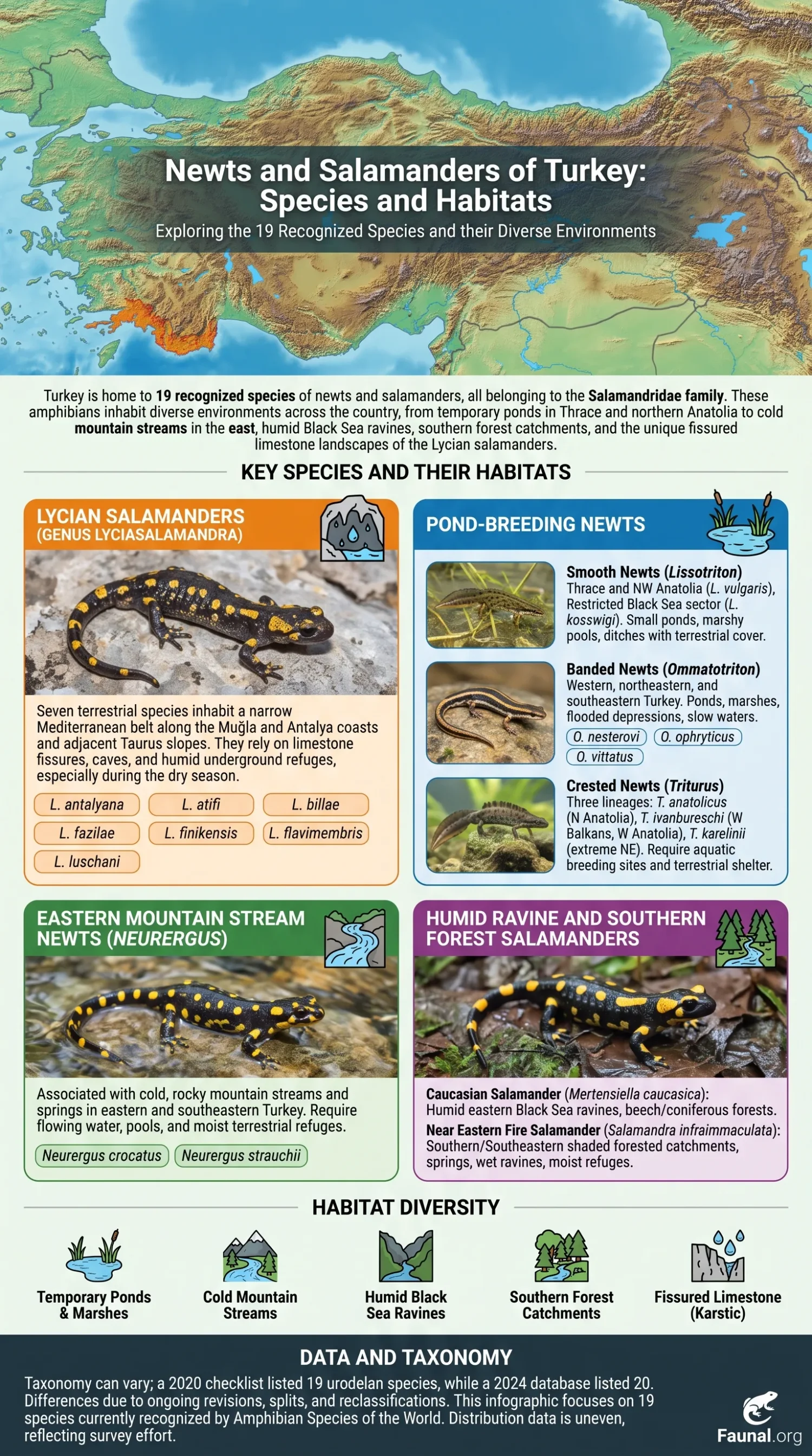
Turkey has 19 currently accepted species of newts and salamanders when recent species-level taxonomy is applied. All belong to the family Salamandridae, but they occupy very different ecological settings: temporary ponds in Thrace and northern Anatolia, cold mountain streams in the east, humid Black Sea ravines, southern forest catchments, and the fissured limestone landscapes inhabited by terrestrial Lycian salamanders.
A Turkish checklist published in 2020 also reported 19 urodelan species, while a literature-based database published in 2024 used a 20-species list. The difference comes from taxonomic treatment rather than a simple change in fauna: several names have since been split, combined, or returned to subspecies rank, and some historical records remain geographically or genetically unresolved.
Current Species-Level Treatment
Current Amphibian Species of the World records place Lissotriton schmidtleri and L. lantzi within L. vulgaris, include Neurergus barani and N. munzurensis within N. strauchii, recognize Lyciasalamandra finikensis, and retain Triturus karelinii for the genetically supported northeastern Turkish occurrence.[b]
The 19 Accepted Species Recorded from Turkey
The checklist below uses species-level names rather than counting named subspecies as additional species. “Recorded range” summarizes the Turkish localities and range statements reported in the cited taxonomic and distribution sources.
| Accepted species | Recorded Turkish range | Principal habitat relationship | Range or taxonomy note |
|---|---|---|---|
| Lissotriton kosswigi[g] | Northwestern Anatolia along the Black Sea side, from the Bosphorus toward the Zonguldak area | Shallow ponds, marshy pools, ditches, and other standing waters with nearby terrestrial cover | Turkish endemic with a restricted known range; commonly called Kosswig’s smooth newt |
| Lissotriton vulgaris[f] | European Turkey and western Asiatic Turkey; a historical northeastern record assigned to the lantzi form remains disputed | Small ponds, temporary waters, ditches, marsh edges, and surrounding grassland or woodland | Turkish populations formerly listed as the separate species L. schmidtleri and L. lantzi are now treated within L. vulgaris |
| Neurergus crocatus[h] | Extreme southeastern Turkey at reported localities including Mus, Kotum, and Sürüm, at about 1,280–2,000 metres | Cold rocky mountain streams, springs, stream pools, and adjacent terrestrial refuges | Shared with northwestern Iran and northeastern Iraq; Turkish occurrence is highly localized |
| Neurergus strauchii[i] | Eastern Anatolia, including areas south and west of Lake Van and records in Tunceli and Malatya | Clear mountain streams and small rivers bordered by shrubland, woodland, rocks, and moist shelters | Turkish endemic; current treatment includes populations formerly named N. barani and N. munzurensis |
| Ommatotriton nesterovi[j] | Northern Anatolia from the Kızılırmak Delta in Samsun westward to the Marmara region near Subaşı | Ponds, marshes, ditches, flooded depressions, and slow waters within wooded or cultivated landscapes | Turkish endemic; previously treated within the northern banded newt complex |
| Ommatotriton ophryticus[k] | Northeastern Turkey from the vicinity of Çatalan and Ünye eastward into the Caucasus | Forest ponds, marshy pools, roadside waters, ditches, and other still or slow breeding sites | Shared with Georgia, Armenia, and southern Russia |
| Ommatotriton vittatus[l] | Coastal southeastern Turkey | Breeding pools and ponds within coniferous, mixed, or deciduous forest landscapes and open upland habitat | Its wider range continues through parts of the Levant and northern Iraq |
| Triturus anatolicus[m] | Northern Asiatic Turkey from the Bosphorus eastward to the Yomra area near Trabzon, usually within about 200 kilometres of the Black Sea | Ponds, ditches, cisterns, flooded quarries, lakes, and other standing-water breeding sites with terrestrial cover nearby | Turkish endemic; formerly confused with T. ivanbureschi and T. karelinii |
| Triturus ivanbureschi[n] | European Turkey and western Asiatic Turkey | Vegetated ponds and other standing waters bordered by woodland, grassland, scrub, or low-intensity farmland | Shared with the southeastern Balkans; meets T. anatolicus in a hybrid zone near Bursa and Lake Ulubat |
| Triturus karelinii[o] | Extreme northeastern Turkey as part of the Caucasian range | Ponds, slow stream pools, drainage waters, and surrounding mountain forest or meadow habitat | Current records restrict true T. karelinii in Turkey to the extreme northeast; older western and northern records largely belong to other crested-newt lineages |
| Lyciasalamandra antalyana[p] | Isolated populations southwest and north of Antalya, including the Kedetler, Termessos, and Yağca areas, at about 100–800 metres | Terrestrial limestone slopes, rock fissures, pine woodland, Mediterranean shrub, and humid underground refuges | Turkish endemic with separated local populations |
| Lyciasalamandra atifi[q] | Along the Taurus range from the Akyaka region in Muğla eastward to Gazipaşa in Antalya, at about 190–1,300 metres | Rocky karst, caves and crevices, pine or mixed woodland, shrub-covered slopes, and moist stone refuges | Turkish endemic with several geographically named subspecies |
| Lyciasalamandra billae[r] | Antalya Province, including Beydağları, Göynük Canyon, Tahtalı Mountain, and nearby coastal and mountain localities | Fissured limestone, rocky forest slopes, canyon margins, pine woodland, and Mediterranean shrub | Current treatment includes populations formerly described as L. arikani, L. irfani, and L. yehudahi |
| Lyciasalamandra fazilae[s] | Southwestern Anatolia between the Köyceğiz–Dalaman region and coastal localities and islands near Domuz, up to about 1,000 metres | Rocky pine forest, Mediterranean shrub, karst slopes, stone walls, and sheltered coastal terrain | Turkish endemic occurring on the mainland and several nearshore islands |
| Lyciasalamandra finikensis[t] | Başkoz River Valley in the Finike region, including Finike, Turunçova, Gölcük Tepesi, Arif, and Çatal Tepesi, below about 800 metres | Pine forest, shrubland, rocky slopes, limestone fissures, and other cool terrestrial shelters | Turkish endemic elevated from L. luschani finikensis to species rank in the current treatment |
| Lyciasalamandra flavimembris[u] | Southwestern Muğla Province, from the Marmaris area toward Ula and Kötekli, mainly at low and middle elevations | Rocky pine forest, maquis shrub, limestone crevices, shaded stone accumulations, and humid cavities | Turkish endemic with a restricted and fragmented coastal range |
| Lyciasalamandra luschani[v] | Southwestern Anatolia from Patara to Demre, generally from sea level to about 400 metres; also present on Kastellorizo in Greece | Low-elevation coastal karst, Mediterranean shrub, pine woodland, ruins, stone walls, and rock fissures | The Turkish portion is not the species’ entire global range because the species also occurs in Greece |
| Mertensiella caucasica[w] | Northeastern Turkey in the eastern Black Sea region, extending westward to the Çambaşı area south of Ordu | Cool narrow mountain streams, wet ravines, stream banks, beech and conifer forest, mixed forest, and subalpine habitat | Shared with Georgia; some populations and historical names remain taxonomically debated |
| Salamandra infraimmaculata[x] | South-central and coastal southern Turkey, with additional isolated populations in southwestern and eastern parts of the country | Forested ravines, spring-fed channels, small streams, moist soil, caves, stones, logs, and shaded terrestrial refuges | The established Turkish fire salamander is distinct from the European Salamandra salamandra |
Why Older Turkish Lists Use Different Names
A 2020 national checklist recognized 19 urodelan species, but its 19 names do not match the present list one for one.[d] Taxonomic rank changes can leave the total unchanged even while several rows are replaced.
| Name found in older sources | Treatment used here | Reason for separate handling |
|---|---|---|
| Lissotriton schmidtleri | Lissotriton vulgaris schmidtleri | Returned to subspecies rank under L. vulgaris after phylogenomic analysis |
| Lissotriton lantzi | Lissotriton vulgaris lantzi | Returned to subspecies rank; its reported Turkish presence is based on unresolved historical evidence |
| Neurergus barani | Included within Neurergus strauchii | Current molecular treatment does not retain it as a separate species |
| Neurergus munzurensis | Included within Neurergus strauchii | The Munzur populations are retained within the wider variation of N. strauchii |
| Lyciasalamandra luschani finikensis | Lyciasalamandra finikensis | Elevated to species rank following genomic species-delimitation work |
| Triturus karelinii in western or northern Turkey | Usually T. anatolicus, T. ivanbureschi, or their contact-zone populations | The name was historically applied to a broad crested-newt complex before genetic separation of the Anatolian lineages |
| True Triturus karelinii | Retained for extreme northeastern Turkey | A genetically supported Caucasian-range occurrence is distinct from the old western Turkish usage |
Seven Lycian Salamanders Occupy a Narrow Mediterranean Belt
The genus Lyciasalamandra contains eight accepted species globally. Seven occur in Turkey; the eighth, L. helverseni, is restricted to Greek islands and is not part of the Turkish checklist.[a]
The Turkish species form a chain of mostly non-overlapping ranges along the Muğla and Antalya coasts and the adjacent Taurus slopes. The divisions are biological rather than administrative. Deep valleys, mountain ridges, dry plains, unsuitable rock, and breaks in humid coastal habitat can separate populations over short map distances.
These salamanders are terrestrial. They do not require an exposed pond for larval development in the way that smooth, banded, or crested newts do. Their usable habitat instead depends on networks of limestone fissures, caves, rock piles, shaded soil, roots, stone walls, ruins, and other spaces that retain moisture during the long Mediterranean dry season.
Range boundaries are often narrower than province maps suggest
Lyciasalamandra flavimembris is centred on the Marmaris–Ula sector, L. fazilae occupies the Köyceğiz–Dalaman region and nearby islands, and L. luschani lies farther east between Patara and Demre. The Finike lineage is now recognized as L. finikensis. Around Antalya, L. billae and L. antalyana occur in separate local population systems, while L. atifi follows a longer Taurus corridor eastward toward Gazipaşa.
Ecological niche work on the genus found temperature and precipitation to be major predictors of modeled range suitability. The results emphasize the dependence of these narrow-range salamanders on cool, seasonally wet terrestrial refuges and identify climate-sensitive parts of their southwestern Anatolian ranges.[y]
Finike Salamander Assessments Follow Older Taxonomy
Older conservation assessments may place the Finike populations within Lyciasalamandra luschani. Any category from that broader treatment belongs to the taxonomic scope and mapped population used in the original assessment, while L. finikensis now has separate species status.
Pond-Breeding Newts Form Three Geographic Belts
Smooth newts in Thrace and northwestern Anatolia
Lissotriton vulgaris occupies European Turkey and much of western Asiatic Turkey, while the endemic L. kosswigi is restricted to a smaller Black Sea sector of northwestern Anatolia. A review of 128 Turkish Lissotriton localities found the reported ranges of the main western taxa to be largely separate and concluded that the historical Turkish record of the Caucasian lantzi form still required confirmation.[e]
Small breeding waters are only one part of smooth-newt habitat. Adults also need vegetated margins and connected terrestrial shelter after leaving the water. A roadside ditch, farm pond, or marsh pool can hold breeding animals while the surrounding grass, leaf litter, scrub, or woodland provides the rest of the seasonal habitat.
Banded newts from Marmara to the Caucasus and Levant
The three Ommatotriton species divide Turkey into broad western, northeastern, and southeastern range systems. O. nesterovi occupies northern Anatolia west of the range of O. ophryticus. O. vittatus belongs to a separate southeastern and Levantine fauna.
Their breeding sites may include ponds, marshy depressions, ditches, flooded tracks, slow channels, and temporary waters. The surrounding landscape can vary from humid Black Sea forest to agricultural mosaics and southeastern woodland. Near range edges and contact areas, locality needs to be considered together with morphology and current taxonomy.
Three crested-newt lineages meet in Turkey
Triturus anatolicus occupies the Black Sea belt of northern Anatolia. T. ivanbureschi reaches Turkey from the southeastern Balkans and extends into western Anatolia. Their ranges meet in northwestern Anatolia, where hybridization means that a locality cannot always be assigned from external appearance alone.
Triturus karelinii has a separate Caucasian and Caspian distribution. Its accepted Turkish occurrence lies in the extreme northeast. Records from western Anatolia published under the same name before the modern revisions often represent T. anatolicus, T. ivanbureschi, or admixed populations.
All three crested-newt species depend on a paired habitat. Eggs and larvae develop in water, while juveniles and adults spend much of the year in terrestrial shelter. Protecting a pond without retaining nearby woodland, grassland, hedges, stone cover, and movement routes leaves only part of the habitat intact.
Eastern Mountain Streams Support the Two Neurergus Species
Neurergus crocatus and N. strauchii are stream-associated newts rather than typical lowland pond breeders. Their Turkish records are concentrated in eastern and southeastern mountain landscapes, where flowing-water habitat is linked to snowmelt, springs, rocky channels, pools, and moist terrestrial refuges along the banks.
Neurergus crocatus has a small Turkish range at the edge of a wider Iran–Iraq distribution. N. strauchii is endemic to Turkey and has a broader east-Anatolian range. The latter now includes the western and Munzur population groups that appeared as N. barani and N. munzurensis in earlier publications.
Suitable Neurergus habitat depends on channel structure, water permanence, temperature, sediment, bank cover, terrestrial shelter, and connections between stream sections. These conditions vary within the same river basin, producing occupied and unoccupied reaches over relatively short distances.
Humid Black Sea Ravines and Southern Forest Catchments
The Caucasian salamander follows cool mountain water
Mertensiella caucasica reaches Turkey through the humid eastern Black Sea and Caucasian landscape. It is associated with narrow mountain streams and wet stream banks in beech, coniferous, and mixed forest, extending in places into subalpine habitat. Stones, fallen wood, bank cavities, and damp ground provide shelter beside the water.
Its Turkish range extends beyond Artvin and Rize through Trabzon, Gümüşhane, Bayburt, Giresun, Kars, and westward toward the Çambaşı area south of Ordu. Published localities are unevenly distributed among provinces, reflecting both habitat patterns and differences in survey coverage.
The Near Eastern fire salamander has a discontinuous Turkish range
Salamandra infraimmaculata occurs across southern Turkey and in separated southwestern and eastern populations. Its habitat is commonly tied to shaded forested catchments, springs, wet ravines, small streams, caves, stones, logs, and soil refuges that retain moisture outside the surface-active period.
The gaps between known population groups may reflect dry intervening landscapes, fragmented habitat, limited survey effort, or a combination of these conditions. The known Turkish range is therefore best described as a series of separated population areas rather than one continuous block.
Each Habitat System Contains More Than Its Visible Water
| Habitat system | Species most closely associated | Aquatic requirement | Terrestrial requirement |
|---|---|---|---|
| Mediterranean limestone and coastal mountain slopes | Seven Turkish Lyciasalamandra species | No exposed breeding pond required | Fissures, caves, rock piles, shaded soil, pine woodland, shrub, ruins, and humid underground spaces |
| Small ponds and temporary standing waters | Lissotriton kosswigi, L. vulgaris | Shallow vegetated water for courtship, eggs, and larvae | Grass, scrub, woodland litter, stones, and connected shelter around breeding sites |
| Forest ponds, marshes, and flooded depressions | Ommatotriton nesterovi, O. ophryticus, O. vittatus | Still or slow seasonal breeding water | Woodland, shrub, meadow, field margins, and movement routes between waters |
| Crested-newt pond networks | Triturus anatolicus, T. ivanbureschi, T. karelinii | Ponds, ditches, cisterns, slow pools, or other standing waters | Woodland, meadow, grassland, scrub, hedges, and frost-free refuges |
| Eastern rocky streams and springs | Neurergus crocatus, N. strauchii | Cool flowing water, pools, springs, and structured stream beds | Moist banks, rocks, shrub, woodland, and connected streamside shelter |
| Humid Black Sea mountain ravines | Mertensiella caucasica | Narrow cool streams and small rivers | Wet forest floor, stones, logs, cavities, and shaded banks |
| Southern and eastern forested catchments | Salamandra infraimmaculata | Springs, stream margins, or other larval waters used by local populations | Shaded forest, ravines, caves, moist soil, stones, roots, and fallen wood |
Published Occurrence Density Is Uneven
The 2024 Turkish amphibian database compiled 1,339 urodele occurrence records from literature available through February 2023. It combined records with published coordinates and records whose coordinates were reconstructed from locality descriptions. The same dataset used 436 literature sources for all Turkish amphibian traits and occurrences.[c]
The 1,339 records represent literature occurrences rather than unique populations. Several entries can refer to the same population, heavily studied species can form dense clusters, and poorly surveyed areas may remain nearly blank. The database authors reported that only 8% of all compiled amphibian occurrence records came from Central Anatolia, illustrating the uneven geographic coverage of published work.
Dense clusters of occurrence records usually mark well-studied taxa and localities, while sparse areas may reflect limited survey or publication coverage.
Historical Records Behind Three Current Taxonomic Decisions
The northeastern smooth-newt record
A historical record attributed to the Caucasian smooth-newt form Lissotriton vulgaris lantzi has been reported from extreme northeastern Turkey. Later reviews regarded its Turkish presence as unresolved. Under the current species-level treatment, the record remains within the wider L. vulgaris complex and does not add a third Turkish Lissotriton species.
The two meanings of Triturus karelinii in Turkish literature
Older publications used Triturus karelinii for crested newts across large parts of Turkey. Modern work separated the northern Anatolian and western lineages as T. anatolicus and T. ivanbureschi. The name T. karelinii remains applicable to the genetically supported extreme northeastern occurrence connected to the Caucasian range, not to every historical Turkish record carrying that label.
The old Salamandra salamandra museum record
An old museum record has been cited for the European fire salamander Salamandra salamandra in western Turkey, but the 2024 national occurrence dataset excluded it because the species’ presence was not considered certain. Current Turkish species lists therefore retain Salamandra infraimmaculata as the established fire salamander and omit S. salamandra.
Sources and Verification
- [a] Amphibian Species of the World: Lyciasalamandra
- [b] Amphibian Species of the World: 2025 taxonomic changes
- [c] Arslan et al. 2024: An extensive database on the traits and occurrences of amphibian species in Turkey
- [d] Kurnaz 2020: Species list of Amphibians and Reptiles from Turkey
- [e] Wielstra et al. 2015: The distribution and taxonomy of Lissotriton newts in Turkey
- [f] Amphibian Species of the World: Lissotriton vulgaris
- [g] Amphibian Species of the World: Lissotriton kosswigi
- [h] Amphibian Species of the World: Neurergus crocatus
- [i] Amphibian Species of the World: Neurergus strauchii
- [j] Amphibian Species of the World: Ommatotriton nesterovi
- [k] Amphibian Species of the World: Ommatotriton ophryticus
- [l] Amphibian Species of the World: Ommatotriton vittatus
- [m] Amphibian Species of the World: Triturus anatolicus
- [n] Amphibian Species of the World: Triturus ivanbureschi
- [o] Amphibian Species of the World: Triturus karelinii
- [p] Amphibian Species of the World: Lyciasalamandra antalyana
- [q] Amphibian Species of the World: Lyciasalamandra atifi
- [r] Amphibian Species of the World: Lyciasalamandra billae
- [s] Amphibian Species of the World: Lyciasalamandra fazilae
- [t] Amphibian Species of the World: Lyciasalamandra finikensis
- [u] Amphibian Species of the World: Lyciasalamandra flavimembris
- [v] Amphibian Species of the World: Lyciasalamandra luschani
- [w] Amphibian Species of the World: Mertensiella caucasica
- [x] Amphibian Species of the World: Salamandra infraimmaculata
- [y] Hosseinian Yousefkhani et al. 2023: Modeled ranges of Lycian salamanders in southwestern Anatolia