Complete guides: •Invasive Species Guides•Freshwater Fish•Regional Fauna Guides•Fauna of Turkey
Updated: October 14, 2026 What changed?
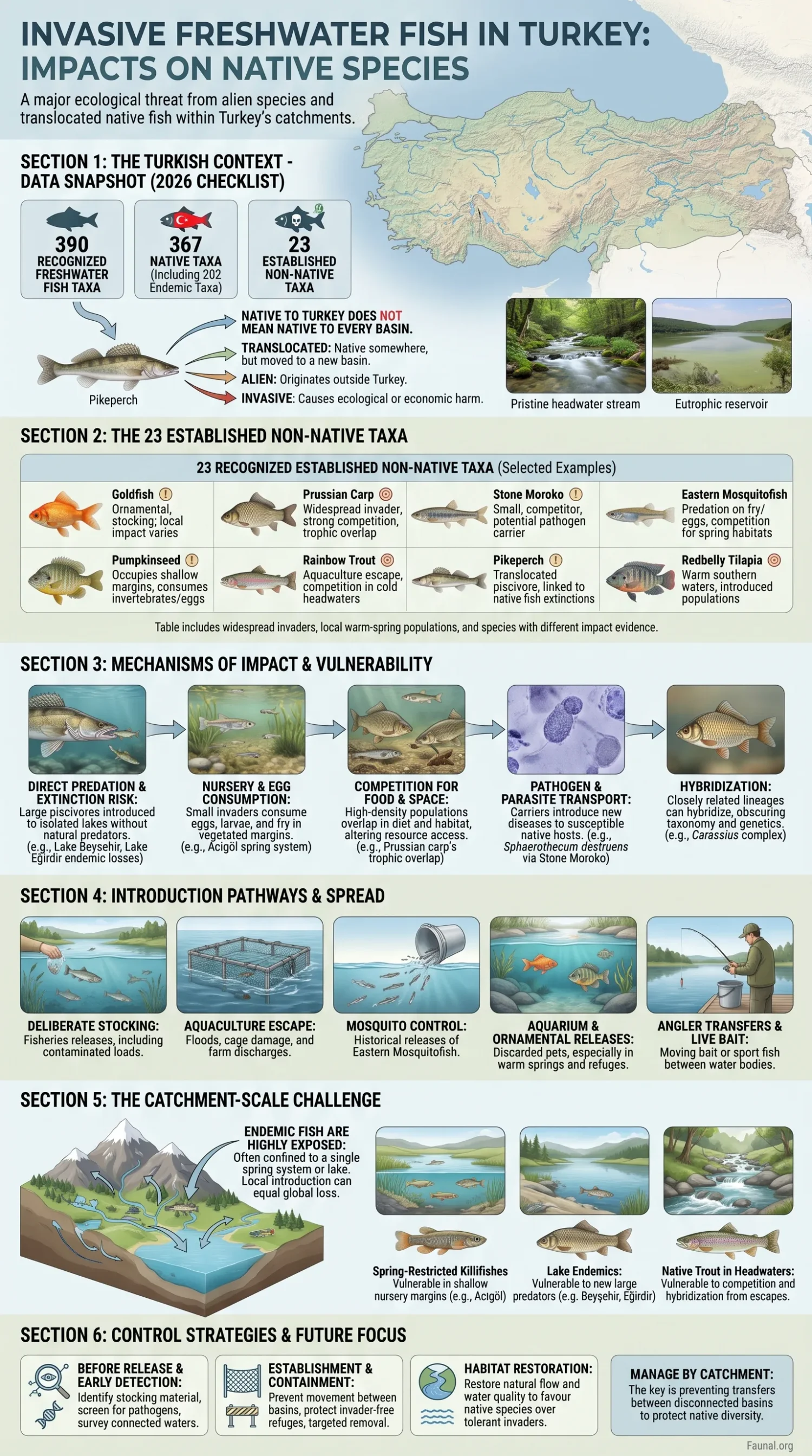
Turkey’s invasive freshwater-fish problem is caused by both alien species arriving from outside the country and fish moved between naturally isolated Turkish catchments. Native fish may be affected through predation on eggs and fry, competition for food and nursery habitat, pathogen transport, altered food webs and the introduction of new predators into lakes that evolved without them. The greatest exposure falls on endemic fish confined to a single spring system, lake or headwater, where the loss of one local population may equal the loss of the species.
The 2026 national checklist recognises 390 freshwater fish taxa in Turkey. It treats 367 as native, including 202 native taxa endemic to the country, and recognises 23 established non-native taxa. These figures depend on the taxonomy and establishment criteria used by the checklist; they are not permanent totals and should not be read as an inventory of species causing equal ecological damage. [a]
Recognised Freshwater Fish Taxa
390
National checklist scope for 2026.
Native Taxa
367
Species and recognised infraspecific taxa treated as native.
Established Non-Native Taxa
23
Biological checklist category; not a count of legally UİST-listed fish.
A Fish Can Be Native to Turkey and Still Invade a Turkish Basin
Freshwater catchments function as partly isolated biological systems. Mountain ranges, drainage divides, waterfalls, saline lakes and closed basins have limited natural movement between many Turkish fish communities. This isolation helped produce high endemism, but it also means that a fish native to one part of Turkey may become an introduced predator or competitor when released into another drainage.
Native Nationally, Introduced Locally
Native to Turkey does not mean native to every Turkish lake or river. Pikeperch, European perch, common carp and eastern sand smelt have natural or historically accepted ranges in parts of the country but have also been moved into basins they could not have reached unaided.
Four terms therefore need to remain separate. An alien fish originates outside Turkey’s natural freshwater fauna. An established non-native fish has persistent records or a self-maintaining population under the criteria used by a checklist. An invasive fish produces ecological, economic or biological harm. A translocated fish is native somewhere in Turkey but has been carried outside its natural catchment.
A national alien-species list alone cannot identify every threatened native population. The relevant unit is the receiving catchment, its natural fauna and the pathway by which the introduced fish arrived.
Biological Status and Legal UİST Status Are Separate
Turkey’s Regulation on the Prevention and Management of the Introduction and Spread of Invasive Alien Species entered into force on 21 February 2026. It provides for a regularly updated National Invasive Alien Species (UİST) List, with listing tied to scientific and technical risk assessment.[m]
| Status question | What it describes | What it does not establish |
|---|---|---|
| Native status | Whether a fish belongs naturally to Turkey or to a particular freshwater catchment. | It does not show whether the fish is harmless after translocation to another Turkish basin. |
| Ecological establishment or invasiveness | Whether an introduced population persists or reproduces, and whether ecological harm is documented. | Established status alone does not prove the same level of impact in every water body. |
| Legal UİST status | Whether a species has been placed on the official UİST List under the 2026 regulation. | A biological checklist entry or an established non-native record does not automatically confer UİST-listed status. |
The 23 established non-native taxa listed below come from the 2026 freshwater-fish checklist. They should not be read as a list of fish legally designated under the UİST system.
Why Published Totals of Alien Fish Differ
A 2022 review reported 34 exotic fish species introduced deliberately or accidentally into Turkish inland waters and considered 19 of them established in the wild. The 2026 checklist recognises 23 established non-native taxa. The two figures are not directly interchangeable: one counts known introductions before separating establishment outcomes, while the later checklist applies updated taxonomy, newer records and its own treatment of repeated observations. [b]
Checklist Status Is Not an Impact Ranking
Some listed fish, including silver carp, bighead carp and rainbow trout, were retained because they have repeated records across localities or years even though the checked national review did not document natural reproduction in Turkey. Their inclusion should not be interpreted as proof that each has formed a reproducing invasive population in every recorded basin.
The 23 Established Non-Native Taxa Recognised in 2026
The 2026 freshwater-fish checklist contains widespread invaders, local warm-spring populations, aquaculture escapees, unresolved taxonomic records and species associated mainly with transitional or coastal waters. The table retains these differences instead of assigning the same invasion label to every row, and it does not assign legal UİST status.
| Taxon | Common Name | Record Context in Turkey | What the Record Supports |
|---|---|---|---|
| Carassius auratus | Goldfish | Reported from numerous lakes, ponds and reservoirs. | Repeated ornamental or stocking-related introductions; local impact evidence varies. |
| Carassius gibelio | Prussian carp | Recorded across Aegean, Mediterranean and Black Sea drainages, as well as the Tigris, Euphrates and Kura systems. | Widespread invader with documented competitive overlap and strong establishment capacity. |
| Carassius langsdorfii | Ginbuna | Present within the difficult-to-identify Carassius auratus species complex. | Accepted as non-native, but hybridisation and misidentification obscure its Turkish distribution. |
| Hypophthalmichthys molitrix | Silver carp | Reported from the Meriç drainage and Keban Reservoir. | Repeated occurrence evidence; natural reproduction has not been documented by the national checklist. |
| Hypophthalmichthys nobilis | Bighead carp | Reported from the Meriç drainage. | Repeated occurrence evidence without documented natural reproduction in the checked national review. |
| Pseudorasbora parva | Stone moroko | Initially recorded in the Meriç and later reported from numerous western, central and eastern drainages. | Established invader associated with competition and pathogen-carrier risk. |
| Pterygoplichthys disjunctivus × P. pardalis | Hybrid sailfin catfish | Recorded in Pınarbaşı Stream near İnönü, with a possible record in the Orontes system. | Local warm-water introduction linked to the ornamental-fish pathway. |
| Clarias sp. | Unresolved walking catfish | Recorded in Pınarbaşı Stream in the upper Sakarya drainage. | The population has often been called C. batrachus, but its identity remains unresolved. |
| Clarias gariepinus | North African sharptooth catfish | Reported from the Sakarya, Orontes, Aksu, Göksu, Seyhan and Ceyhan systems. | Introduced distribution spanning several southern and western drainages. |
| Heteropneustes fossilis | Stinging catfish | Recorded in the Tigris system around Diyarbakır and in some brackish settings. | Restricted but repeated non-native occurrence evidence. |
| Coregonus albula | Vendace | Reported from Lake Aktaş. | Localised introduced population rather than a broadly distributed invader. |
| Oncorhynchus mykiss | Rainbow trout | Recorded widely in connection with aquaculture escapes and stocking. | Repeated records are documented, but natural reproduction was not confirmed in the national checklist. |
| Salmo trutta | Brown trout | Introduced populations recognised in the southeastern Lake Van drainage and an upper Tigris tributary. | Established outside the taxon’s accepted natural Turkish range in these locations. |
| Rhinogobius sp. | Unresolved stream goby | Reported from the Aras near the Armenian border. | Listed as non-native, but species identity and regional interpretation require further taxonomic work. |
| Gambusia holbrooki | Eastern mosquitofish | First associated with mosquito-control releases at Lake Amik and now reported widely. | Established invader with documented pressure on small native fish and spring habitats. |
| Poecilia reticulata | Guppy | Recorded in thermal waters of the upper Tohma, middle Sakarya and Ilıca near İzmir. | Ornamental release sustained by warm-water refuges. |
| Xiphophorus hellerii | Green swordtail | Recorded in warm springs of the upper Tohma system. | Local thermal population associated with aquarium release. |
| Xiphophorus maculatus | Southern platyfish | Recorded in warm springs of the upper Sakarya drainage. | Local thermal population associated with aquarium release. |
| Amatitlania nigrofasciata | Convict cichlid | Recorded in hot-spring habitats of the upper Sakarya. | Localised ornamental introduction dependent on warm conditions. |
| Coptodon zillii | Redbelly tilapia | Reported from the Orontes, Lake Köyceğiz, lower Dalaman and a spring in the Burdur basin. | Introduced populations across several warm southern water systems. |
| Oreochromis aureus | Blue tilapia | Reported from the Orontes, Ceyhan and Sakarya systems and from transitional waters. | Introduced fish associated with aquaculture, stocking and warm-water persistence. |
| Planiliza haematocheilus | Soiuy mullet | Expanded from an introduction in the Sea of Azov into Black Sea, Marmara and Aegean coastal waters. | Range expansion involving marine, brackish and connected freshwater environments. |
| Lepomis gibbosus | Pumpkinseed | Reported from western and northern drainages, reservoirs, Lake İznik and parts of Thrace. | Established invader whose Turkish distribution continues to receive new records. |
Three entries need particular taxonomic caution. The true distribution of Carassius langsdorfii is difficult to separate from hybrid and misidentified members of the goldfish complex. The walking catfish reported as Clarias batrachus has not been securely identified to species. The Aras Rhinogobius record is also unresolved. These records belong in the national evidence base, but precise species-level claims should wait for diagnostic morphological or genetic work.
Endemic Fish Are Exposed at a Smaller Geographic Scale
An invader does not need to occupy a large part of Turkey to threaten a native species. Many Anatolian freshwater fish have ranges limited to one lake, one spring complex or a short group of tributaries. A local introduction can therefore overlap with most or all of an endemic fish’s global habitat.
Spring-Restricted Killifishes
Small killifishes in the family Aphaniidae often use shallow spring margins, vegetation and low-flow channels for feeding and reproduction. Eastern mosquitofish use many of the same microhabitats. Competition and predation can therefore occur in the nursery area rather than only between adult fish in open water.
Lake Endemics Without a History of Large Predators
Fish communities in isolated Anatolian lakes developed under their own predator regimes. Stocking a large piscivore can create an ecological relationship that did not previously exist. Small endemic cyprinids may then face sustained predation without alternative refuge habitat or an external population able to recolonise the lake.
Native Trout in Cold Headwaters
Turkey’s native trout diversity is divided among river systems and headwater populations. Escaped or stocked rainbow trout may overlap with native trout in feeding stations, pools and spawning reaches. The risk is not uniform: water temperature, flow, farm density, barriers and the ability of escaped fish to reproduce all change the outcome.
Eastern Mosquitofish Can Occupy the Entire Nursery Margin
Gambusia holbrooki was historically released for mosquito control and now occurs in many Turkish water systems. In a survey covering 130 localities across six geographic regions, the species was recorded at 67 sites, including 39 flowing-water and 28 standing-water localities. The survey does not represent every Turkish water body, but it shows that the fish is no longer restricted to a few original release sites. [d]
Mosquitofish mature rapidly, give birth to live young and use shallow vegetated margins where many small native fish feed and reproduce. Their effects can include attacks on fry, consumption of eggs or early life stages, competition for invertebrate prey and occupation of limited spring habitat. The strength of each mechanism differs among locations and should be demonstrated locally rather than assumed from presence alone.
Acıgöl Shows Why a Small Spring System Can Carry Global Risk
The Acıgöl killifish, now accepted as Anatolichthys transgrediens and published in older studies as Aphanius transgrediens, is confined to freshwater springs around the Acıgöl basin. A field assessment surveyed 20 springs and found the native killifish at only six, while eastern mosquitofish occurred in almost all surveyed springs. Habitat alteration and mosquitofish pressure were identified together rather than as separate threats. [e]
In a spring endemic, population decline may begin with the loss of shallow breeding margins even while adult native fish remain detectable elsewhere in the site.
Prussian Carp Competes Across More Than One Feeding Zone
Carassius gibelio has one of the broadest introduced distributions among Turkey’s freshwater fish. It tolerates reservoirs, ponds, low-flow rivers and eutrophic lakes, allowing it to persist in habitats where water quality and natural flow have already changed. Its effect is not limited to direct predation. High abundance and broad dietary use can create extensive trophic overlap with native fish, particularly where many species depend on the same benthic invertebrates, zooplankton or plant material.
A Turkish trophic-niche study found broad overlap between Prussian carp and members of the native fish community and described the invader as a strong competitor in the examined system, particularly around a river-mouth habitat. Such results should not be transferred unchanged to every lake, but they show how a dense Prussian carp population can alter resource access without acting as a specialised predator. [g]
Prussian Carp Is Not Crucian Carp
Carassius gibelio should not be confused with Carassius carassius. The informal label “Israeli carp” is also taxonomically unreliable because it has been applied inconsistently to different forms. Scientific identification is complicated further by hybridisation within the Carassius complex.
Stone Moroko Carries a Risk Beyond Its Small Body Size
Pseudorasbora parva, often called stone moroko or topmouth gudgeon, can be transported unnoticed with stocking material intended for other species. Early maturation, repeated spawning and the ability to use ponds, lakes, reservoirs and slow river reaches allow a small founding population to expand.
The species competes with native juvenile fish for zooplankton and small invertebrates. It is also recognised as a healthy carrier of the pathogen Sphaerothecum destruens. Carrier status means that an apparently healthy introduced population may create disease exposure for susceptible native fish. It does not prove that every Turkish population has transmitted the pathogen or caused a local outbreak.
A Lake Manyas study recorded both P. parva and G. holbrooki and treated their arrival as an added pressure in a lake already affected by eutrophication and habitat degradation. The case shows why invasion effects should be assessed together with water quality and habitat change. [f]
Pumpkinseed Uses Vegetated Shorelines and Reservoir Connections
Lepomis gibbosus occupies shallow margins, slow channels, ponds and reservoirs. Males construct and defend nests in the littoral zone. The species feeds on aquatic insects, crustaceans and other small animals and may also consume fish eggs or fry. These traits create overlap with native fish using the same shoreline for spawning and juvenile development.
A population study in Gökpınar Dam Lake documented the species’ age, growth and reproductive characteristics, providing biological evidence for an established reservoir population and supporting calls for continued monitoring and control of further spread. [h]
A later record from Bayramiç Reservoir in the Karamenderes Basin added a new northwestern Turkish locality. Only five specimens were reported, so the record demonstrates occurrence rather than the scale of ecological impact. It nevertheless raises the possibility of natural movement through connected water or more than one human-assisted introduction. [i]
Rainbow Trout Records Require Three Separate Questions
Rainbow trout are widely farmed and stocked in Turkey, and escaped individuals are frequently reported. A record downstream from a farm, however, does not by itself show that the fish has reproduced, formed a self-maintaining population or altered a native trout population. These outcomes require different evidence.
- Escape evidence: fish are found outside a farm or stocking site.
- Establishment evidence: multiple life stages or repeated recruitment demonstrate reproduction in the wild.
- Impact evidence: native fish show measurable changes linked to competition, predation, disease or habitat occupation.
A basin-scale risk assessment identified the Western Black Sea, Eastern Black Sea and Meriç-Ergene basins among the areas with the highest climatic and ecological suitability for rainbow trout establishment. The study also found that exposure differs among native trout taxa and catchments. It did not establish that rainbow trout are reproducing throughout every suitable basin. [j]
Climate effects also differ from those expected for tropical aquarium fish. Warmer water may open more habitat for warm-adapted releases but reduce suitability for rainbow trout in many basins. Temperature therefore cannot be treated as a single directional force acting on every introduced fish.
Cross-Basin Introductions Can Produce the Same Ecological Damage
Pikeperch and the Loss of Two Lake Endemics
Sander lucioperca is native to parts of the Black Sea drainage but was introduced into Anatolian lakes and reservoirs for fisheries. Its stocking in Lakes Beyşehir and Eğirdir in 1955 placed a large piscivore into isolated fish communities containing small endemic species.
The predatory introduction has been identified as a major part of the extinction processes affecting Alburnus akili, endemic to Lake Beyşehir, and Pseudophoxinus handlirschi, endemic to Lake Eğirdir. The two extinct species belonged to different lakes and should not be merged into a single Eğirdir example. Water-level changes, habitat alteration and fishery pressure also affected these systems, but the arrival of a new piscivore changed the biological relationship between predator and prey. [k]
Why Older Turkish Studies Use the Name Atherina boyeri
Sand smelt moved into reservoirs and inland lakes have often been published in Turkey as Atherina boyeri. The 2026 national checklist applies Atherina pontica to Turkish freshwater and Black Sea-associated populations and restricts the current interpretation of A. boyeri more narrowly to the western Mediterranean. Older ecological studies remain useful, but their scientific name should be read within the taxonomy used at the time.
Atherina pontica has been translocated into inland systems including reservoirs in the Konya closed basin, Kızılırmak, Tigris, Euphrates and Levant drainages. Dense populations may consume zooplankton used by native juvenile fish, while larger individuals can take fish eggs or larvae. The effect depends on population density, available prey and the original food web of the receiving reservoir.
Different Turkish Waters Show Different Invasion Outcomes
| Water System | Introduced Fish | Native Fauna Exposed | Supported Outcome or Evidence Boundary |
|---|---|---|---|
| Acıgöl spring system | Gambusia holbrooki | Anatolichthys transgrediens | The endemic killifish was found in six of 20 surveyed springs, while mosquitofish occurred in almost all. Habitat loss and biological pressure act together. |
| Lake Beyşehir | Sander lucioperca | Alburnus akili and the former endemic lake community | Introduced piscivory was identified as a major part of the extinction process affecting A. akili. |
| Lake Eğirdir | Sander lucioperca | Pseudophoxinus handlirschi and other small native fish | The addition of a large predator was linked to the extinction process of the lake-endemic P. handlirschi. |
| Lake Manyas | Pseudorasbora parva and Gambusia holbrooki | Shoreline-spawning and juvenile native fish | New non-native records add competition, predation and disease-carrier concerns to an already eutrophic and altered lake. |
| Gökpınar and Bayramiç reservoirs | Lepomis gibbosus | Littoral fish, eggs, fry and invertebrate-feeding species | An established Gökpınar population and a later Bayramiç occurrence show persistence and range expansion; local population effects still require site-specific measurement. |
| Northern and northwestern basins | Oncorhynchus mykiss | Native Salmo populations | Risk modelling identifies areas of high suitability and overlap, but it does not confirm wild reproduction or impact in every basin. |
Egg Predation Is Only One Route to Native-Fish Decline
Recruitment Failure
Adult native fish may remain visible for several years while eggs, larvae and juveniles disappear. When an introduced fish repeatedly consumes early life stages or occupies the nursery margin, the first measurable change may be an ageing native population rather than an immediate fall in adult abundance.
Competition for Food and Space
Prussian carp, stone moroko, pumpkinseed and mosquitofish overlap with native species in different feeding zones. Competition may involve zooplankton, benthic invertebrates, shoreline insects, vegetation or access to low-flow refuge habitat. The effect is strongest where the receiving habitat is small or already degraded.
Pathogen Transport
Stocking and fish transfers move more than the intended species. Parasites and pathogens may travel with fish, water, equipment or unnoticed contaminant species. A carrier can appear healthy while exposing native hosts that have not encountered the pathogen previously.
Food-Web Reorganisation
An introduced planktivore may reduce prey available to native juveniles. A dense benthic feeder may change how energy moves between bottom sediments and open water. A stocked piscivore may suppress several small fish species at once. These effects extend beyond direct encounters between one invader and one native species.
Hybridisation and Identification Loss
Closely related introduced and native lineages may hybridise, making taxonomic boundaries and distribution records harder to interpret. The Carassius complex already presents this problem. Even where hybridisation does not immediately remove a population, it can obscure which lineage remains and whether conservation action is protecting the intended taxon.
Most Secondary Spread Begins with Human Transport
A historical review of non-native and translocated fish in Turkey found that fisheries, aquaculture and stocking were major deliberate introduction routes. Contaminated stocking material was identified as an important route for the secondary spread of species such as Prussian carp, stone moroko and pumpkinseed. The analysis also found complete establishment among the cross-basin translocations included in its historical dataset, although that result should not be applied automatically to every future transfer. [c]
Unwanted Fish Hidden in Stocking Loads
Small-bodied fish, eggs and juveniles may be transported with carp or other intended stocking material. Once released, a contaminant species can move through connected reservoirs, irrigation channels and downstream reaches.
Mosquito-Control Releases
Eastern mosquitofish were deliberately released under the assumption that mosquito consumption would provide a public benefit. That narrow target did not account for attacks on native fry, food competition or the ecological role of existing insect predators.
Aquaculture Escape
Floods, damaged cages, farm discharge and routine handling can release cultivated fish. Risk is higher when a facility is close to headwaters containing native trout or when escaped warm-water fish enter a thermally suitable channel.
Aquarium and Ornamental Releases
Guppies, swordtails, platies, cichlids and sailfin catfish cannot survive every Turkish winter, but geothermal springs and heated discharge channels can provide year-round refuges. A local thermal population can also act as a source if connected waters become suitable during warmer periods.
Angler Transfers and Live Bait
Moving live bait or desirable sport fish between water bodies can bypass natural drainage barriers. The receiving lake may lack predators, competitors or diseases present in the source system, making the ecological outcome difficult to predict from the fish’s behaviour in its native basin.
Reservoirs, Warm Springs and Eutrophication Change Establishment Conditions
Reservoir construction converts flowing river habitat into large areas of standing or slow water. Native rheophilic fish adapted to current, gravel and seasonal flow may lose habitat, while generalist carp, pumpkinseed, stone moroko and other introduced fish gain shoreline and open-water environments closer to their preferred conditions.
Eutrophication, turbidity and reduced oxygen can add another advantage for tolerant invaders. A removal programme that leaves nutrient loading, shoreline degradation and altered flow unchanged may create space for the same species to return or for another generalist to replace it.
Geothermal springs create a different form of refuge. A 2025 assessment of aquarium fishes in Turkish freshwaters found that climate-adjusted screening placed more species in the high-risk category than screening based only on current conditions. The result supports closer surveillance of warm springs and release sites, but it does not show that every assessed aquarium species is already present in the wild. [l]
Control Depends on the Stage of the Invasion
Before Release
- Identify every species and life stage in stocking material before transport.
- Screen fish, water and equipment for pathogens and unwanted companion species.
- Evaluate the receiving catchment rather than relying only on the species’ national status.
- Keep farmed non-native fish away from headwaters containing restricted native populations.
- Prevent aquarium disposal into springs, canals, park ponds and natural waterways.
During Early Establishment
- Verify the taxonomic identity before choosing a control method.
- Survey connected ponds, tributaries, canals and downstream reaches rather than treating the first site as isolated.
- Combine environmental DNA with nets, electrofishing or direct specimen examination when possible.
- Determine whether juveniles and multiple year classes are present.
- Act first in small springs, ponds and isolated reservoirs where removal remains biologically possible.
After Wide Establishment
- Contain movement into uninvaded tributaries and neighbouring basins.
- Protect or create invader-free refuges for narrow-range native species.
- Use selective removal methods matched to the invader’s habitat and breeding season.
- Restore flow, vegetation and water quality where habitat degradation favours the introduced fish.
- Measure native recruitment and population structure, not only the weight of invasive fish removed.
Removal Can Also Harm the Native Fauna
Nets, electrofishing, water-level reduction and chemical control can kill native fish or destroy spawning habitat. Any intervention must account for the identity, distribution and breeding period of the native community. A poorly targeted removal can cause more immediate damage than the population it was intended to control.
The Catchment Is the Management Unit
The same species may be native in one Turkish drainage, translocated in another and absent from a third. Management decisions therefore require three linked questions: Where did the fish originate, is it reproducing in the receiving water, and which native population overlaps with it?
Priority should fall on spring complexes, closed lakes, headwaters and short isolated tributaries holding endemic fish. These systems offer little room for native populations to retreat, but their limited size may also make early detection and containment more achievable.
Preventing one transfer between disconnected basins can protect more native diversity than attempting to remove a widely established invader after it has entered an entire river network.
Sources and Verification
- [a] A Critical Checklist of Turkish Freshwater Fishes (2026) — Used for the accepted national species totals, endemic count, established non-native taxa, drainage records and current taxonomic treatment.
- [b] Alien Fish Species in Turkish Inland Waters: Introduction Pathways and Establishment Status — Used for the earlier total of introduced and established exotic fish and for explaining why historical counts differ from the 2026 checklist.
- [c] Non-Native and Translocated Freshwater Fish Species in Turkey — Used for the historical analysis of aquaculture, fisheries, stocking contamination, secondary spread and cross-basin establishment.
- [d] Distribution of Gambusia holbrooki in Inland Waters of Turkey — Used for the survey of 130 localities and the documented occurrence of eastern mosquitofish at 67 sampled sites.
- [e] Conservation Assessment of the Acıgöl Killifish and Its Spring Habitats — Used for the 20-spring survey, the restricted occurrence of the native killifish and the widespread presence of mosquitofish within the surveyed spring system.
- [f] New Non-Native Fish Records from Lake Manyas — Used for the Manyas records of stone moroko and eastern mosquitofish and for the pathogen-carrier concern associated with Pseudorasbora parva.
- [g] An Invasive Species, Carassius gibelio, Alters the Native Fish Community Through Trophic Niche Overlap — Used for Turkish evidence of broad dietary overlap and competitive pressure between Prussian carp and native fish.
- [h] Population Biology of Lepomis gibbosus in Gökpınar Dam Lake — Used for age, growth and reproductive evidence from an established pumpkinseed population in a Turkish reservoir.
- [i] Occurrence of the Non-Native Pumpkinseed in Bayramiç Reservoir — Used for the recent Karamenderes Basin record and its limited specimen-based evidence.
- [j] Rainbow Trout Establishment Risk and Native Trout Vulnerability in Turkey — Used for basin-level suitability, native trout exposure and the distinction between modelled risk and confirmed wild establishment.
- [k] Extinct Endemic Freshwater Fishes of Turkey and the Effects of Introduced Pikeperch — Used for the separate Beyşehir and Eğirdir extinction cases involving Alburnus akili and Pseudophoxinus handlirschi.
- [l] Turkish Freshwaters as a Case of Rising Aquarium-Fish Invasion Risk Under Climate Change — Used for climate-adjusted aquarium-fish risk screening and the role of warm-water refuges in future establishment potential.
- [m] Regulation on the Prevention and Management of the Introduction and Spread of Invasive Alien Species — Used for the 2026 UİST listing system, its regular updating and the scientific and technical risk-assessment basis for listing.