Complete guides: •Freshwater Fish•Regional Fauna Guides•Wildlife Habitat Guides•Fauna of Turkey
Dams fragment freshwater fish habitat in Türkiye in two linked ways: they divide river populations with physical barriers, and they replace natural river conditions with reservoirs and regulated downstream reaches. A fish can remain surrounded by water yet lose access to the spawning gravel, nursery margin, cool tributary, floodplain channel, or seasonal refuge required to complete its life cycle. In catchments containing fish restricted to short river sections or isolated basins, the effects can extend far beyond a single migration season.
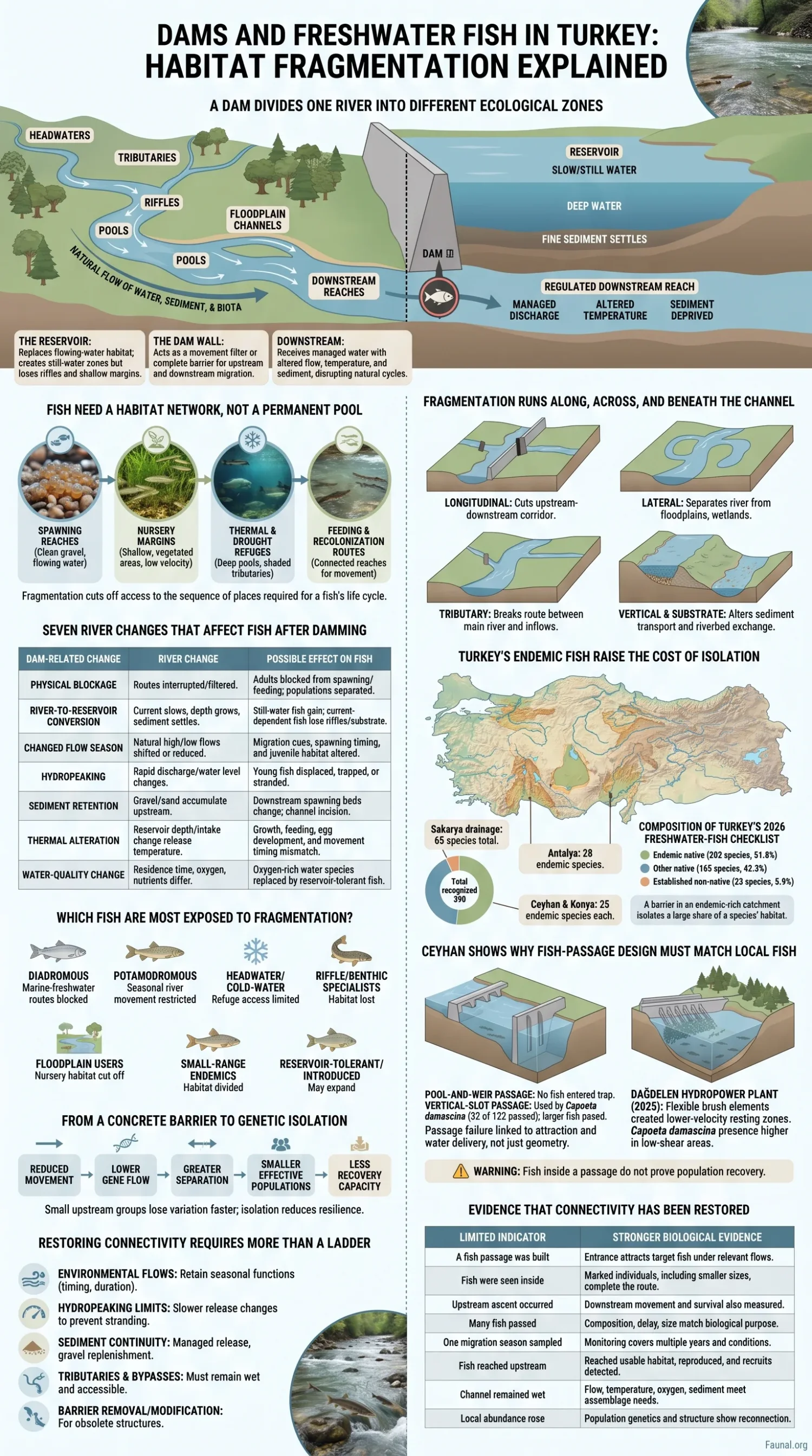
A Dam Divides One River into Different Ecological Zones
Before impoundment, a river is a connected sequence of headwaters, tributaries, riffles, pools, banks, floodplain channels, wetlands, and downstream reaches. Water, sediment, organic matter, invertebrates, fish, eggs, and larvae move through that sequence at different speeds and seasons. A dam interrupts several of those movements at once.
The reservoir replaces flowing-water habitat
Upstream of the wall, current velocity falls, water depth grows, fine material settles, and the former channel becomes part of a reservoir. This can create habitat for fish that tolerate open, slow, or still water, but it does not reproduce the shallow riffles, coarse substrate, alternating pools, or current-facing feeding stations used by river specialists. Water-level operation can also expose and reflood reservoir margins, leaving shoreline vegetation and nursery habitat unstable.
The dam wall becomes a movement filter
The barrier may stop upstream movement completely, allow only larger or stronger swimmers to pass, or permit movement only when gates, spillways, or fish passages operate under suitable flows. Downstream movement presents a separate problem: fish can encounter turbine intakes, screens, spillways, abrupt pressure changes, or a reservoir in which the former river current no longer provides a clear route.
The river below receives managed water
Below the dam, discharge follows operating rules rather than the full natural sequence of rain, snowmelt, drought, and flood. Releases may be steady when the former river varied seasonally, or they may rise and fall sharply with hydropower generation. Water drawn from deep reservoir layers can be colder, warmer, or lower in oxygen than the river would naturally be at that time of year. Sediment retained upstream no longer replenishes gravel bars and channel margins downstream.
Habitat fragmentation is therefore not only the distance between a fish and the opposite side of a dam. It is the loss of a connected sequence of places and physical conditions.
Fish Need a Habitat Network, Not a Permanent Pool
Many freshwater fish use more than one habitat during a year or lifetime. Movement may cover a long main-stem migration, a short shift from a pool into a tributary, or repeated daily movement between current and shelter. The ecological distance can be small while the consequence of losing it is large.
Spawning reaches
Some species reproduce over clean gravel exposed to flowing, oxygenated water. Others use vegetation, submerged margins, springs, small tributaries, or shallow floodplain water. A barrier can separate adults from those sites. Altered flow can also remove the hydraulic cue that normally starts movement or leave spawning substrate covered by fine sediment.
Nursery margins
Larvae and young fish often cannot hold position in the velocities used by adults. They may depend on shallow banks, backwaters, low-flow side channels, submerged plants, or seasonally flooded areas. Flow regulation that disconnects these margins can reduce recruitment even when adults remain present.
Thermal and drought refuges
During warm or dry periods, fish may move into deeper pools, spring-fed reaches, shaded tributaries, or groundwater-influenced sections. A weir at a tributary mouth, a dewatered bypass reach, or a reservoir shoreline can cut off that escape route. Isolation becomes more damaging when drought reduces the size and duration of the remaining refuge.
Feeding and recolonization routes
Movement is not limited to reproduction. Fish redistribute as prey availability, current, temperature, and competition change. Connected reaches also allow fish to recolonize a site after a flood, pollution event, channel drying, or local population loss. A barrier can convert a temporary local disturbance into a lasting absence when no source population can return.
Fragmentation Runs Along, Across, and Beneath the Channel
Longitudinal fragmentation cuts the upstream–downstream corridor. It is the most visible form because the barrier occupies the main channel, but it is not the only connection altered by dam operation.
Lateral fragmentation separates the river from floodplain pools, wetlands, side channels, and low banks. Flood-control storage and reduced peak flows can prevent water from reaching habitats used by juveniles and floodplain-associated fish.
Tributary fragmentation breaks the route between a main river and smaller inflows. These tributaries may contain spawning substrate, cooler summer water, or populations that can replenish the main channel after disturbance.
Vertical and substrate fragmentation develops when sediment transport and riverbed exchange change. Gravel may be buried in the reservoir while the downstream channel is deprived of replacement material. The spaces between stones used by eggs, larvae, benthic fish, and aquatic invertebrates can fill with fine sediment or disappear as the channel erodes.
Seven River Changes That Affect Fish After Damming
| Dam-related change | What changes in the river | Possible effect on freshwater fish |
|---|---|---|
| Physical blockage | Upstream and downstream routes are interrupted or filtered by the structure. | Adults cannot reach spawning or feeding habitat; separated populations exchange fewer individuals. |
| River-to-reservoir conversion | Current slows, depth grows, fine sediment settles, and open-water habitat expands. | Still-water and generalist fish may gain habitat while current-dependent fish lose riffles, runs, and coarse substrate. |
| Changed flow season | Natural high and low flows are shifted, reduced, or held at a narrow operating range. | Migration cues, spawning timing, floodplain access, and juvenile habitat can be altered. |
| Hydropeaking | Discharge and water level rise or fall rapidly with power production. | Young fish may be displaced, trapped in isolated pools, or left on drying margins. |
| Sediment retention | Gravel, sand, and silt accumulate upstream instead of moving through the system. | Downstream spawning beds and shelter spaces change; channel incision can reduce bank and side-channel access. |
| Thermal alteration | Reservoir depth and intake position change the seasonal temperature of released water. | Growth, feeding, egg development, emergence, and movement timing may no longer match the natural season. |
| Water-quality change | Residence time, stratification, oxygen, nutrients, and suspended material differ from the former river. | Species adapted to flowing, oxygen-rich water may be replaced by fish tolerant of reservoir conditions. |
These processes interact. A fish passage may address part of the physical blockage while leaving altered flow, temperature, sediment supply, reservoir habitat, and downstream mortality unchanged. Dam-impact research therefore treats connectivity, hydrology, thermal conditions, and channel form as connected drivers of fish habitat rather than separate engineering details.[a]
Türkiye’s Endemic Fish Raise the Cost of Isolation
The national freshwater fauna is shaped by isolated basins, short coastal catchments, springs, old lake systems, and river networks divided by natural geography. That history produced many species with small native ranges. A barrier in a large, species-rich river can divide several populations; a barrier in a short endemic-rich catchment can isolate much of a species’ known habitat.
Composition of Türkiye’s 2026 Freshwater-Fish Checklist
The national checklist separates endemic native species, other native species, and established non-native taxa.
Source: Kaya et al., A Critical Checklist of Turkish Freshwater Fishes (2026). “Other native” is calculated as 367 native species minus 202 endemic native species. The chart describes checklist composition, not extinction risk.
The 2026 national checklist recognizes 390 freshwater fish species in 37 families: 367 native species, 202 endemic native species, and 23 established non-native taxa. Catchment totals show why a single national average is misleading. The checklist records 65 species in the Sakarya drainage, the highest catchment total in that assessment, while Antalya has 28 endemic species, the highest endemic count. Ceyhan and Konya each have 25 endemic species. Sakarya also has the highest recorded established non-native richness in the checklist, with ten taxa. These patterns point to different management problems: a species-rich river may contain many interacting native and introduced populations, while an endemic-rich short catchment may contain species with few alternative reaches.[b]
A reservoir can add fish habitat without replacing river habitat
Reservoir creation may increase open-water area and support fishery production or species tolerant of still water. That gain is not ecologically equal to the loss of flowing reaches, tributary junctions, floodplain channels, and gravel beds. A rise in total fish abundance can occur alongside a decline in native river specialists.
Which Fish Are Most Exposed to Fragmentation?
| Fish group or trait | Connection used | Main fragmentation risk |
|---|---|---|
| Diadromous fish | Routes between marine and fresh water. | A single barrier can block access to large parts of the freshwater phase of the life cycle. |
| Potamodromous river fish | Seasonal movement within a river basin. | Spawning, feeding, and refuge reaches become separated even though the species never enters the sea. |
| Headwater and cold-water fish | Cool tributaries, springs, shaded reaches, and connected pools. | Warm reaches, dewatered channels, and barriers at tributary junctions restrict access to thermal refuge. |
| Riffle and benthic specialists | Fast water, coarse substrate, interstitial spaces, and bed-level routes. | Reservoir formation and fine sediment remove the habitat even when passage around the wall is possible. |
| Floodplain and margin users | Seasonally inundated banks, side channels, wetlands, and backwaters. | Reduced flood peaks and rapid water-level change cut off nursery and feeding habitat. |
| Small-range endemics | A short stream, spring complex, isolated basin, or limited group of tributaries. | One structure may divide a large share of the available habitat into small populations. |
| Reservoir-tolerant generalists and introduced fish | Slow water, open reservoir margins, and human-assisted connections. | Some may expand after impoundment, changing competition and predation faced by native river fish. |
Body size alone does not predict vulnerability. Large migrants can lose long routes, but small benthic or spring-associated fish may have narrow habitat needs and limited ability to cross fast or turbulent structures. Passage design based only on powerful swimmers can therefore reconnect one part of the fish community while leaving another part isolated.
From a Concrete Barrier to Genetic Isolation
When individuals stop moving between reaches, breeding groups exchange fewer genes. Population structure does not change at the same speed in every species: the response depends on generation time, population size, previous natural isolation, movement behavior, and how completely the barrier filters passage. Small upstream groups can lose variation faster through genetic drift, while large populations may retain variation for many generations.
The pathway is usually gradual: reduced movement → lower gene flow → greater separation among breeding groups → smaller effective populations → less capacity to recover after drought, disease, pollution, or local habitat loss. Downstream-only passage can also produce an ecological one-way valve, removing individuals from an upstream group without allowing an equal return. Research on the evolutionary effects of dams shows that barriers can raise genetic differentiation, but it also warns against assuming that every newly divided population will show an immediate genetic decline.[c]
Ceyhan Shows Why Fish-Passage Design Must Match Local Fish
A field comparison in the Ceyhan River Basin tested two fish passages with traps, external tags, passive integrated transponder tags, and radio telemetry. No fish entered the trap in the studied pool-and-weir passage, and none of the tagged fish passed it. The vertical-slot passage was used by fish, but the measured success changed with tagging method and fish size. Among externally tagged Capoeta damascina, 32 of 122 individuals ascended the vertical-slot passage; fish longer than 20 centimetres passed more often than smaller individuals. The study linked failure at the other site mainly to attraction conditions and insufficient water delivery rather than the presence of concrete pools alone.[d]
A 2025 study at the Dağdelen hydropower plant in the same basin examined whether flexible brush elements could create a lower-velocity resting zone inside an existing pool-weir fishway. The researchers recorded Capoeta damascina, Alburnus kotschyi, Garra turcica, and Chondrostoma ceyhanense. Velocity and horizontal turbulence stress fell below the brush tips, and camera analysis found 61.5% of C. damascina presence intensity in areas with low Reynolds shear stress. The finding supports retrofit work that changes hydraulic conditions within a passage rather than assuming the original pool geometry suits every local species.[e]
Fish inside a passage do not prove population recovery
Entry, ascent, downstream survival, arrival at suitable habitat, spawning, and recruitment are separate outcomes. A structure can pass some adults while filtering smaller fish, failing during part of the migration season, or delivering fish to habitat altered by the reservoir.
Fish Passages Address One Part of River Fragmentation
The entrance must intercept the fish’s route
Fish tend to follow the dominant current toward a barrier. If the fish-passage entrance has weak attraction flow, lies away from the approach route, or is hidden by competing discharge, fish may never attempt ascent. Attraction failure and passage failure must be measured separately.
Velocity and turbulence must fit several species and sizes
A passage designed around one swimming speed can exclude small fish, bottom-oriented fish, juveniles, or species that need resting zones. Suitable depth, water velocity, turbulence, drop height, substrate, and shelter vary among taxa. Seasonal temperature can also change swimming performance.
Upstream passage is only half of connectivity
Fish moving downstream need a safe route past intakes and turbines. Larvae and juveniles may drift with current and cannot locate a narrow bypass in the same way as an upstream adult. Reservoir delay, predation, screen contact, turbine injury, and spillway passage can all reduce survival.
Operation and maintenance determine whether the structure remains usable
Debris, sediment, blocked openings, insufficient discharge, or operation outside the movement season can turn a technically present passage into an ecological barrier. Türkiye’s DSİ guidance treats fish passage as a task requiring biological information, hydraulic design, dimensions, operation, and monitoring rather than a standard channel attached to every structure.[f]
Büyükçekmece Shows That a Barrier Can Reassemble a Fish Community
Büyükçekmece was a lagoon connected to the Sea of Marmara before the dam closed the marine connection in 1985. The water body became freshwater over time, and the recorded fish assemblage shifted from one that included marine species toward freshwater species. Later records of the euryhaline big-scale sand smelt, Atherina boyeri, varied among surveys, and researchers proposed that opening dam gates during very wet periods may have allowed recolonization. The example shows that a barrier can do more than reduce the number of migrants: it can change salinity, access, and the set of species able to persist in the water body.[g]
Restoring Connectivity Requires More Than a Ladder
Environmental flows must retain seasonal functions
A fixed minimum release may keep part of the channel wet while failing to provide spring movement cues, floodplain access, gravel maintenance, or gradual recession for young fish. Flow targets need to consider timing, duration, rate of change, and the habitat function produced by each part of the hydrograph.
Hydropeaking needs ramping limits
Slower increases and decreases in generation flow can reduce sudden displacement and stranding. The safe rate depends on channel slope, bank shape, season, fish size, and the availability of low-velocity refuge.
Sediment continuity needs its own intervention
Fish passage does not move gravel through a reservoir. Sediment bypass, managed sediment release, gravel replenishment, and channel restoration may be needed where spawning beds and downstream channel form depend on material retained by the dam.
Tributaries and bypass reaches must remain wet and accessible
Protecting a cool tributary has little value to the main-river population if its mouth is perched, blocked, or separated by a dry reach. Water abstraction, culverts, small weirs, and road crossings can compound the fragmentation created by the main dam.
Barrier removal or modification can be the better option for obsolete structures
Where a small barrier no longer provides its intended service, removal, lowering, or replacement with a nature-like channel can restore more processes than a narrow technical passage. The decision still requires sediment, contamination, flood, invasive-species, and downstream-habitat assessment.
Connectivity Can Also Help Non-Native Fish Spread
Reconnecting habitat is not automatically beneficial to every native population. A barrier may also restrict an introduced predator, competitor, parasite carrier, or stocked fish from entering an upstream refuge. Sakarya’s combination of high total richness and the highest established non-native richness in the 2026 checklist illustrates why passage planning should identify which taxa are likely to move in both directions.
Selective passage, seasonal operation, targeted removal, or retention of a barrier may be considered where the conservation value of an isolated native population outweighs the benefit of unrestricted movement. Such decisions require current species surveys rather than assumptions based on reservoir catches or old basin lists.
Dams Rarely Act Alone
A decline below a dam does not show that the dam is the only cause. Water abstraction, untreated discharge, agricultural runoff, channelization, gravel extraction, overfishing, drought, warming, stocking, and introduced species can act on the same population. Fragmentation often makes these pressures harder to survive because fish cannot move to better habitat or receive immigrants from another reach.
Türkiye’s Ministry of Agriculture and Forestry began an ecoregion-based ecological water-quality assessment project in 2025. Its planned work includes biological and hydromorphological indices, water-body reference conditions, spatial integration of biological and physical data, and assessment of climate effects on aquatic ecosystems. That basin- and water-type approach is better suited to dam impacts than judging every river against one national condition, because a short Mediterranean stream, a spring-fed endemic habitat, and a large continental river do not have the same natural flow or fish assemblage.[h]
Evidence That Connectivity Has Been Restored
| Limited indicator | Stronger biological evidence |
|---|---|
| A fish passage was built | The entrance attracts target fish under the flows and seasons when they move. |
| Fish were seen inside | Marked individuals complete the route, including smaller size classes and bottom-oriented species. |
| Upstream ascent occurred | Downstream movement and survival are also measured through intakes, bypasses, spillways, and the reservoir. |
| Many fish passed | Native species composition, passage delay, sex, size, and life stage match the biological purpose of movement. |
| One migration season was sampled | Monitoring covers several years, variable flows, drought, high-water periods, and operating changes. |
| Fish reached the upstream side | They reached usable habitat, reproduced, and produced recruits detected in later surveys. |
| The channel remained wet | Flow, temperature, oxygen, sediment, bank habitat, and tributary access remained within the needs of the target assemblage. |
| Local abundance rose | Population genetics, age structure, recruitment, and distribution show that isolated groups are reconnecting without harmful non-native spread. |
Useful monitoring can combine traps, PIT tags, radio or acoustic telemetry, underwater cameras, sonar, environmental DNA, standardized electrofishing, larval surveys, population genetics, temperature loggers, discharge records, and sediment measurements. The method should match the question. Cameras can show behavior inside a passage; telemetry can measure delay and completion; genetics can test long-term exchange; larval and juvenile surveys can show whether passage is followed by reproduction.
For freshwater fish in Türkiye, the decisive question is not simply whether a fish can cross concrete. It is whether connected populations can still reach usable habitat under the flow, temperature, sediment, and water-quality conditions produced by the whole dam system.
Sources and Verification
- [a] River Damming Impacts on Fish Habitat and Associated Mitigation Measures — Used for the linked effects of barriers, flow regulation, water temperature, sediment, and channel change on fish habitat.
- [b] A Critical Checklist of Turkish Freshwater Fishes (2026) — Used for the current national species total, native and established non-native totals, endemic count, family count, and catchment-level richness.
- [c] Evolutionary Consequences of Dams and Other Barriers for Riverine Fishes — Used for gene-flow reduction, population differentiation, effective population size, and delayed genetic responses to barriers.
- [d] Efficiency and Suitability of the Fish Passages of River Ceyhan, Turkey — Used for trap and telemetry results from pool-weir and vertical-slot passages, including size-related passage performance.
- [e] Creating Micro-Habitat in a Pool-Weir Fish Pass with Flexible Hydraulic Elements — Used for the 2025 Dağdelen field experiment, recorded fish taxa, low-velocity resting habitat, and fish presence in low-shear areas.
- [f] DSİ: Fish Passages—Design, Dimensioning and Monitoring — Used for the technical scope of fish-passage planning, hydraulic design, operation, biological requirements, and monitoring.
- [g] An Example for Fish Barriers: Büyükçekmece Dam (Istanbul) — Used for the loss of lagoon–sea connection, freshwater conversion, and recorded changes in fish composition.
- [h] Türkiye Ecoregion-Based Ecological Water-Quality Assessment Project — Used for the current national work on biological and hydromorphological indices, reference conditions, spatial data integration, and climate effects on aquatic assessment.