Updated: September 16, 2026 What changed?
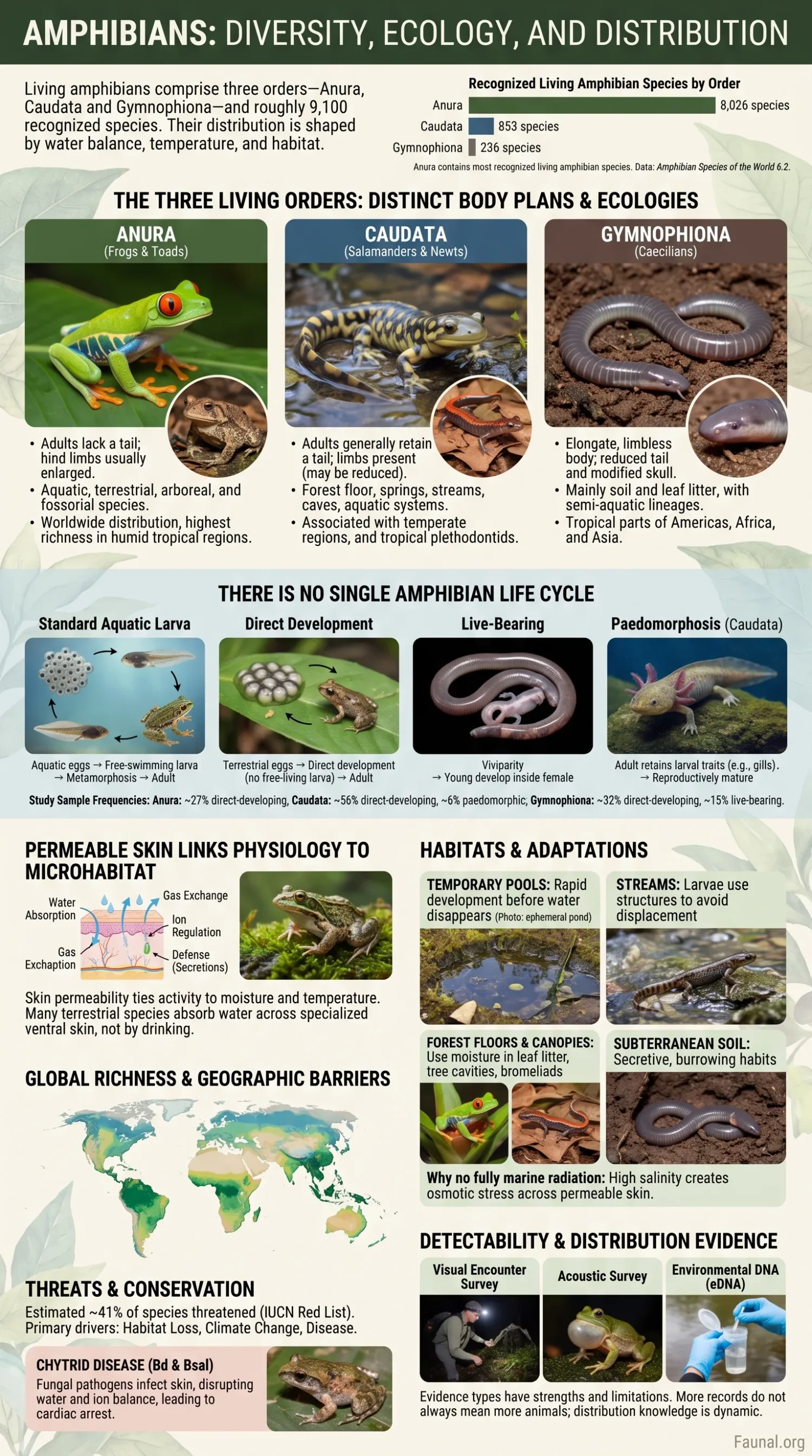
Living amphibians comprise three orders—Anura, Caudata and Gymnophiona—and roughly 9,100 recognized species, but there is no single permanent species total. Frogs and toads dominate the class numerically, while salamanders and caecilians follow very different ecological and geographic patterns. Their distribution is shaped by water balance, temperature, reproductive mode, habitat continuity, evolutionary history and barriers such as mountains and drainage divides.
Living amphibian diversity is dominated by Anura
Amphibian Species of the World currently recognizes 9,118 living amphibian species: 8,029 Anura, 853 Caudata and 236 Gymnophiona. That places about 88% of described living amphibians in Anura, with salamanders and newts accounting for about 9% and caecilians for less than 3%. [a]
Recognized living amphibian species by order
Current order totals reported by Amphibian Species of the World.
Data: Amphibian Species of the World 6.2. Values are accepted species totals for Anura, Caudata and Gymnophiona; they do not represent population size.
Why current amphibian totals differ between databases
AmphibiaWeb reports 9,096 species for September 15, 2026: 8,018 Anura, 845 Caudata and 233 Gymnophiona. Its total is therefore 22 species lower than Amphibian Species of the World. The difference should not be read as a population change. Active taxonomic databases can adopt species descriptions, synonymies, splits, merges and revised placements on different schedules. AmphibiaWeb also reports that the number of recognized amphibian species has risen by more than 60% since 1985. [b]
The three living orders represent different body plans and geographic histories
| Order | Living forms | Adult body plan | Ecological range | Broad geographic pattern |
|---|---|---|---|---|
| Anura | Frogs and toads | Adults lack a tail; hind limbs are usually enlarged to varying degrees | Aquatic, terrestrial, arboreal and fossorial species; many stream, pond and temporary-pool breeders | Worldwide across a wide range of non-polar environments, with the greatest richness in humid tropical regions |
| Caudata | Salamanders and newts | Adults generally retain a tail; limbs are usually present but may be reduced | Forest floor, springs, streams, caves, underground habitats and fully aquatic systems | Most families are associated with temperate regions, while tropical plethodontid radiations add high richness in the Americas |
| Gymnophiona | Caecilians | Elongate, limbless body; reduced external tail and strongly modified skull in many species | Mainly soil and leaf litter, with semi-aquatic and aquatic lineages | Tropical parts of the Americas, Africa and Asia |
Anura: the largest radiation
Anura contains frogs and toads; “toad” is a common-name category rather than a separate amphibian order. Adult anurans share a tailless body plan, but their ecologies range from permanent aquatic habitats to dry seasonal landscapes. Some climb high into vegetation, some live on forest floors, some burrow for much of the year, and others remain closely associated with streams or ponds.
Caudata: salamanders are not simply elongated frogs
Salamanders and newts retain a tail as adults and include lineages with terrestrial, stream-dwelling, cave-dwelling and fully aquatic species. Life-history variation is especially broad: some undergo a recognizable larva-to-adult metamorphosis, many develop directly from terrestrial eggs, and some remain reproductively mature while retaining larval traits.
Gymnophiona: subterranean amphibians with unusual parental care
Caecilians are limbless amphibians, not reptiles or worms. Most are associated with tropical soils or leaf litter, although aquatic forms also occur. Their reduced eyes and paired sensory tentacles reflect a strong association with subterranean life. Reproduction is unusually varied for such a small order. Some species lay eggs and develop directly, while others give birth to live young.
Parental care can also involve direct nutrient transfer. A 2024 study of the egg-laying caecilian Siphonops annulatus documented hatchlings consuming lipid- and carbohydrate-rich milk released from the maternal vent for about two months; the secretion originated from enlarged glands in the oviduct epithelium. [c]
There is no single amphibian life cycle
The familiar sequence of aquatic egg, free-swimming larva, metamorphosis and more terrestrial adult is only one amphibian strategy. A broad phylogenetic study coded reproductive modes for 7,681 species and found extensive use of terrestrial eggs, direct development, live-bearing and, in salamanders, paedomorphosis. The percentages below describe that study sample and should not be treated as percentages of the larger 2026 species totals.
| Order | Reproductive patterns documented in the study | Selected study frequencies | Biological meaning |
|---|---|---|---|
| Anura | Aquatic, semi-terrestrial, terrestrial, direct-developing and rare live-bearing modes | 43.8% fully aquatic; 20.9% semi-terrestrial; 27.2% direct-developing | Many frogs still use aquatic larvae, but a large share place eggs on land or bypass a free-living tadpole stage |
| Caudata | Aquatic, semi-terrestrial, direct-developing, live-bearing and paedomorphic modes | 56.1% direct-developing; 5.7% obligately paedomorphic; 1.9% live-bearing | Salamanders contain both highly terrestrial lineages and species that retain larval traits at reproductive maturity |
| Gymnophiona | Semi-terrestrial, direct-developing and live-bearing modes | 35.4% semi-terrestrial; 32.1% direct-developing; 14.6% live-bearing | Caecilian development is not tied to a free-swimming larval stage; viviparity is proportionally more common than in frogs or salamanders |
Across the same study, 51.5% of sampled anurans, 61.1% of sampled salamanders and 67.5% of sampled caecilians laid eggs on land. The ancestral amphibian condition was inferred to involve aquatic eggs and aquatic larvae, but repeated transitions moved reproduction away from open water. [d]
A tadpole is not a universal amphibian stage
Direct-developing species complete the major transformation inside the egg and hatch without a free-living larval stage. Paedomorphic salamanders follow a different route: they become reproductively mature while retaining traits associated with the aquatic larval condition. These life histories change which habitats a species must reach in order to reproduce.
Permeable skin links physiology to microhabitat and distribution
Amphibian skin is involved in water absorption, ion regulation, gas exchange, defense and communication. Its permeability is one reason amphibian activity is often tied closely to moisture and temperature, but the class includes many physiological and behavioral solutions to water loss. Some species shelter in humid refuges, reduce daytime activity, use burrows, form protective cocoons during dormancy or produce skin secretions that reduce evaporation.
Water gain also differs from the pattern familiar in mammals. Many terrestrial amphibians absorb much of their water across specialized ventral skin rather than relying on oral drinking. The same skin surface must balance water movement, electrolytes and respiration, creating a close link between local humidity, body condition and activity. [e]
Dependence on water does not mean dependence on permanent ponds. The relevant water source may be a stream, temporary pool, moist soil, leaf litter, a tree cavity, a bromeliad, saturated rock crevices or humidity retained beneath the forest canopy.
Amphibian habitats extend from temporary pools to caves and tropical soils
Temporary wetlands can favor rapid development
Seasonal ponds and rain-filled depressions can provide breeding habitat without supporting permanent populations of predatory fish. The tradeoff is time: eggs and larvae must complete vulnerable aquatic stages before the water disappears. Species using temporary water therefore differ in developmental rate, breeding timing and tolerance of drying conditions.
Streams select for different breeding sites and larval traits
Mountain streams, seepages and headwaters present moving water, localized pools and sharply separated drainage branches. Eggs may be attached to protected substrates or placed outside the main current, while larvae of stream specialists may use structures and behavior that reduce displacement. A species tied to one headwater system can remain geographically close to another watershed yet be poorly connected to it.
Forest floors and canopies hold amphibians far from open water
Moist leaf litter, decaying wood, epiphytes and tree cavities provide small but biologically distinct environments. Direct-developing frogs and salamanders can reproduce in terrestrial sites where enough moisture remains around the eggs. Arboreal frogs may use water held in vegetation, while terrestrial salamanders can spend entire life cycles within humid forest systems.
Soil and underground water hide much of caecilian ecology
Many caecilians move through soil or leaf litter where ordinary visual surveys are ineffective. Others are semi-aquatic or aquatic. Their secretive habits help explain why distribution data and natural-history information remain much thinner for Gymnophiona than for most frogs and many salamanders.
Why amphibians have not produced a fully marine radiation
Modern amphibians are primarily freshwater and terrestrial vertebrates. High salinity creates osmotic stress across permeable skin and can affect reproduction, embryos and larvae before it excludes an adult. This helps explain why amphibians have not radiated through seawater in the manner of marine reptiles or fishes.
The boundary is not absolute. Some frogs and salamanders occupy brackish or salt-affected habitats, and tolerance can differ among populations and life stages. A meta-analysis and experimental study of anurans found the egg stage to be especially salt-sensitive while also showing that some coastal populations can evolve greater tolerance to saline wetlands. [f]
Global amphibian richness is concentrated unevenly
Amphibian richness generally rises toward the tropics, but latitude alone does not explain the pattern. A global analysis found high richness in tropical moist forests, especially the Amazon Basin, with other major concentrations in the Congo Basin and Southeast Asia. The eastern United States stands out from many other temperate regions because of its salamander diversity. Within regions, water and temperature help constrain richness, while regional evolutionary history changes how many lineages are available to occupy suitable climates. [g]
The three orders do not contribute equally to the same map. Anura drives most global species totals and dominates tropical amphibian richness. Salamanders have a much stronger Northern Hemisphere component, although tropical American plethodontids form a major radiation. Caecilians remain restricted to tropical regions and are often under-recorded because many species live underground.
Mountains and watersheds can generate diversity while restricting movement
Mountains compress temperature, rainfall, vegetation and cloud conditions into short geographic distances. Valleys, ridges and isolated massifs can separate populations, while cool wet forests create narrow habitat bands for moisture-sensitive species. Over evolutionary time, such isolation can promote endemism. The same geography can later increase exposure to habitat loss or warming because a species with a small elevational range has fewer routes into suitable conditions.
Drainage systems create another scale of isolation. A stream-breeding salamander may be strongly associated with one headwater network, while a frog that crosses terrestrial habitat between ponds may connect wetlands that are not hydrologically linked. A watershed is therefore highly informative for some amphibians but not a universal boundary for the class.
Endemic does not mean threatened
Endemism describes geographic restriction. Threat status describes extinction risk under a defined assessment. A species can be endemic without being listed as threatened, while a widespread species can still qualify for a threatened category if the assessment criteria are met.
Amphibians move energy through both aquatic and terrestrial food webs
Amphibian larvae and adults can occupy different trophic positions. Tadpoles may graze algae and periphyton, process detritus or consume other animals depending on species, while post-metamorphic frogs and salamanders commonly prey on invertebrates and other small animals. Amphibians are also prey for fishes, reptiles, birds, mammals and large invertebrates.
Where species move between water and land, biomass and nutrients move with them. Salamanders provide a well-studied example: ecological reviews describe their roles as mid-level predators, prey and links transferring energy and matter between aquatic and terrestrial systems. [h]
About two in five amphibian species are estimated to be threatened
IUCN Red List version 2026-1 gives a best estimate that 41% of extant amphibian species are threatened, with a lower estimate of 37% and an upper estimate of 48% after accounting for Data Deficient species. The threatened categories are Vulnerable, Endangered and Critically Endangered. [i]
The second Global Amphibian Assessment evaluated 8,011 species and estimated 40.7% to be globally threatened in its assessment dataset. Threat concentration did not simply mirror total species richness: dense concentrations of threatened amphibians occurred in the Caribbean, Mesoamerica, the Tropical Andes, western Cameroon and eastern Nigeria, Madagascar, the Western Ghats and Sri Lanka, with additional concentrations in Brazil’s Atlantic Forest, the Eastern Arc Mountains, parts of China and the southern Annamite Mountains. Among genuine status deteriorations from 2004 to 2022, climate-change effects were identified as the primary driver for 39% of species that worsened, followed by habitat loss and degradation at 37%. These percentages describe causes of status deterioration in that time window; they are not percentages of all living amphibian species exposed to each threat. [j]
Habitat loss acts through breeding sites, shelter and connectivity
Wetland drainage can remove breeding water; forest clearing can alter shade and humidity around terrestrial eggs; stream modification can change flow, sediment and refuge structure; roads and open land can separate seasonal movements between breeding and non-breeding habitat. The same amount of land conversion can therefore affect amphibian species differently depending on their life cycle.
Climate exposure differs among lowlands, mountains and seasonal wetlands
Changes in rainfall timing can alter the duration of temporary pools, soil moisture and stream conditions. Higher temperatures can raise evaporative stress and change disease dynamics. Mountain endemics may face a different problem: suitable climate can shift upslope until very little habitat remains above the population.
Chytrid disease attacks an organ amphibians use for water and ion balance
Chytridiomycosis is caused by chytrid fungi that infect amphibian skin. Batrachochytrium dendrobatidis (Bd) has been linked to declines across many amphibian lineages. Batrachochytrium salamandrivorans (Bsal) is an emerging chytrid pathogen that can infect multiple amphibian hosts and has caused disease in susceptible salamanders. [k] Infection status alone does not predict the same outcome in every species or population; host susceptibility, pathogen dose, temperature and local ecology can affect disease expression.
In severe Bd infection, disruption of skin function can reduce sodium uptake and disturb electrolyte and water balance. Experimental work on frogs has linked severe chytridiomycosis to depletion of major electrolytes and impaired cardiac electrical function. The disease is therefore directly connected to the same skin physiology that helps amphibians regulate water and ions in normal environments. [l]
Distribution evidence depends on how an amphibian can be detected
Amphibian distribution is unusually sensitive to detectability. Calling frogs can be located acoustically during breeding periods, terrestrial salamanders may require searches beneath cover, stream species may be found only in narrow aquatic microhabitats, and caecilians may remain underground during ordinary surveys. Environmental DNA can detect genetic material in water even when no animal is seen, but it can produce false positives or false negatives and does not replace field survey design. [m]
| Evidence type | What it can support | What it does not establish by itself |
|---|---|---|
| Museum specimen | Documented occurrence at a locality and collection time, subject to identification and locality quality | Current persistence at the same site |
| Visual encounter survey | Animals detected during a defined search period and survey method | Absence when no individual is detected, or population size without effort-based design |
| Acoustic survey | Calling anurans detected during a defined period | Presence of silent species, non-calling life stages or abundance without calibrated methods |
| Environmental DNA | Genetic evidence compatible with recent presence in sampled water or substrate | Exact animal location, breeding population size or complete range |
| Species checklist | Inclusion of a taxon within the checklist’s geographic, temporal and taxonomic scope | Continuous distribution, abundance or local breeding status |
| Range polygon | A mapped interpretation of known or expected geographic range under the source’s method | Occupancy of every site inside the polygon |
More records do not automatically mean more animals. Record density can rise with road access, survey effort, museum history, citizen-science activity or targeted monitoring. Amphibian maps are strongest when taxonomy, record type, survey date, habitat context and geographic scale are kept separate.
Species totals and range maps will continue to change
New amphibian species continue to be described, while molecular studies split some widespread names into multiple lineages or merge names that do not remain taxonomically distinct. Museum specimens can reveal overlooked diversity, bioacoustics can separate cryptic frog calls, and field surveys can fill geographic gaps. A rise in the number of recognized species therefore describes taxonomic knowledge, not growth in the number of amphibian individuals living in nature.
The same caution applies to maps. New records can extend a documented range, revised identifications can remove records, and a taxonomic split can divide one former range among several accepted species. For amphibians, distribution is best treated as a source- and date-dependent biological claim rather than a permanent shaded area.
Sources and Verification
- [a] Amphibia — Amphibian Species of the World — Used for the current accepted total and order-level species counts in Amphibia.
- [b] Amphibian Species By the Numbers — AmphibiaWeb — Used for the September 15, 2026 AmphibiaWeb total, order counts and the reported increase in recognized species since 1985.
- [c] Milk provisioning in oviparous caecilian amphibians — Used for milk provisioning and maternal care documented in Siphonops annulatus.
- [d] The evolution of reproductive modes and life cycles in amphibians — Used for study-sampled reproductive-mode frequencies, terrestrial egg laying, direct development, live-bearing and paedomorphosis.
- [e] The Complex Bridge between Aquatic and Terrestrial Life: Skin Changes during Development of Amphibians — Used for amphibian skin functions, water absorption and water-balance adaptations.
- [f] Adaptive responses to salinity stress across multiple life stages in anuran amphibians — Used for salinity sensitivity across life stages and evidence of population-level adaptation in salt-affected wetlands.
- [g] Environmental and historical constraints on global patterns of amphibian richness — Used for broad global richness patterns and the combined roles of water, temperature and regional history.
- [h] On the Ecological Roles of Salamanders — Used for salamander trophic roles and aquatic-terrestrial transfers of energy and matter.
- [i] IUCN Red List Summary Statistics — Used for the IUCN Red List 2026-1 best estimate and uncertainty range for threatened amphibians.
- [j] Ongoing declines for the world’s amphibians in the face of emerging threats — Used for the 8,011-species assessment dataset, threatened-species concentrations and primary drivers of genuine status deterioration from 2004 to 2022.
- [k] Broad host susceptibility of North American amphibian species to Batrachochytrium salamandrivorans suggests high invasion potential and biodiversity risk — Used for Bsal host susceptibility and disease evidence across tested amphibian species.
- [l] Frog skin epithelium: electrolyte transport and chytridiomycosis — Used for the mechanism linking Bd infection with impaired cutaneous ion transport and electrolyte imbalance.
- [m] Using eDNA to survey amphibians: Methods, applications, and challenges — Used for eDNA detection strengths, false-positive and false-negative limitations, and its role alongside traditional surveys.
How Amphibians Indicate Freshwater Ecosystem Health in Turkey
Amphibians are examined as indicators of freshwater ecosystem health in Turkey, connecting species presence with environmental conditions.
Newts and Salamanders of Turkey: Species, Habitats, and Identification
Turkey’s newts and salamanders are organized by species, habitat, and identification traits within the country’s amphibian fauna.
Toads of Turkey: Identification, Habitats, and Regional Records
Turkey’s toads are described through identification traits, habitat use, and regional records, linking species recognition with geographic context.
3 articles in Amphibians