Complete guides: •Freshwater Fish•Regional Fauna Guides•Fauna of Turkey
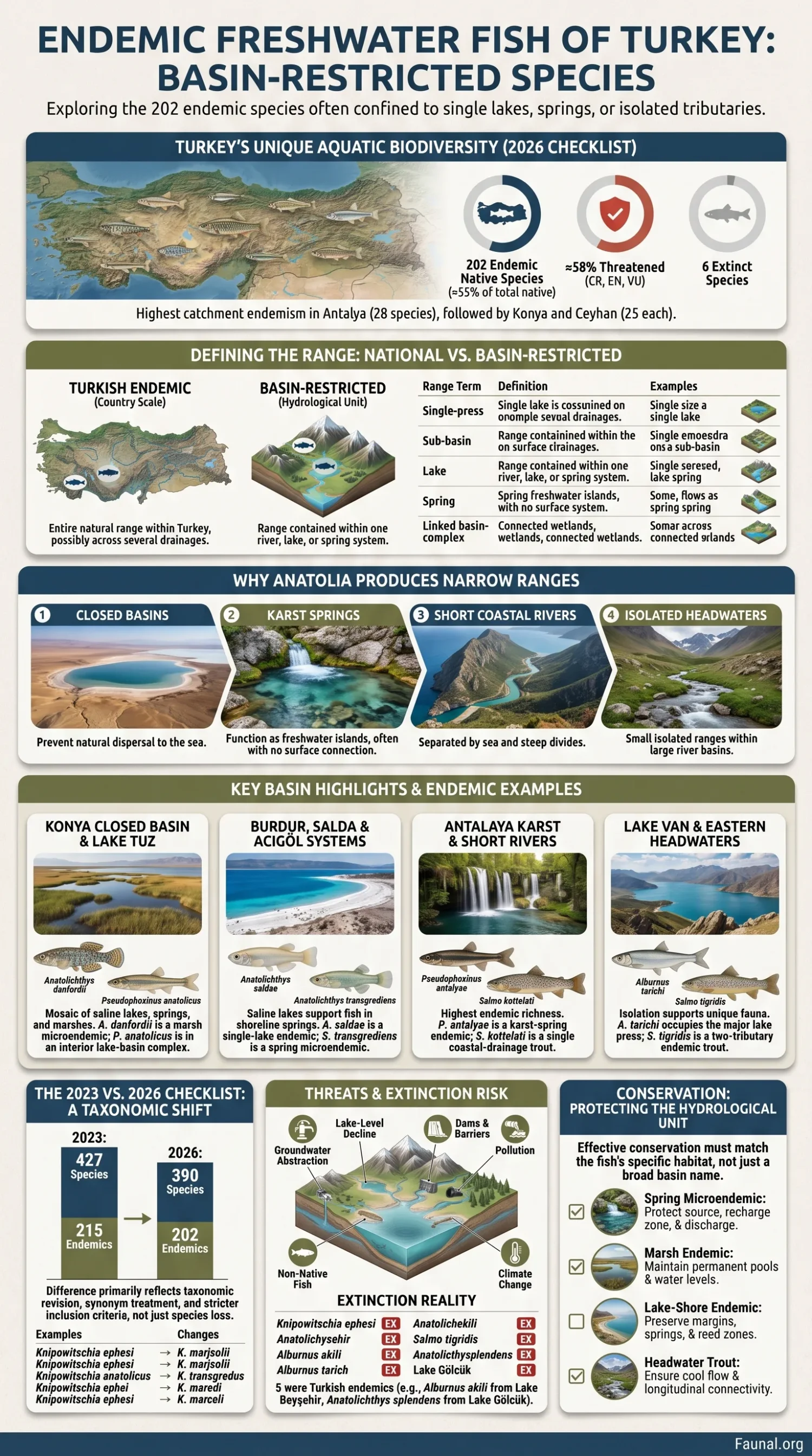
Turkey has 202 endemic native freshwater fish species under the 2026 critical checklist, but the narrowest ranges are defined by water boundaries rather than the national border. Some species occupy a large lake basin, while others are confined to one tributary, marsh, karst spring or group of freshwater discharge points. Unless another source is named, the accepted names, distribution summaries and status codes on this page follow the 2026 checklist, which recognizes 390 freshwater and freshwater-associated species: 367 native and 23 established non-native taxa. [a]
Native freshwater fishes
367
Accepted by the 2026 critical checklist.
Highest catchment endemism
Antalya: 28
Konya and Ceyhan follow with 25 endemic species each.
Threatened endemic fishes
About 58%
Share of assessed endemic species reported as CR, EN or VU.
Species listed as extinct
6
Five of the six were endemic to Turkey.
National Endemism and Basin Restriction Measure Different Ranges
The 2026 checklist defines an endemic fish at the country scale: its entire known natural distribution must fall inside Turkey. That definition does not state whether the fish occurs in one drainage or several. A Turkish endemic may inhabit neighboring basins, while a spring microendemic may occupy only a few hundred metres of permanent water.
| Range term | Geographic meaning | Example of the conservation unit |
|---|---|---|
| Turkish endemic | The complete natural range lies within Turkey, possibly across several drainages. | All Turkish populations and the connections among them. |
| Single-basin endemic | The natural range is contained within one river or closed drainage basin. | The main channel, tributaries, lakes, wetlands and groundwater inputs of that basin. |
| Sub-basin or tributary endemic | The fish is restricted to one branch or headwater system inside a larger basin. | The occupied tributary and barriers separating it from nearby habitat. |
| Lake endemic | The species is native to one lake and its directly connected waters. | The lake, shoreline habitat, inflowing streams and freshwater discharge zones. |
| Spring microendemic | The known range consists of one spring or a small group of linked sources. | The spring outlet, aquifer recharge area and downstream outflow. |
| Linked basin-complex endemic | The species occurs in several neighboring lakes or drainages with a shared geological history. | Each surviving population, even when present-day surface connections no longer exist. |
A 2018 analysis recognized 194 endemic freshwater fishes under the taxonomy available at that time and placed 143 species, or 73.71%, within a single basin. The figure cannot be transferred directly to the 2026 checklist because accepted names and range limits have changed, but it shows how strongly Turkish freshwater endemism is tied to isolated drainage systems. [b]
A Country Endemic Is Not Automatically a Single-Basin Fish
Lampetra lanceolata, for example, is endemic to Turkey but has been reported from several northeastern Black Sea streams, the upper Büyük Melen and streams draining toward Lake Sapanca. Its national range is restricted, yet it is not confined to one small catchment.
Why Anatolia Produces Narrow Freshwater Ranges
Closed Basins Prevent Natural Dispersal to the Sea
The Konya, Lake Tuz, Burdur and Acıgöl systems contain waters that do not drain naturally to the sea. Fish populations isolated inside these endorheic basins cannot follow a continuous river corridor into another watershed. Changes in lake extent, former connections and groundwater flow can divide one closed basin into several smaller biological units.
Karst Springs Function as Freshwater Islands
Spring systems around Antalya, Burdur, Denizli, Konya and the Taurus foothills may be close to one another on a road map while belonging to separate aquifers or surface drainages. A spring fish may have no permanent channel through which it can reach another source. The loss of discharge at one locality can therefore remove an entire natural population.
Short Coastal Rivers Remain Separated by Sea and Mountain Ridges
Mediterranean and Aegean coastal streams often descend from mountain catchments over short distances. Marine water separates their lower reaches, while steep divides restrict movement between their headwaters. This pattern helps explain the presence of different trout, loach, chub and spring-minnow lineages in neighboring drainages such as Alakır, Alara, Köprüçay and Aksu.
A Large River Basin Can Contain Small Isolated Ranges
A species recorded from the Euphrates, Tigris, Ceyhan or Seyhan system is not necessarily distributed throughout that river. Several Turkish endemics occupy one upper tributary, spring-fed marsh or mountain stream inside a much larger drainage. The biologically relevant range can be far smaller than the name of the main basin suggests.
Konya Closed Basin, Lake Tuz and Sultan Marshes
Central Anatolia contains a mosaic of saline lakes, freshwater springs, marshes, small tributaries and former lake connections. “Konya Closed Basin” therefore does not describe one continuously connected fish habitat. Species associated with Sultan Marshes, Lake Beyşehir tributaries or the western springs of Lake Tuz may remain isolated from one another even though they belong to the same broad interior drainage region.
| Accepted species | Checklist status | Reported hydrological range | Range pattern |
|---|---|---|---|
| Anatolichthys anatoliae | VU | Lake Tuz, Beyşehir and Suğla basins, extending eastward toward Niğde | Linked closed-basin complex |
| Anatolichthys danfordii | CR | Sultan Marshes | Marsh microendemic |
| Gobio gymnostethus | CR | Melendiz River in the southeastern Lake Tuz Basin | Sub-basin endemic |
| Gobio hettitorum | VU | Yeşildere, Deliçay, Gödet, Ayrancı and Ereğli marsh systems | Konya closed-basin complex |
| Gobio insuyanus | CR | İnsuyu drainage in the western Lake Tuz Basin | Spring and tributary endemic |
| Gobio intermedius | EN | Akşehir and Eber lake basins | Two-lake basin endemic |
| Pseudophoxinus anatolicus | VU | Beyşehir, Suğla, Hotamış and Akgöl systems | Interior lake-basin complex |
| Pseudophoxinus crassus | EN | İnsuyu Stream, Kozanlı and Samsam basins, and springs near Aksaray and Niğde | Lake Tuz spring complex |
| Pseudophoxinus elizavetae | CR | Sultan Marshes | Marsh microendemic |
| Pseudophoxinus hittitorum | VU | Tributaries of Lake Beyşehir | Lake-tributary endemic |
| Pseudophoxinus iconii | CR | Gölyazı, Büget, Tersakan and Bolluk drainages in the Lake Tuz Basin | Spring and wetland complex |
| Pseudophoxinus mehmeti | CR | Lake Çorak, also called Akgöl | Single-lake-basin endemic |
| Cobitis joergbohleni | CR | Sultan Marshes | Marsh microendemic |
| Cobitis turcica | EN | Ereğli, Melendiz, Sultanhanı and Gölyazı systems | Konya–Lake Tuz wetland complex |
| Oxynoemacheilus axylos | VU | Springs, streams and lake systems of the Lake Tuz Basin | Single major basin |
| Oxynoemacheilus ciceki | CR | Sultan Marshes | Marsh microendemic |
| Oxynoemacheilus isauricus | EN | Beyşehir and Suğla systems | Linked lake-basin endemic |
| Oxynoemacheilus nasreddini | VU | Akşehir, Eber, Eğirdir and Ilgın lake systems | Interior lake-basin complex |
| Seminemacheilus ahmeti | CR | Sultan Marshes | Marsh microendemic |
| Seminemacheilus ekmekciae | EN | Lake Tuz Basin and Ereğli marshes | Closed-basin endemic |
| Alburnus akili | EX | Lake Beyşehir | Extinct lake endemic |
| Chondrostoma beysehirense | VU | Lake Beyşehir drainage | Single-lake-basin endemic |
| Cobitis bilseli | EN | Sarıöz and Sarıçay in the Beyşehir–Suğla system | Lake-tributary endemic |
| Pseudophoxinus handlirschi | EX | Lake Eğirdir | Extinct lake endemic |
| Anatolichthys iconii | VU | Lakes Eğirdir and Kovada drainages | Linked lake-system endemic |
Closed Basin Does Not Mean Connected Habitat
A fish surviving in one spring of the Lake Tuz or Konya system may be unable to reach another spring in the same named basin. Surface-water loss can turn a formerly connected population into several isolated remnants.
Burdur, Salda, Acıgöl and the Southwestern Spring Systems
The southwestern lake district contains some of Turkey’s narrowest fish ranges. Saline or alkaline lakes may support fish only where freshwater enters along the shore. Other species live in nearby springs, small marshes or short tributaries rather than in the open lake. Protecting the mapped lake surface without maintaining groundwater discharge can therefore leave the occupied habitat outside effective protection.
| Accepted species | Checklist status | Reported hydrological range | Range pattern |
|---|---|---|---|
| Anatolichthys fontinalis | EN | Springs near Yarışlı and Burdur, former Karaevli waters, and the Karataş and Salda systems | Southwestern spring complex |
| Anatolichthys irregularis | CR | Kaklık Spring in the Büyük Menderes drainage | Single-spring microendemic |
| Anatolichthys maeandricus | EN | Lake Işıklı and Düden Spring | Upper Büyük Menderes wetland endemic |
| Anatolichthys saldae | CR | Lake Salda | Single-lake endemic |
| Anatolichthys splendens | EX | Lake Gölcük in Isparta | Extinct lake endemic |
| Anatolichthys sureyanus | EN | Lake Burdur, especially shoreline habitat and freshwater spring-discharge points | Lake and discharge-zone endemic |
| Anatolichthys transgrediens | CR | Freshwater spring system of Lake Acıgöl | Spring microendemic beside a saline lake |
| Pseudophoxinus burduricus | EN | Salda and Yarışlı systems and tributaries southwest of Lake Burdur | Southwestern lake and tributary complex |
| Pseudophoxinus maeandri | EN | Tributaries of Lake Işıklı in the upper Büyük Menderes | Lake-tributary endemic |
| Pseudophoxinus maeandricus | CR | Küfi and Karadirek streams in the upper Büyük Menderes | Two-stream endemic |
| Pseudophoxinus ninae | EN | Onaç Stream, Karaevli and Kestel marshes | Spring and marsh complex |
| Gobio maeandricus | EN | Lake Işıklı Basin | Single-lake-basin endemic |
| Chondrostoma meandrense | EN | Upper Büyük Menderes drainage | Upper-basin endemic |
| Squalius carinus | EN | Lake Işıklı Basin | Single-lake-basin endemic |
| Turcichondrostoma fahirae | EN | Springs and reservoirs of the Burdur Basin | Single-basin endemic |
| Seminemacheilus ispartensis | EN | Eğirdir, Salda, Beşevler and Burdur-area waters | Southwestern lake complex |
| Pseudophoxinus evliyai | EN | Kırkpınar Spring, Söğüt and Avlan basins, and the Akçay drainage | Lycian spring and lake complex |
| Anatolichthys meridionalis | VU | Upper Eşen drainage and the Söğüt, Avlan and Gölhisar lake basins | Lycian basin complex |
| Scardinius elmaliensis | VU | Akçay, Gölhisar–Dalaman and Burdur-area lake systems | Southwestern basin complex |
| Cobitis indus | DD | Middle Dalaman drainage | Single-river-basin endemic |
| Cobitis dorademiri | EN | Köyceğiz, lower Dalaman and nearby coastal streams | Southwestern coastal-drainage complex |
| Knipowitschia caunosi | EN | Lake Köyceğiz | Single-lake endemic |
| Knipowitschia byblisia | EN | Lake Köyceğiz Basin, lower Dalaman and a small stream entering Gökova Bay | Restricted coastal wetland complex |
A Lake Boundary May Exclude the Occupied Refuge
Anatolichthys transgrediens is tied to freshwater springs associated with Lake Acıgöl, while A. sureyanus is reported especially from Lake Burdur’s shore and spring-discharge points. Water management must include the aquifer and source outlets, not only the open-water surface.
Antalya Karst and the Short Rivers of the Taurus
Antalya has the highest endemic richness reported for any catchment in the 2026 checklist, with 28 endemic fishes. Its fauna is divided among major rivers, short coastal drainages and karst springs. Düden, Kırkgöz and Yediarıklar form one restricted habitat group, while Köprüçay, Alakır and Alara support different endemic lineages.
| Accepted species | Checklist status | Reported hydrological range | Range pattern |
|---|---|---|---|
| Pseudophoxinus alii | VU | Ilıca, Aksu, Köprüçay and Kömürcüler waters around Antalya | Antalya drainage complex |
| Pseudophoxinus antalyae | EN | Düden, Kırkgöz and Yediarıklar systems | Karst-spring endemic |
| Pseudophoxinus fahrettini | EN | Upper and middle Köprüçay drainage | Single-river-basin endemic |
| Cobitis sipahilerae | EN | Düden, Kırkgöz and Yediarıklar systems | Karst-spring endemic |
| Seminemacheilus attalicus | EN | Kırkgöz Spring | Single-spring microendemic |
| Oxynoemacheilus mediterraneus | LC | Aksu and Köprüçay drainages | Two-river regional endemic |
| Salmo ekmekciae | EN | Köprüçay drainage | Single-river endemic trout |
| Salmo kottelati | EN | Alakır Stream | Single coastal-drainage trout |
| Salmo opimus | LC | Alara drainage | Single coastal-drainage trout |
| Pseudophoxinus turani | VU | İncesu Spring, a tributary of the Orontes | Spring and tributary endemic |
| Oxynoemacheilus amanos | CR | İncesu Spring near Hassa in the lower Orontes system | Single-spring microendemic |
Ceyhan, Seyhan and the Eastern Mediterranean Drainages
Ceyhan contains 25 endemic species in the catchment summary, matching Konya’s reported total. The basin includes spring systems, middle-river habitats and cool upper tributaries. Some fishes are restricted to Ceyhan itself; others occupy a narrow Ceyhan–Seyhan range created by neighboring headwaters in the Taurus Mountains.
| Accepted species | Checklist status | Reported hydrological range | Range pattern |
|---|---|---|---|
| Pseudophoxinus zekayi | EN | Springs around Çöçelli and Lake Gölbaşı in the eastern Ceyhan drainage | Spring and lake micro-range |
| Cobitis evreni | EN | Middle Ceyhan drainage | Single-river-basin endemic |
| Cobitis erkakanae | EN | Lake Gölbaşı south of Adıyaman | Single-lake endemic |
| Oxynoemacheilus ceyhanensis | LC | Upper Ceyhan drainage | Upper-basin endemic |
| Oxynoemacheilus evreni | LC | Upper Ceyhan drainage | Upper-basin endemic |
| Oxynoemacheilus sarus | LC | Lower Seyhan and Ceyhan drainages | Two-basin regional endemic |
| Oxynoemacheilus seyhanicola | LC | Seyhan and Ceyhan drainages | Two-basin regional endemic |
| Salmo chilo | NE | Upper Ceyhan tributaries and Sarız in the upper Seyhan system | Headwater basin-complex trout |
| Salmo labecula | VU | Ecemiş, lower Zamantı and Çakıt in the Seyhan drainage | Restricted tributary trout |
| Paraphanius boulengeri | EN | Lakes Gölbaşı and Azaplı in Adıyaman | Two-lake endemic |
Isolated Aegean, Marmara and Black Sea Systems
Narrow-range fishes are not limited to Central Anatolia. Western and northern Turkey contain lake endemics, single-stream species and fishes divided among short coastal drainages. A species occupying several neighboring Black Sea streams may remain nationally endemic without meeting a strict single-basin definition.
| Accepted species | Checklist status | Reported hydrological range | Range pattern |
|---|---|---|---|
| Squalius aristotelis | EN | Behramkale–Tuzla coastal stream | Single coastal-drainage endemic |
| Cobitis troasensis | EN | Tuzla River | Single coastal-drainage endemic |
| Knipowitschia ricasolii | EN | Gebekirse and Kocagöz lake basins and Eleman marshes in the lower Küçük Menderes | Lower-basin wetland endemic |
| Knipowitschia mermere | VU | Lower Gediz and Madra drainages | Two-drainage coastal endemic |
| Oxynoemacheilus kottelati | NE | Havran and Karınca drainages | Restricted Aegean drainage complex |
| Gobio baliki | VU | Büyük Melen drainage | Single-river-basin endemic |
| Phoxinus abanticus | LC | Lake Abant | Single-lake endemic |
| Cobitis emrei | VU | Lake Sapanca | Single-lake endemic |
| Oxynoemacheilus fatmae | NE | Güzelhisar drainage | Single coastal-drainage endemic |
| Oxynoemacheilus fatsaensis | LC | Yeşilırmak and the neighboring Elekçi drainage | Regional Black Sea endemic |
| Ponticola rizensis | VU | Coastal streams entering the eastern Black Sea | Multi-stream coastal endemic |
| Alburnoides freyhofi | LC | Kızılırmak drainage | Single-river-basin endemic |
| Alburnoides kurui | LC | Yeşilırmak drainage | Single-river-basin endemic |
| Alburnoides turani | LC | Filyos drainage | Single-river-basin endemic |
| Salmo brunoi | NE | Aras, Deliçay and Ericek tributaries of the Nilüfer in the Susurluk drainage | Restricted tributary trout |
Lake Van, Lake Hazar and the Eastern Headwaters
Lake Van has only 11 freshwater fish species in the 2026 catchment comparison, the lowest total among the listed systems, yet its isolation supports fishes found nowhere outside the basin. Low total richness does not imply low conservation value. Alburnus tarichi occupies much of the basin, while Alburnus timarensis has a far narrower range in the Karasu tributary.
Farther south and east, the Euphrates, Tigris, Greater Zab, Kura and Aras are large river systems, but many endemic fishes occupy only one upper tributary or lake. These rivers also cross national boundaries, so a species may be endemic to Turkey while living inside one part of a wider international drainage. A 2020 review of Turkey’s five transboundary basin groups reported dams and habitat loss among the recurring pressures on their fish fauna. [g]
| Accepted species | Checklist status | Reported hydrological range | Range pattern |
|---|---|---|---|
| Alburnus tarichi | LC | Lake Van Basin, including lakes Nazik and Aygır | Single major basin endemic |
| Alburnus timarensis | EN | Karasu tributary of Lake Van | Single-tributary endemic |
| Oxynoemacheilus ercisianus | VU | Lake Van and its tributaries | Single major basin endemic |
| Kosswigichthys asquamatus | EN | Lake Hazar | Single-lake endemic |
| Oxynoemacheilus hazarensis | EN | Lake Hazar | Single-lake endemic |
| Salmo tigridis | EN | Çatak and Müküs in the upper Tigris drainage | Two-tributary endemic trout |
| Alburnus kurui | EN | Yüksekova wetland in the upper Greater Zab | Wetland and headwater endemic |
| Turcinoemacheilus kosswigi | CR | Upper Greater Zab drainage | Upper-basin endemic |
| Salmo baliki | EN | Sinek and Cumaçay in the upper Murat drainage | Restricted tributary trout |
| Salmo emireae | NE | Lake Balık in the Aras drainage | Single-lake trout |
| Salmo euphrataeus | LC | Selected streams of the Karasu in the northern Euphrates | Restricted headwater trout |
| Salmo munzuricus | LC | Munzur and Murat waters in the upper Euphrates | Upper-basin trout |
| Salmo murathani | LC | Lake Çıldır and upper Aras–Arpaçay tributaries | Upper Aras lake and stream complex |
| Salmo okumusi | LC | Göksu, Lake Gökpınar and Sürgü in the Euphrates drainage | Restricted western Euphrates trout |
| Salmo platycephalus | LC | Soğuksu, Uzunyayla and Karagöz in the upper Zamantı | Restricted headwater trout |
| Salmo araxensis | LC | Upper Aras tributaries | Upper-basin trout |
| Salmo ardahanensis | LC | Kura drainage | Single-river-basin trout |
| Oxynoemacheilus arsaniasus | LC | Upper Murat drainage | Upper-basin endemic |
| Oxynoemacheilus cyri | LC | Upper Kura drainage | Upper-basin endemic |
| Oxynoemacheilus paucilepis | EN | Mancınık, Çetinkaya and Kalkım streams in the upper Euphrates | Restricted headwater loach |
| Paracobitis salihae | VU | Göksu near Gölbaşı in the Euphrates drainage | Restricted tributary endemic |
| Schistura chrysicristinae | EN | Ambar and Batman systems in the upper Tigris | Restricted upper-basin loach |
| Turcinoemacheilus minimus | LC | Göksu and tributaries in the upper Euphrates | Restricted upper-basin loach |
The 2023 and 2026 Species Counts Are Not Interchangeable
The national checklist published in 2023 reported 427 freshwater species and 215 endemics. The 2026 critical review recognizes 390 species and 202 endemics after applying a different inclusion process, reassessing doubtful records, incorporating recent revisions and treating several names as synonyms. The lower total does not represent the disappearance of 37 living species between those years. It mainly reflects a changed taxonomic and evidence base. [c]
| Taxonomic issue | Current treatment in the 2026 checklist | Effect on basin records |
|---|---|---|
| Pseudophoxinus evliyae | Spelling changed to Pseudophoxinus evliyai under grammatical gender rules. | Older surveys may use the former spelling for the same southwestern populations. |
| Knipowitschia ephesi | Treated as a synonym of Knipowitschia ricasolii. | Records under both names must not be counted as two endemic species. |
| Ponticola turani | Treated as a synonym of Ponticola rizensis. | Eastern Black Sea records belong to one accepted taxon in the checklist. |
| Salmo coruhensis | Treated as a synonym of Salmo labrax. | Older trout lists can overstate the number of accepted regional species. |
| Former Aphanius species | Many Anatolian killifishes are placed in Anatolichthys following the revised generic classification. | Searching only the current genus can miss historical records published under Aphanius. |
| Unconfirmed or sporadic records | Excluded when establishment or reliable freshwater occurrence could not be demonstrated. | A record is not automatically part of the established basin fauna. |
Status Codes Follow the Checked Source
EX means Extinct, CR means Critically Endangered, EN means Endangered, VU means Vulnerable, LC means Least Concern, DD means Data Deficient and NE means Not Evaluated. A code describes the assessment reported by the checklist; it does not measure how much habitat remains at every locality.
Why One Local Water Change Can Affect an Entire Species
A review of endemic fishes inhabiting Turkey’s major lakes repeatedly identified declining water levels, climatic drought, agricultural pressure and non-native fishes among the pressures affecting lake fauna. These pressures act differently across habitats: a falling lake may remove shoreline refuges, while groundwater withdrawal can stop a spring before a visible lake has disappeared. [d]
| Pressure | Change within the water system | Why narrow-range fishes are exposed |
|---|---|---|
| Groundwater abstraction | Spring discharge declines, becomes seasonal or stops. | A spring microendemic may have no second permanent habitat. |
| Lake-level decline | Shallow margins, reed beds and freshwater discharge zones contract. | Lake-shore specialists can lose the part of the lake they actually occupy. |
| Irrigation withdrawal | Tributaries lose summer flow and pools become disconnected. | Small populations cannot move to another branch when the occupied channel dries. |
| Dams and barriers | Longitudinal movement and recolonization routes are interrupted. | Headwater and tributary populations become smaller isolated units. |
| Channelization | Vegetated margins, shallow runs, gravel patches and natural flow variation are removed. | Habitat specialists are left with a uniform channel that may support fewer life stages. |
| Nutrient and chemical pollution | Oxygen conditions, plant cover and benthic habitat change. | The entire occupied range can be affected by one upstream source. |
| Non-native fish | Predation, competition, disease exposure and food-web structure change. | A small isolated native population has limited space for refuge or recovery. |
| Cross-basin translocation | Fish native to one Turkish drainage are released into another. | Previously separated faunas are mixed even when the introduced fish is native elsewhere in the country. |
| Warmer and drier conditions | Water temperature, persistence and seasonal flow patterns shift. | Cool-water headwaters and shallow spring habitats can shrink without an alternative range. |
Climate-distribution models for endemic fishes of Central Anatolia project contraction of suitable climatic habitat under future scenarios. These outputs are risk projections rather than verified future ranges; they do not include every local factor controlling spring flow, water extraction, barriers or species interactions. [e]
A separate model for the endemic loach genus Seminemacheilus also projected strong losses of climatically suitable habitat toward 2050 and 2070. The result is especially relevant to species such as S. ahmeti and S. attalicus, whose known ranges are already tied to small spring or marsh systems. The modeled areas should not be treated as confirmed occurrence records. [f]
Extinction Can Remove an Entire Lake Lineage
The 2026 checklist reports six freshwater fishes as extinct. Five were Turkish endemics: Anatolichthys splendens, Cobitis kellei, Alburnus adanensis, Alburnus akili and Pseudophoxinus handlirschi. The sixth, Acanthobrama centisquama, was not confined entirely to Turkey, although much of its historical range was inside the country.
Alburnus akili and Pseudophoxinus handlirschi were restricted to the Beyşehir and Eğirdir lake systems respectively, while Anatolichthys splendens was associated with Lake Gölcük in Isparta. Their loss shows the scale of risk faced by lake and spring endemics: when the occupied water body is the complete natural range, there is no distant wild population outside the affected system.
Protection Must Match the Fish’s Hydrological Unit
| Range pattern | Minimum ecological unit requiring attention | Evidence needed for management |
|---|---|---|
| Single-spring microendemic | Spring outlet, recharge zone, downstream channel and all water extraction affecting discharge | Seasonal discharge, occupied length, water chemistry, abstraction points and repeated population surveys |
| Marsh endemic | Permanent pools, connecting channels, seasonal inundation area and groundwater supply | Hydroperiod, dry-season refuges, invasive fish presence and connection to neighboring basins |
| Lake-shore endemic | Lake margin, freshwater discharge points, reed zones and inflowing streams | Shoreline occupancy, lake level, spring flow, spawning habitat and water quality |
| Lake-tributary endemic | Lake, tributary network and passage between feeding, refuge and spawning habitat | Barrier inventory, seasonal movement, flow continuity and distribution by life stage |
| Headwater trout | Cool upper tributaries, shaded reaches, source areas and longitudinal connections | Summer temperature, flow permanence, genetic structure, stocking history and barrier location |
| Closed-basin species complex | Each surviving lake, spring and wetland population within the basin | Population identity, former connections, present isolation and cross-basin translocations |
| Transboundary headwater endemic | The occupied Turkish tributary together with downstream processes that alter flow or connectivity | Verified range, dam effects, water withdrawal, border-spanning records and shared taxonomic standards |
For a basin-restricted fish, protecting “the river” or “the lake” is often too broad and too vague. The effective conservation unit may be one aquifer-fed source, one marsh channel, one spawning tributary or one group of shoreline discharge points. Distribution records must therefore be connected to the water process that keeps the occupied habitat present.
Sources and Verification
- [a] A Critical Checklist of Turkish Freshwater Fishes (2026) — Used for the accepted national species total, endemic count, catchment richness, status codes, scientific names, taxonomic notes and distribution descriptions in the basin tables.
- [b] Endemic Freshwater Fishes of Turkey (2018) — Used for the historical estimate of endemic species restricted to a single basin under the taxonomy accepted in 2018.
- [c] Freshwater Lampreys and Fishes of Türkiye: An Annotated Checklist, 2023 — Used to compare the 2023 total and endemic counts with the more restrictive 2026 checklist.
- [d] Status of Endemic Freshwater Fish Fauna Inhabiting Major Lakes of Turkey under Climate and Human Pressures — Used for the lake-focused synthesis of drought, declining water levels, agricultural pressure and non-native fish threats.
- [e] Climate Change Effects on Endemic Freshwater Fish Species in Central Anatolia — Used for model-based projections of changing suitable habitat in Central Anatolian basins.
- [f] Species Distribution Models of Türkiye’s Endemic Genus Seminemacheilus — Used for the 2050 and 2070 climatic-suitability projections concerning endemic Seminemacheilus loaches.
- [g] Endemic Fishes in Transboundary River Basins in Turkey — Used for the transboundary basin context and the reported effects of dams and habitat loss on riverine fish fauna.