Complete guides: •Regional Fauna Guides•Reptiles•Fauna of Turkey
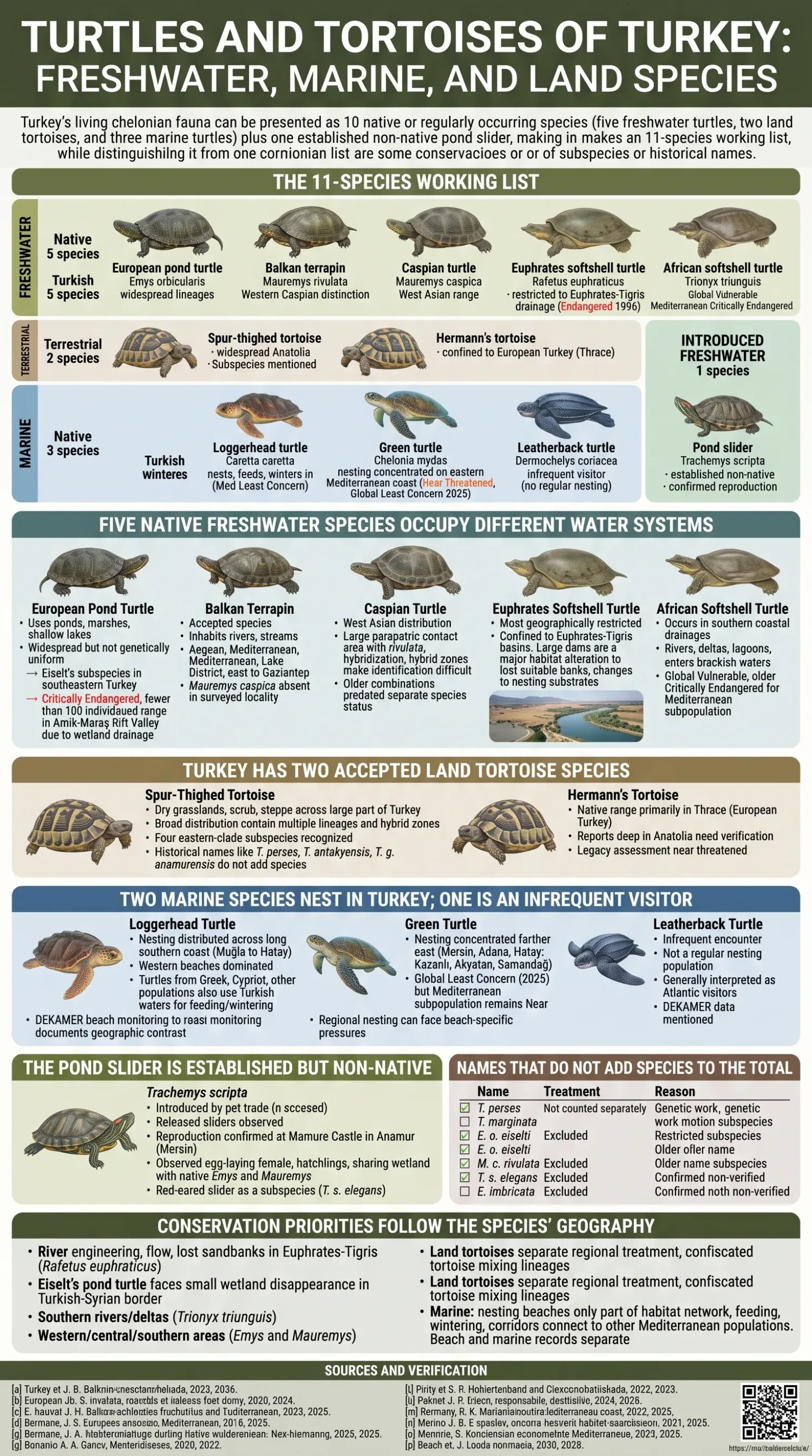
Turkey’s living chelonian fauna can be presented as 10 native or regularly occurring species—five freshwater turtles, two land tortoises, and three marine turtles—plus one established non-native pond slider. The resulting 11-species working list does not mean that Turkey has 11 native species. It separates the accepted national fauna from an introduced population and from subspecies or historical names that should not be counted as additional species.[a][b]
Seven of the accepted native species use terrestrial or inland freshwater habitats. Loggerhead and green turtles nest on Turkish beaches, while leatherbacks are infrequent marine visitors. The eleventh species, the pond slider, originates from North America and became established after releases from captivity.
The 11-Species Working List
The conservation column below preserves the geographic scale and assessment year where they matter. A global category, a European assessment, and a Mediterranean subpopulation assessment are not interchangeable. Several non-marine turtle assessments are old and describe extinction risk at the time of assessment rather than a current Turkish population estimate.
| Environment | Family | Accepted species | English name | Status in Turkey | Conservation reference |
|---|---|---|---|---|---|
| Freshwater | Emydidae | Emys orbicularis | European pond turtle | Native; represented by several regional lineages and subspecies | Global legacy category: Lower Risk/near threatened, assessed 1996 and marked as needing an update[c]; European assessment: Near Threatened, 2024 |
| Freshwater | Geoemydidae | Mauremys rivulata | Balkan terrapin; Western Caspian turtle | Native; western, southern, and parts of southeastern Turkey | European assessment: Least Concern, 2024[n] |
| Freshwater | Geoemydidae | Mauremys caspica | Caspian turtle | Native; Turkey forms part of its West Asian range | Global Least Concern, assessed 1996; European Vulnerable, assessed 2004[f] |
| Freshwater | Trionychidae | Rafetus euphraticus | Euphrates softshell turtle | Native; restricted to the Euphrates–Tigris drainage system | Endangered, assessed 1996[g] |
| Freshwater | Trionychidae | Trionyx triunguis | African softshell turtle; Nile softshell turtle | Native; southern coastal rivers, deltas, lagoons, and connected brackish waters | Global Vulnerable, assessed 2017; Mediterranean subpopulation Critically Endangered, assessed 1996[h] |
| Terrestrial | Testudinidae | Testudo graeca | Spur-thighed tortoise; Greek tortoise | Native; widespread across much of Anatolia | Global Vulnerable, assessed 1996; European Vulnerable, assessed 2009[i] |
| Terrestrial | Testudinidae | Testudo hermanni | Hermann’s tortoise | Native; confined mainly to European Turkey | Legacy Lower Risk/near threatened category, assessed 1996 and marked as needing an update[j] |
| Marine | Cheloniidae | Caretta caretta | Loggerhead turtle | Native marine species; nests, feeds, migrates, and winters in Turkish waters | Global Vulnerable; Mediterranean subpopulation Least Concern |
| Marine | Cheloniidae | Chelonia mydas | Green turtle | Native marine species; nesting is concentrated on the eastern Mediterranean coast | Global Least Concern, 2025; Mediterranean subpopulation Near Threatened |
| Marine | Dermochelyidae | Dermochelys coriacea | Leatherback turtle | Infrequent visitor; no regular Turkish nesting population | Global Vulnerable |
| Introduced freshwater | Emydidae | Trachemys scripta | Pond slider; populations are often dominated by red-eared sliders | Established non-native species with confirmed reproduction | Not included in the native species total |
The three marine assessments in the table follow the current IUCN Species Survival Commission Marine Turtle Specialist Group listing. The 2025 global reassessment places the green turtle in Least Concern, while the Mediterranean subpopulation remains Near Threatened. Loggerheads show the opposite type of scale difference: the species is Vulnerable globally but the Mediterranean subpopulation is assessed as Least Concern.[k]
Why the Total Is Sometimes Reported as 10
A list restricted to native and regularly occurring marine species contains 10 species. Adding the established alien Trachemys scripta produces an 11-species record-based list. A total should therefore state whether introduced turtles are included.
Five Native Freshwater Species Occupy Different Water Systems
Turkey’s native freshwater group contains three hard-shelled turtles—one Emys and two Mauremys—and two softshell turtles. Their national distributions overlap in places, but each is tied to a different mixture of climate, drainage basin, water permanence, substrate, and connection to coastal or river systems.
European Pond Turtle: Emys orbicularis
Emys orbicularis uses ponds, marshes, slow river sections, canals, shallow lakes, and other wetlands with basking places and terrestrial nesting ground nearby. Turkish records extend from European Turkey and western Anatolia into central, northern, and southeastern parts of the country, but the species does not form one genetically uniform national population.
Named Turkish forms such as Emys orbicularis eiselti belong below the species level and must not increase the checklist total. This distinction is especially important for conservation: a widespread species can contain a highly restricted subspecies whose condition is much worse than the global species category suggests.
A 20-year search for Eiselt’s pond turtle in southeastern Turkey located only 18 individuals. The researchers estimated fewer than 100 mature individuals and reported that its area of occupancy in the Amik–Maraş Rift Valley had contracted from an estimated 11,612 square kilometres to about 206 square kilometres after extensive wetland drainage. Their proposed Critically Endangered treatment applies to E. o. eiselti, not automatically to every Turkish population of E. orbicularis.[d]
Balkan Terrapin: Mauremys rivulata
Mauremys rivulata is an accepted species rather than a western subspecies of Mauremys caspica. It inhabits rivers, streams, ponds, marshes, irrigation channels, and human-modified water bodies. Turkish studies document it in the Aegean region, the Mediterranean region, the Lake District, and localities extending eastward into Gaziantep.
A Turkish Journal of Zoology study added Lake Eğirdir to its documented distribution and recorded specimens at Sakçagözü–Kömürler in Gaziantep, the eastern edge of that study’s survey area. The absence of M. caspica from the same sampled locality illustrates why national distribution should be built from verified locality records rather than assumed from a broad range map.[m]
Caspian Turtle: Mauremys caspica
Mauremys caspica belongs to a West Asian distribution extending through Turkey toward the Caucasus and Mesopotamia. It also uses rivers, ponds, swamps, canals, and other permanent or semi-permanent waters. Older literature frequently placed M. rivulata inside this species, so historical records labelled Mauremys caspica rivulata require taxonomic reinterpretation.
The two Mauremys species are largely parapatric, meaning their principal ranges tend to meet rather than overlap broadly. Genetic evidence nevertheless indicates hybridization in Turkey. Individuals from contact areas may therefore be difficult to assign from superficial shell and head markings alone.[e]
Euphrates Softshell Turtle: Rafetus euphraticus
Rafetus euphraticus is the most geographically restricted full species in Turkey’s freshwater checklist. Its world range is confined to the Euphrates and Tigris basins of Turkey, Syria, Iraq, and Iran. Within Turkey, verified presence is therefore tied to southeastern river systems and connected wetlands rather than to Anatolia as a whole.
The species account identifies large dams as a major alteration of habitat in the Turkish Euphrates watershed. Reservoir formation, changed flow patterns, loss of suitable banks, separation of river sections, and changes to nesting substrates cannot be reduced to a simple national presence or absence record. A locality can remain inside a mapped range while its habitat no longer functions in the same way.
African Softshell Turtle: Trionyx triunguis
Trionyx triunguis occurs in southern Turkish coastal drainages rather than in the Euphrates–Tigris system occupied by Rafetus euphraticus. It is associated with rivers, tributaries, lakes, deltas, lagoons, and estuarine habitats and can enter brackish coastal water. Its Turkish occurrence forms the northern edge of a much larger African and eastern Mediterranean range.
The global species assessment and the Mediterranean subpopulation assessment describe different units. Global Vulnerable status must not replace the older Critically Endangered category assigned to the Mediterranean subpopulation, and neither category is a direct count of turtles remaining in Turkey.
Turkey Has Two Accepted Land Tortoise Species
The accepted modern land-tortoise fauna consists of Testudo graeca and Testudo hermanni. Their ranges differ sharply: the spur-thighed tortoise occupies much of Anatolia, while the native Turkish range of Hermann’s tortoise is primarily in Thrace.
Spur-Thighed Tortoise: Testudo graeca
Testudo graeca occurs in dry grasslands, scrub, open woodland, field margins, steppe, rocky slopes, and agricultural mosaics across a large part of Turkey. Its broad Turkish distribution contains several evolutionary lineages and transition zones rather than a single uniform Anatolian form.
The current specialist account recognizes four eastern-clade subspecies with ranges entering Turkey: T. g. armeniaca, T. g. buxtoni, T. g. ibera, and T. g. terrestris. Their estimated ranges meet or overlap in parts of Anatolia, producing intergradation and hybrid zones. Historical names including Testudo perses, Testudo antakyensis, and Testudo graeca anamurensis do not represent three extra species in the national checklist.
Hermann’s Tortoise: Testudo hermanni
Turkey lies at the eastern end of the native range of Hermann’s tortoise. Turkish populations belong to the eastern form, Testudo hermanni boettgeri, and occur in European Turkey as part of the broader Balkan distribution. Reports far inside Anatolia require separate verification because released or transported tortoises can produce records outside the accepted native range.
The species’ old global assessment is still presented as Lower Risk/near threatened and explicitly requires updating. It should not be rewritten as a current national population trend. Turkish status depends on the condition and connectivity of Thracian populations, not on the condition of every population across southern Europe.
Two Marine Species Nest in Turkey; One Is an Infrequent Visitor
Loggerhead and green turtles reproduce on Turkish beaches and also use surrounding waters for migration, feeding, development, and wintering. Leatherbacks can enter Turkish seas but are not treated as regular nesters. Marine presence, nesting presence, and a stranded individual are three different kinds of evidence.
Loggerhead Turtle: Caretta caretta
Loggerhead nesting is distributed across a long section of Turkey’s southern coastline. Monitored beaches extend from sites in Muğla and Antalya through Mersin and Adana to Hatay. Western beaches are generally dominated by loggerhead nests, although both loggerheads and green turtles can occur at some eastern and central sites.
Turkish waters are not used only by turtles hatched on Turkish beaches. Satellite tracking and genetic mixed-stock analyses indicate that the southern Aegean and western Mediterranean coasts also provide feeding and wintering habitat for loggerheads originating from Greek, Cypriot, and other Mediterranean nesting populations.
Green Turtle: Chelonia mydas
Green turtle nesting in Turkey is concentrated farther east than loggerhead nesting. Beaches in Mersin, Adana, and Hatay—including Kazanlı, Akyatan, Sugözü, and Samandağ—support much of the country’s documented nesting activity. Individuals also use Turkish coastal waters outside the nesting season.
The change to global Least Concern in 2025 does not make Turkish nesting beaches biologically replaceable. The relevant Mediterranean subpopulation remains Near Threatened, and a regional nesting colony can face beach-specific pressures even when the worldwide species category is lower.
Leatherback Turtle: Dermochelys coriacea
Leatherbacks are infrequently encountered in Turkish coastal waters and do not form a regular Mediterranean nesting population. Individuals recorded in the Mediterranean are generally interpreted as visitors entering from the Atlantic. The species belongs in a marine occurrence checklist but not in a list of turtles that regularly nest in Turkey.
DEKAMER’s monitored-beach compilation documents the geographic contrast between broad loggerhead nesting and the more easterly concentration of green turtle nesting.[o] Regional tracking and mixed-stock work also shows that Turkish marine habitats support turtles originating from nesting populations outside Turkey.[p]
The Pond Slider Is Established but Non-Native
Trachemys scripta reached Turkey through the pet trade. Released sliders have been observed in natural or semi-natural waters in Thrace, western Anatolia, and southern Anatolia. Sightings alone show release pressure, but establishment requires evidence that the animals survive and reproduce without continued introduction.
Reproduction was confirmed at Mamure Castle in Anamur, Mersin. Researchers recorded an egg-laying female, another nesting female, and hatchlings in a naturalized population sharing the wetland with native European pond turtles and Balkan terrapins. This evidence supports inclusion in a record-based Turkish checklist while retaining its status as an introduced species.[l]
The red-eared slider, Trachemys scripta elegans, is a subspecies of T. scripta, not a separate twelfth species. Other slider subspecies and hybrids may also appear in captivity or after release, so photographs of facial stripes alone do not establish the composition of every wild population.
Names That Do Not Add Species to the Total
| Name encountered in records or older lists | Treatment in this checklist | Reason |
|---|---|---|
| Testudo perses | Not counted separately | Genetic work places it within the Testudo graeca complex, particularly the T. g. buxtoni group. |
| Testudo marginata | Excluded from the working national list | It is not recognized as a Turkish species by the national checklist and country review used here. A verified native Turkish basis would be required before adding it. |
| Emys orbicularis eiselti | Counted within Emys orbicularis | It is a geographically restricted subspecies, not an additional full species. |
| Mauremys caspica rivulata | Reinterpreted as Mauremys rivulata | The older subspecies combination predates the acceptance of M. rivulata as a separate species. |
| Trachemys scripta elegans | Counted within introduced Trachemys scripta | The red-eared slider is a subspecies within the established alien species. |
| Eretmochelys imbricata | Not included in the accepted Turkish marine total | The reconciled national list recognizes loggerhead, green, and leatherback turtles. Wider Mediterranean occurrence does not by itself establish a Turkish record. |
Conservation Priorities Follow the Species’ Geography
The Euphrates–Tigris basin holds the entire Turkish range of Rafetus euphraticus. River engineering, altered flows, disconnected channels, loss of sandbanks, and changes to nesting habitat therefore affect a species with no alternative Turkish drainage system. The restricted Eiselt’s pond turtle faces a different freshwater problem: the disappearance and fragmentation of small wetlands near the Turkish–Syrian border.
Southern rivers and deltas support Trionyx triunguis, while western, central, and southern ponds, streams, marshes, and canals support different combinations of Emys and Mauremys. Wetland drainage, pollution, channel modification, road mortality during terrestrial movements, and the release of sliders can therefore affect several species without producing the same result in every basin.
Land-tortoise management also requires separate regional treatment. Testudo hermanni depends on the remaining connected habitats of Turkish Thrace, whereas Testudo graeca crosses several Anatolian climate zones and taxonomic contact areas. Moving confiscated or captive tortoises without origin data can mix lineages and create records outside native ranges.
For marine turtles, nesting beaches are only one part of the habitat network. Nearshore feeding grounds, wintering areas, migratory corridors, and fishing zones connect Turkish waters to nesting populations elsewhere in the Mediterranean. Beach records and marine occurrence records should therefore remain separate datasets rather than being merged into one distribution count.
Sources and Verification
- [a] Kurnaz, M. — An Updated Species List of Amphibians and Reptiles of Turkey — Used for the 11-taxon Testudines treatment, the inclusion of established Trachemys scripta, and the rejection of taxonomic inflation within Turkish Testudo.
- [b] Safi et al. — Diversity, Distribution, and Conservation Status of Turtles of Türkiye — Used to verify the 10 native or regularly occurring species, five freshwater species, two tortoises, three marine turtles, and the separate exotic slider population.
- [c] IUCN Red List — Emys orbicularis — Used for the legacy global Lower Risk/near threatened assessment, its 1996 date, and the notice that the assessment requires updating.
- [d] Ayaz et al. — Results of a 20-Year Quest for Eiselt’s Pond Turtle — Used for the 18 located individuals, estimated mature population, wetland-range contraction, and subspecies-level conservation finding in southeastern Turkey.
- [e] The Reptile Database — Mauremys rivulata — Used for the accepted species name, historical combinations under M. caspica, freshwater habitat, and evidence of hybridization in Turkey.
- [f] IUCN TFTSG — Mauremys caspica — Used for accepted taxonomy, the global and European assessment categories, assessment years, and the species’ occurrence-record basis in Turkey and West Asia.
- [g] IUCN TFTSG — Rafetus euphraticus — Used for the Euphrates–Tigris restriction, Endangered assessment, and documented effects of large dams in the Turkish Euphrates watershed.
- [h] IUCN TFTSG — Trionyx triunguis — Used for the 2017 global Vulnerable assessment, the Mediterranean subpopulation category, and the distinction between the two assessment scales.
- [i] IUCN TFTSG — Eastern Subspecies Clades of Testudo graeca — Used for the accepted Turkish subspecies, historical synonyms, hybrid zones, and global and European conservation categories.
- [j] IUCN TFTSG — Testudo hermanni — Used for the native range extending into European Turkey, the eastern subspecies treatment, and the legacy global assessment.
- [k] IUCN-SSC Marine Turtle Specialist Group — Red List Assessments — Used for current global and Mediterranean categories for loggerhead, green, and leatherback turtles, including the 2025 green turtle update.
- [l] Çiçek and Ayaz — Does the Red-Eared Slider Breed in Turkey? — Used for release records, the naturalized Anamur population, observed nesting, hatchlings, and coexistence with native freshwater turtles.
- [m] Ayaz and Budak — Distribution and Morphology of Mauremys rivulata in Turkey — Used for Lake Eğirdir, Mediterranean and Lake District records, and the documented eastern survey locality in Gaziantep.
- [n] IUCN TFTSG — Chelonian Conservation News, December 2025 — Used to verify the 2024 European Near Threatened assessment for Emys orbicularis and Least Concern assessment for Mauremys rivulata.
- [o] DEKAMER — Nesting Beaches — Used for the documented sequence of Turkish nesting beaches and the west-to-east contrast between loggerhead and green turtle nesting activity.
- [p] Mediterranean Turtles Project — Turkey Project Sites — Used for satellite-tracking and mixed-stock evidence showing that Turkish waters provide feeding and wintering habitat for turtles from several Mediterranean nesting populations.