Complete guide: Regional Fauna Guides
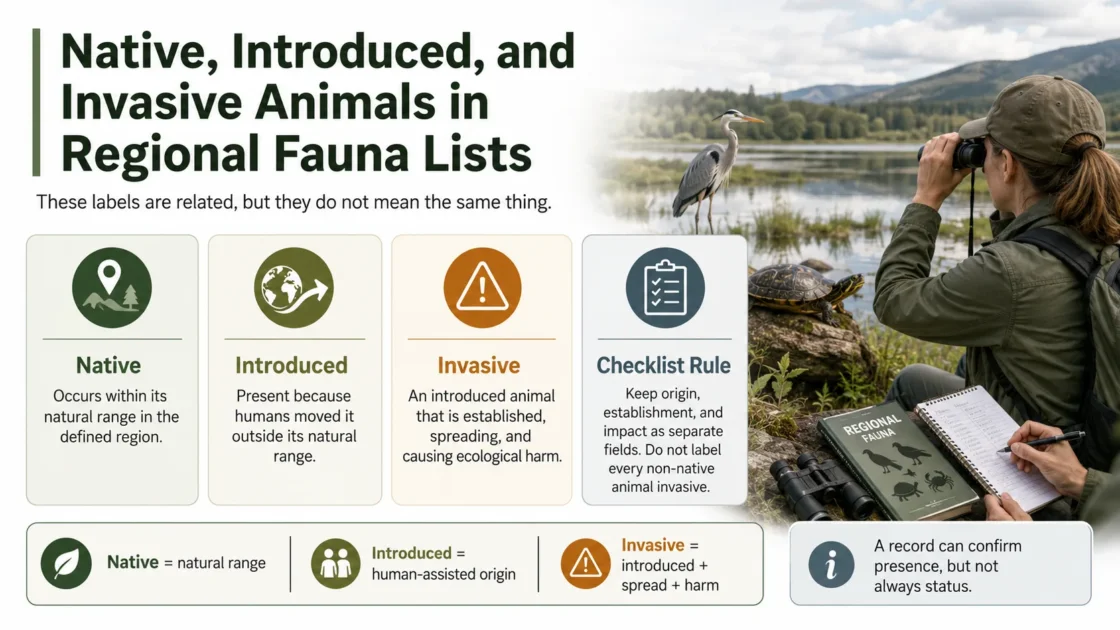
In a regional fauna list, native, introduced, and invasive should not be treated as three interchangeable entries in one simple status column. Native and introduced describe a taxon’s relationship to its natural range and the role of human agency. Establishment describes whether a wild population survives and reproduces. Invasive requires a stated rule concerning spread, ecological impact, or both. Under the Convention on Biological Diversity definition, an invasive alien species is an alien taxon whose introduction or spread threatens biological diversity, so an invasive alien animal is introduced in the focal region, but many introduced animals are not invasive.[a]
The Three Labels Answer Different Biological Questions
A reliable fauna list first separates origin from population condition and impact. Combining these dimensions into labels such as “native or invasive” removes information and creates false opposites.
| Status | Question answered | Evidence normally required | What the label does not establish |
|---|---|---|---|
| Native | Does the taxon occur within its natural range in the defined region? | Biogeographic range evidence, historical records, expert checklists, museum material, or other evidence of natural occurrence | Abundance, year-round residence, endemicity, conservation security, or absence of management problems |
| Introduced | Did human activity move the taxon, directly or indirectly, beyond its natural range? | Release, escape, transport, trade, stocking, translocation, corridor creation, provenance, or first-arrival evidence | Wild reproduction, long-term establishment, rapid spread, ecological harm, or legal control status |
| Invasive | Has the introduced population met a declared spread or impact criterion? | Documented expansion under a spread-based system, or evidence of adverse effects under an impact-based system | That every population of the species has the same impact, or that the species is legally regulated in every jurisdiction |
The correct unit of classification is usually a taxon population in a defined place and period, not the species name considered globally.
Geographic Boundaries Can Reverse a Status
Native status is inseparable from geography. An animal may be native to a continent, country, river basin, or mainland region while being introduced to an island, isolated lake, administrative province, or protected area within that broader territory.
A country-level label can therefore hide subnational introductions. Moving a fish between unconnected drainage basins, releasing a mainland mammal on an offshore island, or stocking an animal outside its natural range within the same country may create an introduced population even though the species is native elsewhere in that country.
GRIIS checklist practice recognizes this problem through a native/alien provenance category for species that are native in one part of a country and alien in another. It also separates uncertain or cryptogenic provenance and bases invasiveness on evidence of impact.[e]
The Regional Unit Must Be Named
A status entry should identify the actual geographic unit used for the decision. “Native to Spain” does not answer whether a population is native to a particular island. “Introduced in the United States” does not identify whether the statement applies to the contiguous states, Alaska, Hawaiʻi, an overseas territory, or a single watershed.
Administrative borders may be useful for reporting, but the evidence may follow biogeographic units such as islands, ecoregions, marine basins, catchments, mountain systems, or historical dispersal barriers. The list should preserve both the reporting unit and the biological reasoning behind the assignment.
Status Is Also Time-Dependent
A regional status can change without a taxonomic change. An introduced animal may fail to survive, become established, spread, be eradicated, or remain known only from historical records. A formerly native animal may be reintroduced after regional extinction. A list that omits the assessment date can preserve an obsolete status indefinitely.
The record should distinguish the first documented occurrence, the period represented by the supporting evidence, the latest confirmation of a wild population, and the date on which the status was reviewed.
Origin, Survival, and Spread Require Separate Fields
Darwin Core separates the process by which an organism came to occur in a place from the degree to which its population survives, reproduces, and expands. The current establishmentMeans vocabulary includes native, native reintroduced, introduced, introduced by assisted colonisation, vagrant, uncertain, and native endemic values.[b] The separate degreeOfEstablishment vocabulary includes captive, released, failing, casual, reproducing, established, colonising, invasive, and widespread invasive stages.[c]
| Information dimension | Purpose in a regional fauna list | Possible values or content |
|---|---|---|
| Occurrence | States whether an organism was detected or not detected in a defined event or dataset context | Present, absent, historical record, unverified report, or another clearly defined local status |
| Establishment means | Records the origin process relative to the focal region | Native, introduced, native reintroduced, assisted colonisation, vagrant, or uncertain |
| Degree of establishment | Records survival, reproduction, persistence, and spatial expansion | Captive, released, failing, casual, reproducing, established, colonising, invasive, or widespread invasive |
| Introduction pathway | Records how the animal arrived | Release, escape, transport contaminant, stowaway, corridor, unaided spread from an alien population, or another controlled pathway |
| Impact evidence | Records whether adverse effects have been documented and how they were assessed | Assessment system, impact category, affected native taxa or ecological process, evidence source, date, and uncertainty |
| Legal or management designation | Records treatment under a named law, regulation, watchlist, or management programme | Listed, regulated, prohibited, monitored, controlled, eradication target, or not assessed under the named instrument |
Introduced Does Not Mean Established
An animal can be introduced without forming a self-sustaining wild population. Released game animals may disappear after stocking ends. Escaped pets may survive temporarily without breeding. Aquarium fish may be reported during warm months but fail after seasonal temperature changes. Repeated observations can also result from repeated releases rather than wild recruitment.
Establishment normally requires evidence that reproduction and recruitment maintain the population without continuing human supply. A record of eggs, juveniles, or breeding does not always prove establishment if offspring fail to survive or if repeated supplementation remains necessary.
“Casual” Has Two Different Uses
Bare use of the word “casual” can make a checklist unclear. In the Darwin Core establishment-means vocabulary, “vagrant (casual)” describes temporary occurrence far outside a natural or migratory range. In the degree-of-establishment vocabulary, “casual” describes individuals surviving outside captivity without reproduction.
A list should therefore store the field name and controlled value rather than publishing only “casual.” A natural vagrant and a surviving introduced animal may otherwise receive the same visible label despite representing different biological situations.
“Invasive” Can Mean Spread or Documented Harm
The word invasive is not operationally identical across all biodiversity systems. Under CBD usage, an invasive alien species is an alien species whose introduction or spread threatens biological diversity. IUCN descriptions likewise connect invasive alien species with negative effects on native biodiversity and other affected systems.
The Darwin Core degree-of-establishment vocabulary uses invasive as a population stage: a self-sustaining introduced population whose individuals and descendants survive, reproduce, and spread away from the original introduction area. That controlled value describes advanced spread, but it does not by itself encode the type or severity of ecological damage.
The Word “Invasive” Needs a Declared Standard
A regional fauna list should state whether “invasive” means a Darwin Core spread stage, a CBD-style threat to biodiversity, an IUCN impact assessment, or a designation under named legislation. Where possible, spread and impact should be stored in separate fields.
Impact Severity Is Not the Same as Establishment
IUCN’s Environmental Impact Classification for Alien Taxa classifies alien taxa according to the severity of documented environmental effects, including the level at which native organisms are affected and whether the effect is reversible.[f] This is a different question from whether the introduced population merely survives or spreads.
A recently detected animal may have severe known impacts elsewhere but no assessed local impact. An established animal may have documented minor effects, no detected effects under adequate study, or no local impact study at all. These conditions should not be collapsed into a binary invasive or non-invasive field.
“Not assessed,” “data deficient,” and “evidence of low impact” represent different evidence states. A lack of local research should not be rewritten as proof that the population causes no harm.
The Minimum Record Needed for a Defensible Fauna List
A publishable list needs more than a common name, scientific name, and one status label. Each row should preserve enough information for another editor to identify the taxon, region, evidence, vocabulary, and date behind the decision.
| Checklist field | Information to preserve | Reason for inclusion |
|---|---|---|
| Accepted scientific name | Current accepted or valid name under the cited taxonomic source | Prevents synonyms from being counted as separate animals |
| Taxon identifier | Stable identifier from the selected taxonomic authority where available | Supports matching when names or classifications change |
| Name used by the evidence source | Original scientific name or synonym as published | Preserves traceability to older surveys and reports |
| Geographic scope | Country, island, basin, province, protected area, marine zone, or other defined unit | Prevents a broad national status from being applied to every subregion |
| Time scope | Observation period, assessment year, first record, latest confirmation, and review date where available | Separates current populations from historical or eradicated records |
| Occurrence status | Detected, not detected, historically recorded, unverified, or another declared value | Separates evidence of occurrence from origin and establishment |
| Establishment means | Native, introduced, reintroduced, vagrant, assisted colonisation, or uncertain | Records why the population occurs in the region |
| Degree of establishment | Captive, released, failing, casual, reproducing, established, colonising, invasive, or widespread invasive | Records whether the population survives, reproduces, and spreads |
| Introduction pathway | Known or suspected transport, release, escape, corridor, contaminant, stowaway, or unaided spread pathway | Separates the route of arrival from the population’s later condition |
| Impact assessment | Assessment system, category, affected native taxa or processes, location, year, and supporting evidence | Prevents spread from being presented as proof of ecological harm |
| Legal designation | Named regulation, list, jurisdiction, effective date, and legal category | Prevents a legal label from being treated as a universal biological status |
| Evidence source | Checklist, paper, museum record, monitoring programme, agency report, or verified dataset | Allows the status assignment to be audited |
| Uncertainty | Reason for doubt, competing interpretations, missing evidence, or provisional status | Prevents uncertain origin or establishment from being converted into false certainty |
Darwin Core defines occurrenceStatus as a statement about detection or non-detection of an organism during an event. It also maintains separate terms for establishment means, degree of establishment, pathway, taxonomic identity, location, event date, and supporting references.[d] An occurrence-status field should not be repurposed to mean native, introduced, or invasive.
Evidence Needed for Each Status Assignment
The evidence threshold changes with the claim. A verified observation may support presence at a place and time, but stronger conclusions require evidence about history, human agency, reproduction, persistence, spread, or ecological effects.
| Proposed assignment | Evidence that can support the assignment | Evidence that is normally insufficient alone |
|---|---|---|
| Native | Historical range documentation, early museum material, archaeological or palaeontological evidence where relevant, biogeographic continuity, long-established expert checklists, and records consistent with natural dispersal | A recent sighting, current abundance, breeding in the region, or a common name containing the region’s name |
| Introduced | Documented release or stocking, escape records, trade or transport evidence, genetic provenance, historical accounts, first records linked to human activity, or spread from a nearby alien population | Recent arrival alone, occurrence near settlements, an expanding range, or absence from an old incomplete checklist |
| Reproducing | Verified eggs, nests, gravid individuals, juveniles, recruitment, or repeated breeding evidence in the wild | Repeated adult observations, breeding in captivity, released juveniles, or unverified reports of nesting |
| Established | Persistence across multiple reproductive cycles, recruitment into later generations, and population maintenance without repeated release or husbandry | A single breeding event, temporary survival, seasonal reappearance caused by releases, or repeated records from managed sites |
| Spreading or colonising | Verified reproduction and survival beyond the initial release area, supported by dated spatial records that are not explained by repeated introductions | More records caused by greater observer effort, duplicated observations, or expansion of survey coverage |
| Invasive under an impact definition | Regional studies, reviewed assessments, monitoring results, or official reports connecting the alien population with adverse effects on native biodiversity | High abundance, public dislike, economic nuisance alone, rapid reproduction, legal listing elsewhere, or severe impacts reported only from another ecological setting |
| Endemic | Evidence that the natural global distribution of the taxon is restricted to the stated geographic area | Being native, being locally common, being recorded only by one survey, or lacking records from neighbouring regions |
Natural Range Expansion Is Not Automatically an Introduction
Animals can expand their ranges through natural dispersal, altered climate, changing habitats, new food resources, or removal of physical barriers. Human-caused environmental change may facilitate expansion without transporting the animals themselves.
The decisive question is not merely whether humans affected the landscape. The list must determine whether human agency transported the population beyond its natural range, deliberately created a dispersal route treated as an introduction pathway, or only changed conditions through which natural dispersal occurred. Where the evidence cannot separate these explanations, uncertain origin is more accurate than a forced native or introduced label.
Records That Should Not Be Forced into the Three Main Labels
Many regional records fall outside a simple native–introduced–invasive choice. Preserving these cases prevents rare observations, captive animals, and unresolved historical populations from distorting fauna totals.
| Case | Recommended treatment | Main classification risk |
|---|---|---|
| Vagrant | Record as a temporary occurrence outside the normal natural or migratory range; retain date and evidence | Misclassifying a naturally dispersed visitor as introduced |
| Uncertain or cryptogenic origin | Preserve uncertainty and document competing native and introduced interpretations | Turning missing historical evidence into certainty |
| Native reintroduced population | Record native origin and human-assisted re-establishment in the former natural range | Treating all human-mediated releases as alien introductions |
| Assisted colonisation | Record introduction outside the natural range and identify the conservation purpose | Calling the population native because the release was intended to protect the taxon |
| Captive animal | Exclude from the wild fauna total or place in a clearly separated captive category | Using zoo, farm, aquarium, rehabilitation, or quarantine records as wild presence |
| Escapee or released individual | Record the event and origin, but do not assume reproduction or establishment | Converting one free-ranging individual into an established regional population |
| Feral population | Record domestic ancestry, wild establishment, regional origin, spread, and impacts as separate attributes | Using “feral” as a substitute for introduced, established, or invasive |
| Native-alien population | State that the species is native to part of the broader territory but introduced to the focal subregion | Applying one national status to biologically separate regions |
| Eradicated introduced population | Retain the historical introduction and establishment record while marking current regional absence or eradication | Deleting the historical record or presenting the animal as currently present |
| Unverified report | Keep outside the verified checklist or flag it as unconfirmed with its original source | Using an unsupported report to establish presence, origin, or invasion |
Occurrence Records Cannot Establish Invasion by Themselves
An occurrence record documents reported evidence of an organism at a place and time. It does not automatically identify whether the animal was wild, captive, transported, reproducing, established, spreading, or causing ecological damage.
Multiple records do not necessarily solve the problem. They may represent the same individual, repeated visits to one site, duplicated datasets, specimens with broad localities, captive observations, recurring releases, or concentrated observer activity. Record density can reflect sampling effort as well as animal distribution.
GBIF data-publishing guidance distinguishes opportunistic observations, targeted surveys, and assemblage sampling because these methods support different conclusions. Opportunistic records are gathered without a planned protocol, targeted surveys focus on selected taxa, and assemblage sampling attempts to record the wider community.[h]
A Presence Record Supports Only a Limited Claim
A verified observation can support the statement that an animal was recorded at the reported location and date. Establishment requires reproductive and persistence evidence. Spread requires comparable spatial and temporal evidence. Introduction requires evidence of human-mediated arrival beyond the natural range. Impact requires an assessment of effects on native organisms or ecological processes.
Before occurrence data are used in a regional list, records should be checked for identification quality, coordinate accuracy, date, basis of record, captive status, duplication, taxonomic matching, geographic scope, and any existing establishment or pathway fields.
One Record Does Not Establish a Regional Population
A single verified record may document temporary presence, a vagrant, an escapee, a release, a transported specimen, or a recording error. It should not be promoted to native, established, or invasive status without additional evidence.
Taxonomic Changes Can Alter Status Totals Without a Faunal Change
Origin and invasion records are attached to taxon concepts, but many working lists store only name strings. This creates duplicate records when an older synonym and a currently accepted name are both counted. It can also detach historical evidence from a species after a name change.
Catalogue of Life distinguishes accepted names, provisionally accepted names, synonyms, ambiguous synonyms, misapplied names, and names that remain taxonomically unresolved.[g] A regional list should retain the name used in the original evidence while linking it to the accepted name and taxon identifier used by the current checklist.
Splits and Lumps Need Status Reassessment
When one species is split into several taxa, an old introduction or impact record may apply to only one of the new entities. When taxa are lumped, formerly separate checklist rows may represent one accepted species. The status should not be copied automatically across every resulting taxon.
The evidence must be rechecked against geography, specimens, identification characters, genetic data, and the taxonomic concept used by the original source. Where the source cannot be assigned below a species complex or former broad taxon, the checklist should preserve that uncertainty.
Misidentifications Can Produce False Introductions
A record may appear to document a new alien animal when it is actually a native look-alike, an outdated identification, a misapplied name, or a specimen assigned before a taxonomic revision. First regional records and new invasion claims require stronger identification review than routine records of familiar fauna.
A Defensible Status Assignment Sequence
- Define the geographic unit. State whether the decision applies to a country, island, basin, province, protected area, marine zone, or another boundary.
- Define the time represented. Separate current presence from historical records, eradicated populations, and statuses based on older assessments.
- Resolve the taxon. Match the reported name to an accepted taxon while retaining synonyms and the original name usage.
- Verify regional occurrence. Confirm that the evidence represents the focal region and determine whether the animal was wild, captive, released, escaped, or unverified.
- Assign establishment means. Decide whether the regional occurrence is native, introduced, reintroduced, assisted colonisation, vagrant, or uncertain.
- Assign degree of establishment. Evaluate survival, reproduction, self-maintenance, expansion, and the role of repeated releases.
- Assess spread and impact separately. State the vocabulary used and do not infer ecological harm from presence, abundance, or establishment alone.
- Record legal designations independently. Name the jurisdiction, regulation, category, and effective date.
- Attach evidence and uncertainty. Preserve the supporting source, assessment date, reviewer where available, and the reason for any provisional decision.
Publishing Regional Counts Without Mixing Categories
Counts should follow the same dimensions used in the underlying records. A list may report native taxa, introduced taxa, established introduced taxa, spreading introduced taxa, impact-assessed invasive taxa, uncertain-origin taxa, vagrants, historical populations, and excluded captive records. These totals answer different questions.
The categories are not always additive. Under an alien-species impact definition, invasive animals form a subset of introduced animals. Established introduced animals form another subset, while some introduced animals remain casual, fail to persist, or are known only from releases. Adding all of these counts together would count some taxa more than once.
Every published total should name the geographic boundary, taxonomic scope, accepted-name source, status vocabulary, evidence cutoff date, treatment of doubtful records, and whether the count represents species, infraspecific taxa, populations, or checklist rows.
A species can contribute more than one population-level status inside a broad region. It may be native in one basin, introduced but not established in another, and established with documented impacts on an island. A single global label cannot preserve those regional differences.
Sources and Verification
- [a] Convention on Biological Diversity: What are Invasive Alien Species? — Used for the international definitions of alien species and invasive alien species and their relationship to biodiversity threats.
- [b] TDWG Darwin Core Establishment Means Controlled Vocabulary — Used for the current controlled values and definitions covering native, introduced, reintroduced, assisted-colonisation, vagrant, uncertain, and endemic occurrence origins.
- [c] TDWG Darwin Core Degree of Establishment Controlled Vocabulary — Used for population stages covering captivity, release, survival, reproduction, establishment, colonisation, invasion, and widespread invasion.
- [d] Darwin Core Quick Reference Guide — Used for the separation of occurrence status, establishment means, degree of establishment, pathway, location, event, and taxonomic fields.
- [e] Global Register of Introduced and Invasive Species — Finland — Used for GRIIS provenance practice, including alien, native/alien, uncertain or cryptogenic origin, and impact-based invasiveness.
- [f] IUCN Environmental Impact Classification for Alien Taxa — Used for the separation of alien-population status from evidence-based classification of environmental impact severity.
- [g] Catalogue of Life Glossary — Used for accepted-name, synonym, ambiguous-synonym, misapplied-name, and unresolved-name distinctions relevant to checklist deduplication.
- [h] GBIF Freshwater Data Publishing Guide — Used for distinctions among opportunistic observations, targeted sampling, assemblage sampling, occurrence datasets, and location-based checklists.
Related Topics
- → Regional Fauna Checklist: What It Includes and What It Does Not
- → Mammals of Turkey: Native Species, Habitats, and Distribution
- → Birds of Turkey: Native, Migratory, and Rare Species
- → How Climate Zones Influence Regional Animal Diversity
- → Bats of Turkey: Diversity, Habitats, and Conservation
- → Wild Ungulates of Turkey: Deer, Goats, Sheep, and Wild Boar