Complete guides: •Regional Fauna Guides•Reptiles•Fauna of Turkey
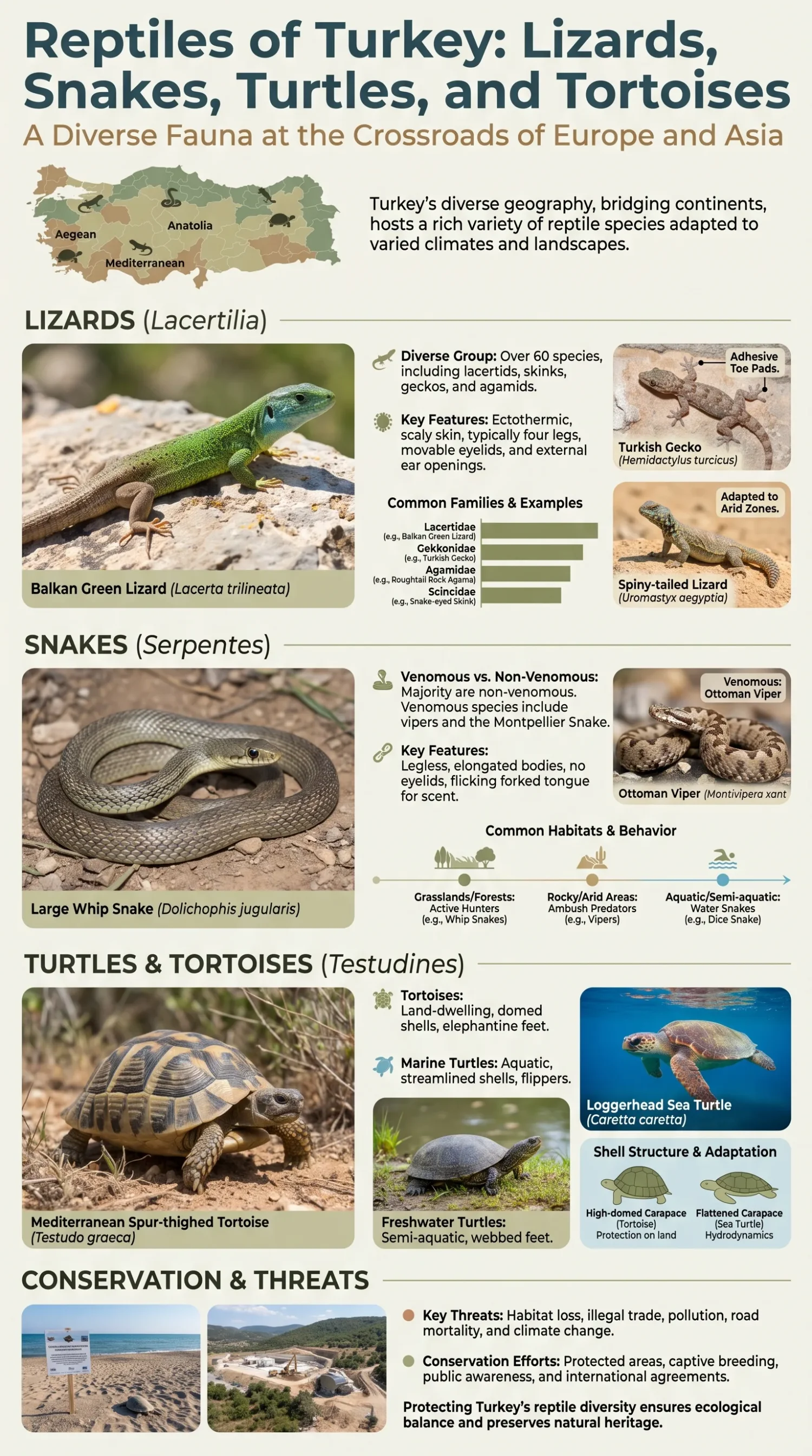
Turkey supports native and naturally recorded sea turtles, freshwater turtles, tortoises, worm lizards, geckos, skinks, lacertids, agamas, glass lizards, monitor lizards, colubrids, blind snakes, boas, elapids, and vipers. A 2021 national atlas recognized 141 reptile species, but that number is not a permanent taxonomic total: later studies described additional Anatolian lizards, corrected several snake records, and changed the rank or accepted name of other taxa.
Why Turkey’s Published Reptile Totals Differ
The broadest mapped national synthesis published in 2021 listed 11 chelonians, 70 lizards, 3 worm lizards, and 57 snakes. It combined literature available through December 2020 with field data gathered from 1987 to 2020 and assembled 11,913 locality records. Its 141-species inventory provides the clearest dated baseline for a national checklist and for the tables below.[a]
A separate checklist published in 2020 counted 145 reptiles: 11 testudines, 71 saurians, 3 amphisbaenians, and 60 snakes. The difference does not represent four reptiles appearing or disappearing in a single year. It reflects alternative decisions about taxonomy, doubtful border records, introduced species, and names treated as species in one source but as synonyms or subspecies in another.[b]
The checklist is dated, not frozen
The main inventory retains the full national-atlas scope, replaces names where a later study directly corrected the Turkish record, and places newer or unresolved taxa in separate tables. Introduced reptiles are shown but are not presented as native members of Turkey’s fauna.
Composition of the 2021 National Inventory
Reptile Groups in the 2021 Turkey Atlas
The values represent species accepted within the study’s national taxonomic scope, not a permanent total for later classifications.
Source: Yaşar et al., national atlas based on literature through December 2020 and field records from 1987–2020.
Turtles and Tortoises Recorded from Turkey
Turkey’s chelonian records include three marine turtles, four hard-shelled freshwater turtles or pond turtles, two softshell turtles, two land tortoises, and an introduced North American slider. Marine occurrence does not imply that every recorded species nests on Turkish beaches; the leatherback is primarily an occasional marine record, whereas loggerhead and green turtles have established nesting use of the Mediterranean coast.
| Family | Scientific name | Checklist treatment in Turkey |
|---|---|---|
| Cheloniidae | Caretta caretta | Native marine turtle; nesting populations occur on the Mediterranean coast. |
| Cheloniidae | Chelonia mydas | Native marine turtle; nesting is concentrated along the eastern Mediterranean coast. |
| Dermochelyidae | Dermochelys coriacea | Occasional marine record; not treated as an established nesting species in Turkey. |
| Emydidae | Emys orbicularis | Native freshwater and wetland turtle. |
| Geoemydidae | Mauremys caspica | Native freshwater turtle, mainly associated with eastern and southeastern drainage systems. |
| Geoemydidae | Mauremys rivulata | Native freshwater turtle of western, southern, and parts of northwestern Turkey. |
| Trionychidae | Rafetus euphraticus | Native softshell turtle of the Tigris–Euphrates system. |
| Trionychidae | Trionyx triunguis | Native softshell turtle recorded from suitable coastal rivers, lakes, and deltas. |
| Testudinidae | Testudo graeca | Native land tortoise with broad but discontinuous occurrence. |
| Testudinidae | Testudo hermanni | Native land tortoise with a more restricted northwestern distribution. |
| Emydidae | Trachemys scripta | Introduced through the pet trade; established reproduction has been reported locally. |
Turkey’s Three Worm Lizards
Amphisbaenians are burrowing squamates rather than true worms or snakes. Turkey’s accepted national lists contain three species in the genus Blanus. Their subterranean habits make them less frequently documented than surface-active lizards.
| Family | Scientific name | Broad Turkish occurrence |
|---|---|---|
| Blanidae | Blanus strauchi | Western and southern Anatolian records. |
| Blanidae | Blanus aporus | Southern Anatolian taxon with a restricted documented range. |
| Blanidae | Blanus alexandri | Southeastern Anatolian taxon associated with the northern Levantine region. |
Agamas, Chameleons, Geckos, Glass Lizards, and the Leopard Gecko
This part of the fauna contains rock-dwelling agamas, a Mediterranean chameleon, nocturnal geckos, an eyelid gecko, and two limbless or reduced-limb anguids. The genera used for the starred agamas vary among recent sources: many Turkish publications use Paralaudakia caucasia and Stellagama stellio, while other current checklists place both in Laudakia.
| Family | Scientific name | Taxonomic or occurrence note |
|---|---|---|
| Agamidae | Laudakia caucasia | Frequently published as Paralaudakia caucasia. |
| Agamidae | Laudakia stellio | Frequently published as Stellagama stellio. |
| Agamidae | Phrynocephalus horvathi | Eastern Anatolian racerunner-like agama of open, dry ground. |
| Agamidae | Trapelus ruderatus | Southeastern dryland species. |
| Chamaeleonidae | Chamaeleo chamaeleon | Mediterranean coastal and lowland occurrence. |
| Phyllodactylidae | Asaccus barani | Turkish populations formerly assigned to Asaccus elisae have been treated as this species. |
| Gekkonidae | Cyrtopodion scabrum | Recorded mainly in southeastern settlements and dry habitats. |
| Gekkonidae | Hemidactylus turcicus | Widespread Mediterranean house gecko. |
| Gekkonidae | Mediodactylus danilewskii | Northwestern and Black Sea-associated records. |
| Gekkonidae | Mediodactylus heterocercus | Eastern and southeastern rocky habitats. |
| Gekkonidae | Mediodactylus kotschyi | Western and southern rocky habitats, buildings, and islands. |
| Gekkonidae | Mediodactylus orientalis | Eastern Mediterranean taxon recorded in southern Turkey. |
| Gekkonidae | Stenodactylus grandiceps | Restricted southeastern sand and dry-soil records. |
| Eublepharidae | Eublepharis angramainyu | Southeastern ground-dwelling leopard gecko. |
| Anguidae | Anguis colchica | Older Turkish records may appear under Anguis fragilis. |
| Anguidae | Pseudopus apodus | Large legless glass lizard recorded in western, northern, and southern regions. |
Lacertid Lizards of Turkey
Lacertidae is the most species-rich reptile family in Turkey. Its diversity is especially high among Anatolian rock lizards, fringe-fingered lizards, green lizards, snake-eyed lizards, and narrowly distributed mountain taxa. Several Darevskia species reproduce parthenogenetically, while others form geographically restricted sexual lineages.
Fringe-Fingered, Anatolian, and Cappadocian Lizards
| Genus | Scientific name | Checklist note |
|---|---|---|
| Acanthodactylus | Acanthodactylus boskianus | Southeastern dryland records. |
| Acanthodactylus | Acanthodactylus harranensis | Highly localized Harran-region taxon; records outside Turkey affect claims of strict national endemicity. |
| Acanthodactylus | Acanthodactylus ilgazi | Southern Anatolian species described from Turkey. |
| Acanthodactylus | Acanthodactylus schreiberi | Eastern Mediterranean coastal and lowland populations. |
| Anatololacerta | Anatololacerta anatolica | Western Anatolian species. |
| Anatololacerta | Anatololacerta danfordi | Southern Anatolian mountain and rocky-habitat species. |
| Anatololacerta | Anatololacerta finikensis | Restricted southwestern Anatolian species. |
| Anatololacerta | Anatololacerta ibrahimi | Southern Anatolian species. |
| Anatololacerta | Anatololacerta pelasgiana | Southwestern Anatolian and adjacent Aegean taxon. |
| Apathya | Apathya cappadocica | Central, eastern, and southeastern rocky habitats. |
Rock Lizards in the Genus Darevskia
The genus Darevskia contains the largest concentration of recent taxonomic change in the Turkish checklist. The first table contains taxa recognized by the 2021 atlas. Newly described or newly elevated species are added immediately afterward rather than silently inserted into the older total.
| Scientific name | Reproductive or taxonomic context |
|---|---|
| Darevskia adjarica | Northeastern Black Sea and Caucasian taxon. |
| Darevskia armeniaca | Parthenogenetic rock lizard recorded in eastern Turkey. |
| Darevskia bendimahiensis | Parthenogenetic eastern Anatolian species. |
| Darevskia bithynica | Northwestern Anatolian taxon; older literature may use a subspecific treatment. |
| Darevskia clarkorum | Northeastern Anatolian species associated with humid mountain habitats. |
| Darevskia derjugini | Black Sea and Caucasian mountain taxon. |
| Darevskia parvula | Northeastern Anatolian member of the D. parvula group. |
| Darevskia praticola | Used in the national atlas; some specialist treatments apply Darevskia hungarica to Turkish populations. |
| Darevskia raddei | Eastern Anatolian and Transcaucasian taxon. |
| Darevskia rudis | Species complex affected by later elevation and description of related lineages. |
| Darevskia sapphirina | Parthenogenetic species with eastern Anatolian records. |
| Darevskia unisexualis | Parthenogenetic species recorded in northeastern and eastern Anatolia. |
| Darevskia uzzelli | Parthenogenetic eastern Anatolian species. |
| Darevskia valentini | Sexual mountain species of eastern Turkey and neighboring Caucasian areas. |
A 2022 revision of the Darevskia rudis complex recognized D. mirabilis, D. obscura, and D. spitzenbergerae at species level and described D. josefschmidtleri. These names should not be hidden under a single unchanged D. rudis entry.[e]
| Later species-level entry | Basis for inclusion |
|---|---|
| Darevskia josefschmidtleri | Species described from the revised D. rudis group in northeastern Anatolia. |
| Darevskia mirabilis | Elevated or restored species-level treatment within the revised group. |
| Darevskia obscura | Recognized as a separate species in the 2022 revision. |
| Darevskia spitzenbergerae | Recognized as a separate species in the 2022 revision. |
| Darevskia tuniyevi | New endemic species described from northeastern Anatolia using morphology, osteology, mitochondrial DNA, and a nuclear marker. |
| Darevskia salihae | New species described from northeastern Turkey after the national atlas. |
| Darevskia saxicola | Turkey is included in current taxonomic-database distribution, although national-list treatment requires careful separation from revised related taxa. |
| Darevskia nairensis | Included by a specialist geographic checklist; its exact treatment should remain explicit when totals are compared. |
Darevskia tuniyevi was diagnosed from 257 specimens using external morphology, osteology, mitochondrial evidence, and a nuclear marker.[f] The separate description of Darevskia salihae provides another reason that a checklist based only on literature available through 2020 cannot be treated as a current fixed total.[g]
Racerunners, Green Lizards, Snake-Eyed Lizards, and Wall Lizards
| Genus | Scientific name | Checklist treatment |
|---|---|---|
| Eremias | Eremias pleskei | Eastern Anatolian open-ground species. |
| Eremias | Eremias strauchi | Eastern Anatolian racerunner. |
| Eremias | Eremias suphani | Restricted eastern Anatolian species. |
| Eremias | Eremias arguta | Current taxonomic-database records include the Lake Van area; absent from the 2021 national-atlas total. |
| Iranolacerta | Iranolacerta brandtii | Eastern Anatolian and Iranian plateau species. |
| Lacerta | Lacerta agilis | Sand lizard with localized northern and eastern records. |
| Lacerta | Lacerta diplochondrodes | Green-lizard lineage recognized in recent Turkish lists. |
| Lacerta | Lacerta media | Large green lizard of eastern and southeastern regions. |
| Lacerta | Lacerta pamphylica | Southern Anatolian species associated with the Antalya region. |
| Lacerta | Lacerta strigata | Eastern and northeastern green lizard. |
| Lacerta | Lacerta viridis | European green lizard recorded mainly in Thrace and northwestern Turkey. |
| Ophisops | Ophisops elegans | Broadly distributed snake-eyed lizard. |
| Parvilacerta | Parvilacerta parva | Central and eastern Anatolian dwarf lizard. |
| Phoenicolacerta | Phoenicolacerta cyanisparsa | Southern Anatolian and Levantine rock-associated species. |
| Phoenicolacerta | Phoenicolacerta laevis | Eastern Mediterranean lizard recorded in southern Turkey. |
| Podarcis | Podarcis muralis | Native wall lizard of northwestern and northern regions. |
| Podarcis | Podarcis tauricus | Native Balkan wall lizard recorded in Thrace and adjacent areas. |
| Podarcis | Podarcis siculus | Introduced Italian wall lizard; not part of the native fauna. |
| Timon | Timon kurdistanicus | Large lizard of southeastern Turkey and neighboring regions. |
| Timon | Timon princeps | Current species accounts include southeastern Turkey; its relationship and boundary with T. kurdistanicus require locality-level identification. |
The present species account for Eremias arguta includes a Turkish record near Lake Van, making it a database-supported addition that was not incorporated into the 2021 atlas.[q] Current distribution information for Timon princeps also includes southeastern Turkey, while distinguishing it from the neighboring T. kurdistanicus lineage.[p]
Skinks and the Desert Monitor
| Family | Scientific name | Checklist note |
|---|---|---|
| Scincidae | Ablepharus anatolicus | Recognized in current specialist and taxonomic sources; not separated in the 2021 atlas. |
| Scincidae | Ablepharus bivittatus | Eastern Anatolian snake-eyed skink. |
| Scincidae | Ablepharus budaki | Southern Anatolian and eastern Mediterranean taxon. |
| Scincidae | Ablepharus chernovi | Anatolian snake-eyed skink with several geographically structured populations. |
| Scincidae | Ablepharus kitaibelii | Recorded mainly in European Turkey and the northwestern transition zone. |
| Scincidae | Chalcides ocellatus | Ocellated skink of Mediterranean and southeastern lowlands. |
| Scincidae | Eumeces schneiderii | Schneider’s skink; some publications divide regional forms under other species or subspecies names. |
| Scincidae | Heremites auratus | Golden grass skink recorded in eastern and southeastern Turkey. |
| Scincidae | Heremites septemtaeniatus | Seven-striped skink of southeastern habitats. |
| Scincidae | Heremites vittatus | Bridled skink of southern and southeastern Turkey. |
| Scincidae | Ophiomorus kardesi | Burrowing skink described from southeastern Turkey. |
| Varanidae | Varanus griseus | Desert monitor with sparse records in arid southeastern Turkey. |
Blind Snakes, Sand Boas, and Water Snakes
| Family | Scientific name | Ecological context |
|---|---|---|
| Leptotyphlopidae | Myriopholis macrorhyncha | Minute fossorial snake recorded in southeastern drylands. |
| Typhlopidae | Xerotyphlops vermicularis | Widespread worm snake living mainly below stones and in soil. |
| Typhlopidae | Letheobia episcopa | Rarely documented blind snake of southeastern Turkey. |
| Boidae | Eryx jaculus | Sand boa recorded in dry grassland, scrub, and cultivated landscapes. |
| Natricidae | Natrix natrix | Grass-snake complex associated with wetlands and surrounding terrestrial habitat. |
| Natricidae | Natrix tessellata | Dice snake closely associated with rivers, lakes, reservoirs, and coasts. |
Colubrid and Psammophiid Snakes
Most Turkish snake species belong to Colubridae. The group includes racers, dwarf snakes, rat snakes, whip snakes, cat snakes, and smooth snakes. The following inventory replaces Platyceps ventromaculatus with P. karelini because the former Turkish records were shown to be misidentified.
| Genus | Scientific name | Checklist note |
|---|---|---|
| Coronella | Coronella austriaca | Northern and upland smooth snake. |
| Dolichophis | Dolichophis caspius | Large racer of Thrace, western, central, and northern regions. |
| Dolichophis | Dolichophis jugularis | Large eastern racer with broad Anatolian occurrence. |
| Dolichophis | Dolichophis schmidti | Eastern red-bellied racer. |
| Eirenis | Eirenis aurolineatus | Small southeastern dwarf snake. |
| Eirenis | Eirenis barani | Localized Anatolian dwarf snake. |
| Eirenis | Eirenis collaris | Eastern and southeastern dwarf snake. |
| Eirenis | Eirenis coronelloides | Current name used for populations formerly listed as Eirenis coronella. |
| Eirenis | Eirenis decemlineatus | Southern and southeastern striped dwarf snake. |
| Eirenis | Eirenis eiselti | Restricted Turkish dwarf snake. |
| Eirenis | Eirenis hakkariensis | Restricted southeastern mountain taxon. |
| Eirenis | Eirenis levantinus | Eastern Mediterranean dwarf snake. |
| Eirenis | Eirenis lineomaculatus | Southern rocky-habitat dwarf snake. |
| Eirenis | Eirenis modestus | Widespread Anatolian dwarf snake. |
| Eirenis | Eirenis occidentalis | Western Anatolian dwarf snake. |
| Eirenis | Eirenis punctatolineatus | Eastern and southeastern dwarf snake. |
| Eirenis | Eirenis rothii | Southeastern and Levantine dwarf snake. |
| Eirenis | Eirenis thospitis | Localized eastern Anatolian species associated with the Lake Van region. |
| Elaphe | Elaphe dione | Eastern steppe rat snake retained in national and specialist lists. |
| Elaphe | Elaphe sauromates | Blotched rat snake of Thrace and much of Anatolia. |
| Elaphe | Elaphe urartica | Eastern Anatolian rat snake recognized as a separate species. |
| Hemorrhois | Hemorrhois nummifer | Coin-marked snake with broad Anatolian occurrence. |
| Hemorrhois | Hemorrhois ravergieri | Spotted whip snake of eastern Turkey. |
| Muhtarophis | Muhtarophis barani | Localized southern Anatolian snake. |
| Platyceps | Platyceps collaris | Red whip snake of western and southern regions. |
| Platyceps | Platyceps karelini | Corrected name for Turkish material previously reported as P. ventromaculatus. |
| Platyceps | Platyceps najadum | Slender whip snake with broad but uneven occurrence. |
| Platyceps | Platyceps rhodorachis | Eastern and southeastern cliff-racer taxon. |
| Rhynchocalamus | Rhynchocalamus melanocephalus | Black-headed snake recorded in southern Turkey. |
| Rhynchocalamus | Rhynchocalamus satunini | Eastern black-headed snake. |
| Spalerosophis | Spalerosophis diadema | Diadem snake of arid southeastern landscapes. |
| Telescopus | Telescopus fallax | European cat snake recorded in western and southern Turkey. |
| Telescopus | Telescopus nigriceps | Black-headed cat snake of southeastern Turkey. |
| Zamenis | Zamenis hohenackeri | Transcaucasian rat snake of northern and eastern Turkey. |
| Zamenis | Zamenis longissimus | Aesculapian snake of Thrace and humid northern regions. |
| Zamenis | Zamenis situla | Leopard snake of western and southern Turkey. |
| Malpolon | Malpolon insignitus | Eastern Montpellier snake; family Psammophiidae. |
The 2024 Şanlıurfa study concluded that the snake previously reported from Turkey as Platyceps ventromaculatus was a misidentified P. karelini and that P. ventromaculatus does not occur in the country.[h]
Elapids and Vipers
Turkey’s medically important venomous snakes are concentrated in Viperidae, with one desert cobra lineage in Elapidae. Species boundaries among mountain and steppe vipers remain an active research subject, so a national total must state whether geographically structured forms are treated as species or subspecies.
| Family | Scientific name | Taxonomic or regional context |
|---|---|---|
| Elapidae | Walterinnesia aegyptia | Current database treatment for the desert cobra historically listed from Turkey as Walterinnesia morgani. |
| Viperidae | Macrovipera lebetinus | Large viper recorded in parts of southern and eastern Turkey. |
| Viperidae | Montivipera bulgardaghica | Mountain viper associated with the Bolkar and Taurus region. |
| Viperidae | Montivipera raddei | Eastern mountain viper. |
| Viperidae | Montivipera wagneri | Restricted eastern Anatolian mountain viper. |
| Viperidae | Montivipera xanthina | Ottoman viper of western and central Anatolia. |
| Viperidae | Montivipera albizona | Central Anatolian lineage treated as a species by current databases, but as M. bulgardaghica albizona in some research. |
| Viperidae | Vipera ammodytes | Nose-horned viper recorded mainly in Thrace and northwestern Turkey. |
| Viperidae | Vipera anatolica | Highly restricted Anatolian steppe viper. |
| Viperidae | Vipera berus | Adder with restricted high-elevation or northern records. |
| Viperidae | Vipera eriwanensis | Also treated as Vipera renardi eriwanensis; northeastern and eastern steppe populations. |
| Viperidae | Vipera kaznakovi | Caucasus viper associated with humid northeastern Turkey. |
| Viperidae | Vipera olguni | Accepted identity for Turkish specimens formerly assigned to Vipera darevskii. |
| Viperidae | Vipera sakoi | Northeastern Anatolian viper recognized as a separate lineage in recent lists. |
| Viperidae | Vipera meridionalis | Appears in current country-filtered taxonomic results; rank and Turkish distribution should be stated when included in a total. |
| Viperidae | Vipera barani | Included as a species in some specialist lists but not consistently separated in current country summaries. |
The Reptile Database assigns Turkish specimens formerly identified as Vipera darevskii to Vipera olguni and limits confirmed V. darevskii to the area beyond the Turkish border.[i] The same care is needed with Montivipera albizona: it is listed as a species in the database, while other work places it below species level within M. bulgardaghica.[l]
Names That Should Not Be Added as Separate Turkish Species
Historical names, changed combinations, misidentifications, and database search artifacts can inflate a checklist when every returned name is counted independently. The following entries require replacement, exclusion, or a stated taxonomic choice.
| Name encountered in older or broad searches | Treatment used here | Reason |
|---|---|---|
| Anguis fragilis | Anguis colchica | Turkish slow-worm populations are generally assigned to the eastern lineage. |
| Asaccus elisae | Asaccus barani | Turkish material was reassigned in the modern national literature. |
| Daboia palaestinae | Excluded from the accepted working checklist | The current species account states that it has not been found in Turkey, although it occurs near the Syrian border. |
| Darevskia hungarica | Alternative treatment to Darevskia praticola | The two names should not be counted independently without declaring the adopted taxonomy. |
| Eirenis coronella | Eirenis coronelloides | Current species name used for the relevant Turkish populations. |
| Eumeces pavimentatus | Not automatically added beside Eumeces schneiderii | Species and subspecies boundaries within the Schneider’s skink complex vary among sources. |
| Eumeces princeps | Not automatically added beside Eumeces schneiderii | Alternative regional taxonomic treatments can otherwise create duplicate counting. |
| Laudakia caucasia / Paralaudakia caucasia | One species-level entry | Genus placement differs; the names do not represent two Turkish species. |
| Laudakia stellio / Stellagama stellio | One species-level entry | Genus placement differs among taxonomic systems. |
| Mesalina microlepis | Excluded from the accepted core pending new verified Turkish evidence | The current species account does not include Turkey in its distribution. |
| Phrynocephalus helioscopus | Phrynocephalus horvathi for the accepted Turkish entry | Older literature and broad searches can return names from the wider species complex. |
| Phrynocephalus persicus | Phrynocephalus horvathi for the accepted Turkish entry | Taxonomic history should not be converted into an extra national species. |
| Platyceps ventromaculatus | Platyceps karelini | The Turkish record was shown to be a misidentification. |
| Testudo perses | Included within Testudo graeca | Not retained as a separate species in the national checklist. |
| Vipera darevskii | Vipera olguni for Turkish specimens | Current taxonomic treatment removes confirmed V. darevskii from Turkey. |
| Vipera renardi | Vipera eriwanensis or Vipera renardi eriwanensis | Species-versus-subspecies rank differs among recent treatments. |
| Walterinnesia morgani | Walterinnesia aegyptia | Older national literature used the former name for the Turkish desert-cobra record. |
| Masticophis flagellum | Excluded | North American species returned by an overbroad search rather than a valid Turkish reptile. |
| Testudo marginata | Excluded without verified Turkish evidence | Nearby Aegean occurrence or historical references do not establish a national population. |
The current account for Daboia palaestinae explicitly states that the species has not been found in Turkey.[j] The current distribution account for Mesalina microlepis likewise omits Turkey, so an older mapped record should not be retained as an accepted species without renewed evidence.[k]
How Geography Structures the Reptile Fauna
Turkey lies across several biogeographic transition zones rather than within one uniform reptile region. Thrace connects the fauna to the Balkans and southeastern Europe. The Aegean and Mediterranean belts support warm-climate tortoises, geckos, lacertids, chameleons, whip snakes, and marine-turtle nesting habitat. The central plateau and Taurus ranges contain dry-steppe reptiles and localized mountain lineages. Northeastern Anatolia connects to the Caucasus and supports the highest concentration of Darevskia and several restricted vipers. Eastern Anatolia adds highland, steppe, and volcanic-plateau taxa, while the southeast contains species linked to Mesopotamia, the northern Levant, and arid western Asia.
| Regional setting | Reptile pattern | Representative source-backed taxa |
|---|---|---|
| Thrace and northwestern Turkey | European, Balkan, wetland, and temperate woodland elements | Lacerta viridis, Podarcis tauricus, Zamenis longissimus, Vipera ammodytes, Testudo hermanni |
| Aegean and Mediterranean coast | Warm rocky slopes, scrub, river systems, wetlands, dunes, and nesting beaches | Anatololacerta species, Chamaeleo chamaeleon, Mauremys rivulata, Caretta caretta, Chelonia mydas |
| Central Anatolian plateau and Taurus ranges | Steppe, dry basins, rocky uplands, and isolated mountain lineages | Parvilacerta parva, Apathya cappadocica, Montivipera xanthina, M. bulgardaghica, Vipera anatolica |
| Northeastern Black Sea and Caucasian transition | Humid valleys, forest edges, alpine slopes, and geographically separated rock-lizard populations | Darevskia clarkorum, D. derjugini, D. salihae, D. tuniyevi, Vipera kaznakovi |
| Eastern Anatolia and the Lake Van region | High plateau, steppe, volcanic terrain, mountain grassland, and rocky slopes | Eremias suphani, Darevskia bendimahiensis, Eirenis thospitis, Vipera eriwanensis |
| Southeastern Anatolia | Mesopotamian plains, dry valleys, rocky desert margins, and the Tigris–Euphrates system | Asaccus barani, Eublepharis angramainyu, Varanus griseus, Rafetus euphraticus, Spalerosophis diadema |
Conservation Evidence Is Uneven and Assessment Dates Matter
A conservation category applies to a named taxon under a particular assessment date and taxonomic treatment. It should not be copied automatically to a renamed lineage, a newly described species, or every population within Turkey. Several narrow-range Turkish reptiles were assessed before later distribution discoveries or taxonomic revisions, while many recently described species have not passed through an equivalent global assessment cycle.
| Taxon | Published conservation evidence | Interpretive boundary |
|---|---|---|
| Acanthodactylus harranensis | Critically Endangered in an assessment dated 14 December 2008 and published in 2009; the assessment used an extent of occurrence of about 3.6 km² and one known location. | Later records outside the original Turkish locality affect claims about endemicity and range, but do not erase the date or basis of the cited assessment. |
| Rafetus euphraticus | Reported as Endangered; recent remote-sensing work documented loss of sandy nesting habitat in the upper Tigris and identified dams and sand extraction as threats. | Changes in nesting habitat are not a direct national population count. |
| Vipera anatolica | Reported as Critically Endangered in the global assessment discussed by recent steppe-viper research. | The 2025 study notes that official threat assessments for the focal steppe vipers were more than 14 years old. |
| Vipera eriwanensis / V. renardi eriwanensis | Recent research reviews taxonomy, distribution, ecology, and conservation across western Asia. | Conservation interpretation depends on whether the lineage is treated as a species or subspecies. |
| Recently described Darevskia | Peer-reviewed species descriptions establish taxonomic identity and known type-locality evidence. | A species description does not itself provide a global threat category or a complete distribution map. |
The dated assessment for Acanthodactylus harranensis classified the species as Critically Endangered under criteria based on its then-known area and habitat decline.[n] Remote-sensing research on Rafetus euphraticus found a marked reduction in sandy nesting habitat in the upper Tigris and linked the pressure to river alteration and sand extraction.[o]
A 2025 review of Vipera anatolica and the Vipera renardi eriwanensis lineage also demonstrates why status and taxonomy must be reported together: the authors discuss distinct lineages across western Asia while noting that the relevant official assessments were already more than fourteen years old.[m]
Occurrence Records Do Not Define a Complete Range
The 11,913 locality records assembled by the national atlas document reported evidence from publications and field observations. They do not mean that every suitable place in Turkey was surveyed equally. Roads, universities, protected areas, long-running field sites, accessible valleys, and well-known nesting beaches can accumulate many records, while remote mountains, border districts, agricultural land, and subterranean habitats remain less sampled.
A point record can support presence at a stated place and time, but it cannot establish continuous occupation between points. Historical museum material may remain biologically valuable even when no recent observation exists, while a single unverified online observation is not enough to add a species to a national list. The country-filtered results of a taxonomic database are therefore useful for checking names and candidate records, but they require review for synonyms, historical citations, introduced populations, border ambiguity, and erroneous search matches.[c]
A specialist geographic checklist provides another independent comparison and explicitly excludes doubtful records and introduced species from its native-fauna scope. Its differences from the national atlas help identify taxa that require synchronization rather than proving that one undated total is final.[d]
The current species account for Darevskia saxicola, for example, includes Turkey in its distribution while also reflecting a complicated history of names and related lineages. Such entries belong in the checklist with their taxonomic boundary stated, not as an unexplained addition to a headline number.[r]
Sources and Verification
- [a] The distribution and biogeography of amphibians and reptiles in Turkey — Used for the 141-species national baseline, group totals, study period, occurrence-record total, mapped taxa, and regional biogeography.
- [b] Species list of Amphibians and Reptiles from Turkey — Used for the alternative 145-reptile checklist, its group totals, and taxonomic notes concerning introduced and renamed taxa.
- [c] The Reptile Database: Turkey country search — Used to check current accepted combinations, candidate country records, and names requiring review before inclusion in a national total.
- [d] Reptiles of Turkey specialist checklist — Used as an independent geographic cross-check for formally described native species and disputed checklist treatments.
- [e] Taxonomic revision of the Darevskia rudis complex — Used for D. josefschmidtleri and the species-level treatment of D. mirabilis, D. obscura, and D. spitzenbergerae.
- [f] Description of Darevskia tuniyevi from northeastern Anatolia — Used for the species diagnosis, Turkish origin, specimen scope, and morphological and genetic evidence.
- [g] Description of Darevskia salihae from northeastern Turkey — Used to add the post-atlas species and distinguish it from related northeastern Anatolian rock lizards.
- [h] Herpetofaunal Diversity of Şanlıurfa Province — Used for the correction of Turkish Platyceps ventromaculatus records to P. karelini.
- [i] The Reptile Database: Vipera darevskii — Used for the reassignment of Turkish specimens to Vipera olguni and the exclusion of confirmed V. darevskii from Turkey.
- [j] The Reptile Database: Daboia palaestinae — Used to separate nearby Syrian occurrence from a verified Turkish national record.
- [k] The Reptile Database: Mesalina microlepis — Used to evaluate the older Turkish atlas entry against the current accepted distribution.
- [l] The Reptile Database: Montivipera albizona — Used for the central Turkish distribution and the alternative species-versus-subspecies treatment.
- [m] Taxonomy, distribution, and conservation of threatened steppe vipers of western Asia — Used for Vipera anatolica, the Vipera renardi eriwanensis lineage, taxonomic rank differences, and the age of existing threat assessments.
- [n] IUCN assessment for Acanthodactylus harranensis — Used for the Critically Endangered category, assessment date, criteria, and then-known range measurements.
- [o] Remote-sensing study of Rafetus euphraticus nesting habitat — Used for the species’ reported threat category, upper-Tigris nesting habitat, and documented pressures from river alteration and sand extraction.
- [p] The Reptile Database: Timon princeps — Used for its southeastern Turkish distribution and separation from Timon kurdistanicus.
- [q] The Reptile Database: Eremias arguta — Used for the current Turkish record associated with the Lake Van area.
- [r] The Reptile Database: Darevskia saxicola — Used for the current country distribution and the need to separate the name from related revised rock-lizard lineages.