Complete guides: •Regional Fauna Guides•Mammals•Fauna of Turkey
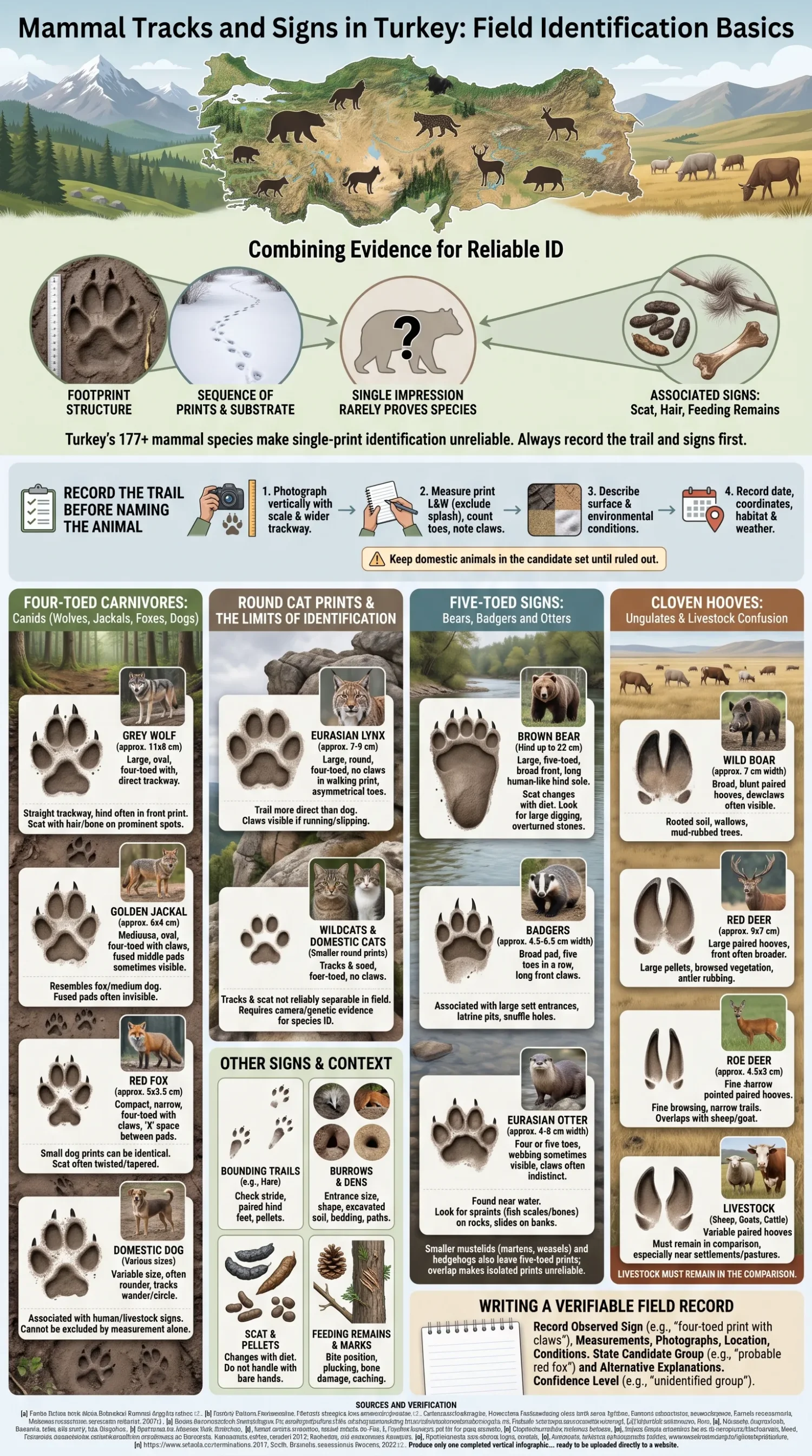
Mammal tracks and signs in Turkey are identified most reliably by combining footprint structure, the sequence of prints, substrate, habitat and nearby evidence such as scat, feeding remains, burrows or hair. A single impression may narrow the animal to a canid, felid, mustelid or hoofed mammal, but it rarely proves a species on its own.
Clear identification begins before a species name is considered. Count the visible toes, check whether claws registered, examine the heel or hoof shape, photograph several consecutive prints and record where the trail was found. Distorted mud, melting snow, loose sand, overlapping steps and livestock traffic can all make unrelated animals appear similar.
Turkey’s Mammal List Is Larger Than Any Footprint Key
A 2025 peer-reviewed checklist reports 177 wild mammal species in Türkiye, including 165 terrestrial and 12 marine species.[a] The Mammal Diversity Database currently returns 181 living species under its own taxonomic and geographic rules, including 76 rodents, 41 bats and 22 species in Eulipotyphla. It also recognizes multiple Turkish hedgehogs, moles, cats and two badger taxa, Meles canescens and Meles meles.[b]
Most of those mammals cannot be separated by ordinary footprints. Bat guano does not normally identify a bat species, a molehill does not resolve Turkey’s several mole taxa, and a tiny rodent trail seldom distinguishes one mouse, vole or hamster from another. A defensible record may therefore be “small rodent,” “mole,” “badger species” or “medium-sized canid” rather than a precise scientific name.
Species Names Should Follow the Evidence
Record the visible sign before selecting a taxon. An observation becomes stronger when several independent clues agree: print anatomy, trackway, measurements, habitat, scat, feeding evidence and an image from a camera trap. A footprint alone should not be used to claim an uncommon cat, carnivore or hoofed mammal.
Record the Trail Before Naming the Animal
A Turkey-based survey in Gölcük-Isparta Nature Park used 1,250 sample plots to record signs of brown hare, wild boar, badger, stone marten, red fox and wolf. The researchers noted that the appearance and persistence of signs can change with the ground surface, diet, elapsed time, wind and other environmental conditions.[c]
Several connected prints are more informative than the sharpest isolated print. A trail reveals whether the animal walked, trotted, bounded or jumped; whether the hind foot landed over the front print; how wide the body straddled the route; and whether the animal followed a direct line or moved irregularly.
- Photograph the clearest print vertically, with a ruler or another fixed scale beside it.
- Photograph the wider trail so the direction of movement and spacing between prints remain visible.
- Measure print length and width without including splash marks or loose soil pushed beyond the pad.
- Count toes and note whether every toe is equally clear.
- Record claws, webbing, dewclaws, heel pads and any long sole impression.
- Describe the surface: wet mud, dry dust, sand, snow, leaf litter, rock or compact soil.
- Record date, coordinates, elevation, habitat, nearby water and recent weather.
- Photograph scat, hair, feeding remains, scratch marks or burrow entrances without moving them.
- Keep domestic dogs, cats, sheep, goats, cattle and equids in the candidate set until their presence has been assessed.
Foot Structure Narrows the Candidate Group
The first useful division is anatomical rather than taxonomic. Split hooves, four-toed paws, five-toed paws and bounding trails lead to different candidate groups. Missing toes do not always mean the animal lacked them; a toe may fail to register on firm ground or disappear when the print edge collapses.
| Visible structure | Candidate group | Turkish mammals to consider | Evidence to check next |
|---|---|---|---|
| Four toes, oval paw, claws often visible | Canids | Grey wolf, golden jackal, red fox and domestic dog | Trackway straightness, stride, pad proportions, repeated prints and nearby human or livestock activity |
| Four toes, round paw, claws usually absent | Felids | Eurasian lynx and smaller wild or domestic cats; other Turkish felids require very strong corroboration | Print diameter, pad asymmetry, trail pattern, camera images, hair or genetic evidence |
| Five toes, broad front foot and long hind sole | Bear | Brown bear | Claw marks, full hind-foot impressions, large trackway, scat and feeding evidence |
| Five toes in a row with strong front claws | Badgers | Meles species | Sett entrances, bedding, digging, latrine pits and repeated broad prints |
| Five toes beside rivers or wetlands | Otter or another mustelid | Eurasian otter; smaller mustelids where print size and habitat fit | Webbing, slides, riverbank routes, spraints and feeding remains |
| Two-part hoof | Even-toed ungulates | Wild boar, deer, wild goat, mouflon, chamois, gazelles and domestic livestock | Toe shape, dewclaws, size, trail pattern, rooting, grazing context and locality |
| Long hind prints landing ahead of smaller forefeet | Hares and other bounding mammals | Brown hare; smaller rodents may leave miniature bounding sequences | Print size, stride, paired hind feet, droppings and feeding marks |
| Very small five-toed or incomplete prints | Small mammals | Hedgehogs, shrews, rodents and small mustelids | Tail drag, burrow form, runways, gnawing, scat and camera evidence |
Four-Toed Carnivores: Foxes, Jackals, Wolves and Dogs
Wild and domestic canids share the same basic footprint plan: four forward-facing toes, a central pad and claws that commonly register. Apparent size changes with age, sex, gait and substrate, while mud can enlarge the print and firm ground may record only the toe tips.
| Candidate | Print and trail clues | Associated signs | Main identification limit |
|---|---|---|---|
| Red fox Vulpes vulpes |
A compact, narrow canid print is often about 5 × 3.5 cm in European references. An imagined diagonal cross can sometimes be drawn through the spaces between the toes and pad in a clean print. | Scat may be twisted and tapered, with fur, bone, insects, seeds or fruit remains depending on diet.[e] | Small dogs can produce nearly identical single prints. The cross-shaped space disappears in spread, slipping or distorted impressions. |
| Golden jackal Canis aureus |
KORA reports front-print reference ranges of about 5.5–6.5 cm long and 3.8–4.4 cm wide, with slightly smaller hind prints. A connection between the two middle toe pads may appear in an exceptionally clear impression. | Tracks commonly resemble those of foxes and medium-sized dogs. Scat and prey remains are not considered dependable field-level species markers.[f] | The fused middle pads are invisible in most field prints. Size overlaps both foxes and dogs. |
| Grey wolf Canis lupus |
Front prints may reach about 11 × 8 cm and hind prints about 8 × 7 cm in KORA reference material. A travelling wolf often places its feet along a direct route and may register hind feet over or close to front prints. | Scat can contain hair, bone, feathers or teeth and may be deposited on tracks or other conspicuous route features.[d] | Large dogs overlap wolf dimensions. A large print without a long trackway or independent evidence is not a verified wolf record. |
| Domestic dog Canis familiaris |
Print dimensions range from very small to larger than many wild canids. Trails may wander, circle, stop near people or accompany vehicle and human footprints. | Human tracks, collars seen on cameras, settlements, livestock areas and repeated route use can clarify origin. | Free-ranging dogs can travel directly and far from settlements. Behavioural assumptions alone cannot exclude them. |
Why Wolf Measurements Cannot Exclude Dogs
Measurements from European monitoring resources are comparison ranges, not fixed thresholds for Turkey. Deep mud spreads toes, melting snow enlarges edges, a running animal lengthens prints and a partial dog impression may appear unusually narrow. Follow the trail and retain “large canid” as the record when the evidence does not separate wolf from dog.
Round Cat Prints and the Limits of Species Identification
Felid prints are usually rounder than canid prints. Four toes register, the central pad is broad and claws are commonly absent because they are retracted during ordinary walking. Claws can still appear during running, climbing, slipping or movement over soft ground.
Eurasian lynx
Adult Eurasian lynx tracks are commonly round, about 7–9 cm across in KORA’s field reference, with asymmetrical toes and no visible claw marks in an ordinary walking print. Front prints are larger than hind prints. The trail may follow a more direct line than that of a wandering dog, but single lynx prints can still be confused with dog impressions.[g]
Wildcats and domestic cats
KORA does not consider wildcat tracks or scat reliably separable from those of domestic cats in the field.[h] Turkey’s current mammal lists include several similarly built cats, so a small round feline print should normally remain “cat-sized felid” unless a camera image, diagnostic hair, genetic sample or direct observation establishes the animal.
A vague cat print is not evidence for caracal, jungle cat, wildcat or leopard. Local plausibility can guide further investigation, but it cannot replace diagnostic evidence.
Five-Toed Signs: Bears, Badgers and Otters
Five visible toes shift the identification away from canids and felids, but they do not identify one species. Bears, badgers, otters and smaller mustelids differ in sole length, claw position, print proportions, habitat and associated signs.
| Animal group | Footprint structure | Signs that strengthen the record | Common source of error |
|---|---|---|---|
| Brown bear Ursus arctos |
Five toes and claws may register. The front print is short and broad; the hind foot can show a long human-like sole, reaching about 22 cm in adult bears in KORA’s reference. | Scat changes markedly with diet and may contain grass, roots, fruit remains, hair or bone. Large digging, overturned stones and feeding damage may occur nearby.[i] | A partial hind print may lose its heel, while an overlapping pair of smaller tracks can imitate a larger impression. |
| Badgers Meles spp. |
A broad pad with five toes arranged across the front. Long front claws usually extend well beyond the toe pads. Reference widths are about 4.5–6.5 cm. | Large sett entrances, excavated soil, bedding, paths, snuffle holes and shallow latrine pits can form a connected sign system.[j] | Direct registration can overlap front and hind feet, creating what appears to be an eight- or ten-toed print. Ordinary tracks do not separate Turkey’s recognized badger taxa. |
| Eurasian otter Lutra lutra |
Prints are commonly 40–80 mm across in the cited field reference, with four or five visible toes. Claws are often indistinct, and webbing may appear in a clean soft-ground print. | Spraints on rocks, banks or crossing points may contain fish scales, small bones or shell fragments. Slides and sheltered bank holes may occur along occupied waterways.[k] | Webbing is frequently absent from incomplete impressions. Dog, fox and other mustelid tracks near water can be mistaken for otter. |
| Smaller mustelids | Most have five toes, but one or more toes may fail to register. Prints are smaller and often occur as paired or bounding groups. | Tracks may accompany narrow paths, holes, prey remains, scent-marking sites or movement along walls, rocks and stream edges. | Stone marten, pine marten, polecat, weasel and marbled polecat signs overlap. A blurred print should remain at family or broad size-group level. |
Small mustelid tracks require caution because toe registration changes with speed and surface. General track references show that several mustelids and hedgehogs leave five-toed impressions, yet print size and pattern overlap enough to make isolated examples unreliable.[p]
Cloven Hooves Across Forest, Steppe and Mountain Ground
Turkey’s wild even-toed mammals include wild boar, deer, wild goat, mouflon, chamois and gazelles. Their two-part hoofprints overlap with domestic sheep, goats, cattle and pigs. Locality and habitat can reduce the candidate set, but neither replaces hoof structure and trail evidence.
| Candidate group | Typical field clues | Associated signs | What prevents a firm identification |
|---|---|---|---|
| Wild boar Sus scrofa |
Broad, relatively blunt paired toes. Dewclaws may print behind and outside the main hooves, even during ordinary walking on soft ground. Reference tracks may reach about 7 cm wide. | Rooted soil, turned turf, wallows, mud-rubbed trees, coarse hair and trails through dense cover.[l] | Domestic pigs and deeply pressed deer tracks can create confusion. Dewclaws are less visible on firm ground. |
| Roe deer Capreolus capreolus |
Small, narrow and pointed paired hooves, with a cited reference footprint around 4.5 × 3 cm. | Fine browsing, narrow trails, beds, pellets and antler rubbing where seasonally applicable.[m] | Young deer, sheep and goats may overlap in print size. Soft mud spreads the toes and changes the outline. |
| Red deer Cervus elaphus |
Larger paired hoofprints that may reach about 9 × 7 cm in the cited reference. The front feet usually appear broader than the hind feet. | Large pellets, browsed vegetation, beds, trails and seasonal rubbing or wallowing evidence.[n] | Large domestic livestock, fallow deer and mountain ungulates can overlap when only one print is available. |
| Fallow deer | Paired hooves generally smaller than large red deer impressions and often more elongated than broad boar prints. | Pellets, browsing, beds and repeated trails through suitable woodland or open habitat. | Size overlap with other deer and domestic small ruminants prevents dependable identification from a single print. |
| Wild goat, mouflon and chamois | Compact split hooves adapted to firm or rocky ground; clean impressions may show hard-edged toe tips. | Mountain paths, pellets, browsing, bedding sites and hair caught on rock or vegetation. | Domestic sheep and goats use many of the same landscapes and can leave nearly matching tracks. |
| Gazelles | Relatively narrow, pointed paired hooves suited to open and dry terrain. | Repeated trails, pellets, resting scrapes and direct or camera observations in a plausible range. | Small domestic ruminants and young deer can produce similar prints. Geographic expectation alone is insufficient. |
Livestock Must Remain in the Comparison
A cloven hoofprint found on mountain pasture, steppe or woodland edge may belong to a domestic sheep, goat or cow even when no herd is visible. Look for bells, droppings, hoof-worn paths, shepherd or dog tracks, fencing and vehicle access before assigning a wild species.
Bounding Trails, Burrows and Small-Mammal Evidence
Brown hare
A moving brown hare usually leaves its long hind feet side by side ahead of the smaller forefeet. At speed, the forefeet may land one behind the other rather than as a neat pair. Hare droppings are rounded to flattened fibrous pellets, but size changes with diet and age.[o]
Hedgehogs
Hedgehog prints are small and five-toed, although the innermost toe may be faint. A slow walking trail can appear broad for the animal’s size. Turkey supports more than one hedgehog taxon, so a footprint without a direct view or camera image should normally remain “hedgehog” rather than receive a species name.
Rodents
Rodent evidence may include paired bounding prints, a tail drag, runways through grass, gnawed seeds, tooth marks, food stores, burrow entrances and small droppings. These signs may separate a ground-living rodent from a climbing or aquatic form, but they seldom identify one of Turkey’s many rodent species without measurements, camera images, a specimen or genetic material.
Moles and shrews
Fresh mounds and raised tunnels show underground activity, not a confirmed mole species. Soil mounds may also be confused with burrowing rodents or invertebrate disturbance. Shrew tracks are tiny and rarely preserved well enough for field-level species identification.
Bats
Bat presence is usually detected through roost observations, acoustic recordings, emergence counts or guano rather than ground tracks. Guano size and texture can suggest that bats use a structure, but visual inspection alone should not be used to name a Turkish bat species.
Scat, Feeding Remains and Resting Sites
Non-footprint evidence becomes most useful when its location and context are preserved. Scat changes with diet, hydration and age. Feeding remains may have been moved by scavengers. A burrow entrance may be reused by another animal, and hair caught on vegetation may not belong to the animal that made the nearest track.
| Sign | Features worth recording | What the sign may support | Why certainty remains limited |
|---|---|---|---|
| Scat | Shape, segmentation, taper, dimensions, contents, position, freshness and whether several deposits form a latrine | Diet class, broad carnivore or herbivore group, repeated route use and possible scent marking | Diet changes appearance; dogs and wild canids overlap; multiple carnivores consume similar prey |
| Hair | Colour bands, length, guard-hair texture, underfur, root and exact attachment point | Contact with a fence, tree, den entrance, resting site or narrow passage | Loose hair can be transported by wind, water, livestock, predators or people |
| Feeding remains | Prey species, bite position, plucking or shearing, bone damage, caching, covering and nearby tracks | Predation, scavenging, herbivory, gnawing or repeated feeding behaviour | Several species may visit one carcass, and the final tracks may belong to scavengers rather than the original predator |
| Digging and rooting | Depth, width, displaced soil, claw marks, exposed roots, overturned stones and repeated patches | Wild boar rooting, badger foraging, bear digging or rodent excavation | Domestic pigs, dogs, livestock and human disturbance can produce similar ground damage |
| Burrow or den | Entrance dimensions, shape, excavated soil, bedding, paths, odour, hair and number of openings | Repeated occupation and a candidate animal size class | Burrows may be abandoned, enlarged, shared or occupied by a species different from the original excavator |
| Scratch or rub | Height, direction, claw spacing, bark condition, mud, hair and associated prints | Territorial marking, grooming, antler rubbing or removal of mud and parasites | Tree damage from machinery, livestock, people and falling branches can imitate animal marks |
| Bed or resting form | Dimensions, compressed vegetation, hair, nearby pellets, approach trail and shelter | Approximate body size and repeated use of a resting location | Livestock, deer, wild boar and large carnivores may use overlapping forms or reuse existing depressions |
Do not handle scat, carcasses or hair with bare hands. Photograph evidence in place, avoid entering occupied dens and do not follow fresh large-carnivore tracks into dense cover.
Writing a Verifiable Field Record
A useful record separates observation from interpretation. “Four-toed print, claws visible, 7.2 cm long, direct trail through wet forest soil” preserves evidence. “Wolf track” records only a conclusion and makes later review difficult.
- Observed sign: footprint, scat, hair, den, feeding remains, scratch, rub, bed or vocalization.
- Measurements: print length and width, stride, trail width, scat dimensions or entrance size.
- Photographs: vertical close-up with scale, wider trackway, surrounding habitat and connected signs.
- Location: coordinates, elevation, province, habitat and distance from water, road or settlement.
- Conditions: date, time, surface, recent rain or snow and estimated freshness.
- Candidate group: canid, felid, mustelid, bear, hoofed mammal, hare, rodent or another defensible group.
- Alternative explanations: domestic dog, cat, sheep, goat, cattle, human disturbance or overlapping tracks.
- Confidence: unidentified group, probable species or independently confirmed species.
- Confirmation: camera image, direct observation, diagnostic hair, genetic result or review by an experienced regional specialist.
Suitable wording includes “probable red fox based on a repeated narrow canid trail,” “large canid; wolf and dog not separated,” or “badger-type five-toed prints associated with a sett.” Occurrence evidence documents a reported sign at one place and time; it does not establish the animal’s full range, abundance or breeding status.
Sources and Verification
- [a] An updated checklist of the mammals of Türkiye — Used for the 2025 peer-reviewed total of wild, terrestrial, marine and endemic mammals recorded for Türkiye.
- [b] Mammal Diversity Database: Turkey — Used for the current database scope, order-level species totals and accepted Turkish taxa discussed in relation to track identification.
- [c] Yaban hayvanlarının envanterinde iz ve belirtilerin kullanımı: Gölcük-Isparta Tabiat Parkı’nda bir uygulama — Used for the Turkey-based sampling study and its observations on environmental changes affecting mammal signs.
- [d] KORA: Wolf Signs in the Field — Used for wolf print dimensions, trackway evidence, scat characteristics and dog-confusion limits.
- [e] The Mammal Society: Red Fox — Used for comparative red fox footprint dimensions, pad spacing and scat characteristics.
- [f] KORA: Golden Jackal Signs in the Field — Used for golden jackal print ranges, middle-toe pad structure and field-identification limits.
- [g] KORA: Lynx Signs in the Field — Used for Eurasian lynx track dimensions, toe arrangement, claw visibility and dog-confusion cautions.
- [h] KORA: Wildcat Signs in the Field — Used for the inability to separate wildcat and domestic-cat tracks or scat reliably in ordinary field conditions.
- [i] KORA: Bear Signs in the Field — Used for brown bear foot structure, adult hind-print reference size and diet-related scat variation.
- [j] The Mammal Society: Badger — Used for badger print proportions, toe and claw arrangement, overlapping prints, setts and latrine evidence.
- [k] The Mammal Society: Otter — Used for Eurasian otter footprint size, toe registration, webbing, spraints and riverbank signs.
- [l] The Mammal Society: Wild Boar — Used for wild boar hoof width, dewclaw registration and rooting evidence.
- [m] The Mammal Society: Roe Deer — Used for comparative roe deer print dimensions and confusion with other small hoofed mammals.
- [n] The Mammal Society: Red Deer — Used for comparative red deer footprint dimensions and overlap with other deer and livestock.
- [o] The Mammal Society: Brown Hare — Used for the brown hare’s bounding footprint arrangement and pellet comparison.
- [p] The Wildlife Trusts: Identify Tracks — Used for broad structural comparisons among five-toed mustelid, hedgehog and other small-mammal prints.
Related Topics
- → Mammals of Turkey: Native Species, Habitats, and Distribution
- → Wild Ungulates of Turkey: Deer, Goats, Sheep, and Wild Boar
- → Large Carnivores of Turkey: Wolves, Bears, Lynx, and Wild Cats
- → Forest Mammals of Turkey: Woodland Species and Records
- → Mountain Mammals of Turkey: Species of High Elevation Habitats