Complete guides: •Regional Fauna Guides•Reptiles•Fauna of Turkey
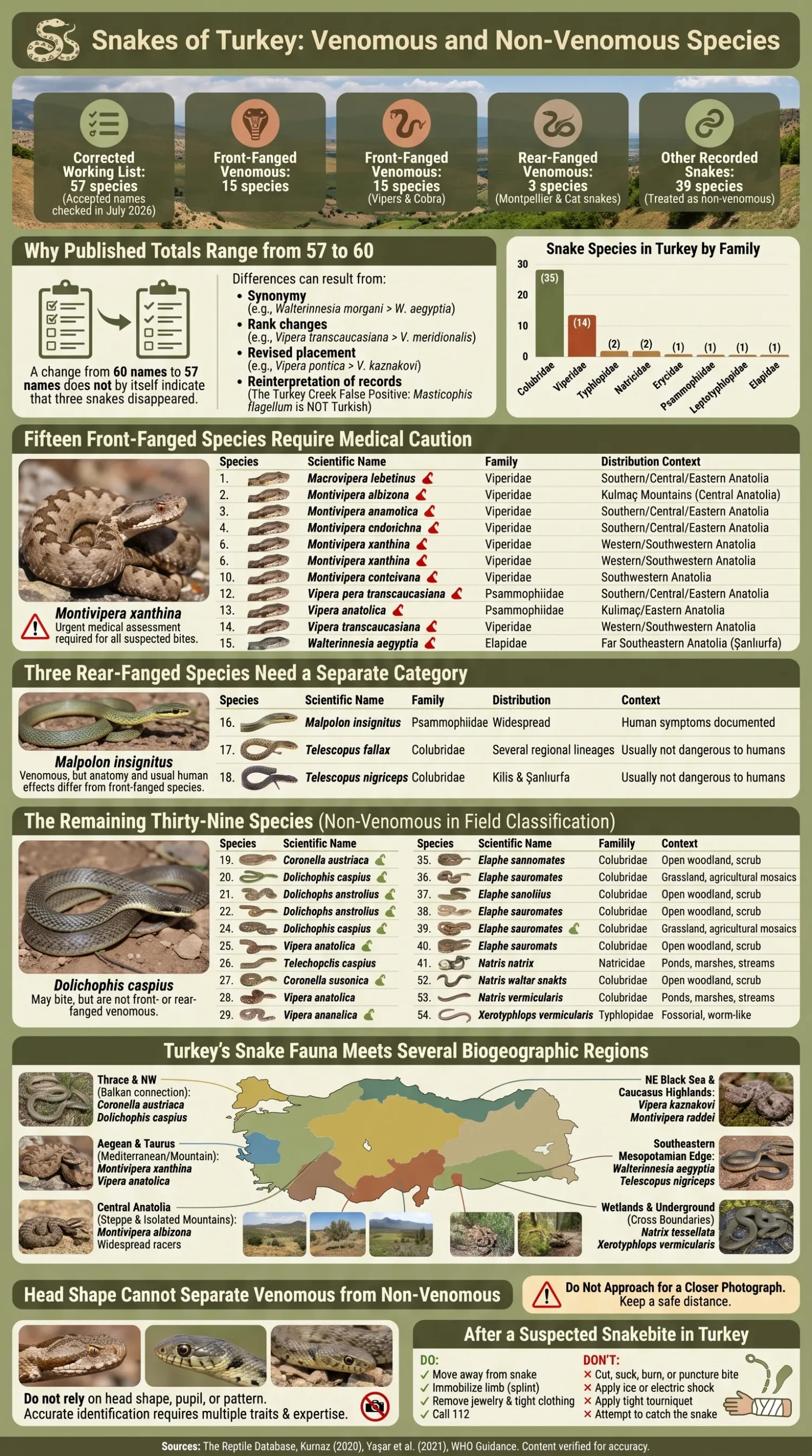
Turkey has 57 snake species under the current Reptile Database treatment: 15 front-fanged venomous species, three rear-fanged venomous species of lower usual medical concern, and 39 species treated as non-venomous in standard field use.
The Reptile Database country search for Serpentes currently returns 58 entries.[a] One of them, Masticophis flagellum, is a North American species pulled into the result by the words “Turkey Creek” in its Colorado type locality. Excluding that text-match false positive leaves 57 species for Turkey.
Current Species Total
57 species
57 Turkey records after excluding one North American text-match false positive.
Front-Fanged Venomous
15 species
Fourteen vipers and one elapid cobra.
Rear-Fanged Venomous
3 species
One Montpellier snake and two cat snakes.
Other Recorded Snakes
39 species
Treated as non-venomous in ordinary field classification.
Why Published Totals Range from 57 to 60
A 2020 national checklist reported 60 ophidian taxa under the names, ranks and distribution records accepted at that time.[c] A later distribution and biogeography study mapped 57 snake taxa across Turkey.[d] Differences between these totals can result from synonymy, changes between species and subspecies rank, revised genus placement and rejection or reinterpretation of older locality records.
Masticophis flagellum Is North American
Masticophis flagellum appears in the Turkey search because its database entry contains “Turkey Creek” in a Colorado type locality. Its distribution is in the United States and Mexico.[b] The species is therefore excluded from the Turkish total and tables.
The difference between older totals of 60 and the current 57 largely reflects taxonomic treatment and record interpretation rather than the disappearance of three snake species.
Snake Species in Turkey by Family
Colubrids dominate the 57-species list, while medically important front-fanged species are concentrated in Viperidae and Elapidae.
Source: The Reptile Database country search for Serpentes in Turkey, September 2026. The North American Masticophis flagellum text match is excluded.
Fifteen Front-Fanged Species Require Medical Caution
Turkey’s front-fanged group contains 14 vipers and one elapid, the desert cobra. All suspected bites from these species require urgent medical assessment. The regional descriptions below give broad Turkish record areas; exact local ranges vary by taxon and available survey coverage.
| Checklist no. | Accepted scientific name | Family | Broad record context in Turkey |
|---|---|---|---|
| 1 | Macrovipera lebetinus | Viperidae | Recorded across parts of southern, central and eastern Anatolia, mainly in dry rocky landscapes and open slopes. |
| 2 | Montivipera albizona | Viperidae | A localized central Anatolian mountain taxon associated with the Kulmaç Mountains and adjoining uplands. |
| 3 | Montivipera bulgardaghica | Viperidae | Restricted to the Bolkar Mountains and nearby parts of the south-central Taurus system. |
| 4 | Montivipera raddei | Viperidae | Recorded in the far eastern highlands near the Armenian and Iranian border regions. |
| 5 | Montivipera wagneri | Viperidae | Eastern Anatolian mountain records, including the Aras basin region and nearby uplands. |
| 6 | Montivipera xanthina | Viperidae | Western and southwestern Anatolia, including Aegean and Mediterranean rocky habitats. |
| 7 | Vipera ammodytes | Viperidae | Northwestern records associated with the Balkan and Thracian sector; its boundary with related nose-horned vipers depends on current taxonomy. |
| 8 | Vipera anatolica | Viperidae | A localized southwestern Anatolian meadow-viper lineage associated with Taurus uplands. |
| 9 | Vipera berus | Viperidae | Limited records from the far northeastern highlands; locality and identification require careful review. |
| 10 | Vipera darevskii | Viperidae | Northeastern border highlands under a taxonomically complex set of Turkish subspecies and related populations. |
| 11 | Vipera eriwanensis | Viperidae | Eastern Anatolian steppe and mountain records connected to the Armenian highland fauna. |
| 12 | Vipera kaznakovi | Viperidae | Northeastern Black Sea and Caucasus-facing habitats, especially humid and mountainous country. |
| 13 | Vipera meridionalis | Viperidae | Northern Turkish records under the current treatment that includes populations previously listed as Vipera transcaucasiana. |
| 14 | Vipera sakoi | Viperidae | Known from the Gümüşhane–Erzincan highland sector; its rank remains under study. |
| 15 | Walterinnesia aegyptia | Elapidae | Far southeastern evidence from the Şanlıurfa region, formerly reported under the name Walterinnesia morgani. |
Clinical effects vary among front-fanged species and individual bites. Outcome depends on the taxon involved, whether venom was delivered, the bite location, the amount delivered, the patient and the time before treatment. A photograph alone cannot show whether a bite was dry or predict whether systemic effects will develop.
Taxonomy Behind the Current 57-Species Total
Walterinnesia morgani Is a Synonym of Walterinnesia aegyptia
Older Turkish checklists and locality papers used Walterinnesia morgani for the black desert cobra recorded in southeastern Anatolia. The current Reptile Database treatment places W. morgani in synonymy with Walterinnesia aegyptia, following a renewed assessment of the genus.[e] The Turkish cobra record remains in the checklist, but it contributes one accepted species rather than two.
Vipera transcaucasiana Is Currently Vipera meridionalis transcaucasiana
The name Vipera transcaucasiana appears in many Turkish publications and older national lists. The current database treatment accepts it as Vipera meridionalis transcaucasiana rather than as an independent species.[f] Publications using a different rank can therefore produce a different national species total without documenting a different snake population.
Vipera pontica Is Synonymized with Vipera kaznakovi
Vipera pontica, described from northeastern Turkey, has been interpreted as a likely hybrid involving Vipera kaznakovi and the taxon historically called V. transcaucasiana. It is placed in the synonymy associated with V. kaznakovi rather than counted as another accepted Turkish species.[g]
The Rank of Montivipera albizona Remains Unsettled
Montivipera albizona remains an accepted species in the Reptile Database, although its account describes the taxonomic status as uncertain and notes possible close relationships with M. wagneri or M. xanthina.[h] A future revision could retain, merge or redefine the name and change the national total.
Vipera sakoi and the Vipera darevskii Complex
Vipera sakoi is currently listed at species rank, but recent work has proposed placing it within Vipera darevskii at subspecies rank.[i] The current V. darevskii account also includes several named Turkish populations and documents continuing disagreement about boundaries within the group.[j]
Taxonomic Revisions Change Species Totals
Synonymizing two names lowers a national species total even when the known localities remain unchanged. Raising a subspecies to species rank has the opposite effect. This is the main reason older Turkish snake totals can differ from the current species count.
Three Rear-Fanged Species Need a Separate Category
Turkey’s three rear-fanged species possess grooved teeth positioned toward the back of the upper jaw. Their venom-delivery anatomy and usual human effects differ from those of front-fanged vipers and cobras as well as from aglyphous snakes. A bite still warrants medical advice, particularly when symptoms develop or the identification is uncertain.
| Checklist no. | Accepted scientific name | Family | Turkish evidence and medical context |
|---|---|---|---|
| 16 | Malpolon insignitus[k] | Psammophiidae | The eastern Montpellier snake has records across several Turkish regions. The database marks it as venomous, and published case literature documents that human symptoms can occur. |
| 17 | Telescopus fallax[l] | Colubridae | The European cat snake occurs in Turkey under several regional lineage names. It is venomous but described as usually not dangerous to humans. |
| 18 | Telescopus nigriceps[m] | Colubridae | The black-headed cat snake is documented from Kilis and Şanlıurfa. It is venomous but described as usually not dangerous to humans. |
The Remaining Thirty-Nine Species
The following snakes are treated as non-venomous in ordinary field and medical classification. They may bite when restrained or threatened, and any bite can damage skin or introduce bacteria, but they are not placed with the front-fanged or rear-fanged venomous groups above.
| Checklist no. | Accepted scientific name | Family | Broad ecological grouping |
|---|---|---|---|
| 19 | Coronella austriaca | Colubridae | Smooth snake associated with open woodland, scrub and rocky grassland. |
| 20 | Dolichophis caspius | Colubridae | Large, fast-moving racer of open and dry habitats. |
| 21 | Dolichophis jugularis | Colubridae | Large whip snake found in warm open country, farmland margins and scrub. |
| 22 | Dolichophis schmidti | Colubridae | Eastern racer associated with dry steppe and rocky slopes. |
| 23 | Eirenis aurolineatus | Colubridae | Small ground snake within Turkey’s diverse Eirenis assemblage. |
| 24 | Eirenis barani | Colubridae | Localized dwarf snake associated with rocky southern Anatolian terrain. |
| 25 | Eirenis collaris | Colubridae | Small secretive snake of dry, stony habitats. |
| 26 | Eirenis coronelloides | Colubridae | Ground-dwelling dwarf snake linked to southeastern dry habitats. |
| 27 | Eirenis decemlineatus | Colubridae | Striped dwarf snake of dry scrub, cultivated margins and rocky ground. |
| 28 | Eirenis eiselti | Colubridae | Localized ground snake recorded from eastern and southeastern Anatolia. |
| 29 | Eirenis hakkariensis | Colubridae | Restricted dwarf snake associated with the Hakkari mountain region. |
| 30 | Eirenis levantinus | Colubridae | Levantine ground snake reaching southern Anatolia. |
| 31 | Eirenis lineomaculatus | Colubridae | Small spotted or lined ground snake of rocky Mediterranean settings. |
| 32 | Eirenis modestus | Colubridae | One of the more broadly recorded Turkish dwarf snakes, using scrub, woodland edges and stony ground. |
| 33 | Eirenis occidentalis | Colubridae | Localized dwarf snake represented by records from southern parts of the country. |
| 34 | Eirenis punctatolineatus | Colubridae | Small ground snake associated with eastern rocky steppe. |
| 35 | Eirenis rothii | Colubridae | Warm-climate dwarf snake recorded in southern and southeastern Anatolia. |
| 36 | Eirenis thospitis | Colubridae | Localized eastern Anatolian dwarf snake associated with the Lake Van region. |
| 37 | Elaphe sauromates | Colubridae | Large rat snake of grassland, open woodland and agricultural mosaics. |
| 38 | Elaphe urartica | Colubridae | Eastern Anatolian rat snake associated with rocky and shrubby uplands. |
| 39 | Eryx jaculus | Erycidae | Sand boa adapted to loose soil, sandy ground and dry open habitats. |
| 40 | Hemorrhois nummifer | Colubridae | Coin-marked racer using rocky slopes, farmland margins and settlements. |
| 41 | Hemorrhois ravergieri | Colubridae | Spotted racer associated mainly with eastern rocky and steppe habitats. |
| 42 | Letheobia episcopus | Typhlopidae | Fossorial blind snake known from very limited southeastern evidence. |
| 43 | Muhtarophis barani | Colubridae | Localized southern Anatolian ground snake and the sole species in its genus. |
| 44 | Myriopholis macrorhyncha | Leptotyphlopidae | Minute fossorial threadsnake associated with warm, dry southeastern soils. |
| 45 | Natrix natrix | Natricidae | Grass snake associated with ponds, marshes, streams and damp terrestrial habitats. |
| 46 | Natrix tessellata | Natricidae | Dice snake closely associated with rivers, lakes, reservoirs and coastal water. |
| 47 | Platyceps collaris | Colubridae | Slender racer occurring in warm, rocky and open habitats. |
| 48 | Platyceps najadum | Colubridae | Dahl’s whip snake, a fast-moving species of dry open ground and scrub. |
| 49 | Platyceps rhodorachis | Colubridae | Racer associated with arid rocky slopes and southeastern drainage systems. |
| 50 | Platyceps ventromaculatus | Colubridae | Spotted-bellied racer reaching Turkey’s southeastern arid zone. |
| 51 | Rhynchocalamus melanocephalus | Colubridae | Secretive black-headed ground snake usually found beneath stones or within loose soil. |
| 52 | Rhynchocalamus satunini | Colubridae | Small ground snake associated with eastern mountain-steppe habitats. |
| 53 | Spalerosophis diadema | Colubridae | Large diadem snake reaching the arid and semi-arid southeast. |
| 54 | Xerotyphlops vermicularis | Typhlopidae | Worm-like blind snake that spends most of its life within soil and beneath stones. |
| 55 | Zamenis hohenackeri | Colubridae | Rat snake associated with rocky woodland, scrub and mountain valleys. |
| 56 | Zamenis longissimus | Colubridae | Aesculapian snake associated mainly with humid woodland and wooded slopes. |
| 57 | Zamenis situla | Colubridae | Leopard snake of Mediterranean scrub, rocky ground and traditional stone landscapes. |
Turkey’s Snake Fauna Meets Several Biogeographic Regions
Thrace and the Northwestern Balkan Connection
European and Balkan-associated taxa enter Turkey through Thrace and northwestern Anatolia. This sector supports snakes such as Coronella austriaca, Dolichophis caspius, Elaphe sauromates and northern nose-horned viper lineages. The Bosporus is a major geographic division, but it is not a universal boundary for every snake lineage.
The Aegean Coast and Taurus Mountains
Western and southwestern Anatolia combine Mediterranean scrub, limestone slopes, river valleys and high mountain grasslands. The region includes Montivipera xanthina, localized Vipera anatolica populations, several racers, dwarf snakes and rat snakes. Elevation can separate closely situated lowland and mountain taxa.
Central Anatolian Steppe and Isolated Mountains
Central Anatolia contains broad steppe, dry agricultural plains, volcanic landscapes and isolated mountain systems. Its snake fauna includes widespread racers and dwarf snakes alongside localized mountain vipers such as Montivipera albizona. A country map that treats central Turkey as one uniform habitat would hide these local divisions.
Northeastern Black Sea and Caucasus Highlands
The humid Black Sea mountains and the drier highlands farther inland support several closely related vipers. Vipera kaznakovi, V. darevskii, V. eriwanensis, V. sakoi, Montivipera raddei and M. wagneri occupy different parts of this wider northeastern transition, making locality especially important for identification.
The Southeastern Mesopotamian Edge
Southeastern Turkey connects Anatolia with the dry plains and rocky landscapes of Syria, Iraq and Iran. The country’s only elapid, Walterinnesia aegyptia, is documented in this sector. Other southeastern elements include Telescopus nigriceps, Spalerosophis diadema, Platyceps ventromaculatus, Myriopholis macrorhyncha and several Eirenis species.
Wetlands and Underground Habitats Cross Regional Boundaries
Natrix natrix and Natrix tessellata follow freshwater systems across several climatic regions. Blind snakes and threadsnakes follow suitable soils and are easily missed by surface surveys, so their sparse records can reflect fossorial behavior and uneven sampling as well as genuinely limited ranges.
Head Shape Cannot Separate Venomous from Non-Venomous Snakes
A triangular head, vertical pupil or bold zigzag pattern is not a reliable universal test. Non-venomous snakes can flatten the head when threatened, lighting can alter the apparent pupil and unrelated species may share similar markings. Institutional wildlife-health guidance warns that no single visible feature reliably separates all venomous snakes from all non-venomous snakes.[n]
Identification may require several traits together: scale arrangement, snout structure, head shields, dorsal pattern, body proportions, locality, elevation and comparison with current taxonomic literature. These details should be examined from photographs or specimens already held by qualified institutions, not by capturing a wild snake.
Do Not Approach for a Closer Photograph
Keep a safe distance and allow the snake an escape route. A distant photograph showing the full body and surrounding habitat can aid later identification. Attempting to move, pin, catch or kill the animal creates a preventable bite risk.
After a Suspected Snakebite in Turkey
Move away from the snake, keep the patient as still as possible and immobilize the affected limb with a splint in a neutral position. Remove rings, watches, bracelets and tight clothing before swelling develops. Arrange urgent transport and call Turkey’s 112 emergency service.
- Do not cut, puncture, burn or suck the bite site.
- Do not apply ice, chemicals, herbal mixtures or electric shock.
- Do not apply a tight arterial tourniquet.
- Do not encourage the patient to walk or run when transport is available.
- Do not wait for severe symptoms before seeking medical care.
- Do not attempt to capture or kill the snake for identification.
WHO guidance limits pressure-immobilization methods to particular neurotoxic bites that do not cause local swelling; it does not support improvised tight bandaging for every snakebite.[o] Turkish Ministry of Health guidance likewise advises rest, removal of constricting items, avoidance of cutting or sucking the wound and rapid medical assistance without a tourniquet.[p]
Antivenom selection, laboratory monitoring and treatment of swelling, bleeding, neurologic effects or allergic reactions belong in a medical facility. A suspected bite should not be managed according to an online species identification alone.
Sources and Verification
- [a] The Reptile Database — Serpentes Recorded for Turkey — Current accepted names, family placement and Turkey country records underlying the 57-species total.
- [b] The Reptile Database — Masticophis flagellum — North American distribution and the “Turkey Creek” type locality responsible for the false country-search match.
- [c] Kurnaz 2020 — Species List of Amphibians and Reptiles from Turkey — Historical national total of 60 ophidian taxa and the earlier Turkish checklist treatment.
- [d] Yaşar et al. 2021 — The Distribution and Biogeography of Amphibians and Reptiles in Turkey — The 57-taxon mapped treatment and broad regional occurrence patterns in Turkey.
- [e] The Reptile Database — Walterinnesia aegyptia — Current desert-cobra taxonomy and the synonymy of Walterinnesia morgani.
- [f] The Reptile Database — Vipera meridionalis — Current treatment of Vipera transcaucasiana within V. meridionalis.
- [g] The Reptile Database — Vipera kaznakovi — Present treatment of Vipera pontica and its proposed hybrid origin.
- [h] The Reptile Database — Montivipera albizona — Accepted species listing and unresolved relationships with other Turkish mountain vipers.
- [i] The Reptile Database — Vipera sakoi — Current species listing and the proposal to treat it within Vipera darevskii.
- [j] The Reptile Database — Vipera darevskii — Turkish subspecies treatment and taxonomic uncertainty within the Vipera darevskii complex.
- [k] The Reptile Database — Malpolon insignitus — Accepted taxonomy, Turkish records and venom status of the eastern Montpellier snake.
- [l] The Reptile Database — Telescopus fallax — Turkish distribution, rear-fanged venom status and regional lineage treatment of Telescopus fallax.
- [m] The Reptile Database — Telescopus nigriceps — Kilis and Şanlıurfa records, venom status and current species treatment of Telescopus nigriceps.
- [n] Cornell Wildlife Health Lab — Understanding Native Snakes — Guidance on the limits of head shape, pupil form and other single-trait venom identification.
- [o] World Health Organization — Snakebite Envenoming Treatment — First-aid guidance on immobilization, tourniquets, pressure immobilization and urgent medical treatment.
- [p] Republic of Türkiye Ministry of Health — Snakebite Precautions — Turkey-specific advice on rest, removal of constricting items, wound care and emergency assistance.