Complete guides: •Regional Fauna Guides•Reptiles•Fauna of Turkey
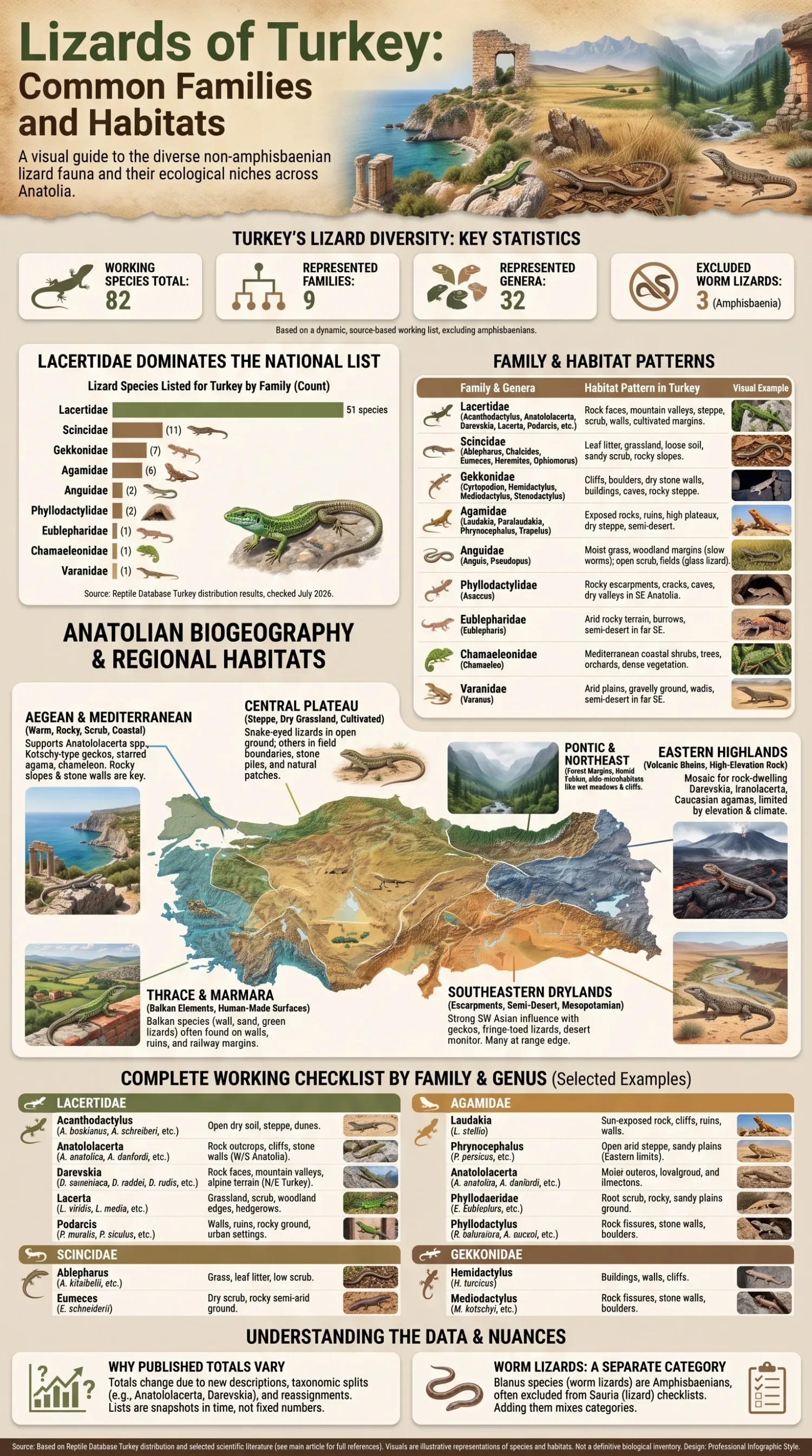
Turkey has a source-based working list of 82 non-amphisbaenian lizard species distributed among nine families and 32 genera. More than half belong to Lacertidae, but the national fauna also includes skinks, geckos, agamas, a chameleon, slow worms, a glass lizard, and the desert monitor. The total is not a permanent official number: it was calculated from the currently accepted taxa returned by the Reptile Database country filter, and it changes when species are described, split, combined, or reassigned.[a]
Working species total
82
Non-amphisbaenian lizards in the checked country list.
Represented families
9
From Lacertidae to the single Turkish monitor species.
Represented genera
32
Counted under the accepted names used in this checklist.
Excluded worm lizards
3
Blanus alexandri, B. aporus, and B. strauchi are treated separately as amphisbaenians.
Lacertidae Dominates the National Species List
Lacertidae accounts for 51 of the 82 species in the working list. Its members occupy very different settings: Mediterranean rock faces, central plateaux, northeastern valleys, alpine scree, open grassland, dry steppe, forest margins, field boundaries, village walls, and urban masonry. Calling every lacertid a “rock lizard” would therefore hide much of the ecological variation within the family.
Lizard Species Listed for Turkey by Family
The chart counts accepted species returned by the checked Turkey distribution list after amphisbaenians, snakes, and turtles were removed.
Source: Reptile Database Turkey distribution results, checked in July 2026. Counts represent a taxonomic working list rather than a fixed national inventory.
| Family | Genera represented | Habitat pattern in Turkey |
|---|---|---|
| Lacertidae | Acanthodactylus, Anatololacerta, Apathya, Darevskia, Eremias, Iranolacerta, Lacerta, Ophisops, Parvilacerta, Phoenicolacerta, Podarcis, Timon | Rock faces, montane valleys, steppe, grassland, scrub, woodland edges, dunes, stone walls, and cultivated margins. |
| Scincidae | Ablepharus, Chalcides, Eumeces, Heremites, Ophiomorus | Leaf litter, grassy ground, loose soil, sandy scrub, warm field edges, rocky slopes, and semi-arid ground. |
| Gekkonidae | Cyrtopodion, Hemidactylus, Mediodactylus, Stenodactylus | Cliffs, boulders, dry stone walls, buildings, caves, rocky steppe, and sandy southeastern plains. |
| Agamidae | Laudakia, Paralaudakia, Phrynocephalus, Trapelus | Exposed rocks, ruins, high plateaux, dry steppe, salt-basin margins, gravel flats, and semi-desert. |
| Anguidae | Anguis, Pseudopus | Moist grass and woodland margins for slow worms; warmer open scrub, fields, and stony ground for the glass lizard. |
| Phyllodactylidae | Asaccus | Rocky escarpments, cracks, caves, and dry valleys in southeastern Anatolia. |
| Eublepharidae | Eublepharis | Arid rocky terrain, burrows, and semi-desert landscapes in the far southeast. |
| Chamaeleonidae | Chamaeleo | Mediterranean coastal shrubs, trees, orchards, dune vegetation, and other structurally dense vegetation. |
| Varanidae | Varanus | Arid plains, gravelly ground, wadis, and semi-desert in the far southeast. |
Why Anatolia Supports Contrasting Lizard Faunas
Anatolia links the Balkans, the Caucasus, the Iranian Plateau, the Levant, and northern Mesopotamia. Mountain building, enclosed basins, river valleys, coastal ranges, and repeated climatic shifts have alternately connected and isolated reptile populations. An early country-wide analysis already associated many northeastern endemic lineages with rocky mountain and plateau habitats, while Mediterranean, European, Caucasian, and southwest Asian elements formed different parts of the fauna.[b]
Aegean and Mediterranean Rock, Scrub, and Coastal Vegetation
Western and southern Turkey contain warm rocky slopes, limestone outcrops, pine and oak margins, maquis, orchards, coastal dunes, and long networks of stone walls. This habitat mixture supports the five currently recognized Anatololacerta species, several green lizards, Kotschy-type geckos, the Mediterranean house gecko, the starred agama, the ocellated skink, and the common chameleon.
Closely related rock lizards are not interchangeable across the southern coast. Genetic work divided Anatololacerta into five supported species with adjoining or partly separated distributions: A. anatolica, A. pelasgiana, A. finikensis, A. ibrahimi, and A. danfordi.[c]
Central Plateau, Dry Grassland, and Cultivated Steppe
The central plateau is not uniform bare steppe. It contains cereal fields, fallow ground, saline basins, volcanic slopes, dry grassland, rocky ridges, stream corridors, and mountain islands. Snake-eyed lizards can use open ground and field margins, while dwarf lizards, racerunners, green lizards, and ground-dwelling skinks separate themselves by soil structure, vegetation cover, elevation, and access to shelter.
A record from a cultivated landscape does not show that a species depends on intensive agriculture. Field boundaries, stone piles, uncultivated strips, irrigation margins, and nearby natural patches may supply the basking sites and refuges absent from the crop itself.
Pontic Forest Margins and Northeastern Rock-Lizard Valleys
The humid Black Sea belt and the mountains behind it contain forest clearings, wet meadows, shaded rock, road cuttings, stream valleys, cliffs, and alpine slopes. These fine-scale transitions are central to the diversity of Darevskia. Some species occupy narrow valleys or mountain systems, while others extend into neighboring Georgia, Armenia, or the Caucasus.
New taxa continue to be recognized in this region. Darevskia salihae was described from Artvin Province after morphological and phylogenetic comparisons separated it from nearby rock-lizard groups.[d] Darevskia tuniyevi, described from northeastern Anatolia, was resolved from the D. parvula group through combined morphological, osteological, and mitochondrial evidence.[e]
Eastern Plateaux, Volcanic Basins, and High-Elevation Rock
Eastern Anatolia combines cold uplands with dry basins, lava fields, mountain steppe, talus, cliffs, and lake margins. Rock-dwelling Darevskia, racerunners, Iranolacerta, Caucasian agamas, toad-headed agamas, and dwarf lizards occur in different parts of this mosaic. Their ranges may be limited by elevation, valley systems, soil, winter climate, or breaks between suitable rock formations.
Acanthodactylus ilgazi illustrates how fieldwork can alter the known composition of an apparently familiar genus. The species was described from eastern Anatolia in 2021 and lies well north of the nearest populations used for comparison in the original study.[f]
Southeastern Escarpments and Mesopotamian Drylands
The southeast holds the strongest southwest Asian and Mesopotamian component of Turkey’s lizard fauna. Dry valleys, basalt and limestone outcrops, caves, gravel plains, sandy ground, semi-desert vegetation, and warm buildings support taxa absent from most of the country. These include leaf-toed geckos, the Iranian fat-tailed gecko, rough-tailed and short-fingered geckos, fringe-toed lizards, agamas, larger skinks, Zagros lizards, and the desert monitor.
Several southeastern species are represented by few published localities or occur near an international range edge. A country-level database entry should therefore not be converted into a claim that the species occupies the whole southeastern region.
Thrace, Marmara, and Human-Made Surfaces
Thrace and the Marmara region add Balkan and European elements such as wall lizards, sand lizards, green lizards, slow worms, and the European glass lizard. Warm walls, ruins, gardens, railway margins, quarries, and building exteriors can also create secondary habitat for geckos, agamas, and some wall lizards.
Human-associated records need separate treatment from native habitat evidence. A species found on masonry may be using a local substitute for natural rock, while an isolated population near transport routes may require investigation of introduction history.
Complete Working Checklist by Family and Genus
Checklist Boundary
The names below follow the accepted species returned by the checked Reptile Database distribution filter. The list includes species recorded for Turkey but does not claim equal evidence quality, nationwide occurrence, native status at every locality, or a finished official inventory. The three Turkish Blanus species are excluded because current checklists normally separate Amphisbaenia from Sauria.
Lacertidae: Wall Lizards, Rock Lizards, Racerunners, and Green Lizards
| Genus | Species currently listed for Turkey | Main habitat association |
|---|---|---|
| Acanthodactylus | Acanthodactylus boskianus, A. harranensis, A. ilgazi, A. schreiberi | Open dry ground, steppe, sandy or friable soils, sparsely vegetated plains, dunes, and semi-arid field margins. |
| Anatololacerta | Anatololacerta anatolica, A. danfordi, A. finikensis, A. ibrahimi, A. pelasgiana | Rock outcrops, boulder slopes, cliffs, stone walls, and rocky openings near woodland or stream valleys in western and southern Anatolia. |
| Apathya | Apathya cappadocica | Rocky slopes, dry valleys, open woodland, scrub, stone walls, and broken ground across parts of central, eastern, and southeastern Anatolia. |
| Darevskia | Darevskia adjarica, D. armeniaca, D. bendimahiensis, D. bithynica, D. clarkorum, D. derjugini, D. josefschmidtleri, D. mirabilis, D. obscura, D. parvula, D. praticola, D. raddei, D. rudis, D. salihae, D. sapphirina, D. saxicola, D. spitzenbergerae, D. tuniyevi, D. unisexualis, D. uzzelli, D. valentini | Rock faces, cliffs, talus, mountain valleys, forest openings, stream corridors, high meadows, and volcanic or alpine terrain, mainly in northern and eastern Turkey. |
| Eremias | Eremias arguta, E. pleskei, E. strauchi, E. suphani | Dry steppe, gravel plains, sandy ground, saline-basin margins, high plateaux, and open terrain with scattered low vegetation. |
| Iranolacerta | Iranolacerta brandtii | Rocky upland steppe and broken highland terrain in eastern Anatolia. |
| Lacerta | Lacerta agilis, L. diplochondrodes, L. media, L. pamphylica, L. strigata, L. viridis | Grassland, scrub, woodland edges, hedgerows, orchards, open slopes, humid clearings, and regionally rocky Mediterranean vegetation. |
| Ophisops | Ophisops elegans | Dry grassland, open steppe, scrub openings, field edges, low vegetation, and sun-exposed ground. |
| Parvilacerta | Parvilacerta parva | Mountain steppe, open rocky grassland, plateaux, and sparsely vegetated upland slopes. |
| Phoenicolacerta | Phoenicolacerta cyanisparsa, P. laevis | Rocky Levantine and eastern Mediterranean settings, cliffs, shaded stone, scrub, and broken terrain in southern Turkey. |
| Podarcis | Podarcis muralis, P. siculus, P. tauricus | Walls, ruins, rocky ground, grassland, open scrub, railway margins, gardens, and other disturbed or urban settings. Local origin should be checked for isolated populations. |
| Timon | Timon kurdistanicus, T. princeps | Rocky scrub, open oak landscapes, stony slopes, dry valleys, and Zagros-influenced terrain in eastern and southeastern Turkey. |
Scincidae: Skinks of Litter, Grass, Sand, and Loose Soil
| Genus | Species currently listed for Turkey | Main habitat association |
|---|---|---|
| Ablepharus | Ablepharus anatolicus, A. bivittatus, A. budaki, A. chernovi, A. kitaibelii | Grass, leaf litter, low scrub, steppe vegetation, open woodland, rocky ground, and field margins with shallow cover. |
| Chalcides | Chalcides ocellatus | Loose soil, sandy coastal ground, dunes, warm scrub, gardens, and cultivated margins in Mediterranean settings. |
| Eumeces | Eumeces schneiderii | Dry scrub, rocky semi-arid ground, open slopes, and warm lowland terrain in southern and southeastern areas. |
| Heremites | Heremites auratus, H. septemtaeniatus, H. vittatus | Warm grassland, scrub, rocky fields, agricultural edges, low vegetation, and shelter beneath stones or debris. |
| Ophiomorus | Ophiomorus kardesi | Loose soil and sandy or friable substrates used by a highly elongated, limb-reduced burrowing skink. |
The name Ophiomorus kardesi reflects a recent resolution of hidden diversity within the Aegean and Anatolian Ophiomorus complex. Older records may place related populations under O. punctatissimus, so locality and publication date matter when comparing lists.[g]
Gekkonidae: Rock, Wall, House, and Ground Geckos
| Genus | Species currently listed for Turkey | Main habitat association |
|---|---|---|
| Cyrtopodion | Cyrtopodion scabrum | Dry rocky ground, cliffs, walls, ruins, and warm buildings in southeastern Turkey. |
| Hemidactylus | Hemidactylus turcicus | Buildings, walls, cliffs, tree trunks, rocky coastal ground, and other warm nocturnal hunting surfaces. |
| Mediodactylus | Mediodactylus danilewskii, M. heterocercus, M. kotschyi, M. orientalis | Rock fissures, stone walls, boulders, cliffs, trees, scrub, and buildings across different western, northern, southern, and eastern ranges. |
| Stenodactylus | Stenodactylus grandiceps | Sandy or gravelly open ground and semi-desert landscapes in the far southeast. |
Phyllodactylidae: Southeastern Leaf-Toed Geckos
| Genus | Species currently listed for Turkey | Main habitat association |
|---|---|---|
| Asaccus | Asaccus barani, A. elisae | Rocky escarpments, cliffs, cave entrances, fissures, and dry valleys in southeastern Anatolia. Species-level assignment should follow locality-based taxonomic evidence. |
Eublepharidae: The Iranian Fat-Tailed Gecko
| Genus | Species currently listed for Turkey | Main habitat association |
|---|---|---|
| Eublepharis | Eublepharis angramainyu | Rocky semi-desert, dry slopes, burrows, and sheltered ground in the far southeast. |
Agamidae: Rock Agamas and Toad-Headed Agamas
| Genus | Species currently listed for Turkey | Main habitat association |
|---|---|---|
| Laudakia | Laudakia stellio | Sun-exposed rock, cliffs, ruins, walls, quarries, old buildings, and rocky scrub. |
| Paralaudakia | Paralaudakia caucasia | Rocky highlands, cliffs, boulder fields, dry mountain valleys, and exposed slopes in eastern Turkey. |
| Phrynocephalus | Phrynocephalus helioscopus, P. horvathi, P. persicus | Open arid steppe, sandy or gravel plains, saline-basin margins, and sparsely vegetated plateaux near Turkey’s eastern range limits. |
| Trapelus | Trapelus ruderatus | Dry steppe, rocky semi-desert, open slopes, and sparsely vegetated ground in eastern and southeastern areas. |
Chamaeleonidae: Mediterranean Chameleon
| Genus | Species currently listed for Turkey | Main habitat association |
|---|---|---|
| Chamaeleo | Chamaeleo chamaeleon | Coastal shrubs, small trees, orchards, dune vegetation, reed margins, and other dense Mediterranean vegetation. |
Anguidae: Slow Worm and European Glass Lizard
| Genus | Species currently listed for Turkey | Main habitat association |
|---|---|---|
| Anguis | Anguis fragilis | Moist grass, woodland margins, hedgerows, shaded gardens, and ground with dense cover, mainly in the northwest. |
| Pseudopus | Pseudopus apodus | Open scrub, grassland, field margins, stony slopes, woodland openings, and warm lowland mosaics. |
Varanidae: Desert Monitor
| Genus | Species currently listed for Turkey | Main habitat association |
|---|---|---|
| Varanus | Varanus griseus | Arid plains, gravel and sandy ground, wadis, and semi-desert in the far southeast. Available Turkish evidence represents the northern edge of a much wider Middle Eastern and North African range. |
Why Published Species Totals Do Not Match
A 2000 analysis recognized 55 lizards in its Anatolian study area. A national checklist published in 2020 reported 71 Sauria and three amphisbaenians, while a 2021 distribution review reported 70 lizards and three amphisbaenians.[h] These totals are snapshots of different taxonomic treatments, publication dates, geographic decisions, and evidence thresholds rather than simple counting errors.
Several changes occurred after older lists were assembled. Species were newly described, subspecies were raised to species rank, cryptic lineages were separated, and some familiar names were reassigned to different genera. The Mediodactylus kotschyi complex, the five-species treatment of Anatololacerta, the growing Darevskia list, Acanthodactylus ilgazi, and Ophiomorus kardesi all affect comparisons between publications.
Older Names Still Appear in Field Records
Records may use combinations such as Cyrtopodion heterocercum for Mediodactylus heterocercus, Trachylepis vittata for Heremites vittatus, or older broad treatments of the Anatololacerta, Lacerta, Mediodactylus, and Ophiomorus complexes. A name should be matched to the taxonomy and publication date of the original record before it is merged into a modern checklist.
Worm Lizards Are a Separate Checklist Problem
Turkey also has three accepted Blanus species: Blanus alexandri, B. aporus, and B. strauchi. English names often call them worm lizards, but modern faunal lists normally place them in Amphisbaenia rather than counting them with Sauria. Adding them would produce a broader total of 85 lizard-like squamates, but it would mix two checklist categories.
Any published total should state whether amphisbaenians are included. Without that boundary, two accurate lists can appear to disagree by three species before taxonomic differences are even considered.
Country Records Are Not Complete Distribution Maps
A species appearing in a Turkey filter means that the database recognizes distribution evidence associated with the country. It does not establish continuous range, local abundance, breeding at every record, or presence in every province with apparently suitable habitat. Narrow valleys, isolated mountains, border regions, islands, introductions, old museum specimens, and uncertain historical identifications require different levels of confidence.
Habitat labels also operate at different scales. “Rocky habitat” may refer to a humid forest-edge cliff, a Mediterranean limestone wall, an alpine talus slope, a dry basalt escarpment, or an urban building. Elevation, moisture, vegetation, crevice structure, substrate temperature, and geographic isolation can separate species that appear to use the same broad habitat.
Recently divided groups need identification evidence that matches the taxonomic question. A photograph may identify a gecko or rock lizard to family or genus, yet remain insufficient for a species separated through scale counts, body proportions, osteology, or DNA. The original locality, specimen record, and publication method remain part of the biological evidence.
Sources and Verification
- [a] The Reptile Database — Turkey distribution search — Used for the accepted names and country records in the working checklist. The 82-species, nine-family, and 32-genus totals were calculated from the lizard taxa returned by this filter.
- [b] Sindaco et al. — The Reptiles of Anatolia: A Checklist and Zoogeographical Analysis — Used for historical species coverage, Anatolian biogeographic patterns, and the association of northeastern endemic reptiles with mountain, plateau, steppe, and rocky habitats.
- [c] Karakasi et al. — More Evidence of Cryptic Diversity in the Anatololacerta Species Complex — Used for the five-species treatment of Anatololacerta applied in the current checklist.
- [d] Kurnaz, Şahin, and Eroğlu — Hidden Diversity in a Narrow Valley — Used for the description, locality, morphology, and phylogenetic separation of Darevskia salihae.
- [e] Arribas et al. — A New Cryptic Species of the Darevskia parvula Group from Northeastern Anatolia — Used for the evidence and taxonomic description supporting Darevskia tuniyevi.
- [f] Kurnaz and Şahin — Description of a New Lacertid Lizard Species from Eastern Anatolia — Used for the description and geographic context of Acanthodactylus ilgazi.
- [g] Kornilios et al. — Cryptic Diversity and Molecular Systematics of Aegean Ophiomorus Skinks — Used for the taxonomic separation of Ophiomorus kardesi and the treatment of older records in the species complex.
- [h] Yaşar et al. — The Distribution and Biogeography of Amphibians and Reptiles in Turkey — Used for the 2021 checklist total and for comparison with the larger working list produced after later taxonomic additions.
- [i] Kurnaz — Species List of Amphibians and Reptiles from Turkey — Used for the 2020 total of 71 Sauria, three amphisbaenians, and the discussion of taxonomic changes affecting national species counts.