Updated: September 16, 2026 What changed?
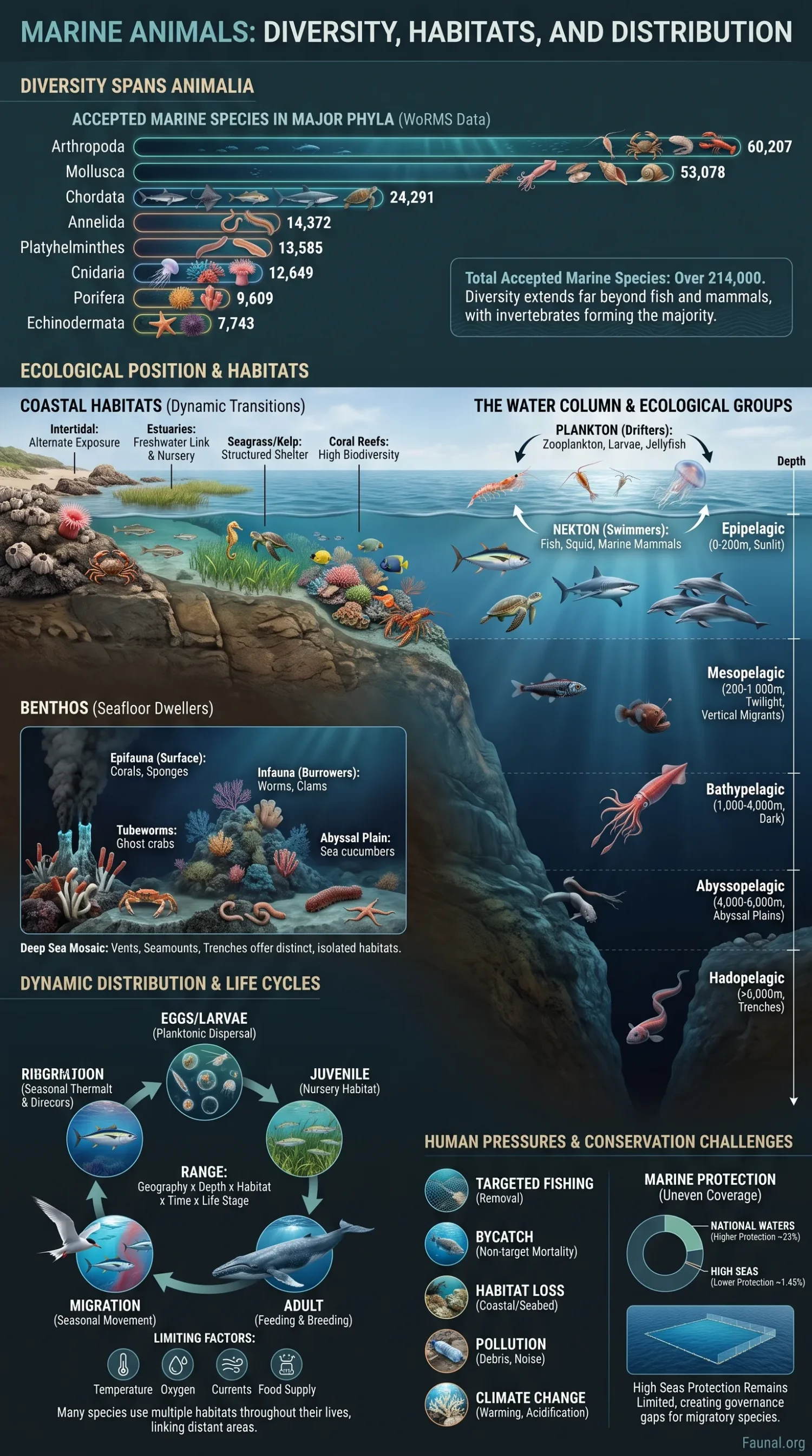
Marine animals are members of Animalia whose life cycle or major ecological activities depend on seawater. They range from sponges, corals, worms, molluscs and crustaceans to fishes, sea turtles, seabirds and whales. Their distribution cannot be represented by ocean name or latitude alone: depth, temperature, salinity, oxygen, currents, substrate, food supply, season and life stage can all change where an animal occurs.
Marine Animal Diversity Spans Much of Animalia
Marine animals do not form one taxonomic lineage. Seawater has been occupied by many branches of Animalia with very different body plans and feeding systems. Sponges filter suspended particles while attached to the seabed. Cnidarians include fixed coral colonies and free-swimming jellyfish. Molluscs range from burrowing bivalves to active squid. Arthropods include copepods, krill, barnacles, amphipods, shrimps, crabs and lobsters. Echinoderms such as sea stars, brittle stars, sea urchins, sea cucumbers and crinoids are represented by living species only in marine environments.
Chordates account for the most familiar marine animals but are only part of the fauna. Marine chordates include tunicates as well as jawless fishes, sharks and rays, bony fishes, sea turtles, sea snakes, marine birds and mammals. Some remain submerged throughout adult life; others, including cetaceans, pinnipeds, sea turtles and seabirds, breathe air or use land for resting, nesting or reproduction while depending heavily on marine food webs and habitats.
WoRMS statistics accessed 16 September 2026 list 214,241 accepted marine species within Animalia. This is a taxonomic inventory maintained through expert-edited records, not an estimate of every marine animal species that exists.
Accepted Marine Species in Selected Major Animal Phyla
WoRMS statistics accessed 16 September 2026 show how much documented marine diversity lies outside fishes and marine mammals.
Taxonomic source: World Register of Marine Species statistics, accessed 16 September 2026. Counts represent accepted marine species in the listed phyla, not estimated undiscovered diversity.
The counts also show why a vertebrate-centered description gives a distorted picture of marine diversity. Arthropoda and Mollusca alone contain far more accepted marine species in WoRMS than Chordata. Numerical richness does not measure ecological influence, biomass or conservation priority, but it does reveal the taxonomic scale of marine invertebrate diversity.
The Known Marine Inventory Is Still Expanding
A current species count is a dated state of taxonomy rather than a permanent total. Newly described species are added, older names may become synonyms, one apparent species may be split after morphological or genetic study, and taxonomic placement can change when new evidence becomes available. WoRMS therefore distinguishes accepted species from the much larger set of marine species names that includes synonyms.
The scale of continuing discovery is visible in recent field and taxonomic work. In May 2026, Ocean Census reported 1,121 previously unknown marine species found through 13 expeditions and nine species-discovery workshops. The reported material included corals, crustaceans, echinoderms, annelids and fishes collected from environments extending to 6,575 metres depth. Ocean Census
A Marine Species Total Has a Taxonomic Date
Described species, accepted species names and the estimated number of species that exist are different quantities. A database total should therefore be identified by source and taxonomic state rather than presented as the final number of animals living in the sea.
Discovery is especially difficult where sampling requires deep submersibles, remotely operated vehicles, specialized sediment equipment or repeated molecular work. Small sediment fauna, cryptic species, isolated seamount communities and deep trenches remain much less accessible than coastal fishes or conspicuous reef animals. Taxonomic knowledge is therefore uneven across both geography and animal groups.
Plankton, Nekton and Benthos Describe Ecological Position
Taxonomy identifies what an animal is; planktonic, nektonic and benthic categories describe how it occupies the marine environment. The categories can cut across phyla, and one species may change category as it develops.
| Ecological position | Meaning | Marine examples | Life-stage relationship |
|---|---|---|---|
| Zooplankton | Animals carried mainly by water movement rather than controlling their horizontal position against ordinary currents | Copepods, krill, salps, many jellyfish and numerous larvae | Some remain planktonic throughout life; others are temporary plankton |
| Meroplankton | Planktonic animal stages belonging to species that later occupy another ecological position | Larval crabs, molluscs, echinoderms and many fishes | Often connects distant adult habitats through larval dispersal |
| Nekton | Animals capable of directed swimming against ordinary water movement | Tunas, sharks, squid, sea turtles and cetaceans | Movement may connect feeding, breeding and nursery regions |
| Benthos | Animals living on, attached to or within the seabed | Corals, sponges, sea stars, clams, worms and many crustaceans | Adults may be benthic even when larvae disperse in the water column |
| Epifauna | Benthic animals living on the sediment surface, rock or another exposed structure | Barnacles, anemones, limpets, many sponges and corals | Attachment and substrate type can sharply restrict distribution |
| Infauna | Animals living within marine sediment | Burrowing polychaetes, bivalves, amphipods and other small invertebrates | Distribution can depend on grain size, oxygen penetration and organic content within sediment |
Plankton is not synonymous with microscopic life, and benthos is not synonymous with immobility. Large gelatinous animals can be planktonic, while many mobile crabs, sea stars and fishes live primarily on or near the bottom. A crab with a drifting larval stage and a benthic adult stage also demonstrates why a species cannot always be assigned to one marine habitat for its entire life.
Coastal Habitats Change Over Very Short Distances
The transition from land to continental shelf contains sharp changes in immersion, wave exposure, salinity, light, substrate and structural habitat. Animals separated by only hundreds of metres horizontally may therefore experience very different physical conditions.
| Marine habitat | Main physical filters | Representative animal assemblages | Distribution consequence |
|---|---|---|---|
| Intertidal shores | Tidal exposure, wave force, drying, temperature change and substrate | Barnacles, mussels, limpets, snails, shore crabs, anemones and polychaetes | Vertical position across the shore can separate species within a narrow geographic area |
| Estuaries | Changing salinity, tides, river discharge, turbidity and sediment | Juvenile fishes, shrimps, crabs, oysters, worms and migratory species | Species may use estuaries only during selected life stages or seasons |
| Seagrass meadows | Shallow light, sediment stability, water clarity and vegetation structure | Juvenile fishes, seahorses, crustaceans, molluscs, turtles and many small epifauna | Nursery and feeding habitat can occupy a much smaller area than the adult range |
| Kelp forests | Rocky attachment surface, cool nutrient-bearing water, light and water movement | Rockfishes, sea urchins, snails, crustaceans, sea stars and marine mammals | Distribution follows suitable rocky coast, light and oceanographic conditions rather than latitude alone |
| Shallow coral reefs | Light, temperature, water chemistry, currents and reef structure | Reef-building corals, fishes, molluscs, crustaceans, echinoderms and sponges | Three-dimensional reef structure creates many closely packed microhabitats |
| Soft continental-shelf seabed | Mud, sand, gravel, oxygen within sediment, currents and organic deposition | Bivalves, polychaetes, amphipods, brittle stars, flatfishes and rays | Large areas that appear uniform from the surface can support different infaunal communities below the sediment |
Intertidal Animals Alternate Between Sea and Air
The intertidal zone lies between high and low tide levels. Rocky ledges, sandy beaches and mudflats all occur within this zone, but their animal communities differ because attachment surface, sediment movement and wave exposure differ. Animals high on a rocky shore may remain exposed to air for long periods, while organisms lower on the shore remain submerged for much more of the tidal cycle. NOAA describes barnacles, marine snails, mussels, limpets and shore crabs among animals able to tolerate upper intertidal conditions. NOAA National Ocean Service
Estuaries Link Marine Ranges to Freshwater Inflow
Estuaries combine seawater with freshwater input and can change over a tidal cycle, rainfall event or season. Many fishes and invertebrates reproduce, grow or feed in these sheltered coastal systems before moving to other marine habitats. NOAA Fisheries describes estuaries as nursery habitat because many animals spend early portions of their lives there. NOAA Fisheries
This creates a distribution problem that a single adult-range map cannot show. An offshore adult fish may depend on a much narrower set of estuaries for juvenile survival. Loss or isolation of that coastal habitat can therefore matter even when most adult occurrence records lie far from shore.
Seagrass and Kelp Create Different Animal Habitats
Seagrasses are flowering plants rooted in shallow marine sediments. Their blades create shelter and feeding surfaces for fishes and invertebrates, while some fish and crustaceans use grass beds during post-larval or juvenile stages. NOAA Fisheries identifies red drum, grouper, flounder, penaeid shrimp and spiny lobster among animals that can use submerged vegetation during part of their life histories. NOAA Fisheries submerged aquatic vegetation
Kelp, by contrast, consists of large brown algae rather than flowering plants. Kelp forests generally require suitable rocky attachment surfaces and enough light for photosynthesis. Their canopy, midwater blades and holdfast region create vertically layered habitat for fishes, echinoderms, molluscs, crustaceans and marine mammals. NOAA Fisheries kelp forest habitat
Coral Habitat Extends Far Beyond Tropical Reefs
Reef-building corals are cnidarian animals. Their colonies add hard three-dimensional structure to shallow tropical and subtropical seabeds, producing crevices, surfaces, overhangs and feeding spaces used by fishes and many invertebrate groups. NOAA Fisheries shallow coral reefs
Coral habitat is not restricted to warm, sunlit reefs. Deep-sea corals occur in cold water where light is weak or absent and do not depend on the light-associated nutritional system of tropical reef-building corals. Their branching and fan-shaped colonies can provide attachment surfaces and shelter for fishes, shrimps, crabs and other deep-water animals. NOAA Fisheries deep-sea coral habitat
The Water Column Adds a Vertical Distribution Axis
Marine distribution is three-dimensional. Two animals may occupy the same latitude and longitude while remaining separated by hundreds or thousands of metres of water. Light, pressure, temperature, oxygen and food availability change with depth, producing recognizable pelagic zones.
| Pelagic zone | Approximate depth | Light environment | Representative fauna and processes |
|---|---|---|---|
| Epipelagic | 0–200 m | Sunlit; photosynthesis is possible through much of this layer | Zooplankton, schooling fishes, tunas, many sharks, sea turtles and surface-associated cetaceans |
| Mesopelagic | 200–1,000 m | Rapidly diminishing light; insufficient for photosynthesis | Lanternfishes, bristlemouths, shrimps, squid, gelatinous animals and extensive vertical migrants |
| Bathypelagic | 1,000–4,000 m | No sunlight | Deep-water fishes, cephalopods, crustaceans and gelatinous fauna adapted to darkness and high pressure |
| Abyssopelagic | 4,000–6,000 m | No sunlight | Sparse midwater fauna dependent largely on material and prey ultimately connected to upper-ocean production |
| Hadopelagic | 6,000 m and deeper | No sunlight | Animals occupying the water of deep ocean trenches and other hadal environments |
These depth limits follow NOAA’s commonly used pelagic terminology: epipelagic to about 200 metres, mesopelagic from 200 to 1,000 metres, bathypelagic from 1,000 to 4,000 metres, abyssopelagic from 4,000 to 6,000 metres, and hadopelagic below 6,000 metres. NOAA National Ocean Service
Pelagic and Benthic Depth Labels Describe Different Spaces
Epipelagic, mesopelagic, bathypelagic, abyssopelagic and hadopelagic describe layers of the water column. Benthic terms describe the seafloor and animals associated with it. An abyssal seabed community should not be treated as the same ecological setting as animals swimming in abyssopelagic water above it.
Open-Ocean Distribution Is Patchy and Mobile
The open ocean may appear visually uniform, but pelagic habitat is divided by water masses, fronts, eddies, current systems, upwelling zones, oxygen gradients and moving concentrations of prey. Highly mobile animals such as tunas, oceanic sharks, squid, sea turtles and cetaceans can cross large distances while still concentrating in relatively narrow environmental bands.
A front where two water masses meet can concentrate plankton and small fishes. An upwelling system can bring nutrient-bearing water toward the surface and alter food availability. Mesoscale eddies can create rotating patches with different temperature, nutrient and prey conditions from surrounding water. These structures move, so suitable habitat for a pelagic predator can also move.
Many Midwater Animals Change Depth Every Day
Diel vertical migration adds a daily time dimension to marine distribution. Many zooplankton, crustaceans, fishes and gelatinous animals remain deeper during daylight and rise toward shallower feeding layers after dark. Predators can follow the same movement. NOAA Ocean Exploration describes these vertically moving organisms as a major component of deep scattering layers detected acoustically in the ocean. NOAA Ocean Exploration
A species can therefore occupy one depth range at midday and a different depth range at midnight without changing its geographic coordinates.
The Deep Sea Is a Mosaic of Distinct Habitats
“Deep sea” describes a vast vertical and horizontal space rather than one habitat. Abyssal sediment, rocky slopes, submarine canyons, seamounts, hydrothermal vents, cold seeps, deep-water coral grounds and hadal trenches differ in geology, food supply, current exposure and biological structure.
Abyssal Sediment Supports Animals Above and Below the Surface
Abyssal plains receive organic material descending from the upper ocean. Animals on or within the sediment include sea cucumbers, brittle stars, crustaceans, polychaetes and many smaller forms. Food is often scattered, making deposit feeding, scavenging and movement between food patches common ecological strategies. The sediment itself contains vertical gradients in oxygen and organic matter, so a flat-looking seabed contains habitat below its visible surface.
Seamounts Add Hard Substrate and Redirect Currents
Seamounts rise above surrounding deep seafloor and change local water flow. Exposed rock provides attachment surfaces for sessile animals such as corals and sponges, while currents deliver suspended food. NOAA Ocean Exploration notes that seamount structure and water movement can support high local diversity and, in some locations, animals with geographically restricted distributions. NOAA Ocean Exploration seamount biodiversity
Hydrothermal Vents and Cold Seeps Support Chemosynthetic Food Webs
Most deep-ocean food ultimately depends on organic production in sunlit surface water, but hydrothermal vents and cold seeps support another pathway. Microorganisms use chemical energy to produce organic material, and those microbes may be consumed directly or live as symbionts in animals such as tubeworms and mussels.
Hydrothermal vents release geothermally heated fluids associated with volcanic or tectonic activity. Cold seeps release hydrocarbon-rich fluids near the temperature of surrounding seawater and can persist for longer periods. Both can support dense local communities despite the absence of sunlight. NOAA Ocean Exploration
Trenches Add Isolation and Extreme Depth
Hadal trenches extend below 6,000 metres and are separated from one another by much shallower seafloor. Their animals encounter high hydrostatic pressure, darkness, cold water and restricted connections between deep basins. Amphipods, holothurians, worms and specialized fishes occur in hadal systems, but faunal composition can differ among trenches because the deepest habitats are not one continuous global zone.
Polar Seas Add Sea Ice to the Habitat Structure
Polar marine animals are shaped by seasonal light, low temperature, sea-ice extent and strongly seasonal production. Sea ice is not simply a cover over the ocean. Its underside and internal brine channels support organisms associated with ice-based food webs, while the timing of ice formation and retreat changes access to feeding and breeding habitat for larger animals.
Arctic and Antarctic fauna should not be treated as interchangeable polar communities. The Arctic is an ocean surrounded largely by continents and connected to the Atlantic and Pacific through limited gateways. Antarctica is a continent surrounded by the Southern Ocean, where circumpolar circulation and geographic isolation have produced a different evolutionary setting. Penguins are part of Southern Hemisphere marine systems, while polar bears are Arctic animals. Each polar region also contains distinct fishes, invertebrates, seabirds, seals and cetacean assemblages.
Temperature, Oxygen, Substrate and Currents Set Range Boundaries
A marine species occurs where its physiological tolerances overlap with the habitat and resources needed for survival and reproduction. Geographic barriers matter, but seawater itself contains environmental boundaries that may be invisible from the surface.
| Environmental control | Direct effect on animals | Possible distribution pattern |
|---|---|---|
| Temperature | Sets physiological and metabolic limits and affects development rates | Tropical, temperate, polar and depth-associated thermal ranges |
| Salinity | Changes osmotic conditions and excludes species with narrow tolerance | Sharp turnover between oceanic water, estuaries, river plumes and highly saline basins |
| Dissolved oxygen | Limits aerobic respiration where oxygen becomes too low | Vertical or horizontal habitat compression around oxygen-poor water |
| Light | Controls photosynthetic production and changes visual conditions | Strong ecological separation between sunlit, twilight and dark water |
| Pressure | Changes steadily with depth and affects physiological processes | Depth limits and specialized deep-water or hadal fauna |
| Substrate | Determines attachment, burrowing and refuge opportunities | Different communities on rock, coral, sand, mud, gravel and biogenic structures |
| Currents and fronts | Transport larvae and plankton while redistributing temperature, nutrients and prey | Connectivity among populations, drifting larval pathways and moving pelagic concentrations |
| Food supply | Controls where feeding is energetically possible | Aggregations around productive fronts, upwelling zones, reefs, seamounts, carcasses and chemosynthetic sites |
| Sea ice | Provides physical habitat and changes seasonal access to open water | Polar distributions linked to ice edge, ice cover and seasonal retreat |
Marine biogeography therefore combines species records with information about habitat and ocean conditions. NOAA defines marine biogeography around the geographic distribution of marine species and habitats together with their relationships to the environment. NOAA National Ocean Service
Marine Biodiversity Is Uneven Across Geography and Depth
High marine species richness does not occur in one universal belt. Coral-associated shallow communities, temperate shelves, polar seas, enclosed basins, mesopelagic water and deep seabeds follow different environmental and evolutionary patterns. A location that is rich in one depth layer or taxonomic group may not rank the same way for another.
A 2026 global analysis compiled about 48 million quality-controlled marine animal occurrence records covering 184,141 species. Reported richness peaks differed by depth: the study found the highest reported shallow-water richness in a Gulf of Mexico grid cell, mesopelagic richness around New Caledonia, and deep-water richness around northern New Zealand. Those results describe the study’s record-based cells rather than complete regional inventories. Nature Communications, 2026
Recorded Richness Also Reflects Sampling Effort
The same 2026 study found large geographic and depth-related data gaps. Areas with many records can appear richer partly because they have been sampled more often, while poorly sampled regions may contain undocumented diversity. Reported hotspots should therefore be separated from claims about absolute global richness.
Endemism Can Develop Even in a Connected Ocean
Ocean connectivity does not mean every marine animal can disperse everywhere. Land barriers, temperature boundaries, depth, currents, enclosed seas, isolated islands, seamount chains and deep trenches can restrict exchange. Larvae may drift with currents, but dispersal still depends on larval duration, current direction, water temperature, suitable settlement habitat and survival during transport.
An animal restricted to one trench, island shelf, enclosed sea, vent province or narrow coastal habitat can therefore have a small global range even though surrounding marine water appears physically connected. Endemism is especially important when the required habitat itself is geographically restricted.
One Species May Use Several Marine Habitats During Its Life
Marine ranges often change between egg, larval, juvenile and adult stages. Planktonic larvae may disperse far from benthic adults. Juvenile fishes may occupy estuaries, mangroves or seagrass before moving offshore. Reef-associated fishes can pass through pelagic larval stages before settling. Sea turtles use nesting beaches, migratory routes, feeding grounds and open water during different phases of life.
Large migratory animals add seasonal geography. Baleen whales can separate feeding and breeding regions by thousands of kilometres. Pelagic fishes may follow temperature boundaries or prey concentrations. Seabirds can breed at fixed colonies while foraging over wide marine areas. Pinnipeds divide their time between marine feeding habitat and terrestrial or ice-based haul-out and breeding sites.
For many marine animals, the biologically relevant range is a network of feeding areas, breeding sites, nursery habitat, migration corridors and depth zones rather than one continuous patch of ocean.
Occurrence Records and Species Ranges Are Not the Same Evidence
An occurrence record documents evidence of an organism at a place and usually a time. It may come from a specimen, visual observation, survey tow, acoustic detection, imagery or another documented sampling event. It does not by itself establish continuous occupancy between records, breeding status, abundance, population size or the outer boundary of the species’ range.
This distinction matters more in the ocean because sampling access varies strongly with distance from shore and depth. Coastal waters near research institutions, fisheries and established monitoring programs can accumulate dense records, while deep pelagic water or remote ocean basins may contain very few observations.
The Ocean Biodiversity Information System currently reports about 224 million species observations across 207,000 marine species, drawn from thousands of datasets. These numbers describe the records available through OBIS, not the total number of marine species and not a complete map of every species’ range. Ocean Biodiversity Information System
Deep-Water Data Gaps Remain Large
The 2026 global marine-animal analysis found that roughly half of the global ocean remained insufficiently sampled under its analytical criteria. More than 160 million square kilometres below 200 metres lacked adequate occurrence information, and records were strongly concentrated in better-sampled regions such as the North Atlantic. Nature Communications
A Blank Marine Map Cell Is Not an Absence Record
No published occurrence in a poorly sampled deep-ocean cell may mean that the area has not been sampled adequately. Confirmed absence requires a different level of evidence from simple lack of records.
Marine Animal Distribution Is Changing With Ocean Conditions
Marine ranges are not permanently fixed. Changes in water temperature can move the locations where thermal conditions fall within a species’ tolerance. Marine heatwaves can temporarily alter local communities. Changes in oxygen can reduce the usable vertical or horizontal habitat available to oxygen-sensitive animals. Altered currents can affect larval transport, prey fields and seasonal migration routes.
Ocean acidification changes carbonate chemistry. Animals that form calcium-carbonate shells or skeletons, including many molluscs, corals, echinoderms and calcifying plankton, can face greater difficulty forming or maintaining those structures under lower carbonate-ion availability. Responses differ among species and life stages, so acidification should not be translated into one uniform outcome for all marine animals. NOAA Ocean Acidification Program
Human Pressures Reach Different Marine Animals Through Different Pathways
A single global threat percentage cannot describe marine fauna as a whole. Fishing mortality, bycatch, seabed disturbance, habitat removal, pollution, noise, warming and changing seawater chemistry affect animal groups through different mechanisms and at different spatial scales.
| Pressure | Direct pathway | Marine fauna most directly exposed |
|---|---|---|
| Targeted fishing | Removal of selected animals | Commercial and subsistence fish and invertebrate stocks |
| Bycatch | Capture or mortality of non-target animals | Sharks, rays, marine mammals, sea turtles, seabirds and non-target fishes |
| Bottom-contact fishing and seabed disturbance | Physical alteration of benthic habitat | Deep-sea corals, sponges, epifauna, infauna and demersal fishes |
| Coastal habitat removal | Loss or fragmentation of nursery, feeding or breeding habitat | Estuarine, seagrass, reef, mangrove-associated and intertidal fauna |
| Marine debris | Entanglement, ingestion or physical obstruction | Sea turtles, seabirds, marine mammals, fishes and invertebrates |
| Shipping and underwater noise | Collision risk and altered acoustic environment | Especially large cetaceans and other animals dependent on sound |
| Ocean warming | Changes in thermal suitability and food-web structure | Effects vary by species, region, depth and life stage |
| Ocean acidification | Changes in carbonate chemistry and physiology | Corals, molluscs, echinoderms and other sensitive or calcifying taxa |
| Deoxygenation | Reduction of aerobically suitable habitat | Animals unable to tolerate low-oxygen water |
The same pressure can also act differently by depth. A coastal habitat may be altered directly by construction or nutrient input, while a deep community may be affected mainly through bottom-contact activity, warming, oxygen change or altered food delivery from the upper ocean.
Marine Protection Is Uneven Between National Waters and the High Seas
Current Protected Planet statistics report that protected areas and other effective area-based conservation measures cover about 10.03% of the global marine area. Coverage is distributed very unevenly: about 23.05% of national waters are reported within protected areas or OECMs, compared with about 1.45% of areas beyond national jurisdiction. Protected Planet
That geographic imbalance matters for animals whose feeding areas, migration corridors or deep-water habitat cross jurisdictional boundaries. Percentage coverage alone also cannot show whether protected areas contain the depth ranges, migratory routes, nursery habitat or isolated communities required by particular taxa.
The United Nations Agreement on Marine Biological Diversity of Areas beyond National Jurisdiction entered into force on 17 January 2026. Its provisions include area-based management tools and marine protected areas, environmental impact assessment and marine genetic resources in areas beyond national jurisdiction. United Nations BBNJ Agreement
A Marine Range Is a Volume That Changes Through Time
A flat distribution polygon can describe part of a marine animal’s geography, but it cannot show the complete ecological space used by the species. A more informative range description can require latitude, longitude and depth together with season, life stage and habitat association.
For a benthic species, substrate and depth may define suitable habitat more closely than distance from shore. For a pelagic predator, the relevant habitat may be a moving water mass, thermal front or prey concentration. For a migratory whale, breeding and feeding areas may occupy different latitudes. For a reef fish with pelagic larvae, adult habitat and dispersal habitat belong to different parts of the water column. For a mesopelagic migrant, the occupied depth changes within a single day.
Marine animal distribution is therefore best represented as geography × depth × habitat × time × life stage. Occurrence databases document portions of that space; taxonomy defines the animal being recorded; habitat and oceanographic evidence explain why its records occur where they do.
Sources and Verification
- World Register of Marine Species — Statistics — Used for accepted marine Animalia totals and phylum-level taxonomic counts accessed 16 September 2026.
- Ocean Biodiversity Information System — Used for current marine-species and species-observation coverage and the distinction between occurrence data and total diversity.
- Ocean Census — Scientists Discover Over 1,100 New Marine Species — Used for the 2026 discovery total, expedition scope and maximum reported collection depth.
- Nature Communications — Gaps and Drivers of Global Marine Animal Biodiversity from the Surface to Abyss — Used for the 2026 global occurrence analysis, depth-specific reported richness and sampling gaps.
- NOAA National Ocean Service — How Far Does Light Travel in the Ocean? — Used for pelagic depth-zone boundaries and the change from sunlit to aphotic water.
- NOAA National Ocean Service — What Is the Intertidal Zone? — Used for tidal zonation and representative upper-shore fauna.
- NOAA Fisheries — Estuary Habitat — Used for estuarine salinity mixing, tidal variation and nursery-habitat relationships.
- NOAA Fisheries — Submerged Aquatic Vegetation and Fish Habitat — Used for seagrass-associated feeding, reproduction and juvenile habitat.
- NOAA Fisheries — Kelp Forest Habitat — Used for kelp habitat structure, environmental requirements and associated marine fauna.
- NOAA Fisheries — Shallow Coral Reef Habitat — Used for reef-building coral biology and shallow reef animal habitat.
- NOAA Fisheries — Deep-Sea Coral Habitat — Used to separate cold-water coral habitat from shallow tropical reefs.
- NOAA Ocean Exploration — What Is the Deep Scattering Layer? — Used for diel vertical migration and daily changes in midwater animal depth.
- NOAA Ocean Exploration — Why Are Seamounts Hot Spots for Biodiversity? — Used for hard-substrate habitat, current effects and localized seamount fauna.
- NOAA Ocean Exploration — Cold Seeps and Hydrothermal Vents — Used for the physical distinction between vents and seeps and their chemosynthetic communities.
- NOAA National Ocean Service — What Is Marine Biogeography? — Used for the relationship among marine species distributions, habitats and environmental conditions.
- NOAA Ocean Acidification Program — Biological Response — Used for carbonate-chemistry effects on calcifying marine animals and variation among biological responses.
- Protected Planet — Marine Protected and Conserved Areas — Used for current global, national-water and areas-beyond-national-jurisdiction coverage.
- United Nations — BBNJ Agreement — Used for the 17 January 2026 entry into force and the agreement’s marine-biodiversity scope.
Aquatic Fauna Explained: Freshwater and Marine Animal Life
Aquatic fauna includes freshwater and marine animal life, separating river and lake communities from coastal and ocean ecosystems.
Marine Mammals of Europe: Seals, Dolphins, Whales, and Porpoises
Europe’s marine mammals are described through seals, dolphins, whales, and porpoises, connecting each animal group with the regional...
Marine Mammals of the Mediterranean Sea
Mediterranean Sea marine mammals are presented through species, habitat, and regional occurrence within the basin’s broader marine fauna.
Marine Mammals of Turkey: Dolphins, Porpoises, and Seals
Dolphins, porpoises, and seals frame the treatment of Turkey’s marine mammals, relating the listed taxa to their regional...
Seabirds of Europe: Coastal Colonies and Marine Habitats
For Europe’s seabirds, the focus is coastal colonies and marine habitats, keeping habitat use central to the species...
5 articles in Marine Animals