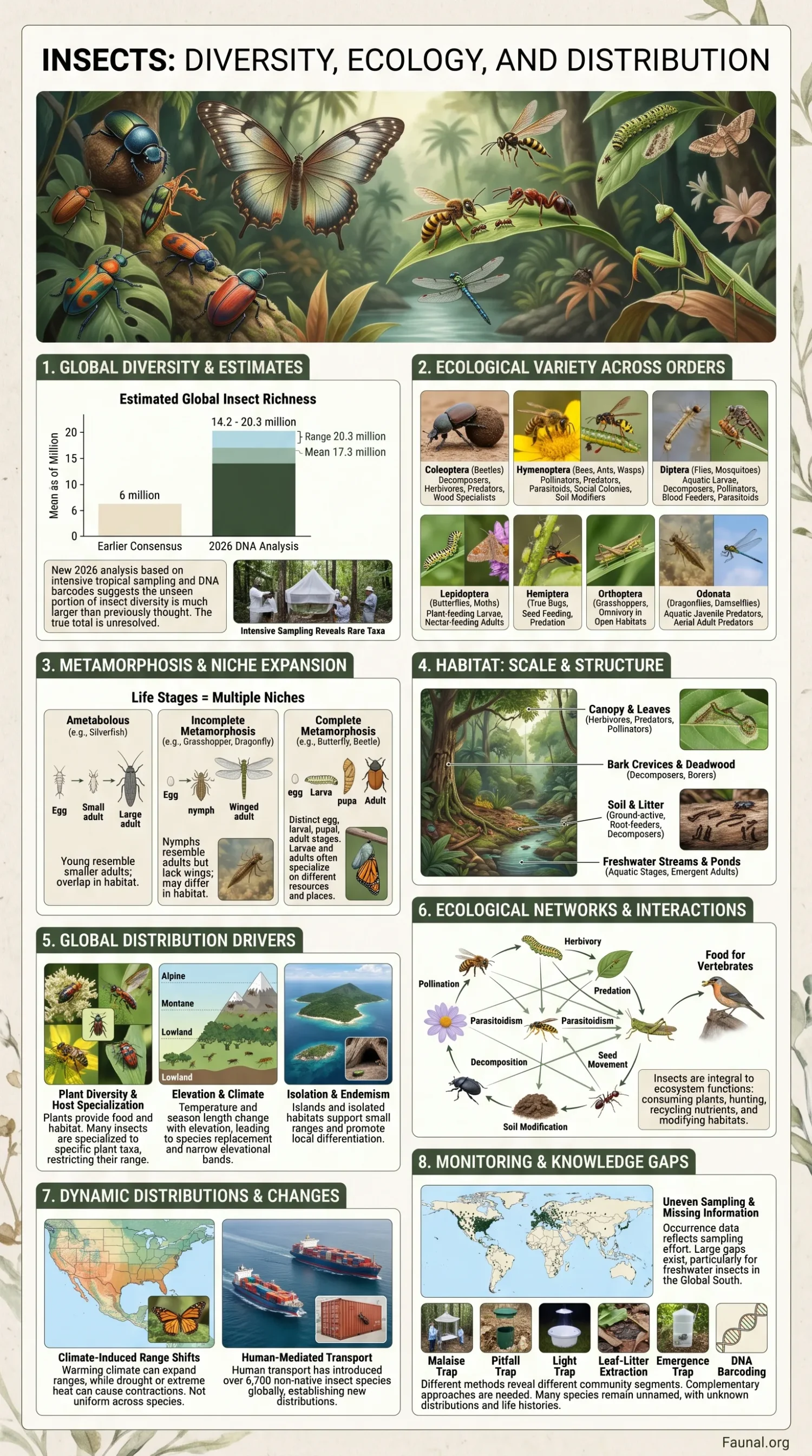
Insects are the most species-rich class of animals known to science, occupying terrestrial and freshwater habitats from tropical forest canopies and desert soils to alpine streams, caves and cities. More than one million insect species have been identified, yet the true total is unresolved. A 2026 analysis based on intensive tropical sampling and DNA barcodes estimated at least 14.2–20.3 million species under its conservative global upscaling assumptions, far above the earlier expert consensus of about six million. Their diversity is equally ecological: insects function as herbivores, predators, parasitoids, pollinators, decomposers, soil engineers and prey, while many species occupy entirely different habitats during different stages of the same life cycle.
Insecta Has a Narrower Boundary Than the Everyday Word “Bug”
Insecta is a class within Arthropoda and the six-legged lineage Hexapoda. The basic adult insect body is divided into a head, thorax and abdomen. Three pairs of legs attach to the thorax, the head carries one pair of antennae, and winged lineages have wings or structures derived from wings attached to the thorax. Some insects are naturally wingless, and others have lost wings during evolution. The Smithsonian National Museum of Natural History describes this combination of three body regions, six legs and one pair of antennae as the practical anatomical pattern separating insects from other familiar arthropods.
Spiders, scorpions, ticks and mites are arachnids rather than insects. Centipedes belong to Chilopoda and millipedes to Diplopoda. Springtails are six-legged arthropods, but modern classification places Collembola outside class Insecta. The distinction matters in biodiversity inventories because an “arthropod survey” can contain large numbers of mites, spiders, springtails and other groups that should not be counted as insect species.
| Group | Insect? | Useful distinction |
|---|---|---|
| Beetles, flies, moths, bees and true bugs | Yes | Members of class Insecta; adults have three pairs of legs. |
| Spiders, scorpions, ticks and mites | No | Arachnids; typical adults have four pairs of walking legs and no antennae. |
| Centipedes | No | Class Chilopoda; elongated bodies with many leg-bearing segments. |
| Millipedes | No | Class Diplopoda; most apparent trunk segments bear two pairs of legs. |
| Springtails | No | Hexapods, but classified outside Insecta. |
ITIS currently treats Insecta as a valid class within Hexapoda, while also marking its global species coverage as partial. That qualification is important: a taxonomic database can provide an accepted hierarchy without representing every living insect species that remains unnamed or absent from its contributing catalogues.
The Known Million Is Only the Named Portion of Insect Diversity
Three quantities are often collapsed into a single “number of insect species”: species formally described by taxonomists, species currently accepted by a particular taxonomic catalogue, and the total number of species estimated to exist. They are not equivalent. Taxonomic catalogues change as synonyms are resolved, species are split or combined, and new datasets are integrated. Catalogue of Life also states that its catalogue remains incomplete, even though its releases combine large numbers of expert-maintained taxonomic sources.
Smithsonian biodiversity material reports more than one million insect species identified by science. The much harder question is how many remain unnamed. For decades, an estimate near six million species became a commonly accepted expert figure. That value depended on extrapolation because no global inventory can physically sample every canopy layer, soil profile, host plant, parasitoid association and tropical microhabitat.
A 2026 DNA-Barcoding Analysis Raised the Lower-Bound Estimate
Colwell and colleagues used genetic information from about 1.6 million tropical insect specimens, intensive sampling in Costa Rica’s Área de Conservación Guanacaste and a deeply sampled assemblage of Microgastrinae parasitoid wasps to examine how much diversity remains unseen even after large collecting efforts. Their conservative upscaling groups produced global estimates from 14.2 million to 20.3 million insect species, with a mean of 17.3 million among those estimates. The authors describe the result as a lower-bound approach rather than a completed inventory.
Why 14–20 Million Is Not a New Species Checklist
The 2026 values are model-based estimates extrapolated from intensively sampled tropical data. They do not mean that 14–20 million species have been formally described, nor do they replace taxonomic catalogues with a fixed new total. The result instead suggests that the unseen portion of insect diversity may be much larger than earlier global estimates allowed.
Estimated Global Insect Richness: Earlier Consensus and the 2026 Lower-Bound Analysis
Values are millions of estimated species. The 14.2 and 20.3 values are the lower and upper endpoints produced by the conservative upscaling groups in the 2026 study.
Data: Colwell et al., Proceedings of the National Academy of Sciences, 2026. These values are estimates rather than counts of formally named species.
The reason the estimate can rise so sharply is not simply that familiar beetles and butterflies are being overlooked. Much of the unresolved diversity is expected among small-bodied tropical insects, poorly revised lineages and host-specialized parasitoids. Intensive Malaise trapping repeatedly encounters rare taxa, and the species accumulation curve can continue rising long after conspicuous groups appear well sampled.
A Few Orders Contain Enormous Ecological Variety
Insect diversity is distributed among many evolutionary lineages, but several orders dominate taxonomic inventories and ecological studies. Their differences are not merely anatomical. A beetle larva inside dead wood, a mosquito larva filtering microorganisms from water, a parasitoid wasp developing inside another insect and a grasshopper feeding on open-country vegetation represent different routes through insect evolution.
| Order | Familiar members | Development | Ecological breadth |
|---|---|---|---|
| Coleoptera | Beetles | Complete metamorphosis | Herbivores, predators, scavengers, fungivores, aquatic forms, wood and dung specialists |
| Hymenoptera | Bees, ants, wasps | Complete metamorphosis | Pollination, predation, parasitoidism, seed movement, social colonies and soil modification |
| Diptera | Flies, mosquitoes, midges | Complete metamorphosis | Aquatic larvae, decomposers, pollinators, predators, blood feeders and parasitoids |
| Lepidoptera | Butterflies and moths | Complete metamorphosis | Mostly plant-feeding larvae; adults include nectar feeders and other feeding strategies |
| Hemiptera | True bugs, aphids, cicadas, planthoppers | Incomplete metamorphosis | Plant-fluid feeding, seed feeding, predation, blood feeding and aquatic predation |
| Orthoptera | Grasshoppers, crickets, katydids | Incomplete metamorphosis | Herbivory and omnivory, especially in grasslands, shrublands and other open habitats |
| Blattodea | Cockroaches and termites | Incomplete metamorphosis | Detritivory, wood processing, soil modification and highly organized termite societies |
| Odonata | Dragonflies and damselflies | Incomplete metamorphosis | Aquatic juvenile predators and aerial adult predators tied to freshwater systems |
| Ephemeroptera | Mayflies | Incomplete metamorphosis | Aquatic juveniles involved in freshwater food webs; short-lived winged adult stages |
| Trichoptera | Caddisflies | Complete metamorphosis | Aquatic larvae functioning as grazers, shredders, collectors, filter feeders or predators |
| Plecoptera | Stoneflies | Incomplete metamorphosis | Mostly freshwater insects, many associated with cool, oxygenated running water |
| Mantodea | Mantises | Incomplete metamorphosis | Terrestrial predators, especially in warm regions |
| Phasmatodea | Stick and leaf insects | Incomplete metamorphosis | Plant-feeding insects with strong camouflage adaptations, concentrated in warmer regions |
The “Beetles Are the Most Diverse” Rule Is Less Settled Than It Appears
Coleoptera contains an extraordinary number of described species and remains one of the largest recognized insect orders. Described-species totals, however, reflect how intensively a group has been collected and taxonomically processed as well as its underlying richness. The 2026 global richness analysis places particular attention on hyperdiverse parasitoid Hymenoptera and other poorly completed groups. Small flies and parasitoid wasps can contain large numbers of genetically distinct lineages that have never received formal species names. Described richness therefore cannot automatically identify which order contains the greatest number of species that actually exist.
Metamorphosis Allows One Species to Use More Than One Ecological Niche
Insect development changes how diversity is distributed through habitats. A juvenile grasshopper and its adult occupy broadly comparable terrestrial environments, while a caterpillar and moth can differ sharply in food, movement and behavior. A dragonfly goes further: its immature stage is an aquatic predator, while the adult hunts flying prey above land and water.
Ametabolous Development
In ametabolous insects such as silverfish and bristletails, young resemble smaller versions of adults. Development involves growth and repeated moulting without a winged nymph or pupal stage. Juveniles and adults can therefore overlap strongly in habitat and resource use.
Incomplete Metamorphosis
Hemimetabolous insects pass through nymphal stages without a pupa. Grasshopper nymphs resemble adults but lack fully developed wings and reproductive structures. In aquatic orders such as Odonata, Ephemeroptera and Plecoptera, the contrast can be greater because immature stages develop in water before the winged stage enters the terrestrial and aerial environment.
Complete Metamorphosis
Holometabolous insects pass through egg, larval, pupal and adult stages. Coleoptera, Hymenoptera, Diptera and Lepidoptera all follow this developmental pattern. Larvae and adults can specialize on different foods and places: caterpillars may consume leaves while adults visit flowers; mosquito larvae live in water while adults disperse through air; beetle larvae may develop inside wood or soil while adults move above ground.
A phylogenetic analysis of hexapod families found the strongest detected increase in diversification associated with the origin of complete metamorphosis. Separation of juvenile and adult ecological roles can reduce competition between life stages while permitting extreme specialization, although metamorphosis is not the only explanation for insect richness.
Insect Habitat Exists at the Scale of Leaves, Bark, Soil Pores and Water Films
Large vertebrates are often described by broad habitats such as forest, grassland or wetland. Those categories are too coarse for many insects. A single tree can contain distinct communities in its roots, living leaves, dead branches, bark crevices, flowers, fruits, leaf mines and decomposing wood. Different species may use the same plant without occupying the same ecological space.
Vegetation Creates Layered Habitat
Forest insects can be separated vertically from litter and understory to trunks and canopy. Herbivores may specialize on one plant family, one species, one tissue type or even one developmental stage of a leaf. Predators and parasitoids then track those herbivores. Flowers create temporary concentrations of pollen, nectar, prey and mating opportunities, while deadwood supports beetles, flies, termites and other decomposer-associated lineages that may disappear when old trees and fallen timber are removed.
Soil and Litter Hide a Large Fraction of Local Diversity
Leaf litter, humus, roots, fungal growth, burrows and rotting wood contain insects that rarely appear in casual above-ground observations. Ant colonies can extend deep below the surface. Beetle and fly larvae exploit buried organic material. Root-feeding Hemiptera and beetle larvae may spend most of their active development below ground. Ground-active assemblages also differ from insects moving through the vegetation immediately above them.
Fresh Water Supports Insects That Later Become Terrestrial
Streams, rivers, lakes, marshes, ponds, temporary pools and water-filled tree holes support aquatic stages of many insect groups. Mayflies, stoneflies, caddisflies and dragonflies are strongly associated with freshwater development, while many flies and beetles also contain aquatic lineages. The adult stage can leave the water entirely, making the recorded distribution of one species dependent on which life stage is being surveyed.
Open-Ocean Insects Are an Exceptional Case
Insects dominate many terrestrial and freshwater environments but are strikingly scarce in the open sea. The genus Halobates is the classic exception. A review of marine water striders identifies five Halobates species that live on the open-ocean surface. Other members of the genus occur in coastal settings, but the high seas have not produced an insect radiation comparable with those on land or in fresh water.
Global Distribution Reflects Climate, Hosts, Topography and History
Insects occur on every continent, but diversity is not spread evenly. Temperature affects growth, activity, overwintering and the number of generations that can be completed in a season. Moisture determines whether aquatic breeding sites persist, whether litter remains humid enough for moisture-dependent taxa and whether plants can maintain the productivity needed by herbivores. These environmental controls interact with vegetation, soils, elevation and biogeographic history.
Plant Diversity Multiplies Available Niches
A plant is both food and habitat for many insect lineages. Host specialization can divide what appears to be one habitat into hundreds of biological niches. One insect may feed on several unrelated plants, while another is restricted to a single host genus or species. Leaf miners live between leaf surfaces, gall makers modify plant tissue into shelters, stem borers enter internal tissues, seed feeders exploit reproductive structures and sap feeders tap vascular fluids.
Host dependence also affects geographic range. An insect cannot maintain a breeding population beyond the environmental range of a required host unless it switches hosts. Climate may therefore appear suitable in a distribution model while a missing plant, prey species, fungal partner or host insect prevents occupation.
Elevation Compresses Climatic Change into Short Distances
Mountain slopes can shift from warm lowland vegetation to cool forest, shrubland and alpine habitat over a relatively short horizontal distance. Temperature, moisture, season length, snow cover and plant communities change together. Closely related insects may replace one another along that gradient, while species with narrow climatic tolerances can occupy small elevational bands.
Isolation Promotes Endemism but Restricts Escape Routes
Islands, isolated mountains, caves and fragmented habitat patches can support lineages with small ranges. Reduced dispersal may promote local differentiation, while specialization can narrow the usable habitat further. The same restricted distribution that contributes to endemism can leave a lineage with few alternative areas when habitat conditions change.
A Global Insect Record Map Also Shows Where People Have Sampled
Occurrence databases are invaluable for insect biogeography, but occurrence density is not the same quantity as species richness. GBIF defines an occurrence record as evidence that a taxon was recorded at a particular place and normally at a specified date. A concentration of records can reflect more collectors, active citizen-science communities, nearby museums, repeated monitoring projects or better digitization rather than a biologically richer insect community.
GBIF’s own data-quality training warns that sampling is unequal among taxonomic groups and geographic regions. Sampling-event datasets are more informative for comparisons when they preserve effort, methods and repeated survey structure. Opportunistic occurrence data remain extremely useful for documenting presence, but they do not automatically document absence, abundance or complete range.
Freshwater Insects Reveal the Scale of Geographic Sampling Gaps
A 2025 global study examined occurrence information for freshwater Ephemeroptera, Plecoptera, Trichoptera and Odonata across 783 river basins. 62.18% of those basins were classified as under-sampled, with especially large gaps in the Global South and East. The study retained 512 more reliably sampled basins for its main standardized analyses and found that corrected diversity patterns could differ from raw observed diversity.
Freshwater Sampling Does Not Represent All Insects
The 783-basin result concerns selected freshwater insect orders, not the whole class Insecta. Its value here is methodological: it demonstrates how uneven collecting effort can alter the apparent geography of insect diversity even in groups with large occurrence datasets.
A dense cluster of insect records is evidence of recording activity as well as biological presence. A sparse region may be species-poor, poorly surveyed, poorly digitized or some combination of all three.
Distribution Can Change Between Larva, Adult, Season and Generation
A static range polygon hides much of insect biology. Aquatic juveniles and flying adults can occupy different environments. Some adults live only days or weeks, while immature stages persist much longer. Seasonal dormancy can make a resident species effectively invisible for part of the year. Migratory butterflies, moths and dragonflies may appear far from their breeding origin during particular seasons.
Diapause Allows Populations to Survive an Unusable Season
Diapause is a regulated period of suppressed development that allows many insects to pass through cold, drought or predictable seasonal shortages. Depending on the species, diapause can occur in the egg, larval, pupal or adult stage. A population can therefore remain present even when active insects are temporarily absent from field observations.
Generation Number Changes with Climate
Univoltine species normally complete one generation per year, while bivoltine and multivoltine species complete two or several. Temperature and season length influence developmental opportunity, so the number of generations can vary across a species’ range. This affects abundance, phenology and the timing of interactions with host plants, predators and parasitoids.
Insect Ecology Is a Network of Feeding, Recycling and Habitat Modification
Pollination is one visible insect function, but it represents only part of the ecological work performed by the class. Insects consume living plants, hunt other animals, develop as parasitoids, break down dung and carrion, fragment dead vegetation, transport seeds, modify soils and transfer biomass between habitats. Their ecological role is therefore better described by interactions than by a simple division into “beneficial” and “pest” species.
- Pollination: bees, flies, moths, butterflies, beetles and some wasps transfer pollen among flowers.
- Herbivory: caterpillars, beetles, grasshoppers, sawfly larvae, true bugs and many other groups consume leaves, wood, roots, sap, seeds or reproductive tissues.
- Predation: dragonflies, mantises, predatory beetles, lacewings, assassin bugs and many wasps consume other animals.
- Parasitoidism: many wasps and flies develop on or inside a host and normally kill it before completing development.
- Decomposition: fly larvae, beetles, termites and other insects help process carrion, dung, deadwood and plant litter.
- Soil modification: ants, termites and burrowing insects move particles, organic matter and nutrients while creating cavities and nests.
- Seed movement: ants transport seeds in many ecosystems, sometimes placing them in microsites suitable for germination.
- Food-web transfer: insects form prey for fish, amphibians, reptiles, birds, bats, spiders and other invertebrates.
Pollination Extends Far Beyond Bees
Bees are prominent pollen transporters, but many flowering plants are visited by flies, beetles, moths, butterflies and wasps. Different insects operate under different temperatures, light levels, flower structures and seasons. No single insect lineage represents the full pollination system of a habitat.
Herbivores Reshape Plant Communities and Plant Defences
Plant-feeding insects remove tissue, tap plant fluids, damage seeds and alter reproductive output. Plants respond through physical barriers and chemical defences, while insect lineages evolve ways to avoid, tolerate or exploit those compounds. Some herbivores sequester plant chemicals into their own bodies, turning a host defence into protection against predators.
Parasitoids Create Hidden Layers of Diversity
Parasitoids differ from ordinary parasites because development usually ends with the host’s death. Many parasitoid wasps specialize on narrow host groups or life stages, creating chains of diversity that are difficult to inventory from vegetation alone. Microgastrinae wasps were especially useful in the 2026 lower-bound richness analysis because intensive sampling allowed researchers to examine species turnover and the long tail of rarely encountered taxa.
This ecological specialization helps explain why insect species richness can remain underestimated even in places that have received years of collecting. Detecting a host species does not automatically reveal all of its parasitoids, and detecting a morphologically similar set of tiny wasps does not guarantee that all genetic lineages have been recognized as separate species.
Aquatic Insects Export Freshwater Production onto Land
Many aquatic insects spend most of their juvenile development underwater and leave the water after metamorphosis. This emergence moves insect biomass from streams and lakes into riparian food webs. USGS research describes adult aquatic insects as an important food resource for terrestrial predators including spiders, birds and bats. What happens to aquatic larvae can therefore alter ecological interactions beyond the shoreline.
Aquatic Larvae Fill Different Feeding Roles
Freshwater insect assemblages contain grazers that remove algae from surfaces, shredders that process coarse plant material, collectors that gather fine organic particles, filter feeders that extract suspended material and predators that consume other invertebrates. These roles distribute energy through streams differently from a simple list of species names.
Mayflies, Stoneflies and Caddisflies Are Used in Stream Assessment
Ephemeroptera, Plecoptera and Trichoptera are commonly grouped as EPT taxa in freshwater bioassessment. The US Environmental Protection Agency notes that EPT richness or relative abundance often decreases under several forms of environmental stress, including nutrient enrichment. The rule is not universal for every species or stressor, so EPT presence should not be translated into a claim that water is automatically pristine.
Social Insects Modify Soils, Vegetation and Resource Flow
Ants, termites and social Hymenoptera demonstrate that insect ecology can operate at colony scale. Ant nests relocate soil and organic matter, workers transport seeds and prey, and colonies can dominate local interactions. Termites process plant material and create tunnels or mounds that alter soil structure and local moisture. Social bees and wasps divide tasks among colony members, but their societies vary greatly in colony size, caste structure and duration.
Termites Belong Within Blattodea
Older references often present termites as the separate order Isoptera. Current ITIS classification places cockroaches and termites together in the valid order Blattodea. This is more than a naming detail: termite sociality evolved within the cockroach lineage, so separating them as unrelated high-level groups obscures their evolutionary relationship.
Climate Change Is Moving Some Insect Ranges, but the Response Is Not Uniform
Insect distribution is dynamic. Warmer conditions can open previously unsuitable areas, alter overwinter survival and shift developmental timing, while drought, extreme heat or changes in host vegetation can remove habitat elsewhere. Expansion at one range edge can occur at the same time as contraction at another.
A 2026 global analysis compiled 6,182 documented range-shift reports from 567 studies and 68 expert assessments, covering 1,758 butterfly species in 105 countries and territories. Eighty percent of represented species had recorded horizontal range expansions, 27% had recorded contractions and 22% had elevational shifts. The categories overlap because a species can show more than one type of range change. The authors associated 79% of reported shifts with climate change or extreme weather.
Butterflies Are Evidence for One Part of Insecta
The 2026 range-shift dataset represents about 10% of documented butterfly diversity, not all insects. It provides strong evidence that insect distributions can change rapidly at large geographic scales, but its percentages should not be assigned to beetles, flies, wasps or other orders without separate data.
Human Transport Is Creating New Insect Distributions
Natural dispersal is only one way insect ranges expand. Timber, nursery plants, agricultural commodities, packaging, ships, aircraft, vehicles and cargo networks move insects beyond barriers they could not readily cross unaided. A 2025 review in Nature Reviews Biodiversity reported that human-mediated transport has resulted in the establishment of more than 6,700 non-native insect species.
Non-Native and Invasive Are Not Synonyms
A species can establish outside its native range without producing the ecological or economic damage associated with the term invasive. The distinction separates geographic origin from measured impact. Treating every introduced insect as invasive exaggerates evidence and makes it harder to compare biological invasions consistently.
Bridgehead Populations Can Become New Launch Points
An introduced insect does not always spread directly from its native region to every newly occupied country. An established non-native population can become a bridgehead from which later transport events begin. This produces secondary invasion routes and can gradually make distant insect communities more similar through the repeated addition of widespread introduced species.
Insect Decline Cannot Be Reduced to One Global Percentage
Evidence of insect decline exists across multiple habitats and taxa, but “insects are disappearing everywhere at the same rate” is not supported by the available data. A 2026 review reports declines in insect biodiversity and changes in community composition while identifying land-use change, loss of suitable habitat, climatic changes, establishment of non-native species, pesticides and fertilizers among the pressures involved. Geographic and taxonomic monitoring remains uneven.
Decline can also describe different biological measurements. Abundance measures numbers of individuals. Biomass measures the mass represented by organisms. Species richness counts taxa. Occupancy describes the portion of surveyed sites where a species occurs. Range concerns geographic extent. Functional composition describes the ecological traits represented in a community. A study showing change in one does not automatically demonstrate an equal change in all others.
This distinction is especially important for widespread generalists and restricted specialists. A community can retain a similar species count while losing formerly common species and gaining a smaller number of disturbance-tolerant taxa. Conversely, local abundance can fall without immediate regional extinction. Long-term monitoring needs repeated, comparable sampling rather than isolated collecting events.
Different Sampling Methods Reveal Different Parts of an Insect Community
There is no single trap that records “the insects” of a site without bias. Insect surveys combine methods because body size, flight ability, activity period, attraction to light, position in vegetation and life stage all change detectability.
- Malaise traps intercept moving insects and are especially productive for many flying Diptera and Hymenoptera, but they do not represent all ground, canopy or sedentary taxa equally.
- Pitfall traps intercept arthropods moving across the ground surface. Their catches depend on activity as well as the number of organisms present.
- Light traps sample nocturnal insects attracted to a light source and can be productive for moths and many other night-active taxa, while missing species that show weak or no attraction.
- Sweep netting collects insects from grasses, shrubs and other vegetation but depends on vegetation structure, operator technique and time of sampling.
- Leaf-litter extraction targets small arthropods hidden in litter and upper soil layers that are poorly represented by aerial trapping.
- Emergence traps capture insects leaving water, soil, wood or another developmental substrate and can connect the recorded adult stage to a defined larval habitat.
- Museum collections preserve historical distribution evidence and type material, but collection intensity and geographic coverage vary through time.
- DNA barcoding and metabarcoding can separate or detect many taxa in bulk samples, including small lineages that are difficult to sort morphologically, while results remain dependent on sampling design, barcode choice, sequence quality and reference libraries.
Research combining Malaise traps, pitfall traps, light trapping and molecular identification demonstrates why complementary methods are preferred for broad insect monitoring. A species that never enters the selected trap is absent from the sample, not necessarily absent from the habitat.
Species Lists, Occurrence Records and Standardized Surveys Answer Different Questions
Global insect data become misleading when evidence types are treated as interchangeable. A checklist can document that a species is included within a stated taxonomic or geographic scope. An occurrence can document an observation or specimen at a place and time. A standardized sampling event can preserve collecting effort. A distribution model estimates environmental or geographic suitability. None of those data types alone establishes abundance across an entire range.
| Evidence type | What it can support | What it does not establish by itself |
|---|---|---|
| Taxonomic catalogue | Accepted names and classification under the catalogue’s current scope | Every undescribed species or every taxonomic opinion |
| Species checklist | Taxa included within a stated geographic, taxonomic and temporal scope | Local abundance or continuous occupation of the entire region |
| Occurrence record | Reported evidence of a taxon at a place and time | Absence from unsampled places, population size or complete range |
| Sampling event | Species observations linked to documented effort, methods, place and time | A universal inventory outside the sampled design |
| Trap sample | Organisms captured by a particular device over a stated period | All insects using the site |
| Species distribution model | Predicted environmental or geographic suitability under stated assumptions | Confirmed presence at every predicted location |
| DNA barcode cluster | Genetic differentiation that can help detect candidate species | Automatic formal taxonomic description or settled species boundaries |
| Conservation assessment | Evaluated extinction risk, threats or trends under the assessment’s scope and date | Status of insect species that have never been assessed |
The Largest Unresolved Part of Insect Diversity Is Often the Least Visible
The largest remaining gaps are unlikely to consist only of conspicuous insects awaiting discovery in obvious habitats. Small tropical flies, parasitoid wasps, soil and litter insects, host-restricted herbivores, canopy specialists and genetically distinct lineages hidden within similar external forms can remain unresolved despite substantial collecting. Many species may be known first as specimens or barcode clusters before they receive formal names and full biological descriptions.
Distribution knowledge is even less complete than naming. A species can have a valid taxonomic name while its larval habitat, host association, seasonal activity or geographic limits remain poorly documented. This creates separate gaps in taxonomy, range, life history and ecological relationships. Filling one does not automatically fill the others.
Insects are both the clearest example of how far animal diversification can extend and one of the largest unfinished inventories in biodiversity science. The gap is not only the number of unnamed species; it is the missing information about where those species occur, what they depend on and how their distributions change through time.
Sources and Verification
- Smithsonian National Museum of Natural History — What Is an Insect? — Used for the defining adult body regions, six-leg pattern, antennae and wing structure of Insecta.
- Smithsonian — About Insects (Class Insecta): Biodiversity — Used for the statement that more than one million insect species have been identified.
- Integrated Taxonomic Information System — Insecta — Used to verify the current placement of Insecta as a valid class within Hexapoda and the partial global species coverage of the record.
- Integrated Taxonomic Information System — Blattodea — Used to verify the current order-level placement of cockroaches and termites together in Blattodea.
- Catalogue of Life — Used for current global catalogue scope and its stated warning that species coverage remains incomplete.
- Colwell et al. — Constructing a lower-bound estimate of the global number of insect species on a hyperdiverse empirical foundation — Used for the earlier six-million consensus estimate, the 1.6-million-specimen DNA-barcode dataset and the 14.2–20.3-million conservative global estimates reported in 2026.
- Rainford et al. — Phylogenetic Distribution of Extant Richness Suggests Metamorphosis Is a Key Innovation Driving Diversification in Insects — Used for the relationship between complete metamorphosis and elevated diversification across insect evolutionary history.
- Cheng and colleagues — Why did only one genus of insects, Halobates, take to the high seas? — Used for the rarity of open-ocean insects and the five open-ocean Halobates species.
- GBIF — Data Quality Requirements: Occurrence Datasets — Used to define occurrence data as evidence of a taxon at a particular place and date.
- GBIF — Introduction to Sampling-Event Data — Used to distinguish effort-documented sampling events from opportunistic occurrence records.
- GBIF — Handling Data Quality — Used for the documented geographic and taxonomic sampling gaps that must be considered in biodiversity analysis.
- Wu et al. — Standardized diversity estimation uncovers global distribution patterns and drivers of stream insects — Used for the 783-basin freshwater analysis, the 62.18% under-sampling result and the distinction between observed and standardized diversity.
- U.S. Geological Survey — Metals in Acid Mine Drainage Affect Aquatic Insects — Used for the transfer of aquatic insect biomass into terrestrial food webs after adult emergence.
- U.S. Environmental Protection Agency — Nutrients — Used for EPT taxa as freshwater bioassessment metrics and their general response to environmental stress.
- Losey and Vaughan — The Economic Value of Ecological Services Provided by Insects — Used for the documented ecological functions of wild insects including pollination, pest control, dung processing and wildlife nutrition.
- Chowdhury et al. — Extensive climate-induced range shifts in butterflies across the globe — Used for the 1,758-species, 105-country range-shift dataset and the reported expansion, contraction, elevation and climate-association percentages.
- Bertelsmeier et al. — Temporal dynamics and global flows of insect invasions in an era of globalization — Used for the reported establishment of more than 6,700 non-native insect species and the bridgehead-population concept.
- Scherber et al. — Insect declines: challenges and solutions — Used for current evidence on insect biodiversity change and the reported pressures involving land use, habitat loss, climate, non-native species, pesticides and fertilizers.
- Towards holistic insect monitoring: species discovery, description, identification and traits for all insects — Used for modern insect-monitoring approaches, mass sampling, molecular identification and the difficulty posed by poorly known hyperdiverse taxa.
- Toward global integration of biodiversity big data: a harmonized metabarcode data generation module for terrestrial arthropods — Used for the complementary roles of Malaise and pitfall trapping in broad arthropod biodiversity sampling.